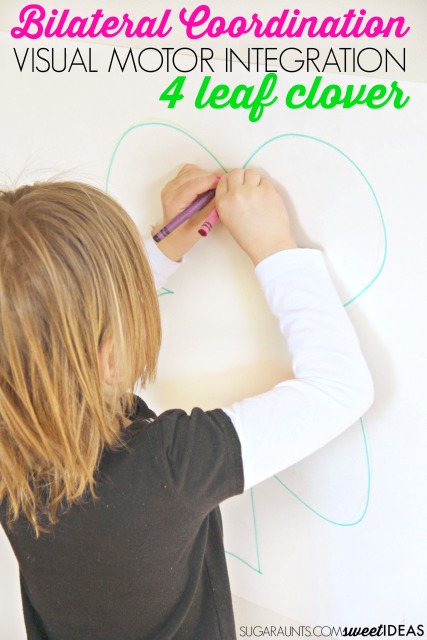
This bilateral integration activity is a powerful way to help kids with a variety of skills. Add it to your line up of hands-on, St. Patrick’s Day theme activities for therapy and promoting child development. Kids can draw the four leaf clover but also work on developing bilateral coordination, eye-hand coordination, visual motor integration, visual scanning, visual convergence, core strength, and so much more. Integrating all of these areas into functional tasks involves many components of development, and this activity can help in so many ways.
Kiddos with sensory or developmental problems might have trouble crossing mid-line. You might know a child who has trouble making both hands work together to accomplish a task like handwriting, cutting with scissors, tying shoes, buttoning a shirt, or catching a ball. Bilateral coordination is necessary for many functional activities!
Bilateral Integration and Functional Activities
Bilateral integration is an area of child development that involves different movements and systems. Coordination of visual systems include visual tracking and scanning as well as depth perception and peripheral vision. All of these skills need to be integrated into movement so that coordinated movement patterns can occur.
Then, there is the crossing midline component. Crossing the midline occurs developmentally, and this milestone is an important one that translates to laterality and coordinated use of both hands together in functional tasks.
Then, visual motor integration, where the eyes and body works together to perform daily tasks is another piece of the puzzle. One part of the developmental progression of these skill areas is symmetrical bilateral integration.
Symmetrical Bilateral Integration
In this stage of development, children bring their hands together at the midline. You’ll see this in small infants that bring their hands to their mouth. They then start to hold toys together with their hands. Later down the road, symmetrical bilateral integration skills are needed to clap, zipper and button a coat, and gross motor tasks, too such as hopping, jumping, and completing tasks like jumping jacks.
Progression beyond symmetrical development relies on this developmental stage. And skills like asymmetrical bilateral integration, crossing the midline are founded on progression of this early developmental stage.
Gross motor and fine motor activities are needed for activities where each hand does the same job (jumping jacks, movement games like the Hokey Pokey, and pulling up pants). Other tasks require both hands to do different jobs in a coordinated way (holding the paper and writing with a pencil, holding paper and cutting with scissors, tying shoes, fastening a zipper, weaving a loom, or putting on a coat).
Bilateral Integration Activity for Kids
This activity is one that’s been on my mind for a while. As an OT, I’ve done versions of this activity many times with kids who have trouble with kinesthetic sense, visual perceptual skills, and bilateral coordination.
This post contains affiliate links.
This activity is a version of the Brain Gym program, which uses whole body movements to improve skills, including learning and functional tasks. Brain Gym can be just one tool in a toolbox of strategies to progress development of skills that kids need to function.
In Brain Gym, there is an activity called Double Doodles, which involves doodling with both hands, with a piece of crayon or chalk in each hand.
The activity encourages children to use both hands together. The point of the activity is to establish direction and orientation relative to the child’s body. The movement activity addresses hand-eye coordination in different visual fields, promotes spatial awareness and visual discrimination, addresses left and right awareness, improves peripheral vision, promotes body awareness and coordination with specialization of the hands and eyes, and works on gross motor movement skills.
Brain Gym is just one way to promote whole body learning through simple and fun movement activities.
Four Leaf Clover Bilateral Activity
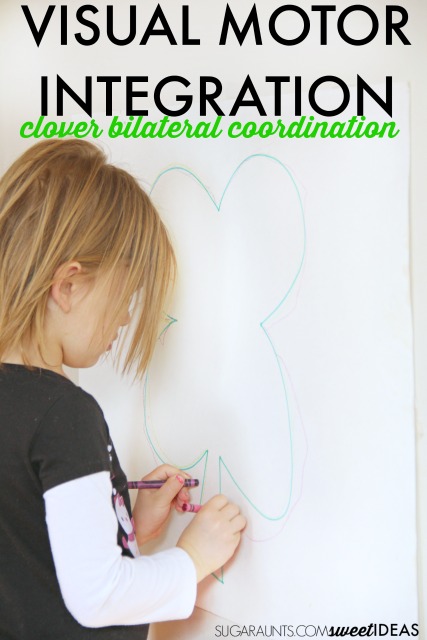
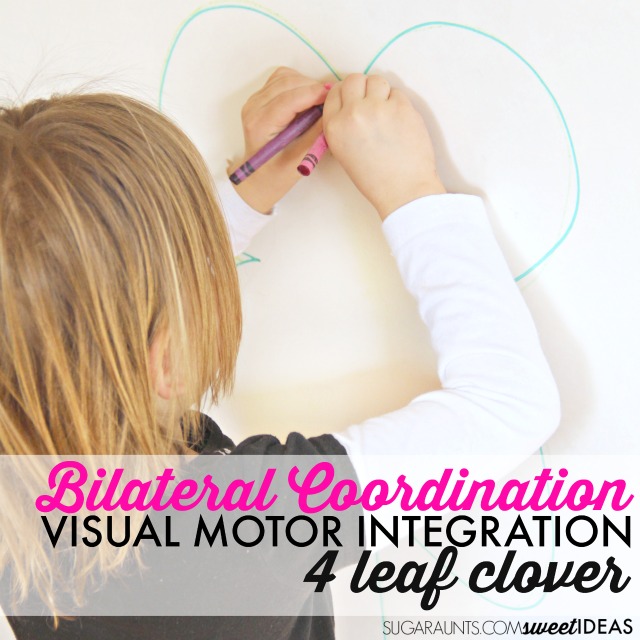
In our gross motor bilateral coordination activity, we’re using visual motor integration. While creating a four leaf clover shape, the child is using his visual sense to guides movement through peripheral vision.
This is an easy activity to set up. Tape a large piece of paper to the wall. Poster board (like we used) works great, but that can get pricey. A nice option is using a large roll of paper like easel paper or butcher paper. You can also perform this activity at a large chalkboard or dry erase board in classroom settings.
First, draw a large and symmetrical four leaf clover shape on the paper. Provide the child with a crayon, pencil, marker or chalk for each hand.
Standing in front of the clover, ask them to stare at the center of the paper. You can draw a dot for them to look at, if needed.
Then, show them how to start both hands at the top center of the clover and to slowly trace the lines of the clover to meet at the bottom center.
We included a stem on our clover, but you can just draw the four leaves.
Tell the child to not worry too much about staying right on the lines. The object is to have both hands move together doing symmetrical motions. Repeat the lines again and again. Add colored crayons/markers/pencils to create a rainbow four leaf clover.
A few things to watch for:
While drawing, watch the child for stiffness in the hand, wrist, or arm.
Be aware of whole body movements. Arm motions should come from the shoulders.
Remind the child to keep their eyes fixed on the dot at the center of the clover.
Remind the child to keep the writing utensils in contact with the paper. They shouldn’t lift the crayons at all.
Watch for bilateral coordination, ensuring that both arms are moving at the same speed, distance, and positioning.
Other ways to extend this activity:
Draw the four leaf clover on paper and have the child sit to perform the re-tracing activity.
Do this activity on a driveway or sidewalk using chalk.
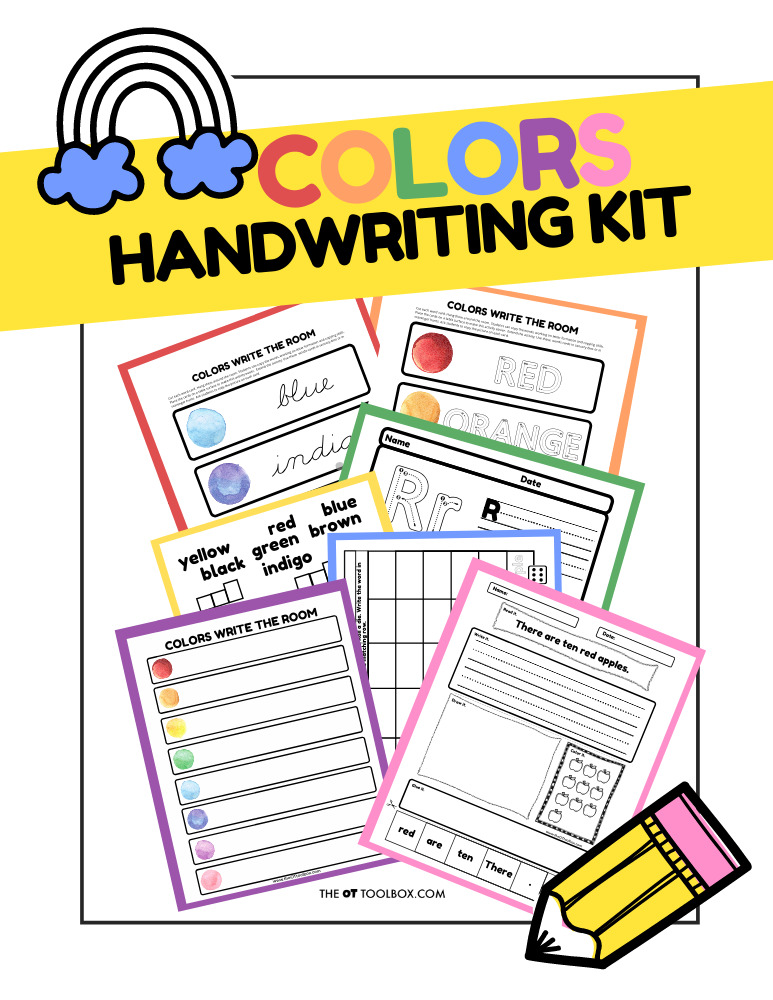
Rainbow Handwriting Kit– This resource pack includes handwriting sheets, write the room cards, color worksheets, visual motor activities, and so much more. The handwriting kit includes:
Write the Room, Color Names: Lowercase Letters
Write the Room, Color Names: Uppercase Letters
Write the Room, Color Names: Cursive Writing
Copy/Draw/Color/Cut Color Worksheets
Colors Roll & Write Page
Color Names Letter Size Puzzle Pages
Flip and Fill A-Z Letter Pages
Colors Pre-Writing Lines Pencil Control Mazes
This handwriting kit now includes a bonus pack of pencil control worksheets, 1-10 fine motor clip cards, visual discrimination maze for directionality, handwriting sheets, and working memory/direction following sheet! Valued at $5, this bonus kit triples the goal areas you can work on in each therapy session or home program.
Colleen Beck, OTR/L has been an occupational therapist since 2000, working in school-based, hand therapy, outpatient peds, EI, and SNF. Colleen created The OT Toolbox to inspire therapists, teachers, and parents with easy and fun tools to help children thrive. Read her story about going from an OT making $3/hour (after paying for kids’ childcare) to a full-time OT resource creator for millions of readers. Want to collaborate? Send an email to contact@theottoolbox.com.
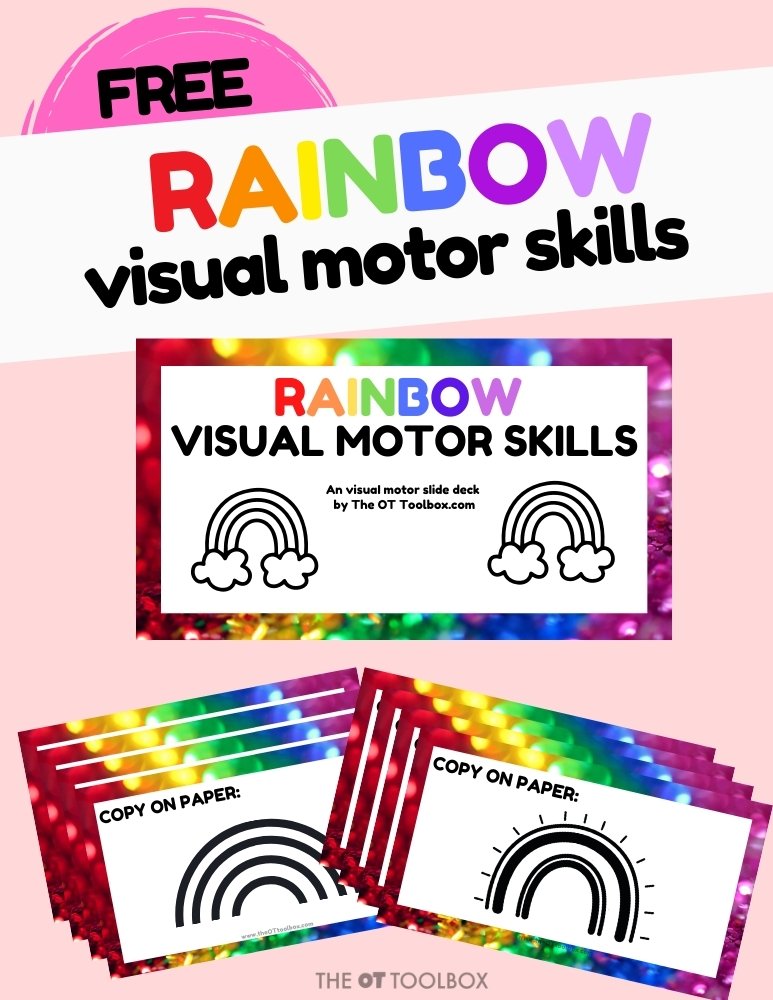
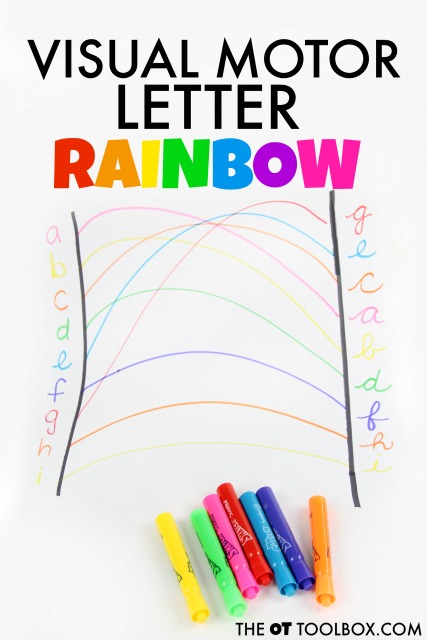
This rainbow art drawing help kids with visual motor skills of copying images and figures. When kids demonstrate the ability to copy shapes and forms, they are building the skills needed for copying words, letters, and sentences. This rainbow slide deck is a teletherapy activity that helps with visual motor skills needed for handwriting. Add this free Google slide deck to your occupational therapy teletherapy services (or home programs) and start building skills in visual motor integration.
Starting with drawing milestones is a good idea, especially if you are wondering about using this rainbow drawing activity with a range of ages.
If you take a scroll on YouTube, you’ll find a lot of directed drawing videos that walk kids through “how to draw a rainbow”… or how to draw hundreds of other images, cartoons, and drawing art ideas.
But, one thing that I have been looking for is simple forms that help kids with visual motor skills like copying simple and complex shapes…that are FUN and motivating.
Here’s the thing: when kids copy shapes, they are developing so many visual motor integration skills that translated to forming letters and numbers, copying sentences, and the eye-hand coordination needed to move a pencil in the way it needs to move so that letters and numbers are placed on lines. It’s all connected!
Copying simple lines and shapes are part of pre-writing skills. By the way, be sure to grab this rainbow pre-writing lines Google slide deck. It’s a freebie that you’ll want for your younger or lower level kiddos.
AND, when kids progress to copying more complex shapes, drawings, and forms, they are developing stronger skills in moving the pencil accuracy, spatial awareness, line awareness, and position in space. All of these skill sets are so necessary for handwriting.
Draw a Rainbow Activity
Kids can copy the different basic rainbow forms and develop these skills using our free rainbow drawing slide deck.
Each slide includes simple or more complex rainbow drawings that challenge kids to copy forms, making this a fun Spring activity that helps to build visual motor skills.
You can ask kids to copy the rainbows onto paper in different ways to extend this activity:
Ask kids to copy the shape in a specific space.
Ask kids to fold their paper into columns and rows. They can copy a rainbow form into each space on the paper.
Ask the child to copy the rainbow in a very large size on a dry erase board or large chalk board to use whole body movements and crossing midline. Air writing is another option.
Copy the forms with different sensory materials: chalk, water colors, paint, rainbow writing, writing on sandpaper, etc.
Copy the rainbow form from memory.
Copy the forms in a very small size.
Copy the forms into a sensory writing tray. Here are ideas for sensory writing trays.
Want this Rainbow Visual Motor Activity?
Enter your email into the form below to access this free Google slide deck.
Colleen Beck, OTR/L has been an occupational therapist since 2000, working in school-based, hand therapy, outpatient peds, EI, and SNF. Colleen created The OT Toolbox to inspire therapists, teachers, and parents with easy and fun tools to help children thrive. Read her story about going from an OT making $3/hour (after paying for kids’ childcare) to a full-time OT resource creator for millions of readers. Want to collaborate? Send an email to contact@theottoolbox.com.
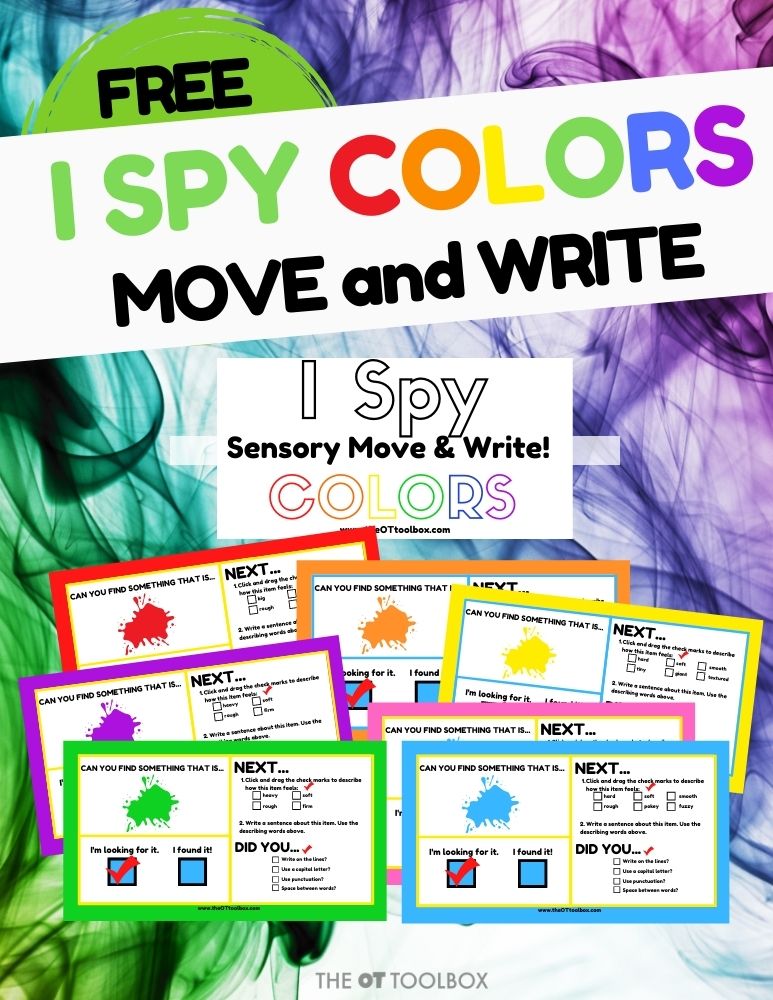
If you’ve ever played “I Spy with my Little Eye”, then you are going to love this I Spy colors therapy slide deck. It’s a movement activity that gets kids up and moving and challenges several developmental skill areas: visual processing, tactile sensory exploration, handwriting, and strength, endurance, and movement challenges. Kids can go through the free therapy slide deck in an occupational therapy teletherapy session and work on learning colors as well. Add I Spy colors as a color scavenger hunt that kids will love!
Use this along with our color exercises slide deck for more color theme activities in therapy.
This I Spy virtual game is just one of the free slide decks we have available here on the site. You’ll also love our printable color by letter worksheet. Check them all out!
Need more teletherapy resources? Working with kids in teletherapy? Need streamlined info on how to structure your sessions? Need activities for week-to-week therapy planning? need answers for all of your teletherapy questions? Join the free teletherapy course, a 5 day email series on telehealth for occupational therapists.
I Spy Colors
The kids you are working with may have played I Spy before. In a traditional look-and-find game, they need to search a book, puzzle page, or other activity page for hidden items. You may have even played I Spy with my little eye while waiting at a doctor’s office, or in a restaurant. It’s a good activity for kids that keeps them busy. But did you know there are even more therapeutic benefits to this game?
I wanted to create a teletherapy activity that required no materials other than paper and pencil. This I Spy Colors therapy slide deck does the trick.
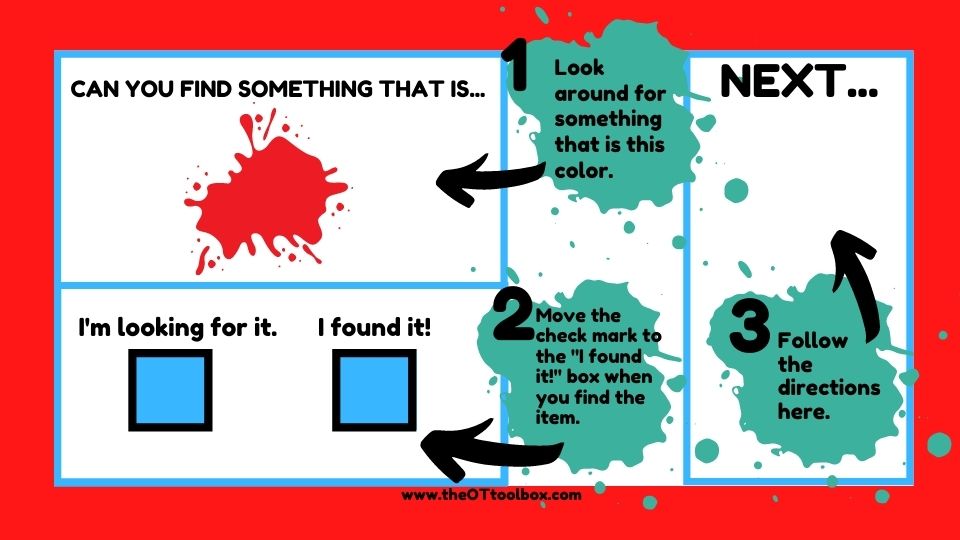
Therapists can use this free interactive slide deck in therapy treatment sessions virtually as a color scavenger hunt activity.
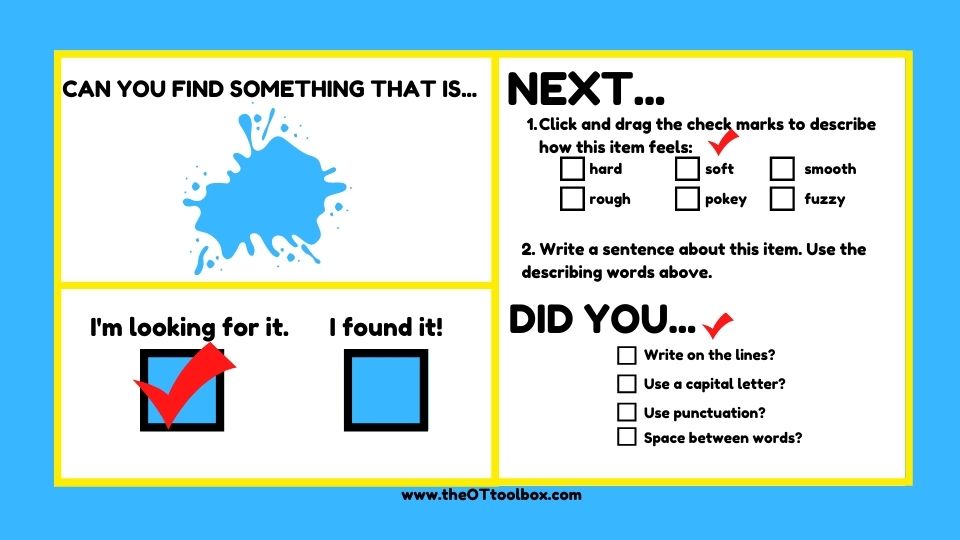
The activity asks users to search their house for an object of a particular color. By looking around the home for the color detail of objects, children are strengthening several visual perceptual skill areas:
Visual scanning– moving the eyes for a specific aspect of details: colors of objects. Visual scanning is a skill needed for reading as kids scan their eyes over the lines of a page.
Visual discrimination– visually determining differences in colors of objects. The slides ask kids to locate items that are in a range of colors. This color activity is slightly more advanced than just finding a blue item. Can they find teal? Visual discrimination is a skill needed for distinguishing differences in letters and words when reading.
Figure-ground– Pulling out details of objects from a busy background. When users scan their home for a specific color, they are visually identifying objects that may be hidden in a busy background. This visual skill is used in functional tasks every day.
Visual memory– Holding a “picture” of details such as the shade of color in the mind. As kids look throughout their room or home, visual memory is needed to recall the color and shade they are looking for. This visual skill is needed in reading and math.
Visual closure– identifying an object when only parts of it are seen. This visual perceptual skill is used when children locate an object in the room that may be partially hidden. Visual closure is used in reading when readers are able to identify a word by only some of the letters.
Visual convergence– A visual processing skill, this motor task allows vision to shift in scanning. By scanning to near and far points, kids are strengthening this skill. Visual convergence is used in the classroom when scanning from a teacher or the board to the desk, or from near to far and far to near.
Users can then identify features of the object by responding to questions about texture. The slide deck asks about aspects of the found item by asking the child to explore the tactile aspect. Is the item fuzzy? Soft? Rough? How does it feel?
This part of the color activity brings in features of the tactile sensory system.
Virtual I Spy
This virtual I Spy activity takes the fun of the classic look and find game online, making it great for teletherapy activities with kids of all ages. This particular color game goes beyond just “I Spy” however…
Use the virtual activity for working on other areas in therapy, too:
Movement challenges- Kids get up and move to find the objects
Visual perceptual skills- covered above
Tactile sensory exploration and challenges- Can they find a green object that is fuzzy? This activity can be expanded in many ways!
Handwriting- work on skills such as line awareness, letter formation, sizing, legibility. Kids can then self-assess their work, making carryover of writing skills stick.
Users can move the interactive piece of the slide deck to mark off tactile sensory aspects of the colorful item they found.
Finally, there is a color writing activity where users can write a sentence about the object, using the describing words that they selected. This part of the slide deck may be a higher level for some users, but the writing piece invites users to incorporate aspects of language and creative writing into the I Spy Colors activity.
I Spy Colors for all ages
The slide deck is designed so it meets various levels and can be graded to different ages:
Younger kids can just look for the objects in a color scavenger hunt.
Teach colors, making it a preschool color activity that is perfect for virtual learning.
Some children can skip the tactile sensory aspect and just seek out items in the I Spy portion of the activity.
Grade the activity up by discussing tactile features.
Further grade the activity up by incorporating handwriting. Younger students can just write the word.
Older students can write the word in a sentence, working on adding describing words.
Kids that complete the handwriting portion of the slide deck activity can self-assess their handwriting, using the interactive check marks as they look over their written work.
There’s somethign for everyone with this I Spy Colors therapy activity!
Want to play I Spy Colors?
Grab the free Google slide deck by entering your email into the form below. You will receive a PDF containing a link to open the slide deck. Be sure you are logged into your Google account before clicking the button on that PDF. Save the PDF in your therapy files so you can access this resource any time and share with those on your caseload.
More color activities
Add this slide deck to these hands-on color activities:
Benefits of coloring– Use a couple of crayons to work on many areas of child development.
Visual Motor Color Match Activity– This activity translates wonderfully to virtual therapy sessions. It can be used in face-to-face interventions as well, or as a home activity.
Color Mixing Rainbow Write– Work on letter formation and size with this rainbow write activity that challenges kids to mix colors and see what the result is.
Colleen Beck, OTR/L has been an occupational therapist since 2000, working in school-based, hand therapy, outpatient peds, EI, and SNF. Colleen created The OT Toolbox to inspire therapists, teachers, and parents with easy and fun tools to help children thrive. Read her story about going from an OT making $3/hour (after paying for kids’ childcare) to a full-time OT resource creator for millions of readers. Want to collaborate? Send an email to contact@theottoolbox.com.
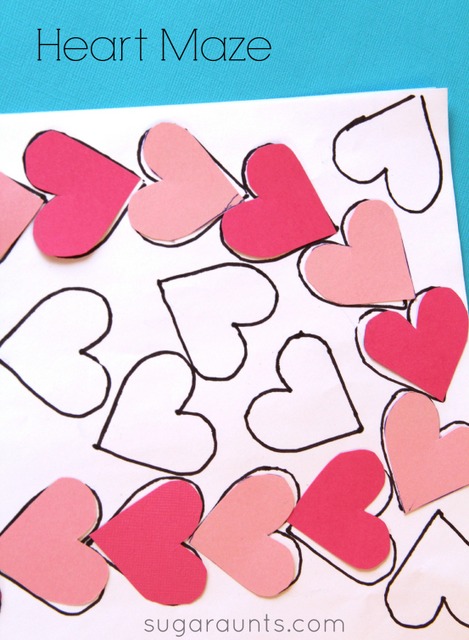
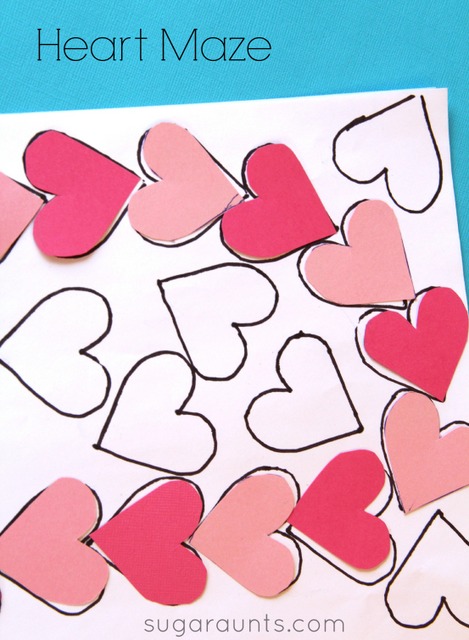
This Valentine’s Day maze is an easy DIY visual perception activity that requires only paper and a pencil. Sometimes an activity can be just easy to throw together and the kids love it. This Heart Maze is a simple visual perception activity that can be adapted to any season or shape. We used hearts for a Valentine’s Day occupational therapy activity, while practicing visual scanning, visual spatial relations, line awareness, and eye-hand coordination.
For more Valentine fine motor fun, use these printable Valentine cards for folding, coloring, and cutting.
Valentine’s Day maze activity
This visual perception maze is an easy way to work on visual motor skills needed for tasks like handwriting, reading, and learning. The hearts are placed in a path-like maze that challenges visual perception skills.
Kids can help with making this Valentine’s Day maze, or you can make a template and copy it over and over again. Let’s discuss how this maze works and how it and other visual perception skills helps kids with reading, learning, reading, and writing.
This post contains affiliate links.
How to make a Valentine’s Day Maze
You need just a few materials for this DIY maze, making this a good occupational therapy intervention for teletherapy.
So, grab your materials:
Paper
Pencil or marker
Scissors
We used construction paper to make a heart, but you could use regular paper as well.
It really doesn’t get much easier.
Draw a small heart. You can use regular paper or colored paper.
2. Using scissors, cut out the heart.
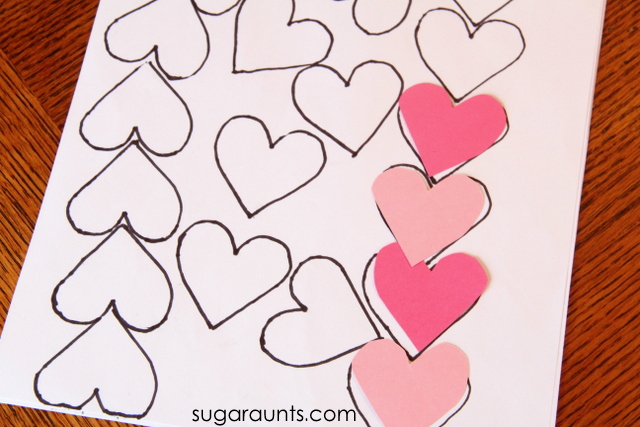
3. Trace the heart on a piece of white paper.
4. Place the point of the heart into the top of the heart so the hearts are connected. Trace the second heart on the paper.
5. Continue tracing, positioning the hearts in a line. You want a “maze” to form around the paper.
6. Fill in the blank space with more heart outlines, but this time, rotate the shape so it’s positioned randomly and not as close to the maze.
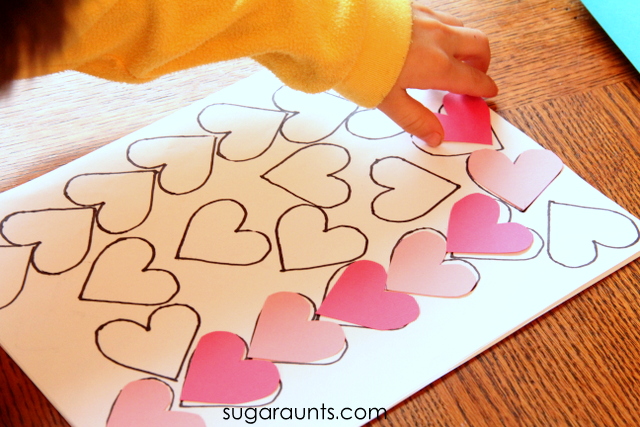
Next, you can follow the path of hearts and color them in. You could also place small objects on the hearts, like craft pom poms or mini erasers.
Another option is to use the heart template to cut more hearts from colored paper. We used a darker shade to work on patterns as we filled in the maze. If two shades of colored paper isn’t available, just use two different colored crayons to color in patterns as the child completes the maze.
For children who are working on scissor skills, try using a thicker paper for the heart template. Cardstock is a great option because the thicker paper is resistive and offers proprioceptive feedback through the hands. Here is a link to pink card stock.
There are many visual skills being addressed in this occupational therapy maze activity.
Lining up the hearts requires eye-hand coordination to position the card stock hearts within the outlines. Using the hands in a coordinated manner based on visual input is an important skill for many functional tasks including handwriting and scissor use.
This is a great strategy to support visual closure skills needed for reading and writing.
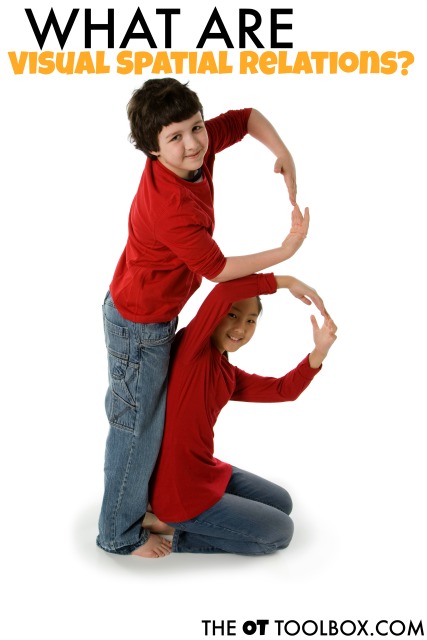
What Are Visual Spatial Relations?
Visual spatial relations is the ability to identify a form/shape/letter despite being rotated, and identify it as being rotated. Children need visual spatial relations to identify the difference between a “b” and “d” and “p”, and “q”.
This sheet full of hearts that look the same requires the child to identify the hearts that are following a path. Some of the hearts not along the path are rotated and the child should be able to identify by scanning, the hearts that are rotated.
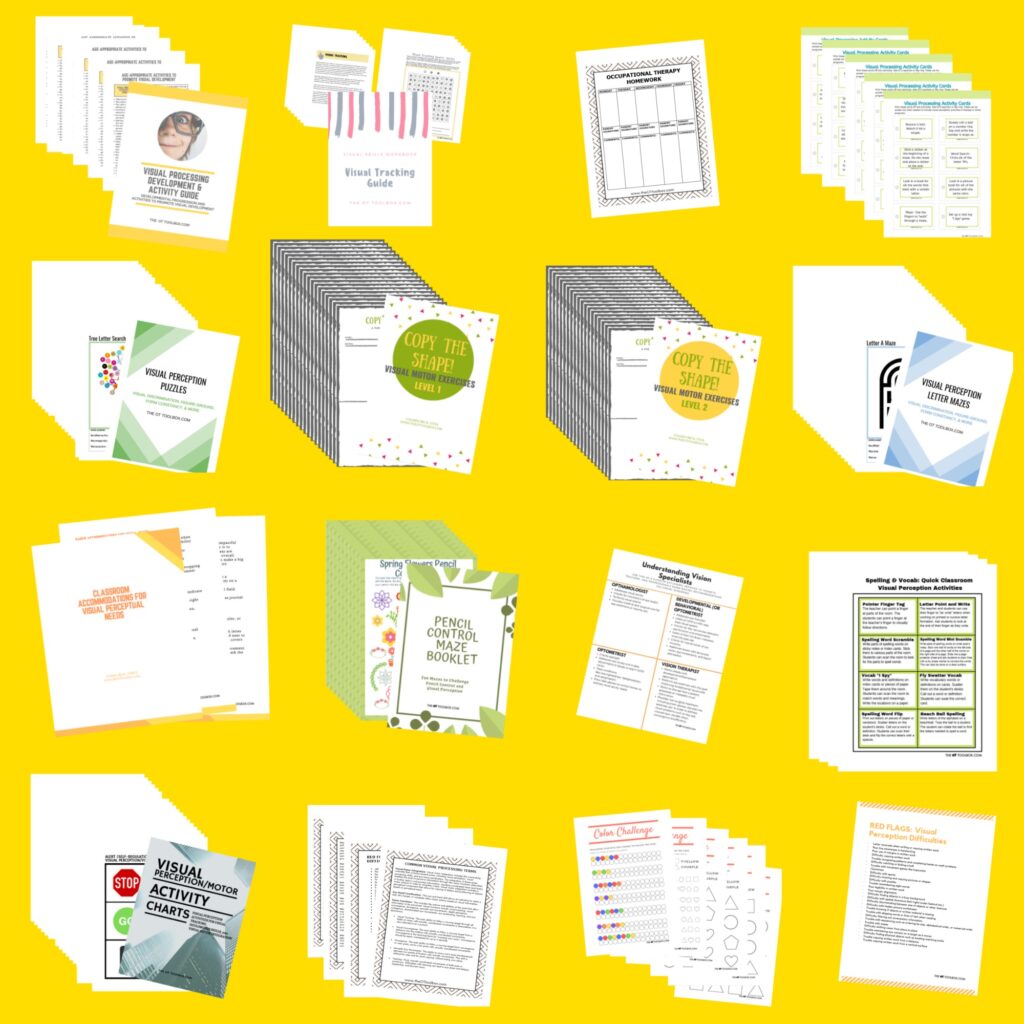
Over 235 pages of tools, activities, resources, informaton, and strategies to address visual processing needs
Classroom accommodation ideas for visual perception challenges
Checklists for trialing various activities and strategies
2 leveled visual-motor integration workbooks…with data collection tools to monitor progress
Pencil control worksheets to integrate visual input and motor work in meaningful ways
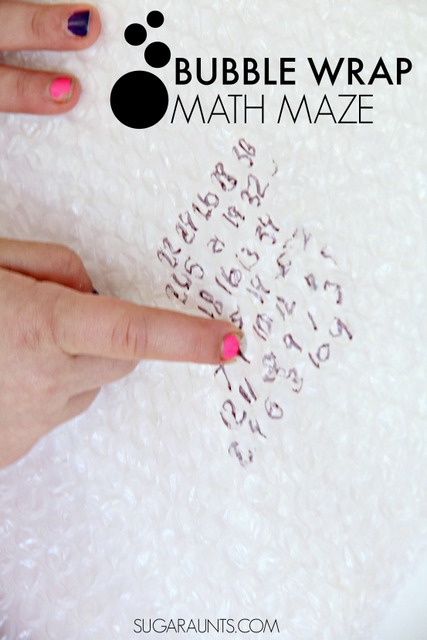
Classroom activities that can be incorporated into reading, spelling, math, and other subjects…reducing the amount of extra “work”. This math maze is a fun idea.
Activity cards to guide therapy warm-up sessions or used in home program development
Specific and open-ended activity cards to address visual attention and spatial awareness
Visual tracking guide explain components of visual tracking and specific activities to improve tracking
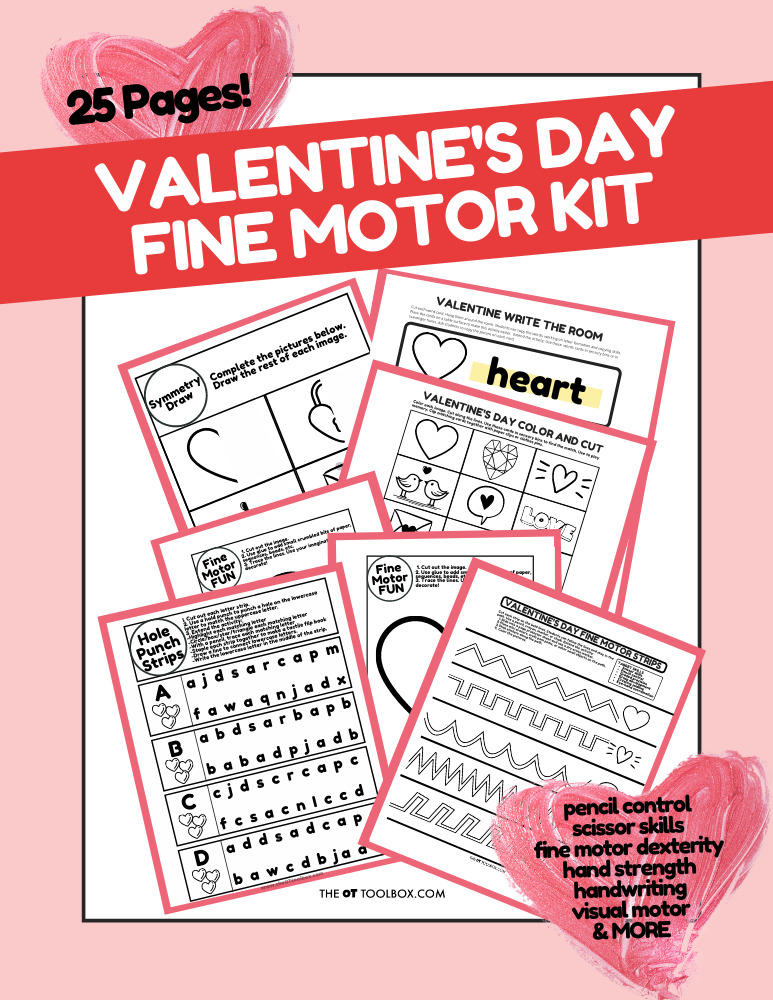
The Valentine’s Day Fine Motor Kit is here! This printable kit is 25 pages of hands-on activity sheets designed to build skills in pinch and grasp strength, endurance, eye-hand coordination, precision, dexterity, pencil control, handwriting, scissor skills, coloring, and more.
When you grab the Valentine’s Day Fine Motor Kit now, you’ll get a free BONUS activity: 1-10 clip cards so you can challenge hand strength and endurance with a counting eye-hand coordination activity.
Colleen Beck, OTR/L has been an occupational therapist since 2000, working in school-based, hand therapy, outpatient peds, EI, and SNF. Colleen created The OT Toolbox to inspire therapists, teachers, and parents with easy and fun tools to help children thrive. Read her story about going from an OT making $3/hour (after paying for kids’ childcare) to a full-time OT resource creator for millions of readers. Want to collaborate? Send an email to contact@theottoolbox.com.
You might know that there is a lot of vision information and resources on visual processing here on the website. Today, I’m excited to bring you all of those vision resources in one place and to to share information on Vision 101, a new vision course that you will find useful.
Vision problems are very common in children that receive occupational therapy.
If you are looking for information on visual processing and vision in kids, then you are in the right place. Check out the various resources and tools available here on The OT Toolbox:
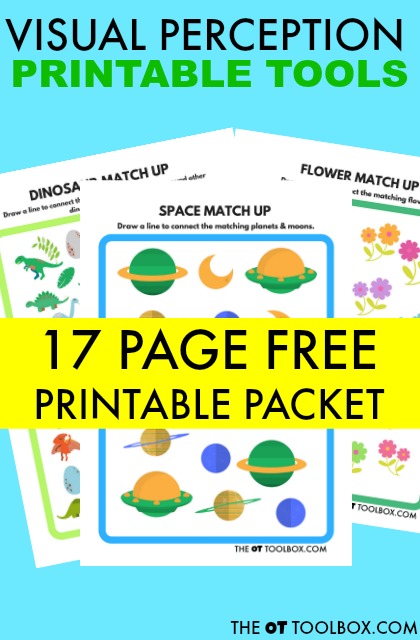
Free Visual Perception Packet– Print and go! These free visual perceptual skills worksheets cover a variety of topics and themes. Work on visual closure, visual scanning, visual discrimination, and more.
Vison Screening Packet– Use this vision screening packet to screen for vision issues that impact occupational performance and education in learning and school tasks.
Vision Information– Check out all of the vision blog posts here on the website.
Vision Activities– Let’s break down vision! These vision activities address specific skills in fun and creative ways. You’ll find information on vision definitions and activities to work on each aspect of visual processing.
Free Visual Processing Lab– This free email course covers tons of information on visual processing and breaks down this massive topic into visual motor integration, visual perception, and visual efficiency…and then explains each aspect.
Visual Processing Checklist– This printable checklist is perfect for screening visual needs in the school setting.
Vision’s Impact on Learning– The fact is that children with vision issues are impacted in their learning. Here’s what you need to know.
Visual Motor Skills– Let’s face it. Much of what we do on a daily basis involves visual motor integration. Here is all of the info and resources to address visual motor skills in kids.
Visual Processing Bundle– This resource is a must-have for all things vision. It includes 17 products that you can use in therapy sessions to work on vision needs impacting occupational performance.
Want to gain continuing education credits while you learn how to apply vision interventions into your school-based practice? Vision 101 is your resource!
Vision 101 Course for School-Based OTs
Vision 101 is a course created by my friend Jaime at Miss. Jaime OT. She’s created this AOTA-approved course as a tool to help you improve your skills as a school-based occupational therapist. In the course, you can learn how to detect, screen for, and treat the visual difficulties that impact students’ learning
Vision 101 for School-based Occupational Therapy Practitioners is a tool to help you understand how vision deficits impact a child’s ability to learn and participate in school work.
The course offers resources on how to helpstudents learn and participate in school tasks.
Included in the Vision course is information on:
Vision and the school-based therapist
Recognizing possible visual impediments to learning
Understanding visual diagnoses
Assessing and documenting eye movements
Visual characteristics of common pediatric diagnosis
Treatment Ideas
Vision and telehealth
Vision in the school setting
Check out the blog comments below for common questions about vision in the school setting.
Colleen Beck, OTR/L has been an occupational therapist since 2000, working in school-based, hand therapy, outpatient peds, EI, and SNF. Colleen created The OT Toolbox to inspire therapists, teachers, and parents with easy and fun tools to help children thrive. Read her story about going from an OT making $3/hour (after paying for kids’ childcare) to a full-time OT resource creator for millions of readers. Want to collaborate? Send an email to contact@theottoolbox.com.
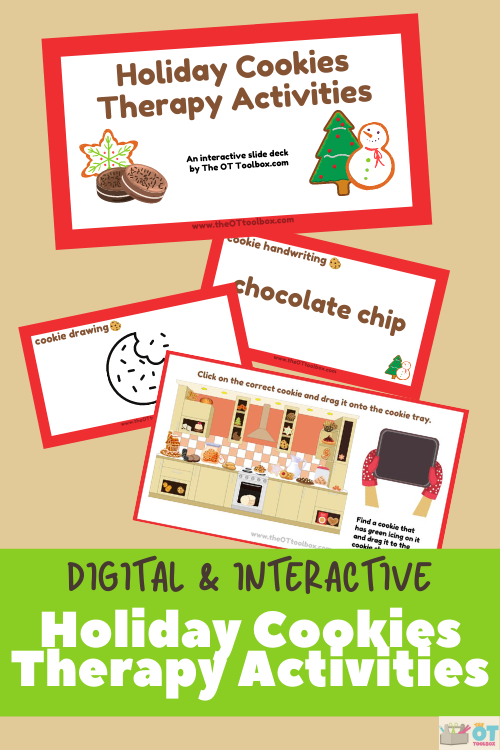
I am excited to share another free slide deck for virtual occupational therapy! This cookies activities slide deck includes cookie themed activities for building skills in therapy. The virtual slide deck goes nicely with our recent gingerbread man virtual activity slide deck. It’s a free slide deck that is interactive AND addresses areas such as working memory, eye-hand coordination, visual motor skills, visual attention, and other areas.
Cookies Activities
This is the time of year for holiday baking. Because perhaps this year needs a little more of the comfort that holiday cookies bring, I thought that a Christmas cookies theme would be appropriate.
These cookies activities are meant to be motivating and an encouraging way to work on specific therapy skills.
This year, especially, it’s all about getting creative with motivating strategies to work on the skills kids need support with.
These Cookies Activities are therapy activities that work on the following therapy areas:
Working Memory
Visual Attention
Visual Memory
Visual Perception (visual figure ground, visual discrimination, form constancy, visual spatial relations, form constancy, visual closure)
Visual Efficiency (visual scanning)
Visual Motor Skills
Handwriting
Cookie Theme for Therapy
This therapy slide deck is an outline of therapy activities for this time of year and addresses different areas that can be worked on in occupational therapy sessions, and even speech therapy!
Working Memory Activity with a Cookie Theme
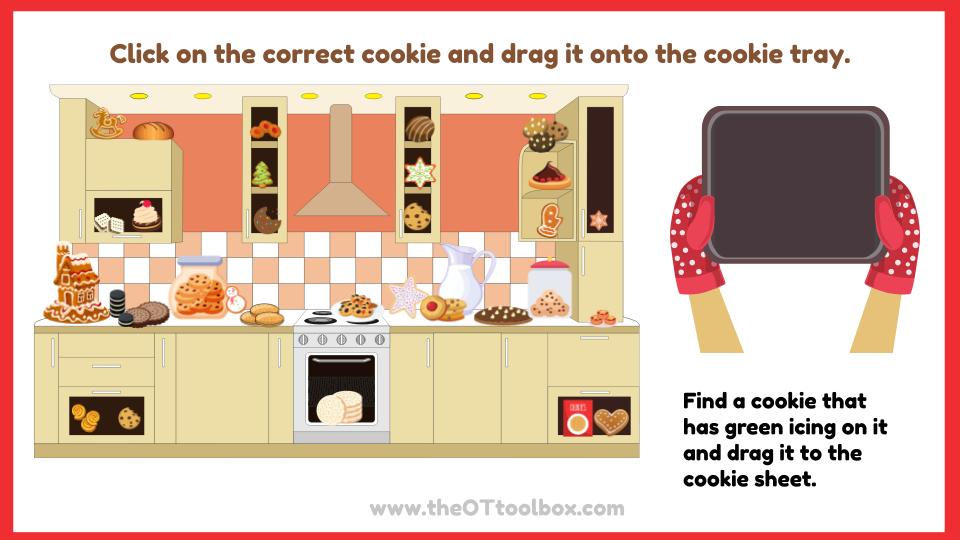
The first several slides include “I Spy” cookies activities, with a direction to locate specific cookies in the kitchen. Students can follow that direction and move the interactive cookie pieces to drag that specific cookie onto the baking sheet.
The directions are text boxes, so that therapists using this slide deck can adjust the directions as needed. You can make the directions more complex or easier, depending on the needs of your client, student, or child. Add 2 or multi-step directions or work on positional terms, too.
The cookies are in the same place on each slide so that children can work on working memory as they look for specific details according to each slide’s directions.
TIP: After your child’s therapy session, click on history at the top of Google slides and reset the slide to it’s original state so that all of the cookies are positioned at the original placement.
Visual Perception Cookie Activities
There are many visual perceptual skills that children can work on with this slide deck:
Visual figure ground– Scanning the image and identifying and locating items hidden in a busy background. This is a skill needed for reading, finding items in a drawer, locating a paper in a homework folder, and other similar tasks.
Visual discrimination– Students can visually scan the kitchen slide deck and identify differences and similarities between the cookies to locate the correct item. Visual discrimination is a skill needed for handwriting, reading, math and other skills.
Form constancy– This visual perceptual skill allows us to recognize similarities and differences between forms and images. This skill is needed for reading, writing, math, and functional tasks.
Visual spatial relations– Understanding positional terms is an important skill. This slide deck works on this area by moving the cookies to different places on the slide. Therapists can make this part of the activity more or less difficult to grade the activity to meet the needs of the child by adding additional directions to the slide to work on positional concepts. Try adding directions that ask the child to move a specific cookie to a different place in the kitchen on the slide.
Form constancy– Students that need more work with this visual perception skill can have several of the cookies duplicated and added to the slide. Then, work on size differences and positional concepts by moving the cookies to different places. You can adjust the directions to ask the child to find all of the same cookie.
Visual closure– Students can work on this visual perception skill by moving some of the cookies to partially hide behind other items on the slide.
Handwriting Cookie Activity
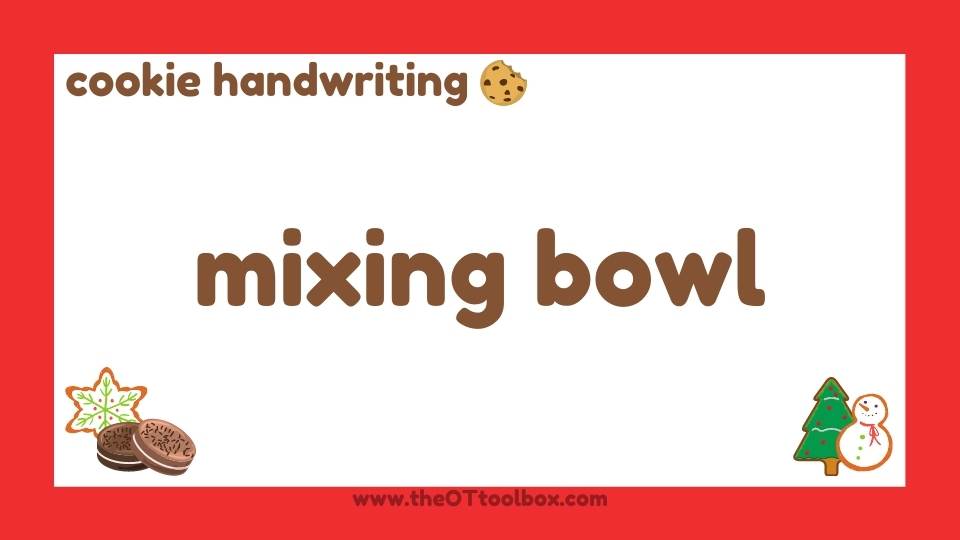
The next part of the slide deck is handwriting prompts in a write the room style of handwriting practice. Students can copy the word in print or cursive, depending on their needs. They can write a sentence using the word, if writing sentences is something they need to work on. Work on letter formation, legibility, and copying skills.
Visual Motor Cookie Activity
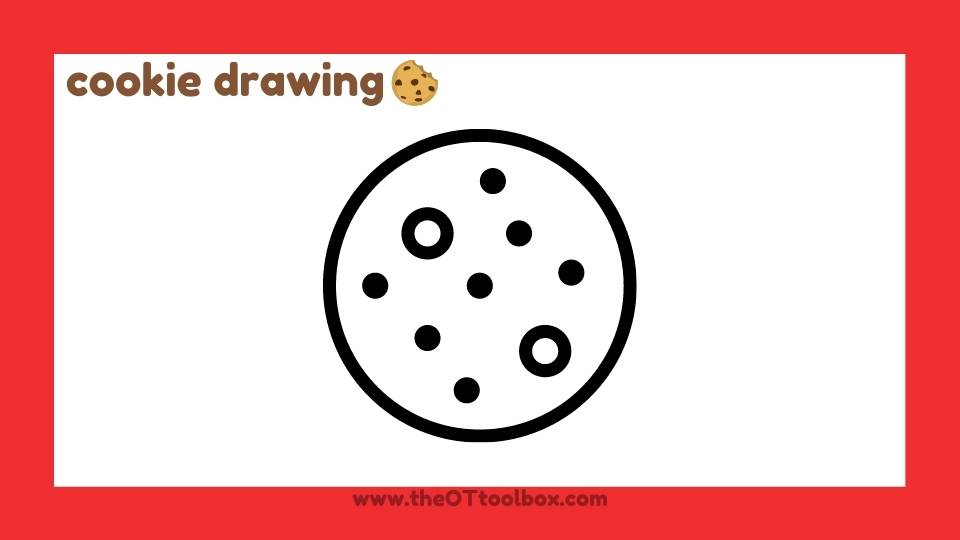
The last part of the cookie activity slide deck includes figure copying tasks. The slides include basic cookie forms that students can copy while working on visual motor skills. This is a nice activity to help children with the visual motor skills needed for forming letters and numbers.
This cookie slide deck should be a motivating a fun way to work on so many areas!
Free Cookie theme Slide Deck for therapy
Want to add this cookie slide deck to your therapy toolbox? Enter your email address into the form below and a PDF will be sent to your inbox. Save that PDF, because you can use this slide deck each year to work on therapy goals with a holiday cookie theme.
When you click the link in the PDF, you will be prompted to make a copy of the slide deck onto your Google drive. Make a copy for each student on your caseload so they have their own slide deck and you can adjust the slides according to their needs.
Colleen Beck, OTR/L has been an occupational therapist since 2000, working in school-based, hand therapy, outpatient peds, EI, and SNF. Colleen created The OT Toolbox to inspire therapists, teachers, and parents with easy and fun tools to help children thrive. Read her story about going from an OT making $3/hour (after paying for kids’ childcare) to a full-time OT resource creator for millions of readers. Want to collaborate? Send an email to contact@theottoolbox.com.
Visual deficits and occupational therapy interventions go hand in hand. And, the connection between vision problems or attention issues impacts children when it comes to ADD and ADHD. In fact, the connection between visual deficits and attention is especially a factor in OT treatment. Trouble paying attention, difficulty with reading, finishing work on time and staying on task can be signs of both attention issues or a vision issue. So, how do you tell the difference, and what do you do about it? Knowing if a visual impairment is present can mean the difference between accommodating for vision difficulties and a different diagnosis, such as attention deficit disorder.
Vision or Attention Deficit Disorder
Children with vision deficits work twice as hard, and use more “brain” power to make their eyes work correctly as compared to peers without vision deficits.
Children with vision deficits may also experience fatigue more quickly, have frequent headaches, or blurry vision.
When they begin to experience the above symptoms, it is easier for the child to look away, leading them to appear to be “staring off into space” or lose focus. These behaviors are often mistaken for ADD in the classroom setting. Vision deficits that may be behind these symptoms and actions include:
Like kids with ADD, kids with vision deficits often appear to have poor social skills. Behaviors include a lack of response to their name, missing social cues or facial expressions, and not attending to others in the room.
This apparent “lack” of social skills is also related to how hard they are working on using their eyes. When this happens, the level of executive function left for other tasks significantly decreases.
This may also make the child appear “scatter brained” or disorganized.
Attention Deficit Disorder Symptoms
Vision concerns outside of acuity are FREQUENTLY missed due to limited vision screening protocols and the desire to quickly remediate behavior.
In addition to limited vision screening, vision deficits are not widely recognized as a potential reason for distracted or inattentive behavior.
Attention issues and vision Problems
If you have concerns, or concerns have been brought to your attention, regarding your child and ADD, rule out vision deficits first. A trip to a developmental ophthalmologist may help better explain your child’s behavior concerns and provide them the help they truly need.
WHAT IF YOU SUSPECT VISION PROBLEMS?
Now what? When vision problems are suspected after a screening by the OT, it is best practice to refer the family to a developmental optometrist.
A developmental optometrist will complete a full evaluation and determine the need for corrective lenses, vision therapy or a home program to address vision concerns.
As occupational therapists, it is imperative that we rule out vision problems before treating handwriting or delays in visual motor integration, to ensure the best possible trajectory of development and success for the child.
OCCUPATIONAL THERAPY VISION SCREENING TOOL
Occupational Therapists screen for visual problems in order to determine how they may impact functional tasks. Our newest Visual Screening Tool is a useful resource or identifying visual impairments. Visual screening can occur in the classroom setting, in inpatient settings, in outpatient therapy, and in early intervention or home care.
This visual screening tool was created by an occupational therapist and provides information on visual terms, frequently asked questions regarding visual problems, a variety of visual screening techniques, and other tools that therapists will find valuable in visual screenings.
This is a digital file. Upon purchase, you will be able to print the 10 page file and print off to use over and over again in vision screenings and in educating therapists, teachers, parents, and other child advocates or caregivers.
Skipping words when reading or copying written work, noticing details about things, reversing letters and numbers, poor eye-hand coordination or being a little clumsy, difficulty with reading comprehension…these are just SOME of the ways that vision impacts functional tasks in kids. Here you will find specific strategies and vision activities that help kids build and develop the underlying areas that impact independence.
These vision activities are outlined by area that they improve, or those underlying skills that therapists work on so that kids can be independent in thins like catching a ball, writing on the lines, building puzzles, and so many other tasks.
We’ve recently put together a huge resource in our Visual Motor Skills section of the blog, which you can find under the tab at the top of the blog. Be sure to stop by and see all of the fun ways to play and develop visual perceptual skills, visual motor integration, visual figure ground, hand-eye coordination, visual discrimination, visual spatial relations, and more by checking out the vision activities for kids that we’ll be updating regularly.
Why Vision Activities?
Vision activities can sometimes be the missing piece to vision problems that we see in kids. Therapists often times working with kids with known or suspected visual perceptual or visual motor concerns, visual acuity issues, or other visual processing needs.
Teachers often have students that struggle with reading, copying, handwriitng, comprehension, attention, or focus.
Parents may have a child with a known vision issue or have a gut feeling about visual processing concerns.
There are many concerns therapists have when it comes to vision needs in kids. Therapists need a quick screen to help identify the visual difficulties Rather than taking the extended time to work through several lengthy assessments, there is a time for evaluation, but a quick screening can pinpoint which strategy to take next.
Having quick activities to either do before or after an OT session, or to hand off to parents for home occupational therapy activities is a need for OTs. Similarly, quick vison activities that build on those underlying areas and are not disruptive to the class are sometimes needed.
Teacher Concerns
One of the main difficulties in the classroom is the impact vision has on learning. Kids struggle with visual stimulation and the inability to stay focused for any length of time due to visually processing so much information around us. Students may visually dart their eyes from not only reading scripts but anything visually available, and they are unable to filter what isn’t required for the task at hand. When this happens, the eyes don’t know where to focus, therefore tasks take longer or don’t get completed, and it’s a real challenge for the child to focus.
Handwriting is another reason to take a look at vision. Many kiddos have difficulties keeping letters aligned on a baseline, or even knowing where to place letters on a blank sheet of paper.
So many kids cannot visually attend to an object to even assess tracking. They will look past the tracking object and say they are looking at it or look at it for 1-2 seconds and their eyes dart in another direction. How many children have you seen that have not had the capability to maintain visual contact with an object for a sustained amount of time? When this occurs, reading and handwriting can be a real problem?
Vision Therapy
There is an overlap in interventions between vision therapy and occupational therapy. Much of the vision therapy research covers the vary skill areas that occupational therapy addresses in it’s OT activities.
So often, these two professions intervene in those vision activities that address the very areas kids struggle in:
-More and more kids who can not visually track- leading to trouble with reading and learning…
-Kids of various levels and abilities who struggle with interventions to address visual motor deficits…
-Students with real difficulties with reading and need strategies that make a difference in the classroom…
-Kids challenged by limited exposure to motor activities that translate to visual motor difficulties…
–Kids struggle with orthographic memory (spelling patterns and knowing if a word looks right), but they have high levels of visual acuity.
-Many students have difficulty with visual memory and visual attention which makes it difficult for them to copy words or sentences. They require visual and verbal cues to refer back to the sample and often can only recall and copy one letter at a time.
Vision Definitions
Before we cover various vision activities, we will go over the vision definitions for terms that relate to all things vision. This guide to vision can help you better understand what’s happening in those eyes.
Under each section are links to activities to build each skill area.
Visual Motor Integration- Visual motor integration includes the overarching umbrella that contains several areas, including visual perception, visual processing skills, and eye-hand coordination. The integration of these areas enables the eyes to perceive information through the vision functions (described in further below) and process information, resulting coordinated hand (and body) motor actions in order to complete a task. Visual motor integration includes a perceptual component that allows for copying of letters and positioning of objects based on perceptual input.
Eye-Hand Coordination- This eye and hand skill allows an individual to catch a ball, hit a target, or complete other motor actions based on visual information. Development of eye-hand coordination occurs from birth and continues as kids develop more physical skills.
Feather Beading– Threading beads onto feathers is a creative and fun way to improve eye hand coordination skills.
Vision Functions- This includes the actions and abilities of the eyes that allow information to be perceived. Visual functions include visual tracking, visual convergence, divergence, saccadic eye movements, depth perception, nystagmus, disassociated eye movements, eye positioning, teaming, and eye dominance. Here are visual scanning activities.
Visual Tracking- The eyes ability to follow a moving target through all fields of vision with smooth, coordinated movements in dissociation; it is also referred to as a pursuit. Here are activities to work on smooth pursuits.
Visual Convergence- The eyes ability to follow a moving target from a distance into the midline with smooth, coordinated movements. Convergence is the technical term for “crossing your eyes”. Convergence should be easily maintained for up to 5 seconds. Here are activities to improve visual convergence.
Saccadic Eye Movements- The ability to move one’s eyes simultaneously between two points of fixation with smooth movements. This skill is utilized for near and far point copying without losing your place. Here are activities for visual saccades.
Teaming- Fluid, smooth coordinated movements of both eyes in synchrony. Difficulties with teaming can lead to eye strain and fatigue, headaches, and blurred vision. Visual teaming is a big part of visual efficiency. Here are activities and more information on visual efficiency.
Disassociated Eye Movements- The ability to move your eyes separately from your head while it is stabilized. Lack of dissociation can indicate under developed motor patterns and eye muscle imbalances.
Eye Positioning- This refers to the position of the eyes when resting. Both eyes should be in neutral, equal position. However, it is possible that one, or both eyes demonstrates deviation in an outward or inward deviation. This can indicate an eye muscle imbalance.
Nystagmus- Nystagmus refers to the reflexive lateral movement of the eyes post rotary stimulation. This should be present only after rotary stimulation. If it is present at rest it is considered abnormal. If it is NOT present or limited post rotary stimulation, it is considered abnormal and may indicate a vestibular disorder.
Eye Dominance- This indicates the eye that is the stronger of the two. This eye is typically the same eye as our dominant side for motor tasks. However, mixed dominance does happen and can cause difficulties.
Depth Perception- Allows us to perceive visual input in multiple dimensions (including length, width and depth), and to judge how far away an object is. Here is information and activities for depth perception.
Visual perception is our ability to make sense of what we see. Visual perceptual skills are essential for everything from navigating our world to reading, writing, and manipulating items. Visual perception is made up of a complex combination of various skills and systems, including sensory processing, visual attention. These visual perceptual skills are necessary together and in coordination with one another in order for use to see information and use that visual information to create responses or react with functional abilities like movement or processing. When visual perceptual skills are delayed or impaired, other areas can suffer, including: learning, social, emotional, self-regulation, behavior, attention, organization, concentration, self-esteem, etc.
Visual Perceptual Skills make up an important component of visual motor skills. For children, these abilities are necessary for so many things…from self-care to fine motor skills, to gross motor skills…all parts of a child’s development require visual perception. There are many pieces to the giant term of “visual perception”. Sub-components include: visual memory, form constancy, visual spatial relationships, visual attention, visual sequential memory, visual figure-ground, and visual closure.
Visual Memory– This is one’s ability to store visual information in short term memory. This skill allows us to recall visual information. When completing hidden picture puzzles, kids visually store images of items they are looking for when scanning to locate a specific shape or image. This skill is necessary for handwriting tasks when copying information from a source, such as lists of words, homework lists, and copying sentences. which direction we see them. Here is more information and activities for visual memory.
Form Constancy– This skill allows us to visually recognize objects no matter their orientation. When completing a hidden picture puzzle, children can recognize the missing object whether it is upside down or sideways. In handwriting skills, we use this ability to read and know letters and numbers no matter the position of the letters/numbers. Here are fun ways to work on form constancy.
Visual Figure Ground is the ability to locate objects within a cluttered area (think “I Spy”). Finding a red square among the pile of foam pieces is one fun way to work on this area of visual perception.
Visual Spatial Relationships- This visual perceptual skill allows us to recognize and understand the relationships of objects within the environment and how they relate to one another. Here are activities to improve spatial relations.
Visual Attention- This visual perceptual skill allows us to focus on the important pieces or parts of what we see. When we “take in” a scene or image in front of us, we are able to filter out the unimportant information. In this way, a student is able to focus our eyes on the teacher when she teaches. Driving down a road requires visual attention to take in the road so we can drive safely. Visual attention is important in copy work as students copy information from a Smart Board or book onto a piece of paper. As they visually scan from one point to another, they attend to the place they left off. Visual attention is also important and very needed in reading. Here is more information on visual attention.
Visual Sequential Memory- This visual perceptual skill is the ability to visually take in and then later recall the sequence or order of items in the correct order. This skill is important in reading and writing. Visual sequential memory is important in spelling words correctly and recognizing that words are not spelled correctly.
Visual Discrimination– This visual perception skill enables us to determine slight differences in objects. In hidden picture activities, this skill is needed to determine and locate different hidden objects. When writing and reading, visual discrimination allows us to perceive the difference between “p” and “d”. Here is a visual discrimination worksheet.
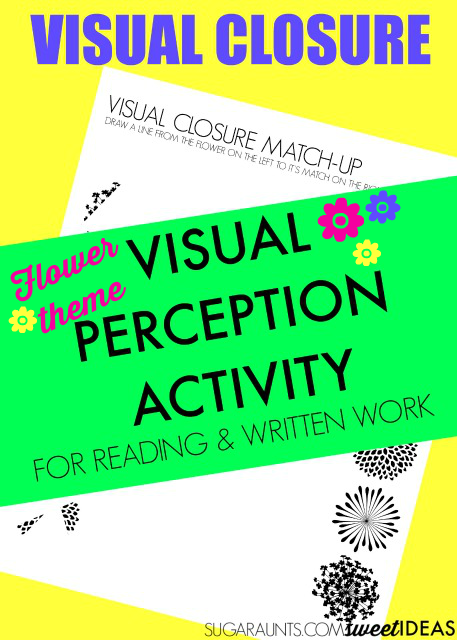
Visual Closure– This visual perceptual skill allows us to see part of an object and visualize in our “mind’s eye” to determine the whole object. When we see part of an item, we use visual closure to know what the whole item is. This skill requires the cognitive process of problem solving to identify items. Visual Closure is used to locate and recognize items in a hidden picture puzzle. In written work, we use visual closure to recognize parts of words and letters when reading and copying work. Here is a visual closure activity.
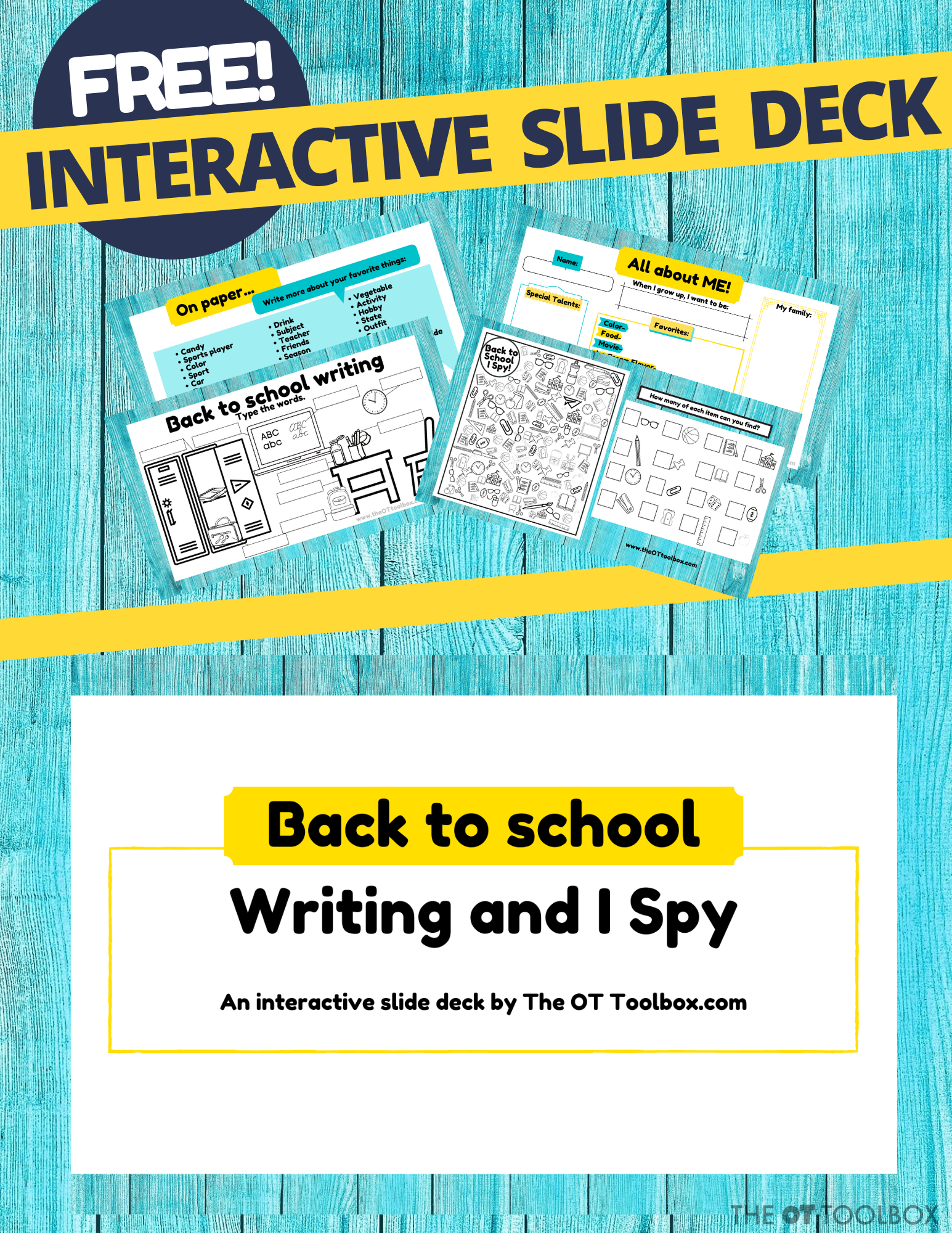
Heading back to school? The return of school looks a lot different this year than any other. That’s why I wanted to create this Back to School activity to use in virtual therapy or teletherapy services, or distance learning. In most cases, kids haven’t been writing with a paper and pencil since around March. This back-to-school activity provides a means to get those pencils moving and little hands writing again! Use this free therapy slide deck to get a baseline of where kids are in regards to writing a short list of words, and sentences. The bonus is that this back to school idea has a school I Spy activity, too that boosts visual perceptual skills. Read on to grab this freebie! And, don’t forget to grab this other back to school slide deck to work on more visual perceptual skills.
Back to School Activity
This interactive activity is great for getting to know students during the firsts week of school. It’s a fun icebreaker activity for students to do with teachers or therapists.
Students can complete these slide deck activities as part of distance learning, virtual days on hybrid learning options, and in teletherapy sessions.
When heading back into the school year, it’s a great idea to get a baseline snapshot of where a child is at with handwriting, especially after such a long break from school. In many cases, students have not been writing or putting pencil to paper during the last months.
With this back to school activity, kids can write a short list of words on paper, as well as use the interactive technology portion of the slides.
Here are some of the slides you will find in this icebreaker activity for returning to school:
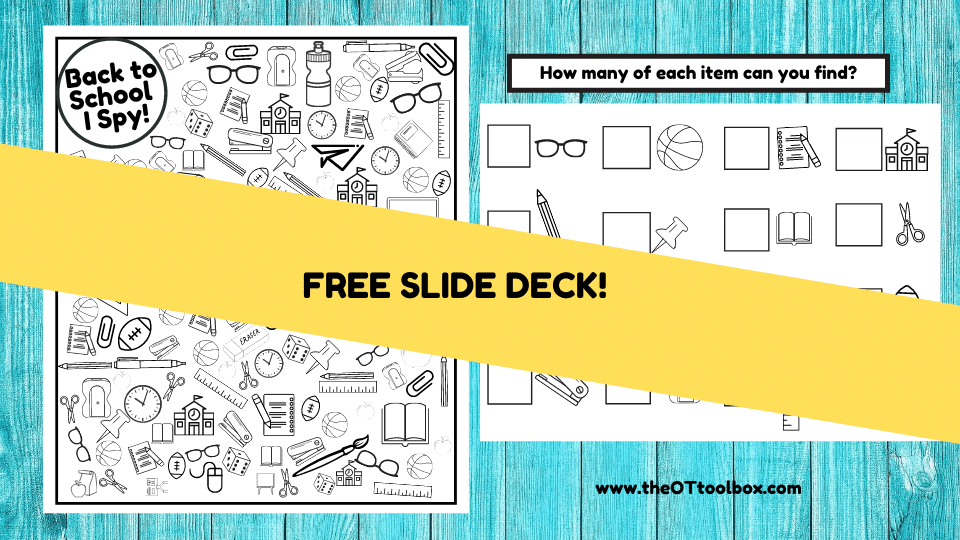
Start with an interactive slide deck I Spy game. Kids can search for school items and then type the number of items that they found into the boxes right on the slide.
Back to school handwriting baseline
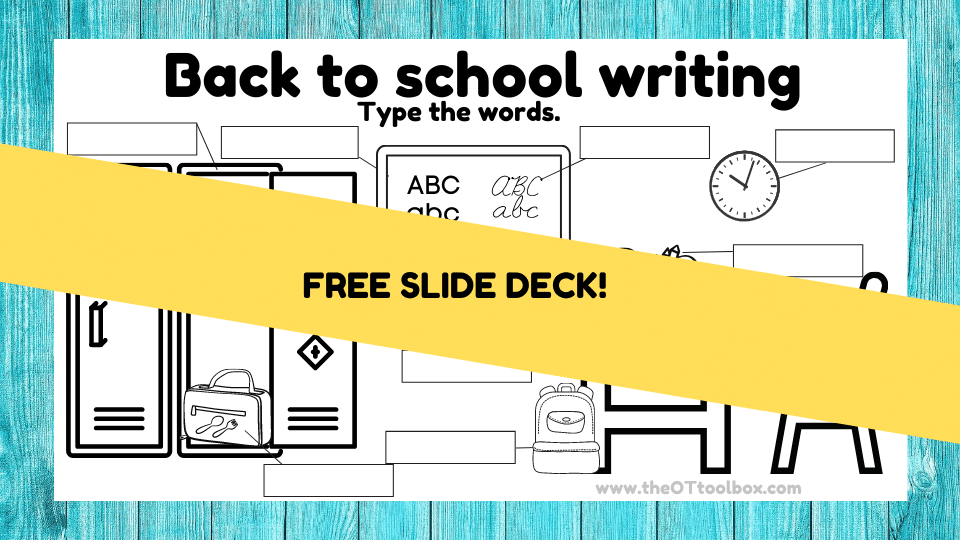
Use the handwriting slides to get a baseline snapshot of handwriting. Kids can type the words into the spaces on the slides. Then in the next slide, they can check their answers and use the written words to copy a short list of school related terms.
Use this list writing activity to check skills such as letter formation, letter size, line use, margins, accuracy, efficiency, and functional writing levels.
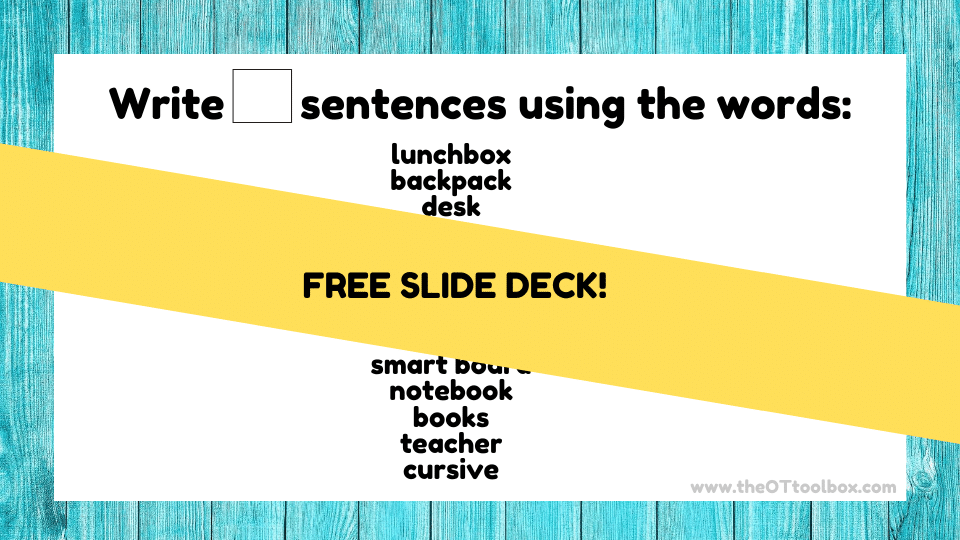
The same words can be used for sentence writing. Fill in the space showing the number of sentences the student should write. Using this writing task, check the handwriting baseline for word and letter spacing, margin use, and legibility.
All about Me Activity
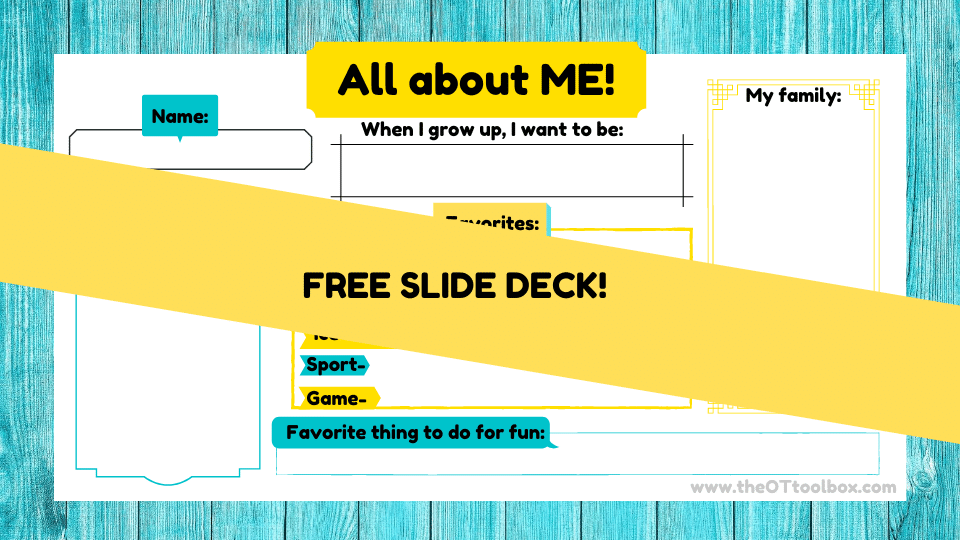
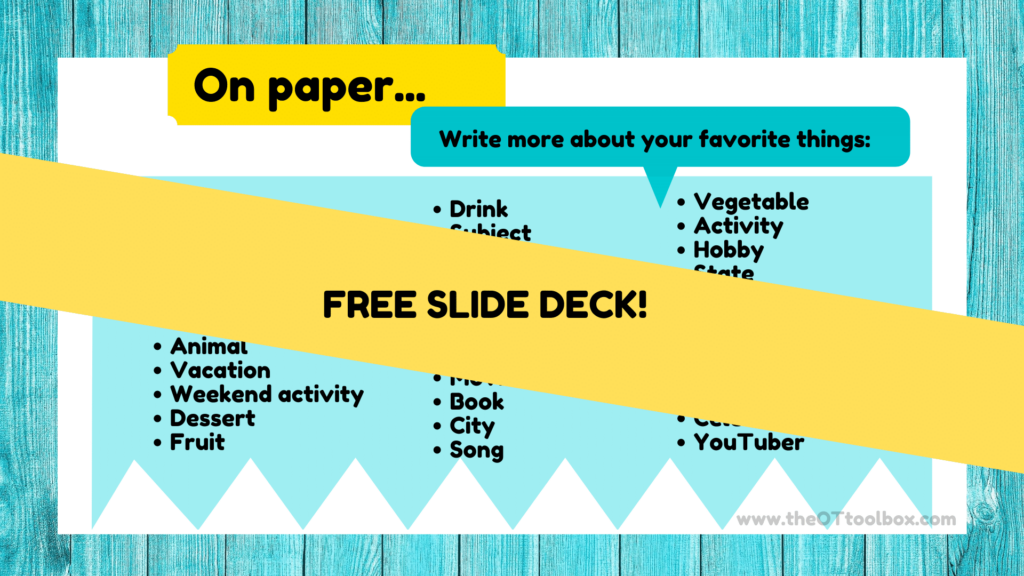
Use the next slide as an icebreaker activity. Students can fill in the spaces on the slide and type in their responses.
Continue on with the all about me activity and ask students to write on paper, more about themselves. Use these responses as a quick screening for handwriting and writing abilities.
There you have it! Want to grab this free slide deck?