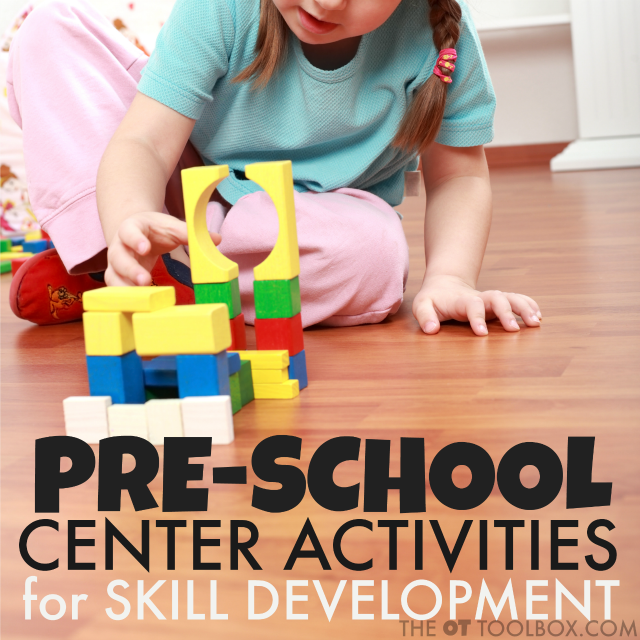
Preschool Centers to Develop Pre-Writing Skills

preschool center ideas

This blog post on preschool center ideas for pre-writing skills was originally written September 20, 2017. We’ve since updated it to include more resources and ideas to support the development of preschool prewriting skills that occurs through play in the preschool age. We have many preschool centers ideas to help with this skill!

preschool center ideas

Our favorite preschool center ideas involve movement, play, and exploration!

Preschool Center Ideas

If you’ve ever been in a preschool classroom and seen a lot of play, you are in a great classroom setting! Preschoolers need play to help them develop the skills that they will use throughout their lifetime. The preschool occupational therapy providers reading this are probably nodding their OT heads. And, actually, so are the school based OTs who later see those same kiddos in the elementary building. Why? Because teaching preschoolers to write is just not developmentally appropriate. Instead, we can focus on how can you help preschool children develop pre-writing skills through developmentally appropriate tasks!

The preschool classroom is a bustling place of activity, play, learning, and development.  All of these areas are happening at once, driven by the focus and intention of the preschool teacher.  I’ve had readers ask how to incorporate more developmental areas into group activities for the preschool aged child and how to incorporate development of pre-writing skills into a small group setting.

Before we get into the preschool center ideas, check out some of our resources to support the preschool aged kiddos:

Preschool Centers for Prewriting Skills

The center activities that we have listed below are designed for the developmental level of preschoolers. This means that prewriting and play go hand in hand…sometimes there are creative ways to do this! For example, you might have the center right on the carpet during a circle time. Other times, you might try a few different ways to sit on the floor during the center activity. These variations can be a great tool for developing balance, coordination, core strength, regulation needs (regulation is different in the preschool child!), motor control, and other skills needed for writing…it’s all connected! 

The activities below are ones that can be used in preschool centers or in small groups of children who are working on development of fine motor, visual perceptual motor skills needed for pre-writing and other tasks needed in a classroom setting. Considering all of the pre-writing skills that are developed during the preschool years, these centers can harness the excitement and play of creative play to promote development of skills needed throughout the child’s life.

The skills developed in the preschool setting has a lot to do with visual perceptual skills. You’ll find easy and fun ways to work on visual perceptual skills through play here. 

Preschool Centers and Development

Centers in the classroom are a common thing.  A center is a small group of children that work together on one area for a short period of time.  While in this small group, the children can work on a single area before moving on to a different center within the classroom.  You may see centers geared toward a single learning concept or area or you may see a center that combines motor involvement with learning.

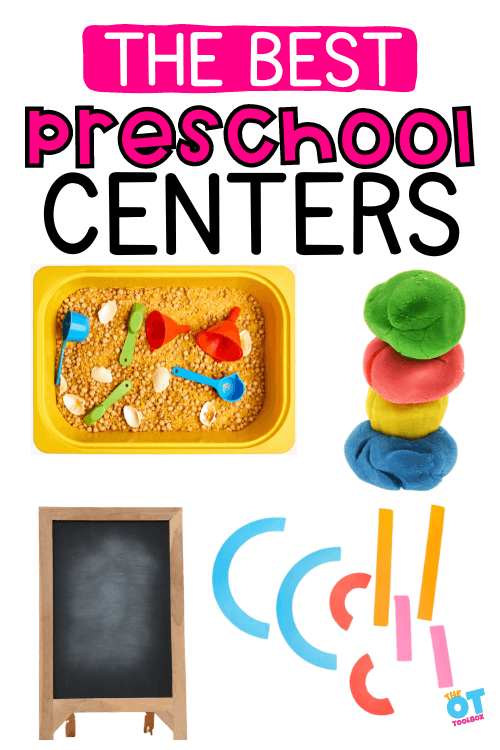
In the preschool setting, centers include tactile play, play dough, water tables, blocks, imagination play, art creation, finger paints, sensory play, name writing, manipulatives, etc.

The Occupational Therapist can contribute information related to development and specific needs of the classroom when collaborating with the preschool teacher, focusing on fostering skill development through play and use of various media and materials within the centers.

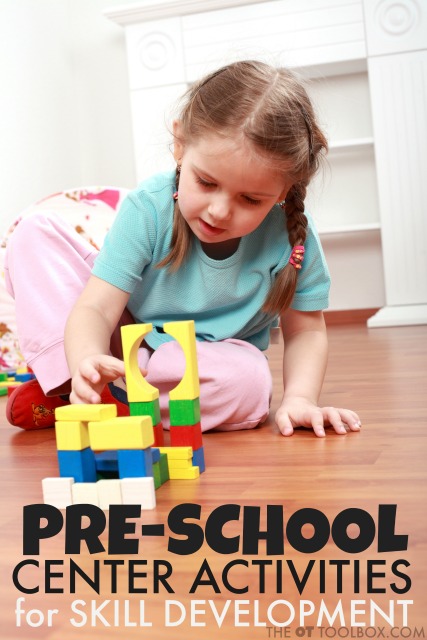
Try setting up center activities on the floor to develop skills like crossing midline, core stability and strength, proprioceptive input, motor planning, arch development of the hands, shoulder stability, and more.

Skills to address in preschool centers

The cool thing is that a center activity often targets many aspects of development. This is why occupational therapy providers working in early intervention, and especially when in the preschool setting love to push into the classroom for circle time. Check out the areas of development addressed with circle time activities:

  • Fine motor development
  • Gross motor development
  • Pincer grasp
  • Bilateral coordination
  • Crossing midline
  • Pre-writing skills
  • Eye-hand coordination
  • Manual coordination
  • Hand strength
  • Body coordination
  • Object manipulation
  • Grasp development

You can incorporate many of these components in a single circle time. For example, check out these indoor gross motor activities for preschoolers.

Fine Motor Preschool Centers

Here are some of my favorite fine motor preschool centers. These learning centers support development of hand strength, manipulation skills, dexterity, and the fine motor skills needed for functional tasks.


Writing Preschool Center

While writing with a pencil in preschool isn’t ideal because of the development of the child, you can target different writing tasks as a pre-writing activity. For example, if you use aspects of the Handwriting Without Tears program, there are many preschool activities that get young kids ready for writing without actually picking up a pencil.

  • Copying shapes
  • You can use the letter pieces to identify the big lines, little lines, big curves, and little curves used in forming letters.
  • Play with letter manipulatives
  • Create a mat man using letter parts (from HWT program)
  • Pre-writing lines with leaves
  • Copying pictures
  • Stamping letters in play dough
  • Tracing shapes
  • Writing in wet clay
  • Drawing on carpet squares
  • Painting water on a chalkboard
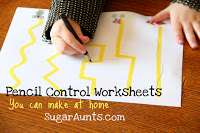
  • Pencil control sheets


Visual Perception Preschool Center

You can also use some fun visual perceptual skill activity in center time:

Here is more information about strategies to address visual perceptual skills and handwriting.

Use these preschool center ideas to help kids develop pre-writing skills and other developmental skills like visual motor and fine motor skills.

Check out our related preschool and developmental resources to better understand child development in order to support the preschooler during center time: 

Colleen Beck, OTR/L has been an occupational therapist since 2000, working in school-based, hand therapy, outpatient peds, EI, and SNF. Colleen created The OT Toolbox to inspire therapists, teachers, and parents with easy and fun tools to help children thrive. Read her story about going from an OT making $3/hour (after paying for kids’ childcare) to a full-time OT resource creator for millions of readers. Want to collaborate? Send an email to contact@theottoolbox.com.
42 Ways to Help Students Stay Organized at School

organization activities

This blog post oh how to help students become more organized at school was originally written on January 11, 2016 and was updated on April 9, 2024. We wanted to update it to include resources to help kids with a messy desk or disorganized locker that results in lost homework, misplaced assignments, and general school organization. A related post that can support these needs is the home aspect with our post on organization activities.

School Organization

Helping students get organized is key when it comes to executive functioning skills and school work and participating in education in the school setting. One way I like to explain this is by referring to school organization as a two part balance.

One side of the balance is the home aspect and the other side is the school aspect.

Executive functioning skills play a major role in homework! And, there is more to it than just doing a homework assignment. There is actually a school and a home aspect that involves EF skills like organization, attention, task completion, working memory, impulse control, and other skills. The thing is that development of these skills isn’t complete until 30 years of age, so having tools and strategies in place is key for each step.

At school there can be supports for each step:

  1. Writing down the assignment in an agenda
  2. Putting all of the needed materials into the backpack: books, tablet/device, papers, folders, etc.
  3. And then turning in the assignment when it is due: locating the assignments and other items

At home, there are several stages as well:

  1. Locating the homework assignment and all items in the backpack
  2. Doing the assignment completely according to the timeline and requirements
  3. Putting the completed assignment back into the backpack or folder along with other materials

Kids need Organization Skills in order to function during their school day.

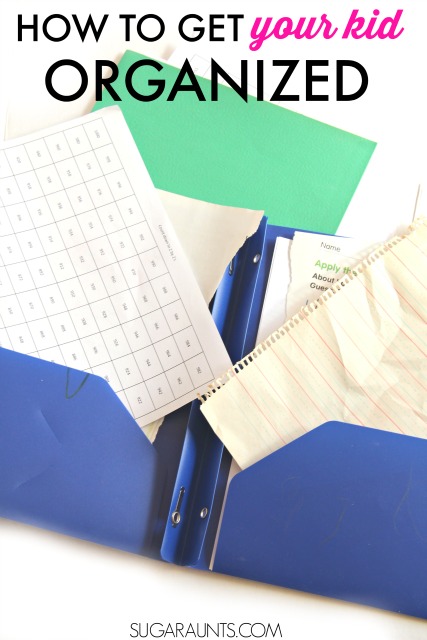
A student’s desk is so over-stuffed that papers are crammed in among pencils, books, last week’s homework, and the missing permission slip for today’s field trip.


A backpack that is filled with crumbled papers, broken pencils, toys, and crumbs from last week’s lunch.


A locker that doesn’t shut because granola bar wrappers, overdue library books, three sweatshirts, and last semester’s gym shorts.
A homework folder that is so full that it doesn’t shut flat, filled with doodles, notes from teachers, homework, and yesterday’s test that needed a parent signature.


How can a child function during their school day when they are so disorganized that desks, backpacks, lockers, and folders are so overwhelming?  


As an Occupational Therapist in the schools, I often times had referrals for kids with organizational difficulties: messy desks, overstuffed book bags, trouble with keeping homework and classroom assignments organized, lost or missing parent/teacher communication, and the ability to organize and care for one’s own belongings during their school day.


Organization tips for students in the classroom. So many ideas here from an Occupational Therapist on how to help kids with disorganization problems and help students with organizing their school work.


How to Help Kids Organize their School Work

There are many ways that a student can overcome disorganization and flourish in school with systems that work for them.  As with any Occupational Therapy recommendation, ideas are individualized to meet the student’s needs.  Every child is different in their strengths, abilities, and needs and what works to organize one student will not work with another.  Today, I’m sharing tips and tools to help organize students so that they may learn in the classroom and school environment.


These sensory strategies for school based occupational therapists can be a big help in addressing the organizational needs of students.

What causes a student to become so disorganized that they cannot complete classroom requirements?

There are many diagnoses that have symptoms of disorganization.  ADHD, Autism, and Learning Disabilities are just a few.  Additionally, many students do not have a diagnosis and are disorganized in their school tasks.

There are so many causes of disorganization that describing contributing factors is a more efficient way to describe reasons why a student may be disorganized. Problems with attention, executive functioning, fine motor skills, and vision may contribute to disorganization, among many others:

Problem Areas leading to disorganization:

Studies show that individuals with a small or underdeveloped frontal lobe of the brain tend to have difficulties with organization, poor memory, emotional reactions, and they tend to become overwhelmed by simple tasks.  These individuals will have trouble keeping themselves organized in tasks.


Often times, organization challenges are a result of difficulty with planning and prioritizing tasks. These problem areas may be contributing to a child’s disorganization in school:


  • Attention difficulties
  • Sensory issues
  • Behavior
  • Executive Functioning
  • Visual Perceptual difficulties
  • Visual Motor difficulties
  • Cognitive deficits
  • Fine motor problems
  • Motor Planning issues
  • Hyperactivity
  • Distractibility
  • Fidgeting
  • Problem solving
  • Memory issues
  • Auditory processing problems
  • Language processing problems
  • Lack of motivation
  • Poor impulse control
  • Emotional instability

    Executive Functioning and Organization difficulties

    Executive functioning is needed to keep up with the growing to-do list of the school’s day.  A child with executive function difficulties can’t see the first step they need to take in a project.

    Taking home a daily planner, packing a backpack, arranging items in a desk, placing homework into the correct bin, all requires working memory, motivation, cognitive skills, focus, planning, and persistence.  Difficulties in any of these areas will result in a breakdown of task completion.


    So, how can a student with organization problems be helped so that they can complete assignments, function in their school day, and excel in learning?


    Full disclosure: This post contains affiliate links.

Organization tips for students in the classroom. So many ideas here from an Occupational Therapist on how to help kids with disorganization problems and help students with organizing their school work.


Organization Tips for Students

Try these tips to help organize students in the classroom:
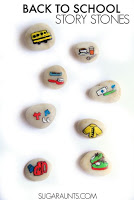
    1. Develop routines and stick to them. Morning routines can involve unpacking a backpack, planning homework into correct bins, putting away items needed for the day, sitting at the desk, and starting on morning work.  Maintain a consistent routine. Develop routines for different parts of the student’s day.  Social stories, picture schedules, story stones, and physical routing minders can help.
    2. Use a simple Schoolwork Folder system. Create a system for paperwork that needs to come back to school and what can stay at home.  A simple 2 pocket folders
      works best for this.  Adding extra pages or parts to the folder creates too much visual input.  Add a bright sticker to one pocket for “Keep at Home” and a bright sticker for the pocket to “Bring Back”.  A plastic folder is more durable. Older students can use color coded folders for each subject.
    3. Clear document folders in different colors can be used to coordinate with each subject’s color.
    4. Create a checklist to help students stay organized.
    5. Use checklists. Make checklists that the student can mark off tasks as they are completed. Using a checklist is a great way to incorporate handwriting skills into the routine.  Marking a check mark or “x” in a small box allows for precision of motor movements.
    6. Homework assignments should be written in the same place on the blackboard each day.
    7. Allow time at the beginning of the class or day instead of at the end to write down that day’s homework.  
    8. Teachers can sign off in an assignment book after the student writes down the day’s homework.  Provide a space for parent sign-off after homework has been completed.
    9. Parents can be provided with a small list of students in the class that can help with homework assignment questions.  These students or parents can be called if there are questions about assignments.
    10. Mailed homework. The parents would need to provide a self-addressed, stamped envelope and the teacher can mail the next few week’s homework assignments.
    11. Use a monthly calendar to keep track of long-term assignments and weekly classes like gym or library.
    12. Break long term projects into smaller tasks with deadlines.
    13. Email parent permission slips.
    14. Breakdown worksheets by folding the paper into sections that can be completed before moving on to the next section.
    15. Provide concise and concrete directions.
    16. Turn in completed assignments immediately and provide a space for completed work with clear label. A bin, file, or tray works nicely for this.
    17. Mark pages in a book or workbook with a paperclip so that the student can turn to the correct page more easily and quickly.
    18. Use a digital clock in the classroom or timers for competing tasks.
    19. Provide a small movement break between tasks.
    20. Allow for self-monitoring of systems.
    21. Provide tools for fidgeting.
    22. Try using an Impulse Control Journal.

Organization Tips for the locker

Another aspect is a messy locker. You’ve probably seen the locker stuffed full of papers from the beginning of the school year. How can the student find a homework assignment in that mess of old papers, torn folders, dirty gym clothes…

These organization strategies can help keep the locker organized:

  1. Create a container system for lockers. Use one container for hat, gloves, scarf, and one container for books.  The container can be emptied into the backpack at the end of the day.  Add pictures to the locker for a visual cue for where the coat, lunchbox, and backpack should hang. Add shelves if needed.
  2. Picture Symbols. A visual cue is a great way to break down tasks.  Create a series of pictures for desk morning tasks, lunch tasks, or end-of-the-day tasks. Pictures can be printed off in a strip and the strips replaced as the day goes by.
  3. Use a second set of textbooks at home to eliminate the need to bring books back and forth between school and home.
  4. Place a checklist of what needs to be brought home each day in the locker or in the desk.

How to help students keep their desk organized

A huge aspect of disorganization for students is the desk. It becomes a catch all that is stuffed with papers. Did you ever experience a teacher that dumped a student’s desk over in anger? Unfortunately, my daughter’s second grade teacher did just that for students in her classroom. Then, the student had to miss recess in order to clean up the mess. While the desk was very disorganized and the students couldn’t find their missing assignments or books, it is a really cruel way to teach organization skills. This aspect of executive functioning actually doesn’t develop for many years, so experiencing this kind of treatment in front of a whole classroom of peers probably isn’t the best way to teach skills…

Here are some actionable and practical ways to help students keep their desk tidy and organized (without needing to dump the desk in the middle of class):

  1. Eliminate dropping of the pencil.  Students with organizational problems often times have difficulty with fidgeting, sensory issues, fine motor skills, attention…(all of the items described in the list above!) Dropping the pencil can create a break in attention that allows for further disorganization.  Tie the pencil to the desk to prevent dropping: Tie a string to the eraser end of the pencil and tie the end of the string to a suction cup. Attach the suction cup to the desk surface.
  2. Reward systems. Set up an incentive or reward system for appropriate organization of folders, backpack, locker, or homework completion.  These can be tailored to the student’s interests.
  3. Color code notebooks, folders, book covers, and workbooks.  Books and notebooks can use prefabricated book covers or you can use colored paper to create book covers in a variety of colors. Add a small colored dot on homework assignments that correspond with the color of the subject’s book.  Use markers or small stickers
    to color code homework.
  4. Use a zippered pouch for pencils, erasers, calculators, etc in the backpack.  This will reduce the items “floating around” in the backpack.
  5. Develop a written contract of organization tasks with the student, teacher, and parent, along with choices for the student.
  6. Clear plastic, gallon-sized bags in the backpack to hold items like gloves, gym clothes, etc.
  7. Reduce distractions in the classroom to prevent distractibility: place desk away from windows, doors, and the pencil sharpener.
  8. Use a classroom peer as an organizing mentor.
  9. Provide a daily class checklist.
  10. Help the student clear their desk of all items except the items they should be using. Work on getting the student to be independent in this task by using visual and verbal cues. Provide a 10 second “Clear Off” time before starting a new task to allow time for the student to clear his work space.
  11. Mark off spaces inside the desk for items like books and pencil box using masking tape.  The items should be “parked” in their correct space unless they are being used.
  12. Provide a low cardboard box inside desks with compartments for organizing supplies.
  13. Provide a clear plastic bin or shelf for the student’s items instead of using a desk or locker.
  14. Use a triangular pencil grip to keep pencils from rolling off desks.
  15. Provide velcro for students to attach their pencil to the desk surface or inside the desk.
  16. Try an eraser ring to prevent losing large erasers inside desks.
  17. Use a Kneadable Eraser. It can be stuck inside the desk when not in use and makes a great fidget toy.
  18. Conduct daily, weekly, and monthly clean-ups of desk, locker, and backpack.
  19. At the end of the day, help the student prepare his work space for the next day.
Organization tips for students in the classroom. So many ideas here from an Occupational Therapist on how to help kids with disorganization problems and help students with organizing their school work.
 

How to Help Organize Kids Schoolwork

Organizing challenges are difficulties with prioritizing and planning.  It is difficult for some students to breakdown a multi-step assignment into manageable steps.  


Try using the tips above for organizing in the classroom.  It can take a period of monitoring along with trial and error to establish an appropriate organizational system that works for your student of child.

Organization tips for students in the classroom. So many ideas here from an Occupational Therapist on how to help kids with disorganization problems and help students with organizing their school work.


This is our first post in a new series on organization for kids.  I’ll be sharing a few other ways to help kids become organized so that they can function in daily tasks.  Stay tuned for more tips to help organize themselves.

Colleen Beck, OTR/L has been an occupational therapist since 2000, working in school-based, hand therapy, outpatient peds, EI, and SNF. Colleen created The OT Toolbox to inspire therapists, teachers, and parents with easy and fun tools to help children thrive. Read her story about going from an OT making $3/hour (after paying for kids’ childcare) to a full-time OT resource creator for millions of readers. Want to collaborate? Send an email to contact@theottoolbox.com.

Cherry Blossom Tree Craft- Fine Motor Activity

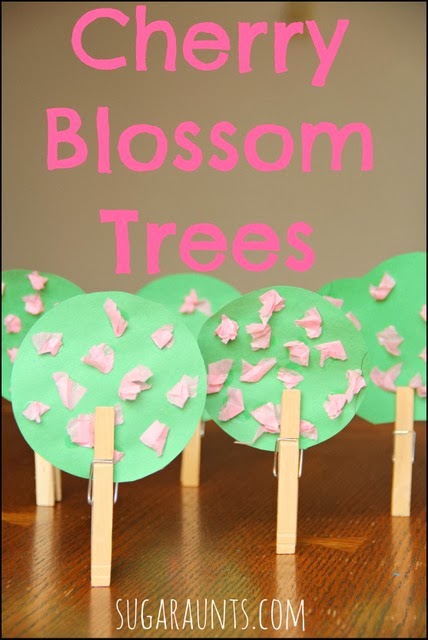
Cherry blossom tree craft

This cherry blossom craft is one of my favorites this time of year because it’s a fine motor power tool that supports so many areas of development with a single craft. We made the tissue paper cherry blossom tree many years ago, and it’s still a favorite when it comes to one craft that supports many areas! This is just one of the fun Cherry blossom crafts here on the site that promote fine motor skills, strengthening, and precision in big ways. Let’s explain…

Cherry Blossom Craft

We made these Cherry blossom trees one day as a Spring occupational therapy activity for kids.  This was the perfect way to brighten up our dining room.  We had a bunch of paper snowflakes hanging on our window and decided we needed to pull those down and make a few fun spring crafts!  This Cherry Blossom Tree craft hit the mark!

Not only were our trees fun to make, they had a great fine motor component to them…and we love fine motor activities!


Cherry blossom tree craft

 
 This post contains affiliate links. 


Cherry Blossom Tree craft

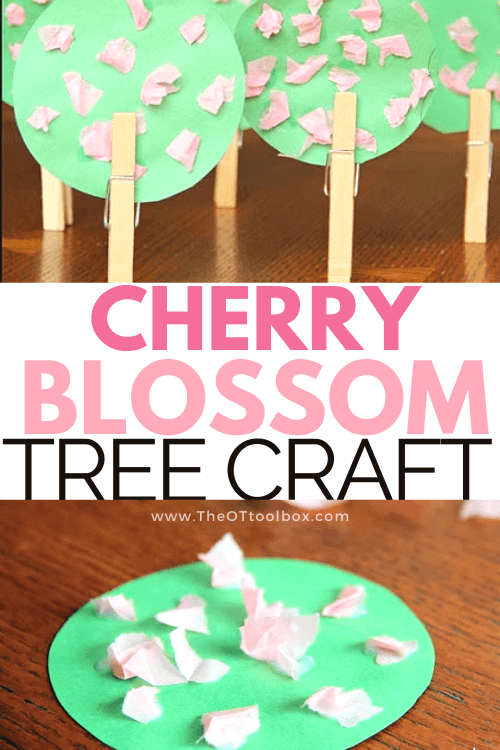
We made this tissue paper cherry blossom craft using simple materials that we already had on hand:

  • Green construction paper
  • Pink tissue paper
  • Glue
  • Clothes pins
  • We also used scissors, a pencil, and a lid (to create the tree circle)

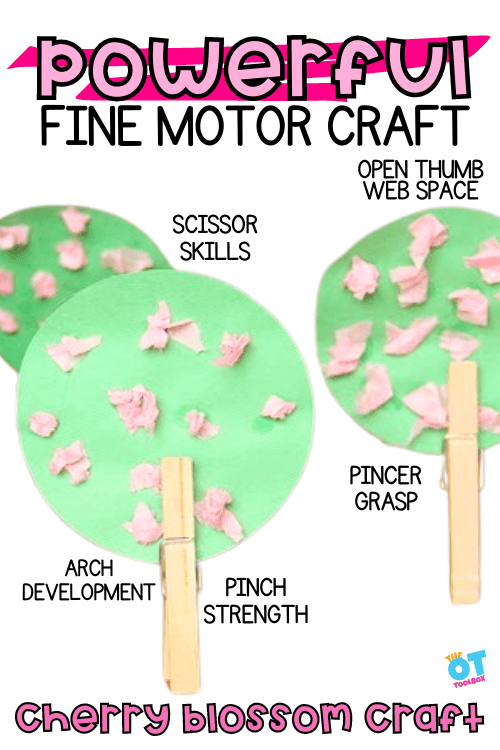
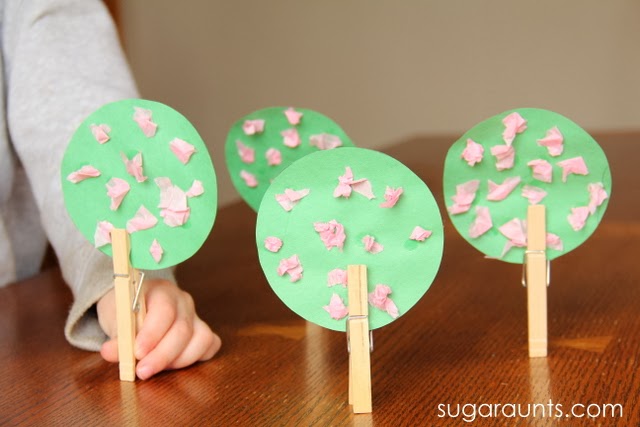
The craft is ideal because there are many skills that are addressed using these materials. We show them in the image at the top of this page, and they include:

  • Finger strength– needed to pinch the clothes pins as a trunk onto the tissue paper cherry blossom craft.
  • Open thumb web space– needed to tear and crumble the tissue paper
  • Scissor skills– necessary to cut the circles
  • Arch development– crumbling the paper into small bits requires refinement of the arches of the hand
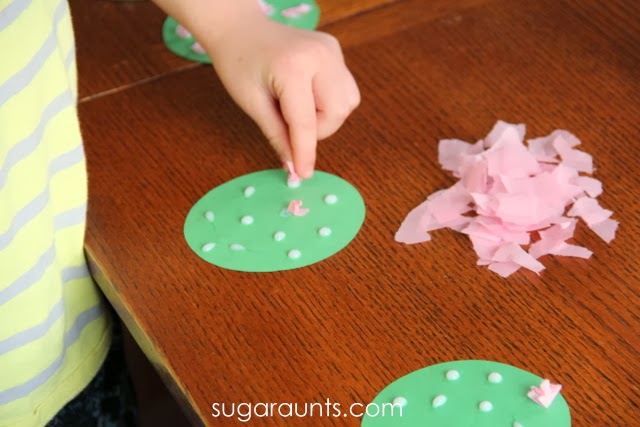
  • Pincer grasp– to pick up and manipulate the small crumbled tissue aper pieces and to place them onto glue spots on the tree

There are other skills that are used as well: tripod grasp, gross grasp, bilateral coordination, intrinsic hand strength, etc.


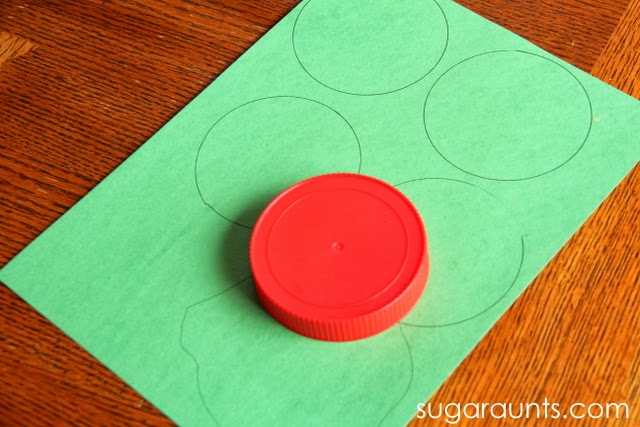
Trace a lid to make circles for cherry blossom tree craft.
 
We started with green Construction Paper and a peanut butter jar lid.  I traced a bunch of circles (and Baby Girl had to try her hand at tracing, too!)
 
Holding the lid and tracing around it is a great way to incorporate bilateral coordination and crossing midline. This is a nice precursor to the task of cutting out each circle. 
 
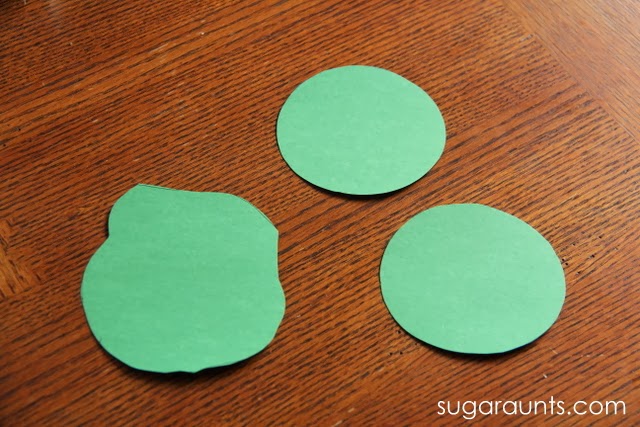
To address scissor skills, consider using thicker paper or cardstock to make the cutting activity easier. Here are strategies for working on scissor skills and cutting accuracy.
 
Cut circles for a Cherry blossom tree


These were cut out and we were ready to get started on our trees.

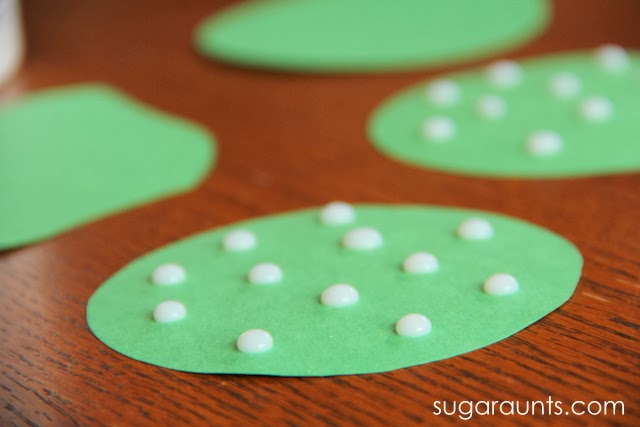
Dots of glue for cherry blossom tree craft

I put a bunch of dots of glue on the circles.  Older kids could do this part.  Squeezing the glue bottle is a great fine motor strengthening exercise for little hands.

For kids that need help working on graded resistance and grasp when managing a bottle of glue, practicing glue spots onto different sizes of circles like in a glue exercise is a good way to help with this functional task. 

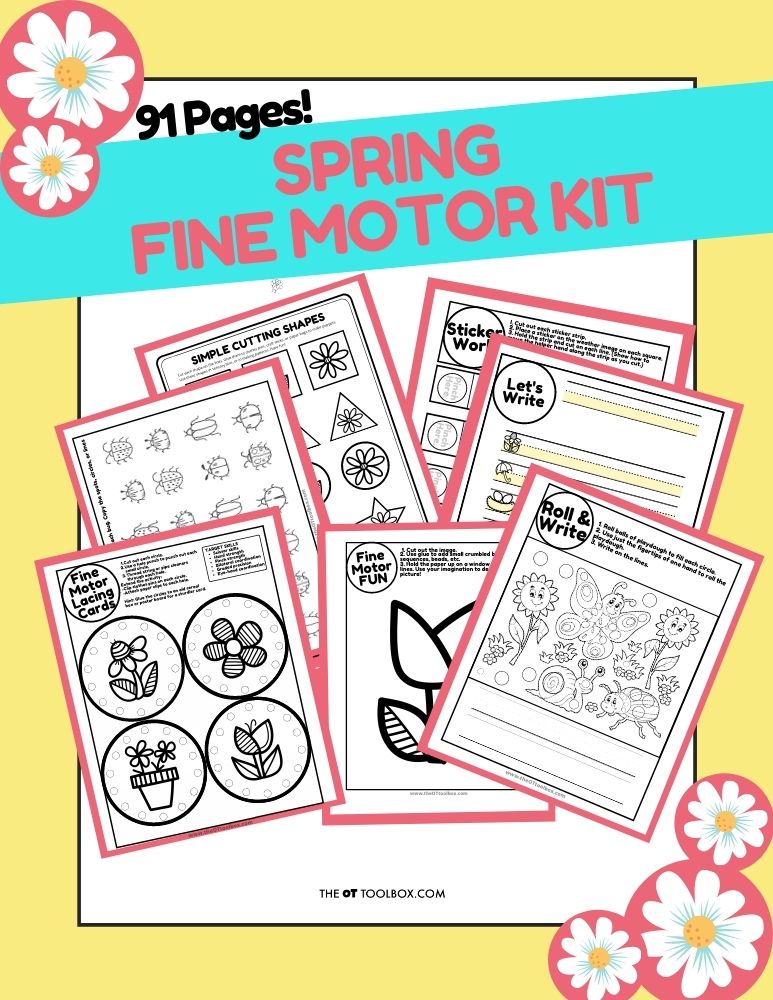
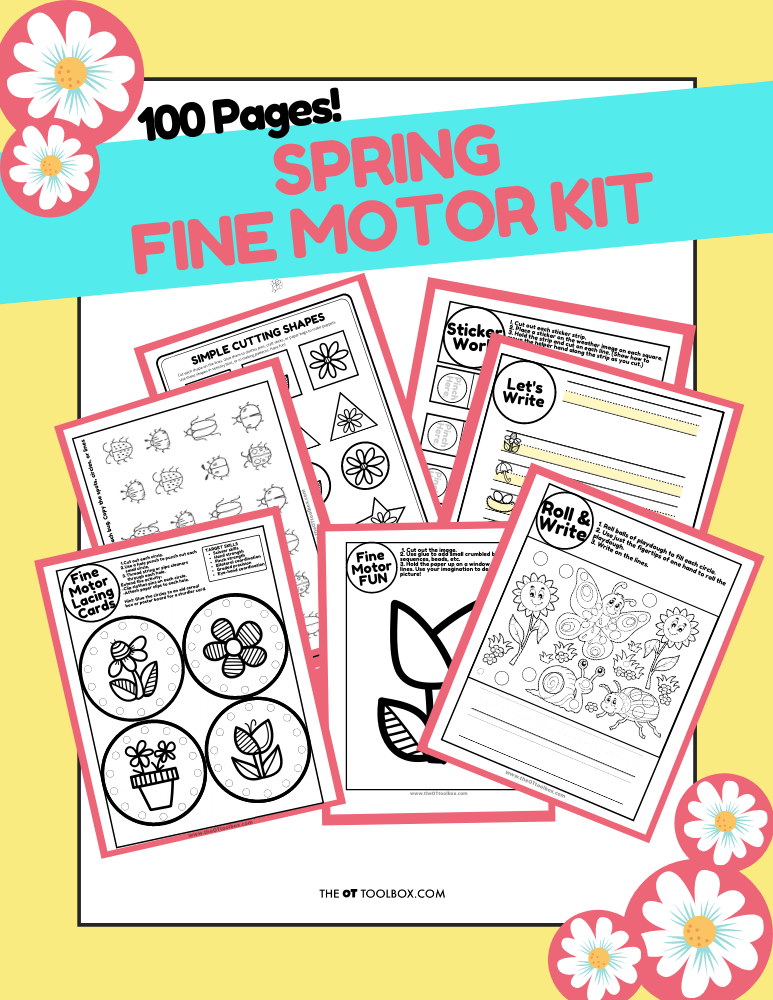
The Glue Spots worksheets in the Spring Fine Motor Kit is a good exercise for this activity.

Crumbling tissue paper is great for fine motor skills.
 
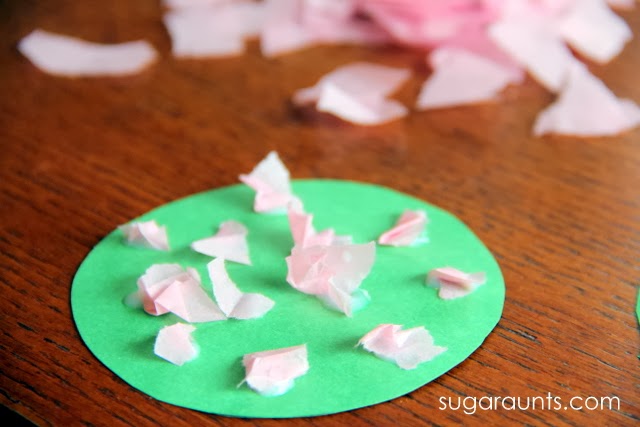
Next, Big Sister pulled small bits of pink tissue paper from a big old sheet. 
 
Tearing tissue paper is such a GREAT fine motor strengthening exercise for kiddos. 
 
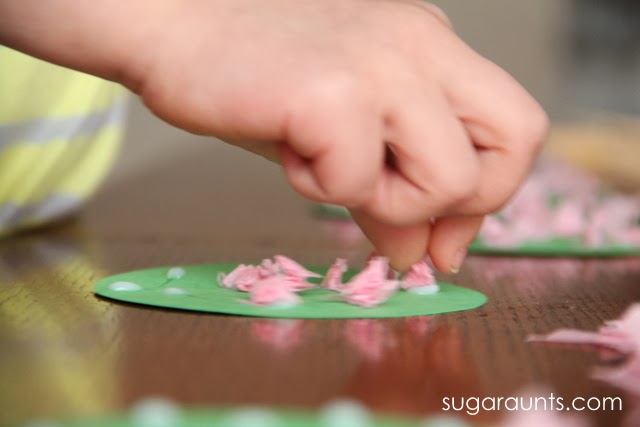
Crumbling those little bits works the intrinsic muscles of the hands (the small muscles that are in the hand and make up arches of the palm.  Strength of these muscles is so important to endurance in handwriting and coloring, maintaining adequate pressure when coloring, holding the pencil accurately…the needs for defined arches of the hands could go on and on and on!
 
Crumbling tissue paper for crumbled paper art is a functional fine motor craft that kids can hang up and admire their hard work. You’ll find more Crumble Art crafts in the Spring Fine Motor Kit, including templates for 5 different crumble art crafts: flowers, mushroom, rainbow, and Easter egg crafts.
 
Pinching tissue paper works on hand strength and tripod grasp.
 
Pressing those little tissue paper crumbles into the glue required a tripod grasp.  And, we had a ton of glue spots…so this was a good long activity!
 
Tripod grasp is worked on with this cherry blossom tree craft.


Cover all of those glue spots!

Make Cherry Blossom tree crat to work on fine motor skills with clothes pins for trunks.


Once our tissue paper/glue was dry, we clipped on clothes pin “trunks” onto our trees.  Pinching those pins was another way to encourage hand strengthening.  We had a whole forest of Cherry Blossom trees and got them involved on our train table, with the Little People stuff, with little dinosaurs.  We played with these Cherry Blossom trees until they fell apart!

Be sure to check out this other cherry blossom fine motor math activity, where we used pink tissue paper to make cherry blossoms and worked on tripod grasp and eye hand coordination skills.


Spring Fine Motor Kit

Score Fine Motor Tools and resources and help kids build the skills they need to thrive!

Developing hand strength, dexterity, dexterity, precision skills, and eye-hand coordination skills that kids need for holding and writing with a pencil, coloring, and manipulating small objects in every day task doesn’t need to be difficult. The Spring Fine Motor Kit includes 100 pages of fine motor activities, worksheets, crafts, and more:

Spring fine motor kit set of printable fine motor skills worksheets for kids.
  • Lacing cards
  • Sensory bin cards
  • Hole punch activities
  • Pencil control worksheets
  • Play dough mats
  • Write the Room cards
  • Modified paper
  • Sticker activities
  • MUCH MORE

Click here to add this resource set to your therapy toolbox.

Spring Fine Motor Kit
Spring Fine Motor Kit: TONS of resources and tools to build stronger hands.

Grab your copy of the Spring Fine Motor Kit and build coordination, strength, and endurance in fun and creative activities. Click here to add this resource set to your therapy toolbox.

Colleen Beck, OTR/L has been an occupational therapist since 2000, working in school-based, hand therapy, outpatient peds, EI, and SNF. Colleen created The OT Toolbox to inspire therapists, teachers, and parents with easy and fun tools to help children thrive. Read her story about going from an OT making $3/hour (after paying for kids’ childcare) to a full-time OT resource creator for millions of readers. Want to collaborate? Send an email to contact@theottoolbox.com.
Cherry Blossom Tree craft for kids with fine motor activity

Awesome Buckle Toys for Fine Motor Skills

buckle toys

I was wasting time on Amazon (do you do that too? It’s the ultimate window shopping experience!) one day and I came across a series of buckle toys that made my occupational therapy mouth drool. Ok, maybe I’m being a little dramatic here, but as a pediatric OT, I can tell you that there are a LOT of kids out there not getting the play skills they need to develop fine motor skills and visual motor skills needed for functioning. We can go into that in more detail, including why a buckling activity supports development, in a bit. But I do want to get this occupational therapy toy into your hands, and for good reason!

buckle toys for fine motor skills

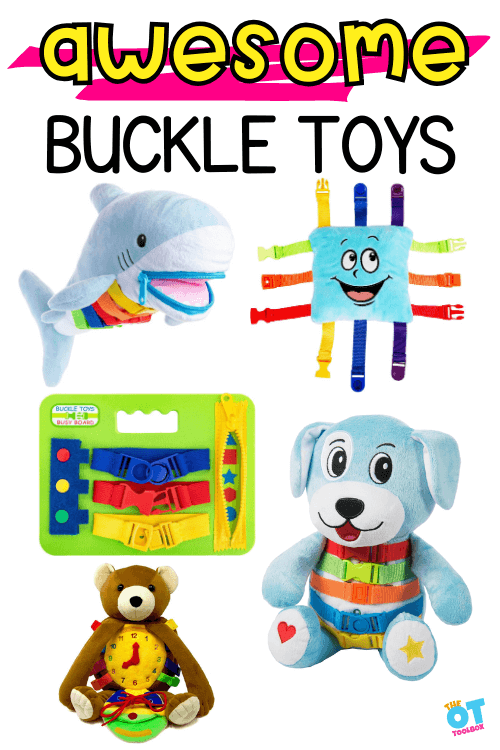
Buckle toys like these ones support fine motor skills and visual motor skills.

What is a Buckle Toy

First, if you aren’t a pediatric occupational therapy provider, you might be wondering “what is a buckle toy!?”

A buckle toy is a handheld toy, usually a soft toy or interactive book, that has various buckles and straps for attaching and connecting. You’ve probably seen Montessori type toys that have buckle before but never thought twice about them. It’s a clothing fastener toy that supports development of much needed skills!

They might be a stuffed animal with colorful straps that snap together. Or, there might be added clothing fasteners that kids can manipulate and attach. I’ve seen buckle and snap toys with clothing fasteners like snaps, zippers, buttons, velcro attachments, and other fun fine motor tasks.

This type of toy is perfect for the child working on fine motor skills and clothing fasteners, but it actually covers more underlying skills than just that.

As a pediatric OT, I LOVE these toys!

We’ve shared various fine motor toys in the past, and specifically, bilateral coordination toys. The buckle/fidgeting toy is a gem!

Why I Love Buckle Toys as a Pediatric OT

I mentioned a couple of the reasons why buckle toys are so fantastic. Let me list this out because the benefits of playing with a buckle type toy is pretty extensive.

We cover all of the fine motor skills needed for dressing skills in a different blog post, because there are many underlying skill components (that are addressed by a buckling toy like the ones below) that are needed for teaching kids self-dressing skills.

Buckle activities build fine motor skills through play!

Awesome Buckle Toys

Some of the best buckle and fidget/manipulation toys are fun stuffed animals, but there are things like backpacks too…You can find a lot of different types on Amazon!

  • Buckle backpacks
  • Stuffed animal buckle toys
  • Buckle board book
  • Shape buckling toys

I found some that I love and I have the OT perspective behind each type of toy.

Buckle Toy Backpacks

The reason I came across these toys on Amazon is that I was actually looking at therapy bags. I saw this buckle and snap toy backpack and thought it actually would be pretty fun to see as a therapy backpack! While it is a bit on the smaller size and you would need a tote to carry paper and files, you could actually use this buckle toy to hold a handful of therapy materials to use in OT sessions.

Because the school based OTs know that carrying a ton of supplies from school to school building is painful, but a must. The other thing that is true is that occupational therapy providers can make a complete therapy session with just a handful of materials. So, add a pair of scissors, some index cards, a pencil, maybe a tub of theraputty, and a fidget or two, possibly a dice or a spinner, and you have a whole session in your hands.

I love that this buckle backpack has the snaps, clips, and a side pouch with snaps. You can have your therapy students access materials like a dice or a fidget from the pocket and work on the functional task of snapping the snap.

Another buckle backpack that I like has a variety of clothing fasteners. This one has ties, lacing, buttons, snaps, and other clothing fasteners.

Stuffed animal backpack– This stuffed animal buckle toy backpack is a little different because it has some added fine motor features but it’s also a fun stuffed animal, too.

Buckle Toy Busy Board

I like this buckling toy busy board because it can be slid into a therapy bag or a diaper bag for fine motor quiet play. Or, slide it into your therapy bag as a table-top toy.

This is a great toddler toy because they can get the benefit of quiet play without a screen!

Stuffed Animal Toys

There are a ton of different stuffed animal manipulation skills toy options. Most of these are nice because they have a zipper pocket that kids can open and put items inside. Holding the zipper and the toy supports bilateral coordination skills. And, when they pinch the zipper to grasp and pull open the pocket, the child is working on hand strength, arch development, open thumb web space, all of which are fine motor skills they need for tasks like pencil grasp.

The ones I listed below are nice lap-sized toys. They are great toddler toys for using in a stroller or in a car seat.

Here are some that I found:

  • Dog Buckle Toy– this one has numbers on its belly to work on number identification, but there are also different colored shapes on the dog’s back and feet. It’s a great way to work on shape identification, color identification, and visual discrimination skills.
  • Buckle Toy Airplane– This buckle activity is fun for the little one that is obsessed with all things airplanes. There are shapes and numbers on this one too.
  • Shark– This cute motor skills toy is an adorable shark. I love that the mouth zippers open and closed because opening and closing the zipper is a fun way to work on precision grasp and hand strength!
  • Turtle
  • Lion– This one has a nice handle and it makes a great stroller toy for toddlers.
  • Crab
  • Ladybug
  • Caterpillar

SHape Buckle Toys

Then, there are the buckle activity toys that are shapes. These are actually a little more advanced than some of the stuffed animal toys that I mentioned above. This is because the straps are a little longer and it can be more challenging to attach the strap to the correct match.

The different toys have different buckle types so this makes it harder to find the correct and matching attachment, too.

Here are some shape options:

So, which do you think you will try? The thing is that these toys all support fine motor skill development, but it’s nice because you can select the toy that fits the needs of the child you are supporting!

Colleen Beck, OTR/L has been an occupational therapist since 2000, working in school-based, hand therapy, outpatient peds, EI, and SNF. Colleen created The OT Toolbox to inspire therapists, teachers, and parents with easy and fun tools to help children thrive. Read her story about going from an OT making $3/hour (after paying for kids’ childcare) to a full-time OT resource creator for millions of readers. Want to collaborate? Send an email to contact@theottoolbox.com.
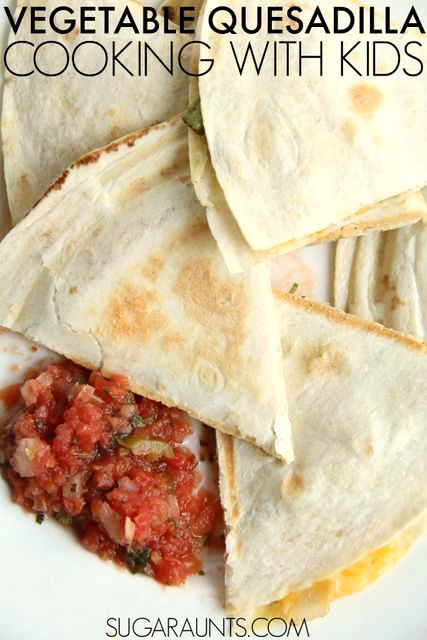
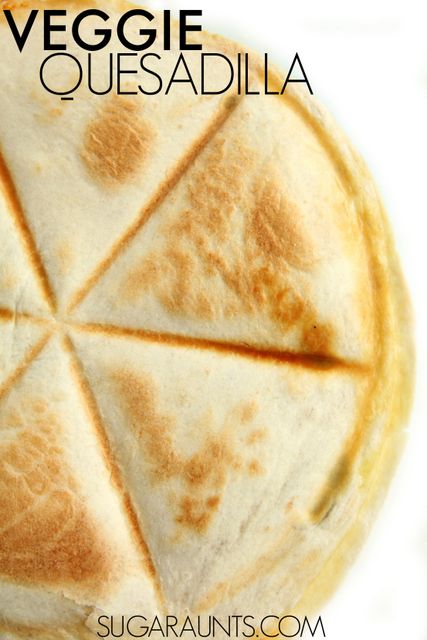
Vegetable Quesadilla Learning with Cooking

This recipe for making a vegetable quesadilla with the kids was originally published in July 2015. We updated it in April 2024 with resources on using the quesadilla recipe for developing life skills and executive functioning. The easy quesadilla recipe is a great tool for developing brain skills in the kitchen.

Cooking with the kids in the kitchen is such a wonderful learning opportunity. The sights and smells of new and interesting foods and the textures and tasks of cooking provide children with a rich  experience.  Then there is the awareness of accomplishment. Kids can help to prepare the food that feeds the family.  Kids can learn the steps of cooking a meal from start to finish.  All of this is so supportive to developing executive functioning skills and life skills.

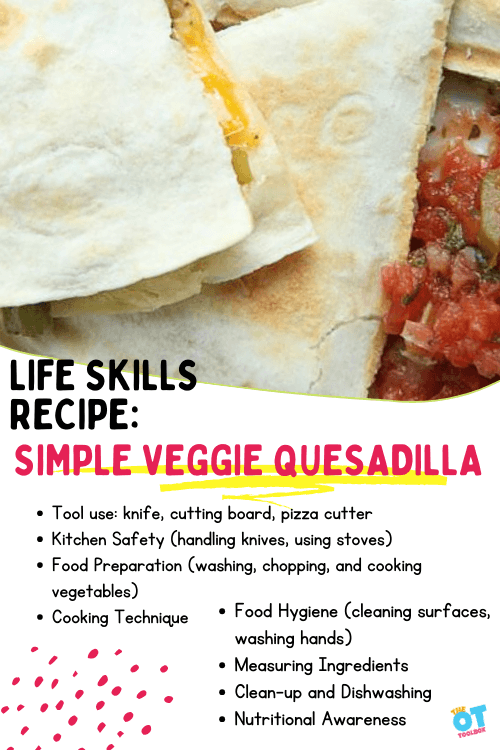
Life skills recipe for OT- an easy vegetable quesadilla recipe

Vegetable Quesadilla Recipe Kids Can Make

This week in our Cooking With Kids A-Z series where we made a recipe for each letter of the alphabet, we are exploring Mushrooms. We made a vegetable quesadilla while learning along the way.

I love to use cooking tasks like the simple veggie quesadilla to support skill development. We’ve previously explained how cooking tasks support fine motor skills. Just like all of the scooping, dicing, and mixing strengthens motor control and coordination, the process of preparing a recipe’s ingredients, using kitchen tools, using safety in the kitchen, washing hands and dishes, and preparing the food are all areas of development for daily life skills.

Cooking is functional and function is cooking! Love that as an OT!

So, when you allow kids to cook and prepare foods, they are gaining so much more than just a snack!

This post is part of our month-long Learning with Free Materials series where we are sharing learning ideas for homeschoolers and school-extension activities using items that are free or mostly free (i.e. CHEAP or you already have in the home), and is part of the 31 Days of Homeschooling Tips as we blog along with other bloggers with learning at home tips and tools.  While the food needed to create this meal is not free, you do need to feed your family.  So, while doing the chore of making dinner, why not learn along the way? Speaking of chores, be sure to check out our resource on age-appropriate chores that kids can help with, because different ages can be involved with various aspects of cooking, even if you think a toddler or preschooler can’t make a quesadilla. They can do different tasks like wash veggies or even help dry and to rinse dishes.

The educational opportunities that go along with cooking are a free lesson in math, process, direction following, listening skills, and safety.

This post contains affiliate links.

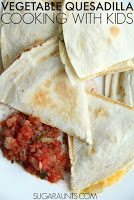
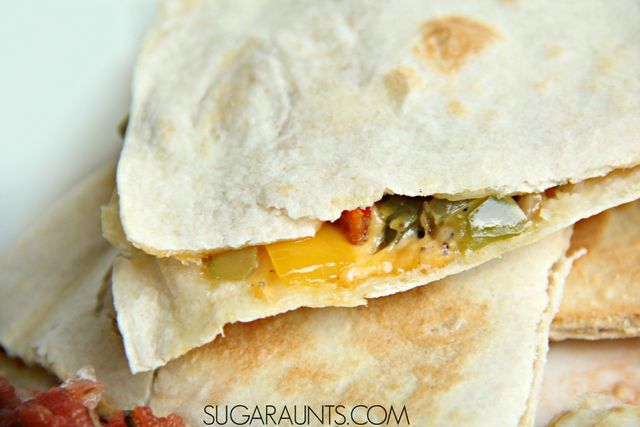
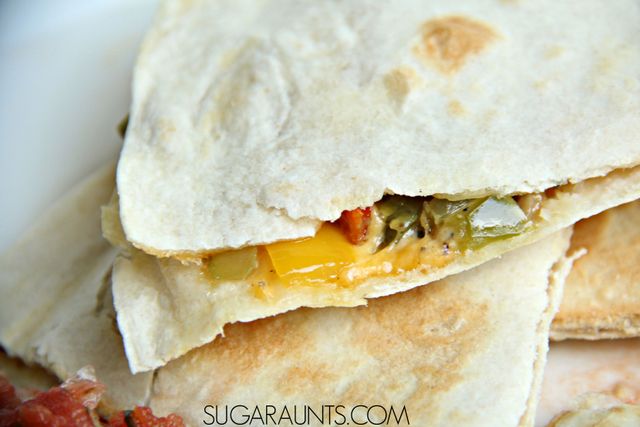
Vegetable Quesadilla Recipe with mushrooms, peppers, onions, and two kinds of cheese, a great dish for kids to eat and make in the kitchen.  Cooking with kids is a great learning opportunity in so many areas!


How can kids learn when cooking?

When cooking with kids, there are so many learning opportunities.  Create a list of steps for the recipe and have your child read as they work.  Children can check off completed steps.  Stress the importance of completing the recipe in order.  Oral and verbal direction following are worked on while kids cook.  Kids can learn about safety while cooking.  Shredding cheese with a grater, using a knife, and cooking at the stove are opportunities for safety lessons. 

Did you know that occupational therapy learn to use cooking tasks as a therapy modality in their education? It’s true! We have entire courses dedicated to activity analysis and often times, cooking tasks play a huge role in those lessons.

We learn to use a simple cooking task to support many areas, from safety and motor skills, to balance, to practically every underlying area that supports function and development of skills.

In fact, executive functioning skills and cooking are pretty much co-existing, so a task like our simple veggie quesadilla is the perfect modality for supporting development. It’s practical and engaging!

When we cook, executive functioning skills are in motion, including cognitive processes such as planning, organization, task initiation, problem-solving, working memory, attention to detail, and self-monitoring. These skills are crucial for daily living and can be developed and enhanced through various activities, including cooking.

We included information on this aspect in each of the steps listed below. We also included information on the life skills components for each step of this recipe. Talk about activity analysis!

Vegetable Quesadilla Recipe with mushrooms, peppers, onions, and two kinds of cheese, a great dish for kids to eat and make in the kitchen.  Cooking with kids is a great learning opportunity in so many areas!

Easy Vegetable Quesadilla Recipe

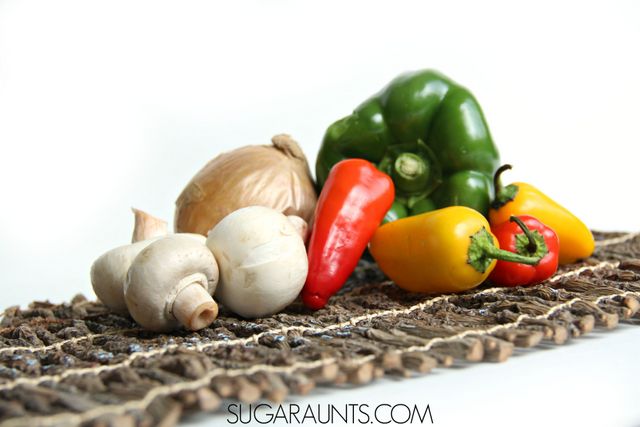
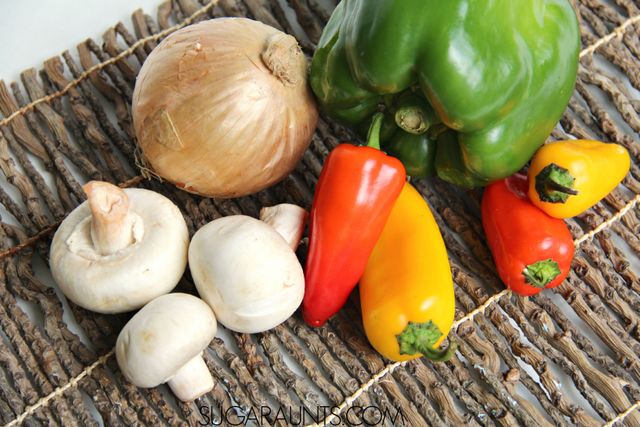
First, you’ll want to gather the ingredients for the vegetable quesadilla recipe. Planning and Organization: Before starting a cooking task, the individual needs to plan by gathering all the necessary ingredients and cooking tools. This step requires thinking ahead and organizing the workspace.

Life Skills Application- You can’t cook without ingredients and you can’t complete daily life tasks without your materials! Just as organizing ingredients and tools is crucial for cooking, being able to organize one’s belongings, workspace, or schedule is essential in daily life. This can translate to managing personal items, setting up a workspace for efficiency, or planning a daily agenda.

Life Skill Activity– Ask your kiddos to conduct a safety audit in the kitchen, identifying potential hazards.

Ingredients:

  • 2 Tortillas
  • 2 Tablespoons olive oil
  • Vegetables (peppers, mushrooms, onions, etc)
  • 1/2 cup shredded Monterrey Jack cheese
  • 1/2 cup shredded Cheddar cheese
  • salsa, ranch dressing, or sour cream to dip 

Directions:

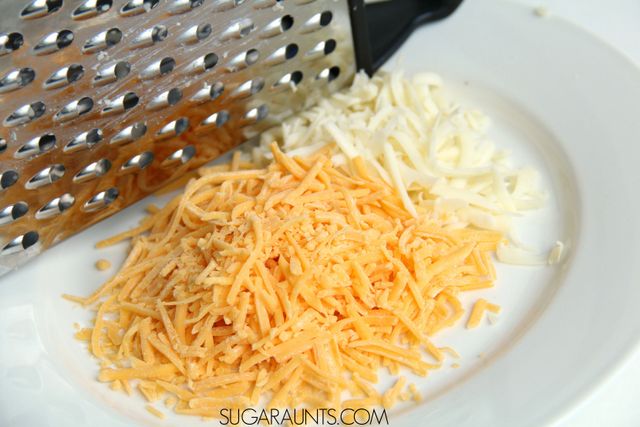
  1. We began our Vegetable Quesadilla recipe by shredding a cup of cheddar and Monterrey Jack cheese. Put these aside on a plate.
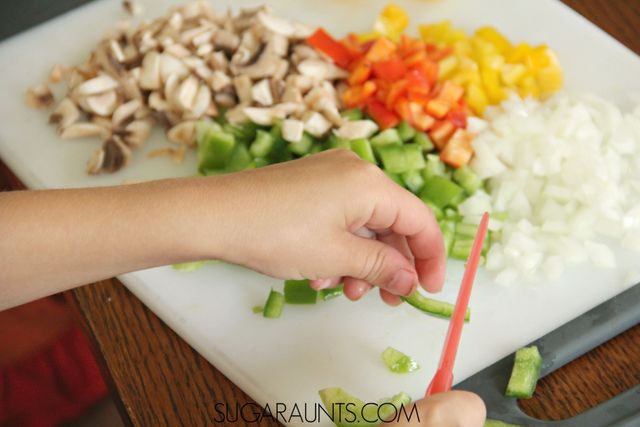
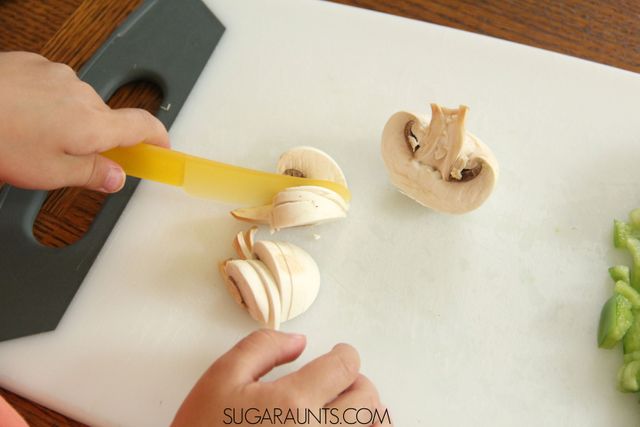
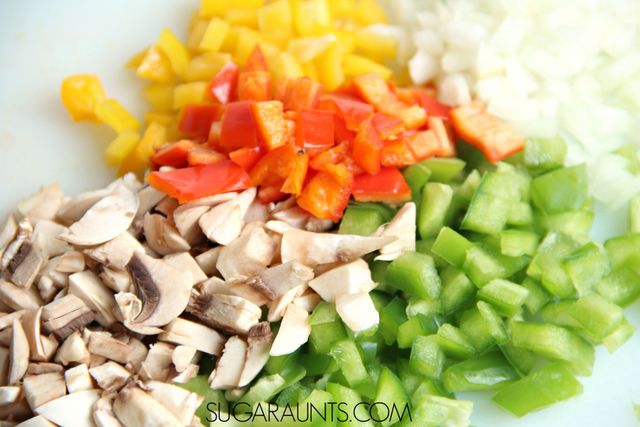
  2. Chop, dice, and slice green peppers, red peppers, yellow peppers, onion, and mushrooms.  The nice thing about a vegetable quesadilla is that you can substitute and add any vegetable.  Add in tomatoes, squash, beans, hot peppers, or eggplant…your produce department or garden is the limit!

Attention to Detail: Paying attention to the size and uniformity of the chopped vegetables can enhance focus and attention to detail.

Life Skill Application- Chopping, dicing, and all of the fun of cooking requires fine motor control and concentration, similar to tasks such as writing, typing, or assembling small parts. The precision needed for chopping can improve one’s ability to perform tasks that require attention to detail, like filling out forms or crafting.

Life Skills Activity- Try chopping and cutting with different kitchen tools.

Vegetable Quesadilla Recipe with mushrooms, peppers, onions, and two kinds of cheese, a great dish for kids to eat and make in the kitchen.  Cooking with kids is a great learning opportunity in so many areas!

3. Next, warm 2 tablespoons olive oil in a pan.  Sauté all of the vegetables except the mushrooms. Task Initiation and Self-Monitoring: This means that adjusting the heat to the correct temperature requires self-monitoring for safety. And, the ability to start a task promptly is needed to stay on task.

Life Skill Application- When you cook, you have to keep an eye on the stove or there can be huge safety issues! Starting and then monitoring the sautéing process supports life skills tasks like beginning a laundry cycle and checking on it periodically. It teaches us to start tasks independently and monitor their progress, adjusting as needed.

4. After 2-3 minutes, add the mushrooms to the pan.  Continue cooking until soft. Teach the kids about safety with the oven at this point!

5. Warm a Quesadilla Maker and place a tortilla on the bottom.  

6. Spread out the cooked vegetables over the tortilla.  Working Memory: Remembering the order of ingredients and where they are placed on the tortilla engages working memory.

Life Skill Application- Placing ingredients on the tortilla in a specific order involves understanding sequences and spatial relationships, and this is a skill we use day in and day out! Think about life skill tasks like organizing a drawer or planning how to pack a suitcase efficiently.

Life Skills Activity- Manage a small budget for a project or a shopping list, making sure to stay within the set limits.

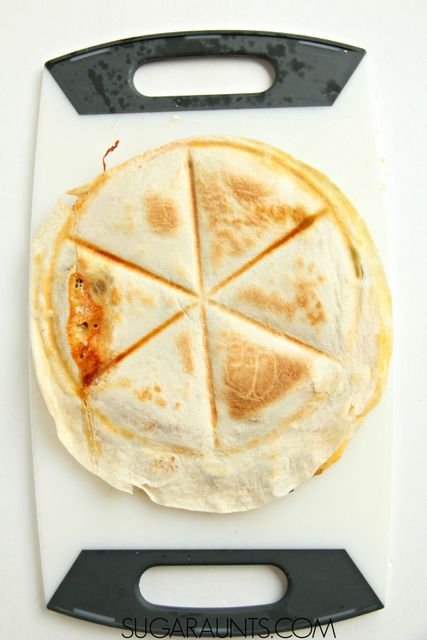
7. Sprinkle cheese all over the vegetables and layer a second tortilla on top of the cheese.  Close the lid to the quesadilla maker and allow it to cook until the light changes, indicating done-ness (about 4-5 minutes).  Problem-Solving: Deciding when to check on the quesadilla in the quesadilla maker uses problem solving. If you are cooking in a pan on the stove top, you’ll need to flip the quesadilla at this point. This ensures it is cooked evenly without burning involves problem-solving and decision-making skills.

Life Skill Application- Cooking each side for the right amount of time requires time management, similar to allocating time for different tasks throughout the day. Adjusting the heat if the quesadilla is cooking too quickly or too slowly involves problem-solving, which is applicable in situations like adjusting plans when an unexpected event changes the day’s schedule.

Vegetable Quesadilla Recipe with mushrooms, peppers, onions, and two kinds of cheese, a great dish for kids to eat and make in the kitchen.  Cooking with kids is a great learning opportunity in so many areas!

8. Slice the quesadillas along the section lines using a pizza wheel.  Goal Achievement: Completing the cooking process and serving the quesadilla provides a tangible result, reinforcing the concept of following through to achieve a goal.

Life Skill Application- Cutting and serving food is a huge life skill! This is one that you will use several times a day.

Life Skills Activity- Prepare the food and ask the kiddos to focus on the layout and organization of the content to make it appealing.

Vegetable Quesadilla Recipe with mushrooms, peppers, onions, and two kinds of cheese, a great dish for kids to eat and make in the kitchen.  Cooking with kids is a great learning opportunity in so many areas!

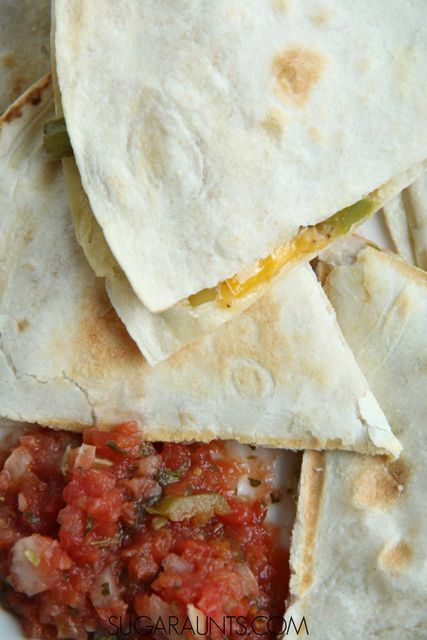
Serve with salsa, sour cream, or ranch to dip.

Vegetable Quesadilla Recipe with mushrooms, peppers, onions, and two kinds of cheese, a great dish for kids to eat and make in the kitchen.  Cooking with kids is a great learning opportunity in so many areas!

With a vegetable quesadilla, children get the opportunity to try new vegetables that might be new to them.  The hand-held finished dish is a fun one to eat.  

Dipping the quesadilla slices into ranch, salsa, or sour cream may encourage your child to try this recipe and new tastes.  Have fun experimenting with vegetable combinations!


Here are more recipes that kids can make to support skill development:

Colleen Beck, OTR/L has been an occupational therapist since 2000, working in school-based, hand therapy, outpatient peds, EI, and SNF. Colleen created The OT Toolbox to inspire therapists, teachers, and parents with easy and fun tools to help children thrive. Read her story about going from an OT making $3/hour (after paying for kids’ childcare) to a full-time OT resource creator for millions of readers. Want to collaborate? Send an email to contact@theottoolbox.com.
Kinesthetic Learning Activities for Outside

This blog post about kinesthetic learning is an older blog post from March 2017 that we updated in March 2024 to add more information on what kinesthetic learning means and what it looks like for kids. Check out our suggestions and strategies below.

The thing about kinesthetic learning is that it’s happening all day long. We know the power of play and how play drives learning in children. After all, we OT practitioners preach about play being the primary “work” in children!

We’ll explain a little more about kinesthetic learning below. The thing is that there is incredible opportunities for movement and learning through movement when exploring in the outdoors, so this older blog post focused a lot on outdoor experiences as a medium for kinesthetic opportunities.

kinesthetic learning activities

What is Kinesthetic Learning?

Kinesthetic learning refers to a style of learning where individuals learn through physical and movement activities. This sounds a lot like tactile learning, right? It’s actually a lot like a term you have probably heard in recent years: multisensory learning.

Kinesthetic learners prefer to engage in the learning process by moving, doing, and touching. This allows them to use their body to explore and the sense of touch to explore and learn about the world around them. For those that have a strong sensory touch, this is great! This approach is grounded in the belief that students learn more effectively when they are physically active or involved in the learning process.

The thing about kinesthetic learning is that there is the added benefit of proprioceptive input and heavy work through the hands as the child learns and explores.

Tactile learners and kinesthetic learners are a lot alike.  

Kinesthetic learners need to move their bodies, manipulate materials, and really interact with learning materials.  These children tend to fidget, wiggle, slouch, or get up out of their seats when in the classroom setting.  This site has a lot of great information on kinesthetic learning. 

Kinesthetic Learning Activities

Kinesthetic learning activities are powerful for some kids. It can mean the difference between paying attention and grasping a concept and missing it all together. Some of my favorite kinesthetic learning ideas include those that involve gross motor work and the senses.

Some kinesthetic learning ideas include:

  • Clipping clothes pins marked with letters onto the edge of paper and then writing the letters. Here are more clothes pin activities.
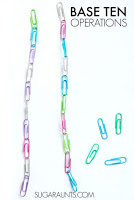
  • Counting paperclips in groups of ten
  • Sorting colored beads into different containers.
  • Creating alphabet shapes with playdough.
  • Using a hopscotch grid to learn numbers or math operations.
  • Themed sensory bins
  • Building geometric shapes with toothpicks and marshmallows.
  • Tracing letters or numbers in a sand tray. Here’s what you need to know about writing trays.
  • Assembling puzzles that correlate with lesson themes.
  • Conducting a scavenger hunt to find objects related to the lesson.
  • Using a ball to pass around for answering questions or storytelling.
  • Walking along a tape line to improve balance while discussing a topic.
  • Playing charades to act out vocabulary words or historical figures.
  • Matching socks to teach pairs, colors, or patterns.
  • Using body movements to represent mathematical operations (e.g., jumping for addition).
  • Organizing classroom objects by size, color, or type.

More ideas for kinesthetic learning include:

Physical Manipulatives: Using physical objects to teach concepts can be particularly effective in subjects like math and science. For example, using block activities are so much fun for some kids and it’s great to teach mathematical operations.

Interactive Notebooks: My daughter has an ELA notebook full of cut outs and interactive activities. They cut out worksheets and glue the pieces into a regular lined notebook. The act of cutting, pasting, drawing, and writing helps all of the vocab and spelling words to “stick”. It’s funny because she can flip through the notebook and find a random vocabulary word because she remembers the cut outs that she did and where they are pasted into the book. It’s fascinating to watch!

Movement-Based Games: We LOVE board games! There are so many board games that can be used to learn concepts and they are so much fun for learning through play. Games that require movement can be used to teach various concepts.

Building and Construction: Tasks that involve building or constructing models can enhance understanding, especially in subjects like engineering, physics, and geometry.

Outdoor Learning: See below for more info. The thing about taking the learning outside the classroom is that kids gain so many vestibular and proprioceptive input through learning . This could include nature walks, geological expeditions, or physical education activities.

Dance and Music: Incorporating dance and music to explain concepts, especially in younger classrooms, can be an effective kinesthetic learning strategy. For example, creating a dance routine to explain the water cycle.

I recently shared a post on tactile learning with a sight word sensory tray. I talked a little bit about kinesthetic learning and how some kids just seek tactile input in their learning.  

Try these kinesthetic learning activities for outside to help kids who need to move while learning.


Kinesthetic Learning Activities for Outside

Taking the learning outside can make a big difference.  As the weather warms up, it can be hard to keep the attention in the classroom.  The birds are chirping, trees are blossoming, and the muddy lawns are calling!  So, when kids want to be nothing more than outside playing, how do you keep them focused and learning?  

Try taking the learning outside!  These kinesthetic learning activities are perfect for the outside play this time of year and all year long.  Add some movement and outdoor play and facts are sure to stick when kids are out of the classroom and outdoors!
Try taking the learning outside to really get some space and movement into the learning experiences.  You could try these activities when practicing math facts, spelling words, vocabulary, memorization, or many other areas.  

Outdoor Learning Activities that Use Kinesthetic Movement

There are several kinesthetic activities that allow for learning while outdoors.

  • Balance Beam Adventure-  Use a jump rope or a board to create a balance beam maze on a driveway or sidewalk.  With sidewalk chalk, draw fish in a pond.  Kids can walk on the balance beam without falling into the “water”.  When they are on the balance beam, ask kids to hop while stating facts or other learning tasks.  Try a bean bag toss game when on the balance beam.  Kids can toss a bean bag into a target while spelling words. Here are more outdoor balance beam activities.
  • No Peeking Simon Says- Play Simon Says outside in the backyard.  This version requires kids to keep their eyes closed when they perform the actions.  As they play, ask them questions.  You might ask them to touch their nose for “true” facts or to touch their shoulders for “false” facts.  Get creative with movement and learning with this one! Simon Says commands can incorporate movement and learning for practically any subject.
  • Backyard maze- Create a maze in the backyard by placing obstacles around the lawn.  Kids can look at the simple maze and then walk with their eyes closed as another person “guides” them with verbal directions around the obstacles.  Set up stations around the obstacle course where they need to answer questions.  This can be as simple as a printed out sheet of questions.  They just may recall the answers later by thinking about where they were in the obstacle course when they learned about those facts!

       This pre-reading obstacle course is perfect for kinesthetic learners. 

  • Backyard Yoga- Try yoga in the outdoors with kid-friendly yoga games like found in this book (Amazon affiliate link)  Try having your child close their eyes during yoga moves to incorporate position of body in space.  Add deep breath spelling or math facts while breathing in and out for several counts.
  • Hopscotch Math-  Practice math facts like addition or multiplication with a hopscotch game on the driveway.
  • Sidewalk Chalk Learning- Kids can use sidewalk chalk in so many ways!  Write out spelling words.  Do math homework on the driveway.  Write out vocabulary words.  Use patio pads or bricks to work on perimeter, area, or geometry.  What would you add?
  • Take a Walk-  Go on a stroll while reviewing information.  What a great way to learn in nature!

Try some of these outdoor lawn games with the kids. 

How can you add learning and movement to the backyard to better serve your kinesthetic learners?

outside activities for kinesthetic learning for kids

How to incorporate sensory and motor play into playing outside

Sensory diet activities can be specific to sensory system like these vestibular sensory diet activities. Sensory activities can be prescribed according to need along with environment in order to maximize sensory input within a child’s day such as within the school day. Using authentic sensory input within the child’s environment plays into the whole child that we must understand when focusing on any goal toward improved functional independence. 

Many sensory diet activities can naturally be found outdoors. In fact, outdoor sensory diet activities are a fun way to encourage sensory input in a child’s environment and without fancy therapy equipment or tools. 


It’s a fact that kids are spending less time playing outdoors. From after-school schedules to two working parents, to unsafe conditions, to increased digital screen time, to less outdoor recess time…kids just get less natural play in the outdoors. Some therapists have connected the dots between less outdoor play and increased sensory struggles and attention difficulties in learning. 

Knowing this, it can be powerful to have a list of outdoor sensory diet activities that can be recommended as therapy home programing and family activities that meet underlying needs.

That’s where the Outdoor Sensory Diet Cards and Sensory Challenge Cards come into play.

They are a printable resource that encourages sensory diet strategies in the outdoors. In the printable packet, there are 90 outdoor sensory diet activities, 60 outdoor recess sensory diet activities, 30 blank sensory diet cards, and 6 sensory challenge cards. They can be used based on preference and interest of the child, encouraging motivation and carryover, all while providing much-needed sensory input.

Here’s a little more information about the Outdoor Sensory Diet Cards

  • 90 outdoor sensory diet activities
  • 60 outdoor recess sensory diet activities
  • 30 blank sensory diet cards, and 6 sensory challenge cards
  • They can be used based on preference and interest of the child, encouraging motivation and carryover, all while providing much-needed sensory input. 
  • Research tells us that outdoor play improves attention and provides an ideal environment for a calm and alert state, perfect for integration of sensory input.
  • Outdoor play provides input from all the senses, allows for movement in all planes, and provides a variety of strengthening components including eccentric, concentric, and isometric muscle contractions. 
  • Great tool for parents, teachers, AND therapists!

Be sure to grab the Outdoor Sensory Diet Cards and use them with a child (or adult) with sensory processing needs!

Colleen Beck, OTR/L has been an occupational therapist since 2000, working in school-based, hand therapy, outpatient peds, EI, and SNF. Colleen created The OT Toolbox to inspire therapists, teachers, and parents with easy and fun tools to help children thrive. Read her story about going from an OT making $3/hour (after paying for kids’ childcare) to a full-time OT resource creator for millions of readers. Want to collaborate? Send an email to contact@theottoolbox.com.

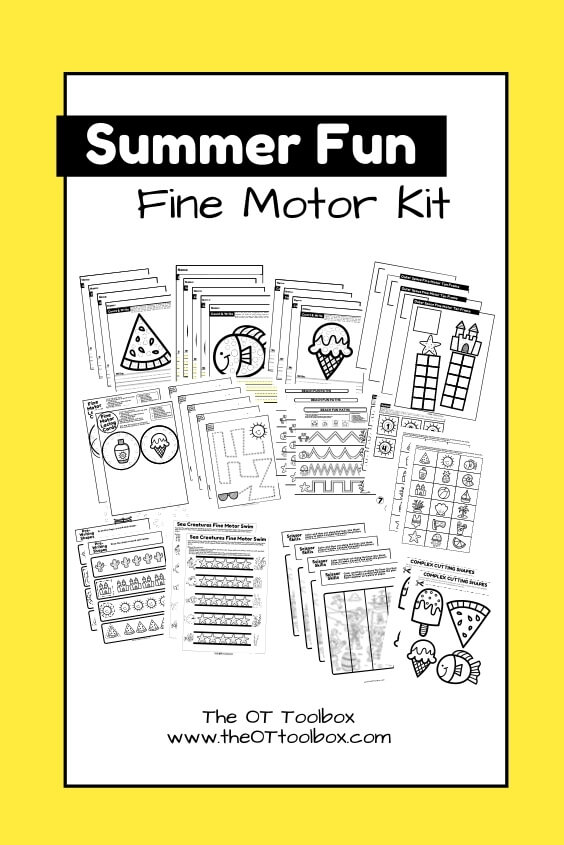
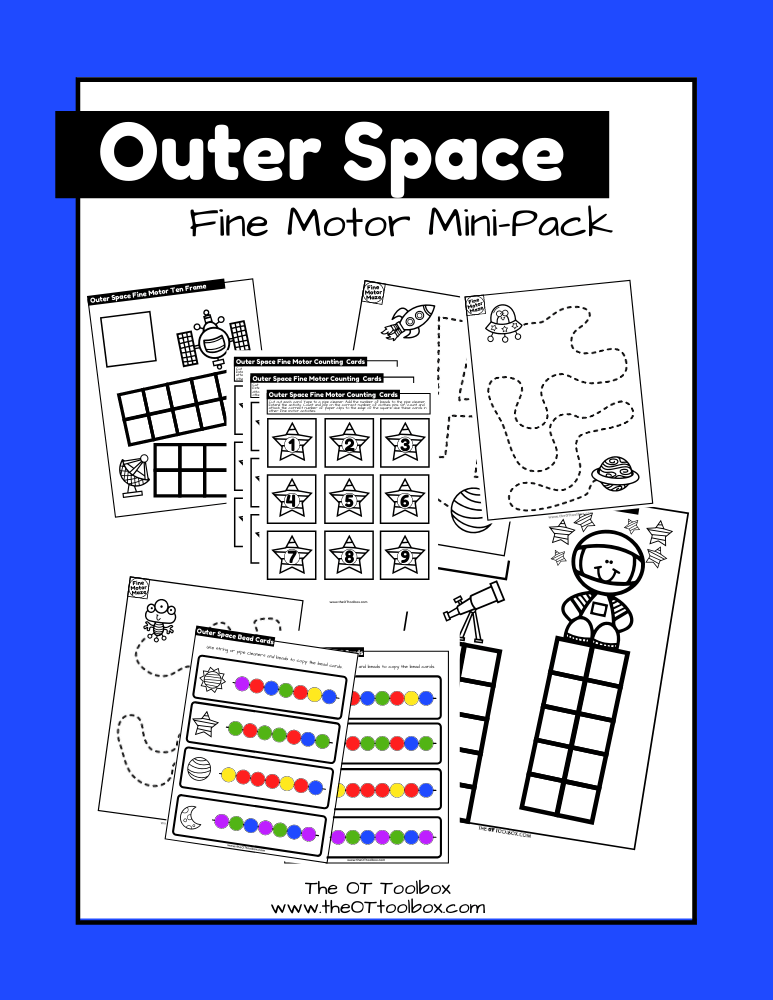
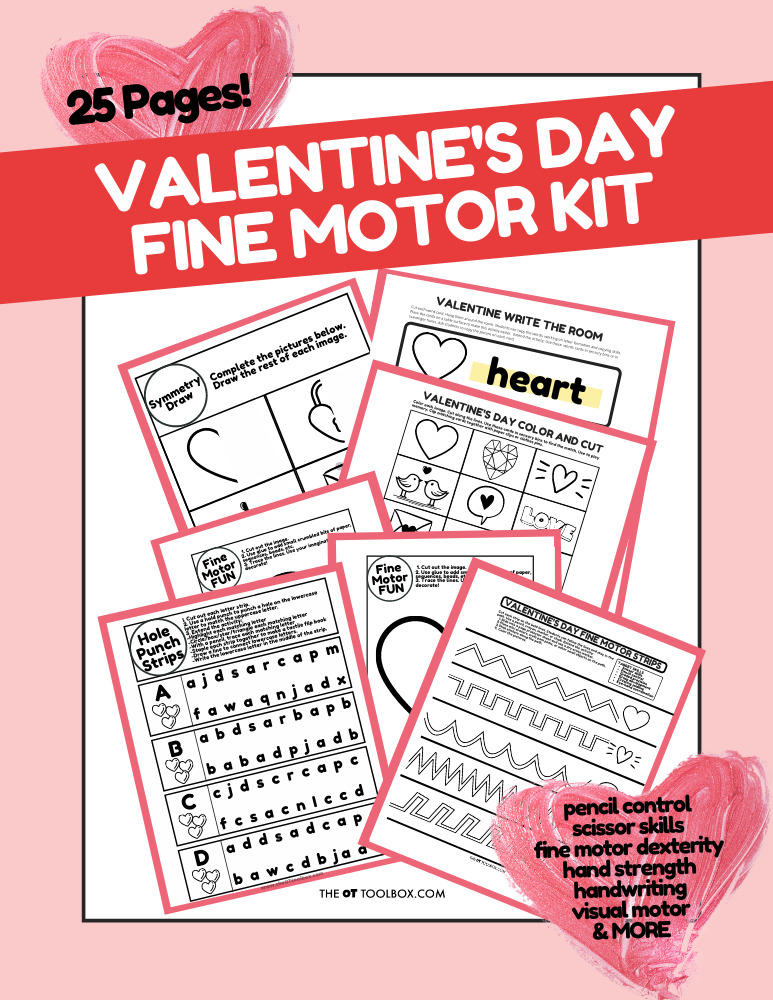
We also love the learning opportunities in our Fine Motor Kits!

Working on fine motor skills, visual perception, visual motor skills, sensory tolerance, handwriting, or scissor skills? Our Fine Motor Kits cover all of these areas and more.

Check out the seasonal Fine Motor Kits that kids love:

Or, grab one of our themed Fine Motor Kits to target skills with fun themes:

Want access to all of these kits…and more being added each month? Join The OT Toolbox Member’s Club!

Occupational Therapy in Schools

school based occupational therapy

Occupational therapy in schools looks a lot different than it has in the past. With social distancing requirements, sanitizing needs, and changes to school schedules, therapists are looking for ways to meet the needs of their students. This year, school-based OT looks different than any other year, and occupational therapy activities will reflect those changes.

Here, you will find strategies that school-based OT practitioners can use in the classroom as part of push-in services, in small groups, or in an individual, pull-out model.

What is school based Occupational Therapy?

One thing that I love about the profession of occupational therapy is that there are many environments and areas to cover. It’s all about the individual and the functional performance areas can be drastically different simply based on the environment.

In school based OT, occupational therapy providers support students in their education. We might support fine motor, visual motor visual perceptual, sensory motor, executive functioning skills, cognitive skills, physical skills or other area which impacts the student’s ability to learn.

School-based occupational therapy practitioners are either occupational therapists (OTs) or occupational therapy assistants (OTAs) who use meaningful activities
(occupations) to help children participate in the tasks they need to do in order to learn and participate in the school day. School based occupational therapy practitioners addresses the physical, cognitive, psychosocial and sensory components of performance which impacts learning.

This might look like supporting needs in academics, play at the playground or at recess, social participation, self-care skills (ADLs or Activities of Daily Living), and transition skills.

From targeting skills like executive functioning in schools to developing fine motor skills through play (ideal for the preschool occupational therapy interventions!), school based OT professionals do it all!

While OT in the medical model can cover similar areas in some ways (underlying developmental areas like fine motor skills and functional skills like self care or handwriting), there are big differences too.

school based occupational therapy

What does a School Based OT do?

We have a really good resource on the occupational therapy scope of practice for school based OT.

A school based OT can work on many different areas in the school environment. It will all depend areas the student struggles with in their education. Basically, if a student’s developmental challenges impact their ability to participate in their education, then OT may be involved to support these areas of need.

It all starts with an OT evaluation. Here is information on how to request an OT evaluation.

Depending on the needs of the student, a school based OT can address:

  • Fine motor skills (impacting areas like holding a pencil, cutting with scissors, using school materials, managing clothing fasteners, manipulating materials like books and glue sticks, etc.)
  • Gross motor skills (impacting areas like moving throughout the school, using playground equipment, walking in the hallway, etc.)
  • Visual-motor integration
  • Sensory processing- For example, here are ideas for using playground equipment to support sensory needs.
  • Sensory Diet creation
  • Coming up with sensory strategies in the classroom to meet needs
  • Self-regulation
  • Handwriting
  • Self-care and daily living skills- for toileting, clothing fasteners, shoe tying, managing coats or jackets for leaving the school building, washing hands, etc.
  • Feeding needs (in some cases)
  • Social skills
  • Play and leisure skills
  • Executive functioning- including organizing materials, attention and focus, problem solving, planning and prioritizing projects, etc.
  • Assistive technology use
  • Environmental modifications- for example, supporting needs like getting on and off the toilet for physically involved students
  • Mobility considerations- accessing areas of the school, bus, auditorium, cafeteria, hallways, etc.
  • Sensory needs in the cafeteria
  • Transition skills
  • Behavioral strategies
  • Motor planning and coordination
  • School participation and access
  • Other areas

Then, knowing that these are all of the areas that a school based OT provider can address in the school environment, there are different roles the OT plays as well.

Roles of a School Based OT

The school based OT has many roles in the school system. AOTA has a resource on this which describes roles like: educator and trainer, resource consultant, advocate, leader, and researcher. These roles typically happen all day long as a school based OT!

When it comes to actually intervening with students, a school based OT can support students in various models:

  • Direct OT Interventions
  • Consultation
  • Professional Development and Training

The typical school based OT will do all of these roles in a single day! Let’s cover each of these roles:

Direct OT Interventions

Direct treatment is done following the OT screen and evaluation, and completion of OT goals which are added to the student’s IEP. There will be a process which is followed, depending on the state requirements, which may include RTI, MTSS, etc.

Direct OT interventions can look like one on one therapy sessions, group OT sessions, or push-in therapy interventions. All of these models provide services to support at-risk students. The main thing to remember is that we always use the most appropriate intervention model to improve the academic outcomes and school conditions the individual student’s learning.

School Based OT Consultation

Consult refers to periodic “check ins” with educators that are involved with the student. The school based OT professional providing consult services will address specific needs and make recommendations that are carried out in the classroom. The consult process involves checking in with the teacher or teacher assistant on how the recommendations are being used and how it’s going.

For example, I’ve moved students from direct intervention into a consult model when the student has progressed to a certain point. I’ve used the consult model with students in middle school OT or high school OT who have had several years of direct interventions.

Another example of consultation is supporting teachers by setting up a calm down corner in the classroom. The teachers that I’ve worked with in this way have been very appreciative.

Professional development and training

This can be a tricky area of the school based OT provider’s job requirements, because if the OT provider is a contracted OT, time spent training and educating educators or other members of the staff may not be paid time. However, this time can roll into the consult model if specific and individualized training and education is provided. For example, in one situation, I ran a training to a group of educators and special educators on using the ALERT program with one student. The training session was individualized for the particular student and we went over recommendations for this one student that would be implemented into the classroom. We scheduled this time as a meeting and it was billed to the student because we were setting up the program for this one individual.

Another area of professional training is to support the entire school by setting up a sensory room. The school based OT professional is a valuable asset for the school in this regard.

Some admin will pay for this time in the way of a staff development training session. OT providers who are employed by the school district however, may have these requirements built into their contract. It’s just one more component of the school-based OT’s job description!

Group Occupational Therapy

Many OTs need to move from a push-in model to pulling each one of their students out of the classroom for therapy intervention. Other therapists will focus on pushing into the classroom for a small group activity with a couple of students who are in the same classroom.

Regardless of the model, occupational therapy activities will need to have social distancing practice in place and thoughtful use of supplies. Looking for group occupational therapy activities that can be completed with a small group?

How to address social distancing in small groups in school occupational therapy this year.

Some recommendations for group OT can include:

Arranging the occupational therapy room so that students are well-spaced out. Using painters tape to create marked stations for each student can be used for social distancing, but also to help kids work on personal space, body awareness, and spatial awareness. Students can carry this skills over to functional tasks such as standing in lines in the hallway or getting on/off the school bus, or in the community.

Sensory coping strategies in the classroom can be adjusted to address social distancing requirements while meeting the child’s needs. Think about Simon Says, wall push-ups, I Spy games, etc. These therapy Simon Says commands can target many different skills through play.

Brain breaks can be used on an individual basis, in small groups, or in the whole classroom.

Mindfulness activities can be implemented in therapy sessions or in small groups.

Pushing into the classroom to work with a small group might be something that some therapists have to do per school recommendations and wishes. When pushing in to the classroom, precautions can be taken to try a group activity without close interaction like “I Spy” or “What’s missing?” visual perception games. Add handwriting to these group activities to work on specific skills, too.

There are points for both push-in service and pull out model of school occupational therapy during a pandemic. For example, pushing into the classroom or using a consultation model can mean less equipment that needs to be sanitized between sessions.

School Occupational Therapy Tips

These suggestions can be used by school-based OT professionals in pull-out sessions or in push-in therapy in the classroom.

Plan ahead. Use this interactive school-based OT planner to plan out activities based on themes and come up with a plan for each week. This can help with accessing materials and using what student’s have in their desks to work on certain skills. (See below for how to use what the student has in their desk.)

Organize the OT space so that items can not be accessed by students. Keeping items out of reach of students will allow for less sanitation time between sessions.

Pull out items that will only be used during that session and place each used item into a designated bin or “sanitize zone”. These items can be sanitized after each session and allowed to dry after the use of sanitizer.

Washing hands before/after each session. When children come into the occupational therapy space as a small group, or when a small group is seen in push-in services, therapists can have each child wash and dry their hands or use hand sanitizer both before and after each session. Make it part of functional goals, if it is something that can be used to meet the goals of the child. Hand-washing offers opportunities to work on eye-hand coordination, fine motor skills, tactile sensory experience, attention, organization, motor planning, and more…all part of a functional activity of daily living. Add in the clean-up portion (throwing away paper towels) and you’ve got aspects of IADL work as well.

Allow time for washing hands/sanitizing. we know that as therapists, we have a FULL schedule. Some OT professionals juggle 60+ students and many different school districts. But, allowing time for sanitizing and hygiene is a must. It’s not going to be easy, but like everything else, we are going to be forced to slow down and take that necessary time. Try to add that cleaning/sanitizing time right into sessions. The student can do their last activity while the therapist sanitizes materials.

Incorporate outdoor recess as a therapy session. So many goal areas can be addressed through play and social interaction in outdoor recess. While this “down time” might look different than it has in years past, games and small group activities can be incorporated into occupational therapy sessions, in a “push-in” model that occurs outdoors. Here are sensory diet activities for outdoor recess.

Outdoor occupational therapy sessions. Sensory processing activities on the playground is an excellent way to work on sensory needs and regulation. What’s more, is that the outdoors offer the perfect environment to work on so many OT goal areas. Take students to the playground for sensory and motor work. Use a blacktop surface for fine motor and core strength activities. Use a shading lawn area to work on various coping strategies. Here are sensory diet activities for the playground.

Use teletherapy slide decks- Even though OT professionals may be in the schools (or virtual depending on the district and state), there are many free teletherapy resources like OT slide decks available that can be used in person, too. Try these teletherapy activities, specifically this alphabet slide deck that teaches letters with a handwriting, letter formation, and gross motor brain break activity.

These occupational therapy teletherapy activities can be helpful for remote learning, hybrid models, or even in the classroom.

School based occupational therapy will have trouble using shared materials and equipment. OTs can create inexpensive school based OT kits for students.

School-Based OT Kits

Using an inexpensive kit for each student can be an easy way to target a variety of goal areas with a few materials. Here, you will find suggestions on how to create a kit for each student. This is great for the school based OT who travels from building to building throughout their day.

Small occupational therapy kits can be created at a low cost. Here are some OT kits that we’ve covered:

A small kit for each student may be necessary. I tried to come up with a list of LOW cost materials and ones that can be spread across a caseload. For example, a $1 deck of cards can be split up among man students as they each get 5-6 cards. A pack of pipe cleaners or a pack of straws can be distributed among many students, especially if the pipe cleaners are cut into smaller sizes.

These kits can be organized into a plastic zip-lock baggie for each student. Write the child’s name on the bag and make sanitizing the outside of the bag part of the child’s session. Kids can participate in this aspect, too…an essential self-care ADL of hygiene!

School Based OT Materials

OTs working in schools cover a lot of different areas. But, the skilled therapy provider knows how to use a limited supply materials to support a variety of needs.

Use the items students have in their desks. This year, they will be using more individual items that come from home and are separated from other students, so use those materials. Some items and occupational therapy activities include:

Markers- Use regular markers in occupational therapy activities like the ones we have listed.

Scissors- Students will likely have their own set of scissors in their desk. Work through this scissor crash course to work on precision and dexterity.

Colored Pencils- If students have colored pencils, use them to work on handwriting, visual motor skills, and fine motor work. Here are colored pencil activities.

Pencil box- If students have a pencil box to hold their materials, use that pencil box in OT activities!

Crayons- Crayons are always on the back-to-school list. There is a reason why crayons are so effective in building skills…Use those power tools in school occupational therapy sessions. Here is just one way to work on distal finger control with crayons. And, kids will love this 3 crayon challenge!

Ruler- If kids have a personal ruler in their desk, use that to work on bilateral coordination, eye-hand coordination, fine motor skills, pencil control. Here is one way to use a ruler to help with cursive writing.

Small pencil sharpener- This is a school supply item that is often times on the back to school supply list. But this year, it will be even more important for students to have their own pencil sharpener. Why not use it to work on arch strength, bilateral coordination, pinch and hand grasp, and endurance? Using a small pencil is effective in tripod grasp and hand strength, but kids can sharpen those pencils and work on skills, too.

Books- Books and workbooks can be used for proprioceptive input and heavy work.

Folders and papers- Kids can work on organization and executive functioning skills with the materials they have in their desks. Folders, papers, and all of the “stuff” can get overwhelming fast, especially for the child struggling with impulse control, focus, attention, and other executive functioning skills. Work on those areas with strategies.

Use these school occupational therapy suggestions to address social distancing, small groups, and changes to school OT this year.

School Occupational Therapy Activities

In other cases, it might look like recommendations for a routine or wellness. This wellness wheel can be helpful in addressing the balance of kids at home and at school.

As therapists, maybe we can offer movement-based activities or brain breaks that can be done as a whole group. Perhaps a consult with a teacher on one student leads to a deep breathing session for the whole class.

Educating parents, teachers, administrators, and even the students themselves on the connection between movement, coping tools, behavior, and cognitive processes will become more necessary.

While many students receiving OT in schools have handwriting goals, OT’s are definitely not handwriting teachers. It is a very common functional task that needs support. Here are handwriting activities to try.

Try some of these mindfulness and coping tools that can be used in school occupational therapy sessions or consultation:

Incorporate recess activities into a sensory diet to meet self regulation needs.

Brain breaks can be used on an individual basis, in small groups, or in the whole classroom.

Mindfulness activities can be implemented in therapy sessions or in small groups.

This easy coping strategy requires no materials or items, making it sanitizing-friendly.

These anxiety and sensory coping strategies can be helpful with re-acclimation to the classroom and learning.

Working on social emotional skills can be helpful in identifying emotions as a result of reentering the classroom…and help kids come up with coping tools.

Here is a free Space Theme Therapy Slide Deck.

Here is a free Strait Line Letters Slide Deck.

Here is a free “Scribble theme” Handwriting Slide Deck.

Teach Letters with a free interactive Letter Formation Slide Deck.

Try this free interactive letter writing/brain break slide deck.

Final note on school based OT

Remember to take time for self-care as a therapist and address the stress and burnout with coping strategies and balance. Rest. Use these tips for occupational therapists to stay organized yourself. You’ve got this!

Colleen Beck, OTR/L has been an occupational therapist since 2000, working in school-based, hand therapy, outpatient peds, EI, and SNF. Colleen created The OT Toolbox to inspire therapists, teachers, and parents with easy and fun tools to help children thrive. Read her story about going from an OT making $3/hour (after paying for kids’ childcare) to a full-time OT resource creator for millions of readers. Want to collaborate? Send an email to contact@theottoolbox.com.

Pipe Cleaner Bunny and Carrots

pipe cleaner bunny craft

These pipe cleaner bunny crafts are a fun Easter craft that supports fine motor skills. We LOVED making these and then using them over and over again!

With Easter being right around the corner, these pipe cleaner bunny crafts and pipe cleaner carrots are a great way to add fine motor skills to your Easter occupational therapy line up. These bunny cuties were easy to make and have been seen a lot in our play time recently.  This isn’t the first time that we’ve made Easter Bunny fine motor activity.

pipe cleaner bunny craft

Pipe Cleaner Bunny and Pipe Cleaner Carrots

So WHAT is a manipulative?? (Even spell check doesn’t know, so maybe we should explain…) These cute little bunny manipulatives can be used for so many fun activities: counting, patterning, sorting, arranging…so much learning can happen with little objects that kids can manipulate. 

We use these in Easter sensory bins and to develop a few fine motor skills, too!

You’ll also want to check out our other Bunny Activities:

Pipe Cleaner Bunny

So we love making fun kids crafts that double as a therapy tool. When you bend and fold pipe cleaners into shapes, you’re actually working on several skills:

I’ve caught baby Girl playing with these bunnies and carrots as she made them talk to each other.  What a great way to work on language and conversation!  Throw these bunnies and carrots into a sensory bin and you’ve got a sensory activity where the kids can explore textures and senses. 

There are SO many ways these manipulatives can be used in learning and play. 

How to make a Bunny with Pipe Cleaners

Here’s what we did to make the pipe cleaner bunnies…

First, you’ll want to gather your materials:

  • White pipe cleaners
  • Pink pony bead


Easter bunny and carrot craft for kids
 
 
Check out the directions to make the pipe cleaner bunny craft under each picture. We wanted to add a step-by-step visual.

Fold the pipe cleaner to make Bunny ears.
 
To start, I created a handful of Easter Bunnies using off-white pipe cleaners.  It’s not hard to do…
 
1. Bend the pipe cleaner to make two bunny ears.
 
Ben a pipe cleaner to form an Easter Bunny
 
2. Twist the pipe cleaner around and through the first “ear”, then through the second “ear”.  The second ear is not a complete loop, so the tail end of the pipe cleaner doesn’t really go through the ear. 
You’ll pinch the pipe cleaner so it stays put.  See the next picture.
 
How to make an Easter Bunny using a pipe cleaner
 
3. Pinch the “ears” in place and pull the long end strait down. 
4. Thread a pink bead onto the pipe cleaner for the bunny’s nose.
 
Use these pipe cleaner Easter bunnies and carrots for pretend play and counting activities
 
5. Wrap the long end of the pipe cleaner straight up and around your thumb. 
6. Repeat twice, making one loop to the right of the bead and one loop to the left of the bead. 
7. Pinch it so it stays in place.  You can kind of squash the bunny down to make it stay put.
 
counting, sorting, patterns with pipe cleaner Easter bunny and carrot manipulatives.
 

Pipe Cleaner Carrot

 
The pipe cleaner carrots are just a piece of an orange pipe cleaner bent into a carrot shape and a small piece of green pipe cleaner  twisted around to make a stem.  Super easy to make.
 
Make a handful of each and you’re ready for counting, patterns, sorting, adding, and subtracting…
 
How many ways can you think of to learn and play with these guys?
 
Pipe cleaner Easter Bunny and carrots for pretend play
 
Our bunnies have been found all over the house this last week.  The carrots made their way into the Little People house and eaten by the Lalaloopsy friends.  The bunny manipulatives have even been caught hanging out with a few Ninja Turtles! 
 
Let us know if you make these bunny and carrot manipulatives.  We would love to see how you’re learning and playing!
 

For more Easter fine motor activities, check out the Spring Fine Motor Kit.

Spring Fine Motor Kit

Score Fine Motor Tools and resources and help kids build the skills they need to thrive!

Developing hand strength, dexterity, dexterity, precision skills, and eye-hand coordination skills that kids need for holding and writing with a pencil, coloring, and manipulating small objects in every day task doesn’t need to be difficult. The Spring Fine Motor Kit includes 100 pages of fine motor activities, worksheets, crafts, and more:

Spring fine motor kit set of printable fine motor skills worksheets for kids.
  • Lacing cards
  • Sensory bin cards
  • Hole punch activities
  • Pencil control worksheets
  • Play dough mats
  • Write the Room cards
  • Modified paper
  • Sticker activities
  • MUCH MORE

Click here to add this resource set to your therapy toolbox.

Spring Fine Motor Kit
Spring Fine Motor Kit: TONS of resources and tools to build stronger hands.

Grab your copy of the Spring Fine Motor Kit and build coordination, strength, and endurance in fun and creative activities. Click here to add this resource set to your therapy toolbox.

Colleen Beck, OTR/L has been an occupational therapist since 2000, working in school-based, hand therapy, outpatient peds, EI, and SNF. Colleen created The OT Toolbox to inspire therapists, teachers, and parents with easy and fun tools to help children thrive. Read her story about going from an OT making $3/hour (after paying for kids’ childcare) to a full-time OT resource creator for millions of readers. Want to collaborate? Send an email to contact@theottoolbox.com.
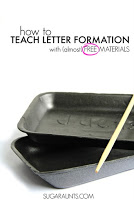
Oral Motor Exercises with a Cotton Ball Bunny

bunny craft

Working on oral motor exercises as a sensory processing strategy for self-regulation, or as an oral motor tool to address physical needs? Ok, so we made a cute little cotton ball bunny to use in an Easter sensory activity as a small world play area to work on fine motor skills with an Easter theme. However, using them in imagination play, but, there are so many oral motor benefits to using these little cotton ball bunnies, too.
It was so much fun with that little cotton ball bunny family that we turned it into a big old collection of bunnies! That’s not all…we used them in an oral motor exercise, with major self-regulation benefits. Here is a how to for this Easter craft for kids as well as a run-down on oral motor skill work with everyday items.

One thing I love about this is that we were blowing cotton balls with straws as a calming and regulating activity, but it was a lot of fun, too!

You’ll also want to check out our other Bunny Activities:

oral motor exercises with an easter theme using a cotton ball bunny craft

Oral Motor Exercises with an Easter Theme

Oral motor skills play a big part of feeding. In fact oral motor problems and feeding can impact food preferences as well as ability to eat certain food textures. There is a lot of information on oral motor skills on The OT Toolbox.

We’ve covered development of oral motor skills to the physical traits you may see with oral motor issues such as exaggerated jaw movements and issues that arise with stability bite patterns. Here is more information if you are wondering if feeding issues are related to oral motor skills or sensory concerns…or both.

Adding sensory work through the mouth in the form of proprioception is a powerful way to help kids recenter and gain input that is calming and regulating. That input “wakes up” the muscles of the mouth.

There is a mindfulness portion to this oral motor strategy, too. Taking deep breaths is so important in relaxation it brings awareness to your body. In this Easter oral motor activity, kids can blow through a straw to move the cotton ball bunnies while focusing on a static viewpoint at the end of the straw.

Did you know that blowing cotton balls with straws can do all of this??

Talk about centering and regulating! You can even ask the child to breathe in while you count to 5 and then breath out as they move the bunny with the power of their breath.

This oral motor exercise uses straws and cotton ball bunnies for an Easter themed

Oral Motor Exercises for Heavy work

To do this self regulation activity, it’s actually pretty simple.

  1. Line up a row of cotton ball bunnies on the table.
  2. Give the child a straw and ask them to blow into the straw to push the bunny toward a target.
  3. You can ask them to move a certain number of bunnies in a specific amount of time, or they can simply move all of the bunny family with their breath.
bunny craft

Oral Motor Exercise

I wanted to try a little Easter-themed game with Big Sister.  (She didn’t know that it was actually an oral motor exercise that supports development!)

I put the cotton ball bunnies out on the table, along with the grass and some straws.    She had to blow the bunnies into the grass using a straw. 

Scroll below for instructions on how to make the DIY grass matt to use in sensory play activities.

To make the oral motor exercise easier or harder:

  1. Try using different lengths of straws to change the breath power and amount of deep breathing they need to take.
  2. You can also pinch the straw to require more effort in the oral motor therapy idea.
  3. Try using different types of straws, too. Some ideas include using a large sports straw like we did in the pictures here, or a coffee stirrer straw.

The options are endless and can be means of grading this activity up or down to meet the specific needs of the child.

This is a fun exercise/game for kids with oral-motor problems including poor lip closure, stability of the jaw, or muscle development of the mouth, jaw, and tongue.  Blowing through a straw can also help with sensorimotor integration. 

Older kids who constantly put things into their mouth (pencils, clothing, fingers…) may be seeking oral input/sensorimotor input that their body needs.   

This game is a fun way to work on any of these areas.  Use fatter straws at first and work toward thinner straws for a graded exercise.  If this activity to too difficult for your child with oral-motor or sensorimotor needs, try a smaller item such as a feather or a crafting fuzz ball.  

You could also work on oral motor skills and the proprioceptive heavy work with this Egg Boat activity.

Oral motor exercises like these are beneficial to add heavy work input through the mouth and lips that is calming and regulating.

These oral motor exercises have an Easter theme anc can work on oral sensory needs for self-regulation or oral motor therapy.
Make this Easter fine motor activity using a cotton ball bunny craft. Kids will love to use this in an Easter play activity with preschoolers and toddlers

Fine Motor Skills Activity

These little Easter bunny crafts were perfect to in a fine motor skills activity, too. With a tray, a handful of river rocks, and a DIY crepe paper matt, we made an Easter-themed small world to work on fine motor skills with my littlest one.

My daughter, who was a toddler in these photos, loved to explore and play as she picked up and moved the cotton ball bunnies, the rocks, and small carrots.

Easter play ideas using a DIY sensory mat and cotton ball bunny crafts for kids to use in fine motor work.

To make the grass matt, we used a roll of green crepe paper. It was glued on one side to a sheet of construction paper. I asked my preschooler to snip into the edges of the top side of the crepe paper, so it made a fringed edge. This was a great scissor activity for her.

This Easter play activity turned out to be a fun fine motor activity for toddlers and a fine motor ideas for preschoolers, too! I think the quote from my preschooler was… “Wow, this is cool, Mom!”

This cotton ball bunny craft is so much fun for fine motor skill activities and oral motor skills work.

Easter Play IDEA

Play idea for toddlers- Baby Girl especially loved playing with the little bunnies in an Easter small world play set-up.  She would move the bunnies, stones, and carrots one at a time from the bowl to the grass…and then back again.

Play idea for preschoolers- Big Sister had fun using the bunnies for imagination play, making them go into their garden, lining up the rocks, and making the bunnies steal the carrots.  

Little Guy wanted nothing to do with any of this. I guess there were not any superheroes or bad guys involved.  Cute little bunnies are not his thing 🙂  

This Easter play idea is great for workingon fine motor skills with toddlers and preschoolers.

We are having a lot of fun with our little bunnies!

Make this cotton ball bunny craft to use in easter themed sensory play and fine motor skills activities

TO make the Cotton Ball Bunny Craft

Making this Easter bunny craft is super easy.

  1. We used a glue gun to make sure the pieces were securely attached for sensory play with my toddler. However, regular craft glue would work as well.
  2. You’ll need a cotton ball, white foam sheet, and a pink felt sheet.
  3. Cut out two large white ears and two smaller pieces for the inner ear.
  4. Use the craft glue to hold these pieces in place.
  5. Add gentle pressure to make sure all of the pieces are securely attached.

This bunny craft came together fairly quickly, so I was able to create a whole set of the bunnies.

Then, use them to play!

This Easter craft idea is great for fine motor activities for preschoolers and toddlers with an Easter theme.

Spring Fine Motor Kit

Score Fine Motor Tools and resources and help kids build the skills they need to thrive!

Developing hand strength, dexterity, dexterity, precision skills, and eye-hand coordination skills that kids need for holding and writing with a pencil, coloring, and manipulating small objects in every day task doesn’t need to be difficult. The Spring Fine Motor Kit includes 100 pages of fine motor activities, worksheets, crafts, and more:

Spring fine motor kit set of printable fine motor skills worksheets for kids.
  • Lacing cards
  • Sensory bin cards
  • Hole punch activities
  • Pencil control worksheets
  • Play dough mats
  • Write the Room cards
  • Modified paper
  • Sticker activities
  • MUCH MORE

Click here to add this resource set to your therapy toolbox.

Spring Fine Motor Kit
Spring Fine Motor Kit: TONS of resources and tools to build stronger hands.

Grab your copy of the Spring Fine Motor Kit and build coordination, strength, and endurance in fun and creative activities. Click here to add this resource set to your therapy toolbox.

Colleen Beck, OTR/L has been an occupational therapist since 2000, working in school-based, hand therapy, outpatient peds, EI, and SNF. Colleen created The OT Toolbox to inspire therapists, teachers, and parents with easy and fun tools to help children thrive. Read her story about going from an OT making $3/hour (after paying for kids’ childcare) to a full-time OT resource creator for millions of readers. Want to collaborate? Send an email to contact@theottoolbox.com.