Organization Handouts

organization handouts

Occupational therapists work with clients on executive functioning skills that impact functioning in daily tasks, or daily occupations. Sometimes organization handouts are needed to help to educate the team of a child struggling with organizational skills. In this post, you’ll find resources as well as free organization information to use helping individuals with organization.

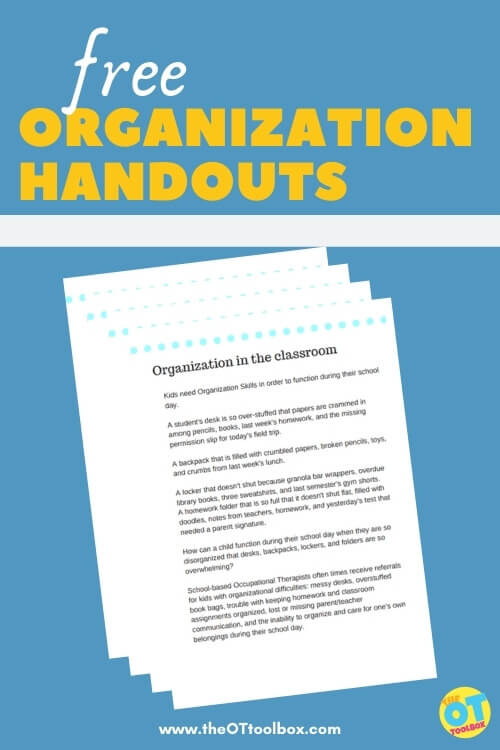
Free organization handouts for helping students stay organized

Organization challenges can look like a lot of different things. In the classroom, it can look like lost homework, messy backpacks, and a disaster of a desk. You can read all about our organization information here on the website. There, you will find strategies, resources, and tools to support organizational skills.

Try these other organization strategies here on the site, too:

Organization Handouts

Studies show that individuals with a small or underdeveloped frontal lobe of the brain tend to have difficulties with organization, poor memory, emotional reactions, and they tend to become overwhelmed by simple tasks. These individuals will have trouble keeping themselves organized in tasks.

These free handouts are printable tools to identify specific needs. You’ll find information describing how these areas are connected, what organization challenges can look like, and tips to help. You’ll also find classroom sensory motor activities that can help with organizing sensory input in the classroom environment.

Free Organization Handouts

To grab these organization handouts, add your email address to the form below.

Free Organization Handouts

    We respect your privacy. Unsubscribe at anytime.
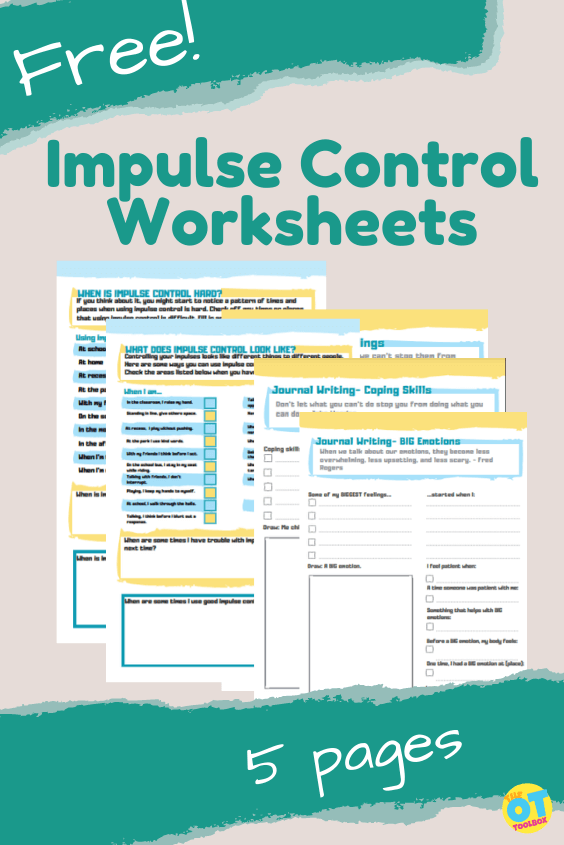
    Impulse Control Journal the OT Toolbox

    The Impulse Control Journal…a printable resource for helping kids strategize executive functioning skill development. When saying “calm down” just isn’t enough…

    When a child is easily “triggered” and seems to melt down at any sign of loud noises or excitement…

    When you need help or a starting point to teach kids self-regulation strategies…

    When you are struggling to motivate or redirect a child without causing a meltdown…

    When you’re struggling to help kids explore their emotions, develop self-regulation and coping skills, manage and reflect on their emotions, identify their emotions, and more as they grow…

    Grab the Impulse Control Journal to build organizational strategies, planning, prioritization, habits, and mindset in kids.

    Colleen Beck, OTR/L has been an occupational therapist since 2000, working in school-based, hand therapy, outpatient peds, EI, and SNF. Colleen created The OT Toolbox to inspire therapists, teachers, and parents with easy and fun tools to help children thrive. Read her story about going from an OT making $3/hour (after paying for kids’ childcare) to a full-time OT resource creator for millions of readers. Want to collaborate? Send an email to contact@theottoolbox.com.
    Truck Handwriting activity Slide Deck

    truck handwriting activities

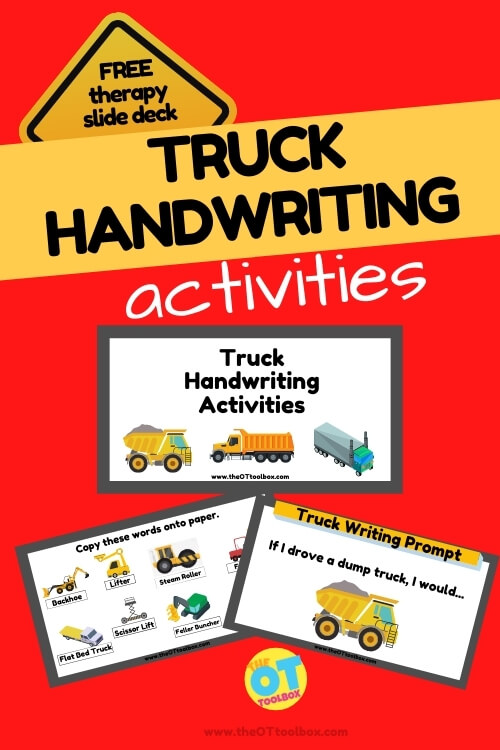
    This truck handwriting activity is another free slide deck, but one that uses truck themes to help with writing, letter formation, and working on legible, functional handwriting. Perfect for kiddos that love all things construction vehicles, this truck handwriting activities go well with our recent construction vehicle brain breaks.

    Truck handwriting activities and truck writing prompts in a free therapy slide deck for teaching handwriting virtually.

    Truck Handwriting Activity

    Use this truck handwriting activity is great for virtual therapy (one of the many free slide decks here on the site) but can be used to outline therapy sessions in a face-to-face manner as well.

    In the handwriting slide deck, you’ll find truck words that kids can copy. There are different types of construction trucks. Users can visually scan to copy the words. Expand the activity in a few different ways to work on more handwriting skills:

    • Write the words in alphabetical order to work on visual scanning, visual memory, and visual scanning.
    • Write the words into sentences to work on spacing between letters and words, margin use, and size.
    • Describe a truck on the screen and ask students to write the word from memory to work on visual memory.
    • Work on cursive writing, uppercase letters, or lowercase letters to address letter formation.
    Truck writing prompts to help kids with writing words and sentences in to practice handwriting.

    Truck Writing Prompts

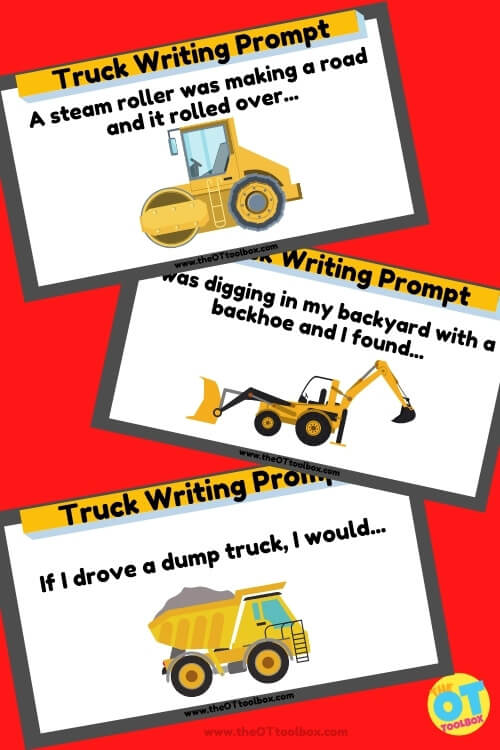
    Also included in the truck handwriting activities are writing prompts. Kids can copy the writing prompt and then continue the writing task to finish the thought. This can be a great way to work on spatial awareness, writing speed, margin use, and functional handwriting.

    There are four different truck writing prompts included in the slide deck:

    • If I drove a dump truck, I would…
    • I was digging in my backyard with a backhoe and I found…
    • A steam roller was making a road and it rolled over…
    • If I could drive any truck, it would be…and I would…

    Kids that love construction vehicles will love these truck writing prompts. Working on handwriting skills doesn’t need to be boring, it’s all about meaningful handwriting to make handwriting motivating and fun that build skills!

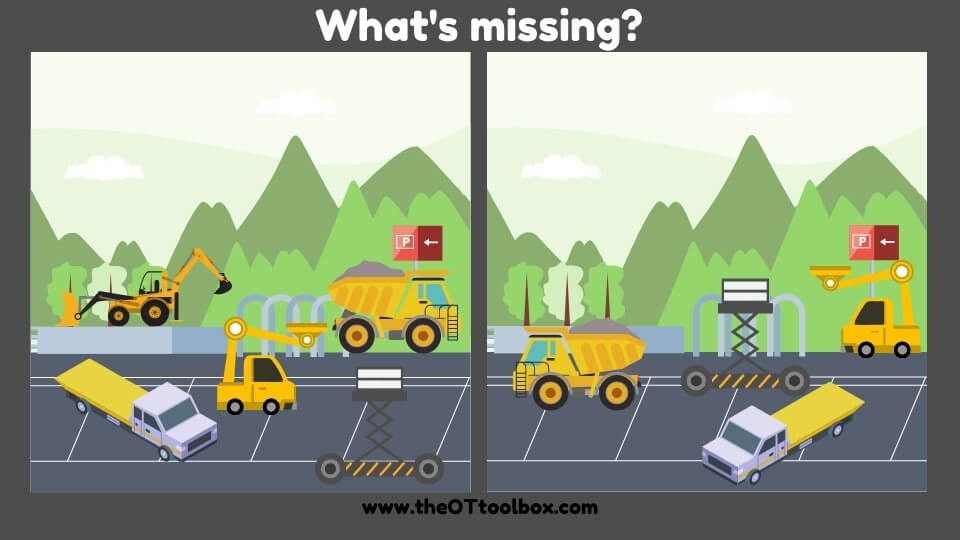
    What's missing pictures like this truck "what's missing" picture help kids with visual perceptual skills like visual discrimination, figure-ground, visual scanning, form constancy, and other visual perceptual skills in handwriting.

    Truck “What’s Missing” Activities

    Also included in this truck activity are different truck “What’s Missing” pages. These visual perceptual activities are challenges to help kids work on visual perceptual skills like:

    • visual discrimination
    • visual figure-ground
    • visual scanning
    • visual attention
    • visual memory
    • form constancy

    Turn these what’s missing activities into a motivating handwriting activity by asking kids to write the names of the truck words that are missing from the image on the right.

    Draw a Truck Activity

    Finally, kids can work on visual motor skills, pencil control, size and spatial awareness to draw a truck! There are several truck drawing slides included that challenge kids to draw different forms.

    Free truck handwriting activities slide deck

    Know a kiddo that loves all things trucks and construction vehicles? Grab this free slide deck to work on handwriting skills.

    Enter your email address into the form below and access these handwriting activities.

    Note: Try to use a personal email address, as work email addresses have been blocking the email delivery due to increased security issues.

    Truck Handwriting Activities (free slide deck)!

      We respect your privacy. Unsubscribe at anytime.

      Colleen Beck, OTR/L has been an occupational therapist since 2000, working in school-based, hand therapy, outpatient peds, EI, and SNF. Colleen created The OT Toolbox to inspire therapists, teachers, and parents with easy and fun tools to help children thrive. Read her story about going from an OT making $3/hour (after paying for kids’ childcare) to a full-time OT resource creator for millions of readers. Want to collaborate? Send an email to contact@theottoolbox.com.
      The Handwriting Book is a comprehensive resource created by experienced pediatric OTs and PTs.

      The Handwriting Book covers everything you need to know about handwriting, guided by development and focused on function. This digital resource is is the ultimate resource for tips, strategies, suggestions, and information to support handwriting development in kids.

      The Handwriting Book breaks down the functional skill of handwriting into developmental areas. These include developmental progression of pre-writing strokes, fine motor skills, gross motor development, sensory considerations, and visual perceptual skills. Each section includes strategies and tips to improve these underlying areas.

      • Strategies to address letter and number formation and reversals
      • Ideas for combining handwriting and play
      • Activities to practice handwriting skills at home
      • Tips and strategies for the reluctant writer
      • Tips to improve pencil grip
      • Tips for sizing, spacing, and alignment with overall improved legibility

      Click here to grab your copy of The Handwriting Book today.

      play dough mat writing prompts

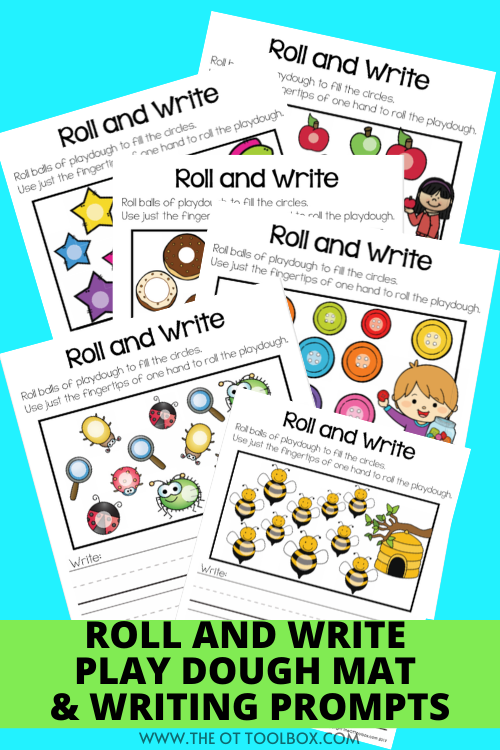
      Add the Roll and Write Play Dough Mat Writing Prompts to your therapy toolbox and build fine motor skills and handwriting in fun and engaging ways.

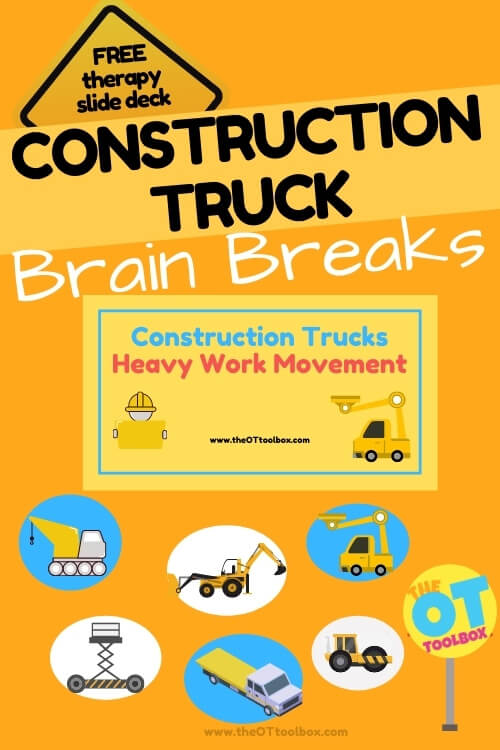
      Construction Truck Brain Breaks

      Construction Truck Brain Breaks

      These construction truck brain breaks are heavy work fun with a truck theme! The gross motor activities that kids can use as a brain break or a heavy work activity to help with attention, focus, and sensory input. The construction truck activities are great for kiddos that love all things trucks! You can access these heavy work activities in a free therapy slide deck and use it in teletherapy sessions or in face-to-face therapy (or at home and in the classroom, too!)

      These are perfect for kiddos that love all things garbage trucks, backhoes, excavators, cranes, steam rollers, and more. We’ve got all the construction vehicle activities covered in this therapy set!

      Construction truck brain breaks for kids that love all things construction vehicles.

      Construction Truck Brain Breaks

      I love using brain breaks in themed activities that kids love. The thing is that children are drawn to certain topics or themes, and construction truck themes are no different. There is just something about garbage trucks, dump trucks, backhoes, cement trucks, and excavators that are irresistible to children.

      These particular construction truck brain breaks offer an opportunity for kids to gain much-needed heavy work input in the way of proprioception. You can read more about proprioception and brain breaks here.

      The truck activities also allow children to move while gaining vestibular input as well. Adding movement in a variety of planes and directions in conjunction with input from the eyes, and heavy work feedback from muscle and joint receptors, is able to contribute to posture, coordination, and appropriate response of the visual system.

      Another reason to use heavy work activities like these truck brain breaks, is for the benefit of improving body awareness. Heavy work improves body awareness by incorporating proprioceptive input, with motor planning, attention, and “self-checks” that allow us to know where our body is in space during tasks. This is so important for kiddos facing more and more screen time than ever.

      For more heavy work activities, try these heavy work cards that come in a variety of themes.

      Free Construction Truck Brain Breaks

      You can grab these construction truck activities and use them in teletherapy sessions, in face-to-face therapy sessions, in the classroom, or in the home. They are presented in a Google slide deck, so that they can be easily accessible from different devices and situations, using a Google drive.

      Check out all of the free therapy slide decks we have available here on the site.

      Want to add this resource to your therapy toolbox? Enter your email address into the form below.

      NOTE: Try to add a personal email address for deliverability, as work emails (who have a strict security wall in place) may block the deliverability of the PDF email.

      Construction Truck Brain Breaks (free slide deck)!

        We respect your privacy. Unsubscribe at anytime.
        Heavy work cards

        Use the Heavy Work Activity Cards in play, learning, and brain breaking!

        Colleen Beck, OTR/L has been an occupational therapist since 2000, working in school-based, hand therapy, outpatient peds, EI, and SNF. Colleen created The OT Toolbox to inspire therapists, teachers, and parents with easy and fun tools to help children thrive. Read her story about going from an OT making $3/hour (after paying for kids’ childcare) to a full-time OT resource creator for millions of readers. Want to collaborate? Send an email to contact@theottoolbox.com.
        Outer Space Visual Perception Worksheet #2

        Outer space visual perception worksheet

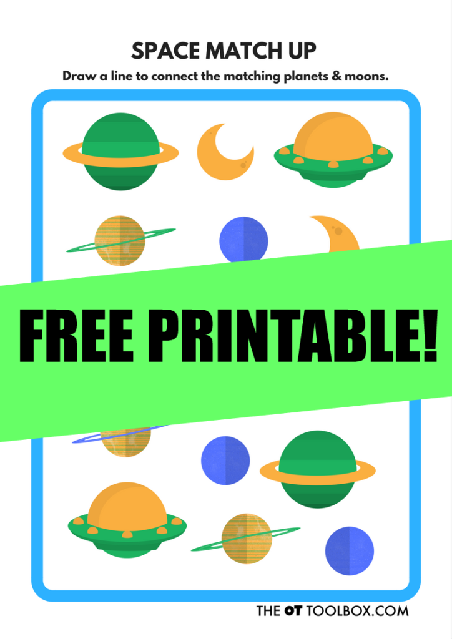
        This outer space visual perception worksheet is a fun printable page for kids who love all things outer space!  Sometimes a fun puzzle is just the way to make to therapy fun.  This Space Visual Perception Puzzle helps kids develop and build skills such as visual discrimination, spatial reasoning, visual motor skills, and motor planning.  It’s part of our free visual perception printable packet, full of resources to address visual scanning, visual discrimination, visual closure, and more.


        Kids can work on pencil control and motor planning to connect matching planets and shapes, but be sure to go around the planets that are in your way!  

        Outer space visual perception worksheet

        Outer Space Visual Perception Worksheet


        When completing this outer space worksheet, kids are working on several skills:


        Visual Discrimination– Noticing and identifying subtle differences in shapes, colors, direction, and forms is a necessary skill for functional tasks like matching socks or silverware.  Visual discrimination is a skill that is essential for handwriting, reading, and math.  Children who struggle with visual discrimination may not notice small details or may confuse letters or numbers that are similar like b, d, 2, and 5. 


        Spatial Reasoning– This skill is what allows us to walk around objects in our path with enough space.  Spatial reasoning is needed for handwriting when determining if a word will fit in a given space or if we need to write smaller or move to the next line at the end of the right margin.  Encourage kids to draw pencil strokes around the planets so they don’t touch the other planets with their pencil.  Visual spatial relations is a spatial reasoning skill. 


        Visual Motor Skills– Coordinating visual information with movements of the hands is a skill that is needed for handwriting.  Use a writing utensil to connect the matching planets and moons while working on visual motor skills needed for written work. 


        Visual Memory–  Children need visual memory for handwriting, reading, math, and many tasks during the school day.  Visual memory is a skill that allows us to store a visual piece of information or a form in our mind and recall the characteristics of that form.  


        This printable sheet can be used over and over again if you laminate it or slide it into a page protector.  Just use a dry erase marker to erase the lines and re-use the puzzle again. 


        The best news is that this space visual perception puzzle is FREE!  
        Grab your free worksheet by clicking the button below.  

        Free Outer Space Worksheet

        Click HERE to get this worksheet as well as 24 other printable worksheets in the free visual perception packet.

        There are a lot of other visual perception and visual motor activities on this site that you will love:

        More Outer Space Activities for Therapy

        Use the free visual perception worksheet along with these outer space activities to help kids develop skills in a variety of areas:

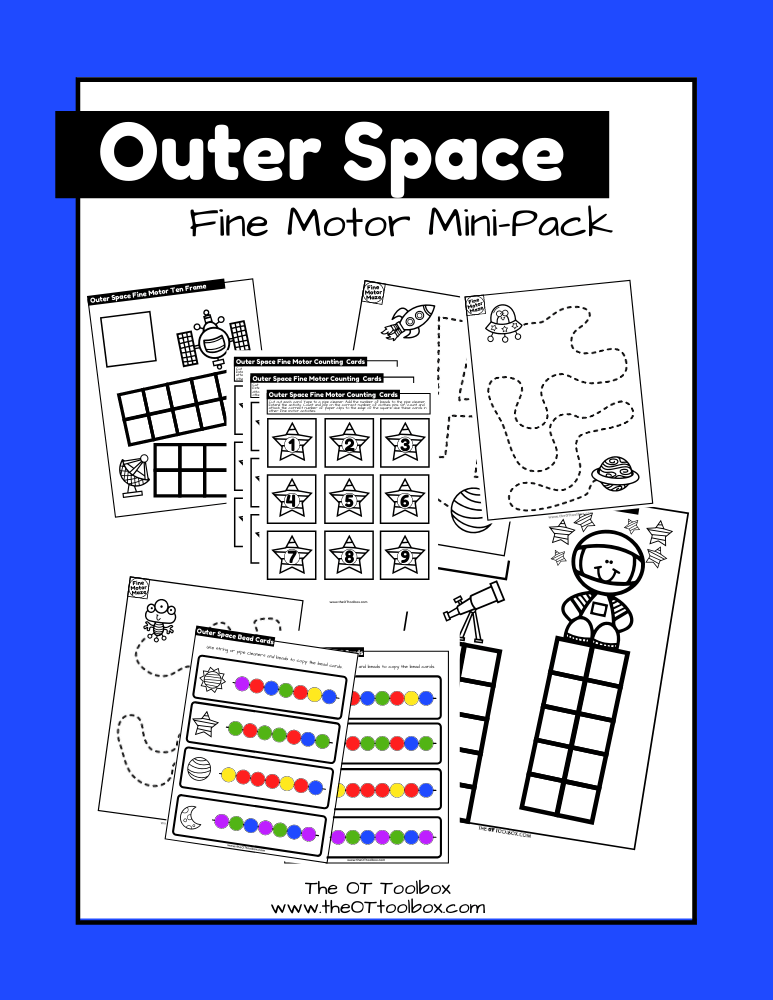
        Know a kiddo that loves all things space, astronauts, and planets? The Outer Space Fine Motor Kit is your chance to develop fine motor strength, dexterity, and coordination skills.

        Addressing hand strength, endurance, and precision is out of this world fun! The Outer Space Fine Motor Kit includes:

        • Fine Motor Mazes
        • Fine Motor Ten Frames for motor activities
        • 1-20 Star Counting Cards
        • Bead Copying Strips
        • Space Alien Directed Drawing Sheets

        This fine motor kit includes 24 pages of printable resources. Included in this printable pack are:

        1. Two pages of color coded bead copying strips
        2. Two pages of blank bead copying strips
        3. Four pages of “draw and write” directed drawing activities with a space theme (Includes 3 styles of handwriting lines: highlighted lines, single rule, and double rule)
        4. Nine pages of fine motor mazes
        5. 1-20 Outer Space Counting Cards
        6. Four pages of fine motor ten frames activities

        These printable activities extend to work on a variety of other functional areas, too: handwriting skills, numbers, math, adding, subtracting, one-to-one correspondence, scissor skills, coloring, and more.

        Click HERE to grab the Outer Space Fine Motor Mini-Kit.

        Outer Space Fine Motor Kit

        Colleen Beck, OTR/L has been an occupational therapist since 2000, working in school-based, hand therapy, outpatient peds, EI, and SNF. Colleen created The OT Toolbox to inspire therapists, teachers, and parents with easy and fun tools to help children thrive. Read her story about going from an OT making $3/hour (after paying for kids’ childcare) to a full-time OT resource creator for millions of readers. Want to collaborate? Send an email to contact@theottoolbox.com.
        Superhero Gross Motor Activities

        superhero gross motor activities slide deck

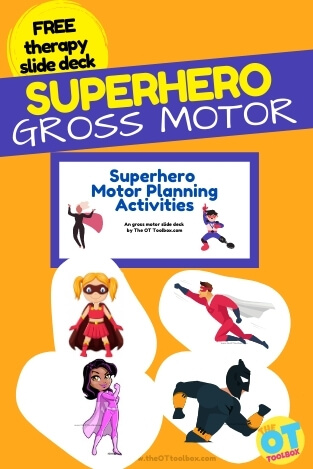
        Today, I have a fun therapy slide deck to share: Superhero Gross Motor Activities! These superhero exercises are movement activities that challenge motor planning, balance, core strength, and crossing midline. When kids move through the superhero movement activities, they can build and develop many areas. Grab this gross motor activity set and start building those motor skills!

        Superhero Gross motor activities for kids

        Superhero Gross Motor Activities

        I wanted to create a gross motor activity set to go along with our superhero writing activity deck, so be sure to grab that free resource as well. This is just one of the free teletherapy slides for OT and PT that are available on the site.

        The gross motor activity set includes 24 different slides and superhero exercises that challenges users to complete different movement patterns. Users can go through the exercises in order and work on various gross motor skills that can be a challenge to incorporate into teletherapy sessions, sometimes.

        By following along with the different superhero gross motor positions, kids can challenge and build:

        These various gross motor skills can help children with self-regulation, attention, and other areas.

        Add these other superhero activities for more skill-building:

        Free Superhero Gross Motor Slide Deck

        Want to add this slide deck to your therapy toolbox? Enter your email address below and you will receive a PDF containing a link to copy the slide deck onto your Google drive. Save that PDF file, because you can come back to it again and again and send it to the kids on your caseload (or classroom) so they can make their own copy on their Google drive.

        Note- You many need to use a personal email address in this form due to increased difficulties with sending deliverables to school district emails, organizations, and those with high security networks.

        Free Superhero Gross Motor Therapy Slide Deck!

          We respect your privacy. Unsubscribe at anytime.

          Colleen Beck, OTR/L has been an occupational therapist since 2000, working in school-based, hand therapy, outpatient peds, EI, and SNF. Colleen created The OT Toolbox to inspire therapists, teachers, and parents with easy and fun tools to help children thrive. Read her story about going from an OT making $3/hour (after paying for kids’ childcare) to a full-time OT resource creator for millions of readers. Want to collaborate? Send an email to contact@theottoolbox.com.
          Superhero writing

          Superhero writing slide deck

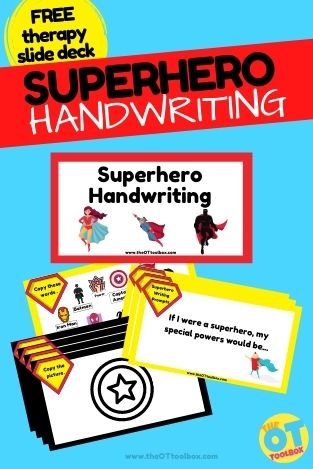
          This superhero writing activity is a free therapy slide deck that can be used in telehealth sessions or face to face occupational therapy interventions. Get ready for superhero handwriting fun, because those pencils are about to be superheroes! Your kiddos will love these superhero writing prompts, superhero drawing prompts that make handwriting practice fun!

          This is another one of the many free therapy slides available here on the site.

          Superhero writing slide deck

          Superhero Writing

          The cool thing about this free therapy slide deck is that it includes a superhero craft to get those hands warmed up for writing practice. Kids can make the pencil superhero craft and then use their pencil superhero to write with for the writing portion of this therapy activity.

          The slide deck includes superhero words that children can copy. I’ve included many different words that are scattered all over the slide. When users visually scan for the superhero images, they are working on a few different visual perceptual skills:

          • Visual memory
          • Visual attention
          • Visual scanning
          • Visual discrimination

          All of these skills are used when copying words or math problems from a distance like when students copy math problems or a homework list from a smart board in the classroom. They need to visually shift from near to far and find their place in order to copy the information without missing letters or other information.

          Superhero Writing Prompts

          Also included in this slide deck are several superhero writing prompts. Users can use the slides as a starting point for handwriting tasks that are longer in nature. Then, work on areas such as spatial awareness between letters and words, line use, margin use, letter formation, and overall writing legibility. You can help children to check over their written work using this handwriting self-assessment list to build carryover of writing skills.

          Superhero writing activities

          Draw a Superhero

          Finally, in the superhero writing slide activities are several slides that invite kids to draw a superhero. The superhero drawing prompts include various pencil line forms that are easy and more complex to meet a variety of needs.

          When drawing and copying from a form, kids work on visual motor skills that are needed for letter formation, eye-hand coordination, spatial awareness, and pencil control. Plus drawing a superhero is fun!

          Add these other superhero activities for more skill-building:

          Superhero writing activity for therapy

          Free Superhero Writing Activity

          Want to add this free therapy slide deck to your therapy toolbox? Enter your email address into the form below and a PDF will be delivered to you. Use that to access the Google slide deck for therapy sessions. Have fun writing about superheroes!

          NOTE- You many need to use a personal email address in this form due to increased difficulties with sending deliverables to school district emails, organizations, and those with high security networks.

          Free Superhero Handwriting Slide Deck!

            We respect your privacy. Unsubscribe at anytime.

            Colleen Beck, OTR/L has been an occupational therapist since 2000, working in school-based, hand therapy, outpatient peds, EI, and SNF. Colleen created The OT Toolbox to inspire therapists, teachers, and parents with easy and fun tools to help children thrive. Read her story about going from an OT making $3/hour (after paying for kids’ childcare) to a full-time OT resource creator for millions of readers. Want to collaborate? Send an email to contact@theottoolbox.com.
            What are Executive Functioning Skills?

            Executive functioning skills are an important component of skilled occupational therapy intervention, but they can be confusing to some. What are executive functioning skills? Executive functioning skills go beyond the basics like working memory and impulse control. Using the individual skills in a cohesive manner with mental dexterity drives function at all ages and stages of life. In fact, there is not necessarily one agreed-upon definition for executive functioning! Ready to learn more? Keep reading!

            What are executive functioning skills

            What are executive FUNCTIONING Skills?

            Executive functioning (EF) skills are diverse. Typically, EF consists of skills including the ability to manage emotions, initiate activities within a timely manner, shift attention from topics or activities, control impulses and urges, retain information for use during functional activities, develop plans and formulate systems to perform a desired task, prevent missing materials, and being mindful of how our own behavior impacts others.

            One aspect to delivering strategies and tools to support executive function development can be through a coaching model. In fact, executive function coaching is a powerful tool to support individuals in specific needs.

            Development of executive functioning skills

            When do executive functioning skills develop?

            Executive functioning skills take a long time to develop! As a result, different ages demonstrate different challenges when facing EF deficits.

            While a child in late elementary school may seem successful with their ability to manage classroom materials, turn in homework assignments on time, and engage in age-appropriate behaviors, the same child may demonstrate significant challenges upon the transition to middle school. For example, now they have to return to their locker between classes to exchange books, which is not just a simple stop-and-go activity.

            There are distractions, the desire to engage in social interactions, a time crunch to make it to the next class on time, the need to remember what class is next and what materials they need, and not to mention needing to remember the sequence for their combination lock! This all happens before they even make it into their next classroom or head home for the day.

            How can executive functioning skills improve?

            Thanks to the brain’s neuroplasticity, EF skills have potential for improvement! Many daily activities require diverse EF skills, making them a fantastic opportunity to integrate effective strategies.

            What are executive functioning skills

            Emotional regulation as an area of executive functioning:

            Emotional regulation is one of the first areas of executive functioning that many parents want to improve, since it can add significant stress to family life. Self-reflection is one way to improve emotional regulation. However, it’s important that this takes place after the big feelings pass, since learning takes place when bodies and minds are “just right.”

            This can easily be added to family routines. One way to encourage self-reflection is to have each family member share a positive and negative from the day when seated for dinner.

            This also allows for family members to support each other (“Good luck on your test today, Jacob, you studied very hard!”) and provides opportunities for continued conversation (“You mentioned having an argument with your friend at lunch today. Is there anything I can do to help?”). It can also normalize the big feelings we all experience!

            Initiation and executive functioning skills:

            We’ve all struggled with initiation at some point in our lives; we need to complete items on an ever-growing to-do list, but just don’t know where to start! Kids experience this, too.

            For children who are competitive, make a contest out of completing tasks. See who can complete their to-do list the fastest, but with the best quality, too! Teaching children and teens how to become more independent with initiation can be fun and successful.

            Shifting as an executive function:

            Shifting is often combined with attention, since shifting requires the individual to determine what is important and focus on that, rather than what they might have been doing or thinking before.

            Take, for example, a student who was writing a paper on a Shakespearean play for their English class. They’ve now finished the assignment and have moved on to a worksheet on the quadratic formula. Their mind needs to completely turn “off” Shakespeare and turn “on” the quadratic formula.

            Luckily, there are many activities for attention. One fun way is to build an obstacle course. Each time the child completes the course, change one of the rules!

            For example, the second time, they can only touch primary colors or can only hop on one foot in between obstacles. They will not only need to remember what the new rule is, but they will have to shift away from the old rules!

            Inhibition and executive functioning:

            Inhibition is often referred to as impulse control. It can be an exhausting component of executive functioning, as it can lead to significant safety concerns.

            One way to improve impulse control with younger children is through the game “Red Light, Green Light.” Many children (even early teenagers) enjoy playing versions of “Floor is Lava,” avoiding certain materials as they attempt to navigate a room. This can also be a great way to work on working memory!

            Working memory as an executive function:

            Working memory can be a significant challenge for many individuals. Working memory requires us to retain learned information and use it during daily activities.

            There are many ways to support working memory development and deficits. There are many task-management apps available, even for things like medication management. For activities to improve working memory, try playing games like Magic Labyrinth, Melissa and Doug’s Sandwich Stacking Game, or making a recipe!

            Planning/organizing for executive functioning success:

            Planning for projects and organizing ideas is stressful! It can be helpful to go through large assignments one at a time. Break the assignment into manageable pieces, including what materials are needed for that step and when that step needs to be completed.

            The good news is that these skills can experience definite improvements with practice. Check out this link for more information and strategies on prioritization and planning skill development.

            Organization of materials and executive functioning:

            Messy rooms with laundry covering the floor, desks and lockers overflowing with paper, expandable folders filled to the brim with assignments—these are the signs of a disorganized student! Organization is often the first thing to go when a person feels stressed or overwhelmed, as it can be time-consuming.

            To support a child’s organization skills development, try making checklists for their locker or desk. As they place each item into their backpack, they can check a box to make sure they have everything they need before they go! Or, use labels to clearly define where belongings go in a closet or on a bookshelf.

            Executive functioning skills in kids

            Monitoring for executive functioning success:

            Monitoring is important since we all interactive with others on a daily basis! Monitoring is the acknowledgement that we behave in certain ways and that these behaviors can affect other people.

            Self-reflection (mentioned above) can be a good way to promote monitoring. An individual can process through what they think went well, what they struggled with, and how they think others felt during these events. Behavior charts can also be helpful by clearly listing out what the expectation is and whether the individual demonstrated that skill area. Ultimately, the goal is to encourage self-monitoring as much as possible, rather than adults monitoring the child. The possibilities for monitoring strategies  are diverse and it’s possible to find something that works for each person.

            More Executive Functioning Skills Resources:

            • Free Executive Function Mini-Course- Wondering about what are executive functioning skills? This Executive Functioning Skills Course is a FREE, 5-day email course that will help you understand executive functioning and all that is included in the set of mental skills.
            • This collection of executive functioning skills resources outline many aspects of higher cognitive skills through various EF skill areas.
            • Getting organized can be a start to addressing several executive functioning skill areas. Here is a collection of organization strategies, tips, and tools.
            What are executive functioning skills? This resource on attention, organization, planning, and other executive functions helps kids develop skills needed for learning.

            For resources, tools, and printable activities to improve and strengthen the development of executive functioning skills, check out The Impulse Control Journal.

            Impulse Control Journal the OT Toolbox

            Free Virtual Connect 4 Game

            Virtual Connect 4 Game

            Today I have another fun virtual therapy activity: A therapy board game Connect 4! This therapy slide deck is a free virtual Connect 4 game designed for occupational therapy services (or other therapy services) that combine motor skills with visual perception and eye hand coordination. Therapeutic games are nothing new; Occupational therapists use board games in therapy services all the time to address function and independence skills. This therapy game is a bit different: it builds skills in kids through game play, and is a fun game for teletherapy.

            Grab this free virtual Connect 4 game for building skills in occupational therapy, using a outer space connect 4 game!

            Therapy Board Game

            We’ve shared virtual games and board games to use in therapy previously on this site. Some games are great for helping kids develop specific skills:

            Today’s virtual Connect Four game is just as much fun, and it’s a great tool to add to your therapy toolbox!

            Virtual Connect 4

            When it comes to teletherapy services, it can be hard to incorporate game play into therapy sessions in a way that addresses functional goals like handwriting, motor skills, or self-regulation. This virtual Connect 4 game does just that!

            This game is a Google slide deck and one of our free slides that can compliment therapy services, both online or in face-to-face sessions.

            To play the game, you’ll add the free slide deck to your Google drive, pull up the slide deck during therapy sessions, and work on a variety of skills. To use this game in distance therapy situations, you can send the link to students and you’ll each play on your own computers, watching as the edits are made to the slide deck. (Be sure to make a copy and send that specific link to a student- this way your student has their own copy of the slide deck on their Google drive.)

            The game is just like the classic Connect 4 game: try to get four in a row and block the other player from getting four in a row.

            This particular Connect 4 game has an outer space theme. So, the game pieces are planets! Check out more space theme activities below.

            When suing the Connect 4 game in therapy, kids can work on the following skills:

            • Visual perception
            • Visual motor skills
            • Eye hand coordination
            • Fine motor skills
            • Mouse use/keyboard use
            • Finger isolation

            The virtual Connect 4 game includes handwriting slides, so that when users place the game pieces, they cover a letter or a number. These are designed to promote handwriting skills and number formation skills.

            Use the handwriting slide to work on letter formation, word writing, sentence writing, and copying skills.

            Use the number slide to work on forming numbers, writing number words, or even gross motor skills: kids can do a motor activity like jumping jacks to animal walks the same number of times as the number they covered with their game piece.

            To reset the game pieces:

            1. When you are done playing, just hit the EDIT HISTORY link.
            2. Look on the right side bar for “Version History”.
            3. Click the box that says “Reset Game”.
            4. Then go to the top left corner of the screen where there is an arrow pointing left. Click this arrow.
            5. All of the movable game pieces will be reset to their original spots. You can start the game over again.

            This Space Connect 4 game will be a hit in your therapy sessions (or at home and in the classroom!)

            More space activities for therapy

            You can add this virtual Connect 4 game to these other Space theme activities, to help with therapy planning:

            Free Virtual Connect 4 for Therapy

            Want to add this free slide deck to your therapy toolbox? Enter your email address into the form below and you’ll gain access to this slide deck on your Google drive.

            For those using school district, university, or organization emails- You may have trouble accessing the free slide deck due to increased security warnings. To get around this, try entering a personal email address.

            Free Virtual Connect 4 Game for Therapy!

              We respect your privacy. Unsubscribe at anytime.

              Colleen Beck, OTR/L has been an occupational therapist since 2000, working in school-based, hand therapy, outpatient peds, EI, and SNF. Colleen created The OT Toolbox to inspire therapists, teachers, and parents with easy and fun tools to help children thrive. Read her story about going from an OT making $3/hour (after paying for kids’ childcare) to a full-time OT resource creator for millions of readers. Want to collaborate? Send an email to contact@theottoolbox.com.
              Outer Space Fine Motor Kit

              NEW RESOURCE: Outer Space Fine Motor Mini-Pack!

              Working on fine motor skills? Know a child who loves all things outer space? This Outer Space Fine Motor Mini-Kit is for you!

              Work on grasp, hand strength, eye-hand coordination, handwriting, scissor skills, and all things fine motor with this Outer Space fine motor mini-kit.

              Addressing hand strength, endurance, and precision is out of this world fun!

              Includes:

              • Fine Motor Mazes
              • Fine Motor Ten Frames for motor activities
              • 1-20 Star Counting Cards
              • Bead Copying Strips
              • Space Alien Directed Drawing Sheets

              Grab your copy of this no-prep Outer Space fine motor worksheet set!

              What are Primitive reflexes?

              what are primitive reflexes

              Have you even heard the term reflexes and wondered what are primitive reflexes? One of the many things that your newborn’s pediatrician will check periodically is their primitive reflexes. The existence of reflexes can be a great marker for neurological health in people of all ages, as they are controlled by the nervous system – the brain, spinal cord, and nerves. Primitive reflexes develop in the womb and are integral to an infant’s survival and future development. Below we will break down each of these reflexes and their purpose. Be sure to read our blog on retained primitive reflexes as well, to discover how to support reflex integration.

              what are primitive reflexes

              Related: Books About Primitive Reflexes 

              What are Primitive Reflexes?

              As infants develop into toddlers, these reflexes should do what health care professionals call “integration”. The response that comes with the primitive reflex should integrate into a more mature or voluntary movement.

              If they are still present long after they should have integrated, the child will display certain characteristics specific to the retained reflex, many of which hold back their development and academic skills. 

              Let’s begin with the most easily noticeable reflex that babies have: the palmar reflex. This is also known as the grasping reflex. You will see this when you place your finger into the palm of an infant’s hand, and they hold on tight. This is an adorable response that can make you feel pretty special, but it is involuntary up until about 6 months of age when the reflex should disappear. 

              PALMAR REFLEX

              The palmar reflex is important for the development of purposeful grasping, something that an infant is learning throughout their first year of life. 

              Fun Fact: if your baby is holding your hair in a death grip because of this reflex, stroke the back of their hand with your finger – it should initiate a release of the grasp. 

              ROOTING REFLEX

              The rooting reflex is one of the main “survival” reflexes. The rooting reflex can be elicited by stroking an infant’s cheek with your finger, or more likely, a bottle or breast nipple. This is because when the cheek is stimulated, the infant will turn his or her head towards that stimulation. 

              If you ever need your baby to pay attention to their feeding, try giving their cheek a little stroke or tap so they turn towards the feeding source. This response should be seen in infants up until about 4 months of age. 

              SUCKING REFLEX

              Similar to the rooting reflex, the sucking reflex is necessary for an infant’s feeding abilities. To stimulate the sucking response, touch the roof of the infant’s mouth and they will automatically begin sucking. 

              Most infants learn this skill very quickly (they do get tons of practice, after all!) and the reflex will disappear by about 2 months old. 

              MORO REFLEX

              This reflex is the first of three on this list that is a response to a change in body position. Also known as the startle reflex, the Moro reflex can be seen by gently dipping a baby’s head and neck backward, as if they are falling. It can also be elicited by other stimuli like a startling noise or a drastic change in temperature. 

              The response that you will see in the baby is that of fear – their arms, legs, and head will reach out and then tuck back in – jerking their body back and forth. They may also open and close their hands and may even cry. The movement that is created by a startling stimulus is to protect your baby and allow them to move away from the stimuli even before they can control their own movements. Pretty cool, huh?

              You may notice the startle reflex really kicking in around 1 month old. If your baby is inconsolable and moving around their body in this way, securing supporting their bottom and their head should help them realize that they are safe. By six months old, or as early as two months, this reflex will disappear. 

              TONIC LABYRINTHINE REFLEX

              The tonic labyrinthine reflex (TLR) is used for head and postural control. We know that baby has poor control of their head and neck when they are born, and this reflex is part of what helps them gain control over this part of their body. 

              It’s important to know that posture in kids that impact functional performance (sitting at a desk for example) can be a result of a retained reflex and this is an area that is sometimes overlooked.

              The TLR can be seen when moving the head and neck forward and backward. When the head moves forward toward the chest, the arms and legs bend and the baby assumes the fetal position. When the head moves back away from the chest, the arms and legs straighten. You can see this really well during tummy time! 

              The TLR will disappear by about 4 months old so that more advanced reflexes and movements can begin development. 

              ASYMMETRICAL TONIC NECK REFLEX

              Last on the list of movement-based reflexes is the asymmetrical tonic neck reflex (ATNR). As the name suggests, this reflex has to do with the neck. You can see the reflex if you turn a baby’s head to one side while they are laying on their backs. They will reflexively straighten their arm and leg on the side that they are looking, and bend the arm and leg of the other side. That is where the asymmetrical part comes in: their left side and right side of their body are opposite. They look a bit like an archer, about to shoot an arrow. 

              This reflex is important in the birthing process, as the motions of the head can control the movement of the rest of the body help the baby through the birth canal. It is also important to the initiation of crawling, as the arms and legs move as a baby turns their heads while on their belly. For this same reason, the ATNR is crucial to the development of hand-eye coordination. 

              The ATNR disappears around the time an infant is gearing up for crawling, around 6 months old. 

              MORE ON PRIMITIVE REFLEXES

              There are a few more infant reflexes that we did not mention, and you can check them out if you are looking to learn more!

              The Spinal Galant Reflex, the Babinski Reflex, the Landau Reflex, and the Symmetrical Tonic Neck Reflex (STNR) are some that we missed in this article. The Landau and the STNR are actually not primitive reflexes, as they develop after the baby is born, but they are developmentally important nonetheless! 

              Luckily, we have a resource to share that covers these reflexes and much more…

              Check out this primitive reflexes course. (affiliate link)

              Assessment And Integration Of Primitive Reflexes For Improved Independence In Daily Activities is a course on primitive reflexes where you’ll learn how to, screen, test and integrate retained primitive reflexes and find tools to help your client or child improve motor, social and daily functioning skills by implementing fun, therapeutic, and functional activities!

              In this primitive reflexes course, created by two occupational therapists, you’ll find modules and functional intervention activities for:

              1. Moro reflex
              2. The Tonic Labyrinthine (TLR) & Landau Reflex 
              3. The Rooting Reflex
              4. The Asymmetrical Tonic Neck Reflex (ATNR)
              5. The Spinal Galant Reflex
              6. The Palmar Grasp Reflex
              7. The Symmetric Tonic Neck Reflex (STNR)
              8. Support for kids who push back
              9. Printable handouts, screening tools, and checklists
              10. Information on postural reflexes, yoga, sensory diets, and more
              11. Case studies
              12. Research
              13. AOTA continuing education: 1.05 AOTA CEUs

              If your child has retained primitive reflexes, learning to integrate them could lead to improved development in many areas:

              • Social Skills
              • Learning
              • Motor Skills
              • Executive
              • Functioning
              • Coordination
              • Reading & Writing

              Find out more and gain insight and tools on retained primitive reflexes and start supporting kids needs with “Assessment And Integration Of Primitive Reflexes For Improved Independence In Daily Activities” today.

              Sydney Thorson, OTR/L, is a new occupational therapist working in school-based therapy. Her
              background is in Human Development and Family Studies, and she is passionate about
              providing individualized and meaningful treatment for each child and their family. Sydney is also
              a children’s author and illustrator and is always working on new and exciting projects.