Colleen Beck, OTR/L is a pediatric occupational therapist and the owner and author of The OT Toolbox website. She manages all of The OT Toolbox social media accounts and runs the popular newsletter.
Read about Colleen's experience and career as an occupational therapist, including how The OT Toolbox began on our About The OT Toolbox page: https://www.theottoolbox.com/about-us/
Colleen created The OT Toolbox in 2011 and since then has written thousands of blog posts designed to support therapy providers, educators, parents, counselors, admin, and caregivers in promoting the healthy development of kids.
Check out Colleen's blog posts below:
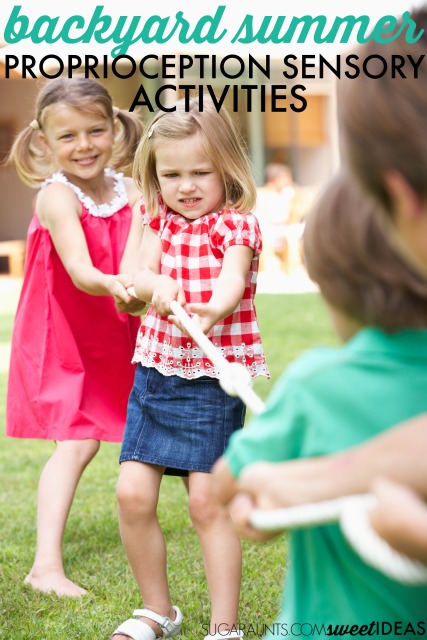
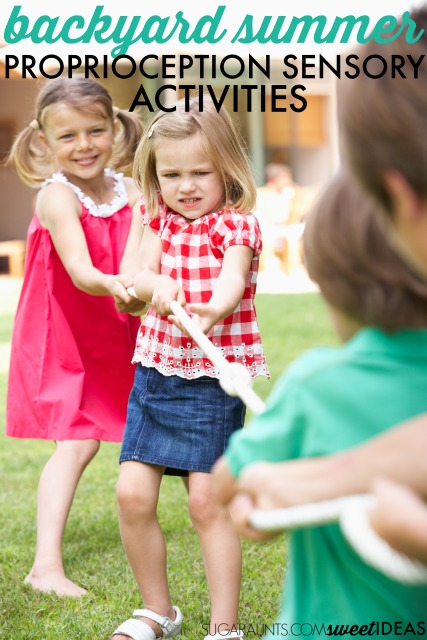
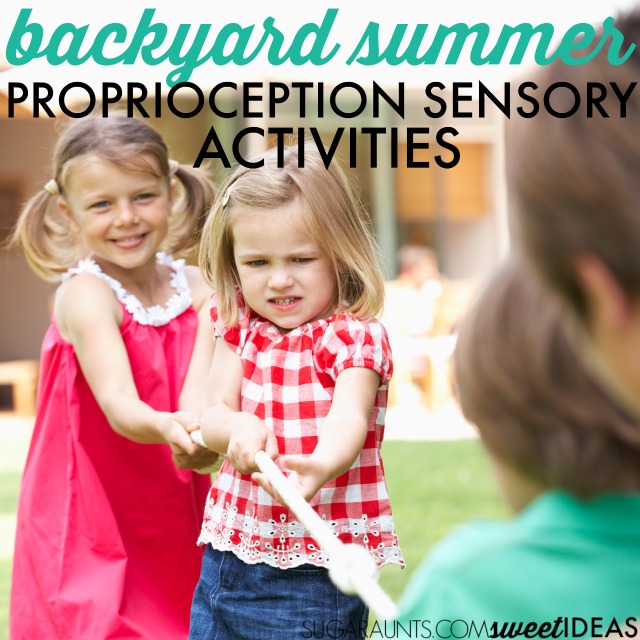
You may have seen our Backyard Summer Sensory series that covers all things outdoor sensory activities. Today, I’ve got outdoor sensory focusing o proprioception activities that are designed to get the kids moving with heavy work using items you’ve probably already got right in your backyard. These are easy ways to build sensory breaks into the day, get the kids moving with heavy work. You can see the other posts in the series, including backyard oral sensory activities, outdoor sensory activities for tactile sense, and outdoor oral motor sensory activities (yep, that’s possible to address in outdoor play!)
Outdoor Sensory Activities for PROPRIOCEPTION
Try these outdoor heavy work activities to add input through the core and gross motor muscle groups for regulation and body awareness.
Amazon affiliate links are included below.
Hoola Hoop Jump- Place out several hoola hoops (or just one) on the ground. Create a hopping obstacle course into the hoops. Jump with both feet, one foot, and then the other. Place the hoops further away for more work. Try making a hopping memory game, much like playing “Simon” in a gross motor way. This activity provides heavy work and input through the lower body as kids jump and hop into hoops.
Hose Tug- Use a regular garden hose to incorporate heavy work by pulling the hose across the lawn. Use the hose to water flowers, bushes, or even to spray at targets drawn with sidewalk chalk.
Shovel Carry and Dig- Use a garden shovel in an adult or kids’ size to shovel dirt, rocks, leaves, sticks, or mulch from one area to another. Try filling a bucket with the different mediums and then carry them to another area of the yard. Good old fashioned lawn work can do wonders for a proprioceptive input seeking kiddo!
Jump Rope Pull and Slide- This activity adds a bit of vestibular input to the heavy work of pulling a jump rope. Use a piece of cardboard cut from a large box or cereal box to create a flat piece. Have your child sit on the cardboard and hold onto a jump rope. Pull them around or down slopes as they hold onto the rope. You can also try this activity with the child pulling another individual on the cardboard.
Hop Scotch
Bean Bags
Corn Hole
Play Leap Frog with friends
Jump Rope
Fly a kite
Climb trees
more backyard sensory ideas for summer?
The activities in this post are part of our Summer Sensory Activity Guide, where you can find everything you need for a summer of sensory input. Use the sensory activities described in the booklet as a guide to meet the individual needs of your child. The activities are not a substitute for therapy. Rather, they are sensory-based summer activities that are designed to address each sensory system through summer play. Activities are described to involve the whole family. Check out the Summer Sensory Activity Guide today!
AND…that guide is actually a bonus item in the Summer OT Bundle. So if you are working with children this summer to improve fine motor skills, handwriting, sensory processing, and other skill areas, check out the Summer OT Bundle:
More proprioception activities that kids will love:
Colleen Beck, OTR/L has been an occupational therapist since 2000, working in school-based, hand therapy, outpatient peds, EI, and SNF. Colleen created The OT Toolbox to inspire therapists, teachers, and parents with easy and fun tools to help children thrive. Read her story about going from an OT making $3/hour (after paying for kids’ childcare) to a full-time OT resource creator for millions of readers. Want to collaborate? Send an email to contact@theottoolbox.com.
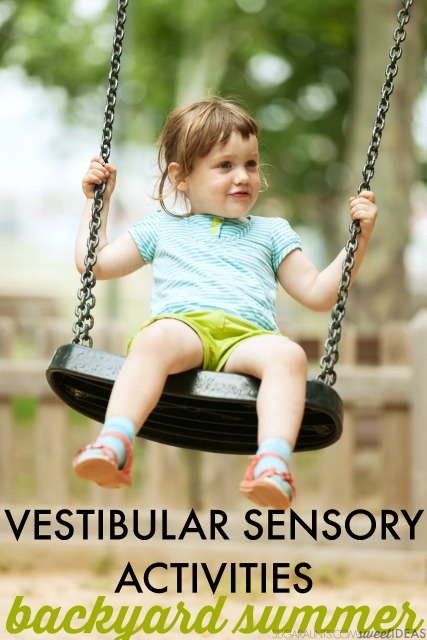
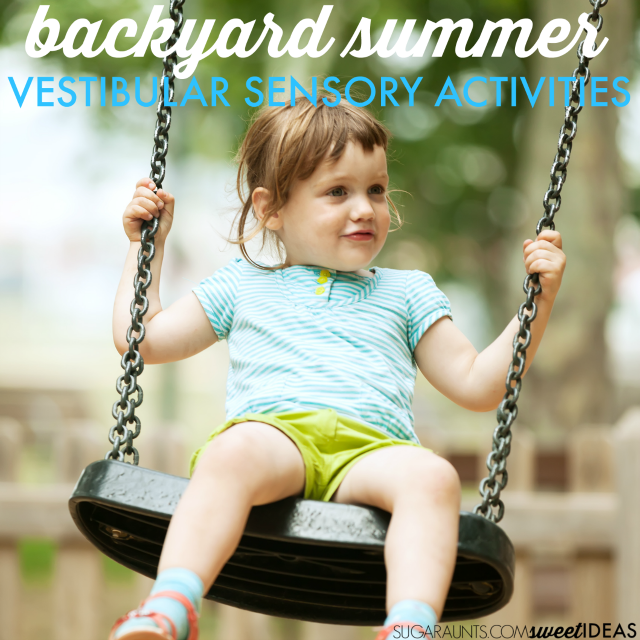
This collection of outdoor sensory activities focus on the vestibular sense. Today, I’ve got another post in the Backyard Sensory Summer series that have here on the website. This series of summer activity ideas are perfect for challenging kids to get outdoors and play. The backyard sensory ideas can be used as part of a sensory diet at home, or as individual summer activities. Today, we are talking about vestibular sensory activities for summer. Grab the kids, the family, or a favorite stuffed animal toy. Here are summer ideas for kids that incorporate the vestibular sense and are perfect for the backyard.
If you are looking for information on how to create a sensory diet and use these movement activities with kids, then you are in the right place. Here are more outdoor sensory diet activities to get you started with sensory needs and the outdoors.
If you’ve been following this summer activity series, then you know that I’ve been sharing sensory activities that can be done right in the backyard. In most cases, these sensory play ideas use toys and materials that you probably already own. Most importantly, these sensory ideas are perfect for getting the kids outdoors and playing in the backyard while meeting sensory needs. They are easy (and fun) ideas that can be added to a child’s sensory diet this summer and every day. Take these ideas and sensory play ideas right into Fall and all season long with backyard sensory play!
You’ll find ideas to use in virtual therapy sessions and to send home as home activities that build skills and power development with a fun, summer theme. Kids will love the Summer Spot It! game, the puzzles, handouts, and movement activities. Therapists will love the teletherapy slide deck and the easy, ready-to-go activities to slot into OT sessions.
VESTIBULAR SENSORY BACKYARD ACTIVITIES:
Swing painting- Grab some paint brushes and create art while providing vestibular sensory input in a calming back and forth motion in the swing. Read more about that here. (Idea from Homegrown Friends.
Slip and Slide Relay Race- Set up a slip and slide and use a timer to time kids as they race down the slide. Children can sit on their bottom, lay on their belly, or slide on their back for variations in positioning.
Slide on cardboard- Grab a cardboard box or even cereal box. Open it up using a sharp knife or scissors to create a large piece of cardboard. Kids can use the cardboard to slide down slopes. Try various positions on the cardboard. An alternative to this activity is using a cardboard box to create a “car” like we did here.
Picnic Blanket Roll- Use a large blanket or comforter as a picnic blanket. Spread it out on the grass and ask your child to lay on the blanket. Roll them up in the blanket to add a calming proprioceptive component with deep pressure. Roll the child in a log-roll fashion while they are wrapped up in the blanket. Then, why not use the blanket for a real picnic?
Roll down hills- Find a hill in the backyard and start rolling!
Spin in circles- This is a great activity with a family member or even a stuffed animal. Hold hands and spin. Try spinning fast, slow, to music, or even in the sprinkler.
Swing side to side on a swing set- Playing on the swings doesn’t need to look like the regular back and forth. Try swinging side to side. Ask the child to sit sideways and straddle the swing.
Hang upside down from swing set equipment- What are some other movement-based ways to play and challenge motor skills using the play equipment you already have? Climb up the slide. Swing on the belly. Create an obstacle course or play “the ground is lava”. The options are limitless.
Swing on a hammock- do you have a hammock? This inexpensive lawn item can be used in calming or facilitating side to side movements, rocking, a log roll swing, laying in prone or supine, or back and forth swinging.
Backyard dance party- Encourage lots of whole body movements and spinning. Use fast or slow movement to facilitate alerting or calming movements. Try adding a copy dance, or freeze dance play. Get the whole family involved.
Cartwheels- Tumbling or cartwheels in the lawn is a fun way to add movement right in the backyard.
Tumbles- If cartwheels are too tricky, try tumbles.
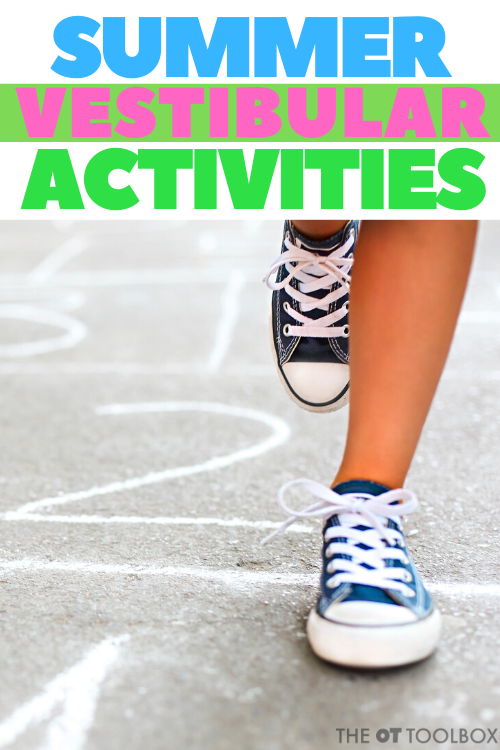
Hopscotch- Add this movement and motor planning game to the backyard. Use sidewalk chalk to draw a hopscotch board on the sidewalk or driveway. This is such a great core stability and strengthening activity for building confidence and coordination. There are options to upgrade or downgrade this activity. Use more or less hop spaces, or make them bigger or smaller.
Play Leap frog- This classic game is a great one for building gross motor skills, motor planning, core stability, visual convergence, and more with a movement based forward motion.
Mini trampoline (or the big sized-trampoline)- If adding a sensory tool to your backyard is priority, then a mini trampoline is an easy and affordable option. Kids can sit or stand to hop or bounce. Try adding other toys to make the sensory play interesting. Add water balloons, chalk, a sprinkler, or make a cozy resting place to calm down.
Colleen Beck, OTR/L has been an occupational therapist since 2000, working in school-based, hand therapy, outpatient peds, EI, and SNF. Colleen created The OT Toolbox to inspire therapists, teachers, and parents with easy and fun tools to help children thrive. Read her story about going from an OT making $3/hour (after paying for kids’ childcare) to a full-time OT resource creator for millions of readers. Want to collaborate? Send an email to contact@theottoolbox.com.
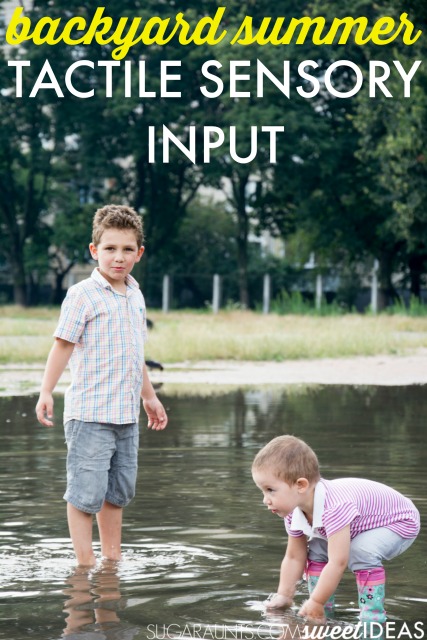
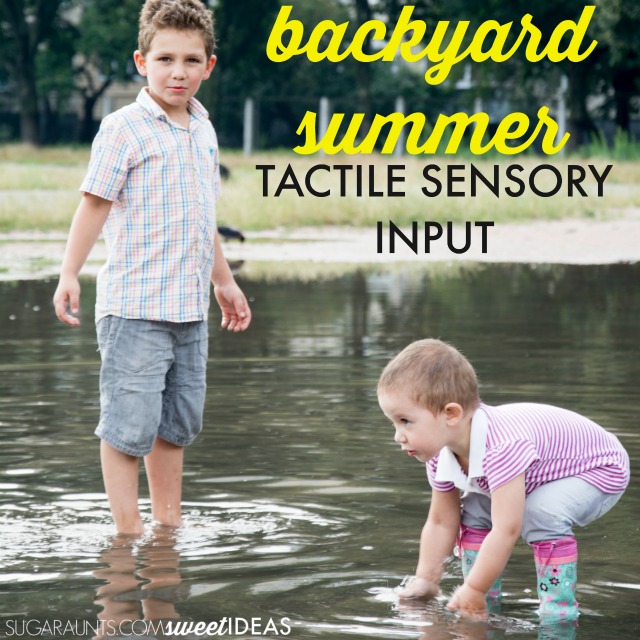
This article on outdoor sensory activities focuses on the tactile sense. Our sensory touch plays a huge part in sensory experiences, sensory tolerance and challenging behaviors (the actions we see) as a result of difficulties regulating tactile sensory input. From tickly grass on the bare feet to tolerating bathing suit textures or sunscreen, tactile input and summer go hand-in hand. If you are looking for outdoor sensory play ideas, then you are in the right spot!
Outdoor sensory Activities for Tactile Sense
Touching toes on the grass can make some kiddos squirm. The sandbox brings on a mini world of sensory defensiveness when grains of sand stick to skin. For the child with a hypersensitivity to touch, the backyard can be overwhelming. Other kids seek out tactile sensations and need to touch everything. Still others find comfort in certain sensations but other textures bring on the tantrums or withdrawal.
If you are looking for information on how to create a sensory diet and use these movement activities with kids, then you are in the right place. Here are more outdoor sensory diet activities to get you started with sensory needs and the outdoors.
outdoor sensory activities for autism
A quick note on various sensory challenges that can result in actions we see in neurodiverse children of all ages (adults included). Some of the outward actions we see can be related to sensory input that is regulated differently in summer or warmer weather:
Tolerance of shorts
Tolerance of bathing suits
Sensation of sunscreen
Sensation of socks or other clothing in hot weather
Humidity changes
Summer thunderstorms (can change the air temperature)
Short clothing that brushes on legs or arms
Sandals or open-toed shoes
Crowds or places where others are in close contact
Wearing a mask in warmer temperatures
This is just a short list of considerations. Remember that no child will be alike and there can be many other situations that arise in the summer months that impact tolerance of differences in tactile sensory input.
Below you will find outdoor sensory activities that focus on tactile sensory input as a challenge or outdoor sensory play ideas that can be helpful and fun this summer.
Create a mud kitchen in an area of your backyard. It doesn’t need to be complicated. A simple piece of wood or a sheet of cardboard makes a nice work space. Use buckets, scoops, and spoons to mix up muddy concoctions while working on fine motor skills, eye-hand coordination to scoop and pour in a tactile sensory (and very messy) imagination play.
Don’t be afraid to let the kids get muddy and messy! Just hose them off afterwards. Mud and puddles are a part of childhood and the dirt will wash off. Have fun and get messy with your kids!
Flower Sensory Bin- Explore tactile differences with an outdoor dandelion messy sensory bin. Add more squishy messy play by adding dirt or sand to the bin. Use scoops and tongs to add in fine motor work.
Feel and Name Game- Fill a bin or paper bag with grass clippings. To the bag, add random small toys, plastic figures, or magnetic letters. Ask the child to reach into the bag without looking. They can locate a small item and feel it as they try to name the object.
Sandbox Dig and Find– Practice tactile discrimination in the sandbox. You’ll need two sets of matching items for this activity. (Magnetic letters, coins, small figures, or matching utensils would work.) When the child is not looking, hide small objects and figures in a sandbox. Then, show the child an object that matches one of the hidden items. Do not name the object. Rather, ask them to “find another one just like this.”
When in doubt add water! Try these backyard sensory tactile play ideas: goop play dough shaving cream backyard messy play date paper mache.
Colleen Beck, OTR/L has been an occupational therapist since 2000, working in school-based, hand therapy, outpatient peds, EI, and SNF. Colleen created The OT Toolbox to inspire therapists, teachers, and parents with easy and fun tools to help children thrive. Read her story about going from an OT making $3/hour (after paying for kids’ childcare) to a full-time OT resource creator for millions of readers. Want to collaborate? Send an email to contact@theottoolbox.com.
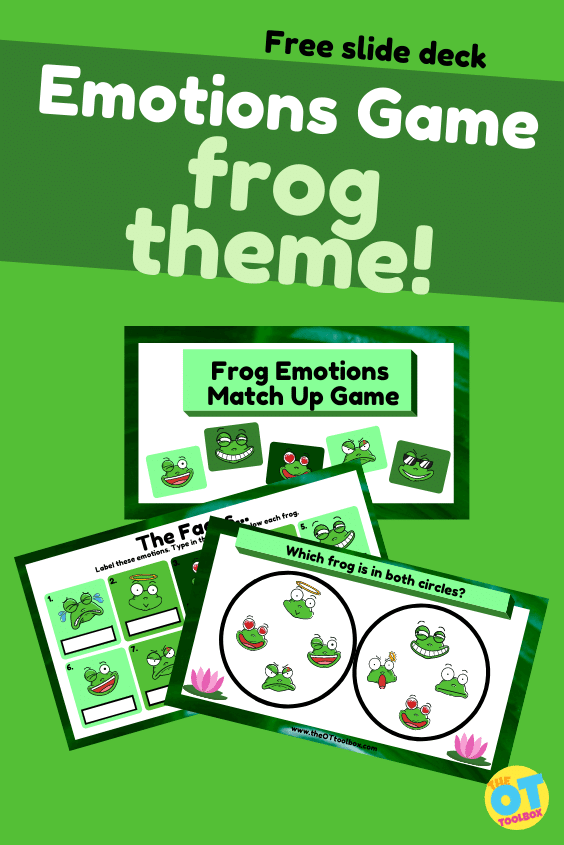
This frog emotions game slide deck is a tool for helping kids to identify emotions based on facial expression. It’s a social skills activity for young children that goes perfectly with this frog writing activity and our cute frog crafts. Use all frog games together as frog themed activities that develop skills.
Teaching emotions is an important part of social emotional development. That’s why this emotions game (with a cute frog theme) is so much fun, but also a great way to help kids learn to identify emotions, match up emotions by facial expression, and label different feelings. It’s just one of the many free slides here on the site, and one you’ll want to add to your toolbox.
Frog Emotions
You might be wondering “frog emotions? What does that mean?”
But we are not talking about the emotions of frogs here…we mean that you can use a fun theme like frogs and toads to talk to kids about emotions and emotional expressions! It’s an activity like this that uses frog emotions to help us explain to kids how they feel, how mood and affect impact their overall wellbeing, and how we all (even the cute frogs in this free slide deck activity) have feelings. It’s empathy skills through play!
Working with kids in occupational therapy sessions have shown me one thing…and that’s the fact that if we can make things fun and engaging (like the cute frogs in this activity) that we can help kids build skills!
This emotions game is modeled after several other similar emotions games we have here on the site. You can use all of these in sequence or to fit with different themes in therapy or in the classroom or home. Each emotions game includes a “spot it” type of matching game that allows kids to feel challenged, but also builds essential skills.
These other emotions games might fit with some of your themes you have planned:
The emotions games in these activities and in the one shown below, children can label different facial expressions and give a name to the visual emotions. The important thing here is to note that there is no right answer. Some children might have different names for emotions or the feelings that they experience.
In the frog theme slide deck, there are different facial expressions for each frog’s face. Kids can type right into the slide deck and add a label for those expressions. You can extend this activity in several ways:
Ask kids to mimic the visual facial expression that they see on each frog’s face.
Ask the user to identify a time that they have experienced that particular emotion.
Ask the user to tell about a time that they have seen other’s experiencing that emotion. You can talk about what might lead up to another person experiencing a particular feeling or emotion. This task helps to build empathy for others.
Ask the child to identify ways to reach out to others when they might be feeling particular emotions. How can they help others who are feeling sad or angry? How would they like others to reach out to them when they themselves are feeling a particular feeling?
Ask the child to specify ways that they respond to particular emotions. What do they do when they feel upset, silly, or frustrated?
The next part of the slide deck includes matching activities in a “spot it” type of emotions game. The slide decks are interactive, meaning that kids can move the lily pads to cover the matching emotion on each slide.
Each slide has only one matching facial expression, and the player can look at each image and try to find the matching expression.
Frog Emotions Game
As an occupational therapist, I’ve found that incorporating themed activities like a frog emotions game can be incredibly beneficial for children. This type of activity not only targets emotional regulation skills but also adds an element of fun and engagement to therapy sessions.
Children are often drawn to themed activities because they provide a novel and exciting experience, making therapy feel less intimidating and more enjoyable. The frog theme adds a playful twist, allowing kids to explore and express their emotions in a lighthearted manner. By integrating games like this into therapy sessions, we can create a motivating environment that encourages active participation and enhances the overall effectiveness of treatment.
The frog theme activity is a social emotional learning game that kids can use to build awareness and strategies, too.
After playing the emotions matching on the slide, then focus more on building awareness of emotions and social development. After the child finds the match, they can identify the expression that is depicted on that frog’s face. T
hen, go back to what was covered in the beginning with some of the same questions: how do they think that frog feels? When did they experience that expression? If they felt angry (or frustrated, silly, sad, etc.) in school when they need to complete an assignment? How would they feel if they were playing a game and experienced feelings of frustration?
All of these questions allow the child to think in situational experiences so they can be ready to function. Situational awareness, empathy of others, and social emotional development are all learned skills, and having experience, the words to use, and tools in their back pocket will allow them to function in future tasks or situations.
After you are done playing, just go to the slide deck edit history and click “reset slides” to revert them to their original set-up. You can then play again…just click the lily pads and drag them to cover each matching frog face, and work on labelling emotions again and again!
Free emotions game slide deck
We have a free frog themed emotions activity in slide deck form.
To add this free emotions game to your therapy toolbox, enter your email address into the form below. You’ll receive a printable that you can use in therapy, the home, or the classroom.
NOTE- Email addresses on a school or work server may block the email delivering your file. Consider using a personal email address for better deliverability.
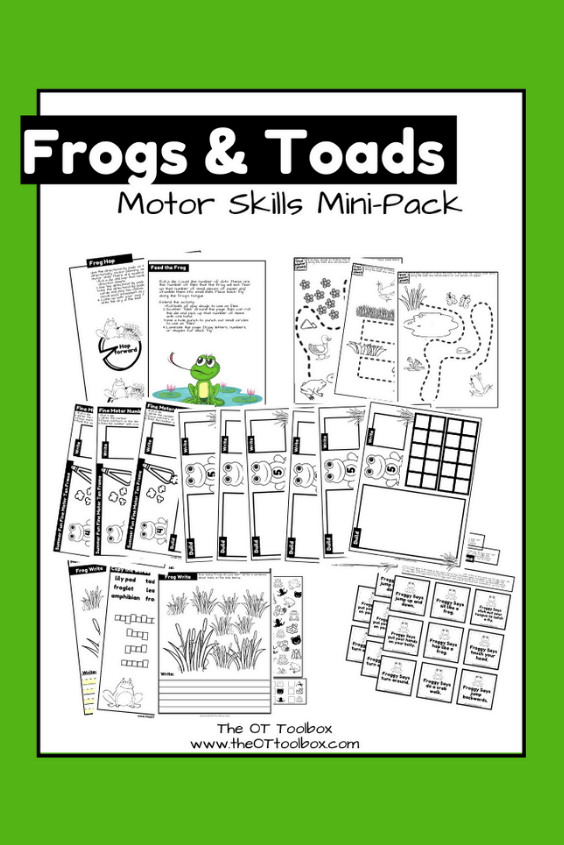
Done for you motor skills activities and FUN frog and toad themes combine in the Frogs and Toads Motor Skills Mini-Pack. Work on grasp, hand strength, eye-hand coordination, handwriting, scissor skills, heavy work, gross motor skills, coordination, and all things fine and gross motor skills in this 43 page printable packet.
Colleen Beck, OTR/L has been an occupational therapist since 2000, working in school-based, hand therapy, outpatient peds, EI, and SNF. Colleen created The OT Toolbox to inspire therapists, teachers, and parents with easy and fun tools to help children thrive. Read her story about going from an OT making $3/hour (after paying for kids’ childcare) to a full-time OT resource creator for millions of readers. Want to collaborate? Send an email to contact@theottoolbox.com.
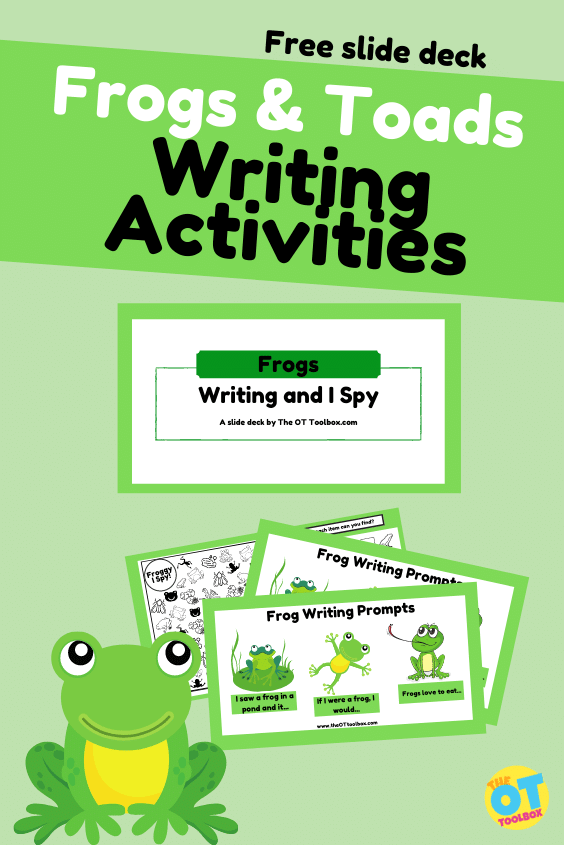
Today we’re talking all about frog writing! These frog writing activities are part of a free slide deck to outline therapy sessions and to use to foster visual perceptual skills and handwriting skills. Add these frog writing activities to this list of cute frog crafts which are designed to develop and refine fine motor skills in kids.
You’ll also love our frog emotions activity as another tool to add to your frog theme of activities!
The frog writing prompts included in this therapy slide deck are perfect to add to your frog theme or use in a weekly occupational therapy theme (or at-home theme for learning, play, and building developmental skills!)
Frog Writing
The kids that I’ve worked with in OT sessions love this frog writing activity…and they don’t realize all of the work they are putting into the task because it’s a fun way to target OT goals.
In my experience as an occupational therapist working in schools, incorporating fun themes into handwriting sessions has been incredibly effective for improving skills that impact learning. A frog theme set of activities is one way to do that!
The frog writing activity supports fine motor skills, visual motor skills, pencil control and overall handwriting skills. Utilizing frog writing prompts and activities not only adds an element of fun for the children but also provides valuable opportunities to address fine motor and visual motor considerations essential for handwriting.
Sometimes, having a set of themed activities set-up for therapy sessions is a “must” to keep therapists sane. It’s not about using the same activities with each student; Using a theme in therapy activities allows the therapist to use the same materials. And having the skilled ability to adjust for each individual is just part of an OT’s skillset. To make your life much easier as a busy therapist, head over to this free slides library and grab all of the therapy themes that fit your interests and those on your caseload.
That’s where these frog writing activities come into play.
The free slide deck includes several frog writing activities for users to build specific skills, depending on their needs and goal areas.
You’ll find frog I Spy game and several frog writing slides to work on handwriting skills.
More Frog Writing Ideas
There are more ways to work on fine motor and visual motor skills with this frog writing activity.
Copy the words to work on letter formation and copying skills
Use tweezers in fine motor activities that mimic the movements involved in catching or feeding frogs, such as using tweezers to pick up frog-themed manipulatives. This further strengthens fine motor skills essential for precise handwriting.
Fold paper into origami frogs
Frog I Spy
The first activity is a warm-up of sorts. You’ll find a frog I Spy game where users can locate, count, and find individual frog and toad images. This is a great visual perceptual skills activity to build and develop skills in areas such as:
Visual discrimination (needed for identifying differences between letters)
Visual scanning (needed for scanning a writing piece for where you’ve left off in copying materials)
Form constancy (knowing that a form or letter is the same no matter the positioning. This skill is needed for recognizing letters in different fonts and sizes)
When kids find the individual frogs and toad images they can type the number into the interactive slide deck.
This frog I spy game is available as a printable worksheet in our Frogs and Toads Motor Skills Mini-Pack. Find the items, then write the numbers in the boxes. Kids can also color or circle the items to build pencil control and fine motor skills. The packet is 43 pages of fine and gross motor skill activities with a frogs and toads theme. Not bad for the cost of a cup of coffee!
Frog Writing Prompts
Next in the frog writing activities are a few writing prompts. I’ve included both frog word writing prompts and also sentences as an open-ended writing prompt to foster creative writing.
The frog words include things like froglet, pond, lily pad, and words that are easily read and recognized by younger children.
Pair this activity with frog lifecycle activities for handwriting practice of letter formation, letter size, legibility, and even cursive handwriting for the older elementary ages.
The next piece is a frog writing prompt slide. This slide includes three writing prompts that users can use for longer writing samples.
All of these writing prompts are open-ended so that you can easily adjust the therapy sessions or home programing to meet the needs of the child or individual.
Free Frog Writing Slide Deck
Want to add this free slide deck to your therapy toolbox and work on handwriting and visual perceptual skills in written work? Grab this resource and outline writing activities so the kids you serve can work on areas like letter formation, copying skills, and more. You’ll need to enter your email address into the form below and the file will be delivered to your inbox. (School email addresses/work email addresses may block this email as it contains a link to access a file. A personal email address may work better for deliverability.)
Colleen Beck, OTR/L has been an occupational therapist since 2000, working in school-based, hand therapy, outpatient peds, EI, and SNF. Colleen created The OT Toolbox to inspire therapists, teachers, and parents with easy and fun tools to help children thrive. Read her story about going from an OT making $3/hour (after paying for kids’ childcare) to a full-time OT resource creator for millions of readers. Want to collaborate? Send an email to contact@theottoolbox.com.
Done for you motor skills activities and FUN frog and toad themes combine in the Frogs and Toads Motor Skills Mini-Pack. Work on grasp, hand strength, eye-hand coordination, handwriting, scissor skills, heavy work, gross motor skills, coordination, and all things fine and gross motor skills in this 43 page printable packet.
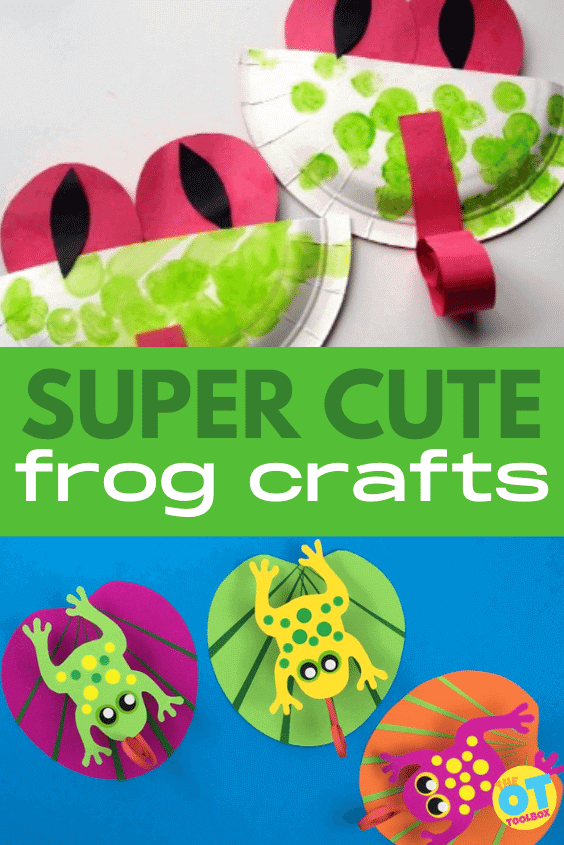
These cute frog crafts are fun ways to use a frog theme to build skills. From paper plat frogs, to cut and paste frog crafts, these are great occupational therapy crafts to use in fine motor skill work, scissor skills activities, and a frog and toad theme. These frog crafts will keep you hopping!
Frog Crafts
Frog crafts like the ones shown here are fun ways to build motor skills within a frog theme. Learning about the frog life cycle is a common theme in preschool or early elementary lessons. Use the frog crafts here as a developmental tool.
I love using crafts like the ones listed below in planning in person or OT teletherapy services. Other crafts can be sent home as an OT home program idea. Children can create while working on skills like fine motor dexterity and strength, line awareness, scissor skills, language, self-confidence, problem solving, tool use, and more.
These frog crafts can be added to a frog theme, with resources like:
As a pediatric occupational therapist, I love using crafts of any kind in therapy sessions because they offer a fun and engaging way to target important underlying skill areas. A fun frog craft is no different!
When children create the frog crafts we share below, they get to practice their fine motor skills by cutting, coloring, and assembling materials, all while strengthening hand muscles and improving coordination.
I especially enjoy seeing their faces light up when we hang the crafts we’ve created up on the therapy door or a bulletin board in the school hallway. This task of hanging the craft up is another way to incorporate functional movement to bend and reach, targeting balance and core strength. They can then use a stapler, tape, or sticky tack to hang their creation. But the real benefit is seeing their creation hanging on the wall for all to see.
We wanted to pull together some great frog crafts that support various skills. Following the step-by-step instructions for the craft also helps enhance their sequencing skills and attention to task, which are crucial for success in school and daily activities.
Plus, crafting allows children to express themselves creatively and provides a sensory-rich experience that supports emotional regulation and well-being. Seeing the joy and pride in their eyes as they complete their frog crafts is truly rewarding and reminds me why I love what I do as an occupational therapist.
Handprint frog Craft
Work on tactile sensory tolerance with this frog handprint craft. This is a great functional craft for kids because you can include a hand-washing activity after making the handprint art.
Washing off the green paint is an excellent visual in ensuring kids are thoroughly washing their hands.
Paper Plate Frog Craft
Work on scissor skills, bilateral coordination, hand strength, sequencing, and motor planning with this frog paper plate craft. Folding and cutting paper plates are great for building hand strength and working on finger isolation.
This craft includes different grades of cutting tasks and can be a great incentive for cutting simple to complex shapes.
Cutting paper plates is a strengthening activity that provides more resistance and can slow down the scissors, allowing for more accuracy along cutting lines. Use this paper plate frog craft to build these skills.
Frog and Lily Pad Craft
For more complex scissor skill crafts, try this frog on a lily pad craft. It can be a challenge for some kids, but cutting the frogs and lily pad shapes can be a just right level for others that are building scissor skills with complex lines.
Paper Frog Craft
For a fine motor workout, make this shredded paper frog craft. Kids can pick up and manipulate the shredded paper pieces while working on precision, tip to tip grasp, open-thumb web space, and more refined precision skills.
This easy shapes frog craft is great for preschoolers or those cutting simple shapes. Use this craft for beginners and to address scissor skills cutting along circles and simple shapes. (Then work up to the more difficult frog crafts.)
Toilet Paper Roll Frog
Try this toilet roll frog to work on refined grasp, precision, scissor skills, and more motor skill development.
You could also use paper towel rolls to make this paper roll frog.
These printable activities extend to work on a variety of other functional areas, too: handwriting skills, numbers, math, adding, subtracting, one-to-one correspondence, scissor skills, coloring, and more.
Done for you motor skills activities and FUN frog and toad themes combine in the Frogs and Toads Motor Skills Mini-Pack. Work on grasp, hand strength, eye-hand coordination, handwriting, scissor skills, heavy work, gross motor skills, coordination, and all things fine and gross motor skills in this 43 page printable packet.
Colleen Beck, OTR/L has been an occupational therapist since 2000, working in school-based, hand therapy, outpatient peds, EI, and SNF. Colleen created The OT Toolbox to inspire therapists, teachers, and parents with easy and fun tools to help children thrive. Read her story about going from an OT making $3/hour (after paying for kids’ childcare) to a full-time OT resource creator for millions of readers. Want to collaborate? Send an email to contact@theottoolbox.com.
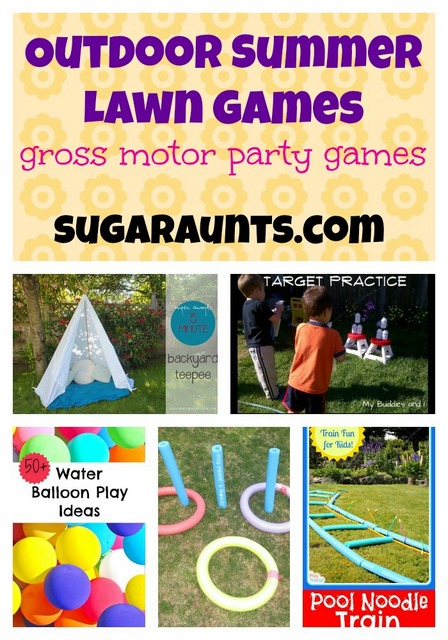
Here, you’ll discover outdoor lawn games that help children and families with development and play. These outdoor yard games build gross motor skills and are great for summer activities for kids, getting them outside and off screens. Playing in the yard is beneficial for so many reasons.
Getting kids outdoors and moving is a great for so many reasons: added physical activity, a break from screen time, adding heavy work movement, a chance to connect with others, and benefit from the outdoors. Whether the kids just need to get out of the house, or you have a birthday party to plan this summer, outdoor yard games are the way to go to add much-needed movement for kids of all ages.
Outdoor play offers an alerting or calming environment.
Outdoor play fosters listening skills.
Outdoor play provides an environment that encourages a calming and alert state of being.
Outdoor play encourages risk-taking and self-confidence.
Outdoor play supports executive functioning skills.
Outdoor play encourages participation in the sense of touch.
Outdoor play promotes heavy work proprioceptive input and movement in a variety of planes, offering vestibular input.
There are so many other reasons to get outside and play. Let’s get started on some of the outdoor lawn games for kids:
Running Games
Tag- There are so many benefits to playing tag with kids. Try these tag games (and read up on the therapeutic benefits of playing tag, too).
Wolf Wolf- One person is the wolf and stands across the yard. The others call out “Wolf, wolf: What time is it?” The wolf then says a time “It’s 3:00” and the other players take 3 steps across the lawn toward the wolf. When the players are close, the wolf yells out, “It’s lunch time!” and turns around and chases after the players.
Red Rover- Players split into two teams and hold hands across the lawn from the other team. One at a time, the team yells, “Red Rover, Red Rover, send (child’s name) over. That child runs across the lawn and tries to break through the line of the other team. If they succeed, that child returns to their own team. If they can not break through the arms of the other team, they then join the new team.
Relay Races- Split everyone into two teams. The two teams can run, jump, move, or do a variety of actions, one at a time. The first team to complete all of the tasks, one by one is the winner. Relay races can involve water balloons, carrying items, adding clothing materials, etc.
Hide and Seek- One person is “it”. The person who is “it” counts to a specified number while all of the other players hide. They then go out and look for the others.
Sardines- Just like hide and seek, sardines is a hiding and finding game. But, one person hides and the others are the seekers. When someone finds the hiding person, they join the person that is hiding. Then, everyone continues to hide with the person who is “it” until there is only one person left.
Monkey in the middle
4 Square
More Outdoor Lawn Activities
This massive list of outdoor lawn activities inspire movement, creativity, eye-hand coordination, motor planning, sensory input,
Colleen Beck, OTR/L has been an occupational therapist since 2000, working in school-based, hand therapy, outpatient peds, EI, and SNF. Colleen created The OT Toolbox to inspire therapists, teachers, and parents with easy and fun tools to help children thrive. Read her story about going from an OT making $3/hour (after paying for kids’ childcare) to a full-time OT resource creator for millions of readers. Want to collaborate? Send an email to contact@theottoolbox.com.
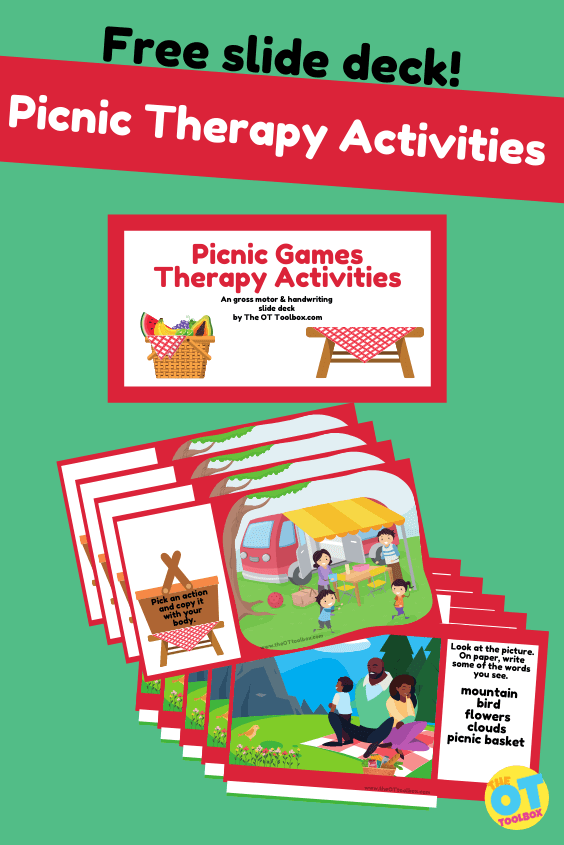
This week’s free slide decks are fun virtual picnic therapy activities that can be used to encourage motor skills in therapy sessions. I love the picnic theme for the upcoming warmer weather this summer, but also as a fun way to spend the last few weeks of the school year. Kids will love this virtual picnic in therapy or at home! Also be sure to grab this left right discrimination picnic theme slide deck.
Virtual Picnic
When you use this virtual picnic to facilitate gross motor skills, kids can move, strengthen core stability, work on bilateral coordination, crossing midline, motor planning, eye-hand coordination, body awareness, muscle memory, and many other skills.
Plus, the virtual picnic activities includes a visual perceptual skills activities, and picnic handwriting activities.
These virtual picnic activities go hand-in-hand with picnic crafts, fine motor activities, mindfulness activities, making a full week of camping themed or picnic themed fun for kids.
Combine the picnic therapy activities on this slide deck to some other, hands-on picnic themed activities to round out the therapy theme:
And, when you have a picnic, making picnic foods with kids is a must…further building fine motor skills, cognitive skills like planning, preparation, impulse control, and other executive functioning skills, and independence in daily tasks! Try these cooking with kids activities that help to build skills, but are GREAT picnic foods for kids to make:
Kids can participate in the virtual picnic by making one of these cooking activities (as long as they have a helper at home for their cooking activities) or, make pretend food and work on direction following, sequencing, planning, and task completion.
So, you can use these ideas to combine therapy recommendations for the home OR use these ideas in therapy sessions to create picnic themed therapy activities!
Want to add virtual picnic activities to your sessions or home programming? This week’s free slide deck covers several different occupational therapy intervention areas (and are great for physical therapy sessions, too.)
Picnic Gross Motor Activities
The first part of the slide deck includes picnic gross motor activities.
Kids can look at the image on the slide deck and pick out one piece of visual information in order to act out the picnic scene. Each picnic scene includes several people that are in various gross motor positions to challenge core strength, coordinatin, midline crossing, bilateral coordinaiton, motor planning, and more.
Kids can also work on visual perceptual skills such as visual discrimination, visual figure ground, visual closure, etc.
Children can then use this part of the slide deck to foster muscle memory, visual memory, and sequencing. You could go through this part of the slide deck several times and work on recalling physical motor sequences or play a memory game. The slides are pretty open-ended to facilitate a number of goal areas when it comes to gross motor skill, coordination, visual skills, etc.
Picnic Handwriting Activities
The next several slides in the slide deck are open-ended picnic writing prompts. There are more picnic scenes that include a variety of picnic items.
Children can scan the image and pull out words to write on paper, or they can use the list on the slide deck to copy and then find the hidden items in the picture.
To grade this activity, ask kids to compose a sentence using the picnic words on the slide. Or, ask children to circle the items on the slide using a shape feature on Google slides. These activities challenge the visual perceptual skills and visual motor skills needed for handwriting and copying written work.
Use these picnic handwriting activities to focus on letter formation, spacing, sizing, and overall neatness in handwriting skills.
Free Virtual Picnic Slide Deck
Want to add this virtual picnic slide deck to your therapy toolbox? Enter your email address into the form below to access this slide deck. Don’t forget to check out all of the Free Slides that we have available for teletherapy and for facilitating therapy sessions with kids!
Colleen Beck, OTR/L has been an occupational therapist since 2000, working in school-based, hand therapy, outpatient peds, EI, and SNF. Colleen created The OT Toolbox to inspire therapists, teachers, and parents with easy and fun tools to help children thrive. Read her story about going from an OT making $3/hour (after paying for kids’ childcare) to a full-time OT resource creator for millions of readers. Want to collaborate? Send an email to contact@theottoolbox.com.
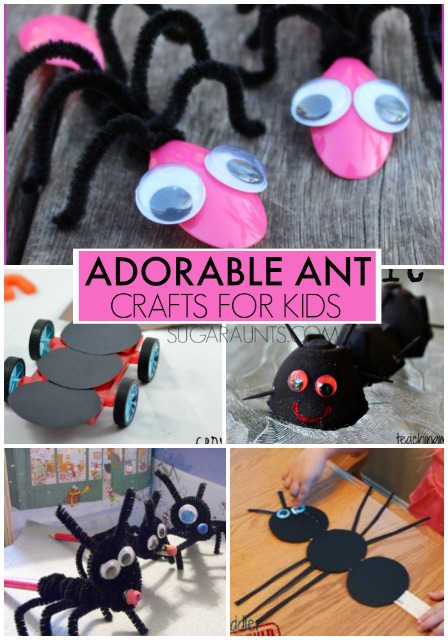
These ant crafts are completely adorable but more than that, each ant craft you find here is a powerful fine motor activity that builds hand strength, scissor skills, motor planning, direction following, sequencing, and precision. Check out each ant craft below for fine motor crafts to use in OT sessions or to develop specific skills.
You can add these ant craft ideas to a picnic theme in therapy. Be sure to grab these picnic activities for your ant crafts to join:
Virtual Picnic Activities– use this free slide deck to work on gross motor skills, coordination, motor planning, and handwriting in therapy or home programming.
When we saw Reading Book By Book’s ant hill reading activity, we had to share it. Then of course, we had to look for more cute ants on the web!
Try these other ant craft ideas as well:
This ant spoon craft from Paging Fun Mums is a fine motor activity for working on bilateral coordination and hand strength.
This ant egg carton craft from Teaching Mama builds precision, dexterity, in-hand manipulation, sequencing, and motor planning skills.
This ant puppet from Toddler Approved challenges scissor skills, bilateral coordination, eye-hand coordination, and other fine motor skills.
This ant theme from Chestnut Grove Academy includes an ant craft stamp activity that can build eye-hand coordination and add proprioceptive input.
Colleen Beck, OTR/L has been an occupational therapist since 2000, working in school-based, hand therapy, outpatient peds, EI, and SNF. Colleen created The OT Toolbox to inspire therapists, teachers, and parents with easy and fun tools to help children thrive. Read her story about going from an OT making $3/hour (after paying for kids’ childcare) to a full-time OT resource creator for millions of readers. Want to collaborate? Send an email to contact@theottoolbox.com.