Colleen Beck, OTR/L is a pediatric occupational therapist and the owner and author of The OT Toolbox website. She manages all of The OT Toolbox social media accounts and runs the popular newsletter.
Read about Colleen's experience and career as an occupational therapist, including how The OT Toolbox began on our About The OT Toolbox page: https://www.theottoolbox.com/about-us/
Colleen created The OT Toolbox in 2011 and since then has written thousands of blog posts designed to support therapy providers, educators, parents, counselors, admin, and caregivers in promoting the healthy development of kids.
Check out Colleen's blog posts below:
This year, as we prepare for back-to-school, many therapists are asking how to create therapy kits. Many parents are wondering how to set their child up for success in hybrid schooling. Many with kiddos that will attend full or part-time online school are trying to figure out how prepare for the upcoming school year.
As a pediatric occupational therapist, I have always come up with small occupational therapy boxes or “kits” to use in practice. I love to create a themed box or bin of OT activities and use that to work on a certain set of skills.
THEMED THERAPY BOXES
In this upcoming school year, we will be using themed kits in our home to help my youngest learn and develop skills (handwriting, precision in cutting with scissors, reading, manipulatives and math). This was one way that I was able to hold her attention for schooling at home this past Spring, and we will continue with that strategy this school year.
Some ideas that help to hold a child’s attention and get them excited for therapy or learning include these therapy boxes based on a theme:
Each of these themed therapy bins takes a common theme and offers ways to build skills- fine motor skills, sensory exploration, and more- through play!
Having a boxed set of therapy materials allows children to explore tools that help them grow stronger as they explore and play. Kids love to “unbox” the materials and use them while they discover the therapy box materials.
It’s a great way to get kids excited about therapy this Fall when school and learning routines are out of the ordinary.
THERAPY BIN GIVEAWAY
The boxes are available as a single box purchase or in a monthly subscription model so that each month, you have a new therapy box arrive at your door. What a great way to get the kids excited about building developmental skills!
When you receive your box, you will be provided with activities for fine motor development, gross motor development, sensory play and family fun to enhance opportunities for growth & development.
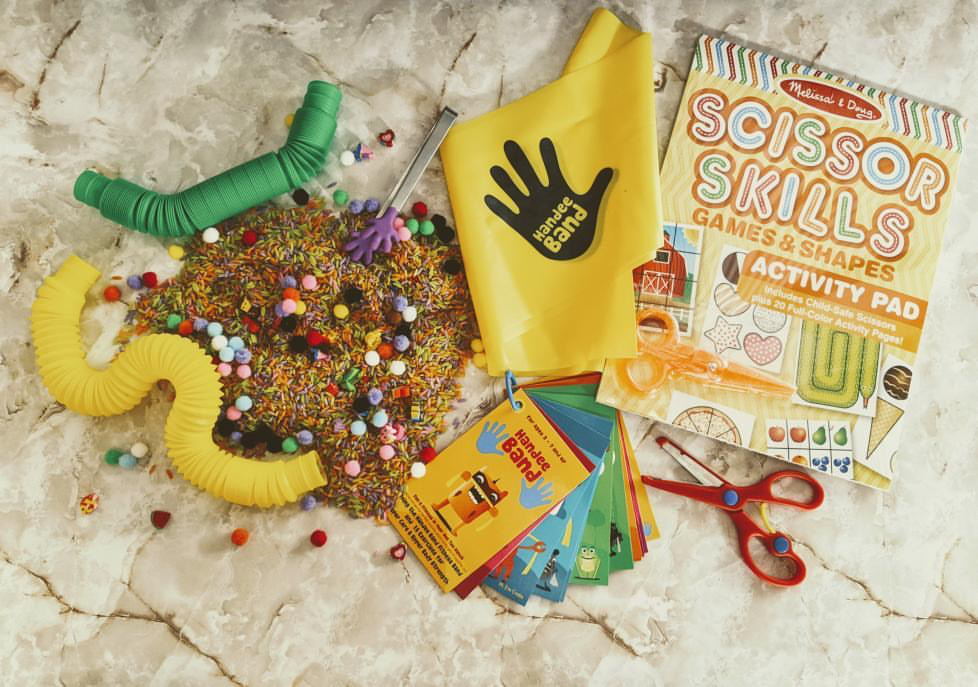
Check out the items in this giveaway box…add these tools to your OT sessions or at home activities:
OT for Me, is dedicated bringing families quality, hand-picked products and activities that have been tested and approved by the occupational therapy creators.
The therapy box aims to enhance kids’ individual skills and is cognizant that not all children develop at the same rate, so descriptions of the skills each product targets include strategies to make each activity harder or easier for that “just-right challenge”.
Each month, the therapy boxes are packed with new and exciting activities, meant to motivate children to “work” on developmental skills, all while having fun. Each box will always have an activity or product targeting the following 4 domains: Fine motor, Gross Motor, Sensory, & Academic/Family Fun- as well as other fun items!
Colleen Beck, OTR/L has been an occupational therapist since 2000, working in school-based, hand therapy, outpatient peds, EI, and SNF. Colleen created The OT Toolbox to inspire therapists, teachers, and parents with easy and fun tools to help children thrive. Read her story about going from an OT making $3/hour (after paying for kids’ childcare) to a full-time OT resource creator for millions of readers. Want to collaborate? Send an email to contact@theottoolbox.com.
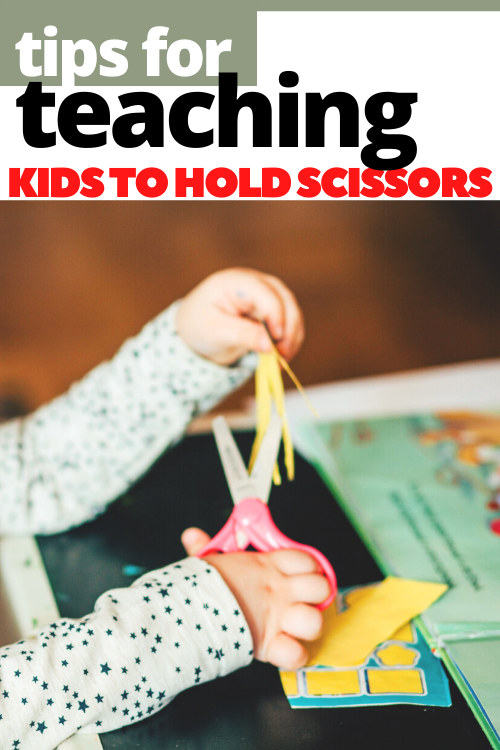
Teaching kids to cut with scissors depends a lot on the type of scissors that are used. Ask any pediatric occupational therapist, and you will find recommendations for kid-friendly scissors that actually allow kids to cut paper. You know…the training scissors to introduce kids to scissor skills…the ones that don’t just tear through paper.
Choosing the best scissors for kids
When it comes to finding the best scissors for kids, there is a lot more to it than you might think. Cutting scissors need to fit the child’s hand and feel comfortable. They need to be safe and allow the child to learn to manipulate the scissors while cutting paper (and nothing else). They need to have molded handles that are easy to hold in the correct position. And they need to grow with the child so they can progress from cutting snips to shapes and multi-angled forms.
Teaching kids to cut with scissors is a progress. There are tips that can help along the way and there are strategies that can help a child succeed.
Having scissors and a strategy can help!
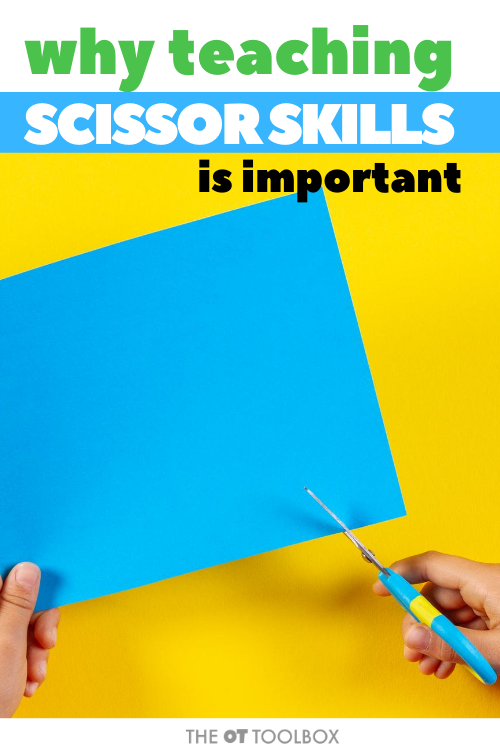
Why is cutting with scissors important?
When we teach kids the correct way to hold scissors, kids find so much more success in cutting shapes. You probably have seen the child that holds scissors sideways on the paper. They open and close the scissor blades but nothing happens.
Maybe you’ve seen the child that pushes the scissors through the paper. They tear and rip the page instead of cutting along the lines.
You might recall the child that holds the scissors with their elbow out and up in the air so they are cutting in toward their body instead of out and along the lines.
All of these positioning tactics lead to poor scissor skills and a frustrated kiddo.
Importance of Scissor Skills
When we show kids how to properly hold scissors we set them up for success. When we hand scissors that properly fit the child, we are providing the tools for accuracy.
Teaching kids to hold the scissors correctly allows them to position correctly so they can cut along the lines and feel success as they cut shapes.
When kids open and close the scissor blades, they gain precision of fine motor skills. And, those same fine motor skills allow the child to gain accuracy in cutting more complex shapes and forms.
Cutting with scissors builds bilateral coordination skills so they can use both hands together in a coordinated manner.
Cutting along lines offers a way to gain accuracy and precision in eye-hand coordination skills.
Not only are kids gaining developmental motor skills, they are completing a functional task, too. Teaching kids the proper way to hold scissors allows them to open and close the blades to cut along the lines with accuracy. They can snip the paper rather than tear. They can progress in scissor skill development from showing an interest in cutting with scissors to cutting complex shapes.
So how to teach kids the right positioning for cutting with scissors?
Positioning for scissor skills
First in addressing positioning for scissor skills is sitting posture. Make sure the child is seated at a desk or table with their feet flat on the floor and arms at a functional position. Using a table that is too high puts the elbows and shoulders into too much flexion.
Tuck the elbows into the sides. Many times, we see new scissor users holding their elbows way out to the sides as they attempt to bring the scissor work closer to their face and body. Actually, having the child tuck their elbows into their side offers more support so they can work on refining those fine motor skills.
Make sure the scissors are positioned on the hand correctly. Kids often times, place their thumb in the small loop of the scissor handles and push all of their other fingers into the larger hole. If possible, ensure that the thumb is in the smaller loop and the middle finger is placed in the larger loop with the ring ginger and pinkie finger tucked into the palm for support.
If that positioning isn’t possible, allow the child to use their middle, ring, and pinkie fingers in the larger loop.
Be sure that the scissors are positioned perpendicular to the paper. When the scissors tilt sideways due to upper body positioning, the paper tends to tear rather than cut.
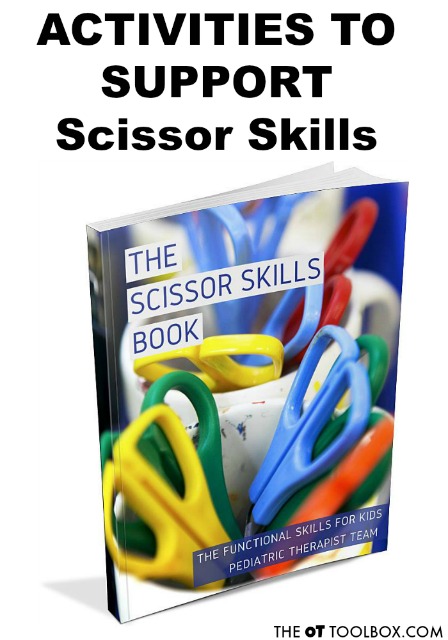
All of these tips, and much more are available in The Scissor Skills Book, created by an occupational therapist and physical therapist team that covers all things development and motor skills needed for cutting with scissors.
Scissor Skills Curriculum
So, if working on scissor skills, positioning, and building scissor accuracy is something you are working on with kids, then you are going to love this item!
This scissor book offers step by step strategies to support development of scissor skills. It’s a therapist’s look at scissor skills curriculum using a developmental approach to help with positioning the scissors so kids can cut along lin
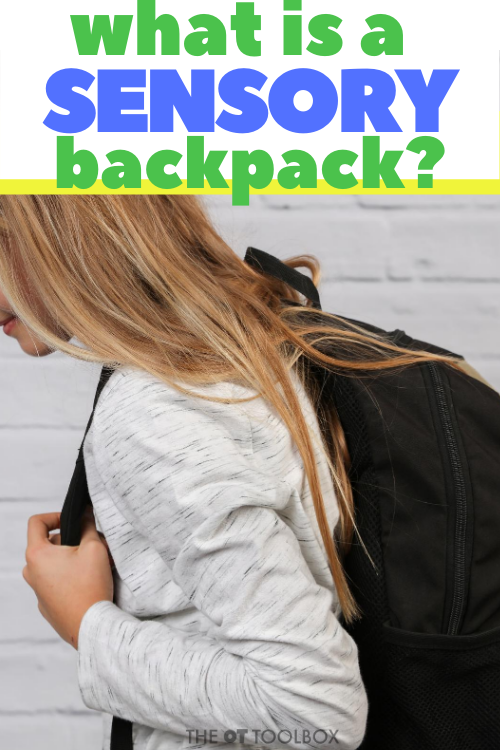
Today, we are starting off our Christmas in July celebration with a giveaway on a Sensory Backpack! Sensory backpacks are a powerful calming tool for children of many needs. There are weighted backpacks, compression packs, and book bag fidget tools out there. Here, you’ll find out some information on these sensory resources AND, can enter for a chance to win a Relax Pack Sensory Backpack of your own!
What are Sensory Backpacks?
Have you heard of the term “sensory backpack”?
Most kids you know probably have a backpack that weighs way too much for their age or size. But for some children, the added weight of a backpack is calming. It’s proprioceptive input that has an organizing effect on kids.
Sensory diet bags are tools that help to support a child’s sensory needs, while on the go, at school, or in the community. Understanding your child’s Sensory Needs is just part of the puzzle.
A sensory kit can be used to meet the needs of a child and can look like many things: Sensory kits like a weighted backpack offers calming sensory inputthat can be used to both calm and stimulate a child’s sensory system.
Typically, it is portable and easy to maneuver as a way to make the tools accessible at all times to the child or children in need. Since all children have sensory needs, a sensory backpack can be a way to provide sensory input in a discreet and engaging way.
Sensory backpacks offer proprioceptive input in the way of pressure and weight.
They offer a means for the child to fidget and move their hands.
Many times, there are chewable items for the child to gain calming, heavy work through the mouth.
By using all of these items on a sensory backpack, kids can gain calming, heavy work input that allows them to focus, pay attention, remain safe in group settings, and help to organize the child during community settings or outings.
Calming Sensory Input
Children with sensory problems often are either at high alert hyper-reactive or unresponsive (hypo-reactive) to the input from their environment. They become overly distracted by outside stimuli, or they may seek out additional sensory input from the world around them. Over responsiveness or under-responsiveness can mean difficulty with paying attention or focusing.
The proprioceptive system receives input from the muscles and joints about body position, weight, pressure, stretch, movement and changes in position in space. Our bodies are able to grade and coordinate movements based on the way muscles move, stretch, and contract. Proprioception allows us to apply more or less pressure and force in a task. But, the sensory system allows us to accept input too, in a way that is calming and organizing, so that we can self-regulate input from the world around us.
Self-regulation is an issue in sensory integration disorders and other diagnoses…as well as in children without a specific diagnosis. Children with self-regulation problems usually demonstrate unusual sleeping patterns, eating difficulties and self-calming issues. They struggle to cope with sensory input and need coping strategies.
Sensory input in the way of deep pressure, weight through the muscles or joints, chewing on resistive surfaces, or bear hugs are some coping tools that can have a grounding effect on kids with sensory issues.
Sensory Backpack Calming STRATEGY
That’s why a sensory backpack offers such a calming and organizing input for kids.
It’s a powerful way to help kids feel safe, pay attention, focus on walking in the hallway, or on the bus.
This year, children may return to school with an even higher level of anxiety or worries. Things are different this year and the school schedule may be different. Maybe kids are not in school at all.
A sensory backpack can offer a routine for schooling at home and allow them to self-sooth using proprioceptive input so they can complete distance learning tasks.
Friends, I think if there is one thing to say about 2020, it’s that we all could use a break. A mental break, an emotional reprieve, and just rest. Because this has been such a stressful year, I wanted to bring you a week of giveaways for an occupational therapy Christmas in July event. This Christmas in July party is to celebrate YOU! It’s to honor all that OTs, teachers, and parents offer in the way of adapting to recent changes, managing balance, and providing support for our kids.
This giveaway offers a chance for you to win an item that will be useful in helping kids thrive. I’me excited to share with you a WEEK of giveaways on items that can be used in occupational therapy practice or in addressing the needs of children of all ages.
Christmas in July Giveaway!
You will want to bookmark this page, because here you will find each day’s giveaway item linked so that you can easily get to the giveaway page.
Here is what you need to know:
1. Each day from July 24th-August 1st, you’ll find a new giveaway item listed here. Feel free to enter one or all of the giveaways!
2. Participants are limited to US entrants only due to deliver-ability.
3. Each item has one winner. Winners will be randomly chosen. Winners will be notified through email. If your name is randomly chosen as the winner we will email you for shipping information. The giveaway item will then be shipped to you.
4. Giveaway is open July 24th-July 31st at 12:01 am PST. Each day, a new giveaway item will be announced here and in a new blog post. Enter to win by leaving a comment on the giveaway item’s blog post.
Without further ado, here are your giveaway items:
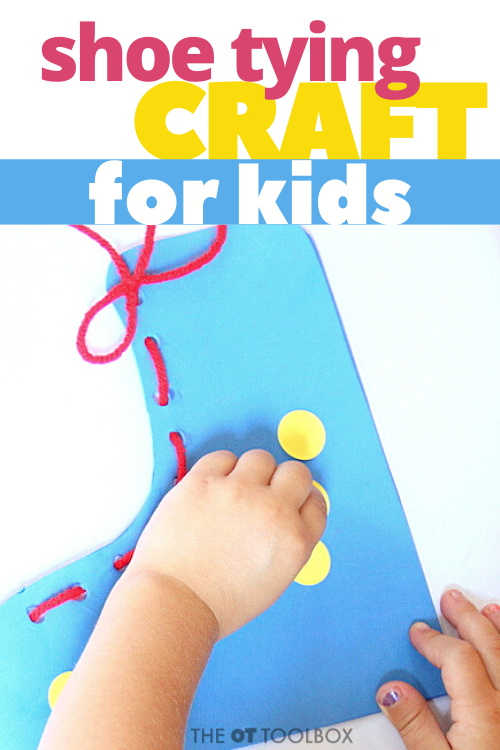
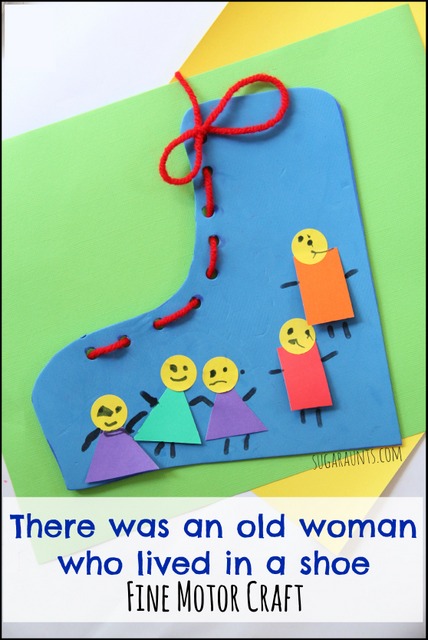
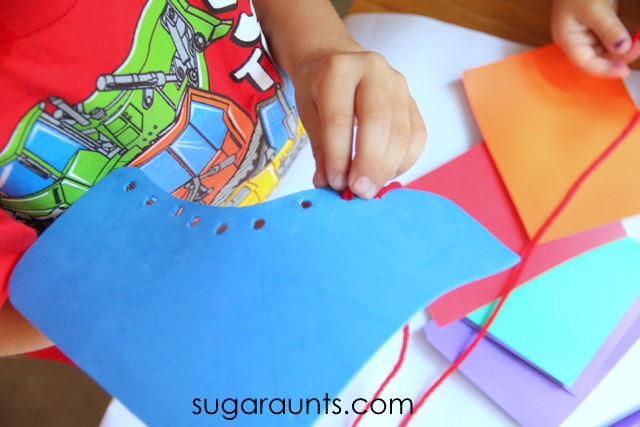
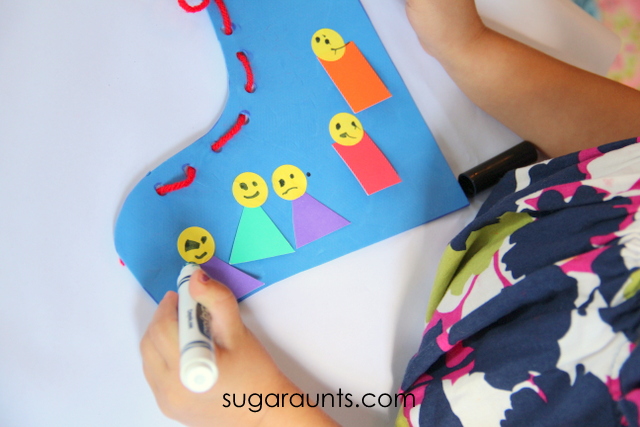
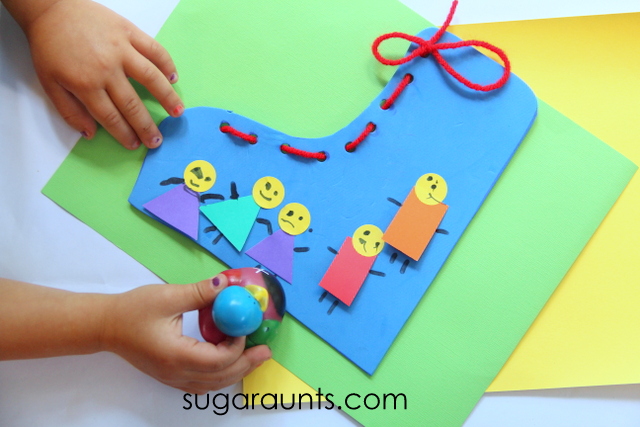
This nursery rhyme craft is based on the classic nursery rhyme, “There was and Old Woman Who Lived in a Shoe”. We had a blast building fine motor skills with this kids craft. It’s a great way to work on shoe tying, too!
Shoe tying craft for kids
We are starting off the nursery rhyme craft and activity series with a timeless nursery rhyme…There was an old woman who lived in a shoe. This is one of our favorite nursery rhymes to recite, although to be honest, in our house we love them all! When we visit the library, we usually hit up the nursery rhyme shelf and come home with a book or two about nursery rhymes.
Nursery Rhyme Craft
There is just something wonderful about reciting nursery rhymes. The repetition of rhythm and rhyme teach kids about language, memory, and literacy. They are fun to say over and over again. And with this repetition, comes self-confidence in the child. The timeless quality of nursery rhymes brings together generations of storytelling. There is much to discover about how nursery rhymes help with learning, including pitch, imagination, sequencing, and phonics.
We recited “There was an Old Woman who lived in a shoe” and made a boot craft to explore the rhyme. There was an old woman Who lived in a shoe. She had so many children She didn’t know what to do. She gave them some broth And a big slice of bread, Kissed them all soundly And sent them to bed. (We went with the Mother Goose version)
This post contains affiliate links. Thank you for your support of this blog.
Shoe Tying Craft
This craft doubles as a shoe tying craft, too. Kids can build so many skills by making this craft, that are so important for shoe tying, including:
Bilateral Coordination
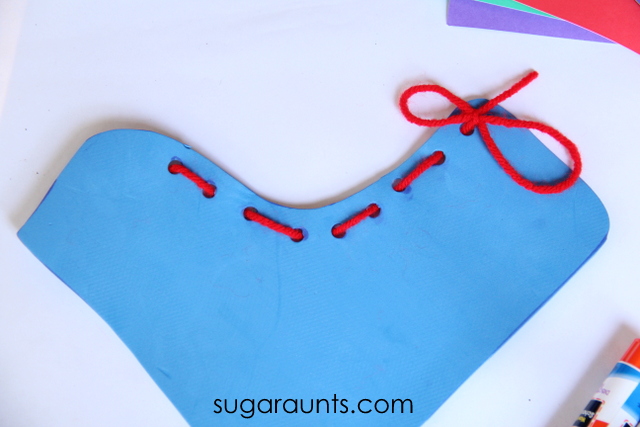
Lacing a shoe
Pincer Grasp
Eye-hand coordination
Tying a bow
The best thing about this shoe tying craft is that kids will leave with a sense of accomplishment, allowing them to feel self-confidence with shoe tying.
There was an old woman who lived in a shoe craft
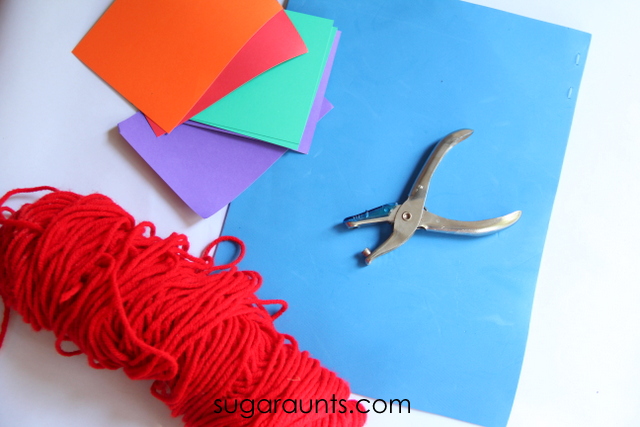
We started with a few supplies to make our nursery rhyme craft:
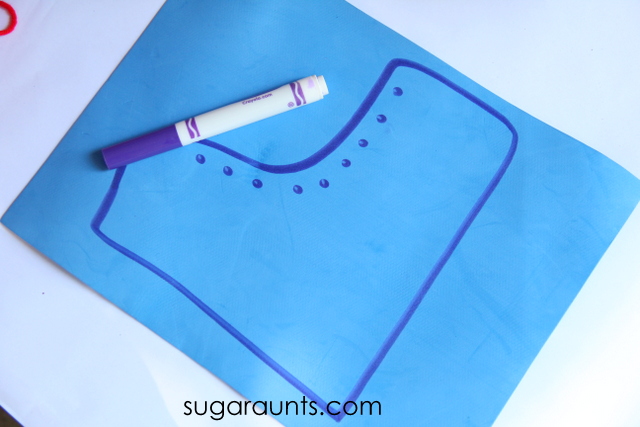
Start by drawing a large boot shape on the craft foam sheet. Draw dots with the marker for the lacing holes.
Older kids can cut out the boot shape. Crafting foam is a great material to snip with scissors and provides a different resistance when cutting.
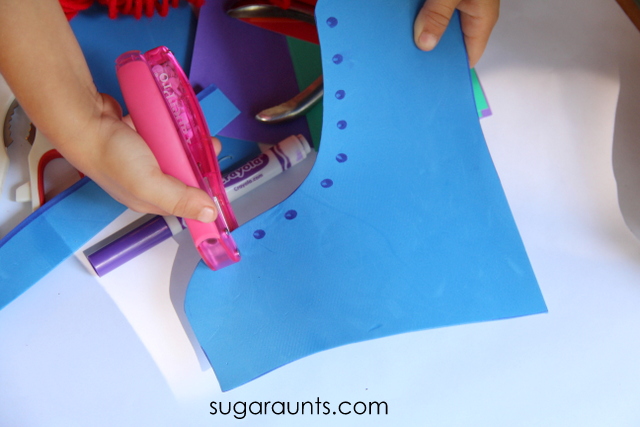
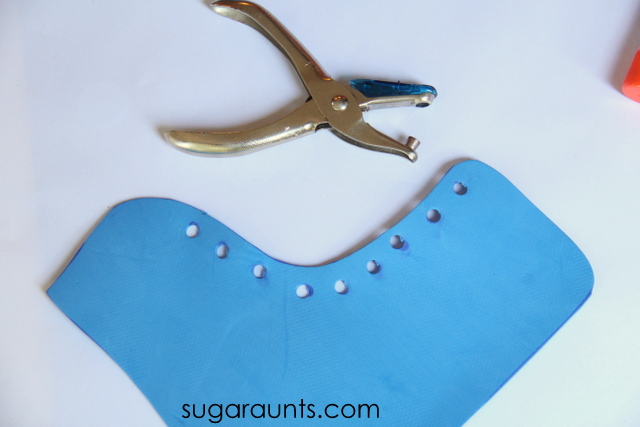
Use the hole punch to punch the lacing holes. We started with a kid friendly hole punch, but it didn’t work very well on the craft foam material. The old fashioned hole punch worked better.
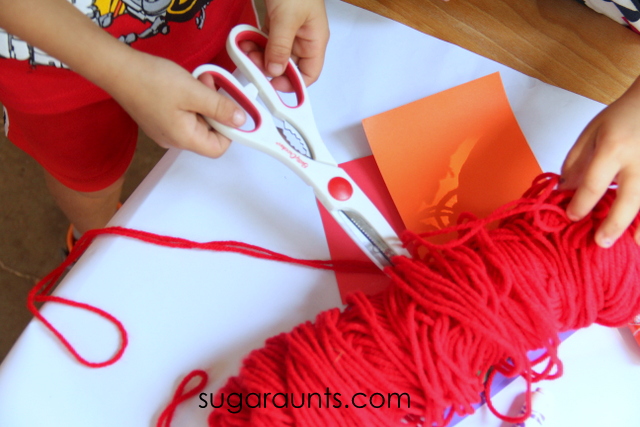
Snip a long length of yarn. Clearly Little Guy needs a little work on his scissor grasp. 😉 He was being silly with cutting the yarn.
Here is a guide to scissor skills, including the bilateral coordination needed for shoe tying AND cutting with scissors.
Tape one end of the red yarn to the back side of the boot. Get the kids lacing away on the boot. This is a fantastic fine motor task for little fingers. Tripod grasp, bilateral hand coordination, motor planning, eye-hand coordination…lacing is great for preschoolers!
This boot alone would make a very cute fine motor craft. But it needs a little something extra for our nursery rhyme.
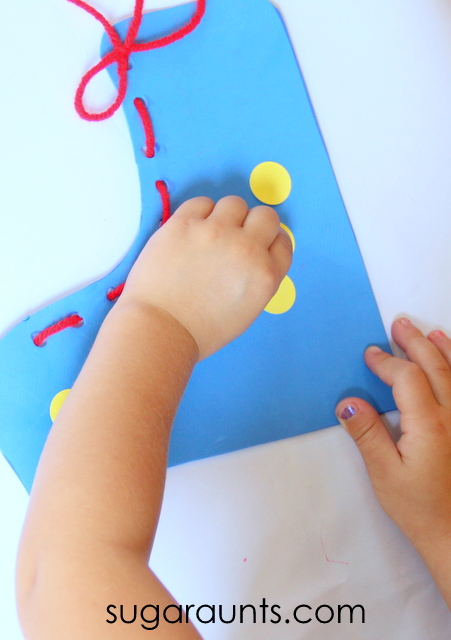
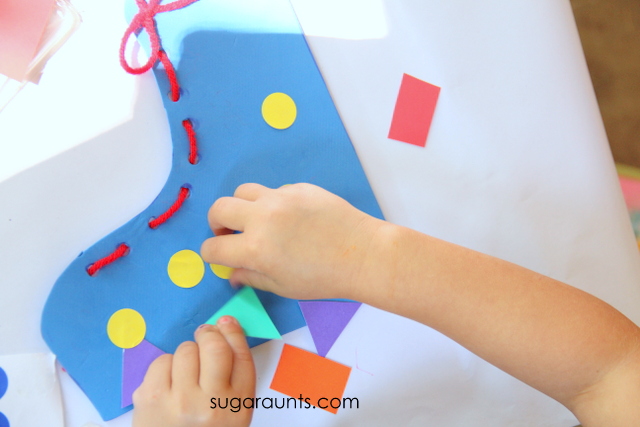
We made a little old woman and many children on the boot. Baby Girl loved sticking the yellow circle label stickers onto the boot. These would be the faces.
Next, we cut our colored card stock into triangles and rectangles for the bodies. More fine motor work with the snipping card stock. A bit of glue holds these shapes in place. Be sure to talk about shapes and colors with your preschooler while doing this part.
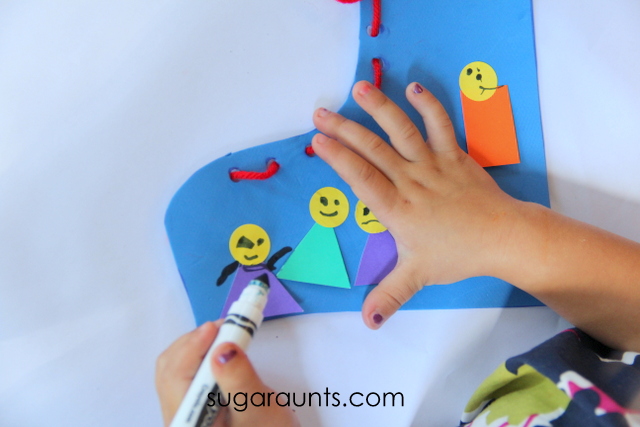
Baby Girl used a marker and drew faces on each person. Working in a small defined area is a great way to further develop pre-handwriting skills drawing and pencil control.
She then drew arms and legs for the old woman and children.
How cute is this nursery rhyme craft? It brings the rhyme to life with imagination and creativity. Baby Girl wanted to introduce a duck to the woman and children.
Be sure to stop back tomorrow and the rest of this week and next week for the rest of the nursery rhyme series. You can find them all of our nursery rhyme crafts here.
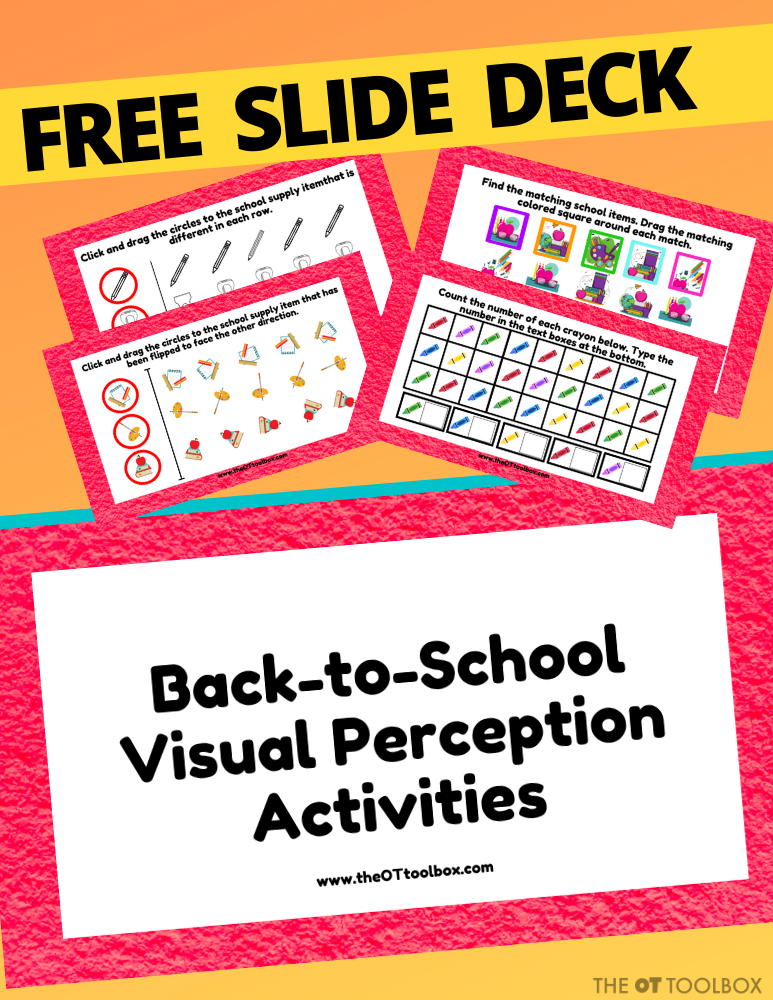
If you are like many OT professionals, you are looking for back-to-school activities for occupational therapy. That’s why I wanted to get this back to school slide deck into your hands! It’s a slide deck activity for addressing visual perceptual skills and fun for occupational therapy activities that may be occurring via teletherapy this year. Use this OT slide deck to work on visual perception with a first day of school theme!
Slide Deck for Back to School Activities
Below, you’ll find a form to enter your email to grab this free interactive slide. But first, I wanted to explain how this slide deck works.
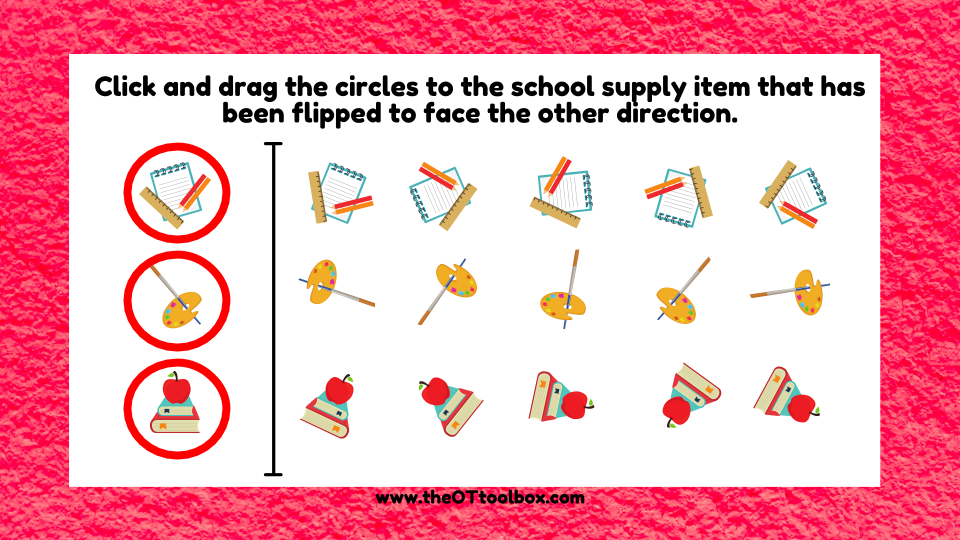
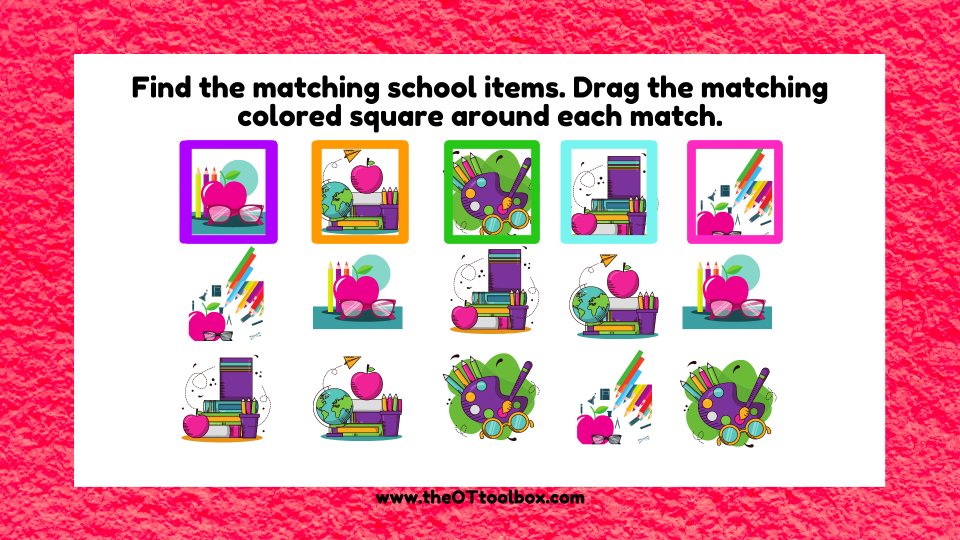
Kids can work through the interactive slides and move the movable parts of the slides to practice visual perceptual skills. The slides are designed to build skills in the following visual perceptual areas:
Form constancy
Visual discrimination
Visual memory
The slides include school materials for a back-to-school theme.
Children can use the slides to practice these specific skills while strengthening visual processing skills including visual scanning, visual fixation, and visual attention.
Finally, eye-hand coordination is needed to manipulate the interactive portion of these slides to move the outline to select certain images.
This blog post on visual motor skills really explains these areas of visual processing and offers tons of hands-on activities to help kids build these skill areas so that they can read and write at a functional level.
Why use a slide deck to work on visual perceptual skills?
There are many functional skills that are impacted by visual perceptual difficulties. Some examples include:
Letter reversal
Poor line awareness in handwriting
Poor margin use in written work
Difficulty copying written work
Trouble recognizing patterns and completing hands-on math problems
Difficulty catching or kicking a ball
Trouble with movement games like hopscotch.
Clumsiness
Difficulty with sports
Difficulty drawing and copying pictures or shapes
Working on the underlying visual processing skills in puzzles and activities like the ones in this back to school slide deck can be one way to build these areas.
FREE back to school SLIDE DECK
Here’s how you can get the interactive slide deck to work on letters:
Enter your email address in the form below. Check your email and click on the button to grab your resource. Save that page so you can access these slide decks again.
Sign into your Google account. Click on the big button in that PDF that you just accessed. It will prompt you to make a copy of the slide deck. That will be your master copy of this slide deck.
Now the slide deck is on your Google account.
Share the slide deck with students. You can make a copy for each student and upload it to their Google classroom or use it in Zoom. Here is a post on FAQ for troubleshooting any issues you might run across with using or accessing the slide deck.
Be sure to sign up for other slide decks that we have to offer. You will have to enter your email address for each one so you can get the resource and make a copy of each slide deck.
Be sure to check out these other slide decks to use in OT teletherapy sessions, distance learning, or homeschooling:
Colleen Beck, OTR/L has been an occupational therapist since 2000, working in school-based, hand therapy, outpatient peds, EI, and SNF. Colleen created The OT Toolbox to inspire therapists, teachers, and parents with easy and fun tools to help children thrive. Read her story about going from an OT making $3/hour (after paying for kids’ childcare) to a full-time OT resource creator for millions of readers. Want to collaborate? Send an email to contact@theottoolbox.com.
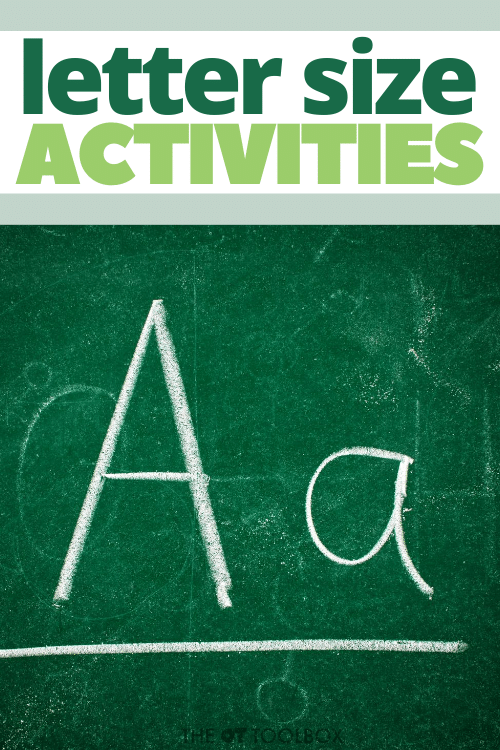
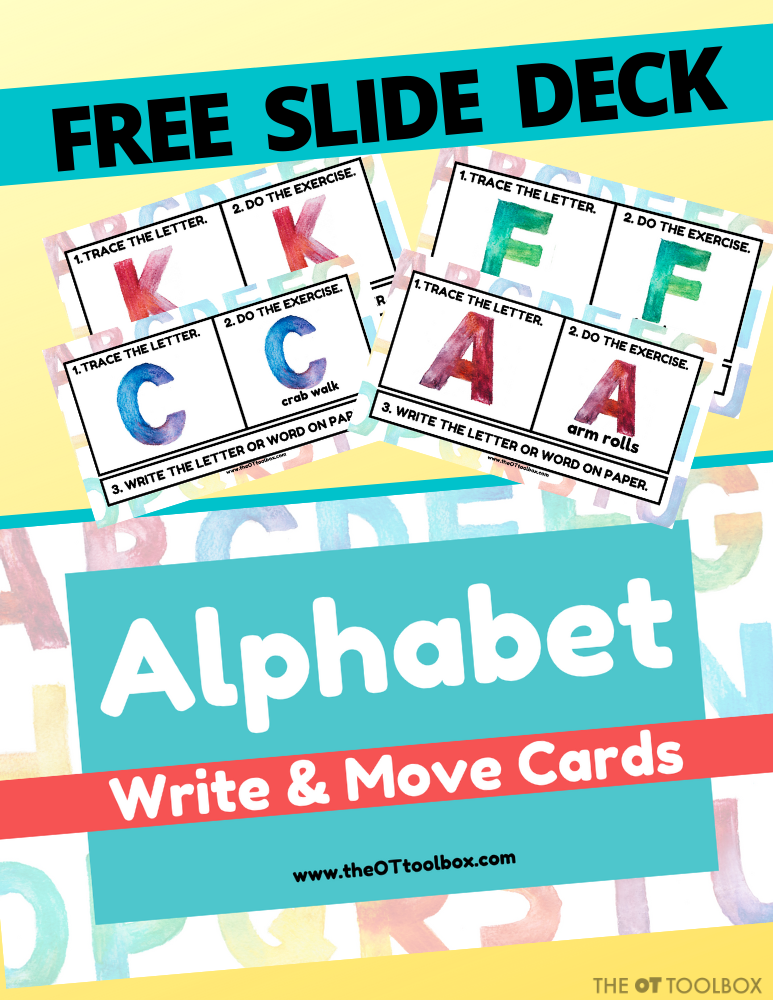
If you’ve been following along with the site over the past few months, you may have seen some of my free interactive slide decks and teletherapy resources. Today, I’m adding to those virtual therapy activities with this alphabet move and write slide deck that makes a nice addition to occupational therapy teletherapy activities. The letter slide deck is great for using in either virtual occupational therapy sessions or as a part of distance learning. With the uncertainty of the upcoming school year, I wanted to fill your therapy toolbox with digital resources like this one. Therapists can use the slide deck for teaching letter formation and handwriting with a fine and gross movement component.
Slide Deck for Teaching Letters
Therapists know the power of combining fine motor work, gross motor work…any movement…with learning. When teaching letters, that is no different!
Recently, I created this alphabet exercise printable that went pretty wild among The OT Toolbox readers. There’s a reason why…kids need movement! And, combining activity with learning letters makes it a win-win for therapy, the classroom, or the home.
That’s why I wanted to turn the worksheet into a letter-themed slide deck that can be used to teach kids letter formation, combining motor planning with gross motor activities, AND handwriting.
Below, you’ll find a form to enter your email to grab this free interactive slide. But first, I wanted to explain how this slide deck works.
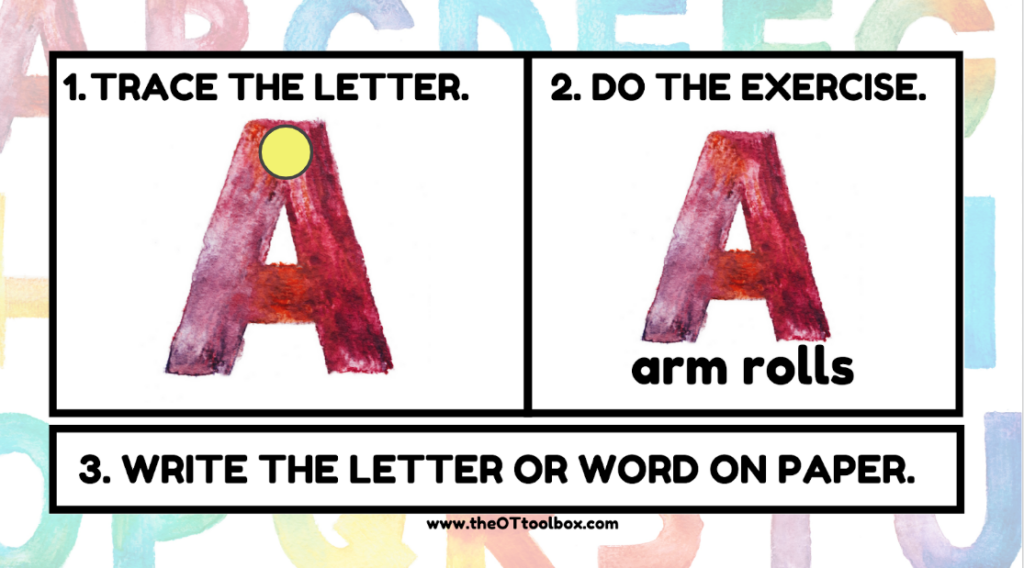
Kids can work through the interactive slides and move the circle to form letters. I paired the letters with the exact same ones found on our alphabet exercise activity for consistency. (Upper case letters in this slide deck).
They can click on the yellow dot and move their mouse or finger to form the letter. They will trace along the lines of the letter on the slide, so they are gaining fine motor work, including finger isolation, separation of the sides of the hand, eye-hand coordination, and motor planning.
Next, students (and a teacher if used in a live class) can complete the gross motor exercise that pairs with the letter. The exercises match the same ones on our letter exercise program. You can read more about each exercises on the Alphabet Exercise Activity page.
The gross motor activity offers a brain break opportunity, while building strength, core stability, motor planning, and whole body motions like crossing midline, inversion, and a sensory break with proprioceptive and vestibular input.
Finally, children can work on handwriting. I left this portion of the slide activity open-ended so that younger children can work only on writing the upper case letter. Older students can write a word or a sentence that contains a word starting with that letter.
Free interactive slide deck
Here’s how you can get the interactive slide deck to work on letters:
Enter your email address in the form below. Check your email and click on the button to grab your resource. Save that worksheet so you can access these slide decks again.
Sign into your Google account. Click on the big button in that PDF that you just accessed. It will prompt you to make a copy of the slide deck. That will be your master copy of this slide deck.
Now the slide deck is on your Google account.
Share the slide deck with students. You can make a copy for each student and upload it to their Google classroom or use it in Zoom. Here is a post on FAQ for troubleshooting any issues you might run across with using or accessing the slide deck.
Be sure to sign up for other slide decks that we have to offer. You will have to enter your email address for each one so you can get the resource and make a copy of each slide deck.
Be sure to check out these other slide decks to use in OT teletherapy sessions, distance learning, or homeschooling:
Colleen Beck, OTR/L has been an occupational therapist since 2000, working in school-based, hand therapy, outpatient peds, EI, and SNF. Colleen created The OT Toolbox to inspire therapists, teachers, and parents with easy and fun tools to help children thrive. Read her story about going from an OT making $3/hour (after paying for kids’ childcare) to a full-time OT resource creator for millions of readers. Want to collaborate? Send an email to contact@theottoolbox.com.

Social emotional learning is defined as a process for helping children gain critical social skills for life effectiveness, such as developing positive relationships, behaving ethically, and handling challenging situations effectively. The specific skills that allow kids to function and complete daily occupations (such as play, learning, participating in social situations, rest, dressing, writing, riding a bike, interacting with others…) are those social emotional skills that help children to recognize and manage emotions, interact with others, think about their feelings and how they should act, and regulate behavior based on thoughtful decision making.
One piece of addressing underlying social emotional learning needs in kids is the fact that the behaviors that we see have an underlying cause that can be found as a result of regulation of emotions, making decisions, and acting on impulses. Social emotional skills are not always a cut and dry aspect of development.
What is Social Emotional Learning?
Today, I wanted to expand on that idea. So many times, we run into children on our therapy caseloads or in our classroom (or hey, even in our own homes!) who struggle with one area…or several. Remembering that beneath the behaviors, troubles with transitions, acting out, irritability, sleep issues, inflexible thoughts, frustrations, etc…can be emotional regulation components.
Let’s consider some of the ways our kids may struggle with social and emotional competencies. We might see kids with difficulty in some of these occupational performance areas (occupational performance = the things we do…the tasks we perform):
Academics/learning
Management of stress in learning/chores/daily tasks
Creating of personal goals in school work or personal interests and following through
Making decisions based on ethical and social norms in play, learning, or work
Understanding/Engaging in social expectations (social norms) in dressing, bathing, grooming, etc.
Social participation
Conflict resolution with friends
Empathizing with others
Responding to feedback in school, home, or work tasks
Making good judgement and safety decisions in the community
Showing manners
Responding to the moods of others and reaching out to others as a support system (both an aspect of co-regulation skills)
Understanding subtle social norms in the community or play
Transitions in tasks in school or at home
Ability to screen out input during tasks
Cooperation in play and in group learning
Considering context in communication
Emotional control during games
Understanding mood and affect and how this relates to behavioral responses
Wow! That list puts into perspective how our kids with regulation concerns really may be struggling. And, when you look at it from the flip-side, perhaps some of our children who struggle with, say, fine motor issues may have sensory concerns in the mix too.
Social Emotional Learning Activities
When we equip our students with tools to identify their emotions and self-regulate, we are giving them tools for life and promoting a positive environment for learning. We can foster social emotional development through play and interactions.
What might this look like at home, in online schooling, or in a classroom setting?
1. Connect emotions to behavior- Children may not have the language knowledge or understand how to explain what they are feeling. They may need concrete examples or scenarios to help them understand how their emotions are tied to their behavior. Does a storm make them feel nervous or scared? How do they react when they feel anxious about a test or quiz? When they argue with a sibling, how do they react? Once they are able to understand their emotions and how they are feeling, they can start using emotional regulation tools and strategies.
2. Be flexible and patient- Flexibility is something we have all been thrown into more than usual lately. But working with children on emotional regulation and understanding their emotions takes patience and being flexible. You may need to change up how you introduce emotions, or maybe a strategy you thought would work isn’t.
3. Set the tone and share your own feelings- This may feel uncomfortable for some of us, but sharing our own feelings with our students and clients and modeling the responses and strategies we are encouraging them to use will have a huge impact.
4. Try specific social skills activities-Social skills activities are those that help kids build underlying emotional and regulation strategies so that making friends, emotions, kindness, empathy, self-awareness, self-management, and other socio emotional tools are built at the foundation. One way to do this is by setting up a system for an emotions check in or a feelings check in to start the day.
Another fantastic resource that can help develop social and emotional skills is the activity book, Exploring Books Through Play.
This digital E-BOOK is an amazing resource for anyone helping kids learn about acceptance, empathy, compassion, and friendship. In Exploring Books through Play, you’ll find therapist-approved resources, activities, crafts, projects, and play ideas based on 10 popular children’s books. Each book covered contains activities designed to develop fine motor skills, gross motor skills, sensory exploration, handwriting, and more. Help kids understand complex topics of social/emotional skills, empathy, compassion, and friendship through books and hands-on play.
The book Exploring Books Through Play, has 50 different activities based on popular children’s books. Each book is used for 5 different activities that cover a variety of areas: sensory play, crafts, gross motor activities, fine motor activities, handwriting, scissor skills, and so much more.
This book is designed to address emotional regulation and connecting with kids.
What’s Inside Exploring Books through Play?
We have handpicked these easy and hands-on activities to help kids develop essential social emotional learning skills.
As classroom curriculum becomes more focused on academics, social and emotional development can get lost in the shuffle. This book focuses on abstract concepts of friendship, acceptance and empathy. By using children’s books that foster understanding of these concepts through pictures and stories, we can help children understand and see these emotions in action. What if you could use books and interactive activities to teach friendship? What if you could read a book that centers on accepting differences and create or make an activity or craft that helps children see acceptance in action. What if you could explore emotions through story and interactive play? In this book, you will find books that cover abstract concepts and use play to build social and developmental skills. The 10 books covered include:
A Sick Day for Amos McGee
Boy + Bot
Little Blue and Little Yellow
Red: A Crayon’s Story
Chrysanthemum
The Day the Crayons Quit
Leonardo the Terrible Monster
The Adventures of Beekle: The Unimaginary Friend
Whoever You Are and Penguin and Pinecone
Want to help kids learn more about complex concepts such emotions, empathy, compassion, and differences?
Exploring Books Through Play uses children’s literature as a theme to engage in fun, hands-on activities that help children and adults delve deeper into the characters and lessons, bringing the stories to life and falling further in love with literature. Read a story and then bring the characters to life while learning and building skills. Each story offers unique activities designed around central themes of friendship, empathy, and compassion.
Each chapter includes 5 activities for each of the 10 children’s books. The activities are perfect for children ages 3-8, can be used in small groups or as a whole class, and are easily adapted to a home or classroom setting.
Hopefully, this resource, and these suggestions to support social emotional learning has been helpful. Remember that fostering SE development across the ages and stages fosters learning, educational participation, and functional performance in all contexts and environments. Specifically, social emotional learning is important to consider when creating self regulation IEP goals or when fostering self regulation and emotional regulation needs in the school environment.
Colleen Beck, OTR/L has been an occupational therapist since 2000, working in school-based, hand therapy, outpatient peds, EI, and SNF. Colleen created The OT Toolbox to inspire therapists, teachers, and parents with easy and fun tools to help children thrive. Read her story about going from an OT making $3/hour (after paying for kids’ childcare) to a full-time OT resource creator for millions of readers. Want to collaborate? Send an email to contact@theottoolbox.com.
Today, I wanted to share some social skills activities and specific social skill interventions that can be used to help kids with social emotional learning and the components that help kids with emotional regulation and wellness. When kids struggle with big emotions, anxiety, fear, transitions, worries, outbursts, or social participation… social emotional development can be impacted. And, all we want is to help them by responding to their underlying needs and to support or connect with that individual.
Social Skills Activities
We know that the underlying areas are the root of the “behavior” that we see. The ability to identify one’s emotions, and understand how internal characteristics influence our actions; These aspects maintain a sense of self-confidence and self-efficacy in coping with stress and managing impulses.
The social skills activities listed here are some of the best ways to target emotional regulation tips, tools, and strategies that will give you a jump start in creating connections with your child or student.
Be sure to check out and grab the resource, Exploring Books Through Play, a 50-activity guide on addressing social emotional learning and emotional regulation through play and exploration of popular children’s books.
Created by an occupational therapist and educators, this digital resource has everything you need to manage and teach about emotions, help with regulation, mindset, empathy, self-awareness, and family connections.
Exploring Books Through Play uses children’s literature as a theme to engage in fun, hands-on activities that help children and adults delve deeper into the characters and lessons, bringing the stories to life and falling further in love with literature. Read a story and then bring the characters to life while learning and building skills. Each story offers unique activities designed around central themes of friendship, empathy, and compassion.
Social SKills Interventions
These strategies are some of the ways to help kids develop social skills and emotional learning:
Social Skills ACTIVITY #1: Role Models
Kids can learn much about social situations including social norms and subtle cues by observing others. That’s why it’s important for parents and families to be a good role model when it comes to self-awareness, awareness of others, empathy, stress management, goal setting, and relationship situations such as preventing and resolving interpersonal conflict or seek help when needed.
Modeling and practicing with children can include many aspects of social skills, including building friendships, kindness, empathy, and awareness of others.
Games and activities that teach self control is one way to begin this process.
A social story is a story that describes a situation, skill, or concept in terms relevant to the reader. I’t provides social cues and perspectives so the reader can respond appropriately. Social stories are reassuring and well-understood by the reader, making them a social skills activity that can be used over and over again. Social stories use pictures and typically are individualized so they meet specific needs of the child and are focused on interests in a motivating manner.
Social stories help children with social skill development because it defines what they should do in a positive manner, while identifying the social expectations which can be frustrating or confusing for some children.
Social stories can be created to address a variety of functional tasks such as potty training or getting dressed. Others are based on emotions and interacting with friends. Still other social stories cover social situations such as wearing a mask when out and about.
Social Skills Activity #3: Group Games
Getting kids involved with group play and group activities is a powerful one in building social awareness, conflict resolution, problem solving, communication, and other important social skills like the critical thinking involved in making decisions.
This group gross motor activity requires a group and also offers sensory input through the proprioceptive and vestibular systems.
Pretend play is another way for kids to practice these important skills in social situations. Whether in a small group or alone, practice occurs through pretend play. Here are some pretend play ideas to get you started:
Social scripts offers a tactic for kids to respond to specific situations. Scripts might be in card format or a prompt that offers a cue. Social scripts can be created for when to do specific tasks like turning off screen time. Other kids may use social scripts for asking a friend to play.
Social scripts are great for kids that read well or can follow verbal prompts. However, some scripts include pictures and images as well.
Social Skills Activity # 5: Video Modeling
Kids can use videos as a motivating way to observe and copy behavior or social situations in action. Some video modeling activities offer kids a way to know how to perform tasks. Others offer opportunities to see social situations in action.
Video modeling can also be used to inform. Kids can watch videos of other children in specific situations and develop awareness of the subtle social rules well as norms. They can learn to empathize with others and take others’ perspectives while building an awareness of self.
Social Skills Activity #6: Self-regulation
By helping kids to better understand their senses and how sensory input impacts their behaviors, thoughts, and offer tools to help kids identify, address, and use strategies to achieve self-control and emotional regulation in a non-judgmental and safe way.
Programs like the Zones of Regulation and How Does my Engine Run offer strategies to impact regulation into every day tasks.
Helping kids understand their senses and how input impacts their behavior, actions, and emotions is a huge starting point for kids to get a handle on social skills.
Social Skills Activity #7: Understanding emotions
Helping kids to better understand emotions is an important step to helping kids understand themselves and how they react to situations. They can then transfer that understanding by better understanding others around them in social situations. Here is a free printable to help kids learn about emotions and their reaction or behavioral responses.
In this resource on using children’s books and social emotional activities (fine motor, gross motor, art, crafts…) kids can learn about emotions of the main characters as they build the social skills needed to better understand and empathize with others.
The main thing to recognize from this list of activities is that it is possible to teach social skills to kids. Some children flourish with one strategy and others will appreciate another social emotional skill activity. Try some of these activities and mix and match others to build a social skills toolbox that will help kids thrive!
Social Emotional Skills Resource
Addressing underlying needs= Making a difference.
Therapists know that all of the activities, programs, courses, worksheets, etc. that we use with clients are TOOLS for promoting skills. They are the strategies we use for meeting functional skills. They are the blueprint for helping clients reach goals. They are the means for fulfilling meaningful occupations!
Exploring Books Through Play is focused on social emotional skills, regulation, connection with kids/families, and empowering kids by meeting the underlying sensory needs so that they can learn, play, and connect with others while building the skills they need to be functioning kiddos.
Social skills activities in the books include ideas such as interactive play experiences, this book guides you through activities for each children’s book. The activities were designed to build fine motor skills, gross motor development, sensory exploration, and much more. By adding movement and fine motor activities, or multi-media sensory-based play and craft ideas, children can build motor experiences and develop skills through activities based on the concepts of each children’s book.
As classroom curriculum becomes more focused on academics, social and emotional development can get lost in the shuffle. This book focuses on abstract concepts of friendship, acceptance and empathy.
By using children’s books that foster understanding of these concepts through pictures and stories, we can help children understand and see these emotions in action.
What if you could use books and interactive activities to teach friendship? What if you could read a book that centers on accepting differences and create or make an activity or craft that helps children see acceptance in action.
What if you could explore emotions through story and interactive play?
In this book, you will find books that cover abstract concepts and use play to build social and developmental skills.
Wow…do our kids need this, right??
As therapists, we strive to focus on the whole child…and all of the sub-layers that play a part in development and growth. We focus on each child individually based on specific needs, strengths, and developmental levels. The connection between the brain, emotional development, sensory input and regulation are the “roots” to everything we do! Focusing on those underlying needs helps the child to flourish in higher-level aspects like being flexible, social participation, using good judgement, responding to feedback, transitioning between tasks, regulating emotions, and much more.
And incorporating those “branches” fosters cognition, completion of tasks, higher-level learning, behaviors, and everything we see!
The bottom-line is that using evidenced-based sensory experiences to improve areas such as cognition, learning, motor performance, etc. is the way to go! Overall, studies suggest that frequent, active participation in multi-sensory experiences can help regulate emotions, improve specific symptoms, address cognitive functions, motor performance, and focus. Research shows us that embedding social-emotional learning strategies within school curricula promotes improved behavior, academic performance, and social skills.
It makes sense! In school an at home, on-task behavior is a required component for student participation. There is a lot to consider…and all of the components work together. sensory regulation, processing of sensory input, filtering out unnecessary input, focusing, transitions…And all of these areas are connected.
Exploring Books through Play, hands-on and sensory-based movement activities to foster social emotional and sensory tools!
Exploring Books Through Play will help to create simple book activities focused on play that fit into a family’s schedule, help parents figure out why their child is irritable or responds in the way they do.
Colleen Beck, OTR/L has been an occupational therapist since 2000, working in school-based, hand therapy, outpatient peds, EI, and SNF. Colleen created The OT Toolbox to inspire therapists, teachers, and parents with easy and fun tools to help children thrive. Read her story about going from an OT making $3/hour (after paying for kids’ childcare) to a full-time OT resource creator for millions of readers. Want to collaborate? Send an email to contact@theottoolbox.com.