Cal Oct OT

Thank you for joining us in this month’s Sensory Challenge in honor of Sensory Awareness month! 


Flip through the booklet and add creative sensory input to your day.  Invite the whole family to take part in these activities that can build on or add to a sensory diet.  


Complete one sensory activity each day.


Print off your October calendar to keep track. Just highlight the activities that you complete and fill in the whole month.  Follow the dates outlined or go through the activities on your own.  


Have fun this month and enjoy all the sensory experiences that October has to offer!
Looking for more ways to explore all things sensory this month?


Are you looking for more information on Sensory Processing and Proprioception (or any of the sensory systems and how they affect functional skills, behavior, and the body’s sensory systems? 

In-hand Manipulation for Functional Tasks and a Letter Activity

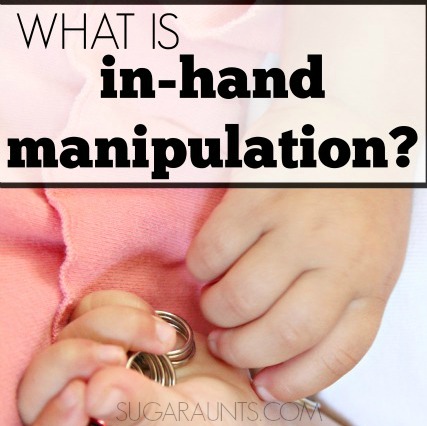
Kids require a lot of skills to write with a pencil, button a coat, zipper a shirt, and manage a handful of coins.  Today we’re sharing ideas to help your child with in-hand manipulation.  This skill is important for moving that pencil, erasing mistakes, and fine motor tasks like managing buttons and zippers, coins, small items that fit in the hand, and pretty much a ton of functional tasks.

SO what is in-hand manipulation and what can you do to improve all of these skills in kids?  Here are a few ideas for you!  This fun and easy activity is part of our 31 Day series of Occupational Therapy series where each post this month are functional and creative activities that can be done in Occupational Therapy treatment or in activities for kids who might need to work on certain skills through play.  All materials are free or items that might be found in your home.

Toys and tools for working on in-hand manipulation skills in kids, perfect for handwriting, pencil use, buttoning, scissor use, zippering, and more from an Occupational Therapist.


In-hand manipulation activity for kids learning letters

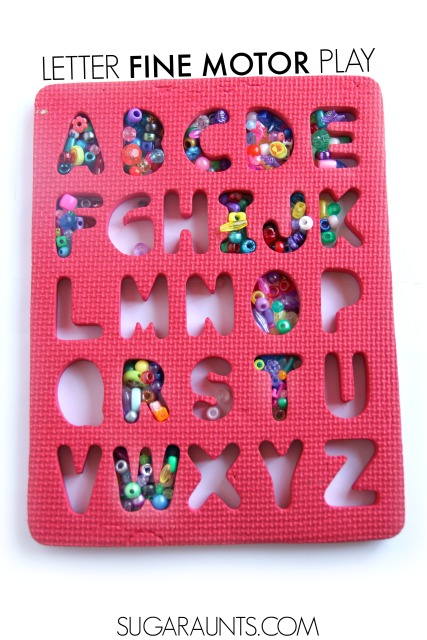
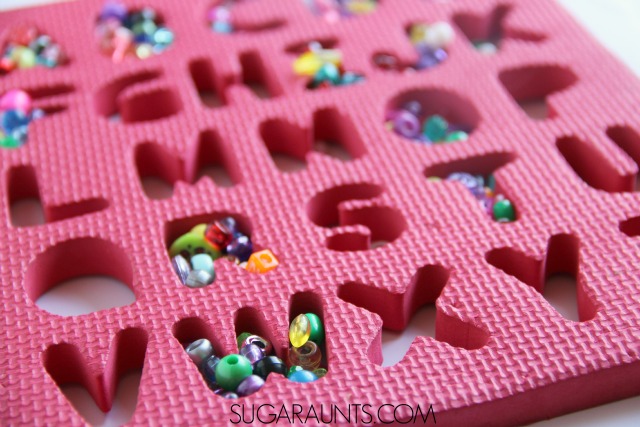
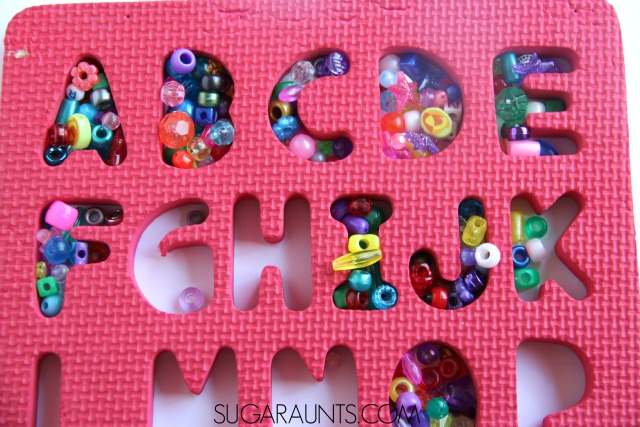
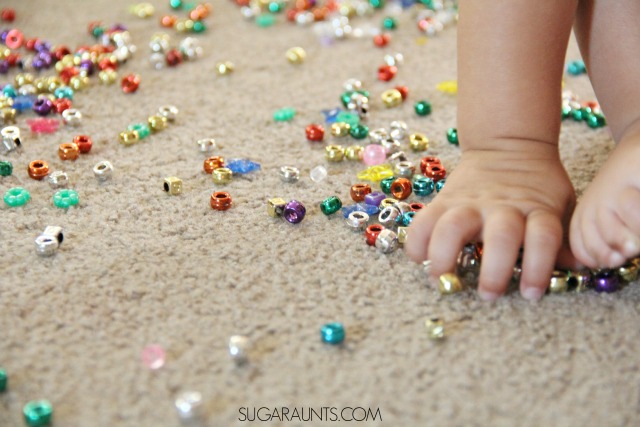
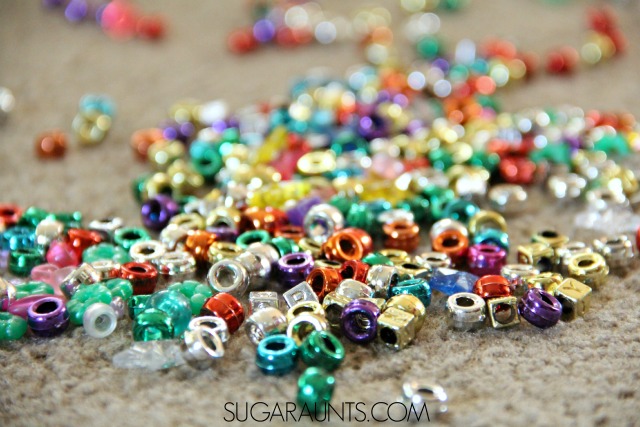
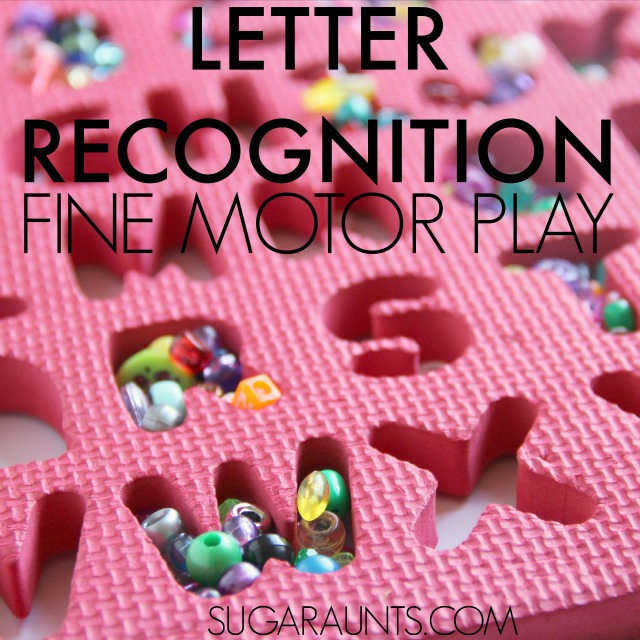
This post contains affiliate links.  This easy play activity was a fun one to set up for my four year old.  She is practicing letter recognition and letter sounds so we practiced identifying letters with this foam puzzle that we have.  We found ours at a garage sale, but you can get one in dollar stores or a similar puzzle here.  Simply grab a pile of whatever you’ve got on hand to fill the letters.  We used beads, but you could use dry beans, corn kernels, dry split peas, or any other small item.

Toys and tools for working on in-hand manipulation skills in kids, perfect for handwriting, pencil use, buttoning, scissor use, zippering, and more from an Occupational Therapist.


Letter Recognition Activity for Preschool

To practice letter recognition, I called out a letter and my preschooler filled that letter with beads.  It was a great way for her to work on letter identification.  We also did a little phonetic awareness and I named a letter’s sound.  She then filled the letter that makes that sound.  She enjoyed testing me, too.  “I’m filling a letter that sounds like this: /mmmmm/.  What letter is that, Mom?”

Toys and tools for working on in-hand manipulation skills in kids, perfect for handwriting, pencil use, buttoning, scissor use, zippering, and more from an Occupational Therapist.


In-hand Manipulation 

So are you still thinking, “Ok, cool. I like it.  But what the heck is in-hand manipu-what”?

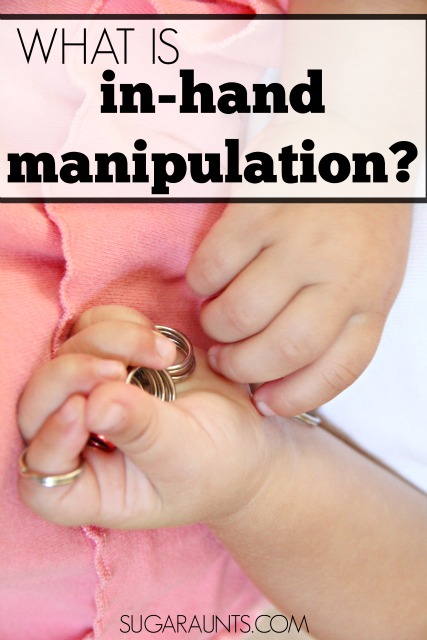
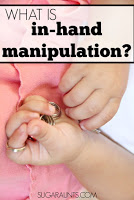
In-hand manipulation is essentially is the ability to move small objects around in your hand without using the other hand to help.  This skill is essential for managing small items within the hand for accomplishment of tasks. There are three parts to In-hand manipulation…translation, shift, and rotation.  We shared two fun activities to work on these skills here.  

In-hand manipulation begins to develop around 18 months, with the greatest skill development occurring between 2 and 2 1/2 years old.  

Toys and tools for working on in-hand manipulation skills in kids, perfect for handwriting, pencil use, buttoning, scissor use, zippering, and more from an Occupational Therapist.

Parts of In-hand Manipulation

Finger-to-Palm Translation: Movement of an object from the fingers to the palm i.e. picking up a coin and moving it to the palm.

Palm-to-Finger Translation: Movement of an object from the palm to the finger tips.  (i.e. moving a coin from the palm to the fingertips to insert into a vending machine.)

Shift: Slight adjustment of an object on or by the finger pads. (i.e. adjusting a pencil up and down in your hand.)

Simple Rotation: Turning or rolling an object 90 degrees or less with the fingers moving as a unit. (i.e. unscrewing a toothpaste lid)

Complex Rotation: Turning an object more than 90 degrees using isolated finger and thumb movements. (i.e. Turning a paper clip)

Each of the above skills can occur with items “squirreled away in the palm using the pinky finger and ring finger.  This is called “with stabilization”.  If other items are not pocketed away in the palm while in-hand manipulation occurs, it is called “without stabilization”.  Stabilization typically occurs around 2 years of age.

Toys and tools for working on in-hand manipulation skills in kids, perfect for handwriting, pencil use, buttoning, scissor use, zippering, and more from an Occupational Therapist.

Activities to work on in-hand manipulation using (almost) free materials.  These a few of my favorite activities from my Occupational Therapy treatment bag and ones that should be pretty easy (and inexpensive!) to set up:

  • Roll play dough into small balls using only the fingertips.
  • Tear newspaper into strips, crumble it, and stuff an art project.
  • Use tweezers to pick up small items.  This works on the intrinsic muscles of the hands.
  • Lacing activities.
  • Eye Droppers to drop water into recycled lids.
  • Coin or button matching, sorting, and stacking.  We loved playing with coins for fine motor fun.
  • Small pegboards, tucking extra pegs into the palm of the hand.  You can use cut up straws and play dough, too.
  • Dropping small items into bottles with a small opening like we did here.
  • Pick up beads from the floor and drop into ice cube trays.
  • Push coins into a piggy bank.
  • Press buttons into a slit cut in the lid of a plastic tub.
  • Pick-up sticks.
  • Games with small chips.
  • Beading.
  • Twisting lids on/off water bottles.


In-Hand Manipulation Toys and Tools for Fine Motor Skills

Toys and tools for working on in-hand manipulation skills in kids, perfect for handwriting, pencil use, buttoning, scissor use, zippering, and more from an Occupational Therapist.

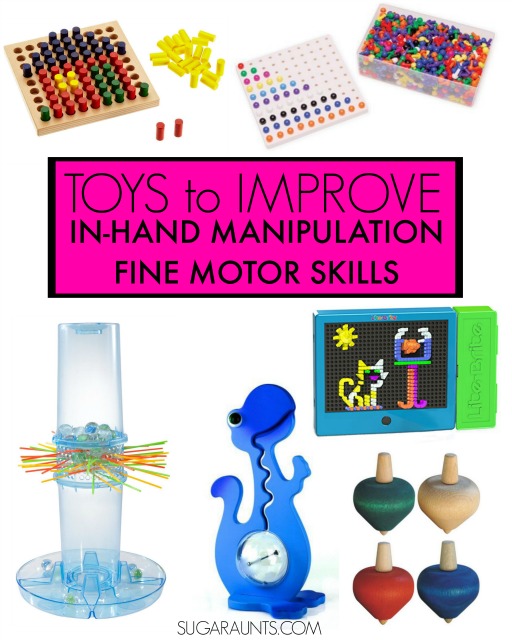
These are some fine motor tools that kids will love.  While they are definitely not free, they are additional ideas for in-hand manipulation play and learning.  These are toys that will help with handwriting, buttoning, zippering, managing snaps and shoe-tying, among other functional skills, and all through play.  

Lite Brite
is a classic art creating activity that works on fine motor skills, and especially in-hand manipulation. Prop the board up on a on angle and you’re getting excellent wrist extension which helps with translation from fingers to palm and vice versa.


 Lacing & Tracing Dinosaurs can help kids with lacing, managing strings, threading, bilateral hand coordination, and strength.  It’s a great activity to work on in-hand manipulation.  Try these Lacing & Tracing Sea Life cards, too.


HABA Color Peg is a fun creating activity to work on in-hand manipulation to translate the small pegs into the slots. 


 This Peg Board with 1000 Pegs
was one of my absolute favorite treatment tools in pediatric Occupational Therapy. I love the small size of the pegs that allow children to manipulate and manage the tools within their hands. The key to working on in-hand manipulation is to use items that are smaller than the child’s hand and these colorful pegs work on so many other skills besides the vital in-hand manipulation. 


 Manipulating coins is such a great way to work on in-hand manipulation. This vortex Bank is a fun bank to practice with! 


 Spinning tops is a nice way to work on rotation. These Standard Tops
are fun! 


 The game, Ker Plunk Game
is an in-hand manipulation powerhouse. Handle the marbles to work on translation, and rotate the sticks with the thumb and the pointer finger. This is a game that will work on so many fine motor skills.

Toys and tools for working on in-hand manipulation skills in kids, perfect for handwriting, pencil use, buttoning, scissor use, zippering, and more from an Occupational Therapist.

Love this? Pin it!  You will also love our Fine Motor Play Pinterest board for more fine motor fun.  


Check out these posts for more ideas:


Healthy Yogurt Parfait Bar Snack

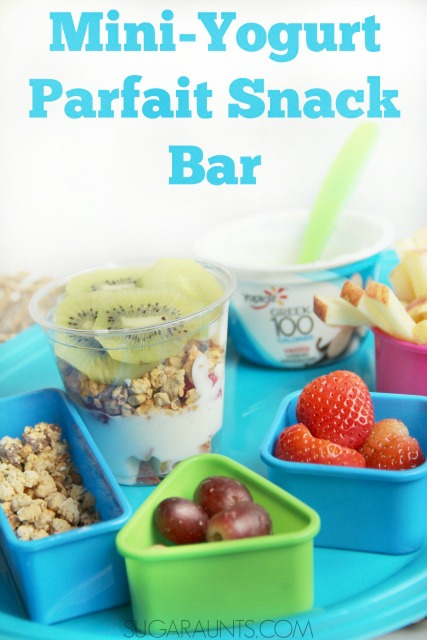
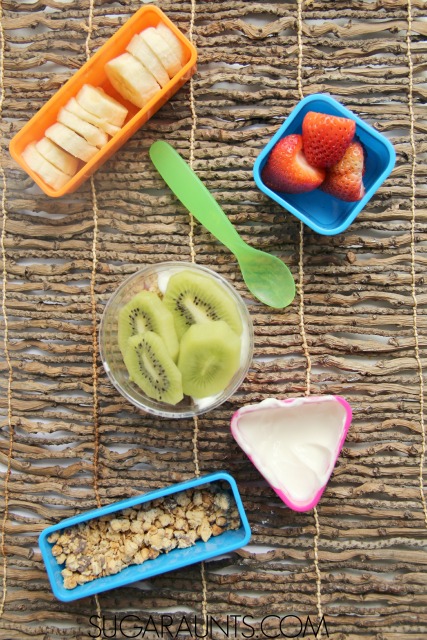
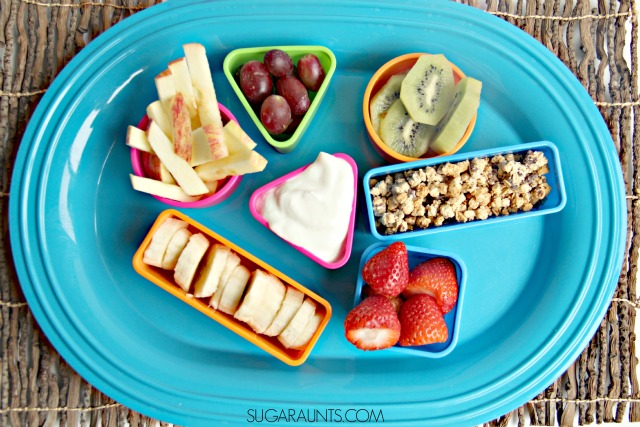
When you have kids in your house, snacks are a must.  With four kids, I go through a ton of snacks. We try to keep our snacking on the healthier side, with lots of fruits and vegetables and wholesome foods that will fill up the bottomless pit bellies that my kids have.  Do your kids do this too?  How do you keep your kids full without constantly feeding them?  Today, I’ve got a snack idea that was a total hit with my kids.  We made a Mini Yogurt Parfait Bar, loaded with fresh fruits and Greek Yogurt.  This was such a fun experience as well as a filling snack that kept the complaints of “I’m Hunnnnnngry” away, for a little bit longer than average!

This yogurt parfait snack bar will fill up the kids with wholesome fruit and Greek Yogurt! #SnackandSmile #sponsored


Greek Yogurt Parfait Bar

This snack idea was such a hit with all of my kids.  We made it as an after-school snack one afternoon.  You know that time of day when the kids are famished after a long day at school and homework just doesn’t seem appealing when the kids are dragging.  When we made these parfaits, it was all smiles and kids happily doing math (or in the younger kids’ case, staying out of the bigger kids’ hair while they ate their parfaits!)  It was so easy to throw together, that I will definitely be making this for play dates, birthday parties, and cousin sleep overs.  To get the kids really smiling, add a few fun containers for the fruits in the parfait bar.  


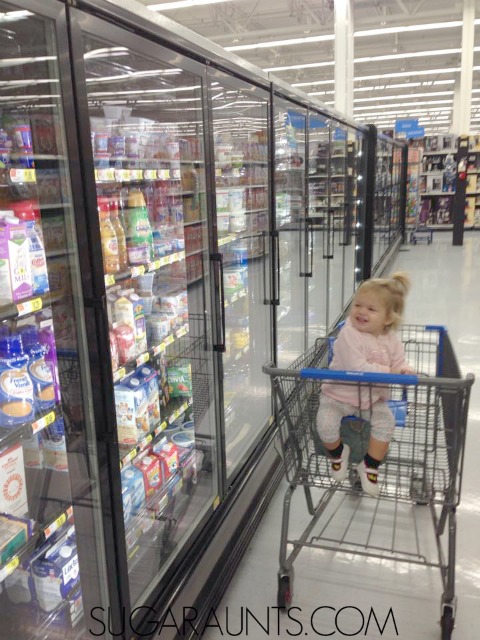
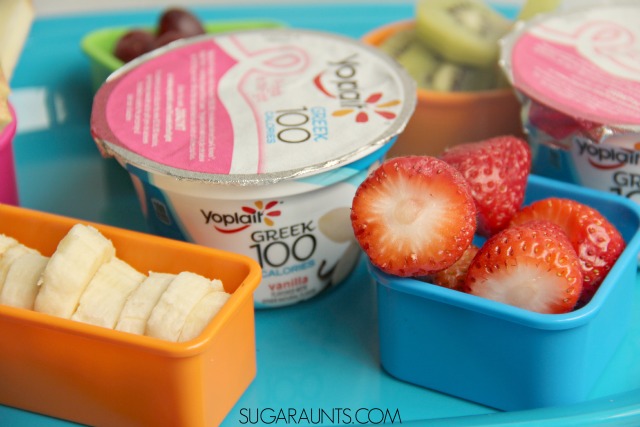
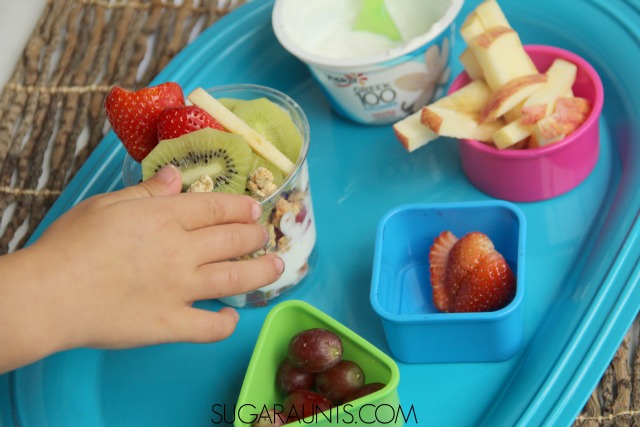
To make your Yogurt Parfait Bar, head to the store and grab your favorite kid friendly fruits.  We used Yoplait yogurt, blueberries, halved grapes, sliced bananas, strawberries, sliced kiwi fruit, apples, and our homemade granola. The fruits can really be customized to what you’ve got on hand.  For the yogurt, we used Yoplait Greek 100 Whips that we had found at Walmart.  The size of the Yoplait yogurt cups were the perfect size for my kids’ snack.  We could open two or three yogurt containers and it filled all four of my kids’ parfait snacks. Using a healthy option like Greek Yogurt makes for a filling and protein-packed snack, perfect for after-school.  It was so nice to grab everything I needed for this snack in one trip.  (Anything that makes things easier with my crew of 4 helps!)


This yogurt parfait snack bar will fill up the kids with wholesome fruit and Greek Yogurt! #SnackandSmile #sponsored


This yogurt parfait snack bar will fill up the kids with wholesome fruit and Greek Yogurt! #SnackandSmile #sponsored

Get your kids involved in the food prep for this snack!  My kiddos love to help me cook, so when I pulled out yogurt and their favorite fruits, they were ready to help with chopping and dicing. 


This yogurt parfait snack bar will fill up the kids with wholesome fruit and Greek Yogurt! #SnackandSmile #sponsored

This yogurt parfait snack bar will fill up the kids with wholesome fruit and Greek Yogurt! #SnackandSmile #sponsored

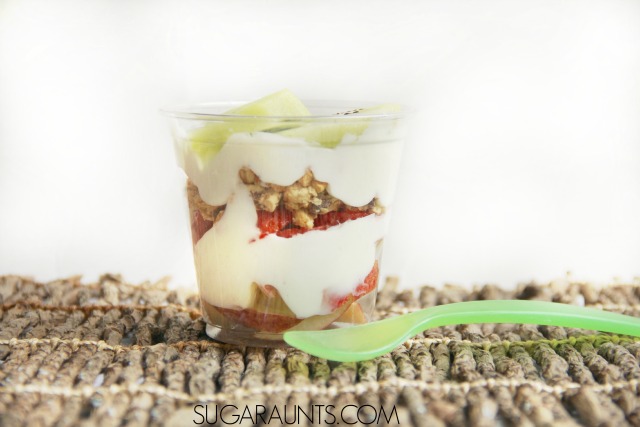
Scoop the fruits, yogurt, and granola into containers and arrange on a table or tray.  Next, show the kids how to layer the yogurt and fruit.  We used spoons for each fruit, but you could use toothpicks with older kids.  


This yogurt parfait snack bar will fill up the kids with wholesome fruit and Greek Yogurt! #SnackandSmile #sponsored

Once your parfait is done, enjoy!  How would a yogurt parfait snack bar work in your house?  Would you make one for an after school snack like we did or as a special weekend treat?  What is your favorite way to snack with Yoplait?  Let us know in the comments below!

This is a sponsored conversation written by me on behalf of General Mills. The opinions and text are all mine.

var ts=document.getElementById(‘ti-pixel-tracker’); var axel = Math.random() + “”; var num = axel * 1000000000000000000; var ti=document.createElement(“img”); ti.style.display=”none”; ti.src=”https://tracking.tapinfluence.com/trk/EbJGA/LxGdL/p.png?p=XmOyD” + String.fromCharCode(38) + “i=DYRFE” + String.fromCharCode(38) + “ord=”+ num + String.fromCharCode(38) + “s=” + encodeURIComponent(document.referrer); ts.parentNode.replaceChild(ti,ts); new TAP.CogFrame(‘/v1/cogs/74a233dc-5e25-11e5-baa7-22000af93a2d/comments’).drop({“program_id”:”749ef0be-5e25-11e5-baa7-22000af93a2d”,”post_id”:”e8c4dffa-6265-11e5-9224-22000af93a2d”,”host”:”api.tapinfluence.com”,”apiHost”:”api.tapinfluence.com”,”sort_order”:”desc”,”limit”:”20″,”offset”:”0″,”sort_by”:”created_at”,”protocol”:”https://”});

Fidgeting During Homework

fidgeting during homework

Ooooh, those wiggles.  The wiggles start and then they become so distracting.  It’s hard to concentrate on homework when the fingers are messing with the pencil sharpener, the feet are kicking, and the bottoms are sliding all over the chair.  Mom gets frustrated, the kiddo gets upset, and the homework battle continues. Does this sound familiar?  

Amazon affiliate links are included in this blog post. As an Amazon Influencer, I earn from qualifying purchases.

Fidgeting during homework

Struggles with concentrating on homework can be far more than just the math facts that need practicing.  Sometimes, the urge to fidget and move and fall out of the chair is just too overwhelming.  

It may be that your child has a sensory need, or it may just be a long day followed by an overstimulating bus ride home…and then having to sit down for more writing, math, spelling, and vocabulary.  Trying to get the homework done with the fidgets is just not easy for any kid.  

Today, I’ve got tips for doing homework when kids just can’t stop fidgeting.  This post is part of our 31 Days of Occupational Therapy  with free (or mostly free) materials.  We’re hoping this resource is helpful for the fidgets!


Tips and tools for kids who fidget during homework and classroom activities.


This post contains affiliate links.  


Tips for helping with Fidgeting during homework

So why do kids fidget?  Fidgeting during work stimulates the brain, allowing a child to complete school work or homework.  Fidgeting is mindless play or touching fingers, pencils, hands…anything that allows a person to focus on the task at hand.  

Kids that are fidgeting are seeking calm, and focus so that their brain can complete a task.  The problem is when the brain’s urge to fidget distracts a child from school tasks.  

They might be so wiggly and moving that they just can not sit still and focus in a functional manner.  Fidgeting can be managed with less distracting techniques which can allow the child to accomplish the homework, and move on to other things.


Solutions for Fidgeting During Homework

Try some of these techniques to help with the fidgeting.  These are certainly methods that can be adapted to classrooms, but I wanted to focus on the kiddos that come home from a long day at school and just need strategies for success in homework.  

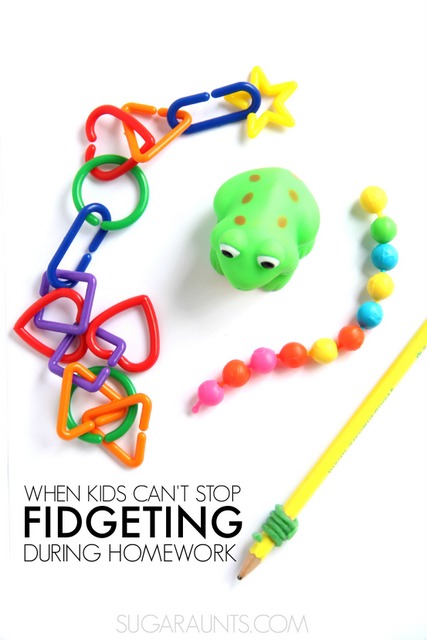
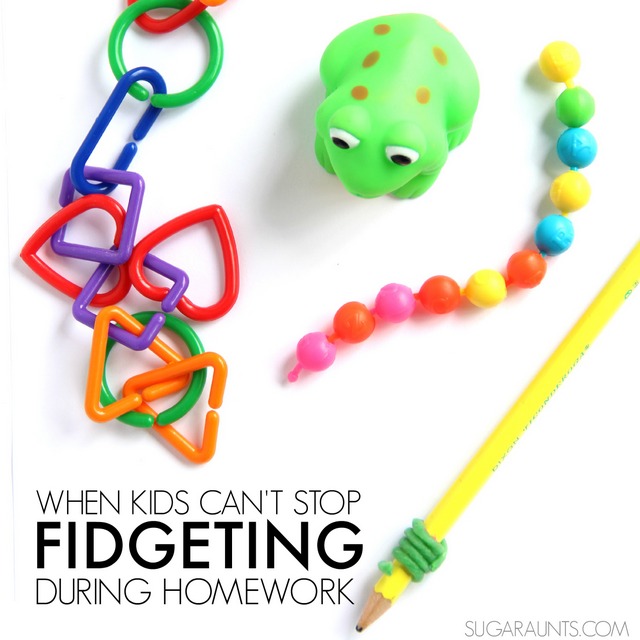
A DIY fidget toy can be just the tool that helps.

  • Brain Breaks: Do jumping jacks as you spell words with your child, toss a ball as you practice math facts, or do a quick jog around the house between math papers.
  • Forget the dining room table.  Do homework on a bean bag or a pile of pillows using a clipboard.  Kids with sensory needs often times, crave proprioceptive input and an upright chair can be overly distracting, especially after sitting in a desk at school.
  • Or, forget sitting down all together!  Try completing homework while standing up.
  • Tie a bungee cord around the chair’s legs so that your child can kick and stretch their feet.  
  • Partially blow up a beach ball. Place this on the chair’s seat.  Kids can sit on the beach ball to get needed movement during homework.
  • Provide a small bit of play dough.
  • Squeeze balls
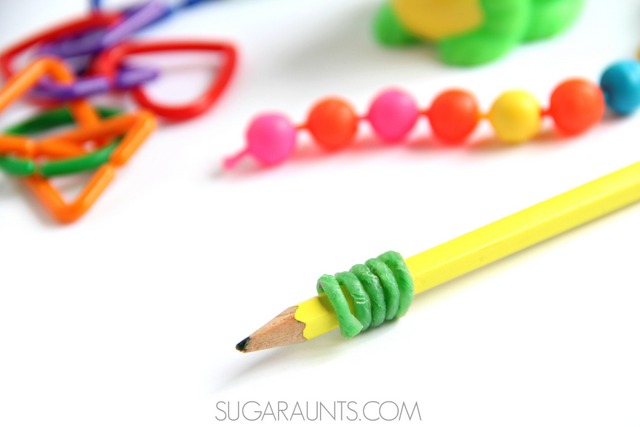
  • Wrap Wikki Sticks around a pencil.
  • Pipe cleaners wrapped in a loose ball.
  • A small bouncy ball and a cup.
  • Rubber bands on a ruler
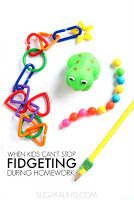
  • A strand of paper clips
  • Pop beads
  • Bubble Wrap
  • Paper binder clip
  • Provide a chewy snack at the same time as homework.  This might include gum, raisins, celery, carrots, fruit leather or fruit roll-ups, or licorice sticks.  You could also try therapy rubber tubing. 
  • Another snack idea is a thick smoothie in a straw.  Try one of these recipes, with added ice for a thicker smoothie. 
  • Drink water from a “squeeze bottle” or sports bottle.
  • Chair push-ups:  Show the child how to push up from their chair, by placing their hands on the seat alongside each leg. Slowly, they should push their upper body up and off the chair.  Do a set of 10 chair push-ups before returning to homework tasks.
  • Roll a tennis ball under their foot.  They can roll the ball back and forth under their feet as they work.
 
Other modifications to homework time that may help with sensory needs causing fidgeting:
  • Eliminate distractions (as much as possible in a busy family’s home.)
  • Begin homework at the same time each day.  Keep routines consistent.
  • Set up a homework station and do homework in the same place each day.


Tips and tools for kids who fidget during homework and classroom activities.


Classroom and homework fidget toys to help with concentration and fidgeting in sensory processing disorder SPD, Autism, Asperger's, and typical sensory needs.


Toys and Tools to Help with Fidgeting

There are many items on the market that are designed to help kids with the fidgeting.  There are apparently A LOT of kids out there who fidget.  
 
These toys and tools are items that may help your child in the classroom and at home during homework.  
 
While the tools detailed below are certainly not free (based on our 31 days of free or inexpensive OT tips), they are items that may be of use to your child or classroom.  These might be items that are a great gift idea if you are looking for more resources for your fidgety kiddo.


Amazon affiliate links below:

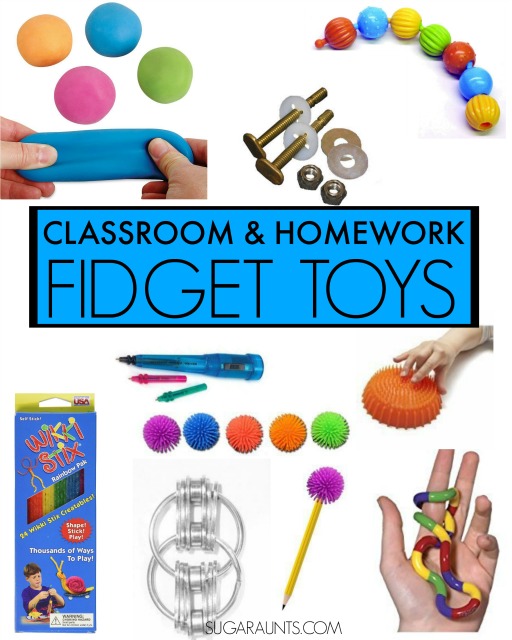
The Tangle Jr. Original Fidget Toy (affiliate link) will keep fingers and hands busy so kids can concentrate on homework or school work. 


 A ball of play dough or this Pull and Stretch Bounce Ball (affiliate link)
is a good way to keep kids’ hand occupied as they move with the small motor proprioceptive input. This heavy work for the hands can allow kids to concentrate as they write. 


 The DESK BUDDY (affiliate link) is great for kids who are doing homework as it can sit on a table surface or it can be a hand-held sensory fidget toy. 


 A pencil topper like these Pencil Tops Fidget (affiliate link) can help kids while they write, and can be fidgeted with on or off the pencil. 


 Try writing with a vibrating pen like this Squiggle Wiggle Writer (affiliate link) for proprioceptive input before a writing homework assignment. 


THE ULTIMATE FIDGET (affiliate link) is a quiet fidget toy that kids can keep in their pocket. 


 Something as simple as nuts, bolts, and washers (affiliate link) can make a great fidget toy for kids. 


 A few Wikki Stix (affiliate link) can give a child just the fidget toy they need to concentrate. Kids can bend them into a ball, and work the bendable strings as they work. 


Grip Pop Beads (affiliate link) are one of my favorite fidget toys for kids. They work on the small muscles of their hands as they build the pop beads and have a fidget once they have a strand of beads.
Are you looking for more information on Sensory Processing or any of the body’s sensory systems and how they affect functional skills and behavior?  

This book, The Sensory Lifestyle Handbook, will explain it all.  Activities and Resources are included.  Get it today and never struggle to understand or explain Sensory Integration again.

What are your favorite fidget toys and tools?

Tips and tools to help with kids who fidget during classroom and homework activities.
 

Learn Cursive Handwriting on the Window

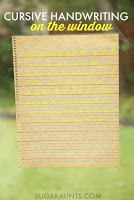
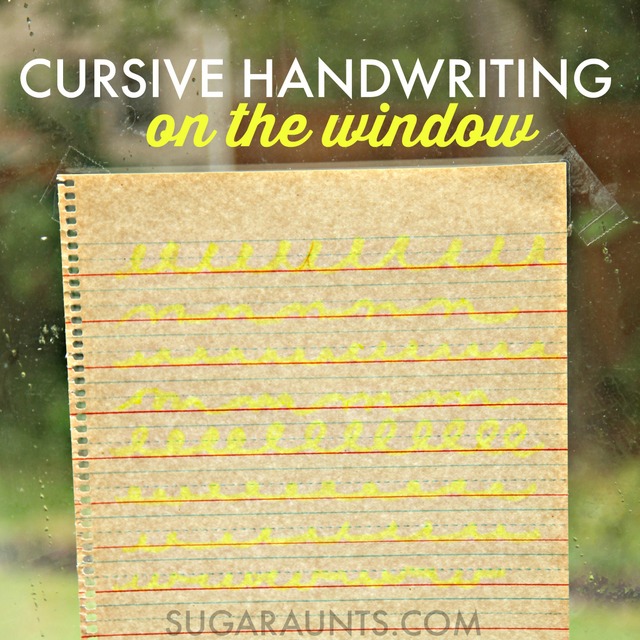
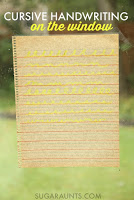
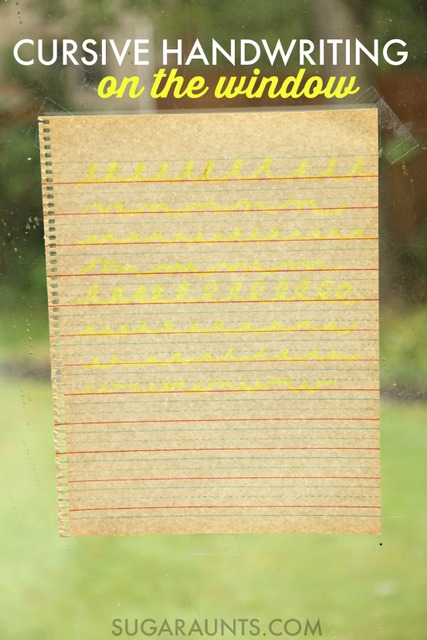
Looking for a fun way to learn cursive writing or practice handwriting?  This cursive handwriting on the window activity will encourage a functional grasp on the pencil, an extended wrist, and improved letter formation.  Learning cursive letters with creative writing techniques makes new concepts fun and memorable.  


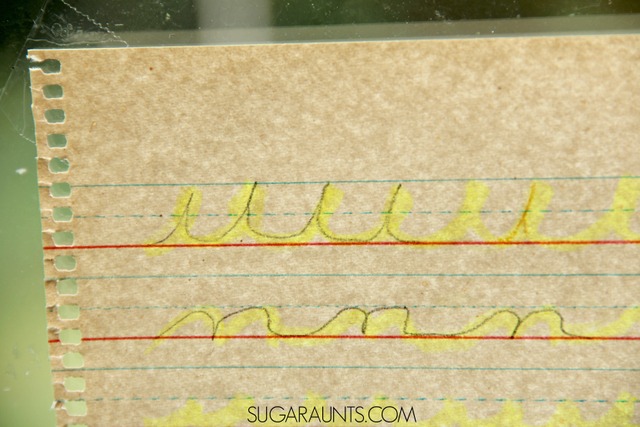
My daughter is all about learning cursive lately.  When I share a fun way to practice, she is even more into it!  One day, I taped a piece of paper to the window for creative cursive practice.  Using a gel highlighter and a pencil makes this activity easy to set-up and efficient for learning.  


We’re sharing this post as part of our 31 Days of Occupational Therapy with free materials where most of the items we’re using are ones that you can find in your home.  It’s been a fun series and we’re excited to continue with today’s post!

Learn cursive writing with this cursive handwriting activity to learn cursive letters, lines, and connecting lines on the window.

 Learn Cursive Writing on the Window: 


This post contains affiliate links.  

Writing on a vertical surface encourages an extended wrist.  While writing on a full vertical surface like a wall or a window is not effective for a lot of writing, practice is appropriate for short periods.  Kids can practice letter formation and learn cursive writing lines with this activity.  
 
This activity is so easy to set up:  

  • Tape paper to a window.
  • Write cursive lines with a highlighter or marker.  I used a gel marker which is perfect with it’s smooth writing lines.  The gel glides onto the paper and with the glass surface of the window, it really provide a a lot of feedback for writing the smooth lines of cursive letters.  Let your child write with the gel marker to try it, too!  
  • Have your child trace the highlighter with a pencil.  The light will shine through the highlighter lines and make a great tracing line.  You can practice beginning strokes like we shared in this post, cursive letters, and words with connecting cursive lines. 
  • It can be helpful to teach similar cursive letters together in groups. Read more about cursive letter families.
Learn cursive writing with this cursive handwriting activity to learn cursive letters, lines, and connecting lines on the window.
 
This would be a great way to continue to learn cursive writing and practice cursive in your Creative Cursive Journal (get it free!)
 
You could also use free cursive worksheets right on the window for another way to practice.
Learn cursive writing with this cursive handwriting activity to learn cursive letters, lines, and connecting lines on the window.

More creative ways to work on learning cursive writing:

Do you remember learning cursive as a kid?  Do you still write in cursive?

Mini Pumpkin Stickers Fine Motor Activity

This mini pumpkin stickers activity is a fine motor workout for little hands!

Sometimes you have to make Second Grade boring homework a little more fun.  Am I right?? Homework is definitely NOT play-based and after a loooong day at school, kids are ready to p.l.a.y! When they have to sit down to do homework and study for those upcoming tests, homework can become more of a battle than is should.  Do we ever know this in our house!  Some days, a visit to the dentist to pull teeth would be easier than getting the 5 minute homework task done.

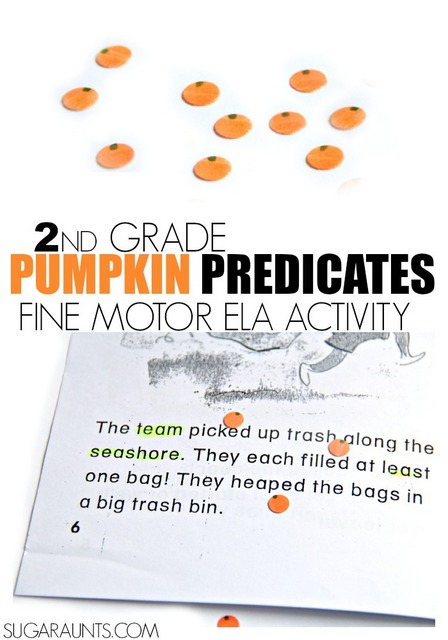
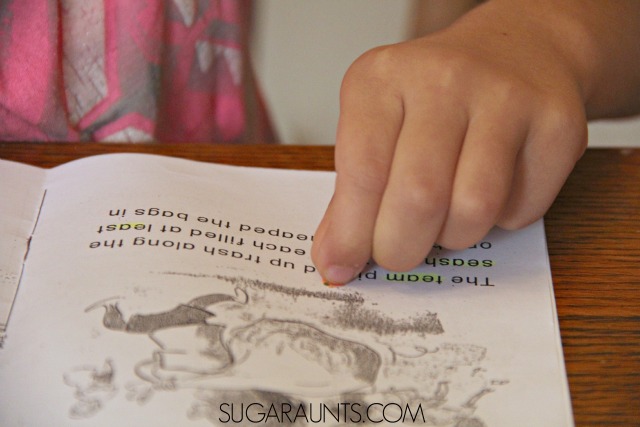
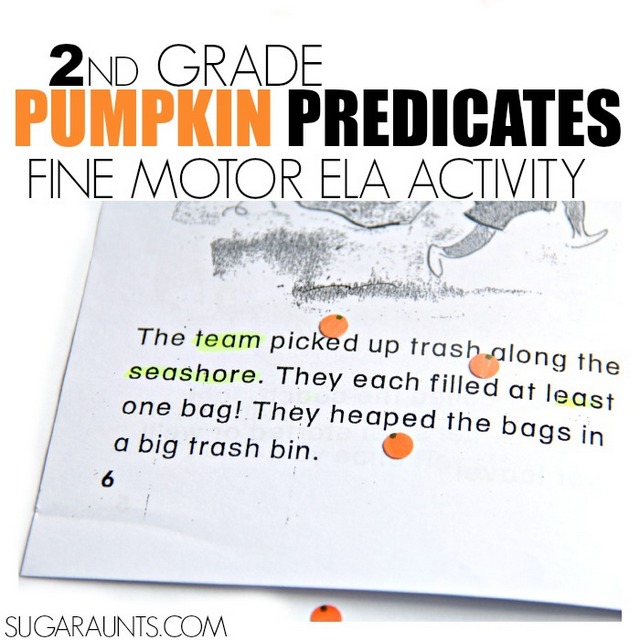
 English Language Arts in second grade covers nouns and predicates in sentences and my kiddo has been busy figuring identifying nouns and predicates in her decodable readers that are sent home from school.  We practiced a bit with these DIY mini pumpkin stickers…and voila!

 Pumpkin Predicates were born!


Practicing Nouns and Predicates with a Pumpkin Theme:

 Pumpkin Predicate and Noun activity for second grade English Language Arts.  Kids will love to identify the pumpkin predicate with these cute DIY pumpkin stickers!


(This post contains affiliate links.)


First, What is a noun and a predicate?

Second graders are responsible for knowing what a noun and a predicate is, by definition and by showing examples in sentences.  
A noun is a person, place, thing, or idea.  There are proper nouns (like Alabama, Tuesday, and Sammy) and plain old fashion nouns aka: common nouns…(like steak, alligator, and tennis ball).  The noun is the subject of the sentence and is the do-er of the action in the sentence.
 
A predicate is a verb or verb string.  It is the action of the sentence.
 
So, after practicing that with my daughter, off we went on our Pumpkin Predicate fun!
 
Pumpkin Predicate and Noun activity for second grade English Language Arts.  Kids will love to identify the pumpkin predicate with these cute DIY pumpkin stickers!
 
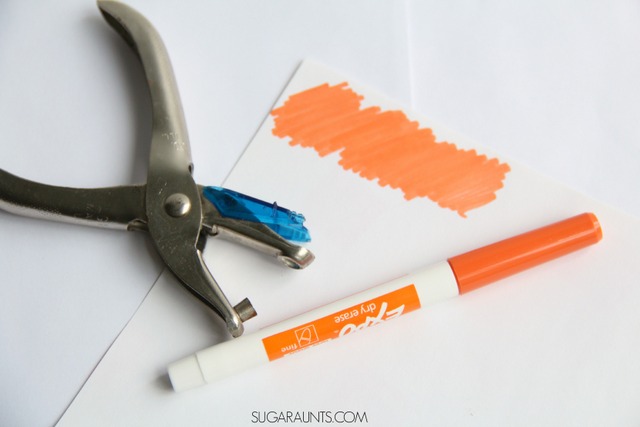
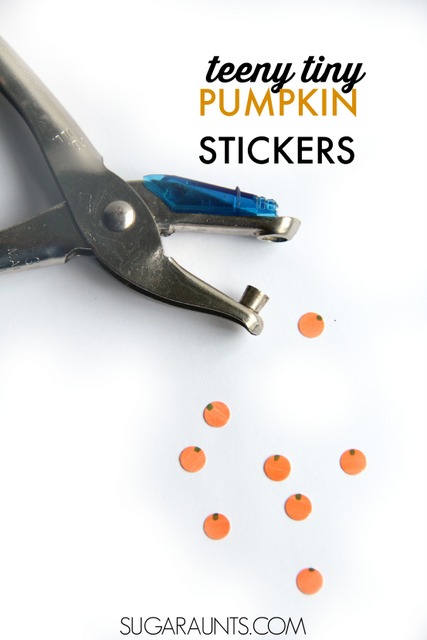
To make the pumpkins, grab a sheet of full-sheet label paper
This is the stuff that has a sticky back and you make address labels with. Very cool and useful stuff in crafting, I might add. Scribble a rectangle of orange with an orange marker. Then, use your
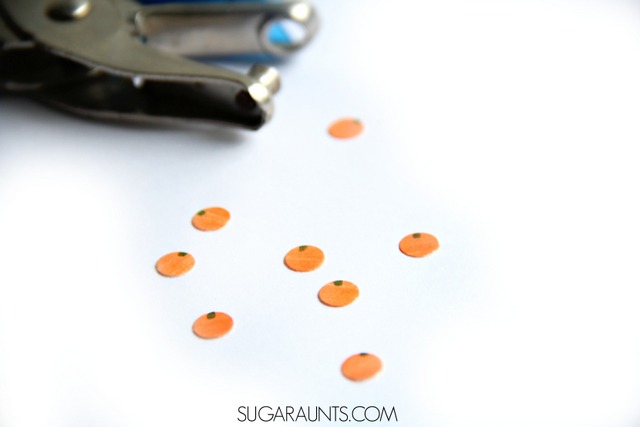
hole punch
to make a bunch of orange holes. Use a green marker to make a tiny little stem, and you are done! Instant teeny tiny cute little pumpkin stickers.
 
Pumpkin Predicate and Noun activity for second grade English Language Arts.  Kids will love to identify the pumpkin predicate with these cute DIY pumpkin stickers!
 
Pumpkin Predicate and Noun activity for second grade English Language Arts.  Kids will love to identify the pumpkin predicate with these cute DIY pumpkin stickers!
 
We used decodable readers that my second grader had from school.  They photocopied booklets that the school has created and sent home with each student.  You can make your own sentences to practice predicate and noun naming, use worksheets, the newspaper, or magazines.  You don’t want to stick these pumpkin stickers in a real book, because the stickers will be hard to remove. 
 
Have your child name the noun and the predicate in sentences.  Place the pumpkin stickers above each predicate.  Note: Peeling the backs from the label sheet stickers can be a real exercise in fine motor dexterity!  Your kiddo will get their fine motor skills moving!
 
Pumpkin Predicate and Noun activity for second grade English Language Arts.  Kids will love to identify the pumpkin predicate with these cute DIY pumpkin stickers!
 
 Love it? Pin it!
 
So punch out those pumpkins and play away the homework blues.  These cute little pumpkins are sure to help make predicate practice a bit more fun!
 
Looking for more second grade activities with a pumpkin theme?  Try these from our Second Grade Blogger Team:
 
How to Carve a Pumpkin Writing Prompts by Still Playing School 
How to Set Up a Pumpkin Engineering Task Your Second Graders Will Love by Thriving STEM


Pumpkin Seed Place Value – Subtraction Math Fact by Rainy Day Mum

Shapes on a Pumpkin by Preschool Powol Packets 

 Pumpkin Math Fact Pick and Solve Sticks by Creative Family Fun


Pumpkin Predicate and Noun activity for second grade English Language Arts.  Kids will love to identify the pumpkin predicate with these cute DIY pumpkin stickers!
 
Looking for more second grade activities?  You will love these: 


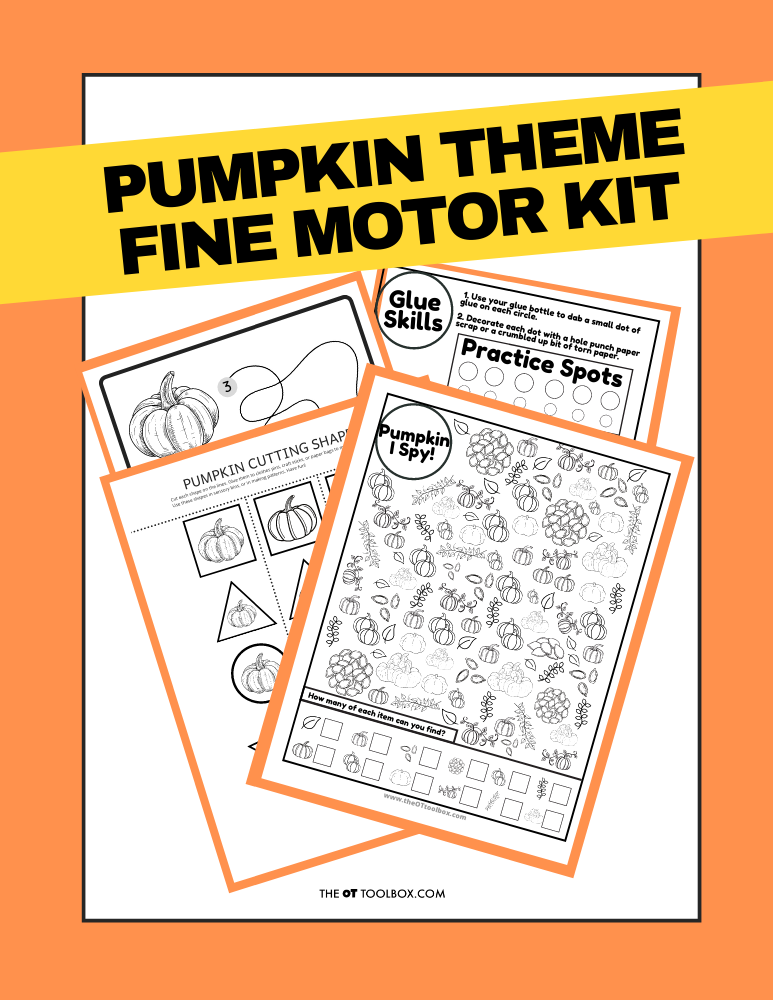
Pumpkin activity kit
Pumpkin Fine Motor Kit

Grab the Pumpkin Fine Motor Kit for more coloring, cutting, and eye-hand coordination activities with a Pumpkin theme! It includes:

  • 7 digital products that can be used any time of year- has a “pumpkins” theme
  • 5 pumpkin scissor skills cutting strips
  • Pumpkin scissor skills shapes- use in sensory bins, math, sorting, pattern activities
  • 2 pumpkin visual perception mazes with writing activity
  • Pumpkin “I Spy” sheet – color in the outline shapes to build pencil control and fine motor strength
  • Pumpkin Lacing cards – print, color, and hole punch to build bilateral coordination skills
  • 2 Pumpkin theme handwriting pages – single and double rule bold lined paper for handwriting practice

Work on underlying fine motor and visual motor integration skills so you can help students excel in handwriting, learning, and motor skill development.

You can grab this Pumpkin Fine Motor kit for just $6!

Colleen Beck, OTR/L has been an occupational therapist since 2000, working in school-based, hand therapy, outpatient peds, EI, and SNF. Colleen created The OT Toolbox to inspire therapists, teachers, and parents with easy and fun tools to help children thrive. Read her story about going from an OT making $3/hour (after paying for kids’ childcare) to a full-time OT resource creator for millions of readers. Want to collaborate? Send an email to contact@theottoolbox.com.

31 Days of Occupational Therapy with Free Materials

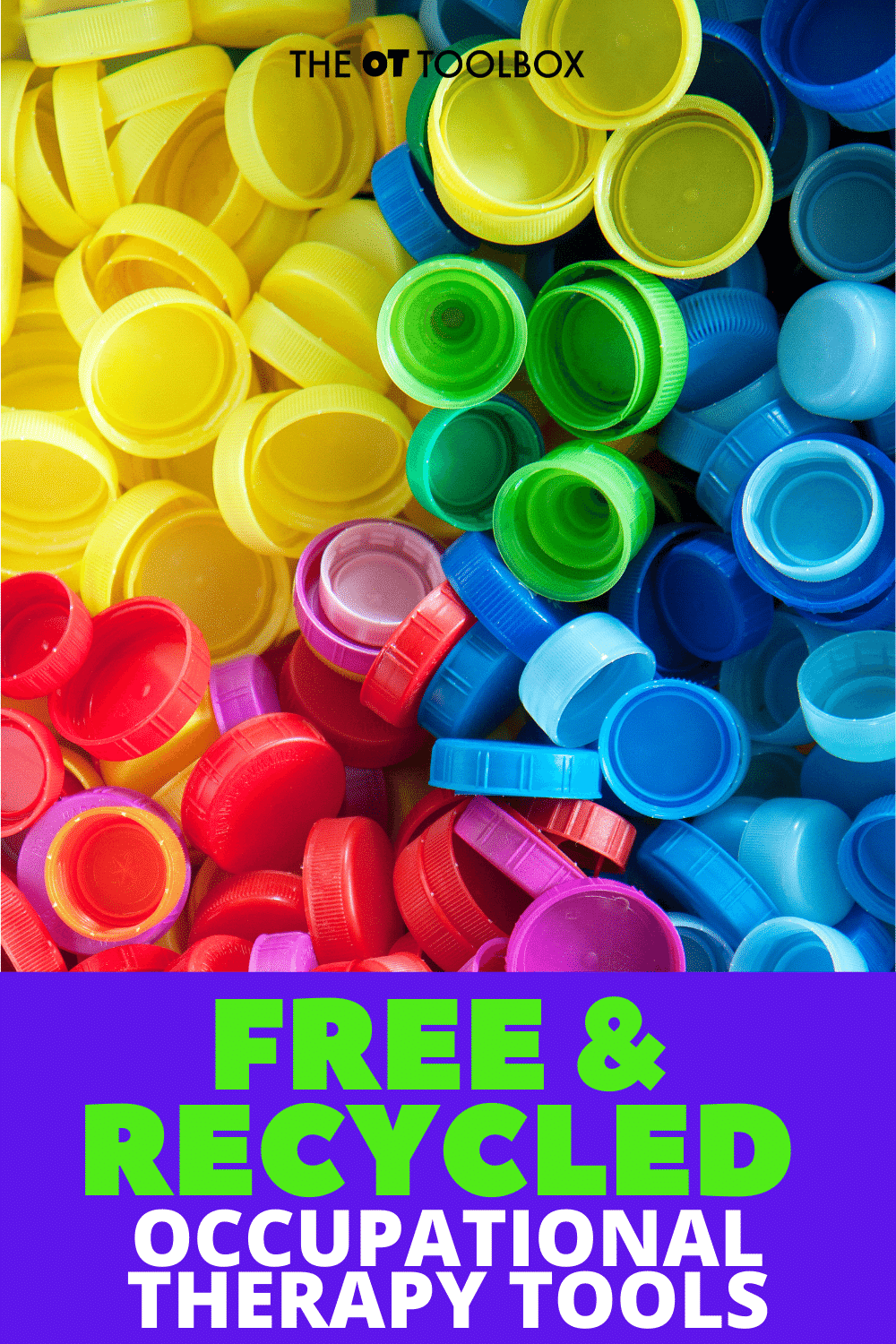
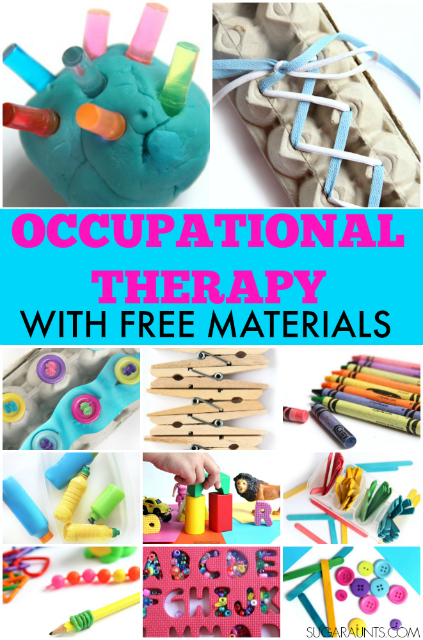
Use these free and recycled items to work on occupational therapy goals

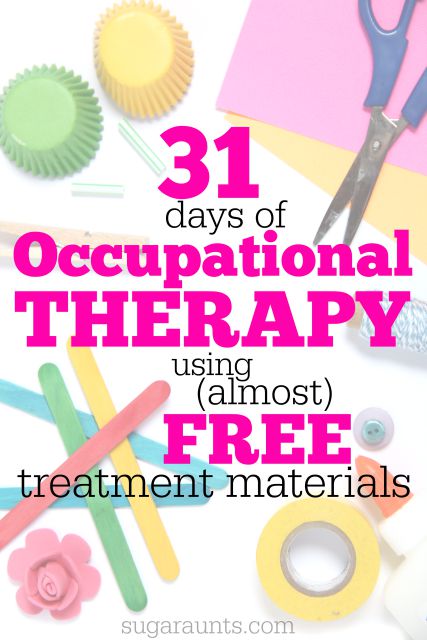
Coming up with fun ideas for occupational therapy activities for interventions can easily become nerve-wracking! It’s easy to fall into a routine and use the same old cookie cutter activities in OT treatment sessions. Here, you will find a challenge designed to change that recipe for burnout! Below is a strategy to use out-of-the-box occupational therapy activities using free materials, or items you probably already have! 


Occupational Therapy Activities


Below is a series I ran one October, in which I challenged myself to write 31 days of posts about my profession: Occupational Therapy!  You will find 31 days of Occupational Therapy with free materials provides treatment activities, tips, tools, and ideas for many developmental, sensory, fine motor, gross motor, and visual perceptual areas. 

I’ve bumped up the OT activities, though, to add more ideas to build fine motor skills or work on development, all with free items.

The best news is that these ideas are going to be creative fun that kids will love and (almost) all free.  The therapeutic modalities that I’ve outlined will provide you will a resource for frugal treatment of many Occupational Therapy goal areas.  

I strive to create crafts and activities that use mostly free items that are found around my home in the play and learning that we do here.  


Use these free and recycled items to work on occupational therapy goals

Occupational Therapy Activities with Free Materials

Scroll through the activities below for fun ways to work on development. But first, let’s discuss a few items you may want to have in your therapy toolbox. These are recycled items and household materials that can be used in various ways.

They are open-ended items to use in fine motor work, or in textured sensory play. Use the items to work on hand strength, scissor skills, motor planning, or other occupational therapy goal areas. 

Here are some free and recycled items to stock your therapy toolbox:

  • Cardboard
  • Cupcake liners
  • Sandpaper
  • Cardstock
  • Construction paper
  • Tissue paper
  • Index cards
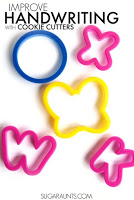
  • Cookie cutters
  • Nuts and bolts
  • Plastic sandwich bags
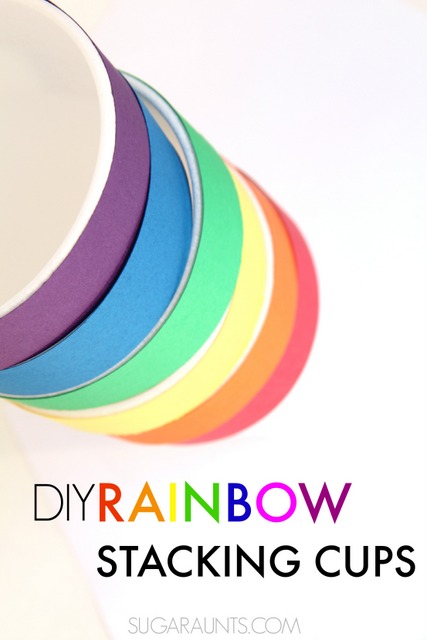
  • Paper cups
  • Newspaper
  • Buttons
  • Tape
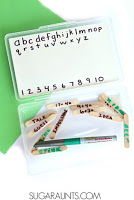
  • Craft sticks (popsicle sticks)
  • Craft pom poms or cotton balls
  • Recycled egg carton
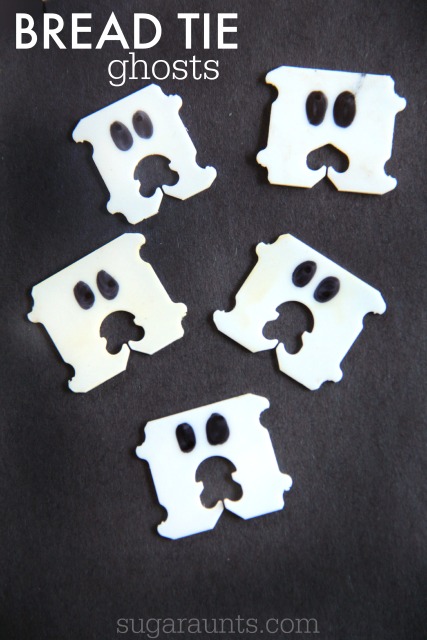
  • Bread ties
  • String
  • Glue
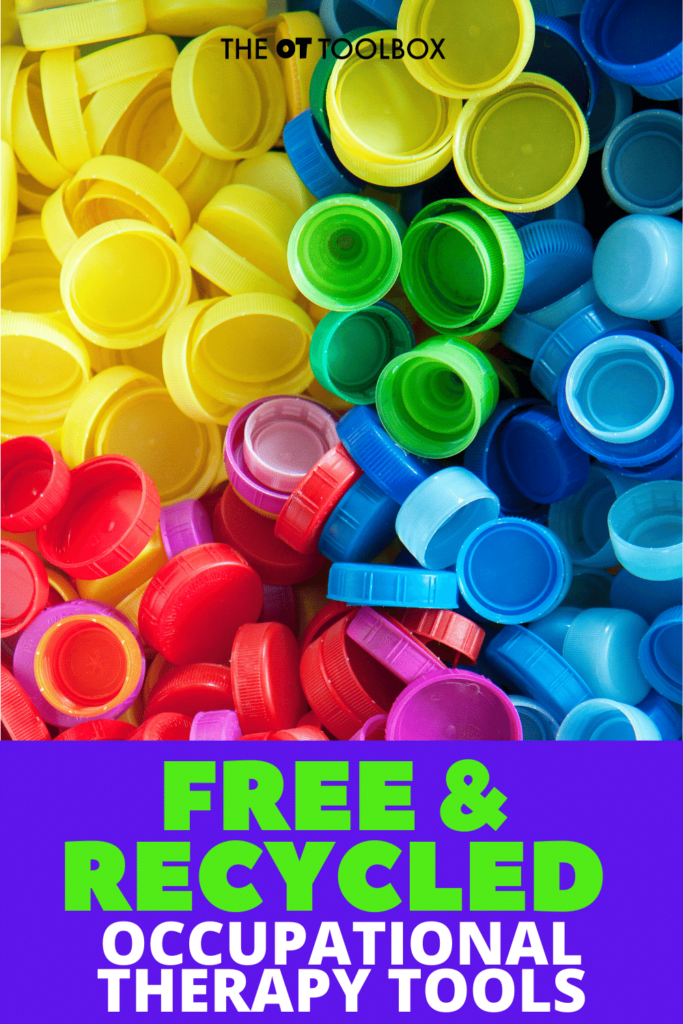
  • Recycled bottle caps
  • Cardboard tubes
  • Rubber bands
  • Small containers
  • Crayons
  • Recycled bottles

occupational therapy items to add to your therapy bag

What would you add to this list?

Occupational Therapy treatment tips and tools for pediatrics and school-based therapy using mostly free or inexpensive materials and items you can find around the home.  Great resource and many ideas here!
 
Affiliate links are included in this post.
 
You can see a previous activity challenge, based on learning in the 31 days of learning with mostly free items challenge. I’m hoping that this series is just as helpful!
 

If you’ve been to this blog before, you might know that I’m an Occupational Therapist by trade, and love sharing helpful tips, tools and strategies that meet a variety of needs. It’s my hope that this OT Challenge will be an idea-generator for you!

More Occupational Therapy Activities

A few more resources on the site may be helpful for you. Below are some of our free courses, printable packets, and email courses that can be used in your practice. Let me know if there is another topic you are looking for information on. I would love to help out!


This Visual Processing Lab is an email series that delivers tons of content and information right into your email inbox. Expect to learn tons on visual perception, visual motor integration, and what that looks like in our kiddos who struggle with handwriting and eye-hand coordination. This email series is totally free! Join the lab here.

This visual processing lab is a series for occupational therapists looking for occupational therapy activities based on visual processing needs.


This Executive Function Mini-Course is a free email course on everything executive functioning. You will learn about executive functioning skills, how they develop, and what executive functioning challenges look like in our kids at home and at school. You’ll gain helpful tips that can be implemented right away. It’s a goldmine for any parent, teacher, or occupational therapist!


Take the Executive Function Mini-Course here. 

This executive function course is a helpful tool for occupational therapists, parents, or teachers working with kids on executive functioning skills.


Occupational Therapy Activity Ideas


In this Occupational Therapy with free materials series, you will find many of my favorite occupational therapy treatment activities for many developmental difficulties in pediatrics, all using items that you probably already have at home.  

The nice thing about this series is that you don’t have to be receiving OT services or have a diagnosis of anything to benefit from these 31 days of tips and tools.  Many, MANY kids out there are working on shoe tying. Or writing on the lines.  Or many other developmental areas.  All of the activities will be low-cost and inexpensive.


Here is a little video that we created based on this series. It’s my hope that the activities below hit on the needs you have on your caseload!

It is my hope that you will find the ideas shared here in the next 31 days to be helpful and and a valuable resource.  AND, not only will the tricks and tips use mostly free or low-cost items, I will also have lists of my recommendations for toys and tools that can help with each area.  

This is going to be a great month …but fun! Use these activities to guide interventions, using out-of-the-box ideas, while working on goal areas your clients need.


And now, without further ado:

31 Days of Occupational Therapy with Free Materials


https://www.theottoolbox.com/2015/10/visual-tracking-tips-and-tools-for.html  


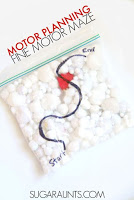
 Motor Planning Fine Motor Maze hand strengthening activity


 Scooping and pouring fine motor and hand dominance with beads
 

Day 22 The Benefits of Coloring

Day 23 Clothes Pin Exercises and Pinch Grasp Types

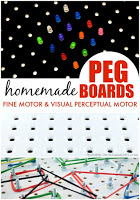
Day 24 Homemade Pegboard Activities

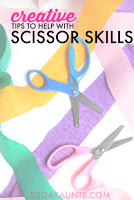
Day 25 Creative Scissor Skills Practice

 
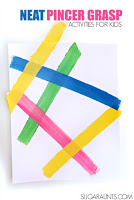
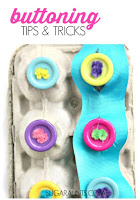
Neat Pincer Grasp Fine Motor Activity Buttoning Tips and Tricks


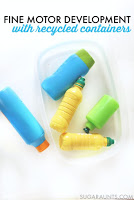
Day 30 Gross Grasp with Recycled Containers

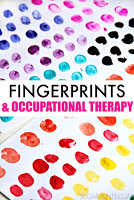
Day 31 Finger Isolation Fingerprint Activities

 
Did you LOVE this series as much as I did?  Here are MORE ways to work on Occupational Therapy using mostly free or inexpensive materials:  
 
Try a few inexpensive treatment tools like kid-friendly tongs and tweezers.  They can be used in so many different ways.  A set of simple supplies can be tools for many different OT treatment goals.


 Sensory Processing and handwritinghttps://www.theottoolbox.com/2015/11/benefits-of-playing-with-stickers-occupational-therapy.html What is motor planning activity for kids


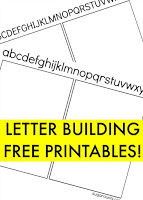
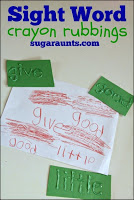
 Free letter building printables Sight word crayon rubbing activity


Even MORE great pages you where you will find tons of Occupational Therapy treatment ideas and info that can be incorporated into simple play at home, using frugal (mostly free) items that you already have:   Sensory Play IdeasVisual Perceptual SkillsFine Motor Skills

Occupational Therapy treatment tips and tools for pediatrics and school-based therapy using mostly free or inexpensive materials and items you can find around the home.  Great resource and many ideas here!
Occupational Therapy treatment ideas using free materials

Love these ideas shared in this series?  Try some of these: 

Occupational Therapy Activities for Scissor Skills

There are many scissor skills resources on the website. Some of our favorite ways to support use of scissors include:

Occupational Therapy Activities for Fine Motor Skills

Building fine motor skills in occupational therapy sessions occur typically in each therapy session. Here are more fun ways to build these essential skills:


Occupational Therapy Activities for Handwriting

We have many handwriting strategies here on the website. Some of our favorite ways to develop handwriting skills in OT include:

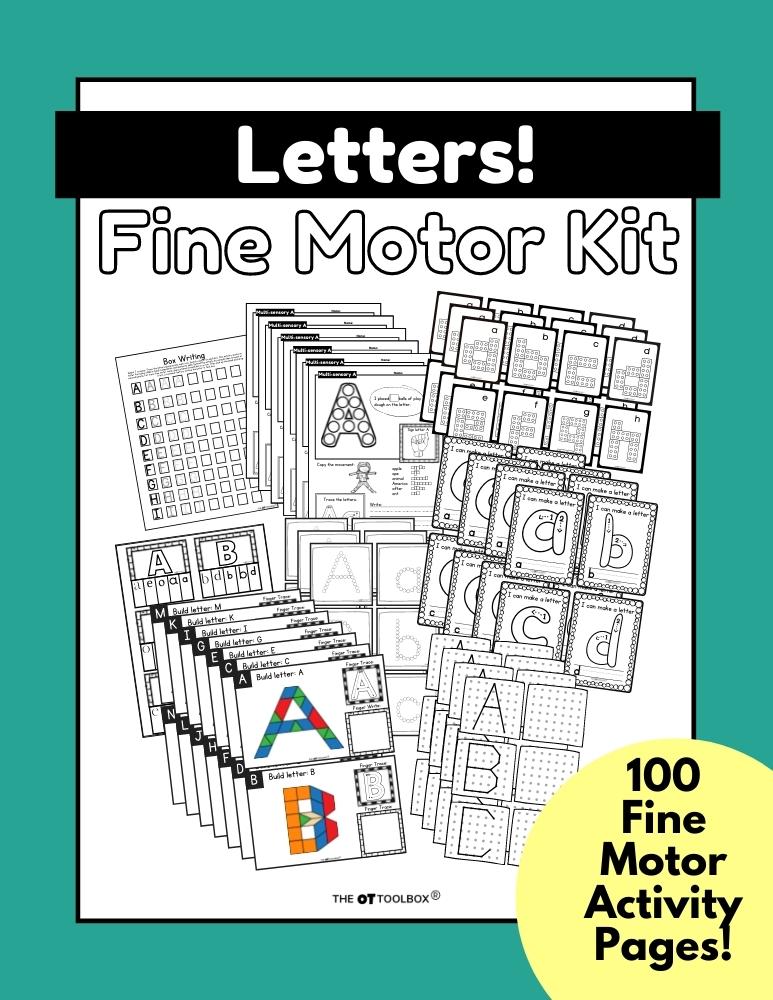
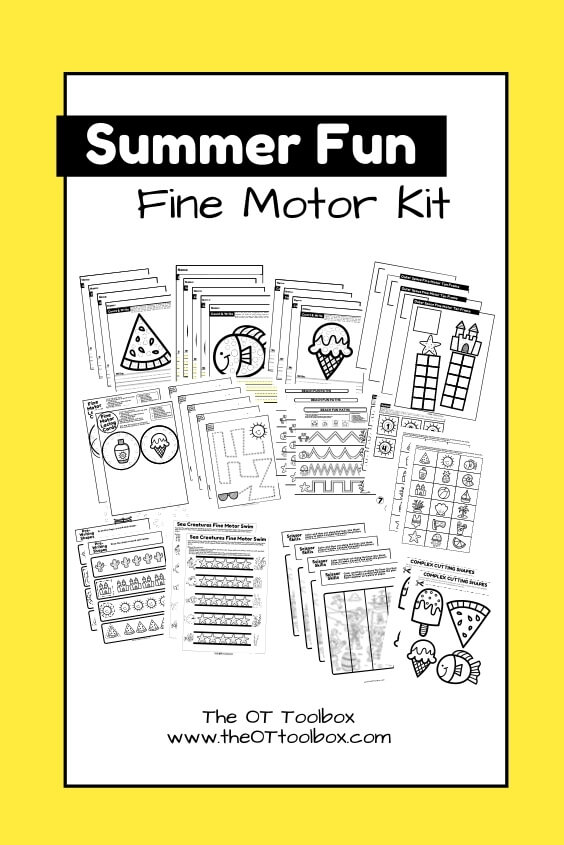
Working on fine motor skills, visual perception, visual motor skills, sensory tolerance, handwriting, or scissor skills? Our Fine Motor Kits cover all of these areas and more.

Check out the seasonal Fine Motor Kits that kids love:

Or, grab one of our themed Fine Motor Kits to target skills with fun themes:

Want access to all of these kits…and more being added each month? Join The OT Toolbox Member’s Club!

Colleen Beck, OTR/L has been an occupational therapist since 2000, working in school-based, hand therapy, outpatient peds, EI, and SNF. Colleen created The OT Toolbox to inspire therapists, teachers, and parents with easy and fun tools to help children thrive. Read her story about going from an OT making $3/hour (after paying for kids’ childcare) to a full-time OT resource creator for millions of readers. Want to collaborate? Send an email to contact@theottoolbox.com.

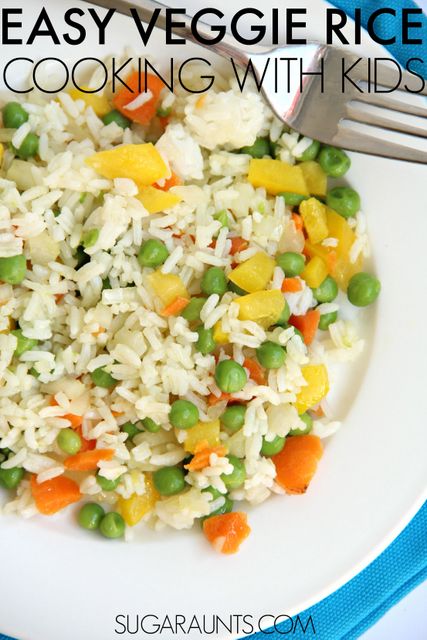
Easy Vegetable Rice Recipe Kids will Eat

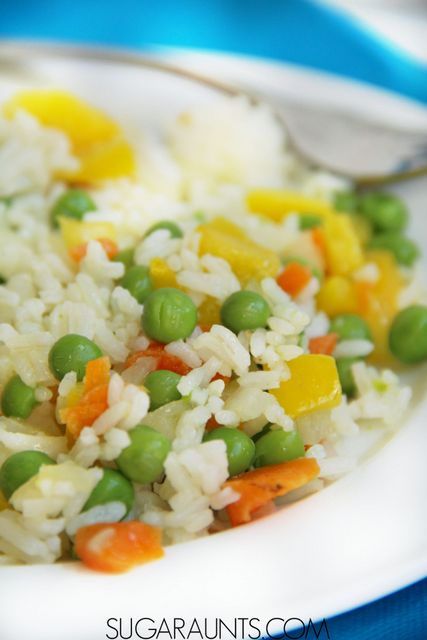
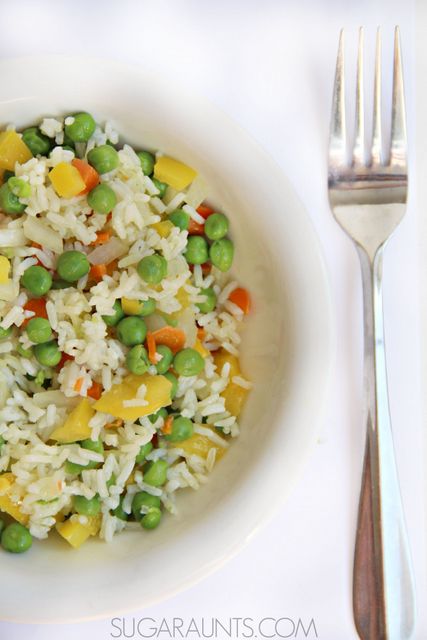
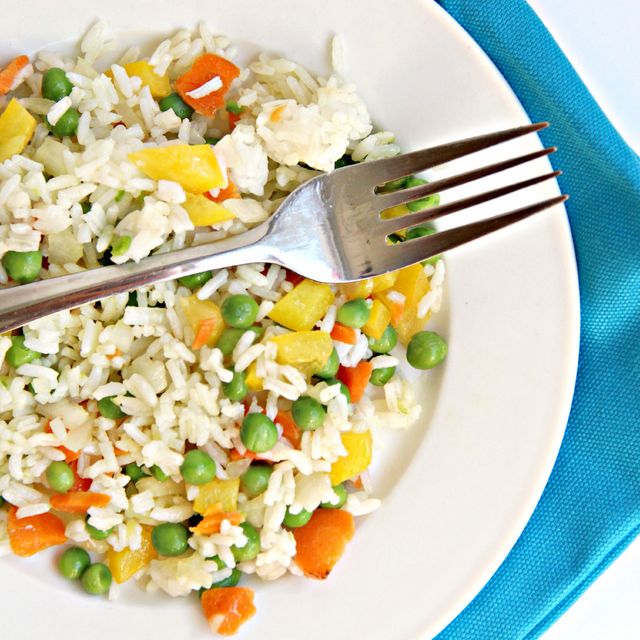
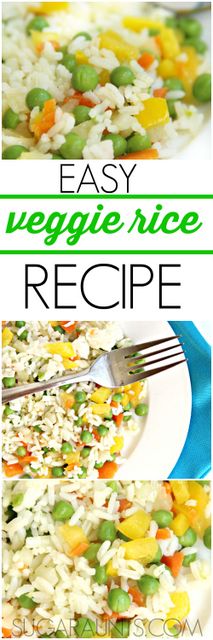
Our Cooking With Kids series has been such a hit, both on the blog in in our home.  My daughter and I have created quality time together as we cook our way through the alphabet.  We’ve love trying new foods and sharing them with you and your families!  Today we’re sharing a go-to and easy recipe for any weeknight dinner.  This Easy Vegetable Rice dish is perfect as a side dish for families when you want to get some extra veggies into the kids.  The colorful rice dish can be a meal in itself, if you add your favorite meat. We made this dish together when a cousin was over for some playtime.  The two cousins had a blast in the kitchen and we got to eat the vegetable rice for dinner, making it a real treat to serve up food that we cooked together.  

Easy Vegetable rice recipe. This is an easy side dish or main meal if you add a protein.  Kids love this and can help with cooking in this easy cooking with kids recipe.

Easy Vegetable rice recipe. This is an easy side dish or main meal if you add a protein.  Kids love this and can help with cooking in this easy cooking with kids recipe.


Easy Vegetable Rice Recipe (for a main dish or side!)

(This post contains affiliate links.)
Start with 3-4 cups of cooked rice.  We used leftover rice, which we always seem to have when we eat any kind of dish with rice.  Save that leftover rice!  It’s totally yummy the next day. 

 (I cook my leftover rice in a saucepan with a layer of water at the bottom.  Stir occasionally and then when it’s started simmering, give it a good stir and cover with a lid.  Leftover rice has now become no-knows-it’s-leftover-rice!)

Back to our veggie dish.  Grab up any vegetables you’ve got on hand.  Frozen peas? Check.  Baby carrots? Yep. Peppers of any and all color? Yes please.  Other vegetables that make a great addition to this recipe: broccoli, cauliflower, onions, beans, cabbage, kale, spinach, celery, brussel sprouts, swiss chard, kidney beans, black beans, any beans…you get the picture.  
We made our vegetable rice dish with cooked onions, red and green peppers, peas, and carrots.  

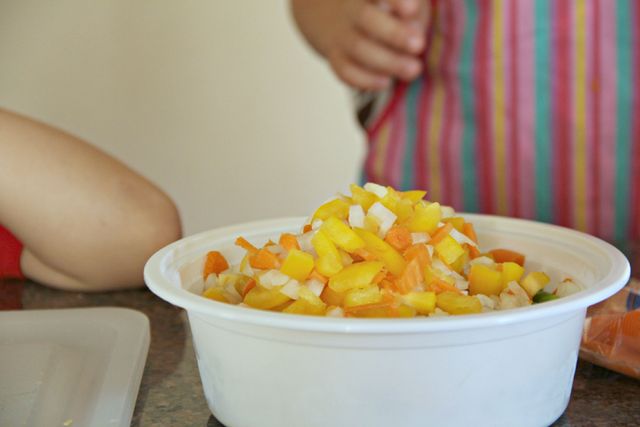
Start by dicing the onion and sauteing in a small amount of olive oil.  You will need to cook any of the “tougher” veggies like broccoli or brussel sprouts.  While the onions are cooking, get the kids busy with chopping and dicing.  

Easy Vegetable rice recipe. This is an easy side dish or main meal if you add a protein.  Kids love this and can help with cooking in this easy cooking with kids recipe.

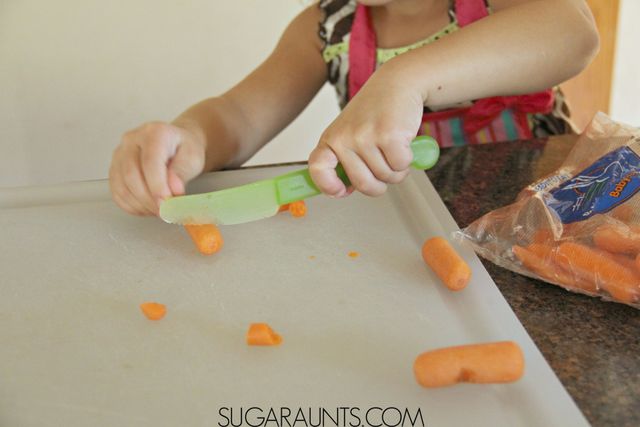
These two cousins used kid-friendly knifes
to slice and dice peppers.  I’ve found that slicing the peppers into strips and then having the kids chop them into chunks works well with the preschool age.  


Easy Vegetable rice recipe. This is an easy side dish or main meal if you add a protein.  Kids love this and can help with cooking in this easy cooking with kids recipe.

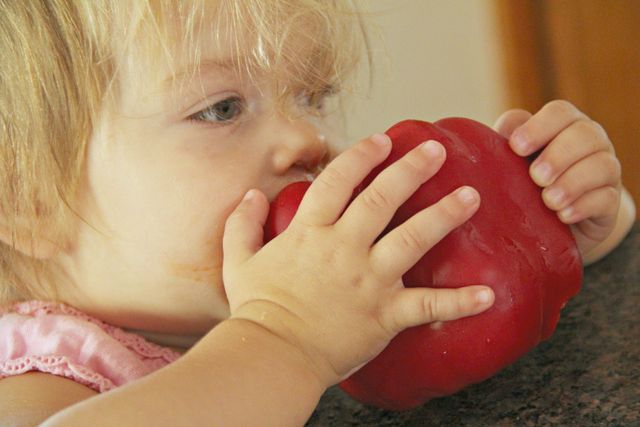
This little one had fun watching all of the cooking action…while enjoying a (large) red pepper snack.  Just kidding.  She only nibbled on the pepper.

Easy Vegetable rice recipe. This is an easy side dish or main meal if you add a protein.  Kids love this and can help with cooking in this easy cooking with kids recipe.

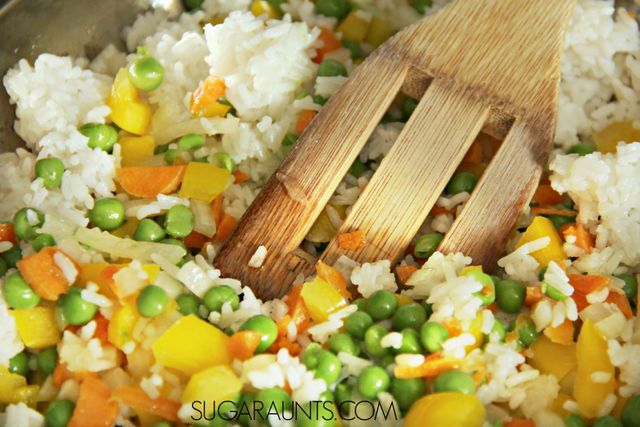
After you’ve got all of your vegetables chopped, add them to the onions.  Sprinkle in salt and pepper to taste.  At this point, we added a dash of lemon juice and 1 teaspoon dried parsley.  Allow the vegetables to cook for 2-3 minutes.  Stir in the cooked rice and heat for 1-2 minutes.  You want all of the flavors to combine.

Easy Vegetable rice recipe. This is an easy side dish or main meal if you add a protein.  Kids love this and can help with cooking in this easy cooking with kids recipe.
Serve hot as a side dish the whole family will love.  If you want to make this a meal, cut up chicken breasts or strip steak and cook on the side.  Then add to the rice at the end. 

Easy Vegetable rice recipe. This is an easy side dish or main meal if you add a protein.  Kids love this and can help with cooking in this easy cooking with kids recipe.
Enjoy!


Easy Vegetable rice recipe. This is an easy side dish or main meal if you add a protein.  Kids love this and can help with cooking in this easy cooking with kids recipe.


      Easy Vegetable rice recipe. This is an easy side dish or main meal if you add a protein.  Kids love this and can help with cooking in this easy cooking with kids recipe.
Looking for more rice recipes?  Try some of these by the Cooking With Kids A-Z blogging team:


Steak Fried Rice from Frogs and Snails and Puppy Dog Tails


More Cooking with Kids ideas that you will love to make with your family:

Vegetable Quesadilla Recipe   Honey Nut Popcorn  Antipasto Skewers
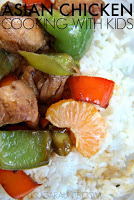
M is for MushroomsVeggie Quesadilla Recipe | N is for NutsHoney Roasted Nuts Popcorn | O is for OlivesAntipasto Skewer Kabobs | P is for Peppers: Asian Chicken

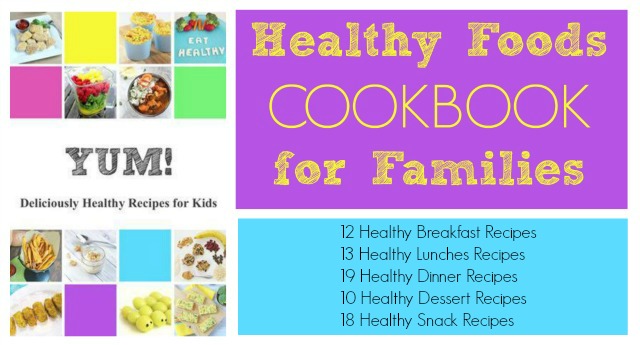
Want to cook healthy foods for your family?  Grab Yum! Deliciously Healthy Meals for Kids, a cookbook for busy families that want healthy meal ideas. 

Healthy recipes for kids

Nickel and Dime Skip Counting Math

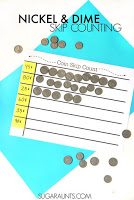
Second grade math.  It can be a complicated thing for kids.  Second grade math moves along fast.  We’re in our third week of school and my second grader is moving right along!  We made this nickel and dime coin activity for our Second Grade Math series.  This week’s theme is money and we used coins in conjunction with the skip counting that my second grader is doing at school this week.  It was fun to show her how skip counting by 5’s and 10’s is used in real-world applications like counting coins.  
Nickel and Dime money math skip counting to count money.  This is second grade skip counting math activity is a fun way to practice addition and teach money.


Nickel and Dime Skip Counting by 5’s and 10’s Math Activity

This post contains affiliate links.  Counting and playing with coins is an excellent fine motor activity.  We’ve shared a coin activity for kids before.  For this skip counting activity, we used our Play Money Set only because we had it.  You can do this math activity using real coins.

Nickel and Dime money math skip counting to count money.  This is second grade skip counting math activity is a fun way to practice addition and teach money.

To start, we practiced naming and sorting coins.  I had my second grader sort the nickels and dimes for this activity.  She is working on skip counting by 5’s and 10’s (both forward and backward) to and from 1,000.  So, skip counting out our nickel and dime coins was a great way for her to see how skip counting is used in real life.
Nickel and Dime money math skip counting to count money.  This is second grade skip counting math activity is a fun way to practice addition and teach money.


Second Grade Math Money Activity

To practice skip counting the coins, I created this Coin Skip Count printable sheet.  You can get the printable worksheet for FREE here.  Next, use small post-it notes to write different amounts of change.  Stick the notes along the left side of the worksheet.  You could also write directly on the sheet, but I wanted to save on ink and only print one page for many coin-counting trials.

Nickel and Dime money math skip counting to count money.  This is second grade skip counting math activity is a fun way to practice addition and teach money.
 
Show your child how nickels add up in increments of 5 and practice skip counting by 5’s to reach the amount on the page.  Then, add up dimes and practice skip counting by 10’s to reach the numbers.  
 
Alternate activities:
  • Practice skip counting down from 100 by subtracting coins to reach the number listed.
  • Add quarters to the activity to practice adding to dollars.
  • Add up coins to beyond one dollar.
Looking for more second grade activities?  Follow our Second Grade Learning Pinterest board.
 
Or, if you are looking for more second grade money activities, see what the others on the Second Grade Bloggers team have come up with this week: 

Here are some other great Money activities for your 2nd graders!

Chemical Reactions with Pennies from Creative Family Fun 

Money Activities for Second Grade from Look! We’re Learning! 

Money Math Problems for 1st-3rd Grade from Planet Smarty Pants 

Counting Coins Scavenger Hunt from School Time Snippets 

Nickel and Dime money math skip counting to count money.  This is second grade skip counting math activity is a fun way to practice addition and teach money.
Love this post?  Share it on Facebook and Tweet: Teach kids how to count money with this nickel and dime skip counting math activity: http://ctt.ec/E9gwN+ it!
 
More math activities you will love:
 Commutative Property of Addition  How to Add with Regrouping  Use play dough in math  Bottle caps in first grade math