Colleen Beck, OTR/L is a pediatric occupational therapist and the owner and author of The OT Toolbox website. She manages all of The OT Toolbox social media accounts and runs the popular newsletter.
Read about Colleen's experience and career as an occupational therapist, including how The OT Toolbox began on our About The OT Toolbox page: https://www.theottoolbox.com/about-us/
Colleen created The OT Toolbox in 2011 and since then has written thousands of blog posts designed to support therapy providers, educators, parents, counselors, admin, and caregivers in promoting the healthy development of kids.
Check out Colleen's blog posts below:
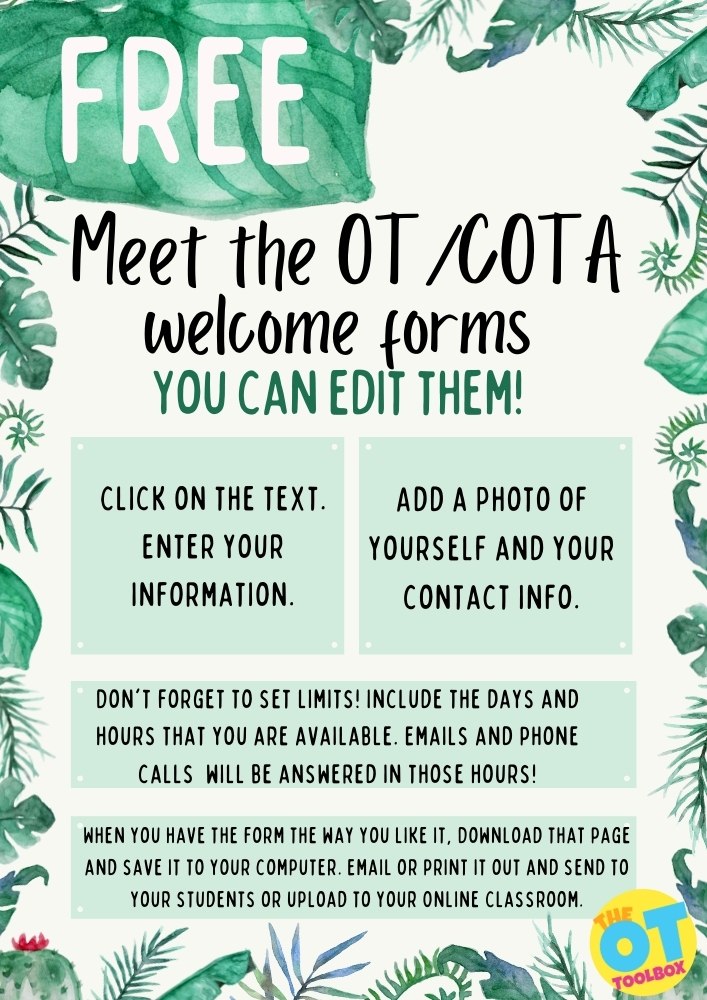
Each year, one of the most exciting parts of back-to-school is meeting a new teacher or therapist. That’s why these free meet the teacher forms/ meet the therapist forms are the way to go when it comes to starting the school year off right. Many teachers have created meet the teacher forms to introduce themselves to their new class, and OTs/COTAs should have the same fun to start off a new year of OT services.
Free Meet the teacher templates
If you’ve worked in the school long, then you’ve probably seen a meet the teacher form or two. Meet the therapist forms are just as important! You can grab this set of editable forms and enter your information, then share them with your new caseload.
Here’s how it works:
Enter your email address into the form below.
You’ll receive an email with a PDF containing a link to access this template of free meet the teacher/meet the therapist forms. (Save the PDF if you want to make a new letter next year!)
When you click the link on the PDF, you’ll be sent to Canva. If you have a Canva account, you can open the files in Canva.
If you don’t have a Canva account, you’ll be directed to create one (it’s free).
When you open the link, you’ll see a template of 13 different Meet the Therapist Forms.
Click on the text and change it to say what you like. Add a picture of yourself if you like.
Download the page that you like and email it to your student’s parents, print it, or add it to your online classroom.
When you access this free template of meet the therapist or teacher letters, you’ll find 13 different templates. Each one is editable in Canva, so you can add your own information.
A Meet the Teacher letter or Meet the Therapist letter is a fun way to start of the school year. You can add fun facts, information about this upcoming school year, and even your working hours. A meet the therapist or meet the teacher letter is the perfect place to set limits on your working days or working times. Don’t set yourself up to answer phone calls or emails outside of your working hours, and you can let parents know that on your back-to-school letter.
Add in contact information like a phone number or email address.
Then, use this meet the therapist form on your school webpage, in an email to parents, or in an online classroom. Some forms are even printer friendly, so you can print off copies and send them home with students.
Have fun making your Meet the Therapist Letter and let’s have a great school year!
Colleen Beck, OTR/L has been an occupational therapist since 2000, working in school-based, hand therapy, outpatient peds, EI, and SNF. Colleen created The OT Toolbox to inspire therapists, teachers, and parents with easy and fun tools to help children thrive. Read her story about going from an OT making $3/hour (after paying for kids’ childcare) to a full-time OT resource creator for millions of readers. Want to collaborate? Send an email to contact@theottoolbox.com.
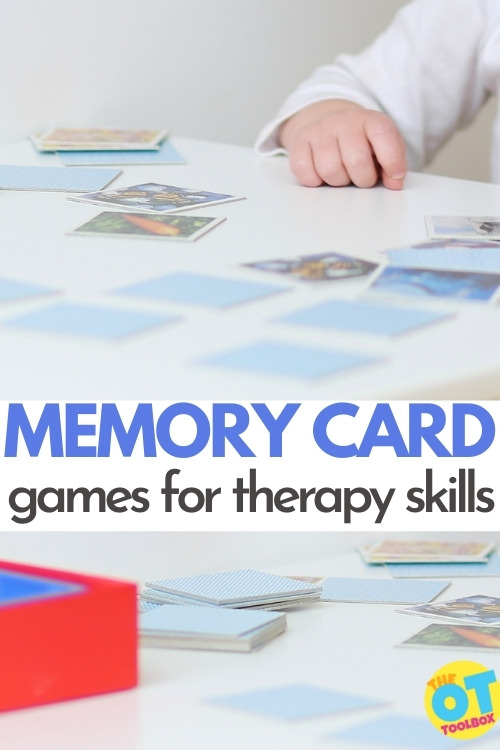
Occupational therapy professionals know the benefit of using memory card games to build skills in therapy sessions. OTs love to use games in therapy sessions to address a variety areas in novel and fun ways…and kids love the gaming aspect of therapy!
Memory Card Games in Occupational Therapy
There are so many reasons to play memory games in OT! Areas like executive functioning skills, to working memory, attention, focus, to fine motor skills, visual motor skills, visual perceptual skills, and even handwriting can be improved through the use of memory card games.
It would be easy to incorporate some handwriting games into a memory card activity.
We’ve talked about using games in a variety of ways…today, we’re covering the use of a Memory Card Game to work on various skills in OT. Here’s why this simple game is such a powerful tool for impacting function:
Memory games are a powerful way to work on sort term memory, working memory, and executive functioning skills such as attention organization planning prioritization organizational skills.
Memory games are fun way for kids to work on short term memory and other skills that are beneficial for learning in the classroom and at home.
When kids play memory they can work on holding short term information in their memory In their short term memory. This allows them to use visual attention and visual memory while they remember where pictures are located playing a classic memory game.
Kids with other executive functioning issues me to be struggling with the same challenges in the classroom or at home. By playing a game such as memory kids can work on these executive functioning skills in a fun and low-key manner.
When they play memory kids can work on prioritization such as choosing which card to pick first.
When you play memory you pick a card and if you seen it before you you need to remember where you’ve seen that location of the card. This scale requires time management self-regulation and self-control. You don’t want to pick up the next card in a rush without thinking through your your process of where you saw that picture last.
Memory card games can be used to address visual motor skills.
Playing a game of memory can help with short term memory and retention of information as well. When kids need to recall where they saw a card in a previous play they need to think back and use their mental memory skills in order to recall where that card is located in the board. This visual component of working memory skills carries over to the classroom when kids need to remember to do it to do their homework or what skills have worked in the past in order to solve problems on tests or in situations of game or learning at school.
A memory game also helps with multitasking and helping kids to stay and complete a task through to completion. All of these executive functioning skills are powerful skills to develop through play such as using a memory game.
“Grading” Memory Card Games to Meet Different Needs
When therapists add a toy or game to their “OT toolbox”, they need to use the material in a variety of ways to meet the needs of different levels of children and while addressing different skill areas.
This refers to grading activities.
Grading, in occupational therapy, means making an activity more or less challenging in order to meet the needs of the individual. This can also refer to changing an activity in the middle of the task, depending on how the client or child is responding. Grading is important when it comes to finding the “just right” amount of support or adaptations that need to be made to a task that challenge the client while also allowing them to feel good about doing the therapy intervention.
If the activity is too easy, you would grade it up to make it a greater challenge.
If the activity is too hard, you would grade it down to make it easier to accomplish a sub-goal or skillset, while also challenging those skills.
Memory card games are a great tool to use to challenge a variety of skill levels and abilities.
You can help to boost skills by changing the number of matches that you are using in the memory card game. If a child who struggles with attention, focus, impulse control, visual perception, eye-hand coordination, or working memory, you might play the memory game with only two matches or four matches so that there are four or eight cards total on the playing board.
You can further adapt this game by giving clear and concise instructions or hints in other words. Try to help the child use their memory, attention, working memory, and recall skills by defining the match that they are looking for and details that are on that image. This can be accomplished by saying things like, “I’ve seen that card before. Have you?”
Work on turn taking skills for use in conversation and play with different modifications and adaptations based on the individual’s abilities and areas of development.
Another strategy to grade memory games is to ask the child to talk through their moves. This self-reflection can build self-confidence, and it’s a helpful way to remember where they seen a matching card before. And, this self-talk skill also translates over to functional tasks. When a child performs a task such as a chore or a homework assignment they can talk through the task at hand. This allows them to recall what they’ve learned and what’s been successful. They are able to use skills they’ve established in the past. Self talk skill is a great strategy for kids who both struggle with executive functioning skills and anyone in general.
Another modification to memory card games include offering visual cues or verbal cues of what the child has seen. You can support this by asking the child “Have you seen this picture already?” Ask them to recall what the image was near on the board and see if you can picture in your mind where that card is in relation to others on the board. This involves a spatial-relations component as well as other visual perceptual skills.
Finally it’s helpful to reduce distractions while playing memory game. Sometimes the aspect of attention is limited by other things happening around a child which can’t be addressed in a situation such as a classroom or a community situation however you can work on specific skills such as showing the child how to self regulate like taking a deep breath or preparing themselves before they make their move. This can help with over feelings of overwhelm and stress the kids sometimes get.
How to play memory games in therapy
When kids play memory they are playing the classic memory game that you’ve probably played in your childhood.
The game uses matching cards which are placed facedown on the table.
Players take turns selecting to picture cards they turned one over at a time and see if they’ve got a match. If they’ve got a match they can go again.
If the player doesn’t have a match they turn the cards back over so they were they are facedown on the table.
Then the next player goes. The second player selects two picture cards and turns them over one at a time. It’s important to turn the cards over one at a time because if you have a card because if the first card that is turned over is a card that you’ve seen before then you need to remember where that match is on the board. This aspect of playing the game of memory really works on attention focus and impulse control.
Players continue finding the matches until all of the cards are selected.
The player with the most number of matches wins the game.
What’s missing Activity with memory cards
“What’s missing” is also another great way to use a memory game to work on specific skills of executive functioning including the ones listed above.
How to play what’s missing with Memory Cards
To play what’s missing you would set out a spare set number of memory cards on the table face up.
Then the player gets to look at the cards for a set amount of time.
The player tries to memorize every card on the table.
Then the player closes their eyes or looks away from the table while another player removes one or more cards.
Then the first player looks back at the table and tries to recall and identify the missing images.
What’s Missing games address a variety of visual perceptual skills, visual memory, visual attention, spatial relations, form constancy, and visual discrimination.
This activity can be graded up or down in a variety of ways by adding more cards shortening the amount of time to look at the cards and remember the cards or to add more matches and to remove more or less cards. To make this harder you can have two all different cards or you can have matches and some without matches.
Memory games in sensory bins
Memory cards make a great addition to sensory bins. Children that especially enjoy specific themes can use memory card games in a variety of themes with specific characters or topics such as vehicles, princesses, sports, animals, ect.
To use memory cards in sensory bins, you need just a few materials. This can include a dry sensory bin material, the memory cards, and possibly scoops, tweezers. Dry sensory bin materials include such as dry beans, rice, sand, shredded paper, etc. Then memory cards can be added to the sensory bin and hidden away, much like we hid sight word cards in this sight word sensory bin.
Another bonus is then building and refining fine motor skills through the scooping and pouring of the sensory bin materials.
In the sensory bin, children can look for the matching memory cards. This activity builds skills such as:
visual discrimination
form constancy
visual memory
attention
sensory tolerance through play
fine motor control
transferring skills
bilateral coordination
controlled movements
MORE
Memory Card Games and Handwriting
Therapists are often looking for short and functional means of working on handwriting skills through play. Memory games are a great way to address this need.
With a memory card game, children can write down the matches that they’ve found when matching cards. The same is true when playing “what’s missing” games. They can write down the words of the images that they’ve found on the playing board. And, by writing down these words, they can then work on letter formation, letter size, spacing, and legibility. This occurs in a in a short list format that is motivating for kids.
Yet another benefit of working on handwriting skills with a memory game is that children are excited to find matches. This excitement can translate to the handwriting portion. Kids will want to write more words because that means they are finding more matches. This is a very rewarding and positive way to work on handwriting skills, which can often times, be a challenge for kids.
Memory Card Games for Therapy
Memory cards are a powerful tool to add to a therapy toolbox! This is especially true if memory games are focused on an interest of the child. You will really enjoy a new series of themed memory cards with handwriting pages that I have coming to the website shop.
Work on attention, memory, focus, visual skills, executive functioning skills, visual perceptual skills, concentration and a variety of other skills. PLUS, the themed cards include handwriting pages with a variety of lined paper options.
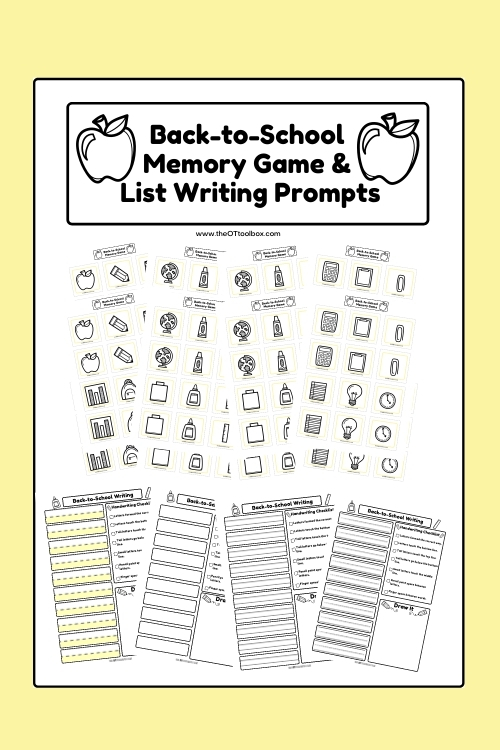
This Back-to-School resource is a great way to quickly assess your caseload for handwriting, coloring, cutting, motor skills, midline crossing, visual memory, visual perceptual skills, motor planning, executive functioning, and more. And, such a fun and motivating activity to quickly and informally reassess each child on your caseload at a “just right” level.
This memory card activity can be printed off, laminated, and used again and again.
Click here to add the Back-to-School Memory Game and List Writing Prompts resource to your therapy toolbox.
Colleen Beck, OTR/L has been an occupational therapist since 2000, working in school-based, hand therapy, outpatient peds, EI, and SNF. Colleen created The OT Toolbox to inspire therapists, teachers, and parents with easy and fun tools to help children thrive. Read her story about going from an OT making $3/hour (after paying for kids’ childcare) to a full-time OT resource creator for millions of readers. Want to collaborate? Send an email to contact@theottoolbox.com.
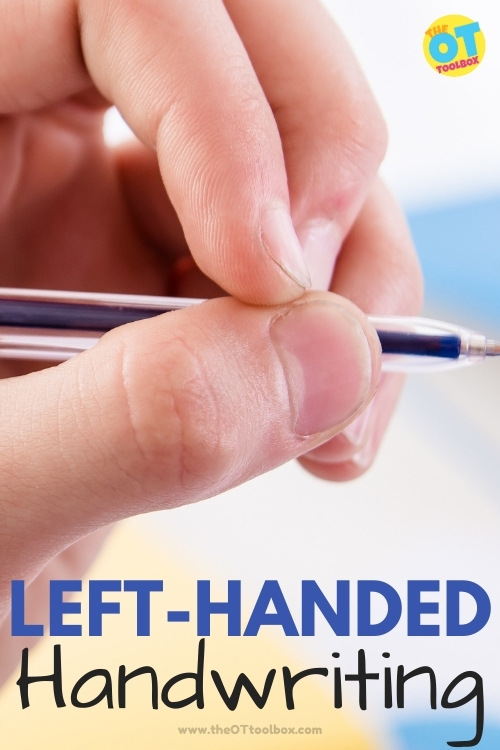
Handwriting for lefties is a common concern among parents and teachers who work with children who are left handed. Here, we are covering left handed writing tips to address common concerns with teaching left handed handwriting. Be sure to check out all of the handwriting resources here on the website.
Left Handed Writing Tips
I am use to working with the occasional left handed person but at the moment I have SIX left handers on my caseload. This motivated me to review some of the recent research on left handers and put together some tips on how to support left handed learners in the classroom.
While most people believe that a person is left or right handed, there are many different types of handedness (1). True handedness When a person uses one hand for more than 70% of tasks this hand is considered their dominant hand. This means a child can still use their non-dominant hand for some tasks.
Below are some common terms that come up when addressing left or right handedness, or the mixed use of hands in tasks. These are important terms to be aware of when it comes to using a set hand in handwriting tasks.
Ambiguous handedness refers to when a child changes from one hand to another hand during the performance of a task. This can be seen in younger children as hand dominance can become established anywhere between the ages of three years and five years.
Mixed handedness
Mixed handedness is the term for when a person uses either hand for a specific task. An example would be a left hander being able to use their left or right hand to use a computer mouse. Most left handers have some degree of mixed handedness.
Ambidexterity
Ambidexterity is the ability to use both hands equally well for all tasks. This is extremely rare and only 1% of the population are considered truly ambidextrous. Getting more information on ambidexterity will help to encourage hand dominance in children for functional use.
Using the Left Hand in Handwriting
So most of us in the world fall into either the right handed or left handed category. A recent worldwide study confirmed that 10.6% of the world’s population are left handed (2). Left handedness is found in more boys than girls and it appears to run in families. There has been much debate on the exact role that genetics have to play in establishing handedness.
There seems to be a hereditary element but handedness does not appear to have a simple pattern of inheritance. Cultural and social factors have an important role to play in the development of handedness (3).
Left Hand Dominance- Development
Hand dominance can emerge anywhere from 14 months to three years and by the age of five most children have settled on a hand of preference for gross and fine motor tasks. In left handers this establishment of a dominant hand can take longer and there is also a greater tendency for them to use one hand for fine motor tasks and a different hand for gross motor tasks (4).
One a more practical note left handers typically experience difficulties in a world that was designed for right handers. I had been aware of some of their struggles but was further enlightened when I went on a course a few years ago. The lecturer described how everyday tasks like handshakes and giving someone a hug could feel so unnatural for a left hander.
In these instances left handers have to go against their natural instinct and reverse the hand that they would naturally use to shake some ones hand with or change the direction they would naturally step in to hug someone.
Left Handed Writing Tips
In the classroom there are a number of ways we can help left handers complete the tasks expected of them. Try these left handed writing tips and tricks to help your lefty use and hold a pencil when writing in the home or classroom so they can write at a functional level.
Left handers should sit on the left hand side of the table if they are sharing a table or on the left side at the end of the row. This ensures there is no elbow bumping if they are sharing table space with a right handed person.
Students who are left handed should be encouraged to tilt their page to the right when they are drawing or writing. The page can be tilted at 30-40 degrees clockwise. This allows them to have a clearer view of their work and prevents some of the smudging that typically happens when a leftie moves their hand across the page.
Encouraging a left handed person to hold their pencil slightly further up the shaft of their pen or pencil will also assist in their ability to see their work and prevent smudging. A pencil grip or elastic band wrapped around their pencil can provide a guide of where to place their fingers when they start developing their pencil grip.
I have found that working on an inclined surface can also be helpful for left handers. Slant boards prevent the flexed / hooked wrist that typically develops in left handers. Slant boards are commercially available or a lever arch file can be used to create an elevated surface.
Directionality can be challenging as the natural inclination for left handers is to work from right to left. Place stickers in the top left hand corner of the page as a reminder to work from right to left.
When copying words, number, letters or pictures ensure that the model /example is on the right side of the page. This prevents the left hander from covering the work that they need to copy with their left hand.
Finger spaces are difficult for a left hander to incorporate when they develop their writing skills. I have found that using an ice-cream stick or strip of paper to mark out finger spaces can be helpful in the early stages of writing. We usually decorate our ice-cream stick or strip of paper with a stick figure who becomes Mr/Mrs Space.
Other products that may make a left handers life easier are left handed pencil sharpeners and a left handed computer mouse.
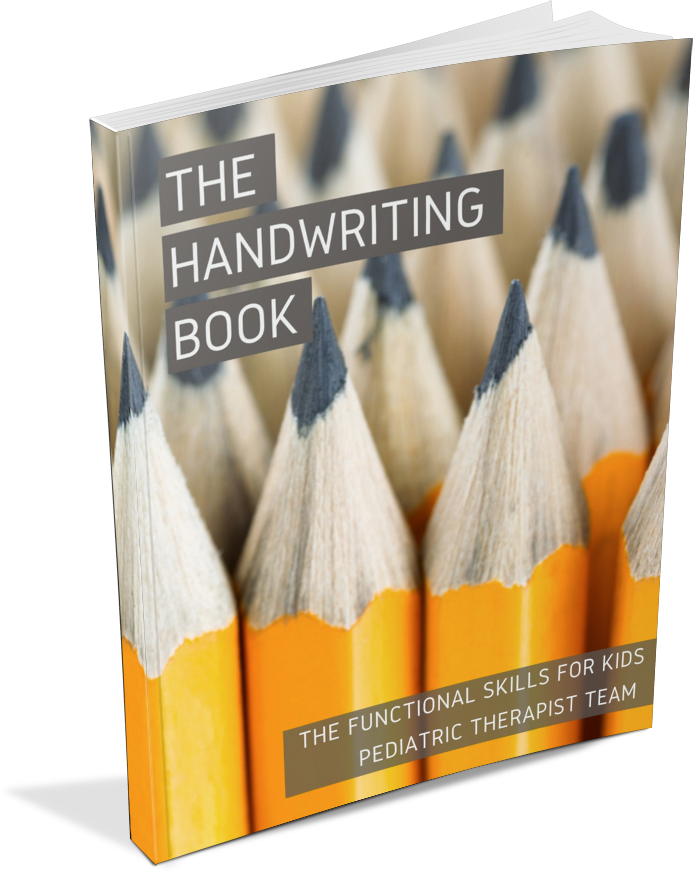
For a comprehensive resource on teaching handwriting skills, use The Handwriting Book. This resource includes tips and strategies for all aspects of handwriting and the book breaks down each underlying skill that impacts functional handwriting skills.
Using scissors can be another difficult task for left handed students. Try some of these tips to teach lefties to use scissors functionally.
Left handed scissors are essential for left handed learners. The leading blade of left handed scissors is on the opposite side to that of right handed scissors making it much easier for the left handed person to line up the blade and the line they are cutting out. Ambidextrous scissors tend to be misleading as the lead blade has to be on the left or the right side.
Left handers should be encouraged to cut to the left and in a clockwise direction. This enables them to comfortable feed the page with their right hand and ensures that they can see the line they are cutting throughout the task. For more information on cutting skills and additional advice for left handed cutting get the resource The Scissor Skills Book, a comprehensive guide on using and cutting with scissors.
I hope some of these suggestions will be helpful for the left handers that are in your lives. The 13 th August marks World Left handed Day so take some time to acknowledge the left handers that you know and the adaptations they have had to make to fit into the very right handed world we live in.
References
Left hand Learning: Teaching the preschool and foundation phase learner (Workshop byTracy van der Merwe, 2008, Durban, South Africa).
McManus, Chris (2003) Right hand, left hand. Great Britain: Phoenix publisher. ISBN 978-0753813553
Sara M Scharoun and Pamela J. Bryden – Hand preference, performance abilities, and hand selection in children. Frontiers in Psychology Published online 2014 Feb 18. doi: 10.3389/fpsyg.2014.00082
Contributor to The OT Toolbox: Janet Potterton is an occupational therapist working predominantly in school-based settings and I love, love, love my job. I have two children (if you don’t count my husband!), two dogs, one cat, two guinea pigs and one fish. When I am not with my family or at work I try to spend time in nature. The beach is my happy place.
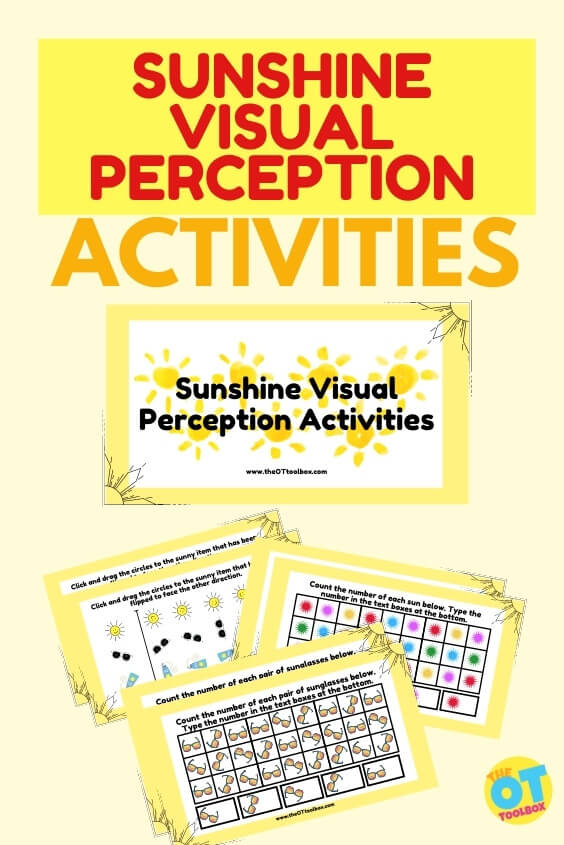
Working on visual perceptual skills with kids this summer? This sun visual perception activity is a fun way to build skills needed for handwriting and reading! It’s a free therapy slide deck that builds skills like visual discrimination, form constancy, and visual figure-ground.
Sun Visual Perception Activity
Summertime doesn’t have to mean not working on specific skills that help kids to improve functional hand writing and learning tasks. It also doesn’t mean building visual perceptual skills requires boring worksheets either.
This free visual perceptual activity has a sun and sunshine theme for summer days.
The visual perception sun activities include visual discrimination, form constancy, visual attention, and visual memory tasks.
Kids can work on form constancy as they recognize differences in the various sun images and activities.
You’ll love adding this these other visual perceptual activities too:
There are several visual perceptual activities with the sun theme on the slide decks.
This is also great if kids are heading off to vacation or taking a break from therapy for a while. They can use the activity as a fun way to work on specific visual perceptual skills.
Want to access this free therapy slide deck? Enter your email address into the form below and to receive this activity.
Colleen Beck, OTR/L has been an occupational therapist since 2000, working in school-based, hand therapy, outpatient peds, EI, and SNF. Colleen created The OT Toolbox to inspire therapists, teachers, and parents with easy and fun tools to help children thrive. Read her story about going from an OT making $3/hour (after paying for kids’ childcare) to a full-time OT resource creator for millions of readers. Want to collaborate? Send an email to contact@theottoolbox.com.
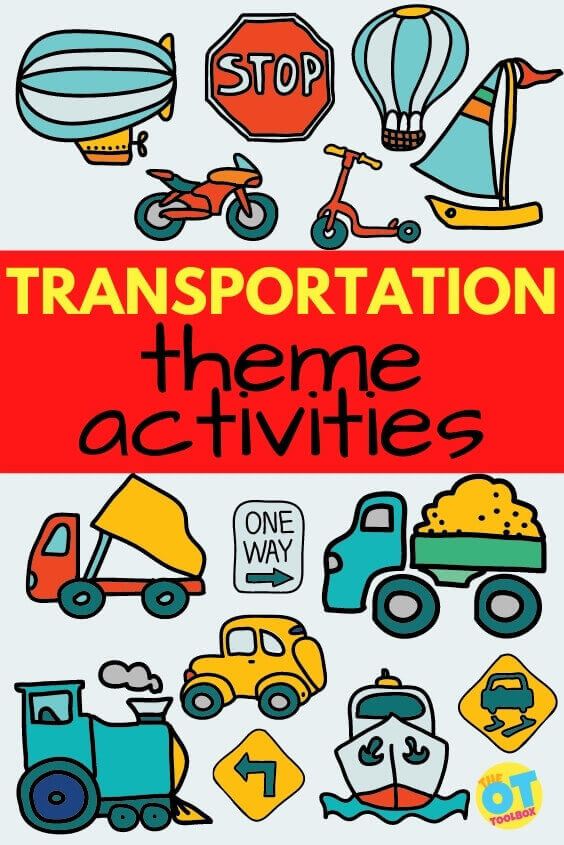
If you’ve got a kiddo that loves all things trucks and construction vehicles, than this transportation theme is for you! Kids seem to gravitate toward trucks, trains, helicopters, airplanes, and all things with wheels, and these hand-picked transportation activities are perfect to help kids develop skills, experience fine motor and gross motor input, and learn through play. If you’re looking for transportation activities for toddlers or preschoolers (and older kids too!), then you are in the right place!
Transportation Theme Activities
I wanted to pull together a trucks and transportation therapy theme that helps children develop essential motor skills…and this collection of transportation crafts, games, and activities do just that.
Chug-chug, vroom-vroom, honk-honk…whatever transportation ideas you need for kiddo activities this is where you can find them!
Transportation activities that include airplanes, trains, cars, trucks, and boats can provide an engaging focus while working on important fine motor, gross motor, visual motor, and sensory skills. Kids always like to pretend with forms of transportation as they drive toy trains on tracks, cars on roads, fly planes in the air, and sail boats in the tub. Activities in this post will target some great skill areas for childhood development and be super fun all with a transportation theme!
Transportation Gross Motor Activities
How about gross motor skills? Gross motor skills are essential foundational skills to help kids perform multiple daily functions. Adding a transportation theme can motivate and provide a play-based focus while addressing sensory, coordination, balance, and motor planning.
Construction Vehicle Brain Breaks– Working on core strength, coordination, balance, endurance, whole body movements, and stability? These brain break activities are great for position changes, movement in all planes, and mobility challenges.
3 Fun Sensory Activities: Row Your Boat – try these activities as a way to work with a partner as well as provide fun activities that address core strengthening and calming vestibular input
Transportation Yoga – try these yoga moves or poses that work on gross motor and motor planning skills during a therapy session, as a brain break, or simply just to use in the classroom
Transportation Themed Gross Motor and Fine Motor Planning – try these activities that include a variety of body moves and some moves using equipment, such as a scooter board and a laundry basket, all have a transportation theme and address many foundational motor skills
Row Your Boat Exercise– try this fun boat themed exercise as well as the other exercises while utilizing a Handee Band, which is similar to a therapy band, and combines strengthening, sensory, and kid-friendly fun all in one.
Transportation Fine Motor Activities
How about fine motor skills? These skills are important for children while performing multiple daily tasks to include self-care. Below you’ll find some great fine motor activities that include many forms of transportation such as a bus, a rocket, and a stoplight! These fun activities will help kiddos focus on important hand and finger strength, bilateral coordination, fine motor coordination, and fastener manipulation.
Transportation Button Buddies – try making these DIY button buddies for kids using felt and buttons to work on fastener manipulation skills, a simple way to make them is provided
Car Wash Fine Motor Activity – try this fun activity that uses shaving cream and a spray bottle to perform a car wash for matchbox cars essentially providing fine motor strengthening along with a tactile sensory experience
Lazy 8 Handwriting Grand Prix Fine Motor Skill Builder – try this vertical lazy 8 pattern to work on crossing midline, directionality, pre-writing, and fine motor skills with the use of various tools, including a matchbox car
Make Paper Planes – try creating these three paper airplane designs using step-by-step instructions with older kiddos and work on fine motor manipulation, visual planning, and sequencing skills
Transportation Crafts
How about visual motor skills? Visual motor skills coordinate what the eyes take in and perceive with hand, leg, and body actions. Children use these skills all day long and these activities will provide an opportunity for children to coordinate eyes and hands together while performing an activity, CRAFTS! Crafts are the perfect opportunity to work on eye-hand coordination as children use their eyes and hands together to create and design fun stuff! They also get to work on important fine motor skills while engaging in cutting, gluing, taping, and assembly.
Try some of these fun visual motor craft activities to work on these skills:
Salt Truck Craft – Work on scissor skills to cut simple shapes. Then address visual attention, sequencing, motor planning, and direction following to make a salt truck craft.
Backhoe Craft – Work on scissor skills to cut simple shapes. Then address visual attention, sequencing, motor planning, and direction following to cut out and assemble a backhoe
Fire Truck Craft – Work on scissor skills to cut simple shapes. Then address visual attention, sequencing, motor planning, and direction following to cut out and assemble a fire truck
Big Rig Craft – Work on scissor skills to cut simple shapes. Then address visual attention, sequencing, motor planning, and direction following to make a big rig craft.
Bus Craft – Work on scissor skills to cut simple shapes. Then address visual attention, sequencing, motor planning, and direction following to cut out and assemble a bus.
Cardboard Box Car– Have a box sitting around from a recent delivery? Grab a bunch of markers or paints and make a car! This is such a fun pretend play activity that the kids will LOVE. Then, take the cardboard car outdoors and slide it down a hill for vestibular input.
Paper Plate Cars – uses paper plates and tissue paper to create cute cars
Try some fun games to work on visual motor and visual perceptual skills too!
Make a train using blocks and work on visual perceptual skills, fine motor skills, and eye-hand coordination.
Rush Hour Traffic Jam Game– (Amazon affiliate link) This visual perceptual skills game is a powerful way to work on specific skills like sequencing, logic, visual scanning, visual memory, visual attention, visual closure, visual discrimination, spatial awareness, and much more. Then, use the game to upgrade and downgrade specifically for OT. Rush Hour Traffic Jam Jr. Puzzle (affiliate link) is a great version of the transportation game for preschoolers.
Transportation Seek and Find Jar – includes the use of Legos and Lego tires in an I Spy type jar activity which emphasizes important visual skills and more specifically, visual discrimination.
Visual Tracking Cars– Work on fine motor skills to set up this car activity, but then use the power of wind and gravity to work on visual tracking skills and visual attention.
Transportation Sensory Activities
Sensory transportation themed activities are so fun to create and so fun for kiddos to do! You can use a variety of materials to target sensory processing with children. Every sensory area can be addressed from tactile defensiveness to proprioception and everything in between. However, always be aware of any allergies when you do these types of activities.
Plastic Egg Boats – try this activity that uses oral motor input (proprioception to the mouth) provided when blowing the boat.
Wikki Stix Race Track – try this activity that uses tactile input (texture tolerance) provided when building the race track with Wikki Stix, or “sticky sticks” as some children call them.
Train Themed Sensory Ideas – try these activities that use a variety of senses, such as proprioception, vestibular, oral, auditory, and tactile.
Construction Vehicle Brain Breaks– Kids that love all things trucks, backhoes, dump trucks, and diggers will get a kick out of these brain breaks. They can help with attention, self-regulation, and coping skills while adding much-needed vestibular and proprioceptive input.
Train Self-Regulation Track – try this activity that uses a train track to address the “just right” body speed for being ready to learn.
Freight Train Snack Idea – try this activity that uses a variety of colorful snacks, which are visually appealing and enticing to eat.
Sensory Car Wash – try this fun sensory car wash where a child crawls on the floor to go through a car wash that hosts a variety of sensory experiences. It is built with PVC pipe and multiple sensory elements which are hung for the child to crawl through.
Transportation Theme Sensory Table – try making this sensory construction site which includes oats as the sensory element to haul and move
Car Themed Sensory Bin – try making this sensory bin which includes black beans as the sensory element for roads (other colorful car theme elements added)
Airplane Sensory Bin – try making this sensory bin which includes shredded paper and cotton balls as the sensory element for airplanes.
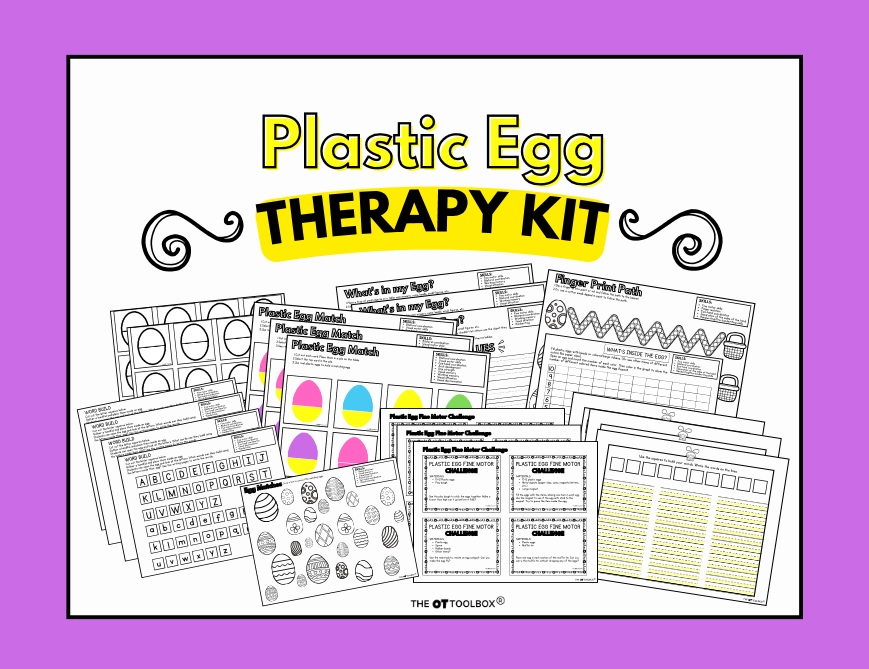
One resource we love is our $5 therapy kit…the Plastic Egg Therapy Kit! It has 27 printable pages of activities with an Easter egg theme. In the kit, you’ll find fine motor activities, handwriting prompts, letter formation pages, pencil control sheets, plastic egg activities, matching cards, graphing activities, STEM fine motor task cards, and more. There are several pages of differentiated lines to meet a variety of needs. This therapy kit has everything done for you.
Regina Parsons-Allen is a school-based certified occupational therapy assistant. She has a pediatrics practice area of emphasis from the NBCOT. She graduated from the OTA program at Caldwell Community College and Technical Institute in Hudson, North Carolina with an A.A.S degree in occupational therapy assistant. She has been practicing occupational therapy in the same school district for 20 years. She loves her children, husband, OT, working with children and teaching Sunday school. She is passionate about engaging, empowering, and enabling children to reach their maximum potential in ALL of their occupations as well assuring them that God loves them!
Recently, I was looking into new ways to challenge fine motor skills for my clients – especially ones that did not require purchasing new materials. I wanted something that could challenge scissors use, problem solving, sequencing, attention, and could be used in prep for ADL skills, like buttoning. Then, it came to me: weaving!
Weaving Projects for Kids
Weaving projects and craft are so simple, yet so effective – even the clients that I thought would be frustrated by this old-school craft were super proud of their work. Weaving is something you can do in many different ways, typically dependent on skill level and desired outcomes.
Since we are talking about buttoning skills, I am offering two different options: an advanced one for the kiddos that are almost ready to button independently, and a beginner version for those who are not quite ready to button yet. I hope you adapt these crafts as needed to meet the “just-right” challenge!
Related: Feathers and Burlap Weaving activity that builds bilateral coordination, eye-hand coordination, pinch, grip, and dexterity.
Complex Weaving Instructions
With two pieces of paper of different colors, cut strips of any thickness or length you’d like – just make sure you have an even number. The thinner and longer you cut them, the bigger the challenge. I like to use two different colors to make the task easier to understand and add visual interest.
Cut holes for threading. Half of your strips (or all of one color) need holes for threading. Have your kiddos figure out how big the cuts need to be in order to fit the other strips of paper through.
Fold the paper in order to cut two holes, side by side, throughout the strip of paper. This will be where you weave the other strips of paper through.
Begin Weaving.
Weave the remaining strips of paper (the ones without the holes) into the paper with the holes, making a basket-weave pattern.
Here is where those buttoning skills come into play! The practice of moving the strip of paper through one hole and up and over through the next hole mimics the actions of buttoning and unbuttoning.
If you are creating a specific craft, here is where you can make the weaved pattern into your kids’ desired shape! If you are unsure what you could offer, see the examples below.
Draw the desired object on top of the weaved pattern OR use simple print out to guide the scissors.
Cut the object out.
Add extra paper or decorative objects with glue to seal the edges if you’d like!
Does this sound a bit too challenging for one of your kids? You can lower the difficulty in a few different ways, but below is one idea that is particularly useful if your child demonstrates difficulty with visual motor or perception skills that are required for buttoning.
Simple Weaving Instructions
With two pieces of paper of different colors: a. Cut multiple, 1-inch thick straight lines to the edge of one piece of paper, leaving about an inch uncut on one edge to “hold” all the strips together. b. Cut 1-inch strips of the other piece of paper.
Simply overlap the loose strips of paper onto the other cut paper, every other to make a checkerboard pattern.
Maybe add a gluing or stapling component to challenge them in a different way!
Weaving Projects for kids
I know that it’s so much easier to motivate kids to complete a craft or activity if it is related to a season, holiday, or something that they are personally interested in. That’s one reason why I love weaving crafts – they are so simple at their base, that they can truly be used for anything!
Fall Weaving Crafts- Plaid shirts, apple baskets, spider webs, or hay bales. Winter Weaving Crafts- Sweaters, holiday gifts, Christmas Stockings, or candy canes Spring Weaving Crafts- Easter baskets, Spring dresses, umbrellas, or raincoats Summer Weaving Crafts- Picnic blankets, picnic baskets, or beach towels.
Or for the sporty kiddos in your life, make basketball hoops, soccer goals, tennis rackets, or hockey goalie helmets! The possibilities with weaving projects really are endless.
Here are some additional weaving and buttoning crafts to get the ball rolling!
Sydney Thorson, OTR/L, is a new occupational therapist working in school-based therapy. Her background is in Human Development and Family Studies, and she is passionate about providing individualized and meaningful treatment for each child and their family. Sydney is also a children’s author and illustrator and is always working on new and exciting projects.
Did you know that the limbic system plays an important role in everything we do? As occupational therapists, educators, and parents, understanding the role of the limbic system and function is not only practical information…it’s essential to understand when it comes to child development and day to day functioning as children learn, play, participate in household tasks, and interact with peers.
Today I am sharing really interesting information on the brain, the limbic system, and emotional regulation. I’m hoping to make this explanation of neuroscience super easy to understand so you can take this info and run with it!
Let’s do this! Recently, we covered emotional regulation and executive functioning skills. When it comes to emotions, regulating behaviors, and the mental skills of executive functioning, you can see how all of these areas play a role in everything we do on a day to day basis. Social emotional learning is part of this. The limbic system is an important brain structure involved in each of these areas.
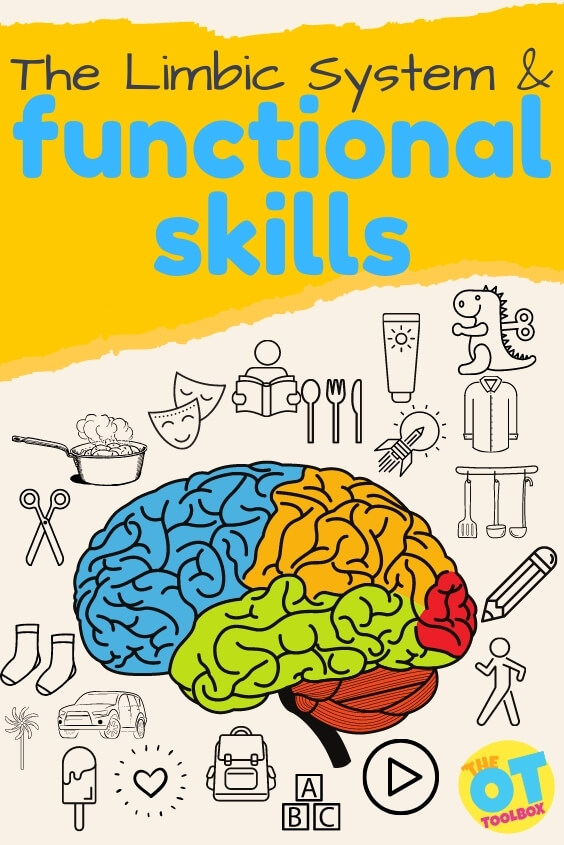
The limbic system is an area of the brain including several brain structures. These include the amygdala, the hippocampus, the hypothalamus, thalamus, and olfactory bulb. There are some really important hormones associated with these structures and their responses as well.
These structures and their hormones control functions such as emotions, behavior, motivation, sleep, appetite, olfaction, stress response. This is really interesting, because you may connect the dots with this list and see that social emotional skills, executive functioning, inner drives, and sensory processing (including the sense of smell and interoception) all centered in one place in the brain! (This is not to say that these are the only places in the brain that operate these functions as well.)
Generally speaking, the limbic system is the emotional brain.
It’s the space where survival behavior occurs. It’s the place in the brain that coordinated emotions, fear, aggression, basic inner drives, and episodic memories.
You know how the smell of freshly baked chocolate cookies brings back cozy memories of baking with Grandma all those years ago? Now, when you smell that ooey, gooey chocolate baked into chewy dough you might feel calm and at peace and picture yourself in your grandmother’s sunny kitchen when you were young. That’s the limbic system at work!
We all have limbic memories…maybe it’s the scent of vanilla that fosters a memory from childhood. Perhaps it’s the scent of glue that takes you back to peeling dried Elmers glue from the palm of your hand. Maybe it’s a certain scent that brings back scary or bad memories. Each one of us is unique in how those connections work in our brains!
“The emotional brain, the limbic system, has the power to open or close access to learning, memory, and the ability to make novel connections,” (Vail, 2017).
How the Limbic System and Function are connected
When it comes to participating in daily tasks, emotional response, behavioral regulation, the limbic system plays a primary role.
Here’s how this inner brain emotional powerhouse works when it comes to the limbic system and function:
The Limbic System is a Fright, Flight, and Freeze Response Center
The limbic system and function are connected by the fight, flight, freeze system of the brain.
A stressful situation sends signals to activate the amygdala, which quickly processes that information. It activates the hypothalamus which tells the adrenal gland to send adrenaline into the blood stream. The hypothalamus also activates other hormones to alert the pituitary gland.
Several hormones work together to keep the body on high alert, while suppressing other body systems. The adrenal glands release hormones such as epinephrine that work to raise blood pressure and heart rate, increase blood flow to muscles and organs, and elevate breathing rate. All of these systems keep you on high alert.
When we are on that high alert state, it is difficult to accomplish everyday tasks.
Think about being in an over-responsive state and trying to read a book, concentrate on completing complex math problems, solving difficult scenarios, or reading a research article. All of these tasks require attention, focus, and the ability to block out other sensory and environmental input. For children, accomplishing day-to-day tasks like getting dressed, completing the morning routine, interacting with peers, or learning can be a similar scenario. For some, that fight/flight/freeze state interrupts the ability to initiate a task or follow through to accomplish a task.
Let’s look at this another way: Have you ever been startled by a deer jumping out in front of your car while driving? You probably recall that whole-body sense of alertness and maybe felt prickly sensation all over your arms and that JUMP of acute awareness. When the deer pranced away, your body probably settled and while you were still feeling that sense of alarm, your body was already settling down. That’s because after a stress response is over or dismissed, hypothalamus activates the parasympathetic nervous system and inhibits the stress response.
Similarly, when in a flight/fright/freeze state, it’s impossible to accomplish routine, mundane, or novel tasks.
The limbic system impacts emotions
The limbic system and functioning are connected by our emotional response and behavioral regulation.
As our “Emotional Center”, the limbic system impacts behavioral response and emotional regulation in everything we do. This inner area of the brain are also deeply associated with emotions. The amygdala and the hippocampus, in particular are the emotional centers. These two structures connect via the thalamus.
Together, these connections play a role in emotional activities like friendship, affection, and mood. Regulation of emotions also occurs here: particularly emotions that have a role in survival such as aggression, love, fear, or anxiety.
These brain organs also help the brain interpret the emotional content of memories. The amygdala assigns emotional meaning to memories and helps the brain form fear-based memories. The hippocampus helps form sensory memories, which are memories associated with sensory input.
The limbic system regulates those automatic responses to emotional stimuli and plays an important role in behavior. Other places in the brain, such as the frontal regions (executive functioning center) are recruited for modulation of amygdala activity. This is when self-regulation happens.
When it comes to self-regulation, many children have a difficult time learning and achieving without help. In any given moment, a child (and an adult) encounters multiple situations and circumstances that require an awareness of self and others as well as the ability to have or gain self-control.
Generally speaking, a child should achieve an optimal level of self-awareness and mindfulness to identify their inner feelings and emotions and be ready to regulate themselves when the time comes. They need to learn strategies and techniques that work for them to assist them in leaving a less optimal level in order to get back to a “ready-to-go” level of regulation so they can accomplish tasks like brushing teeth, reading a book, interacting with a friend, crossing the street…the list can go on and on!
Is this brain talk fascinating? Or are your eyes glazing over??
How to facilitate the limbic system for function
The main thing to remember is that we CAN help kids with regulation and modulation of those inner brain workings, so the can play, learn, interact with others, and complete day to day tasks.
We can teach them tools to help with the stress input and give them strategies so they are not in constant fright/flight/freeze mode.
We can offer sensory input that provides the movement that their body needs so the nervous system has what it needs.
We can give kids the words they can use so they can recognize their body’s emotions.
We can show them strategies to help regulate.
We can offer opportunities to connect with them.
We can help them build a personal toolbox of emotional regulation strategies
Fostering connections and providing the right kind of tools facilitates emotional regulation, behavioral regulation, and functioning skills.
The Sensory Strategies Toolkit is powerful in working on the emotional regulation skills of kids. Not only does it offer resources to explain and better understand behaviors, but it offers solutions that kids want to use. It’s a goldmine in building social connections between friends, family, and social relationships…but also builds those essential brain connections, too!
Colleen Beck, OTR/L has been an occupational therapist since 2000, working in school-based, hand therapy, outpatient peds, EI, and SNF. Colleen created The OT Toolbox to inspire therapists, teachers, and parents with easy and fun tools to help children thrive. Read her story about going from an OT making $3/hour (after paying for kids’ childcare) to a full-time OT resource creator for millions of readers. Want to collaborate? Send an email to contact@theottoolbox.com.
Emotional regulation and executive function are connected in more ways than one. Development of social emotional skills includes an awareness of self and self-monitoring skills, among other areas. The regulation of those emotionsis critical for executive functioning cognitive tasks and mental dexterity, especially when emotions are involved. When we regulate behavior, the frontal lobe is at work with it’s impulse control, initiation, self-monitoring, and other cognitive skills. Furthermore, emotional skill development includes the ability to self-regulate. These skills mature and develop throughout childhood and into adulthood.
Related, you’ll want to check out our blog post on mood and affect as a resource for emotional regulation needs.
Emotional Regulation and Executive Function
In a previous blog post, shared a little background information on social emotional learning and regulation. We’ll go more into this relationship below. We’ll also cover social emotional learning and occupations that our kids participate in each day…and how executive functioning skills and regulation impacts functioning at home, work, and school. You will also want to check out these social skills activities for interventions to build areas related to social-emotional skills.
Emotional regulation is essentially a person’s ability to manage stress. This is not a skill we are born with.
For children, particularly those who have anxiety, autism, ADHD, ASD, early childhood trauma, Sensory Processing Disorder, and other special needs, it can be especially challenging.
Poor emotional regulation can lead to social issues, meltdowns, problems at home and school, negative behavior, anxiety, and later in life, even addictions and difficulty with relationships.
Sometimes, emotions become intense and out of control. They become dysregulated and impact the ability to manage behaviors and cognitive thought processes, or the executive functioning skills.
Emotional and sensory dysregulation requires mental skills like focusing, following directions extremely difficult. When the emotions take over, our brain has trouble communicating between the limbic system and the frontal lobe.
Social emotional learning is defined as a process for helping children gain critical skills for life effectiveness, such as developing positive relationships, behaving ethically, and handling challenging situations effectively.
The specific skills that allow kids to function and complete daily occupations (such as play, learning, participating in social situations, rest, dressing, writing, riding a bike, interacting with others…) are those social emotional skills that help children to recognize and manage emotions, interact with others, think about their feelings and how they should act, and regulate behavior based on thoughtful decision making.
One piece of addressing underlying needs in kids is the fact that the behaviors that we see have an underlying cause that can be found as a result of regulation of emotions, making decisions, and acting on impulses. Social emotional skills are not always a cut and dry aspect of development.
Today, I wanted to expand on that idea. So many times, we run into children on our therapy caseloads or in our classroom (or hey, even in our own homes!) who struggle with one area…or several. Remembering that beneath the behaviors, troubles with transitions, acting out, irritability, sleep issues, inflexible thoughts, frustrations, etc…can be emotional regulation components.
Let’s consider some of the ways our kids may struggle with social and emotional competencies. We might see kids with difficulty in some of these occupational performance areas (occupational performance = the things we do…the tasks we perform):
Academics/learning
Management of stress in learning/chores/daily tasks
Creating of personal goals in school work or personal interests and following through
Making decisions based on ethical and social norms in play, learning, or work
Understanding/Engaging in social expectations (social norms) in dressing, bathing, grooming, etc.
Social participation
Conflict resolution with friends
Empathizing with others
Responding to feedback in school, home, or work tasks
Making good judgement and safety decisions in the community
Showing manners
Understanding subtle social norms in the community or play
Transitions in tasks in school or at home
Ability to screen out input during tasks
Cooperation in play and in group learning
Considering context in communication
Emotional control during games
Wow! That list puts into perspective how our kids with sensory processing concerns really may be struggling. And, when you look at it from the flip-side, perhaps some of our children who struggle with, say, fine motor issues may have sensory concerns in the mix too.
Break it down
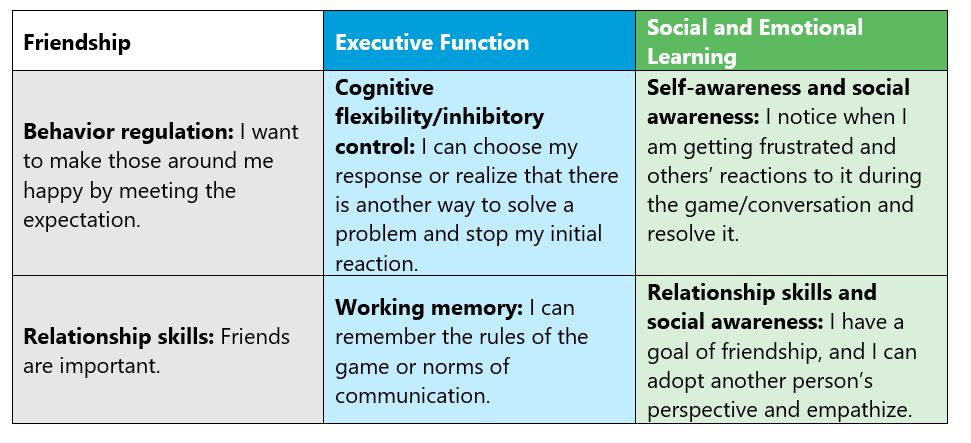
Let’s break this down even further. There is a connection between social emotional skills and executive functioning skills. When you read through that list of occupations, many of the areas of struggle have a component related to impulse control, working memory, attention, focus, metacognition, and persistence, etc. This chart explains more:
And, that is just one aspect of friendship/social participation. Consider the connection of social/emotional skills and executive functioning skills in activities of daily living, social participation, learning, play, or chores!
Emotional regulation is a topic that can get hairy, and fast. Emotional regulation is essentially a person’s ability to manage stress. This is not a skill we are born with. For children, particularly those who have anxiety, autism, ADHD, FASD, early childhood trauma, Sensory Processing Disorder, and other special needs, it can be especially challenging.
Poor emotional regulation can lead to social issues, meltdowns, problems at home and school, negative behavior, anxiety, and later in life, even addictions and difficulty with relationships.
>>When you’re a parent or teacher watching a child you care about struggle, it can be a helpless feeling. Some kids just don’t know what to do with their big emotions.
>>Perhaps you’ve tried everything you can think of and you’re still being held hostage by your child’s emotional outbursts.
>>Or, maybe you are a therapist working with dysregulated children having emotional meltdowns and a fixed mindset who really need the tools to manage overwhelming emotions.
What we do know is that more and more research is showing that emotional regulation and learning are linked.
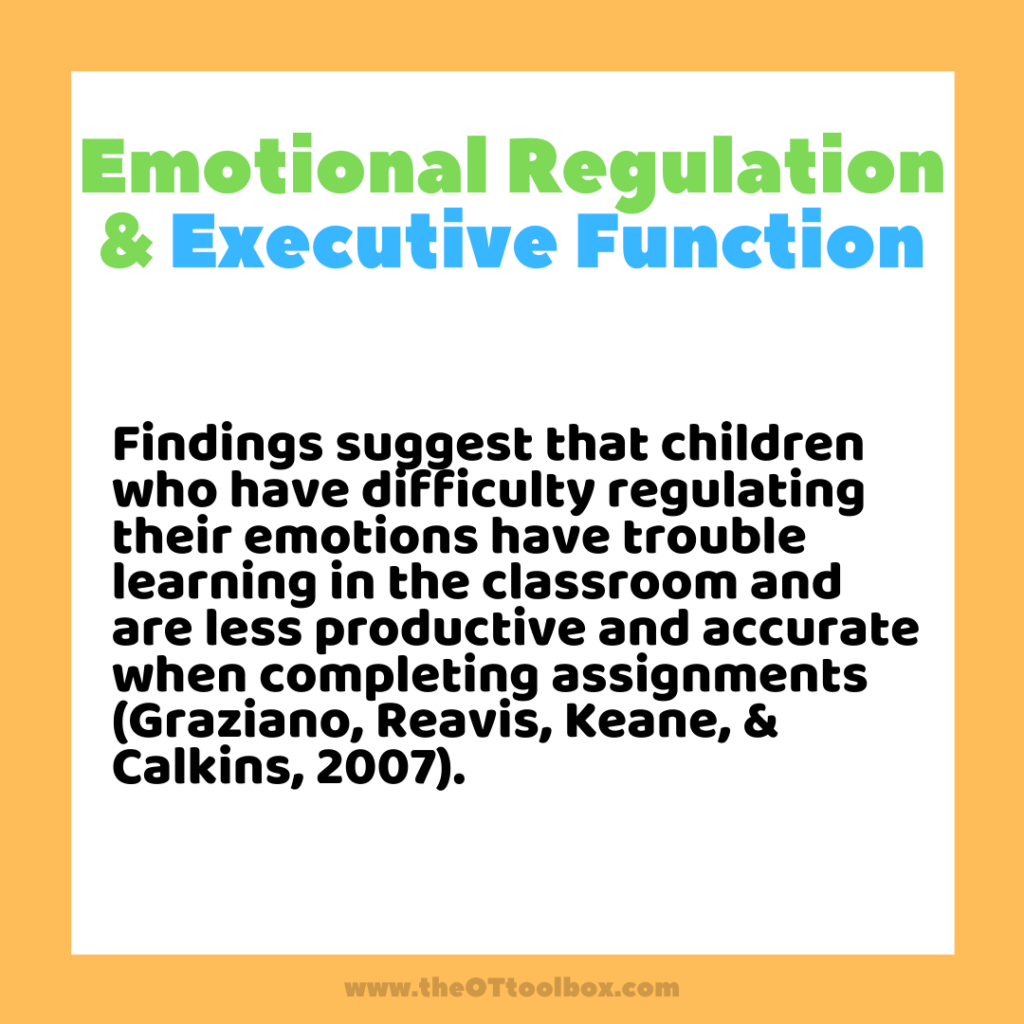
In 2007, researchers stated, “Our findings suggest that children who have difficulty regulating their emotions have trouble learning in the classroom and are less productive and accurate when completing assignments,” (Graziano, Reavis, Keane, & Calkins, 2007).
“The ability to regulate emotions is an essential prerequisite for adaptive development and behavior” (Sousa Machado & Pardal, 2013).
Social Emotional Learning Strategies
When we equip our students with tools to identify their emotions and self-regulate, we are giving them tools for life and promoting a positive environment for learning.
What might this look like at home, in online schooling, or in a classroom setting?
1. Connect emotions to behavior- Children may not have the language knowledge or understand how to explain what they are feeling. They may need concrete examples or scenarios to help them understand how their emotions are tied to their behavior.
Does a storm make them feel nervous or scared?
How do they react when they feel anxious about a test or quiz?
When they argue with a sibling, how do they react?
Once they are able to understand their emotions and how they are feeling, they can start using emotional regulation tools and strategies.
One way to connect emotions to behavior is to start by identifying emotions, facial expressions, and feelings that are associated with these names and features. These emotions play dough mats create a multisensory means to teach these skills.
One way to foster this skill is by conducting an emotions check in. Then, the child can be more aware of their emotions and identify triggers.
2. Be flexible and patient- Flexibility is something we have all been thrown into more than usual lately. But working with children on emotional regulation and understanding their emotions takes patience and being flexible. You may need to change up how you introduce emotions, or maybe a strategy you thought would work isn’t.
3. Set the tone and share your own feelings- This may feel uncomfortable for some of us, but sharing our own feelings with our students and clients and modeling the responses and strategies we are encouraging them to use will have a huge impact.
…it’s ALL connected!
A Sensory Strategy Guide
Having a toolkit of ideas to pull from so you can change things as needed is why we created the Classroom Sensory Strategies Toolkit.
Executive Function and Emotions
Let’s break this down even further. There is a connection between social emotional skills and executive functioning skills. Critical thinking is a huge part of this. When you consider the daily occupations of kids, many of the areas of struggle have a component related to impulse control, working memory, attention, focus, metacognition, and persistence, etc. Big emotions can impact task performance in each of these areas in different ways.
Play
Cleaning up after oneself
Social/family relationships
Learning
Chores
Homework
Schooling at home
Reading
Grooming/Hygiene
Dressing/Bathing
Caring for materials
And, that is just some of the daily jobs that occupy a child or teen’s day. When we consider the connection of social/emotional skills and executive functioning skills in activities of daily living, social participation, learning, play, or chores, there is a lot going on!
Self-regulation skills of both sensory regulation and emotional regulation depends on various subcategories of executive functioning skills, including inhibition/impulse control, task initiation, working memory, mental flexibility, and self-control. We know that all of these mental skills are deeply inter-connected and that executive functioning is like the air traffic control center of the brain…it keeps us operating as we should.
Impulse Control– Attention and impulses are another set of executive functioning skills that are very closely related. When the distracted child can not focus on a specific task or conversation, or situation, then the tendency to impulsively respond is quite likely. A great tool for assessing and monitoring impulses in the child with attention struggles is the impulse control journal.
Working memory– This executive functioning skill is the ability to act on past memories and manipulating the information in a new situation. Processing short term memories and using it allows us to respond in new situations.
Attention– Executive functions are heavily dependent on attention. Distractions can come in many forms. The child who is overly sensitive to sensory input may over respond to the slightest sounds, textures, sights, scents, tastes, or motions. Children who are excessively distracted by their sensory needs will struggle to attend to simple commands. Other children are able to “keep it together” in a classroom or home setting yet their concentration is challenged.
Self-Monitoring– This executive functioning skill goes hand in hand with attention and focus. Self monitoring allows us to keep ourselves in check in a situation. We need to stay on task and focus on that a person is saying and respond in appropriate ways. If the child with attention issues can not focus on what a person is saying for more than a few minutes, than the ability to respond appropriately can be a real issue.
Emotional Control- Kids with attention issues may not be able to attend for extended periods of time on a situation that enables them to control their emotions. They can perseverate on the emotions of a specific situation or may not be “up to speed” on the situation at hand or be able to process their emotions as they attend to a different situation. Issues with emotional control can then lead to behavioral responses as they struggle to keep their emotions in check.
Prioritizing- Planning out and picking the most important tasks of a project can be a struggle for the child with attention issues. It can be easy to become overwhelmed and distracted by the options for importance.
Processing Speed- Processing speed refers to the ability to receive, understand, and process information in order to make a decision or response. It also involves using working memory in a situation or experience. Children who experience attention struggles may experience difficulty in retrieval of information (using working memory) and responding using that information (initiation). This carries over to missed information, difficulty keeping up with a conversation or lesson in school, or a fast-moving game or activity.
Task Initiation– Children with attention difficulties can be challenged to start tasks. It can be difficult to pull out the starting point or the most important parts of a multi-step project so that just starting is a real struggle.
Task Completion- Similar to the initiation of specific tasks, completing a task or project can be a real challenge for the child who is limited in attention. Reading a multiple chapter book can seem overwhelming and quite difficult and just never is finished. Cleaning a room can be a big challenge when there are visual, auditory, or other sensory-related distractions that make up the project.
Emotional regulation is a topic that can get hairy, and fast. Emotional regulation is essentially a person’s ability to manage stress. This is not a skill we are born with. For children, particularly those who have anxiety, autism, ADHD, FASD, early childhood trauma, Sensory Processing Disorder, and other special needs, it can be especially challenging.
Poor emotional regulation can lead to social issues, meltdowns, problems at home and school, negative behavior, anxiety, and later in life, even addictions and difficulty with relationships.
When it comes to breakdowns in the school setting that impact learning, having tools in place in the way of coping strategies can make all the difference. These can be implemented into a regulation station or a calm down space.
You can also support needs by using calm down toys to support regulation needs.
Further development of executive functioning and emotional regulation can be fostered by the methods described here, as well as by some basic strategies:
Routines
Modeling behavior
Establishing a support system
Creative play
Emotional regulation strategies
Opportunities for movement and motor skill development
Practicing wellness, healthy habits, and wellbeing
Family Connection
Mindfulness and Growth Mindset
Social networks and interactive play
Coping tools for worries, stress, or changes to routines
Emotional Regulation and Executive Function Strategies
Targeting emotional regulation and executive functioning can happen together or by fostering support in isolation. These areas and their close connection are important to keep in mind when writing self-regulation IEP goals.
Use the information below for further resources in interventions.
Colleen Beck, OTR/L has been an occupational therapist since 2000, working in school-based, hand therapy, outpatient peds, EI, and SNF. Colleen created The OT Toolbox to inspire therapists, teachers, and parents with easy and fun tools to help children thrive. Read her story about going from an OT making $3/hour (after paying for kids’ childcare) to a full-time OT resource creator for millions of readers. Want to collaborate? Send an email to contact@theottoolbox.com.
There are many types of child therapy healthcare professionals that work with children, and so many of them are considered “therapists”. What is the difference between a physical therapist, an occupational therapist, and a speech therapist? Or how about a child therapist, a psychologist, a psychiatrist? We will break down the roles of these professions, why they may be recommended for your child, and discuss the main differences between them that make them unique.
Types of Child Therapy
Before we get to talking about these fantastic professions and the different types of child therapy that helps kids develop into the best version of themselves, let’s talk about stigma. No type of therapy, whether it be for physical or mental needs, should come with feelings of guilt or embarrassment. Therapy should be celebrated! You are improving as an individual – whoo!
We hope that parents and caregivers of children receiving therapy understand this, and are able to let go of any negative connotations that used to come along with receiving services.
PHYSICAL, OCCUPATIONAL, AND SPEECH THERAPISTS
You are most likely to come across these three therapists when your child has a developmental disability, a physical injury or deficit, or a diagnosis that makes it harder for them to develop skills independently.
Often, the OT, PT, or ST professionals work as a team to improve the independence of the children they work with.
Does my child need a physical therapist?
A physical therapist works with the physical body. They work to make sure that all the muscles, tendons, joints, and moving parts of the body are working properly.
Kids that have muscle weakness, joint stiffness or contractures, or an irregular walking pattern may be recommended physical therapy. Interested in hearing more? Head over to here for some great information.
Does my child need an Occupational therapist?
An occupational therapist helps people function through their occupations (activities). This article dives deeper into pediatric occupational therapy, but here is the just of it: if your child needs help with their daily activities, like dressing, eating, playing, or writing, an occupational therapist can work to improve their functional abilities.
While physical therapists work with the physical body only, occupational therapists work with physical as well as cognitive, social, and emotional needs.
Does my child need a speech therapist?
A speech therapist, or a speech-language pathologist (SLP), is pretty much what it sounds like – they help children with their communication abilities. More than that, however, is the way that they work with cognition, as all speech and language skills come from the cognitive abilities of the brain.
A child may be referred to a speech therapist if they have a physical speech impairment (originating in the mouth, tongue, face, jaw, etc.) or a cognitive delay or disability that impairs their ability to speak, to understand spoken language, or any other kind of communication barrier. Children with slurred speech or stutters often receive speech therapy. Learn more about speech therapy here.
MENTAL HEALTH THERAPISTS
Mental health therapists usually hold a master’s degree from a field like social work, marriage and family therapy, or counseling. Therapists can diagnose and treat mental, emotional, and behavioral issues in a counseling, play-based, or group therapy format.
Does my child need a child therapist?
A child may be referred to a child therapist because of their health history, for example, experiences of trauma, divorcing parents, losses of loved ones, etc.
Children with big feelings like anxiety, depression, or overwhelming fear may be recommended therapy. Therapists are not able to prescribe medication but may be the right choice for non-pharmaceutical interventions for a child’s mental well-being. Other reasons for pursuing a mental health therapist may include:
Big personality changes
Social or emotional difficulties such as having trouble making and keeping friends
Challenges that get worse with age rather than better, including participating in activities, dropping out of school or school activities, and hobbies
Difficult situations such as bullying, divorce, moving, health problems, death of a family member or friend, etc.
Consistent behavior or mood changes
Anxiety, attention issues, worries, depression, etc.
CHILD PSYCHOLOGISTS & PSYCHIATRISTS
Child psychologists hold doctorate degrees and may work clinically, with patients, or complete research for the field. A clinical child psychologist is able to provide counseling and traditional methods of therapy for children and their families much like a therapist, but can also provide more thorough testing and diagnosis for children.
Does my child need to see a Child Psychologist?
A child psychologist may be the right route for you if your child needs accommodations in school for a psychological or neurological issue. These professionals are not medical doctors, so they cannot prescribe medication. Psychiatrists, on the other hand, are able to prescribe medication for mental health.
Does my child need to see a psychatrist?
Child psychiatrists may treat a patient for traditional therapy services, but most often they only see their patients occasionally to manage medications. A child may be referred to a psychiatrist if non-pharmaceutical methods of therapy are not providing the results that are necessary for their participation in activities.
The Center for Mental Wellness offers great information on the specific types of treatment therapies that a child psychologist may offer. If you are looking for more information on the differences in mental health providers for children, this webpage is a great resource!
While this is not an exhaustive list of therapists and their abilities, we hope to have provided you with some new information on these wonderful professions.
Remember: therapy is not always necessary but often life-changing, mental health is just as important as physical health, and all of the professionals on your child’s health care team are there for you and your family.
Sydney Thorson, OTR/L, is a new occupational therapist working in school-based therapy. Her background is in Human Development and Family Studies, and she is passionate about providing individualized and meaningful treatment for each child and their family. Sydney is also a children’s author and illustrator and is always working on new and exciting projects.