This blog post describes a cute dragonfly craft that can be used to address a variety of occupational therapy activity areas including: fine motor skills, visual motor skills, crossing midline, bilateral coordination, dexterity, and more.
Dragonfly Craft
Looking for a creative and crafty occupational therapy activity that is easy to
prepare and packs big punch in addressing a variety of skills? This dragonfly occupational therapy activity and craft creation may be just what you need!
It’s fun, versatile, easy to implement, and addresses a large variety of skills and multiple skill levels while also being cheap!!
It’s a great activity that can be easily upgraded or downgraded to provide the “just right” challenge. While this dragonfly craft is perfect for the pediatric and school-based occupational therapy practitioner, but would make a great classroom center or take home activity too.
Dragonfly Craft Ideas
These dragonfly crafts are so versatile they could be used as a simple occupational therapy craft activity, an assembly activity, a game-like activity, or any combination.
For occupational therapy professionals looking for a quick craft and easy set up activity, this one is it…plus it supports a variety of skill areas.
For example, you can adapt the craft to support different skills, depending on the goals you’re addressing with kids:
- Have students cut out paper strips to work on scissor skills
- Use a variety of textured paper to work on cutting different paper thicknesses (tissue paper, printer paper, cardstock, sandpaper, etc.)
- Color or paint the clothespins.
- Add eyes with different small items or draw the eye features.
Take a look at all of the crafty fun that can be had with these fun flying creations.
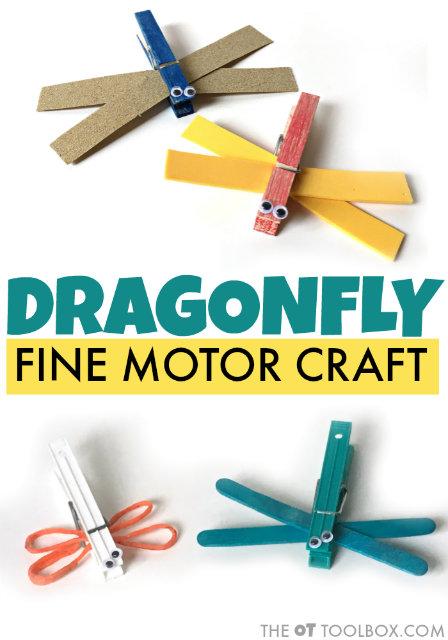
Dragonfly Craft – A Fun Occupational Therapy Activity
Using the dragonfly as a take home occupational therapy craft encourages skill development during the making process with the end product being used for play or display.
The child could make one dragonfly or a group of dragonflies with the focus of the activity being on coloring and cutting which addresses a child’s fine motor coordination, manipulation and grasp, distal control, bilateral coordination and visual motor skills.
Related: For more bilateral coordination activities like this one, try some of the ideas on our list of Winter Bilateral Coordination Activities.
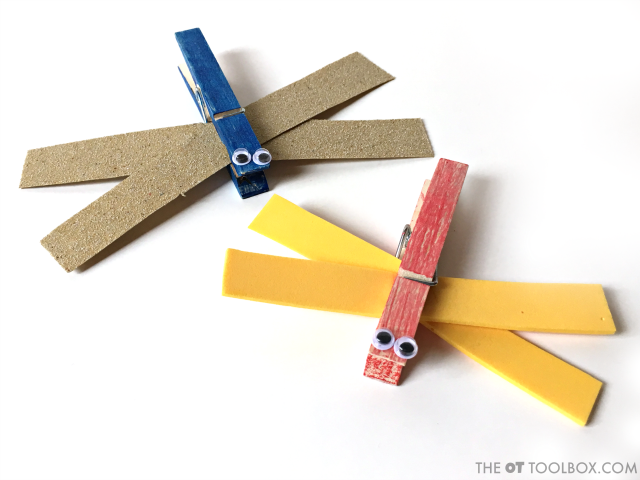
How to make a dragonfly craft:
Affiliate links are included below:
Color the clothespins with either a marker, crayon, or a colored pencil working on grasp patterns and distal control.
Use tacky glue to glue on the googly eyes working on precision skills.
Cut the wings from selected tactile material working on scissor skills, including scissor grasp, bilateral coordination, and eye-hand coordination.
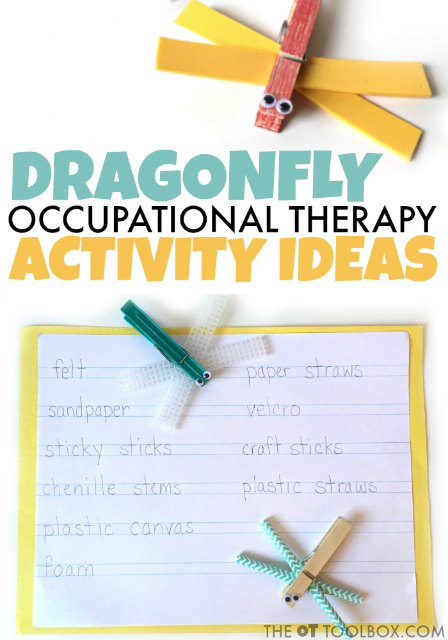
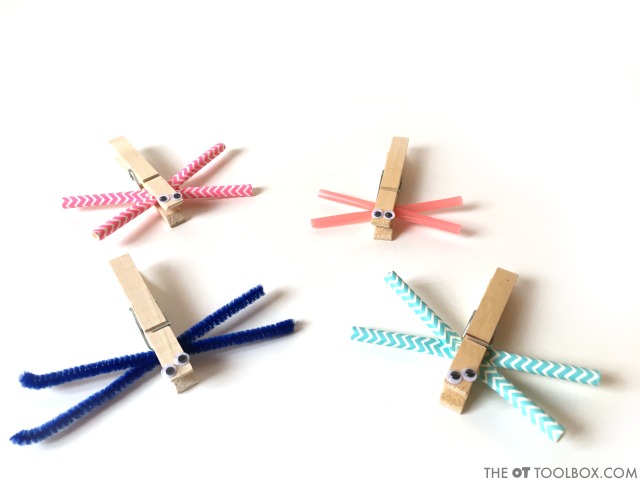
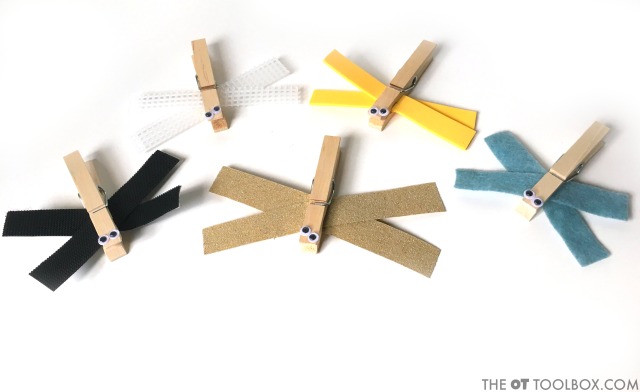
Possible materials that can be used for dragonfly designs could include felt, sandpaper, sticky sticks, chenille stems, paper straws, plastic straws, foam, Velcro, craft sticks, and plastic canvas.
Place the wings that are cut into an X pattern and pinch the clothespin to insert the wings. This process addresses fine motor strength, manipulation, pinch, and visual perceptual skills.
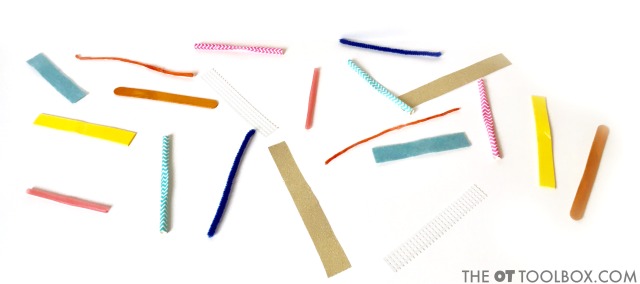
Dragonfly Occupational Therapy Activity
To use the dragonflies as an assembly activity requires the dragonfly materials to be prepared prior to the session.
The therapist pre-assembles the clothespins, having the googly eyes
glued on and the wing materials are already cut.
Having these pieces ready prior to the session allows the focus of the session to be on targeted skill development directed by the therapist addressing individual goals.
Activity focus areas might include fine motor skills, bilateral coordination, tactile
tolerance, isolated or intersecting diagonal line practice, visual scanning,
motor planning and problem solving.
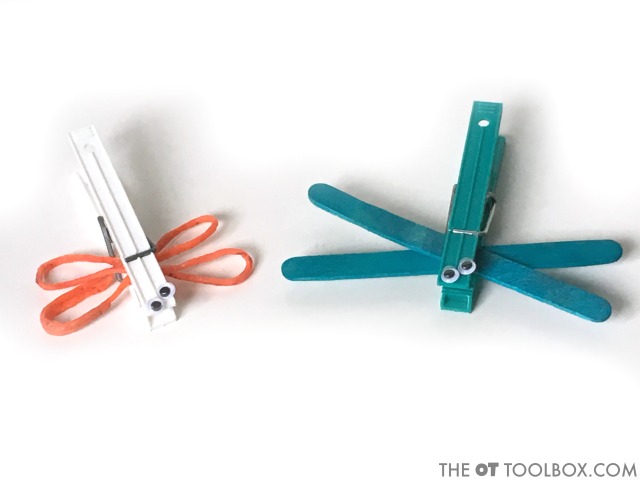
To set up the dragonfly craft as an occupational therapy assembly activity:
· 1. Place the wing materials scattered on the tabletop and have the child visually scan the table top for matching pieces.
· 2. Have the child take the matches and create an X pattern for wing assembly.
· 3. Have the child pinch clothespins open to insert the wings.
· 4. Continue this process until all dragonflies are assembled with matching wings.
Dragonfly Game
To use the dragonflies for fun game-like activities, the dragonfly materials would be prepared prior to the session with one set of wing materials inside of a bag.
Dragonfly Matching Game
1: Have the child reach into the bag, feel for only one wing, pull it out and
locate its match on the table top for dragonfly assembly.
Dragonfly Texture Game
2: Have child reach into the bag and feel the texture of one wing inside of the
bag and while keeping their hand in of the bag, use their other hand to locate
its match on the table top and assemble the dragonfly.
Activity focus areas might include the same as simple assembly, but with this game-like approach tactile perception is more actively targeted.
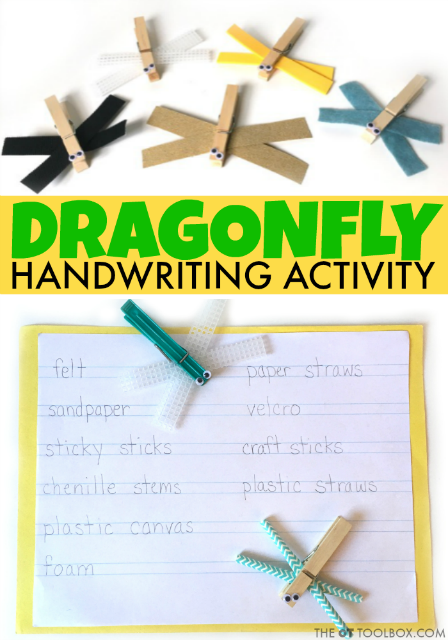
Dragonfly Handwriting Activity
A bonus would be to couple this activity with some handwriting practice. Take a look below at how easy it is to toss in some quick
handwriting work.
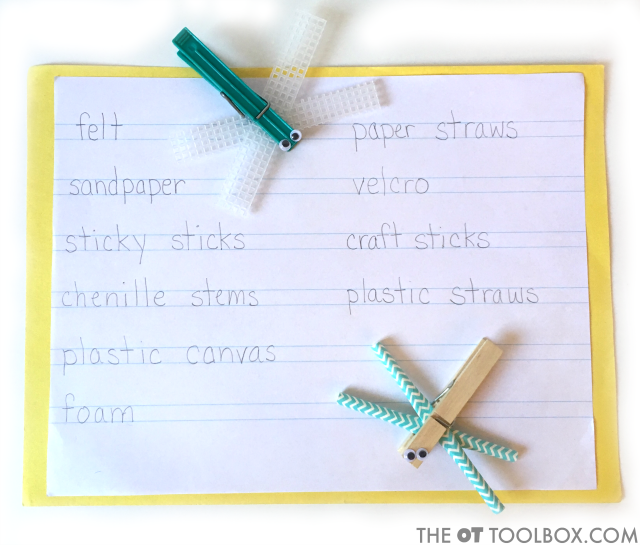
Dragonfly designs is a fun, cheap summertime activity that is easy to implement during therapy sessions and packs a big therapeutic punch. What therapist doesn’t enjoy those elements for a therapy activity?

Regina Parsons-Allen is a school-based certified occupational therapy assistant. She has a pediatrics practice area of emphasis from the NBCOT. She graduated from the OTA program at Caldwell Community College and Technical Institute in Hudson, North Carolina with an A.A.S degree in occupational therapy assistant. She has been practicing occupational therapy in the same school district for 20 years. She loves her children, husband, OT, working with children and teaching Sunday school. She is passionate about engaging, empowering, and enabling children to reach their maximum potential in ALL of their occupations as well assuring them that God loves them!
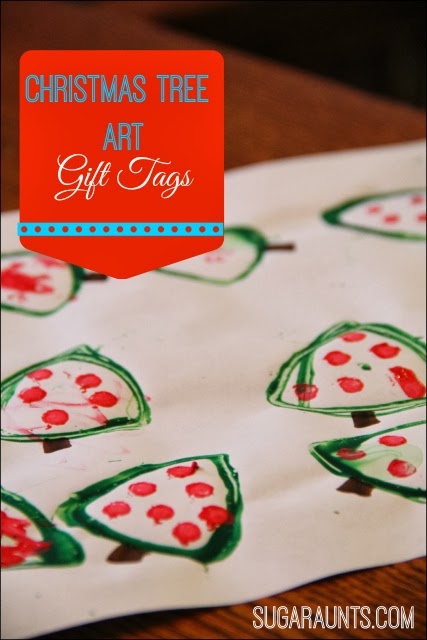
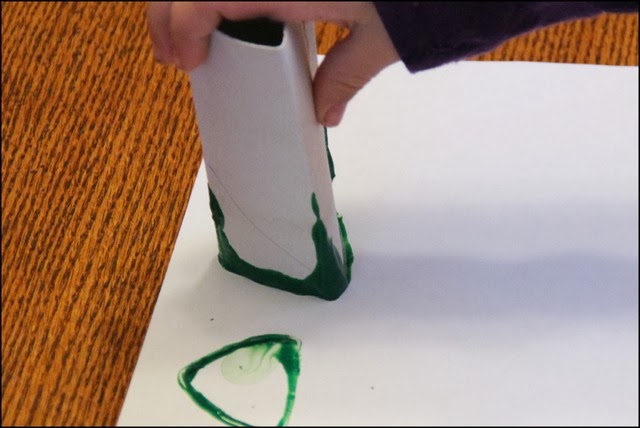
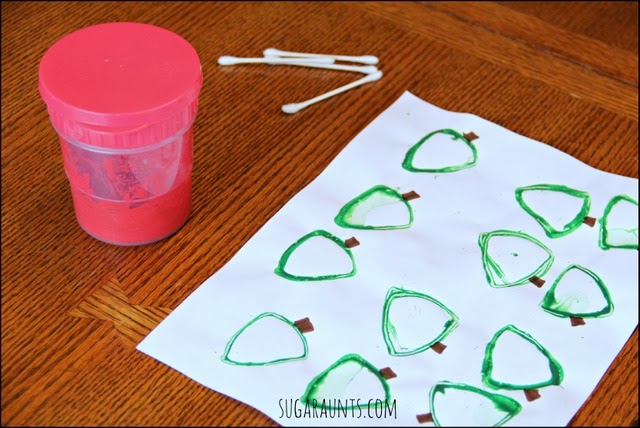
 and some
  to decorate our Christmas Trees.