Adaptive Equipment For Eating

Adaptive equipment for eating

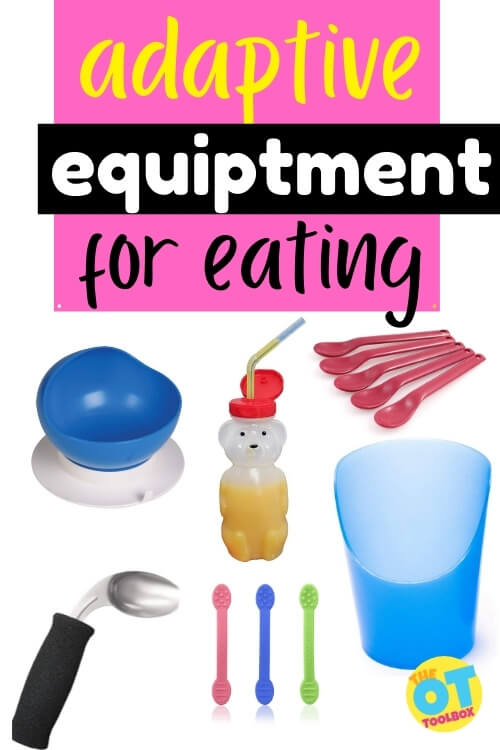
This article covers adaptive equipment for eating, including adaptive feeding equipment, assistive feeding devices, adaptive utensils, plates, bowls, and other tools to support functional feeding skills.

One of the main paths that occupational therapists help people achieve success in their daily occupations is through adaptive equipment and technology. There are so many great feeding products and eating tools available to increase independence, and today we will start off the conversation by introducing adaptive equipment specifically for feeding. 

Adaptive equipment for eating

A great place to start with learning more about adaptive equipment for eating and the possible need for reaching out to occupational therapy for adaptive eating tools or support is this resource on Pediatric Feeding: Is it Sensory, Oral Motor, or Both?

Adaptive Equipment for Eating

When it comes to helping individuals become more independent with daily occupations, feeding and eating skills have a big role. Occupational therapy, being the holistic profession that it is, recognizes the overall piece of eating has on wellness and wellbeing, nutrition, and day to day functioning. OTs focus on both the feeding aspect for nutritional intake as well as functional eating skills in use of utensils, cups, and bowls for independence.

Let’s take a look at various adaptive equipment tools for feeding and eating:

Adaptive utensils for feeding needs

Adaptive Utensils

Adaptive dinnerware includes adjusting handles on eating utensils, adding width to the utensil handle, adding weight or length, and addressing the ability to hold a fork and spoon, or knife. Other adaptive feeding needs cover difficulty bringing food to the mouth or the ability to remove food from the utensil as a result of oral motor issues.

Let’s take a look at various adaptive utensils.

Amazon affiliate links are included below.

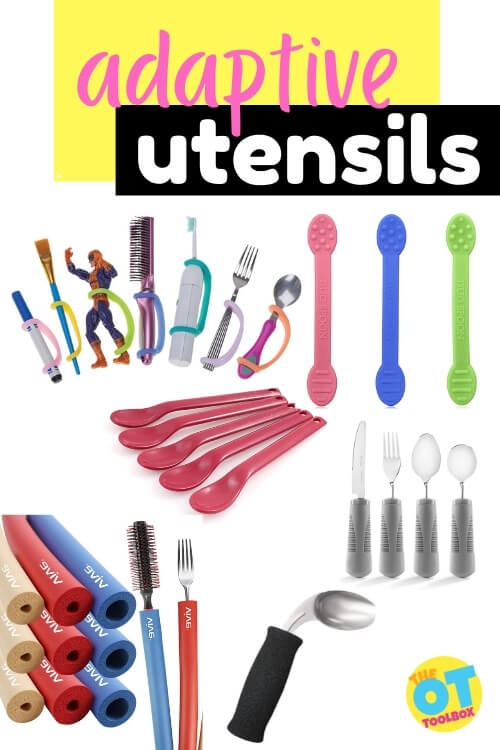
EazyHold Silicone Silicone Aide-Basically a silicone universal cuff, this adaptive utensil tool is perfect for feeding! The silicone texture makes it easy to clean, and it comes in sizes for newborns through adults. This piece of equipment can be placed around the hand and hold common objects like forks, spoons, markers, and paintbrushes making it a one-stop device for turning household spoons, knives, and forks into adaptive eating utensils. It can remarkably increase independence for individuals that demonstrate deficits in grip strength. 

Maroon Spoon– This adaptive feeding utensil is a classic! The maroon spoon has a shallow spoon depth that can assist in feeding for users with poor lip closure, oral hypersensitivity, or tongue thrust. 

Weighted, Thick Handled Utensils– These weighted utensils have thick handles that are great for those who can grasp a wide handle but have a harder time holding on to something smaller that requires more grip strength. If this is the case, built-up handles are a lifesaver!

You can also use Viva Foam Tubing to make any household spoon, fork, or knife handles thicker and easier to grasp. The added weight of these utensils is also great for individuals who have tremors – the extra weight helps to combat the motion of the tremor, leading to a more successful meal time. 

Textured Spoons– The texture on the spoon provides oral-motor stimulation to the mouth, increasing wanted oral movement patterns and decreasing hypersensitivity. The texture can also cue the user to engage with the tastes and textures while feeding. This spoon comes with extra-long handles to make hand over hand assist a bit easier, too! 

These bendable textured spoons are great for self-feeding and oral motor stimulation as they have a smaller, hand-held size and can offer different textures for gum and tongue sensory input.

Off- Set Spoon– This tool, and many other utensils like it, allow for easier self-feeding for individuals who have limited mobility. The angle of the spoon is turned toward the person, instead of being straight, so that they can bring their spoonful of food directly to their mouth without having to change the orientation of the spoon or their bodies. 

Adaptive plates and adapted bowls for feeding issues

Adaptive Eating Plates and Bowls

When it comes to a container to hold food, plates and bowls can look like many things. Here, you’ll find recommendations for lipped plates, suction cup

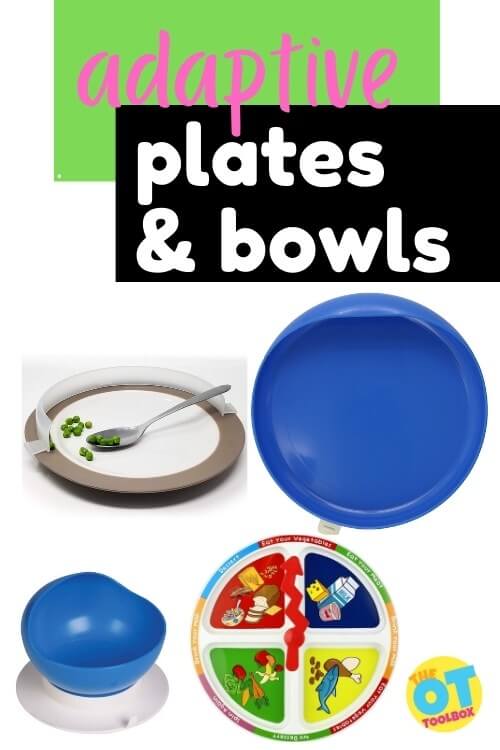
Scooper Plate– A lipped plate is just one way to help individuals scoop food from the plate surface, and not onto the table. This scooper plate is a dinner plate with a lip, or a higher edge. Here is another must-have item for individuals that have trouble scooping or stabilizing their plate or bowl.

This “scooper plate” is a plate with high walls like a bowl that have been specifically designed to make it easier to scoop and pick up food items with a utensil. Even better, there is a suction cup feature at the bottom to secure it to the tabletop for more stability while scooping. You can also get the scooper bowl here.

Plate Guard– Similar to the scooper plate, these plate guards can be added to any of your existing plates to add a wall to scoop against. This reduces spills, food waste, and time spent chasing food around with a utensil. That being said, there is much to learn from messy food play.

4-Square Meal Plate– Some feeding therapy involves increasing food repertoire for picky eating. This plate can be a great tool to help make mealtime fun and engaging for kids.

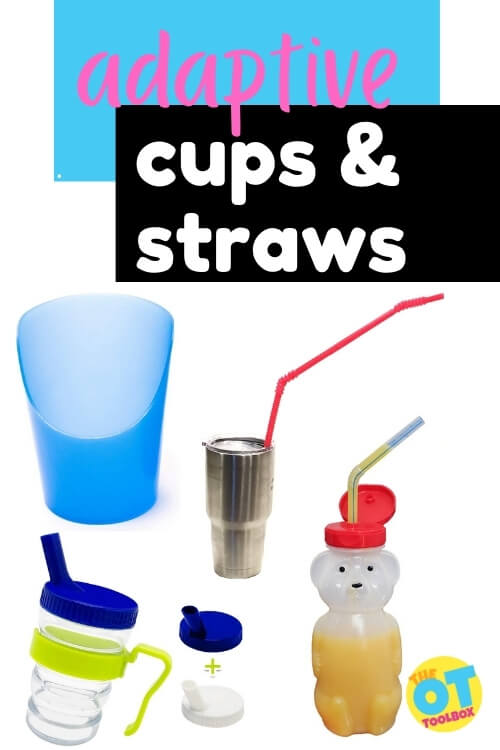
Adaptive cups and adaptive spoons for feeding needs

Adaptive Cups

Adaptive cups can help with drinking without lifting the head or chin or can help address other motor control and strength challenges. For individuals that struggle to hold a cup or sip from the edge of a cup, there are straw options as well. Below, you’ll find adapted cups that are designed for those with dysphasia or aspiration precautions. Those requiring thickness needs or safety concerns with swallowing liquids should consult a professional. Read this resource on oral motor issues and feeding needs to get started.

Flexi Nosey Cup– This is a flexible drinking cup that also has a space cut out of it to fit a person’s nose. This is a simple and effective way to improve the independence of those who are limited in their ability to tilt their head back while drinking. With the space cut out for the nose, there is no need to tilt their head back while using this cup. The flexibility of the cup can control the flow of the fluid as well, to promote safe swallowing. 

Bear Straw Cup– This kit can help teach a child how to drink out of a straw. The design keeps the liquid near the top of the straw so that less effort is required to take a sip. This can be great for those with oral motor deficits or those just learning how to suck. The kit comes with a lip block to prevent biting on the straw or having the straw enter the throat, and encourages oral motor exercise as well! 

Recessed Lid Cup– This drinking cup is designed with two handles and a recessed lid that can improve lip closure while avoiding sippy cup use. Why do we want to avoid sippy cups? Short answer: if they are used to exclusively, for too long, they can cause dental issues and speech problems. The recessed lid cup mimics drinking from an open cup without all the spillage. Plus, it improves lip closure and tongue retraction for improved oral motor function. This kind even comes with two lid options, one that is suitable for straw use, and the other for typical drinking. 

Flow Control Cup– This cup helps with oral motor control, lip closure, and tongue mobility that impacts sucking from a straw and managing the flow of liquids when drinking from a cup.

Extra-Long Drinking Straw– This flexible drinking straw is extra long, addressing mobility needs that limits an individual’s ability to move closer to a cup and straw that are positioned on the table surface.

If you are a therapist or another professional looking for brands to support during feeding therapy, take a look at Ark’s products. They make tons of oral motor tools for desensitizing and strengthening a child’s mouth to encourage the development of food repertoire and safer, more independent feeding and swallowing. 

Finally, if adaptive feeding equipment is something that needs to be further adapted to meet the specific needs of an individual, don’t forget the many uses that Dycem will have in addressing specific needs.

Sydney Thorson, OTR/L, is a new occupational therapist working in school-based therapy. Her
background is in Human Development and Family Studies, and she is passionate about
providing individualized and meaningful treatment for each child and their family. Sydney is also
a children’s author and illustrator and is always working on new and exciting projects.

Yearly Goal Planner

Annual Goal Planner for therapy professionals

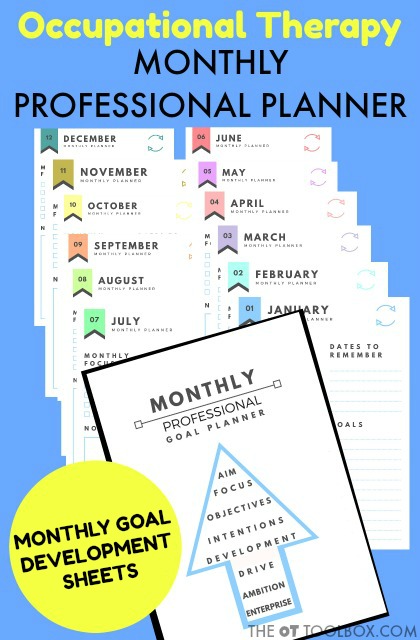
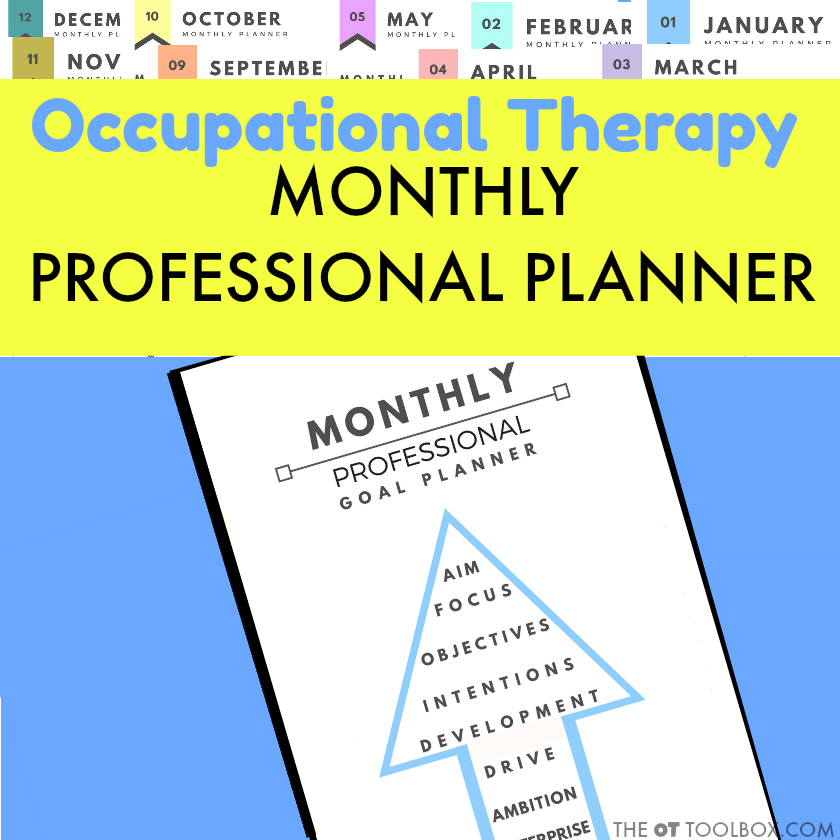
I am so excited to share a yearly goal planner specifically for occupational therapy professionals (or any therapy professional!) The printable professional goal planning tool is specifically designed to develop and integrate annual goal planning into monthly and weekly goals for professional development as a therapy professional.

Yearly Goal Planner for Therapy Professionals

As therapy professionals, we know the value of a goal. We write them every day. We analyze progression and develop strategies for obtaining goals. We focus on making goals measurable and obtainable.

Many therapists create annual goals for themselves as part of professional
development. This may be a requirement for work or it may be a means for
obtaining professional development units in order to maintain licensure. 

Yearly goal planner printable sheets for occupational therapists who what to develop as a professional with monthly and annual goals when identifying and planning professional development.

Yearly Goal Planner for Professional Development

When we work toward a goal, we decide how to make small advances.
This is true in meeting goals of any kind. Big goals need to be broken down into
steps. A long term goal can be achieved through short-term pieces.  

Making goals provides a focus to our professional development. Making goals provides a sense of commitment that allows us to achieve. A focus on commitment can foster increased accomplishments in our success.  

It’s been determined that you become 42% more likely to achieve your goals and dreams, simply by writing them down on a regular basis.  

That’s why we’ve created these monthly professional development goal worksheets.

How to Plan for Yearly Professional Goals

There are many ways this yearly goal planner can be used. As therapy professionals, we know the power in creating goals based on mindset, motivation, and daily occupations. We know the power in making achievable goals at a “just right” level. And, we know the progress that can be made when monitoring and analyzing progress towards goal achievement.

Use the yearly goal planner to support professional development as a therapy professional in these ways:

  • They are a tool for developing as a professional and making small advances on those professional goals by breaking big annual goals into smaller chunks.  
  • The monthly professional development sheets are perfect for making goals and analyzing how we’ve worked toward meeting those goals.  
  • Use the sheets to strategize professional development, make notes, jot down ideas, and to itemize how those goals will advance.  
  • Identify what’s important to you as a professional. Is it working toward a certification? Is it gaining an advanced degree? Is it taking specific continuing education courses? Is it teaching as a professional? Creating a business? Use the annual goal planner to identify specifically where you are moving forward in the next year.
  • Identify a monthly focus based on self-reflection.
  • Create specific, measurable, achievable, relevant, and timed goals for each month.
  • Use the resources on AOTA on professional development, to create SOAR goals using Strengths, Opportunities, Aspirations, and Results (SOAR) along with the Yearly Goal Planner to move forward with goal planning.

It’s been shown that goals which are shared with others are more likely to be achieved. In fact, one study found that goals shared with others are more than 70%  more likely to be achieved compared 35% of those who did not share their goals with others. And sharing progression on goals as well as how we’re working on meeting those goals improves the likelihood of meeting those goals even more. Sharing goals and progress holds us accountable.

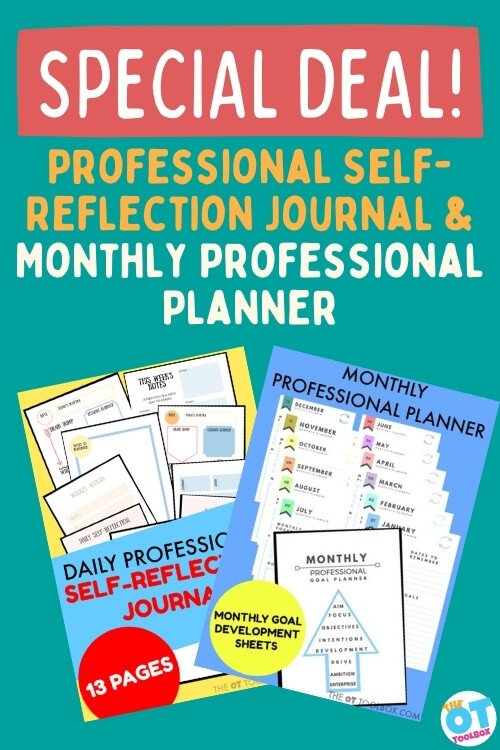
Get the Annual Professional Goal Planner OR as a special deal, get both the Yearly Professional Goal Planner AND the Professional Self-Reflection Journal DEAL for $5.

Yearly Professional Goal Planner printable sheets for occupational therapy professionals.

Colleen Beck, OTR/L has been an occupational therapist since 2000, working in school-based, hand therapy, outpatient peds, EI, and SNF. Colleen created The OT Toolbox to inspire therapists, teachers, and parents with easy and fun tools to help children thrive. Read her story about going from an OT making $3/hour (after paying for kids’ childcare) to a full-time OT resource creator for millions of readers. Want to collaborate? Send an email to contact@theottoolbox.com.

Evidence Based Practice in Occupational Therapy Appraisal Worksheets

Evidence based review and appraisal worksheets The OT Toolbox

Today, I have a resource for understanding and implementing evidence based practice in occupational therapy. Therapy professionals know that utilizing evidence-based practice utilizes critically appraised research and combines those results with clinical expertise and a patient or client’s needs or preferences to create best practices, informed clinical decisions, and research-driven interventions. 


Evidence-based practice (EVP) is essential for up-to-date information for making care decisions.

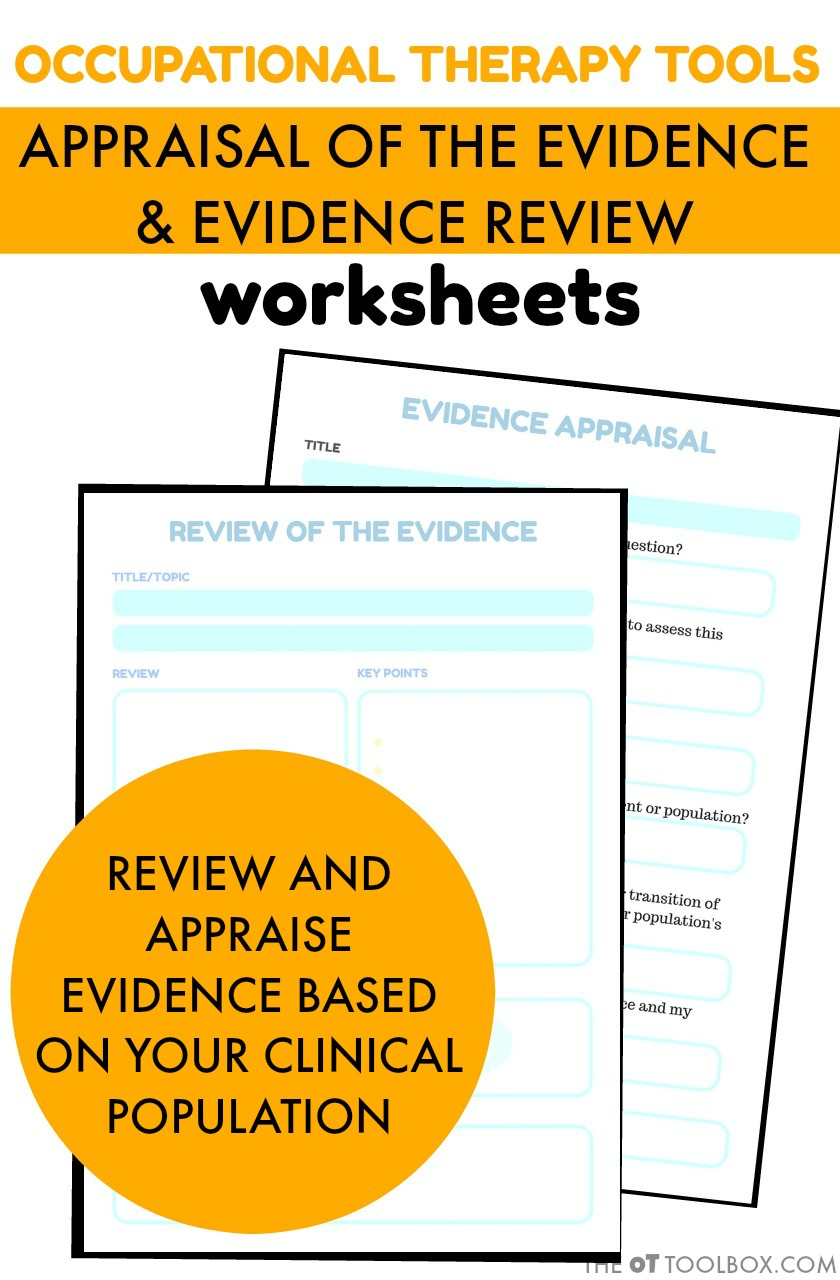
Free appraisal worksheets for evidence based practice in occupational therapy

evidence based practice in occupational therapy

These worksheets are a tool for applying critical appraisal of the importance and applicability of clinical evidence.


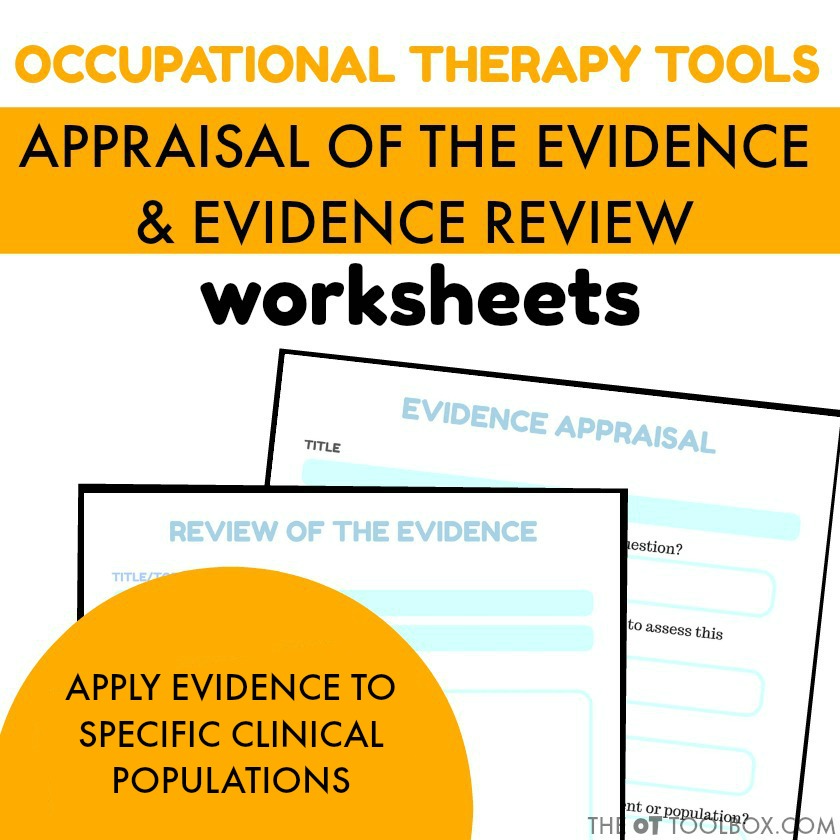
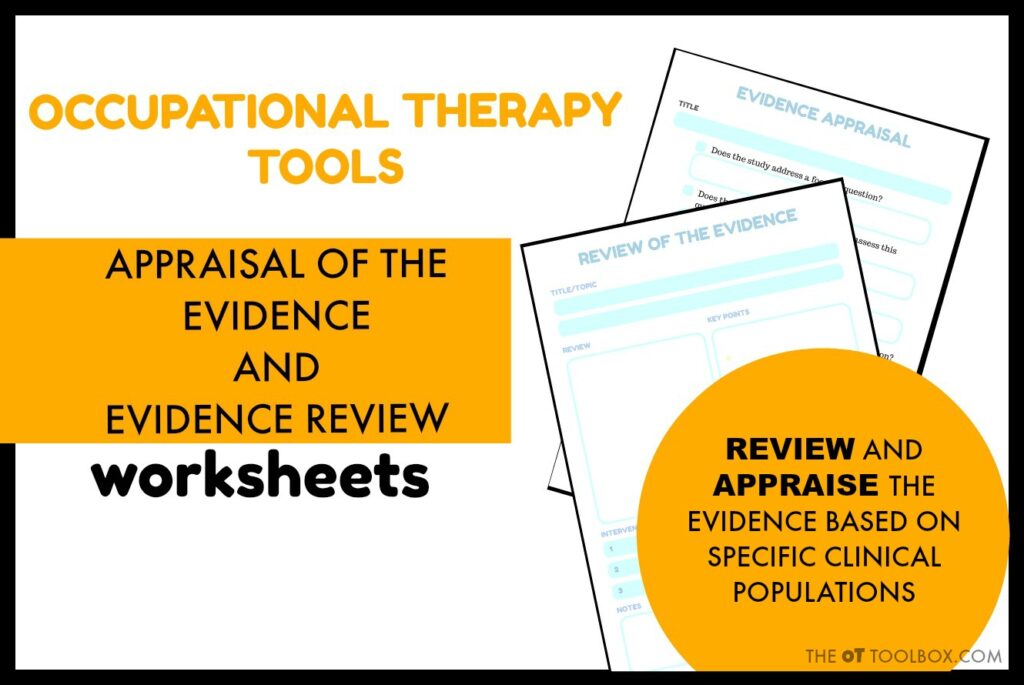
These two worksheets aim to guide and develop evidence-based Occupational Therapy assessment, treatment planning, and interventions through appraisal and review of the evidence, allowing self-directed promotion of  the highest standards.


Using the Appraisal of the Evidence worksheet and the Evidence Review worksheet, clinicians will be able to apply a critical analysis of available research. The worksheets  empower practitioners to apply the findings into the context of practice. By incorporating thoughts and notes into the analysis, clinicians can add the perspectives and judgment that is imperative for true evidence-based practice.

Why is this analysis and review of the evidence important for therapy professionals?

Using evidence based practice in therapy is important for so many reasons!

  • Integrating evidence into therapy interventions for most-recent and appropriate strategies
  • Research-backed treatment plans
  • Advocacy for the profession
  • Improves quality of care
  • Allows clinicians to stay current in the profession
  • Improved quality of therapy 
  • Improves outcomes
  • Promotes best practices using standardized, evidence-based protocols
  • Informed decision making
  • Effective selection of treatment
  • Guide research by revealing evidence gaps
  • Improves accountability of clinicians
  • Development of individualized guidelines of best practices
  • Opens the door for dialogue between patients and providers, incorporating patient preferences and values into decision-making

How to review Evidence for therapy

Understanding how to review evidence to incorporate evidence-based practice into therapy sessions and therapy interventions is important for many reasons that we covered above. But HOW do you review evidence and use those findings in therapy interventions?

As a general overview, there is a process of incorporating research-backed therapy into practice. Appraising evidence involves asking, searching for evidence, appraising the evidence findings, and a final but important piece: implementing evidence into practice.

  1. Ask questions- Beginning with a question or problem, a therapist should ask a question. This question may be related to assessment, prognosis, intervention, treatment planning, or other areas. 
  2. Search for the evidence- Use a variety of tools and research sources to locate evidence.
  3. Appraise the evidence- This is where the Appraisal of the Evidence Worksheet comes into play. Review and assess the evidence for validity, outcomes, services, and other areas.  
  4. Implement the evidence into practice. Utilize the information gathered to apply the evidence into daily practice, alongside experience and clinical expertise. Utilizing these areas as well as a patient’s values, preferences, and interests, it is possible to guide treatment.
  5. Follow-up- Finally, an assessment of the outcomes can guide and promote further clinical expertise based on evidence. 

Evidence-Based Practice Worksheets

To help therapy professionals with the steps outlined above, I’ve created evidence based practice appraisal worksheets. The worksheets described below are tools for guiding clinical best practices using the evidence. They are strategies for fostering a dialogue toward best practice while supporting new learning. 


Facilitating professional growth, the evidence-based worksheets are guides to reflecting on evidence and incorporating EBP into the clinic. 

Evidence Review Worksheet

This review worksheet can be used by clinicians as they reflect on the evidence and apply it to a specific client’s needs, preferences, interests, values, and goals. The worksheet promotes a quality of intervention related to evidence and is a tool for improving services. It can be used as a pre-post assessment related to expectations and outcomes based on evidence. The review worksheet can be a helpful resource in guiding standards toward best outcomes. 


Together, these worksheets are a valuable tool in transitioning therapists toward quality intervention based on the evidence. 


This one page worksheet can be used to appraise research articles. The questions guide conversation on an article’s validity and relevance in practice. Areas for notes allow for self-reflection on the evidence related to outcomes, particular client needs, services, and decision-making. 

These evidence-based practice and evidence based appraisal worksheets are helpful tools in developing an EBP therapy practice and guiding treatment based on the evidence, for Occupational Therapist practitioners.

References for evidence based practice in occupational therapy:

  1. George Tomlin, Bernhard Borgetto; Research Pyramid: A New Evidence-Based Practice Model for Occupational Therapy. Am J Occup Ther 2011;65(2):189-196. doi: 10.5014/ajot.2011.000828.
These evidence-based practice and evidence based appraisal worksheets are helpful tools in developing an EBP therapy practice and guiding treatment based on the evidence, for Occupational Therapist practitioners.

Want to use evidence-based resources and information in your therapy practice, but don’t know how to keep it all organized? 

Need to break down all of the information into key take-aways to offer key-takeaways AND 

Evidence Based Practice in Occupational Therapy Resources

evidence based practice in occupational therapy

Therapy professionals, are you looking for evidence based practice in occupational therapy? This list of EBP occupational therapy resources include places to find the evidence for implementing in occupational therapy interventions. As Occupational Therapy practitioners, we value evidence based practice (EBP) to use in clinical practice intervention and evaluation. But finding evidence-based resources can be a struggle for therapists. There are many reasons for difficulties in finding this information including time, effort, cost, opportunities, availability of resources, and other issues. Below you will find various ways to obtain evidence-based resources as occupational therapy practitioner.

EVIDENCE BASED PRACTICE IN OCCUPATIONAL THERAPY RESOURCES

In this blog post, you’ll find information on evidence based practice for OT. You’ll understand the hierarchy of evidence levels in EBP, and you’ll find 21 places to find evidence based practice in occupational therapy.

This resource identifies and explains evidence based practice in occupational therapy.

First, we’ll dissect the various levels of evidenced based practice that OTs may encounter in searching for evidence based literature.

Hierarchy of evidence

There is quality of evidence that needs to be determined when analyzing resources. Understanding the hierarchy of evidence helps to identify different levels of evidence when determining the validity of sources. A framework for ranking evidence provides a hierarchy to enable different research methods to be ranked according to the validity of their findings.

This link explains various grades and levels of evidence, defining types of evidence that provide reliable answers and best practice, while also describing the strength and rigor of a study.  

Hierarchy of evidence within Evidence Based Practice is effective in identifying quality and high-level research backed information.  

The Sackett method of ranking evidence is one method for outlining levels of evidence in EBP:

1A = Systematic Review of Randomized
Controlled Trials (RCTs)
1B = RCTs with Narrow Confidence Interval
1C = All or None Case Series
2A = Systematic Review Cohort Studies
2B = Cohort Study/Low Quality RCT
2C = Outcomes Research
3A = Systematic Review of Case-Controlled
Studies
3B = Case-controlled Study
4 = Case Series, Poor Cohort Case Controlled
5 = Expert Opinion

Understanding the levels of evidence is necessary when investigating a topic area in the literature.

Resources for Evidence Based Practice in Occupatoinal Therapy

The following list is a collection of places to obtain evidence based resources for implementing into therapy interventions. By obtaining the evidence, therapists can use research and evidence in practice.

These resources can then be appraised using our free Evidence Based Practice Appraisal Worksheets.

1.) Continuing education opportunities- When obtaining professional development units needed to maintain licensure, therapists are able to connect with other therapists and are exposed to resources related to a specific question or topic. The struggle with this source of evidence-based practice is that continuing education opportunities can be pricey and limited. 

2) The American Occupational Therapy Association (AOTA) publishes the American Journal of Occupational Therapy (AJOT) along with Special Interest Sections as a quarterly resource. AOTA  has online resources with evidence-based practice information and articles available to members. The struggle with this means of obtaining evidence based practice and literature is that topics are limited and therapist may not be able to to obtain the evidence they need related to specific clinical questions. Another issue is that the cost of membership.

3.) National Board for Certification of Occupational Therapy (NBCOT) The national certification board for Occupational Therapy professionals provides an online portal for certificants, including evidence-based literature. Pro-Quest is one source for obtaining evidence-based articles needed in practice or for when researching needs. RefWorks is another tool for obtaining evidence-based literature that allows individuals to organize research references and easily create citations and bibliographies.

4.) American Occupational Therapy Foundation (AOTF) is an educational organization striving to  It support occupational therapy research and public understanding of the important relationship between everyday activities (occupations) and health. AOTF creates a quarterly publication, the journal OTJR: Occupation, Participation, and Health.

5.) AOTA and AOTF jointly support OT Search, a literature database of occupational therapy and related health articles. OT Search requires a paid membership.

6.) The Australian Occupational Therapy Association (OTAUS) is another source of current research. Journal articles in the Australian Occupational Therapy Journal are available in the Wiley Online Library.

7.) The Canadian Association of Occupational Therapists (CAOT) publicizes the Canadian Journal of Occupational Therapy (CJOT).

8.) Royal College of Occupational Therapists (RCOT) offers the  British Journal of Occupational Therapy (BJOT) to it’s members.

9.) The American Society of Hand Therapy (ASHT) offers the Journal of Hand Therapy. Finding the time to search various journals can take effort and energy out of a therapist’s busy schedule. These searches are often done on a therapist’s own time.

10.) Other journal options include the British Journal of Occupational Therapy and American Family Physician.

11) Networking with co-workers- Evidence related to a clinic or therapy setting’s particular needs can be shared in team meetings. This form of professional development is performed with colleagues or within small groups at a working place. However, many therapists have said that their workplace is limited in the number of therapists or they may even be working in isolation. This is especially true in the school based environment.

12). Magazines such as Advance for Occupational Therapist PractitionersOT Practice published via AOTA, and Occupational Therapy Now (OT Now) published by RCOT can be a source of locating recent research through article archives. 

13.) Online sources Today in OT is an online source for obtaining continuing education credits.  College or university courses, meet-ups. Additionally, alumni are able to access research libraries in many cases.

14.)  EBSCO Information Services provides research databases, e-journals, magazine subscriptions, e-books.  

15.) State Association memberships and meetings.  

16.) National Institutes of Health is a library of electronic journals, e-books, and databases.

17.) PubMed has more than 27 million citations for biomedical literature from MEDLINE, life science journals, and online books.   

18.) The Agency for Healthcare Research and Quality  promotes evidence-based practice and reviews the evidence in order to  facilitate the translation of evidence-based research findings.

19.) The Cochrane Library is part of Cochrane, a network of researchers, professionals, patients, and others, in order to produce valid and reliable health information that is free from commercial sponsorship and other conflicts of interest.

20.) Guideline is a division of the US Health and Human Services that provides a public resource for summaries of evidence-based clinical practice guidelines. 

21.) Google Scholar. Therapists are able to search online for evidence-backed research using Google’s tool titled google scholar. Simply type google scholar into the search bar and a library of research is available at your fingertips. However it can be difficult narrow down questions specific to clinical questions. Google Scholar offers a broad search for scholarly literature from a variety of sources including articles, theses, books, abstracts and court opinions, from academic publishers, professional societies, online repositories, universities and other web sites. 

22. Medbridge Continuing Ed– This online source for OT continuing education is an online program where you can take evidence based courses and obtain licensure requirements at the same time. Use the code THEOTTOOLBOX to save $150 off your subscription.

How to obtain evidence based practice resources for occupational therapy

Resources: Sackett DL, Strauss SE, Richardson WS, et al. Evidence-Based Medicine: How to Practice and Teach EBM. Philadelphia, Pa: Churchill-Livingstone; 2000.

Evidence based practice for occupational therapy

Free EBP Apprasal Forms

Want to take analysis of the evidence to the next level? Grab our set of evidence based practice appraisal worksheets (they’re free!) and get focused action plans for each research article.

FREE Evidence Based Review & Appraisal Worksheets

    So I can best serve you, are you…
    We respect your privacy. Unsubscribe at anytime.
    self-reflection journal for therapists

    Get the Annual Professional Goal Planner OR as a special deal, get both the Yearly Professional Goal Planner AND the Professional Self-Reflection Journal DEAL for $5.

    Colleen Beck, OTR/L has been an occupational therapist since 2000, working in school-based, hand therapy, outpatient peds, EI, and SNF. Colleen created The OT Toolbox to inspire therapists, teachers, and parents with easy and fun tools to help children thrive. Read her story about going from an OT making $3/hour (after paying for kids’ childcare) to a full-time OT resource creator for millions of readers. Want to collaborate? Send an email to contact@theottoolbox.com.

    Fall Cootie Catcher Template

    Fall fine motor cootie catcher template

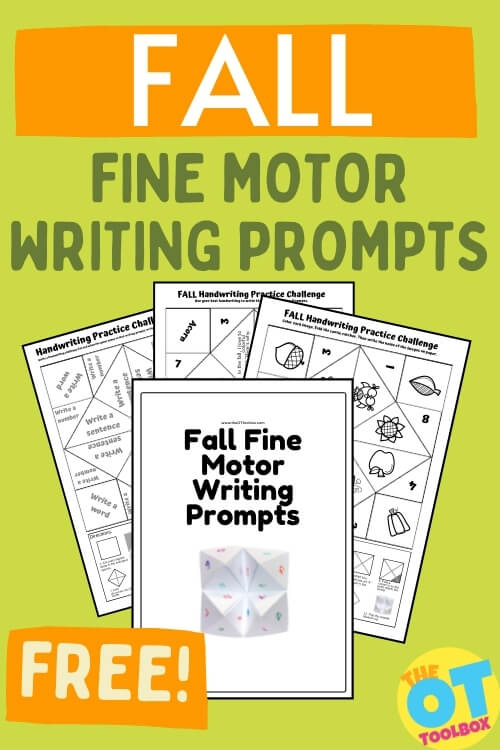
    Working on handwriting with kids? This Fall cootie catcher template is a Fall writing prompt activity that builds fine motor skills. Just print off the cootie catcher templates, pick the one that works best to meet the needs of the child you are working with, and work on copying letters, words, and sentences. This cootie catcher PDF is a fun way to work on so many skills!

    Fall cootie catcher for a fine motor writing prompt activity

    We shared this Spring cootie catcher earlier this year and it was a huge hit, so this Fall themed printable will be loved as well.

    Add this printable activity to Fall fine motor activities and Fall writing prompts.

    What is a cootie catcher?

    A cootie catcher is a folded paper game that includes squares and triangles that can be opened to contain written words or pictures. Cootie catchers are often used as a paper fortune teller game. A cootie catcher is an form of origami that kids can make, using a cootie catcher template. Once they practice using the blank template, children can learn the motor plan to create paper fortune tellers on their own.

    In our case, we are using a cootie catcher as a fine motor tool for kids.

    This one in particular includes writing prompts to make handwriting skills motivating and engaging for kids, with a Fall theme.

    When you use this cootie catcher, kids can develop so many skills:

    • Bilateral coordination– When children fold paper, they use both hands together in a coordinated manner.
    • Hand strength– Pressing the paper into folded shapes requires strength in the hand to create a sharp crease.
    • Separation of the sides of the hand– Opening and closing the cootie catcher requires both hands to open and close at the thumb web space, and is a separation of the sides of the hand activity.
    • Arch development– Using fingers to fold paper develops arch development in the hand, which is needed for endurance in fine motor activities.
    • Finger isolation– Using a finger to fold and crease paper focuses on finger isolation, a dexterity skill in fine motor tasks.
    • Eye-hand coordination– Using the eyes and hands together to create and use the paper fortune teller develops and refines eye-hand coordination skills.
    • Letter formation– copy the words on the printable.
    • Spacing between letters and words– Copy the words and sentences and work on spatial awareness, letter formation, and legibility.
    • Letter size– Write words on the spaces on the blank template to work on fitting letters and words into the given space.

    And those skills are just developed with kids use and play with the cootie catcher!

    Cootie Catcher Template

    This Cootie catcher printable includes four templates.

    1. You’ll find a printable fortune teller template pdf with instructions to write a word, sentence, or number.
    2. Next is a cootie catcher with sentence writing prompts in a Fall theme.
    3. There is a cootie catcher with Fall images which kids can write the name of the image.
    4. Finally there is a blank cootie catcher template.

    This free printable cootie catcher worksheet is another Fall freebie in our Fall week.

    Be sure to grab the other Fall printables that work on various skills:

    Want to print off this free cootie catcher? Enter your email to the form below and you’ll receive this printable in your inbox.

    Fall Cootie Catcher Writing Prompts

      We respect your privacy. Unsubscribe at anytime.

      Colleen Beck, OTR/L has been an occupational therapist since 2000, working in school-based, hand therapy, outpatient peds, EI, and SNF. Colleen created The OT Toolbox to inspire therapists, teachers, and parents with easy and fun tools to help children thrive. Read her story about going from an OT making $3/hour (after paying for kids’ childcare) to a full-time OT resource creator for millions of readers. Want to collaborate? Send an email to contact@theottoolbox.com.

      Upper Body Strength

      upper body strength

      In occupational therapy, addressing upper body strength can iffy for some. All OT interventions must be functional and based on daily tasks that make up a person’s day. OT is occupation! So when it comes to upper body strengthening, the question can arise whether the strengthen is functional. BUT, when you think about functional tasks, upper body strength is a must. When upper body strength results in less function of daily occupations, upper body exercises relate back to the functional task, making skilled strengthening activities part of the OT treatment plan. Let’s look at upper body strength and upper body strengthening activities that are used in occupational therapy sessions.

      Upper body strength activities for kids that develop upper body strengthening through play.

      These upper extremity activities for toddlers can get you started on some ideas for strengthening the upper body through play.

      Upper Body Strength

      The other day I was working on hand strength with a young child in one of my therapy sessions and I noticed how difficult it was for him to keep his arm in position while he was trying to complete the activity. I was reminded once again of how important upper body strength is when we are working towards improving fine motor skills.

      Upper body strength is made up of the muscles in the upper chest, muscles in the upper back and muscles attached to the shoulder joint. All of these muscles work together to create stability at the shoulder joint. This shoulder girdle stability is essential for establishing a solid anchor for the rest of the arm. Without this anchor it is difficult to develop good control in the lower arm, hands and fingers. In therapy-speak we talk about developing proximal stability before we can achieve distal control. 

      The stronger body enables functional performance in purposeful activities.

      Development of upper body strength

      Upper body strength emerges as young toddlers and children engage in movement activities. In the first few months of life babies push up on their arms when lying on their tummies.

      This early weight-bearing leads to strengthening and allows them to progress to four-point kneeling and eventually crawling. Upper body strength is very important as babies pull themselves into standing and begin to cruise along the couch or coffee table. This upper body strength continues to develop as children learn to climb jungle gyms, hold on to swings and learn to ride bicycles. The importance of play and movement in the early years reinforces the need for parents and caregivers to provide opportunities for young children to move and grow.

      Read more about the power of play and the impact that the occupation of play has on strength development in kids.

      Upper body strength remains vital in school-aged children as they tackle the challenge of refining their fine motor skills. 

      How to develop upper body strength

      When focusing on developing upper body strength in children the vertical surface will become your new best friend!   

      Working on a vertical surface places extra demands on the upper body as these muscles have to move against gravity to complete the task. Working on a vertical surface has the added bonus of placing the wrist and fingers in a good position for drawing or writing. This is a great way to incorporate finger strength exercises into the task.

      A vertical surface can be a wall, a door, a mirror, a blackboard or a white board.

      Have a look at the following activities (and purposeful, functional tasks) that you can complete on a vertical surface:

      1. Draw or color pictures

      Use tape to stick a piece of paper or picture on the wall. Use chalk, crayons, pastels or pencil crayons to draw a picture or color a picture in. When working for upper body strength try to encourage big movements that incorporate a wide range of movement for the shoulder muscles. Big bold rainbows and large lazy eights work very well. Related, these are the best crayons to support development, based on age and motor skills.

      Remember that the physical demands of working on a vertical surface are much greater than working at a table or a desk so give your child a chance to build up stamina and endurance. 

      Read more about coloring as a functional occupation and the development of coloring skills.

      1.  Playdough press

      I like to use a mirror or white board for vertical playdough activities. Playdough lends itself to endless creative outcomes and working against a vertical surface adds a new fun dimension. Playdough pieces can be used to fill in outlines of pictures or playdough creations can be stuck onto the white board. A large piece of playdough can be stuck onto the vertical surface and impressions can be made using everyday objects e.g. spoon, pencil. We have even had fun making handprint and footprint impressions.

      Also try these play dough activities for improving upper body strength through play. 

      1. Stickers 

      There are many reasons why stickers improve skills. Using stickers adds some refined pincer grip control, pinch strength, eye-hand coordination, wrist stability, shoulder girdle strengthening, and more. Place a page or picture on a vertical surface and use stickers to decorate. You can give verbal instructions to add listening skills and spatial concepts to the task e.g. place the blue sticker next to the cat. 

      1. Painting

      Painting is another functional task that improves hand and upper body strength. Occupational performance includes leisure activities such as painting and art. Painting is a great functional way to improve upper body strength. Complete your painting activity on an easel or vertical surface.  

      1.  Shaving cream on a mirror

      This fun, messy activity is a firm favorite with children. Spray a dollop of shaving cream into their hands and encourage them to spread it across the mirror to create a shaving cream drawing board. Draw pictures, shapes and patterns across the mirror. 

      1. Whiteboard activities

      Use whiteboard and white board markers to practice letter or number formations. To improve hand and upper body strength, use the whiteboard to play games like tic tac toe, word searches, and more.

      1. Tearing and sticking

      Stick the outline of a picture or shape on the wall. Tear small pieces of paper from a magazine and use a glue stick to paste the pieces onto the shape to fill the shape. Tearing paper strengthens the hand, wrist, shoulder girdle, and upper body. To make this a functional task, try using junk mail as a paper tearing activity.

      1. Body shapes

      This works well on a mirror. Ask the child to stand with their back up against the mirror. Use a Koki to trace the outline of the child. Encourage the child to add in the facial detail and clothing in order to complete the picture.

      1. Race tracks 

      Draw a race track on a chalkboard or on a large piece of paper stuck to the wall. Drive a small car along the race track. Older children can draw their own race tracks. Try this race track activity using wikki stix. Playing on the floor strengthens the upper body, core, shoulder girdle, and wrist.

      Using wikki stix activities to pinch and peel on the floor while incorporating upper body support is a great way to build upper body strength through play.

      Kids also love this garage door activity where we used magnetic letters on the garage door. What a great activity for using a vertical surface to strengthen the upper body through play.

      1. Tic Tac Toe

      This can be played on a vertical surface.  Encourage your child to draw the grid before playing the game. Engaging in these activities on a vertical surface will contribute to the development of upper body strength. Many of the games and activities that you have at home or in the classroom can be adapted to ‘vertical’ activities with a bit of tape or prestik. 

      For more functional upper extremity exercises using functional activities to strengthen the upper body for pencil grasp, scissor use, dressing, clothing fasteners, and more, be sure to grab our seasonal Fine Motor Kits. Each one includes resources for upper body strengthening but can be used on vertical surfaces for shoulder and core strengthening.

      These Heavy Work Activity Cards promote full body movement and strengthening through play. Add them to your therapy toolkit.

      Contributor to The OT Toolbox: Janet Potterton is an occupational therapist working predominantly in school-based settings and I love, love, love my job. I have two children (if you don’t count my husband!), two dogs, one cat, two guinea pigs and one fish. When I am not with my family or at work I try to spend time in nature. The beach is my happy place.

      Fall Pumpkin Cutting Activities

      pumpkin cutting activities

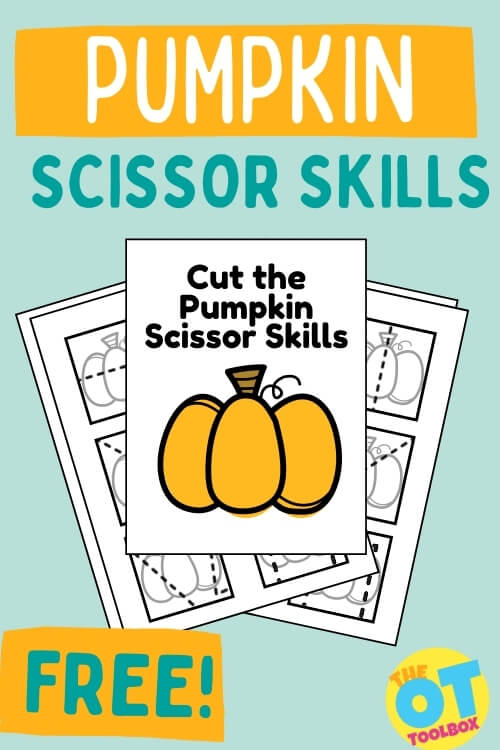
      If you’ve been following along with our Fall fine motor activities, then you will love adding these Fall pumpkin cutting activities! I love these pumpkin scissor skill worksheets for cutting practice with a fun Fall theme. The pumpkin images have simple cutting lines, making them a great pumpkin activity for preschool, or any child that is working on early scissor skills. Also check out our pumpkin activities for ways to extend this activity in therapy sessions.

      Add this activity to our pumpkin sensory bin activity for a full therapy session of fun this Fall.

      Pumpkin Cutting Activities for Fall themed occupational therapy activities.

      Get a copy of these pumpkin printables by entering your email address into the form at the bottom of this blog post.

      Fall Pumpkin Cutting Activity

      Print out the pumpkin worksheets and then use them to work on scissor skills with kids. I wanted to create a simple shape (square) to hold the pumpkin shapes. This way, kids can work up to cutting the square as a “next step” in developing scissor skills after cutting strait lines, curved lines, and jagged lines.

      This resource is a great read on cutting skills progression for kids.

      • Each pumpkin image includes a cutting line. You’ll find strait lines, diagonal lines, angled lines, jagged lines, and curved lines.
      • Kids can “cut the pumpkin” to slice through the pumpkin pictures!
      • The lines on each shape start at different sides, so kids can work on placement with their non-dominant hand.

      Extend the Pumpkin Cutting Activities

      There is more than one way to use these pumpkin shapes this Fall. Try these pumpkin cutting activities to address a variety of skills and abilities:

      • Start with the large pumpkin cutting pieces and work toward using the smaller pumpkins.
      • Color in the pumpkins to work on coloring skills, line awareness, and hand strength.
      • Trace the dotted line with a fingertip to work on finger isolation.
      • Trace the dotted line with a marker, crayon, or even a bottle of squeeze glue to work on line awareness and visual motor skills.
      • Cut out the pumpkin images. Cut the dotted lines. Then, these can be used as mini pumpkin puzzles to work on visual perceptual skills.
      • Place the separated pumpkin images around the room. Kids can complete gross motor actions like donkey kicks, balance beams, lunges, or hops to reach different pieces of the pumpkins. They can try to piece all of the pumpkins together.
      • After cutting the lines on the large shapes and the smaller pumpkins, then ask kids to work on cutting the square to work on turning the paper to cut around corners.
      • Use these worksheets as a pumpkin craft ideas for toddlers. If given the cut out pumpkin pieces (start with the strait lines and diagonal lines), toddlers can place the pumpkin halves together like a puzzle. Use glue to glue the pumpkin back together onto construction paper to make a pumpkin patch craft! This would be a great pumpkin craft for preschool, too.

      Free Pumpkin Cutting Practice Worksheets

      Want to grab these free pumpkin cutting practice sheets? Enter your email into the form below. Have fun this Fall!

      Pumpkin Scissor Skills Worksheets

        We respect your privacy. Unsubscribe at anytime.

        Colleen Beck, OTR/L has been an occupational therapist since 2000, working in school-based, hand therapy, outpatient peds, EI, and SNF. Colleen created The OT Toolbox to inspire therapists, teachers, and parents with easy and fun tools to help children thrive. Read her story about going from an OT making $3/hour (after paying for kids’ childcare) to a full-time OT resource creator for millions of readers. Want to collaborate? Send an email to contact@theottoolbox.com.

        For more pumpkin and Fall activities, check out these tools:

        1. Free Pumpkin Deep Breathing Exercise
        2. Halloween Occupational Therapy Activities
        3. Pumpkin Activity Kit
        4. Fall Fine Motor Activities
        5. Fall Fine Motor Kit

        Fall Sensory Stations

        sensory stations Fall theme

        I have another fun freebie for you! These Fall sensory stations are printable sensory station posters that you can use in classrooms, school hallways, the home, or therapy clinics to offer sensory input and whole body movements with a Fall theme. Just hang these sensory station posters on the wall and add calming sensory input with a Fall theme!

        Related to these seasonal sensory path printable, you’ll also love these other themed sensory walks: Winter Sensory Stations, Summer Sensory Stations, and Spring Sensory Stations.

        Fall themed sensory stations for a sensory walk in the school hallways, classroom, therapy clinic, or home.

        Earlier this year, we made these free Spring sensory stations and they were a huge hit!

        This set of sensory stations are a great addition to our Fall deep breathing exercise we shared yesterday.

        Fall Sensory Stations

        If you’ve been in a school hallway in recent years, you may have seen a sensory walk. They are fun ways to offer movement for kids, especially when they need a brain break during learning. But sensory walks can be expensive to create. So, going off the theme of adding movement, coping tools, and heavy work input through the proprioceptive system, these Fall sensory system posters for a very inexpensive cost (Hint: it’s nothing! They are free!)

        I love these Fall sensory stations because you can print them, laminate them, and place them in the hallway or on a wall for quick movement breaks. Add them to a Fall learning theme, Fall therapy activities, Fall fine motor work, or Fall crafts. They are great prep-work for these Fall writing prompts, too.

        These sensory station posters include:

        • Fall Figure 8 Breath Poster- for calming deep breathing, mindfulness, and self-regulation
        • Fall Animal Walk (Leap like a squirrel)- for motor planning input and proprioceptive input
        • Fall Wall Push-Ups- for proprioceptive input through the arms, shoulder girdle
        • Fall Jumping Jacks- for motor planning work, vestibular input, and proprioceptive input
        • Fall Trace and Breathe- for visual tracking, finger isolation, deep breathing, and self-regulation

        Free Sensory Station Posters

        Want to add these Fall sensory station printables to your therapy toolbox? You can grab this freebie and add it to your tools!

        Fall Sensory Walk Posters

          We respect your privacy. Unsubscribe at anytime.

          Colleen Beck, OTR/L has been an occupational therapist since 2000, working in school-based, hand therapy, outpatient peds, EI, and SNF. Colleen created The OT Toolbox to inspire therapists, teachers, and parents with easy and fun tools to help children thrive. Read her story about going from an OT making $3/hour (after paying for kids’ childcare) to a full-time OT resource creator for millions of readers. Want to collaborate? Send an email to contact@theottoolbox.com.

          Want more ways to work on skills this Fall? Grab our Fall Fine Motor Kit (or any of the seasonal kits):

          Working on fine motor skills, visual perception, visual motor skills, sensory tolerance, handwriting, or scissor skills? Our Fine Motor Kits cover all of these areas and more.

          Check out the seasonal Fine Motor Kits that kids love:

          Or, grab one of our themed Fine Motor Kits to target skills with fun themes:

          Want access to all of these kits…and more being added each month? Join The OT Toolbox Member’s Club!

          Fall Leaves Deep Breathing Exercise

          Fall leaves deep breathing exercise

          Today’s resource is a free printable Fall Leaves Deep Breathing exercise. This printable breathing exercise handout is a great way to work on mindfulness with a Fall leaves theme! Add this therapy resource to your Fall therapy activities and breathing exercises for kids as a self-regulation tool designed to help kids thrive and build skills.

          Fall leaves deep breathing exercise

          Fall Leaves Deep Breathing Exercise

          This free printable can be used with our other deep breathing activities as a self-regulation strategy for kids. Deep breathing is a powerful tool for calming the body as a coping mechanism. When you add a themed breathing exercise to the mix, it can be a fun way to focus on the regulation strategies kids need.

          To use this mindfulness exercise, kids (and adults) can point to the dots on the Fall leaves image. Trace the arrow as the child breathes in deeply. They should pause at the end of the arrow and hold their breath. Then, trace along the next arrow while slowly breathing out. They can continue around the image as they slowly breathe in and out.

          This slowed breathing with a pause at the end of the breath fosters breath control and allows the heart rate to slow, engaging the diaphragm for full, “belly breaths” allow for controlled breathing and is helpful in allowing children to reach a calm and alert state so they can focus.

          Add this Fall leaves breathing exercise to these Fall themed activities in therapy:

          Free Fall Mindfulness Printable

          Want to print off this mindfulness exercise to use in your therapy sessions, at home, or in the classroom? Enter your email address into the form below to grab this printable.

          Fall Leaves Deep Breathing Exercise

            We respect your privacy. Unsubscribe at anytime.

            Colleen Beck, OTR/L has been an occupational therapist since 2000, working in school-based, hand therapy, outpatient peds, EI, and SNF. Colleen created The OT Toolbox to inspire therapists, teachers, and parents with easy and fun tools to help children thrive. Read her story about going from an OT making $3/hour (after paying for kids’ childcare) to a full-time OT resource creator for millions of readers. Want to collaborate? Send an email to contact@theottoolbox.com.