Colleen Beck, OTR/L is a pediatric occupational therapist and the owner and author of The OT Toolbox website. She manages all of The OT Toolbox social media accounts and runs the popular newsletter.
Read about Colleen's experience and career as an occupational therapist, including how The OT Toolbox began on our About The OT Toolbox page: https://www.theottoolbox.com/about-us/
Colleen created The OT Toolbox in 2011 and since then has written thousands of blog posts designed to support therapy providers, educators, parents, counselors, admin, and caregivers in promoting the healthy development of kids.
Check out Colleen's blog posts below:
This collection of sunflower activities are perfect for adding to your therapy toolbox of weekly OT themes when it comes to helping kids develop skills through play. Check out the sunflower fine motor activities, sunflower crafts, and sunflower sensory play ideas below!
We are back with more seasonal activities that will be sure to put a smile on your face! After all, what is happier than a sunflower? We hope you use these crafts and activities to support the development and growth of your child’s skills, so we organized them accordingly. You’ll find projects to address fine, gross, and visual motor skills, as well as sensory, social-emotional, and cognitive needs as well!
Sunflower Fine Motor Activities
Do you have access to sunflower seeds? Use them in fine motor activities. Try these ideas using real sunflower seeds:
If you are looking for Fall fine motor activities, than adding sunflower activities to the list is the way to go.
This Cupcake Liner Sunflower Craft challenges scissors skills, precision, and pincer grasps. Plus, you can strengthen the hands even more by squeezing a glue bottle while crafting.
I love addressing feeding needs with an artistic activity, just like this Fork Sunflower Painting. Using feeding utensils during play will work to develop the fine motor skills for self-feeding while participating in a meaningful and fun craft.
This Lacing Sunflower craft requires skills for using a hole punch, scissors, and lacing yarn – what more could you ask for? Go ahead and assess their visual motor skills while they are hole punching onto marked targets and lacing through holes, too!
Sunflower Gross Motor Activities
Sunflower Harvest Dash can be used to address gross motor skills in a group relay race or in a smaller session. Fill up a cup of sunflower seeds (or a ladle or spoon to increase the challenge) and race to the other side to dump your seeds into your sunflower bowl.
Place obstacles in between for a greater challenge. The bowl with the most sunflower seeds wins! This challenges dynamic movement, balance, and quick coordination/ gross motor problem solving skills. If working in teams, it can address social skills and team-building skills, too!
Use Reach and Squat Sunflower Vases to challenge your kiddo’s coordination, movement between sitting and standing, and visual spatial skills, too! Tape toilet paper or paper towel rolls to a wall at varying heights – these will be your “vases”. Have your child reach, jump, squat, lean, etc. to place flowers – real or crafted – into the vases. For an extra challenge, have a climbing feature near the wall to climb and place the flowers into very high vases.
Fall themed movement activities make kids smile and are always a safe bet to get kids the movement breaks they need to learn! Plus, you can add the extra challenge of motor coordination and visual processing skills by having them try to copy the movement on the picture, without demonstration. Grab the Fall Fine Motor Kit for gross and fine motor activities (including fun sunflower themed activities!)
Sunflower Activities to Develop Visual Skills
You can add sunflower activities designed to develop visual skills as they relate to handwriting, like letter recognition, letter reversals, and more!
A Visual Perception with Flowers worksheet can help develop skills of visual discrimination, spatial reasoning, visual motor skills, and motor planning.
Be sure to read more on visual motor skills to better understand various visual skills and what activities to do to improve each individual skill.
Sunflower Sensory Activities
Just about any theme can be made into a sensory bin for some sensory exploration – including a great Sunflower one! Add in additional activities or skills to address visual motor skills (scooping and dumping items) or fine motor skills (using tongs with items).
Sunflower Playdough is another great way to strengthen skills through working in a multisensory way – squish and mold the playdough onto images on mats, use a pincer grasp to place sunflower seeds, or anything their heart desires! Try to scent the sunflower playdough with earthy/floral essential oils for a more robust sensory experience.
Sunflower Activities for Social Emotional Learning
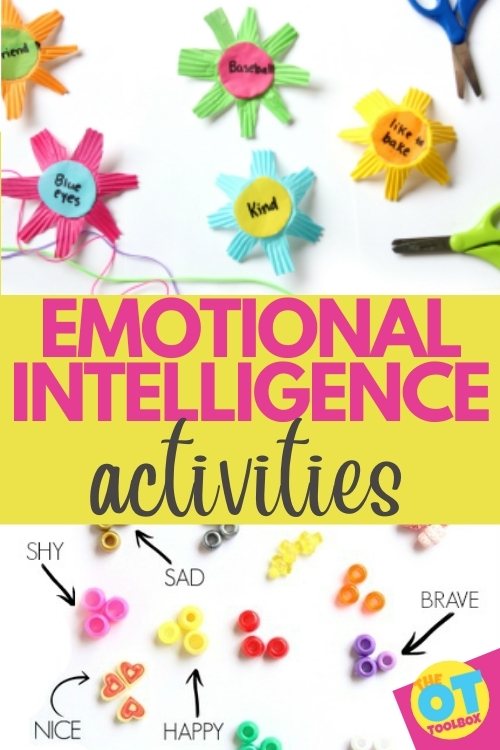
Sunflowers can be used to identify emotions as part of social emotional learning development. Use the sunflower cupcake liner craft to make sunflower faces and add emotional identification via facial expressions of others. Kids can draw faces onto the cupcake liners to help strengthen social bonds and understand how to name emotions of their own and others.
My favorite way to use these cards is as a tool to bring emotional regulation into the conversation; i.e, “Yes, this sunflower does feel sad – why do you think he is sad? What could he do to feel better?”.
This Positive Self Talk Flower worksheet can help those of us who have low-self esteem or lack of confidence. Starting here, with positive self-talk, may be the first step to encourage more successful social skills.
Here is another Sunflower Resource for positive thinking and coping skills. This was designed for group use but can easily be adapted for one-on-one or a take-home project as well.
Sunflower Activities for Executive Function
Crafts are a great way to incorporate attention, focus, task completion, impulse control, prioritization, and direction following! Use these flower crafts to focus on specific executive functioning skills. Just add yellow and brown paper to make the flowers into sunflowers.
Sequencing cards are definitely a go-to for me – someone has made one for just about every theme imaginable! These sunflower themed ones are perfect for addressing sequencing tasks and direction following.
Using sunflower seeds and petals in a Sunflower Life Cycle activity can challenge short term memory, problem-solving, and sequencing.
BOOKS ABOUT SUNFLOWERS
I always love to strengthen a theme with additional on-theme activities like a snack, a story or a place to visit. To fully embrace the sunflower theme, here are some sunflower books to check out from your local library:
That ought to get the ball rolling for some excellent sunflower-themed activities in your home, school, or clinic. We hope that you adapt these activities to best suit your practice and bring some sunshine to your day!
Sydney Thorson, OTR/L, is a new occupational therapist working in school-based therapy. Her background is in Human Development and Family Studies, and she is passionate about providing individualized and meaningful treatment for each child and their family. Sydney is also a children’s author and illustrator and is always working on new and exciting projects.
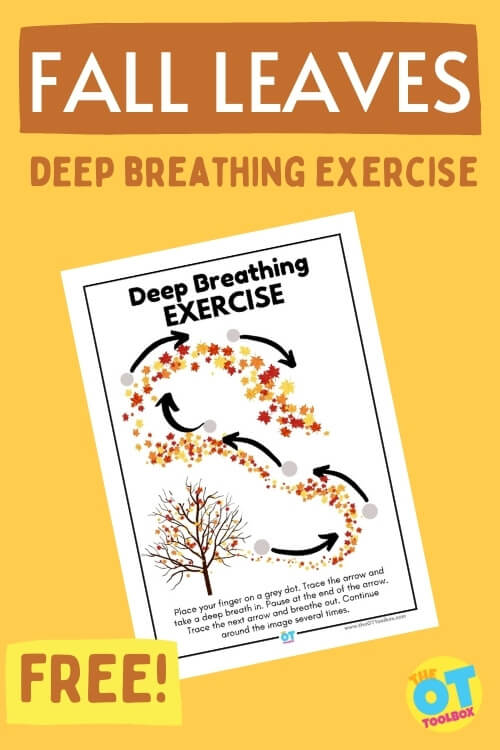
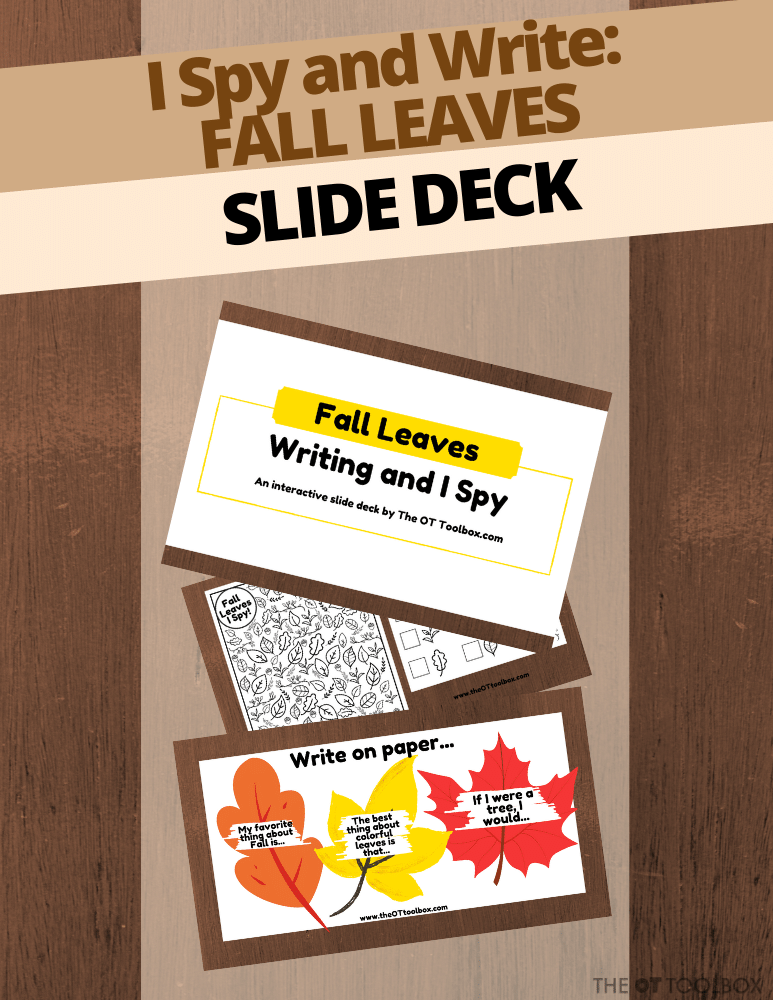
If using a Fall leaves theme in therapy or the classroom is on your Fall to-do list, then this Fall Leaves slide deck is a resource you’ll want to access. I wanted to put together a free slide deck that uses the fun of Fall leaves to work on visual perceptual skills and handwriting. Add some of our favorite Fall Fine motor activities to make a Fall themed therapy session!
Today’s Fall leaves slide deck is just one of the many free slides here on the website, and a great resource for both occupational therapy teletherapy and face-to-face therapy sessions.
Be sure to check out our Fall worksheets designed to build fine motor skills, our Fall leaves slide deck, and our free Fall Fine Motor Kit, all at the bottom of this post. The activities in this free booklet are a fun way to encourage fine motor and gross motor movement and development through fall activities. Scroll to the bottom of this blog post to grab your copy!
You’ll also want to snag this Fall Leaves worksheet. It’s a tic tac toe activity board designed to help kids build skills through play and fine or gross motor activities using Fall leaves.
Fall Leaves Slide Deck
This fall leaves slide deck is a virtual therapy activity that you can use to work on visual perceptual skills. The fall leaves slide deck includes a Fall leaves I Spy game.
Users can look for matching fall leaves and count the number of leaves that match. This I spy activity is powerful in developing visual skills such as visual scanning, visual attention, visual discrimination, figure ground, and form constancy.
This is a great tool for both virtual therapy students and face-to-face activities:
Virtual Therapy Sessions– Open the slide deck on google drive and students can type their answers right on the slide.
Face-to-Face therapy sessions– open the slide deck to use as an outline for interventions. More students are copying written work from a smart screen in the classroom, so the visual shift from vertical to desk top is improtant to address. Print off the screen and work on the I spy sheet right at the desk, or taped to a wall, with movement actions between each type of leaf that the student finds. The options are limitless.
Leaf Handwriting Activities
The free slide deck continues with the fall leaves theme and offers handwriting challenges for users. This can be used to address a variety of needs: letter formation, line use, spacing, sizing, overall legibility, copying from a near source, copying from a distant source, and much more.
Want to access this free therapy slide deck?
Want this free slide deck with a leaves theme? Work on visual perceptual skills and handwriting. Get it here:
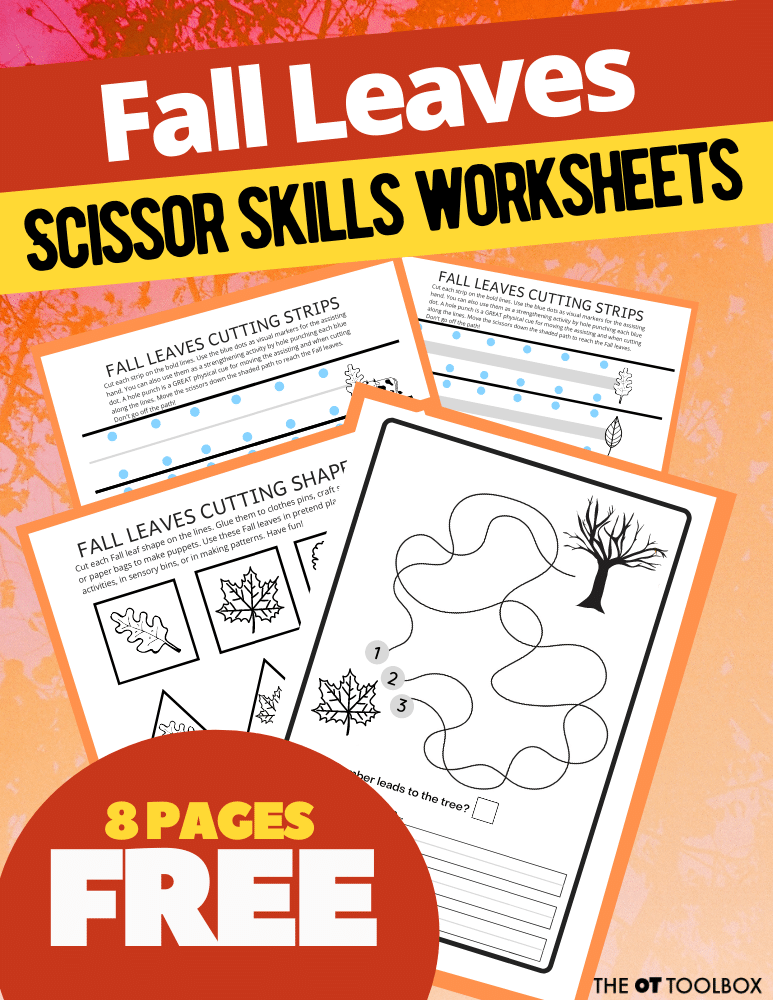
You’ll also love this 8 page packet of fall leaves cutting activities, fine motor pages, and more. This freebie has been added to the subscriber-only library. Join our email list for access.
Colleen Beck, OTR/L has been an occupational therapist since 2000, working in school-based, hand therapy, outpatient peds, EI, and SNF. Colleen created The OT Toolbox to inspire therapists, teachers, and parents with easy and fun tools to help children thrive. Read her story about going from an OT making $3/hour (after paying for kids’ childcare) to a full-time OT resource creator for millions of readers. Want to collaborate? Send an email to contact@theottoolbox.com.
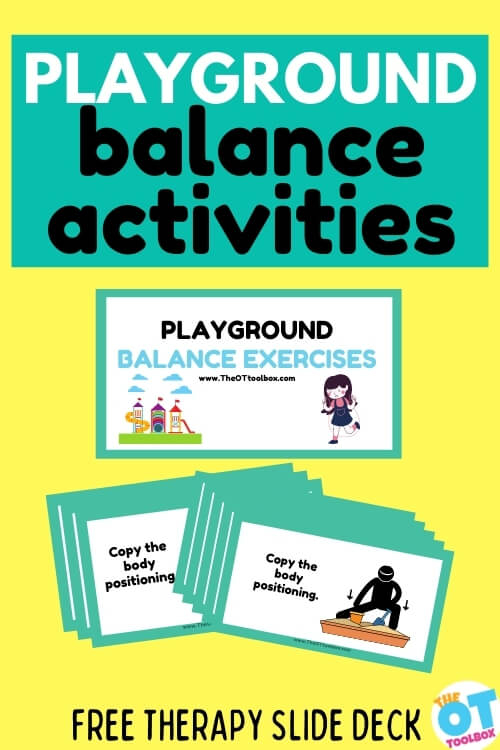
Today I have a fun activity for kids…playground themed balance activities! This virtual playground activity has various movement and coordination tasks that challenge kids to work on posture, position changes, coordination, core strength, and much more. While playing at the playground is the way to go to develop gross motor skills, sometimes getting outdoors is just not possible. That’s where this playground therapy slide deck comes in!
For more information on playground therapy, check out our previous post.
Add these playground themed gross motor coordination stretches, movements, and poses to your therapy obstacle courses, brain breaks, and transition activities.
Playground Balance Activities
When you think about playing at the playground, you think climbing, stooping, sliding, and balancing, right? There are so many ways that playing on playground equipment is such a powerful way to develop gross motor skills, balance, coordination, and overall strength.
But, sometimes it’s just not possible to get out to the playground. Things like weather can impact playground use. Other times, limitations in using public spaces impacts use of the playground in the school setting. And, for therapists running therapy sessions, sometimes you want to incorporate all of the fun of a playground setting in the therapy clinic!
When you access this playground balance activity slide deck, you get to pretend you are at the playground no matter what setting you are in. Then, by following the commands on each slide, children can get all of the benefits of stooping, crawling, balancing, and changing postures.
Each slide on this free slide deck asks kids to follow the visual cue. There are visuals for different playground task. Things like:
Balancing on one leg by monkey bars
Stooping to pick up a ball
Kicking a ball
Squatting to play in the sandbox
Climbing on playground equiptment
Throwing a ball
Climbing on a merry-go-round
Jumping rope
Reaching up for monkey bars.
There are many types of playground equipment that can challenge balance and coordination, including:
Balance beams: These narrow beams require children to maintain their balance as they walk across.
Wobble bridges: These bridges are designed to wobble and move as children walk across, challenging their balance and coordination.
Swinging steps: These are sets of steps that swing and move as children step on them, requiring them to maintain their balance and adjust their movements.
Climbing nets: Climbing nets require children to use their balance and coordination to navigate the ropes and reach the top.
Rope bridges: These bridges are made of ropes that sway and move as children cross, challenging their balance and coordination.
Stepping stones: These are sets of raised platforms that require children to step from one to the other, using their balance to keep from falling off.
Monkey bars: These require children to swing from bar to bar using their arms and legs, while also maintaining their balance.
Rocking platforms: Similar in nature to the sensory benefits of a platform swing, these playground surfaces are large, flat platforms that rock back and forth, challenging children to maintain their balance while standing or walking. If you can find a playground with an actual platform swing, that’s even better!
We used various images to challenge all of these movements!
Playground theme therapy
By going through the playground exercises, kids work on a variety of areas:
These skills impact daily functioning in kids! Why not use a playground theme to work on these skill areas?
When kids follow the directions on each slide, they are also gaining whole-body movements and heavy work input that can be calming as a regulation tool.
If creating a weekly therapy theme works for your plans, then this playground theme is one you’ll want to add to your line up of occupational therapy activities and PT activities. You can use these playground balance exercises in therapy sessions to incorporate a therapy theme.
Try using these visual playground strategies in between other tasks in a therapy session. Work on handwriting, scissor skills, and other functional tasks. And then come back to the balance activity. Then do another task and come back to the balance activity.
Kids can work through the slides and try to remember all of the movements.
Call out a piece of playground equipment and the child can recall the specific balance exercise. This is a great way to work on working memory and attention to detail.
Incorporate handwriting: Ask students to list out all of the playground equipment. Work on letter formation, legibility, spacing, and line use. Then they can go through the slides and do the balance exercises.
Add these activities to a sensory diet that helps kids regulate sensory input. Our outdoor sensory diet cards are the perfect combination to a playground theme!
Free Playground Balance Activities Slide Deck
Want to access this free therapy resource? It’s just one of the many free slides here on the website. All you need to do is enter your email address into the form below. You’ll receive a PDF containing a link to a Google slide deck. Copy it onto your drive and you are good to go! Start playing on the playground no matter where you are!
Why use this playground pretend activity?
We know the value that play has for children. When children play, they are developing skills. Occupational therapy and play go hand in hand because of the value and importance of play as a primary role for children.
Through pretend play, or copying the poses in this playground slide deck, kids can pretend to move through playground equipment, while challenging the motor skills, coordination, and balance needed to perform playground activities. The pretend play is a valuable tool to support preschoolers, school aged children, and all ages because it offers a no-risk opportunity to build motor plans. The ability to practice skills in a stress-free environment such as a home, classroom, or therapy clinic can support the young child to prepare them for maneuvering over, under, and around that playground equipment.
Have fun!
Colleen Beck, OTR/L has been an occupational therapist since 2000, working in school-based, hand therapy, outpatient peds, EI, and SNF. Colleen created The OT Toolbox to inspire therapists, teachers, and parents with easy and fun tools to help children thrive. Read her story about going from an OT making $3/hour (after paying for kids’ childcare) to a full-time OT resource creator for millions of readers. Want to collaborate? Send an email to contact@theottoolbox.com.
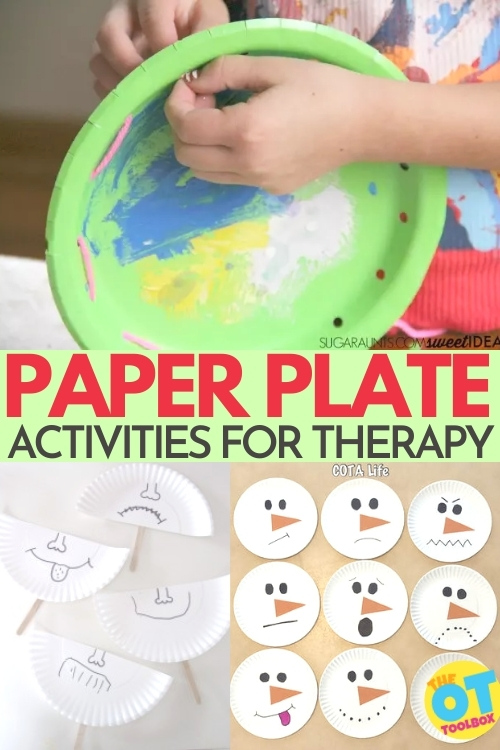
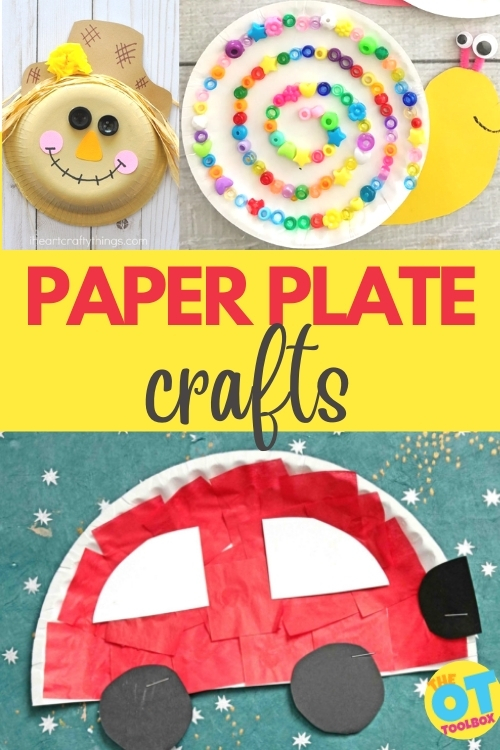
In occupational therapy, paper plate activities are one of those OT intervention tools that are low-cost and can be used in a multitude of ways to support many different developmental skills. From paper plate interactive activities, to scissor activities, to fine motor development, paper plate crafts and sensory activities can be used to promote many skill areas in occupational therapy interventions or at home and in the classroom.
Paper Plate Activities
I get really excited when I talk about the next subject – paper plate activities! Paper plate crafts and activities are so fun and often require very little materials with the end result being so wonderful for kids!
Paper plates can easily be used for arts and crafts, fine motor skills, gross motor skills, subject or topic learning, visual motor and perceptual skills, emotions and self-regulation as well as a myriad of games.
Paper plates can be a go-to when you need a quick activity in any setting or on those cold, rainy days when you need something to keep the kids busy. They are a great motivator for kids and can help build important skills that a child needs to continue to learn and to grow.
Paper plates are a thrifty tool for therapy to build those motor and perceptual skills while providing a fun activity that any child will want to engage in during sessions. The use of paper plates in the classroom can be for exploring emotions and self-regulation, creating after reading a book and lots of subject and topic learning fun. Their use in the home can include arts and crafts, instrument making, and games that result in some fantastic family entertainment.
Paper plates will give you the variety you need to help many kiddos on your caseload, in your classroom, or in your household. So, the next time you’re at the store, grab some plain or even festive paper plates and see what fun you can create with kids and you may find that you enjoy the fun too!
Paper Plate Crafts
In occupational therapy interventions, we often use crafts as a medium for developing skills (taking us back to our roots of our profession!) These paper plate crafts are great for developing fine motor skills, scissor skills, bilateral coordination, motor planning, executive functioning skills, and more.
Mini Beach– Work on hand strength, utensil use, and more to make a paper plate beach craft.
Paper Bowl Scarecrow Craft– Use this paper plate craft to work on fine motor skills like precision, dexterity, and mixed medium use. Add in emotional learning to make the scarecrow personalized. Kids can take this craft and add their own unique twists for a multi-sensory craft with open-ended results.
Paper Plate Snail Craft– Work on precision, in-hand manipulation, arch development, and other fine motor skills with this paper plate snail craft.
Paper Plate Cars This craft is great for addressing scissor skills.
Thanksgiving Feast Plate – Use this craft to work on functional tasks such as meal skills and utensil use, as well as hand strength.
Tin Foil Moon– This is a great craft for working on graded hand strength and bilateral coordination skills.
Paper Plate Activities for Emotions and Self- Regulation
The best thing about occupational therapy professionals is that they can use ANY material to work on a variety of skill areas. Use paper plates to address social emotional learning and self-regulation skills!
Paper Plate Frisbees– Address eye-hand coordination and gross motor arm coordination.
Paper Plate Skating– Use paper plates for indoor skating and vestibular input.
Paper Plate Learning Activities
Use these activities to work on functional tasks and executive functioning skills needed in daily occupations such as learning, math, using a phone, telling time, name writing, and more.
Now, what are you waiting for? Go grab some paper plates and pick an activity!!
Regina Parsons-Allen is a school-based certified occupational therapy assistant. She has a pediatrics practice area of emphasis from the NBCOT. She graduated from the OTA program at Caldwell Community College and Technical Institute in Hudson, North Carolina with an A.A.S degree in occupational therapy assistant. She has been practicing occupational therapy in the same school district for 20 years. She loves her children, husband, OT, working with children and teaching Sunday school. She is passionate about engaging, empowering, and enabling children to reach their maximum potential in ALL of their occupations as well assuring them that God loves them!
These leaf activities are fun ways to incorporate colorful fall leaves into occupational therapy sessions! Fall themed activities to use all week in done-for-you therapy planning. Use real leaves from outside, or materials on hand. Fall leaves make a great theme for weekly occupational therapy themes!
Leaf Activities
Leaf Handwriting– These Fall writing prompts include leaf writing prompts, among other fall themed prompts. Includes sentence prompts and single words, all with a Fall and leaf theme.
Pre-Writing Lines Activity- Work on Pre-writing activity with real leaves. Use real leaves to work on eye-hand coordination, visual motor skills, and pre-writing lines with hands on fine motor work.
Bilateral Coordination Activity: Use this Leaf Craft to address bilateral coordination skills. Use real leaves to make a craft that builds bilateral coordination, heavy work proprioceptive input, and scissor skills.
Leaf Craft for Older Kids: This Sewing Skills Leaf Craft is great for older kids that need to address fine motor skills. Use a needle and thread, wire, lacing cord to thread around leaf shapes. We used plastic canvas, but you could use cardboard, cereal boxes, or even laminated paper.
Leaf Auditory Processing Activities– You can use leaves found out in the lawn to work on so many auditory processing skills including auditory discrimination and more.
Leaf Therapy Activities– This free printable home program uses a Fall leaves theme for a leaf tic tac toe game. Kids can complete different leaf themed therapy activities and score tic tac toe!
Hand Strength– Leaf Ten Frames are a great way to build hand strength using leaves. Use a hole puncher with leaves to work on hand strength and hands-on math.
Leaf Sensory Play– This Nature Water Table is perfect for sensory exploration, but is a fun toddler Fall activity with very little prep. Use a bin, water table, or bowl to explore Fall’s colors and textures and challenge the senses.
Leaf Sensory Activity– This corn husk painting activity is sensory activity art with the corn husk leaves of Fall! Sensory Painting- Use leaves, corn husks, and grasses for sensory painting. Then, practice handwashing!
Leaves Heavy Work Activity– We used play dough and Fall leaves in this Fall Play Dough Press to add heavy work through the hands. Use natural materials and play dough to add heavy work for the hands. This is a great visual perception activity, too.
Leaf Eye-Hand Coordination Activity– Use leaves to make these Fall tree crafts. They are great to work on eye-hand coordination and problem solving with a sensory experience to make these fall trees.
Fall Scissor Skills Activity– This Fall leaves scissor activity uses leaves found right outside the home or therapy clinic! Use leaves to work on line awareness, bilateral coordination, and visual motor skills.
Bilateral Coordination Activity– Work on bilateral coordination skills with this Fall leaf garland craft.
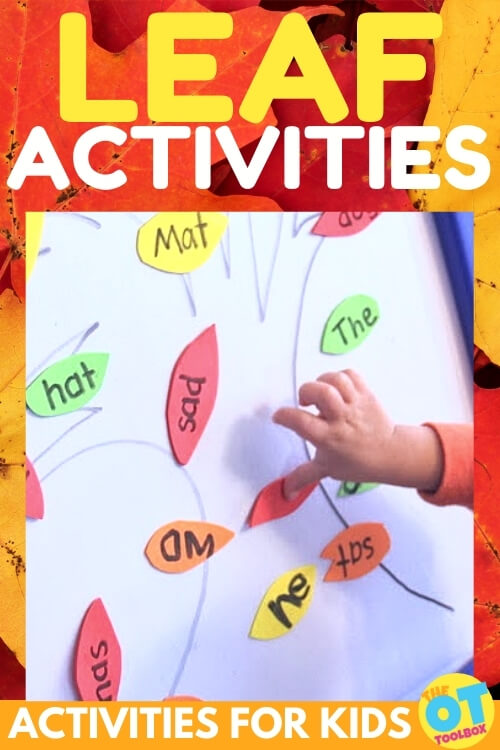
Shoulder Stability and Posture– Use a vertical surface to build strength, stability, posture, balance, coordination, and eye-hand coordination skills with this easel leaf activity. We used these easel leaves to work on sight words and trick words, but you could use this activity for any multi-sensory learning or math activity, too.
Fall Crafts
This Fall Art Collage from A Little Pinch of Perfect adds a sensory and fine motor component to Fall art for preschoolers!
These Autumn Leaf Hats from Mosswood Connections are a fun craft to work on scissor skills, bilateral coordination, and fine motor skills.
Address bilateral coordination, eye-hand coordination, finger isolation, and precision skills to make these Leaf Stamping Tee Shirts from Mommy Crusader.
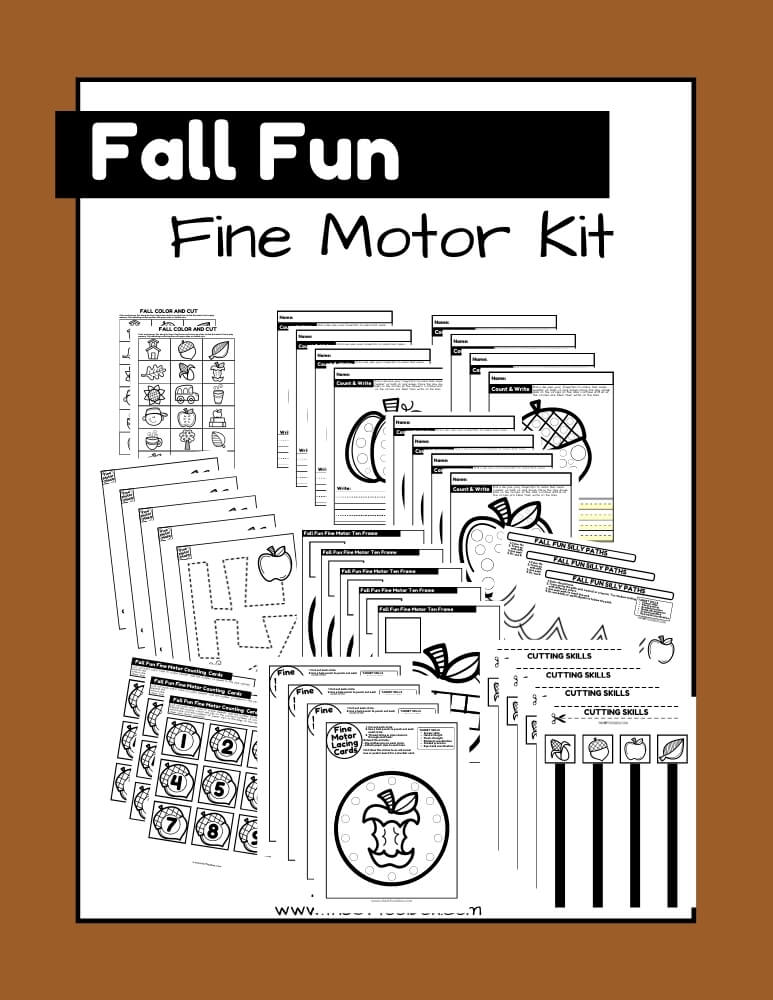
Printable 76 page, (no-prep) Fall themed fine motor activities and fine motor worksheets designed to build strong hands so kids can learn, hold & write with a pencil, and play.
This print-and-go Fall Fine Motor Kit includes no-prep fine motor activities to help kids develop functional grasp, dexterity, strength, and endurance. Use fun, Summer-themed, fine motor activities so you can help children develop strong fine motor skills in a digital world.
Includes Fall themed activities for hand strength, pinch and grip, dexterity, eye-hand coordination, bilateral coordination, endurance, finger isolation, handwriting, scissor skills, pre-writing skills, and much more.
Colleen Beck, OTR/L has been an occupational therapist since 2000, working in school-based, hand therapy, outpatient peds, EI, and SNF. Colleen created The OT Toolbox to inspire therapists, teachers, and parents with easy and fun tools to help children thrive. Read her story about going from an OT making $3/hour (after paying for kids’ childcare) to a full-time OT resource creator for millions of readers. Want to collaborate? Send an email to contact@theottoolbox.com.
Emotional intelligence in children is a skill that takes practice, example, and more practice to develop. For all of us, emotional intelligence can be an ongoing skill that impacts social emotional skills, relationships, and functioning in day to day tasks. Here we are
For those of us raising children and working with children it is clear that they need more than ‘book smarts’ to navigate the rather complex world that they are growing up in. For a long time the intelligence quotient or Emotional IQ was the only benchmark for measuring children’s potential and predicting how well they would achieve.
In more recent times people studying development and psychology realized that there were other skills necessary for achieving success in the world. One of these sets of skills has become known as Emotional Intelligence.
What is Emotional Intelligence?
Emotional intelligence is described as the ability to understand and manage your own emotions and to understand the emotions of those around you. The concept of emotional intelligence also known as emotional quotient or EQ developed in the 1990’s and has gained widespread acceptance in recent years.
Instrumental in the development of the theory and models of emotional intelligence is Daniel Goleman a psychologist and author. Goleman and emotional intelligence may be terms that you’ve heard connected, where he describes four main domains that make up Emotional Intelligence.
These domains are self-awareness, self-management, social awareness, and relationship management. What do each of these emotional intelligence domains mean?
Self-awareness – Self-awareness is having conscious knowledge of your own character and feelings. This results in being able to recognize your strengths and weaknesses. Self-awareness in kids plays a role in emotional control, mindset, habits, and executive functioning skills.
Self-management – Self-management is being able to control and manage your emotions in a healthy way. Self-management for kids involves self-regulation, mindset, habits, and self-control. Co-regulation plays a role in this aspect as well.
Social awareness – Social awareness is the ability to pick up the emotions of other people and to understand what they are feeling. This can be a challenge for children of all needs.
Relationship management – Relationship management is the ability to build relationships with others through positive interpersonal communication skills (Segal, 2020). Children develop relationship management skills through example by watching others in their lives, by interacting with peers and adults, and through play.
The domains are further broken down into twelve competencies and learnable skills that are relevant to the specific domain. (Matlock, 2017)
At the bottom of this post, you can find hands-on activities for children that develop each area of these emotional intelligence skills.
Emotional intelligence and emotional leadership
Emotional leadership is a term developed by Goleman and others, and refers to leadership in groups, impacted by one’s emotional intelligence. When you take a look at the domains of EI, you can see how they play into the functioning of a group.
Occupational therapists know a thing or two about group management and group leadership. At it’s infancy, occupational therapy played a major role in group therapy and mental health. While this domain of occupational therapy intervention is no longer primary area of intervention, there are still many OTs working in the mental health arena and especially in the group treatment intervention.
Emotional leadership is an important part of group occupational therapy sessions, as the participants are interacting with others in the group and developing specific individualized goal areas but also group goal areas. Groups in therapy have a leader, often the therapist, but sometimes the therapist presents as a facilitator but one that keeps the group on track as the group interacts with other participants.
In this way, participants can develop emotional leadership skills and skills that can be used outside of the group setting as a development of emotional intelligence and emotional learning.
It is clear that a lot of work has been done on developing an understanding of emotional intelligence and the components that make up this construct. But how important is emotional intelligence in the lives and development of our children?
Is Emotional Intelligence Important?
Cognitive behavioral therapy recognizes that feelings or emotions can influence thoughts. When emotions run high they can alter the way our brains work and this can have a negative effect on our cognitive abilities. Our feelings can influence the decisions we make and how we interact with other people. It makes sense that having a greater understanding of our emotions will help guide how we interact with others.
Improving our emotional intelligence makes it easier to resolve conflicts, manage our stress and interact appropriately with those around us (Segal, 2020). And children will definitely benefit from developing these skills. Children’s learning is influence by their emotional state so managing emotions in a positive way allows children to be receptive learners at school.
Emotional intelligence includes the ability to name emotions. The act of naming emotions tends to diffuse their intensity and lessens the negative impact they may have on our cognitive abilities. The psychologist Dan Siegel refers to this as ‘name it to tame it’ (Schwartz, 2015). The value of recognizing feelings and emotions is evident but how does emotional intelligence develop.
Development of Emotional Intelligence
When asked how emotional intelligence develops in a recent interview Daniel Goleman stated that “emotional intelligence begins to develop in the earliest years. All the small exchanges children have with their parents, teachers, and with each other carry emotional messages. These messages repeat over and over to form the core of a child’s emotional outlook and capabilities.” (Scholastic, viewed 2021)
As adults interacting with children it becomes important to ensure that we are able to recognise and manage our own emotions. Once we are able to do this we can become valuable role models for children and we can provide opportunities for them to see emotional intelligence in action. Recognizing and discussing emotions with children lays a foundation for their self-regulation.
The development of emotional intelligence begins in infancy, through interactions with caregivers, and continues as children are socialized across their school years alongside parents, peers, and teachers. Emotional intelligence is gained through both informal experiences (observations and conversations) and through and formal instruction (being taught emotion vocabulary, learning self-regulation strategies).
How emotional intelligence is taught depends on age, but unlike learning other skills such as math and science or English language arts, there is no age at which it is too early or too late to develop your emotional quotient. The parts of the brain needed to develop emotional intelligence are active from birth and will continue to develop throughout life.
As with many developmental tasks it seems that the first few years of life the brain is at its most receptive to learning key skills. And emotional intelligence is one of these important skills. (Brackett, Cipriano, 2015)
An essential part of developing emotional intelligence is being able to talk about feelings. This skill set is often termed emotional literacy and it is something that we are able to teach young children.
We can teach children to read and understand emotions and to respond appropriately to their own emotions and the emotions of others. Goleman explains that you can teach young children about the most basic emotions, such as happiness and anger and when they get older touch on more complicated feelings, such as jealousy, pride, and guilt (Scholastic, viewed 2021).
It is important to remember to include a range of emotions both positive and negative when talking about feelings.
Although it is not always comfortable talking about negative emotions it is important that children recognize and accept the wide range of emotions that they are likely to experience during their lives. We can incorporate opportunities to promote emotional intelligence in our everyday lives.
Emotional Intelligence Activities
What does promoting Emotional Intelligence look like in a therapy session?
As an occupational therapist (and a parent!) it can be overwhelming to think about the number of developmental needs that fall within your domain of influence. My therapy approach has always been aligned with building confidence and self-awareness in the children that I treat so in that way emotional intelligence has been fostered through incidental learning and interactions.
In more recent times I have used tools and resources that focus specifically on building skills that will enhance emotional intelligence – empathy, self- regulation, communication skills – depending on what the individual child needs.
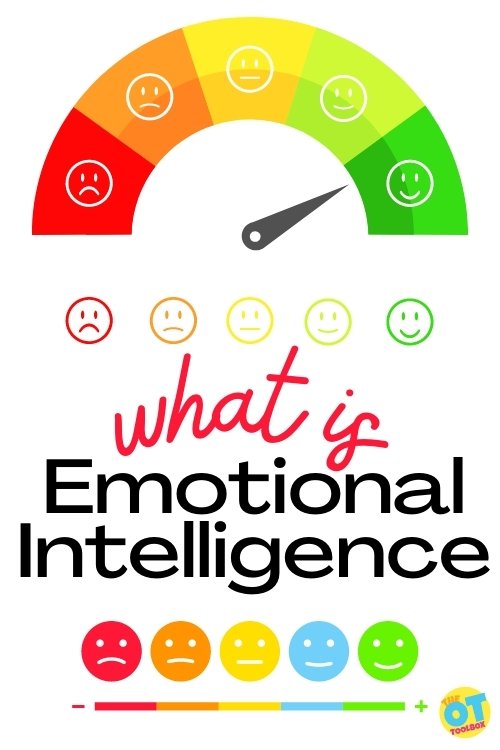
In my therapy session the first few minutes are spent getting a gauge of where the child is at and what their mood is like. By spending a few minutes engaging one on one with the child I am able to assess their level of attention, level of arousal and motivation at the time. I also have a mood meter on my wall and the kids love moving the arrow to the colour that corresponds to how they are feeling that day – low energy, just right energy, slightly high energy or off the chart energy levels.
With a reluctant child I might get the ball rolling by sharing how I am feeling that day and using the mood meter to plot my energy levels. I also have a feeling chart called ‘How does your jellybean feel today?” adapted from a book by Susan Jelleberg (Jellybean Jamboree).
This introduces the idea of naming emotions and of expanding our vocabulary related to emotions. In this way I feel I am working on the self-awareness component of emotional intelligence.
The next step is ensuring that the child is in a good space to learn and this means aiming for a calm-alert level of arousal. The Zones of Regulation offer a number of tools to help children reach that just right space. Some children need activities to lift their energy and some children need activities to lower their energy levels. I find deep pressure or proprioceptive activities work like a charm and I also use breathing activities frequently in my therapy sessions.
In this way we tackle some of the self-management aspects of emotional intelligence.
Social management is a tricky one for young children to pick you. Learning that the people around them do not always think and feel the same is them is an on-going process. There are some lovely activities to encourage empathy in children and to help them become aware of other people’s feelings.
Finally relationship management is encouraged through appropriate interactions between myself and the child during the therapy session. For some children this means learning how to deal with losing a game or competition, learning the skills of turn taking in conversation, or how to give and receive complements.
So within the confines of a short therapy session, while working on other specific OT goals, it is very possible to facilitate and encourage a child’s emotional intelligence. An understanding of emotional intelligence and is various elements means that it is also possible to encourage its growth in the classroom and in our homes.
And it is with this well-developed emotional intelligence that I believe our children will be able to successfully navigate the world they are growing up in and find meaning in their lives.
For further information on some of the component skills and activities related to emotional intelligence have a look at the following links. There are numerous resources on the OT Toolbox that deal with developing different components of emotional intelligence.
Self-Awareness Activities for Kids
To develop self-awareness it is important to be able to understand what you are feeling. Children can participate in some of the following activities in increase their awareness of emotions.
These self-awareness activities promote social emotional development through the awareness and process of practicing identification of emotions:
These emotions playdough mats can be used to teach kids emotion names and emotions they may have felt in the past. Kids can create the facial expression that matches the emotion name, building self-awareness of emotions.
Penguin emotions game– Use this penguin theme emotions activity to support emotional intelligence in kids.
Social emotional learning– This social emotional skills worksheet supports the development of emotional intelligence by allowing children to draw in facial expressions that match various emotional states.
Social emotional learning 2– This comprehensive resource on social emotional learning supports development of emotional intelligence by offering resources and information on how children develop emotional skills and ways to support that development.
Spring matching emotions slide deck game– This Spring themed emotions activity supports the development of emotional skills by offering practice and matching of facial expressions.
Emotions Check in– You can foster a sense of self awareness by allowing kids to identify their emotions. This can be a part of the routine in the classroom, home, or with each therapy session. A sightly different strategy would be identifying feelings with a feelings check in.
Self-Management Activities for Kids
To develop self-management skills you need to move beyond identifying emotions and figure out strategies that will help to regulate these emotions and subsequent behaviours.
This Zones of regulation toolbox offers a collection of activities and resources designed to promote self-regulation and self-management skills for kids.
Breath control is an important skill for kids to achieve in developing and refining self-management skills.
Deep breathing exercise cards are a powerful tool to use in building and developing self-management skills for kids. Print off these cards and use them over and over again to meet the interests and needs of a whole classroom or clinic of children.
Proprioception activities are heavy work movement activities that provide children with a sense of awareness when it comes to how their body moves through space or in a given situation.
Social Awareness Activities
To develop social awareness you will need to understand other people’s emotions effectively.These hands-on social awareness activities are strategies that children can use to develop emotional intelligence in social situations.
Empathy for others- Developing empathy requires practice and awareness. This Quick as cricket activity for Empathy helps children to understand the perspectives of others through a classic children’s book. The hands-on accompaniment activity gives kids a chance to practice their empathy skills and put them to work in social situations or through the social interaction with others.
Try these friendship activities to work on specific skills in developing social awareness, relationships skills, and interpersonal skills in children.
Through books, families can look at the pictures and come back to specific concepts again and again. And, adding hands-on, multi-sensory play experiences brings those concepts home. Be sure to check out our resource on calm down toys for more ideas.
This digital, E-BOOK is an amazing resource for anyone helping kids learn about acceptance, empathy, compassion, and friendship. In Exploring Books through Play, you’ll find therapist-approved resources, activities, crafts, projects, and play ideas based on 10 popular children’s books. Each book covered contains activities designed to develop fine motor skills, gross motor skills, sensory exploration, handwriting, and more. Help kids understand complex topics of social/emotional skills, empathy, compassion, and friendship through books and hands-on play.
To develop relationship management skills you will need to know how to develop and maintain good relationships with other people. These relationship management activities are strategies to work on emotional intelligence during interactions and relationships with others.
These Social skills interventions are therapy activities designed to promote relationships with others through hands-on activities that give kids practice to support relationship skills with others.
To work on emotional development requires many executive functioning skills, including impulse control, working memory, mindset, attention, planning, self-talk, inhibition, and more. To address these skills in kids, using a fun, hands-on approach to talking about these skills through lists, drawing, and goal-setting is key. You’ll find the exact tools to address these needs in the printable, Impulse Control Journal.
The Impulse Control Journal…a printable resource for helping kids strategize executive functioning skill development. When saying “calm down” just isn’t enough…
When a child is easily “triggered” and seems to melt down at any sign of loud noises or excitement…
When you need help or a starting point to teach kids self-regulation strategies…
When you are struggling to motivate or redirect a child without causing a meltdown…
When you’re struggling to help kids explore their emotions, develop self-regulation and coping skills, manage and reflect on their emotions, identify their emotions, and more as they grow…
Grab the Impulse Control Journal to build organizational strategies, planning, prioritization, habits, and mindset in kids.
Contributor to The OT Toolbox: Janet Potterton is an occupational therapist working predominantly in school-based settings and I love, love, love my job. I have two children (if you don’t count my husband!), two dogs, one cat, two guinea pigs and one fish. When I am not with my family or at work I try to spend time in nature. The beach is my happy place.
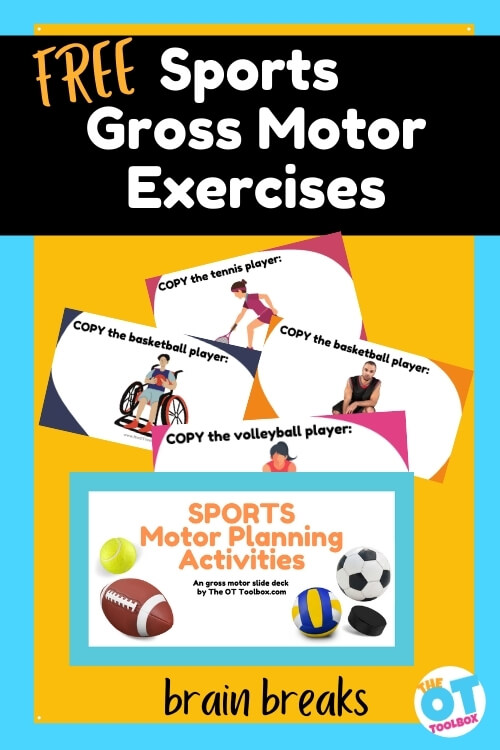
Working on gross motor skills, motor planning, or self-regulation? These sports gross motor exercises are perfect for kids that love all things sports! Use the football, baseball, hockey, and other sports activities to add athletic themed brain breaks and whole body movement.
Sports Gross Motor Exercises
These sports gross motor activities are a free therapy slide deck to use in virtual therapy sessions or in face-to-face sessions with an outline of activities.
There are so many ways you can use these sports movement activities to promote development of gross motor skills:
Copy the athlete to work on motor planning
Go through several slides to encourage sequencing and memory skills
Use the sports activities as heavy work in sports themed brain breaks
Copy the athletes on each slide to work on bilateral coordination, crossing midline, and segmenting the body.
Address posture, position changes, coordination, balance, and endurance
Use these sports exercises in a sports themed therapy session and encourage functional tasks like ball catching and throwing
Ask students to copy the words and work on handwriting with a sports related brain break between each word
How would you use these sports exercises in therapy?
Sports Exercises Slide Deck
This resource is a free Google slide deck that you can download and add to your Google drive. Open the slide deck in your Google classroom or right on your computer/device to encourage gross motor activities.
This is a great addition to other free slides that we’ve shared here on the website, and a fun weekly therapy theme when you’ve got a sports fan on your caseload.
To access this free therapy slide deck, enter your email address into the form below. You’ll receive an email containing a download. Save that PDF so you can use this again and again! Then click the link on the PDF and copy the exercises to your Google drive. Then get ready to lead therapy kiddos through motor planning and gross motor exercises that build skills!
Colleen Beck, OTR/L has been an occupational therapist since 2000, working in school-based, hand therapy, outpatient peds, EI, and SNF. Colleen created The OT Toolbox to inspire therapists, teachers, and parents with easy and fun tools to help children thrive. Read her story about going from an OT making $3/hour (after paying for kids’ childcare) to a full-time OT resource creator for millions of readers. Want to collaborate? Send an email to contact@theottoolbox.com.
Scooping and pouring. Toddlers pour, and dump toys (or cereal, a cup of water, a bin of diapers…) as soon as they discover that they can. It’s a developmentally appropriate skill that happens as mobility develops. When little ones pick up a bowl or cup and turn out the contents on the floor, it may be frustrating to a mama that’s just picked up all of the toys in the house for the third time, but it is such a great function that is the occupation of play.
These scooping and pouring activities can also help with questions of being ambidextrous or simply having a mixed dominance present.
Today, we’re exploring how scooping, pouring, and transferring materials benefits toddlers and preschoolers, in big ways. You can use this fun fine motor and visual perceptual motor activity with children at the toddler, preschooler, and school-aged levels to improve the precision of skills, practice math, and discover skills, all through scooping, pouring, and transferring small items.
Scooping Activities for Toddlers
There are so many benefits to scooping, pouring, and transferring materials. These scooping activities for toddlers are an easy way to help to build motor skills in toddlers and preschoolers, at just the right stage of development. It’s during the toddler years that children develop more motor control, stronger eye-hand coordination skills. They are starting to gain more control of their arms in a coordinated manner, especially when manipulating tools like scoops, spoons, cups, and bowls. It’s through play and the weight of sensory materials that the benefits of scooping, pouring, and transferring of materials builds motor control, more refined movements, and tolerance of a variety of sensory materials.
But, you don’t need to stop at the toddler years. Manipulating tools and sensory materials to pour, scoop, and transfer is great for preschoolers, too!
Benefits of Scooping, Pouring, and Transfering
Fine Motor Benefits of Scooping and Pouring– By manipulating sensory materials, cups, scoops, and bowls, toddlers and preschoolers refine and build motor experience in fine motor skills. Areas of development include: pincer grasp, precise wrist movements, arch development, wrist extension, and separation of the wrist from the elbow.
Development of these areas promotes a more distal motor control while using the proximal arm (shoulder and elbow) to stabilize and support the movements of the distal arm (wrist, hand, thumb, and fingers).
This separation of the proximal stability from the distal mobility is a needed motor development for coloring with the hand and fingers instead of using the whole arm to move the crayon.
You can show a child of this age how to dump the dry cereal from the scoop into a large tray. Kids in the Toddler range would benefit from scooping and pouring using larger scoops or small cups.
In order to scoop food when eating or scooping like in this play activity, kids need precision of very small wrist motions.
Moving the wrist from side to side is called radial deviation (moving the wrist towards the thumb side) and ulner deviation (moving the wrist towards the pinkie finger side).
In addition, slight wrist extension (the wrist slightly bent back in the direction of the back of the hand) is needed to accurately and efficiently scoop and pour.
Simply holding the scoop is an activity for grasp development by refining the arches of the hands and intrinsic muscles.
When kids have trouble with holding a spoon to eat, you can try targeting functional grasp patterns so the child can feed themselves. This is possible with spoon scooping activities that target specific grasp patterns. While this can be accomplished through play and scooping play materials, it’s a great transfer of skills to scooping foods.
Hand dominance with Scooping, pouring, transferring– Hand dominance is an area that they can be working on, depending on their age. It takes experience, or muscle memory through activities to refine and establish a dominant hand or side of the body. By scooping, pouring kids can hold the container, bin, cups, or bowls with their non-dominant hand while scooping and pouring using a spoon, cup, or bowl with their dominant hand.
As children establish a hand dominance, this refined motor coordination becomes easier to control. Toddlers can start with larger objects and larger scoops. Progressing to more fluid or smaller materials like smaller pellets, flour, or liquids can help preschoolers further refine coordination and manipulation of materials.
Self-Awareness Benefits of Scooping and Pouring– Pouring and dumping is discovery and exploration of gravity, weight, muscle control, cause and effect, and self-awareness. Not only are toddlers discover what they can do by pouring, they are learning about their environment while working on so many skills.
Motor Skills Benefits of Scooping and Pouring– Scooping small items is important in development and refinement of motions needed for managing utensils during self-feeding. This is an important independence step in the Toddler range. The establishment of visual input and motor output results in eye-hand coordination skills.
Also needed is the muscle memory or “experience” in pouring materials. You’ll see this in action when pouring a liquid or something that really “flows”. You don’t want to pick up a pitcher of milk and pour with speed. The liquid will splash out of the cup and onto the floor. It takes motor skill development and experience to know that pouring different materials, liquids, and containers take different amount of force, accuracy, and controlled movements.
Learning by Scooping and Pouring- Adding in learning objectives makes this play activity a bonus. You can add themed materials, counting cards, letter cards, or sensory bin cards. Add math and reading activities by counting or using sight words. Add sensory bin cards. the options are limitless when making pouring and scooping activities educational. One idea we love is using water beads like in our purple sensory bin.
Scoop and Pour for Bilateral Coordination Skills- When pouring and manipulating containers, a development of bilateral coordination skills occurs naturally. A weighted material is in one hand, while the non-dominant hand stabilizes. This transfers to bilateral coordination tasks such as holding the paper while coloring or writing, using two hands in clothing fasteners, cutting with scissors and holding the paper, and the very functional task of pouring materials in cooking!
Mindfulness Benefits of Scooping and Pouring- There is a mindfulness component to sensory play too. Have you ever tried using a zen garden to rake or manipulate sand using a sand tray? If so, then you know the power of mindfully manipulating sensory materials. This mindfulness activity works with children too. Many children find a scooping and pouring activity fun and relaxing. Use the scooping and pouring activity as a heavy work activity that adds calming proprioceptive input with visual attention. Help kids to focus on the sensory material as it slowly pours from the hands or from a cup to another cup.
If kids are moving too quickly or if they become overly excited with the sensory material, add slow movement, a calm environment, a set of “rules” before beginning the scooping and pouring activity, and a broom to clean up!
Sensory Benefits of Scooping and Pouring Activities– By experimenting with pouring, scooping, and transferring materials, children gain sensory benefits. This occurs through the proprioceptive input from manipulating the materials, as well as tactile sensory input.
I’ve found pouring and scooping activities to be very calming for children. They love to watch the beads as they fill the scoop and watch them fall into the bowl as they pour. Other children can become overly excited by the visual stimulation of scooping beads and soon the beads will scatter all over the table. You can eliminate mess by doing this activity in a large bin like an under the bed storage bin.
Scooping and Pouring Activities
This post contains affiliate links, but you can use items that you already have in your home. We used plastic scoops found in food like cocoa powder, coffee, or iced tea mixes. For the scooping, we used plastic beads that we already had, however, this activity will work with any small item such as rice, dry beans, field corn, pebbles, or sand. Use what you’ve got on hand to make this activity free!
Materials for this scooping and transferring activity include:
Small Plastic beads OR other materials to pour and scoop (Toddler-aged kids can use dry cereal or edible items. See below.)
This activity is very easy to set up.
Simple set out a bowl or tray of beads and scoops in different sizes.
Show your child how to scoop, transfer, and pour the beads into another bowl.
Play!
Precautions for Pouring and Scooping Activities with Toddlers
Just be sure to keep a close eye on your little one. Materials like dry cereal are great for starting out. However, if you try scooping activities with other materials like beads, toys, corn, dry beans, etc, it can be easy for them to forget they are scooping beads and not cereal!
As with any activity found on this blog, use your best judgement with your children. This activity, while beneficial developmentally, is especially a choking hazard for young children. Always stay within hands-reach of young children with a developmental activity like this one.
If you are concerned with your child placing beads in their mouth, simply don’t do this one and put it on hold for a few weeks of months.
Development of Scooping and Pouring skills in Toddlers
Note: Use edible materials for this activity with Toddlers. Dry baby cereal or broken up finger foods (like Cheerios) are great. For Toddlers, they will be focusing on simply scooping and pouring with accuracy.
Grasping pellets (bead-sized items) is a fine motor skill that typically develops around 11 months. Children at that age can grasp small pellets with their thumb and the pad of their pointer finger, with their arm positioned off the table. Holding a scoop with either the dominant or non-dominant hand typically develops around 13 months of age.
Toddlers will use an exaggerated elbow motion when they first begin an activity like this one and until those small wrist motions are developed.
At around 15 months, Toddlers will be able to scoop and pour from a small scooping tool, although as soon as 13 months, many children are able to complete this activity.
Managing a spoon during self-feeding happens around this age, as well, as children scoop food and bring it to their mouth. It is messy, but they are able to get food to their mouth.
Using a scoop to move beads or spoon to eat develops with more accuracy at 15-18 months.
At around 12-13 months, children will begin to develop unilaterality in hand dominance. They will begin to show a preferred hand that manipulates as the other, non-dominant hand assists in holding the bowl or tray.
(Other kids don’t define a hand dominance until later. You can use this activity in the preschool years to work on hand dominance!) You will want to use a wide tray or large bowl for improved accuracy in both scooping and pouring. Try using a spoon for scooping the cereal pellets, too.
Scooping and Pouring Preschool Activity
In the preschool years, sensory bin play with a concentration on scooping, pouring, and transferring is very powerful. It’s at the preschool age that motor skills become more refined. The dominant hand becomes stronger in preparation of pencil grasp and handwriting. The muscles of the hands are used in coloring and cutting activities.
Preschoolers can use scooping, pouring, and transferring activities for functional tasks and learning activities, but also development of motor skills needed for tool use like pencils, scissors, crayons, etc. Use crayons based on development, as we covered in a resource on the best crayons for young children.
Helping kids establish a hand dominance can be a pivotal moment for addressing fine motor skill development concerns. Kids can refine motor actions by using a preferred hand consistently.
Preschool aged children can refine their scooping and pouring activity using beads.
Hand preference in Preschool
While Toddlers begin to show a hand preference, a true hand dominance doesn’t typically develop until 2 to 3 1/2 years. That is such a huge age range! That is because while a toddler can show a hand preference, hand usage is experimented with during different activities throughout the Toddler and Preschool years.
There is typically variability in hand preference as toddlers and young preschoolers poke, pick up, throw, color, and play. Another consideration is that often times, kids of this age are influenced in which hand they choose by position of toy, location of the adult or playmate, method materials are presented, and sitting position of the child. True hand dominance may not be completely integrated in the child until around 8 or 9 years of age.
Knowing all of this, use this activity to practice and play while working on a hand preference. If your child shows a preferred hand, set up the activity to work on scooping with the typically used hand. If your kiddo uses their right hand most of they time in natural situations (You will want to watch how they do things on a normal day and in a variety of activities.), then set the bowl of beads on the left side of the child and the scoop on the right side.
When using pouring and scooping activities in preschool, try these strategies:
Show them how to scoop from left to right. A set up like this one also encourages the left-to-right motion of reading and writing.
Use a variety of materials: dry beans, rice, beads, dry cereal, flour, sand, shaving cream, water, etc.
Use a variety of scoops: spoons, coops, small bowls, cups, pitchers, mixing cups, measuring cups, etc.
Kindergarten Scooping, Pouring, and Transferring Activities
For children in kindergarten and older, scooping, pouring, and transferring activities are powerful as well! You can use this pouring and scooping activity in math, learning, and sensory play-based learning.
Work on measurement
Work on reading, spelling, and letter awareness. This sight word scooping activity is a great multisensory reading activity for kindergarten.
Use scooping in math to add or subtract scoops
Count the number of scoops it takes to fill a container
Use letter or word cards in reading or handwriting activities
Work on prediction- Ask them to predict how many scoops it will take to fill different sized cups and bowls. They can count the number of scoops and see if their prediction was correct.
Incorporate addition and subtraction as they move scoops of beads from one container to another.
Address motor skill development- Scooping works on important skills like bilateral hand coordination, including using the non-dominant hand to assist as they would in holding the paper in writing, coloring, and cutting with scissors.
Pouring, Scooping and Transferring Activities
Try these various pouring scooping and transferring activities with each age range to develop specific skill areas depending on the individual child:
Use a variety of materials for scooping besides beads to work on fine motor control and dexterity. Other ideas include wet sand (heavier and great for coordination and strength) and a light material like foam pillow filler (for more coordination and dexterity).
Water Sensory Bin Ideas– Use a bin and water, along with some scoops and other materials to work on motor skills, coordination, and refined movements. Scooping water takes precision and control, but it’s a great functional task for children.
Scoop Nuts– Use seeds or nuts to scoop and work on scooping different sizes, different weights. This is a great activity for graded precision, sorting, and eye-hand coordination.
Scoop Ice– This simple scooping and pouring activity uses just ice, water, and scoops. Children can work on eye-hand coordination skills to scoop up ice within a bin of water to work on controlled motor skills, utensil use, visual tracking, and more.
Scoop, pour, and transfer dry corn– Grab some un-popped popcorn and some bins or spoons to transfer materials from one container to another. This simple scooping and pouring activity is easy to set up and works for all ages.
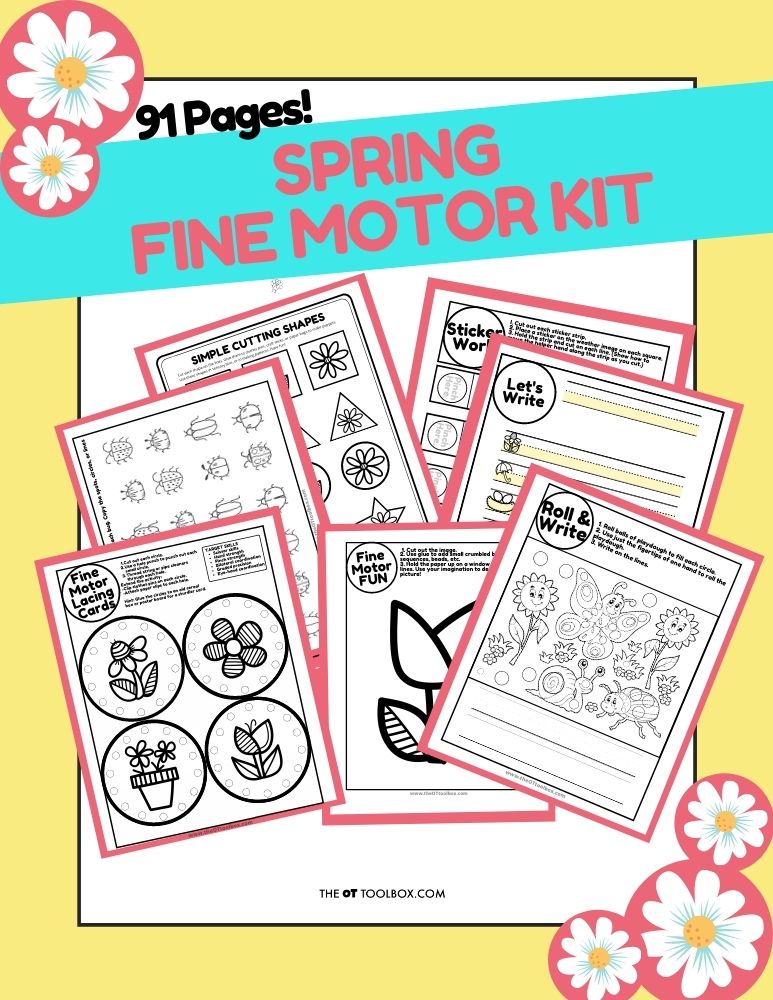
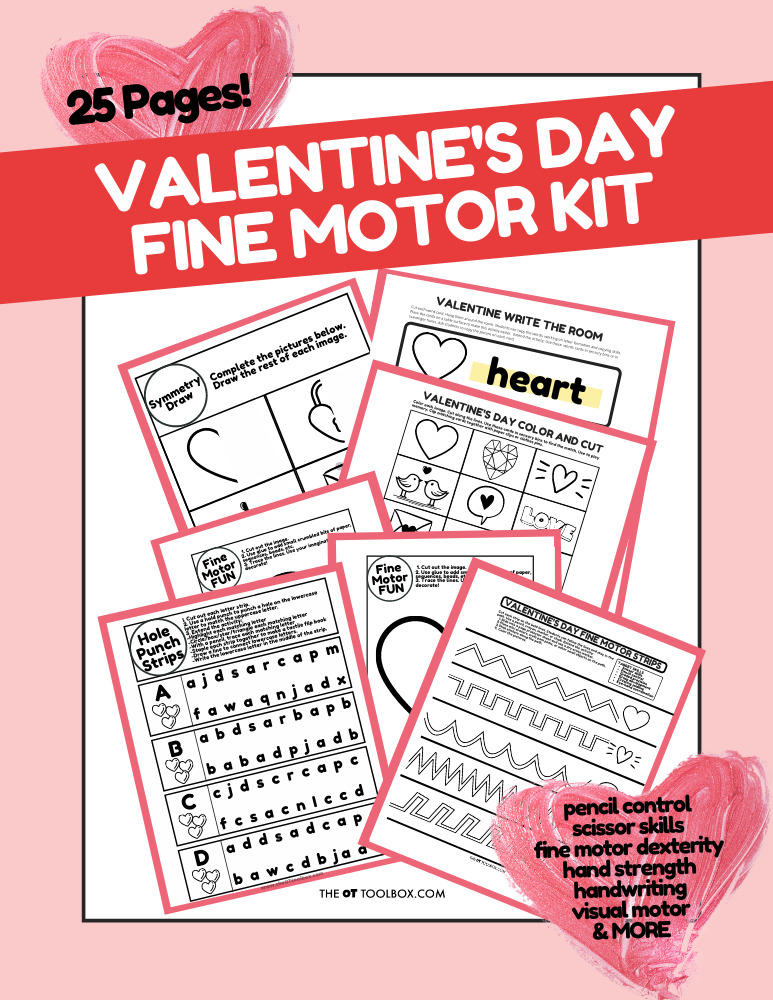
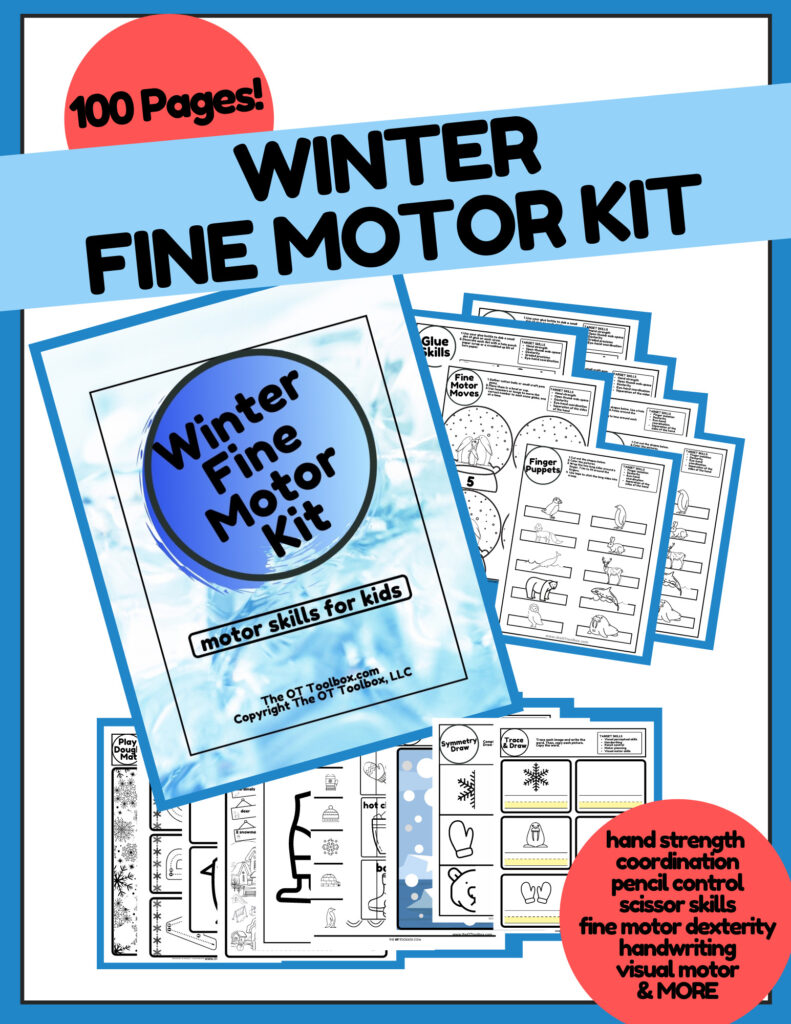
Working on fine motor skills, visual perception, visual motor skills, sensory tolerance, handwriting, or scissor skills? Our Fine Motor Kits cover all of these areas and more.
Check out the seasonal Fine Motor Kits that kids love:
Colleen Beck, OTR/L has been an occupational therapist since 2000, working in school-based, hand therapy, outpatient peds, EI, and SNF. Colleen created The OT Toolbox to inspire therapists, teachers, and parents with easy and fun tools to help children thrive. Read her story about going from an OT making $3/hour (after paying for kids’ childcare) to a full-time OT resource creator for millions of readers. Want to collaborate? Send an email to contact@theottoolbox.com.
Everyday, social skills are a part of every interaction we have with other people. Today, I have a social skills checklist that can be used to identify areas of difficulty and areas of successes related to social interactions, social emotional development, and a way to identify specific areas that impact in social emotional learning. This list of social skills for children can be helpful in breaking down social learning and social skill development.
Social Skills Checklist
Before we get to the social skills checklist, let’s break down social skills into the components.
Included in this checklist are the individual components of social emotional skill areas, or social abilities:
Conversational Skills
Interpersonal Skills
Emotional Skills
Social Play
Emotional Development
Emotional Regulation
Peer Interactions
Self-Awareness Skills
Self-Confidence
You’ll see each of these social and emotional skills areas listed below with a checklist of each area related to social emotional learning. Use this list of social skills to support social emotional development in children.
How to Use a Social Skills Checklist
When we can identify specific aspects of our behavior and actions related to what’s happening around us, we can identify specific thoughts feelings, reactions and responses that impact our interaction in the environment and with others.
Having an awareness of each aspect of social and behavioral responses and internal thinking is a helpful place to start when it comes to promoting social emotional development. Then, we can know where to start by identifying specific areas of need in kids.
By helping individuals identify aspects of social skills, observing social emotional skills in others, identifying expected and unexpected behaviors, we can help the kids we serve to notice and the impact they have on others’ thoughts, emotions, reactions and responses.
By having individuals observe their own behavior, they can recognize how it impacts others, how it impacts participation in functional tasks in various environments, and they can make the connection between emotions, regulation, social skills, and functioning.
A Note About this Social Skills List
Remember that all children develop differently, and when it comes to social emotional learning, there is a close compont of executive functioning. Executive functioning skills down’t fully develop until adulthood. And so, social skill development can occur through adulthood as well.
This list of social skills is meant to be comprehensive. Not all aspects of social skills will be achieved and steps can be skipped or developed in various orders based on experiences. In general, the lists are written in a developmental order, but the segments of social skills (Conversational skills, Interpersonal skills, Emotional Skills, Social Play, Emotional Regulation, Peer Interactions, Self-Awareness skill, and Self-Confidence) can all be developing and occurring at once. These social abilities are all happening at once and are fluid in development.
Use this social skills checklist to identify areas of development, including self and social awareness in one-on-one tasks, peer tasks to function, learn, and play.
conversational Skills
Conversational skills occur throughout almost all functional tasks and environments. From the home, to school, to the community, conversational skills are needed for social interactions all day long.
Participates in conversation (verbal and/or non-verbal)
Responds to yes/no questions
Answers questions
Initiate conversation when it is appropriate to do so
Initiates conversation around specific topic
Adds to a conversation around a specific topic
Asks questions around a specific topic
Responds to questions around a specific topic without getting off track
Makes a variety of comments, related to the topic, without getting off track
Ends conversations appropriately
Waits to interject in a conversation
Maintains appropriate proximity to conversation partner
Recognizes the facial expressions of others
Recognizes the nonverbal cues, or “body language” of others
Requests assistance from others when needed
Understands the jokes of others
Maintains eye contact during conversations (able or unable)
Maintains an appropriate distance when interacting with peers
Speaks at an appropriate volume in conversations
Speaks at an appropriate volume on virtual/digital conversations online or via a device
Considers the perspective of others
Notices when others may be struggling
Offers assistance to others
Verbally expresses their feelings
Responds to greetings expressed by others
Joins a conversation with two or more people without interrupting
Maintains back and forth conversation
Initiates greetings to others
Provides compliments to others
Introduces self to others
Politely asks others to move out of their way
Acknowledges the Compliments Directed at Him/Her by Others
Allows Peers to Join Him/Her in Activities
Responds to the Invitations of Peers to Join Them in Activities
Allows Others to Assist Him/Her With Tasks
Responds to Questions Directed at Him/Her by Others
Experiences Positive Peer Interactions
Compromises During Disagreements With Others
Responds Slowly in Conversations
Changes the Topic of Conversation to Fit Self-Interests
Misinterprets the Intentions of Others
Makes Inappropriate Comments
Engages in Solitary Interests and Hobbies
Ends Conversations Abruptly
Fails to Read Cues to Terminate Conversations
Exhibits Fear or Anxiety
Regarding Social Interactions
Experiences Negative Peer Interactions
Engages in Socially Inappropriate Behaviors
Exhibits Poor Timing With His/Her Social Initiations
Is Manipulated by Peers Engages in Solitary Activities in the Presence of Peers
Conversational skills online in email or text messages
Conversational skills during times of stress such as tests, games, etc.
Interpersonal skills
Part of interpersonal skills is the self awareness and social awareness involved in peer interactions. Interpersonal skills refers to interacting with others in social situations, classrooms, homes, and the community. Also involved is interpersonal skills on a digital manner, which is a new ballgame for many adults who are raising children in this digital era.
Types of Interpersonal Skills
Interpersonal skills can be broken into several areas:
Listening
Collaboration
Empathy
Problem solving
Conflict resolution
Constructive feedback
Diplomacy
Interpersonal skills enable us to interact with others. These social skill checklist includes aspects of interpersonal skills.
Introduces him/herself to someone new
Introduces people to each other
Makes eye contact (if able/willing)
Uses manners
Problem Solving related to others in a specific situation
Referring back to previous situations where they needed to use problem solving (working memory)
Seeks help from peers in a one-on-one setting
Seeks help from peers in a group setting
Seeks help from adult
Accepts consequences
Plays a game successfully
Wins a game with appropriate behavior
Wins a game with appropriate conversation to others
Loses a game with appropriate behavior
Loses a game with appropriate conversation to others
Responds to constructive criticism
Shows self-confidence in group situations
Shows self-confidence in one-on-one situations
Shares with others (when appropriate)
Shows ability to compromise
Shows ability to cooperate on a problem
Shows ability to cooperate on a disagreement
Listens to others
Takes turns
Uses personal space
Respects the personal space of others
Follows directions in a given situation
Works with others to follow directions as a group (walking on one side of the hallway)
Identifies/defines problems
Generates solutions to problems
Carries out solutions by negotiating or compromising
Understands impact his/her behavior has on peers
Interprets body language in others
Interprets or recognizes body language in self
Clearly communicates
Offers constructive feedback to others in a one-on-one basis
Offers constructive feedback to others in a group setting
Responds to constructive feedback from others in a one-on-one setting
Responds to constructive feedback from others in a group setting
Offers input to problem solve
Accepts input from others to problem solve
Uses given information to problem solve with flexibility
Emotions and Social Skills
Understanding emotions in general
Identifies emotions in others
Identifies emotions in self
Able to identify a potential reason for emotional displays in others
Able to identify a potential reason for emotional displays in self
Justifies emotions once identified
Able to regulate emotions with appropriate responses
Displays empathy towards others
Displays a variety of emotions
Identifies likes and dislikes
Demonstrates affection and empathy toward peers
Refrains from aggressive behaviors toward peers
Refrains from aggressive behaviors or self-talk toward self
Identify emotional state during a conversation or situation
Uses different tones of voice to convey messages
Compliments others
Appropriately receives compliments
Asks for a favor appropriately
Apologizes independently
Says thank you
Gives compliments to peers
Gives compliments to adults
Flexibility
Accepts making mistakes without becoming upset/angry
Accepts consequences of his/her behavior
Accepts unexpected changes
Continues to try when something is difficult
Ignores others or situations when it is desirable to do so
Conversational Skills
Problem Solving
Compliments
Flexibility
SOCIAL PLAY AND EMOTIONAL DEVELOPMENT
Beginning Play Behaviors
Maintain proximity to peers within 1 foot
Observe peers in play vicinity within 3 feet
Parallel play near peers using the same or similar materials (Playing alongside a peer with own toys or games)
Imitate peer (physical or verbal)
Take turns during simple games (e.g., rolling ball back and forth). We have a great resource on teaching turn taking skills.
Intermediate Play Behaviors
Play associatively with other children
Shares toys during play
Changes play with flexibility
Respond to interactions from peers such as accepting a toy from a peer;
Answers questions during play
Return and initiate greetings with peers (e.g., wave or say “hello”).
Know acceptable ways of joining in an activity with others (e.g., offering a toy to a peer or observe play and ask to join in).
Invite known peers to play
Take turns during structured games/activities (social games or board games)
Ask peers for toys, food, and materials
Advanced Play Behavior
Play cooperatively with peers
Game play with rule following
Game play with problem solving when rules are broken
Make comments about what he/she is playing to peers
Organize play by suggesting play plan
Plays the role of a leader during peer play
Follow another peers play ideas
Plays the role of a follower during peer play
Turn taking during structured activities
Take turns during unstructured activities
Invites unknown peers to play (age-appropriate unknown peers in settings such as playgrounds)
Give up toys, food and materials to peers
Offer toys, food, and materials to peers
EMOTIONAL REGULATION
Emotional regulation is broken down into several areas when it comes to different social skills. this includes internal self-regulation as well as self-regulation during peer interactions, group interactions, problem solving, and flexibility of emotional regulation. A component to these concepts is working memory.
Accept consequences of his/her behaviors without becoming upset/angry
Ignore others or situations when it is desirable to do so
Accept unexpected changes
Accept changes in routine
Continue to try when something is difficult
Problem Solving in social situations
Claim and defend possessions.
Identify/define problems.
Generate solutions using working memory or with innovative thought generation
Carry out solutions by negotiating or compromising
Seek assistance from adults
Seek assistance from peers
Give assistance to peers
Identify when assistance is needed for self
Identify when assistance is needed by others
Self-Regulation and Group Interactions
Participate in group interactions
Respond/participate when one other child is present.
Respond/participate when more than one other child is present.
Respond/participate in a group of children WITHOUT adult supervision
Respond/participate in a group of children WITH adult supervision
Use appropriate attention seeking behaviors (e.g., calling name, tapping
shoulder).
Follows the rules of a group
Remain with group during group tasks
Follow the group routine
Follow directions during group settings
Make transition to next activity when directed
Accept interruptions/unexpected change
Take turns with others in group settings
Work collectively as a group to solve a problem
Interact with group members
Refrain from breaking off into smaller groups
Refrain from gossip or turning other group members against one another
Peer Interactions
Invites peers to join them in activities
Joins peers in activities
Takes turns during games or activities
Takes turns in situations such as waiting in line, using the bathroom etc.
Maintains personal hygiene
Interacts with peers during unstructured activities
Interacts with peers during structured activities
Asks questions about others
Asks questions to to continue a conversation
Engages in one-on-one interactions with peers
Interacts in groups of peers
Maintains the “give-and-take” of conversations
Expresses sympathy for others
Expresses empathy for others in conversation
Expresses empathy for others in action
Acknowledges the interests of others
Limits negative conversations about others
Responds to negative conversations about others
Self-Awareness Skills
Self-awareness is an important part of social emotional learning and development of social skills. Self-awareness refers to the ability to understand one’s own emotions, thoughts, and values. This ability to be self-aware influences how an individual responds to situations. Self-awareness also impacts behaviors.
Self-awareness involves body awareness, confidence, an awareness of interests, strengths, and weaknesses in given tasks.
Self-awareness skills include:
Identifying personal strengths
Identifying personal weaknesses
Identifying one’s emotions
Identifying and developing interests, likes, and dislikes
Demonstrating an awareness of feelings and values
Having self-confidence
Understanding the concept of over-confidence
Being able to differentiate between abilities and inabilities
Examining prejudices and biases
Experiencing self-efficacy
Having a growth mindset
Social Confidence
It’s through the development of self-awareness skills that social confidence forms. When we are able to be aware of ourselves and build in the areas listed above, confidences in our abilities to react, respond, and use regulation strategies follow. This is one aspect of social confidence.
Another aspect of social confidence refers to develop self-esteem and an ability to interact with others in a variety of situations. This can happen in established friendships, new friendships, established and known settings, and new or novel settings.
Social confidence refers to these aspects of social skills:
Having confidence in our emotional response
Being yourself
Participating in new settings
Participating in new activities
Reaching out to others who the child doesn’t know
Participating in activities even through there is a chance of failure
Trying again after failure
Learning new things
Being supportive to others
Not worrying about what others think of one’s actions
Not worrying about what others may think of one’s behaviors
How to promote Social Skills in Kids
Take a look at the lists of specific social skills in this checklist. It is hard to think of any daily task that doesn’t require some aspect of social skill development. From interacting with family, the community, peers, there are tasks occurring all day long that require social skills.
For more ways to pinpoint areas of development in kids, try the Impulse Control Journal. This comprehensive resource outlines daily interactions and allows children to identify how they’ve behaved or responded to situations.
Children can identify aspects of social situations that have worked well, and aspects that they can improve upon.
The Impulse Control Journal has activities and tools to support and develop mindset, habits, goals, interactions, working memory, and much more.
The Impulse Control Journal…a printable resource for helping kids strategize executive functioning skill development. When saying “calm down” just isn’t enough…
When a child is easily “triggered” and seems to melt down at any sign of loud noises or excitement…
When you need help or a starting point to teach kids self-regulation strategies…
When you are struggling to motivate or redirect a child without causing a meltdown…
When you’re struggling to help kids explore their emotions, develop self-regulation and coping skills, manage and reflect on their emotions, identify their emotions, and more as they grow…
Grab the Impulse Control Journal to build organizational strategies, planning, prioritization, habits, and mindset in kids.
Another fantastic resource that can help develop social and emotional skills is the activity book, Exploring Books Through Play.
This digital E-BOOK is an amazing resource for anyone helping kids learn about acceptance, empathy, compassion, and friendship. In Exploring Books through Play, you’ll find therapist-approved resources, activities, crafts, projects, and play ideas based on 10 popular children’s books. Each book covered contains activities designed to develop fine motor skills, gross motor skills, sensory exploration, handwriting, and more. Help kids understand complex topics of social/emotional skills, empathy, compassion, and friendship through books and hands-on play.
The book Exploring Books Through Play, has 50 different activities based on popular children’s books. Each book is used for 5 different activities that cover a variety of areas: sensory play, crafts, gross motor activities, fine motor activities, handwriting, scissor skills, and so much more.
This book is designed to address emotional regulation and connecting with kids.
WHAT’S INSIDE EXPLORING BOOKS THROUGH PLAY?
We have handpicked these easy and hands-on activities to help kids develop essential social emotional learning skills.
As classroom curriculum becomes more focused on academics, social and emotional development can get lost in the shuffle. This book focuses on abstract concepts of friendship, acceptance and empathy. By using children’s books that foster understanding of these concepts through pictures and stories, we can help children understand and see these emotions in action. What if you could use books and interactive activities to teach friendship? What if you could read a book that centers on accepting differences and create or make an activity or craft that helps children see acceptance in action. What if you could explore emotions through story and interactive play? In this book, you will find books that cover abstract concepts and use play to build social and developmental skills. The 10 books covered include:
A Sick Day for Amos McGee
Boy + Bot
Little Blue and Little Yellow
Red: A Crayon’s Story
Chrysanthemum
The Day the Crayons Quit
Leonardo the Terrible Monster
The Adventures of Beekle: The Unimaginary Friend
Whoever You Are and Penguin and Pinecone
Want to help kids learn more about complex concepts such emotions, empathy, compassion, and differences?
Exploring Books Through Play uses children’s literature as a theme to engage in fun, hands-on activities that help children and adults delve deeper into the characters and lessons, bringing the stories to life and falling further in love with literature. Read a story and then bring the characters to life while learning and building skills. Each story offers unique activities designed around central themes of friendship, empathy, and compassion.
Each chapter includes 5 activities for each of the 10 children’s books. The activities are perfect for children ages 3-8, can be used in small groups or as a whole class, and are easily adapted to a home or classroom setting.
These social skills checklists are to be viewed as educational and informative resources. If you suspect a child or individual of any age has trouble or regressions in any of the areas listed, be sure to seek out individualized support via a pediatrician, therapist, or other professional.
In addition, for the toddler-aged children, changes, regressions, or lack of development as typically expected when it comes to social and emotional skill achievement can be a toddler behavior red flag that should be explored in greater detail.
Colleen Beck, OTR/L has been an occupational therapist since 2000, working in school-based, hand therapy, outpatient peds, EI, and SNF. Colleen created The OT Toolbox to inspire therapists, teachers, and parents with easy and fun tools to help children thrive. Read her story about going from an OT making $3/hour (after paying for kids’ childcare) to a full-time OT resource creator for millions of readers. Want to collaborate? Send an email to contact@theottoolbox.com.