Outdoor Sensory Activities

outdoor sensory activities

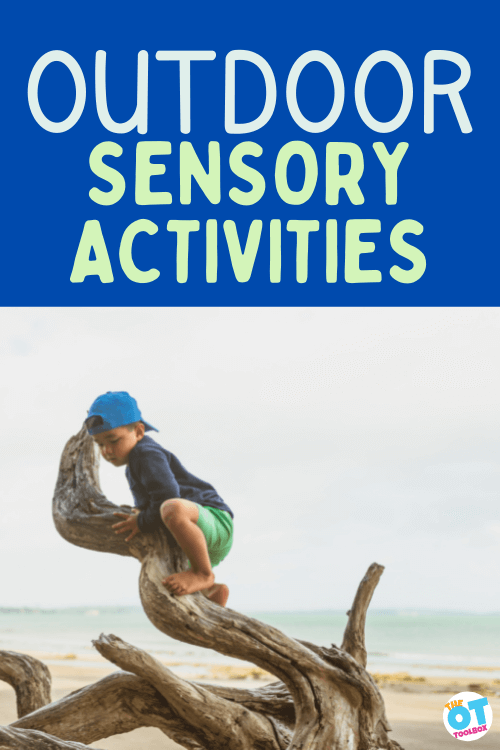
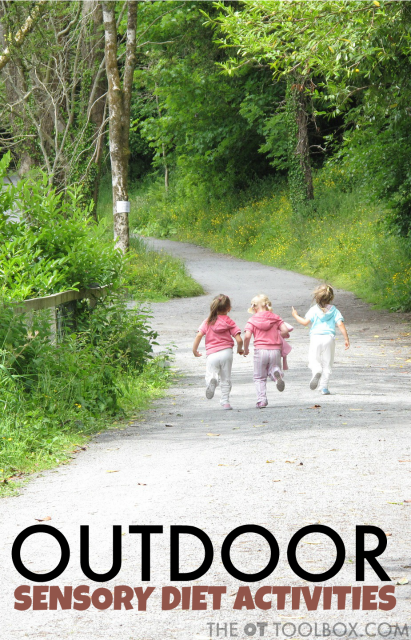
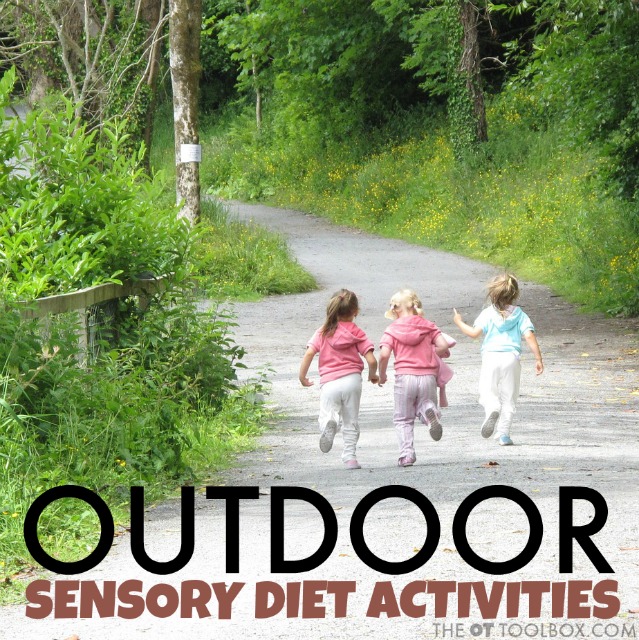
Have you ever considered what a wealth of sensory input there is in outdoor sensory play? Here, you’ll find outdoor sensory activities that would make a great addition to outdoor occupational therapy sessions, or just sensory input through playing outdoors! Consider taking the benefits of sensory play and moving them to an environment with differences in sounds, temperatures, textures, surfaces. You end up with a functional space that invites motor and sensory development!

Previously, we’ve shared how to go on a sensory nature walk, but this resource covers much more in the way of outdoor occupational therapy activities to support needs.

Outdoor sensory activities to support sensory processing

Outdoor Sensory Activities

The outdoor sensory ideas listed below include sensory activities that can naturally be found outdoors!


It’s a fact that kids are spending less time playing outdoors. From after-school schedules to two working parents, to unsafe conditions, to increased digital screen time, to less outdoor recess time…kids just get less natural play in the outdoors.

Research on outdoor sensory play tells us that playing outdoors supports development through areas such as: developmental and primary tasks that children must achieve can be effectively improved through outdoor play. These include: exploring, risk-taking, fine and gross motor development, absorption of basic knowledge, social skills, self-confidence, attention, language skills, among others.

In fact, one study found a sensory diet in outdoor play along with sensory integration therapy resulted in better functional behavior of kids with ADHD (Sahoo & Senapati). 

Some therapists have connected the dots between less outdoor play and increased sensory struggles and attention difficulties in learning. Knowing this, it can be powerful to have a list of outdoor sensory activities that can be recommended as therapy home programing and family activities that meet underlying needs.

A note about using outdoor activities in sensory diets (and creating a sensory lifestyle…)

Sensory activities can be prescribed according to need along with environment in order to maximize sensory input within a child’s day such at home, within the community, during transitions, or within the school day. Outdoors are part of our everyday. Whether it’s walking to the car or school bus, travelling down a sidewalk, or spending time outside in the yard, there are many opportunities to support sensory and emotional regulation needs with outdoor play.

Using authentic sensory input within the child’s environment plays into the whole child that we must understand when focusing on any goal toward improved functional independence.

We’ve been talking a lot about sensory diets here on The OT Toolbox recently. Understanding what a sensory diet is and how it can be used within a sensory lifestyle is a big part of integrating sensory activities and sensory play into needed sensory input that a child needs to self-regulation, cope with his or her environment, and to attend or focus despite sensory overload or distractions.

You’ll find more outdoor sensory diet activities like these outdoor sensory diet activities for the backyard coming to the site very soon!

For specifics on how to get started with a sensory diet, and how to use these outdoor sensory processing strategies in a sensory plan, start here with this resource on how to create a sensory diet.

Outdoor sensory activities can be specific to sensory system like proprioception activities, auditory processing, vestibular sensory diet activities, and the rest of the sensory systems.

Use these outdoor sensory activities to help kids with sensory processing needs

Outdoor occupational therapy

When therapists develop a specific and highly individualized sensory diet, it’s not just throwing together a day filled with sensory input. It’s activities based on sensory need and strategizing. Each of the nature-based sensory activities above should meet specific needs of the child.

outdoor occupational therapy activities and reasoning

Imagine a world with more creative outdoor play that involves a variety of enriching sensory input. The proprioceptive input from running and jumping into puddles can calm the child who is typically overactive.

Outdoor occupational therapy supports the development of skills in a functional and natural space. When OTs venture outdoors for therapy practice, the world opens up in the way of sensory input, motor experiences, emotional regulation, and skill-building.

Occupational therapists practice outdoors for many reasons:

  • Develop confidence
  • Social skill building
  • Independence with clothing
  • Attention
  • Focus
  • Body awareness
  • Problem solving
  • Executive functioning skills
  • Safety skills
  • Motor planning
  • Sensory processing
  • Connection with others

Through outdoor occupational therapy, individuals experience all that nature has to offer while developing skills, just like one would in traditional occupational therapy services.

Below, you’ll find specifically sensory occupational therapy activities that can occur outdoors.

Sensory Activities for Outdoors

Nature, playing outdoors, and experiencing everything the outdoors has to offer supports all of the sensory systems. Let’s break this concept down:

  1. Visual System- Outside, we can see details in the trees, notice differences in plants, spot items hidden in the grass. Vision is more than just acuity. It’s through the visual sense that we learn, communicate. Visual motor activities and visual processing tasks occur naturally through play and experiencing the outdoors.

Try some of these outdoor activities to support the visual system:

  • Play I Spy
  • Hide objects and find them
  • Play tag (visual tracking and visual scanning)
  • Collect rocks or leaves (visual figure ground)
  • Watch the clouds (visual attention)
  • Look for birds
  • Collect items from nature and notice differences

2. Proprioceptive System- Another of the “Big 3” sensory systems (explained in detail in our book, The Sensory Lifestyle Handbook), is the proprioceptive system.

There are so many proprioceptive activities supported by the outdoors. Try some of these:

  • Hike of inclines or declines
  • Animal walks in the grass
  • Relay races
  • Pound and smash ice
  • Lift and carry rocks or logs

3. Vestibular System- The vestibular benefits of slowing swaying side to side on a tree vine can organize the child who is challenged by sensory overload.

Try these outdoor vestibular activities:

4. Interoceptive System- There is a connection with interoception, too. This sensory system is responsible for hunger, thirst, fatigue, digestion, sleep, toileting, and other internal systems. Sensory activities like going outdoors, experiencing differences in temperature and texture (warmth of the sun, cool breeze, wet rain drops, damp soil, etc.) on the skin receptors can impact how we feel, how mindful we are, and how the interoception system responds.

Outdoor sensory activities that impact the interoceptive system include:

  • Running/walking/crawling
  • Playing in wet sand, soil, grass
  • Feeling the breeze on skin
  • Feeling the warmth of sun on skin
  • Playing on swings
  • Going up or down a slide
  • Laying on the ground (pressure on the stomach and internal organs)
  • Rolling on the grass (vestibular and proprioceptive systems)

5. Auditory System- Outdoors, you can rest your state of mind just by listening. The outdoors offer a great mindset strategy for emotional regulation and is a way to calm the body. These backyard auditory processing activities will get you started. Try these outdoor auditory processing strategies for regulation and sensory needs:

  • Listen for birds
  • Mimic sounds
  • Play “I hear” (just like I Spy for sounds)

6. Tactile System- The outdoors offer so many tactile experiences. From walking in grass without shoes on, to playing the variety of natural tactile sources, there are so many ways to support the tactile system outdoors.

Try some of these calming or alerting sensory activities for the tactile sense:

  • Walk barefoot in grass
  • Play in a sandbox
  • Climb a damp tree
  • Pick grass
  • Dig in dirt
  • Play with messy, sensory play outside
  • Pick flowers
  • Feel and crunch leaves (also great for the auditory sense)
  • Create a tactile nature walk collection

7. Gustatory System- The gustatory sense, or the sense of taste can be incorporated into the outdoors. Think about your experience with picking berries, tasting a cool and sweet popsicle on a hot day. There are so many sensory-based memories involving tastes. Try some of these gustatory sensory activities in the outdoors:

  • Grow a sensory garden with fruits and vegetables that can be eaten outdoors
  • Eat a juicy watermelon outside- This is a great tactile activity, too
  • Make ice pops, smoothies, or ice cream using fresh fruits.

9. Olfactory System- This is the sense of smell. Outside, there are so many scents that occur and may change every day (and even based on the time of day!) Consider these olfactory sensory ideas:

  • Smell flowers
  • Smell grass
  • Identify odors and scents by location
  • Name the type of plant based on scent
  • Garden- Plant herbs such as mint, parsley, basil, lavender, etc. These are powerful scents that can be calming.
These outdoor sensory diet activities are great for occupational therapists to use in development of a sensory diet for kids with sensory needs, using outdoor play ideas.


Outdoor Sensory Play

There are so many outdoor activities that incorporate play naturally while meeting underlying needs in the great outdoors! The ideas you’ll find below are naturally occurring play ideas using items found in nature, natural environments. They are outdoor activities that kids can try without any additional equipment or specialty therapy items.

The point with these outdoor occupational therapy strategies is to support motor skill development, motor planning, visual motor skills, and overall development through the natural environment of the outdoors.

Ideas for outdoor occupational therapy:

  • Hike
  • Play in the woods
  • Roll down hills
  • Balance beam on logs
  • Climb trees
  • Collect nature
  • Play at the beach
  • Nature walk
  • Play in the backyard
  • Climb on stumps
  • Jump in puddles
  • Driveway or pavement play activities
  • Swing on tree vines
  • Sensory play on a porch or enclosed space
  • Collect sticks
  • Leaf hunt
  • Water table
  • Move and carry rocks of various sizes
  • Hide and seek
  • Create with nature
  • Outdoor water play
  • Collect fireflies
  • Pour rocks
  • Build with rocks, stumps, sticks, small logs
  • Mix and create nature soup (mud, sticks, flower petals, grass clippings)
  • Mud play
  • Use more of the ideas in our Outdoor Sensory Diet Cards

The outdoor world is full of sensory input that can meet individual needs of every child. The kids with sensory needs as well as those who present as neurotypical will benefit from a lifestyle of sensory play and experiences in the outdoors.

These outdoor sensory diet activities are great for occupational therapists to use in development of a sensory diet for kids with sensory needs, using outdoor play ideas.

As always, these activities should be looked over and utilized along with assessment and intervention of an occupational therapist, as each child differs so very vastly.

Some of the ideas above are going to be described in more detail here on The OT Toolbox. Watch this space for more outdoor sensory play ideas based on the following outdoor play spaces:

Sensory diets and specific sensory input or sensory challenges are a big part of addressing sensory needs of children who struggle with sensory processing issues.

Incorporating a schedule of sensory input (sensory diet) into a lifestyle of naturally occurring and meaningful activities is so very valuable for the child with sensory needs.   

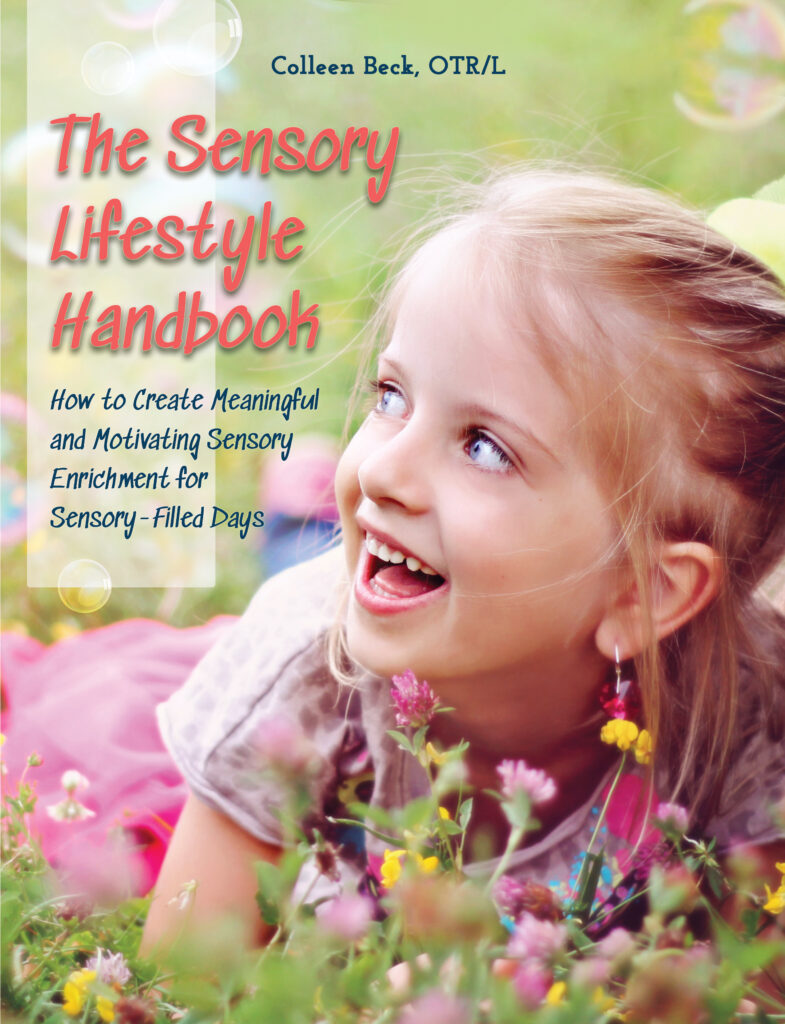
That’s why I’ve worked to create a book on creating an authentic and meaningful sensory lifestyle that addresses sensory needs. The book is now released as a digital e-book or softcover print book, available on Amazon.   

The Sensory Lifestyle Handbook walks you through sensory diet creation, set-up, and carry through. Not only that, but the book helps you take a sensory diet and weave it into a sensory lifestyle that supports the needs of a child with sensory processing challenges and the whohttps://www.theottoolbox.com/product/the-sensory-lifestyle-handbook/le family.  

Get The Sensory Lifestyle Handbook here.

The Sensory Lifestyle Handbook is a resource for creating sensory diets and turning them into a lifestyle of sensory success through meaningful and motivating sensory enrichment.

Scanning Activities for Reading (Free Download)

visual scanning for reading

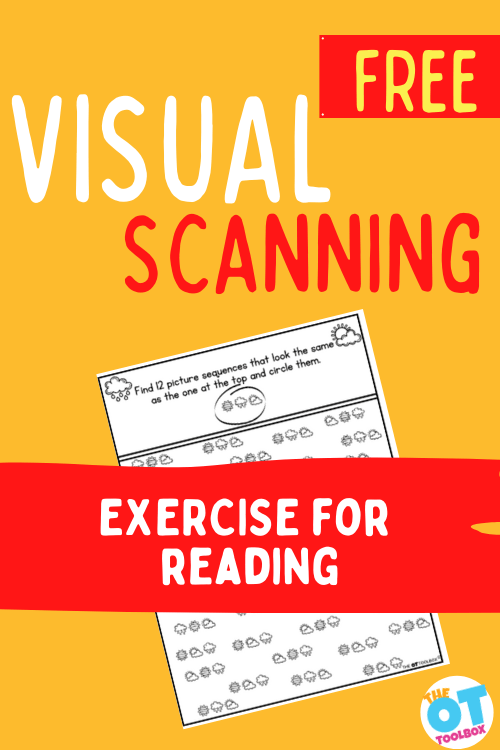
Today, we have a fun scanning activities for reading using a printable visual scanning worksheet resource that supports the underlying visual skills to target scanning exercises. Plus, the scanning worksheet users will love the fun theme. Vision truly impacts learning so if we can support the areas of development that help a child thrive, we are moving in the right direction.

One of the ways that occupational therapy professionals support development is through meaningful occupations, and anything fun and playful is a winner when it comes to pediatric OT! This visual scanning worksheet is just that: a fun skill-builder!

There are many visual scanning activities that support functional participation. Here, we’re talking specifically about reading skills.

Visual Scanning and reading

The end of the school year might feel like coasting into the finish line, however it needs to be focused on meeting goals and preparing learners for summer reading. 

Learners seem to have a love/hate relationship with reading. I believe the people who hate reading struggle with this task. 

Becoming a proficient reader takes a combination of skills. Beyond vision, phonics, spelling, and letter recognition, are the visual perceptual skills needed to read fluently. One way to foster the needed skills is with an activity like the visual scanning worksheets shown below. It’s a printable resource that focuses on scanning activities for reading. 

Visual scanning impacts reading in many ways.

  • The child who struggles with letter reversals
  • The child who labors with reading and commonly skips words or lines of words when reading.
  • Saccadic eye movement, or visual scanning, is necessary for reading a sentence or paragraph as the eyes follow the line of words.
  • Visual scanning allows us to rapidly shift vision between two objects without overshooting as when shifting vision during reading tasks.
  • In copying written work, this skill is very necessary.
  • Skips words or a line of words when reading or re-reads lines of text
  • Must use finger to keep place when reading
  • Poor reading comprehension

All of these aspects of reading can be an issue because of scanning challenges.

So what’s going on here, visually?

Visual scanning is one of several visual perceptual skills. These have been highlighted in posts before, but as a reminder, they are:

  • Visual Attention: The ability to focus on important visual information and filter out unimportant background information.
  • Visual Discrimination: The ability to determine differences or similarities in objects based on size, color, shape, etc.
  • Visual Memory: The ability to recall visual traits of a form or object.
  • Visual Spatial Relationships: Understanding the relationships of objects within the environment.
  • Visual Sequential-Memory: The ability to recall a sequence of objects in the correct order.
  • Visual Figure Ground: The ability to locate something in a busy background.
  • Visual Form Constancy: The ability to know that a form or shape is the same, even if it has been made smaller/larger or has been turned around.
  • Visual Closure: The ability to recognize a form or object when part of the picture is missing

All of these areas combined make up visual perception, and is part of the bigger picture of how our eyes work functionally.

Visual perception is the ability to organize and interpret the information that is seen and give it meaning.  This is a common thread in therapy treatment, as it is the foundation for many activities addressed daily.

Visual perception is essential for reading, writing, math, self care tasks, instrumental activities of daily living, and play.

How to develop SCANNING Skills FOR READING

There are ways to support the development and accuracy of visual scanning skills when using visual scanning worksheets.

  1. Reading Readiness Skills- When my girls were young, the summer reading list meant a chance to earn a ticket to Six Flags from the school!  It also meant a dollar per chapter book from mom and dad.  I was out $61.00 just from one kid that summer.  It was worth it. 

In preparation  we did a lot of scanning activities for reading readiness.  These included worksheets like the ones offered on the OT Toolbox, as well as games.  Amazon has their (affiliate link) visual perceptual games chunked into one search category. 

This might include using reading prompts, desired books, and short reading passages or use of a short series of images, letters, or icons on visual scanning worksheets.

Other strategies include working on scanning the environment for details. Ask kids to look for items that are all one color, for example.

Another reading readiness activity that supports reading is I Spy activities like these I Spy colors game, I spy with real toys, and printable pages (Many are found in our Membership).

2. Visual Scanning Games- Some activities to develop scanning skills for reading include:

  • Tricky Fingers
  • QBitz
  • Where’s Waldo
  • Highlights Magazine
  • Spot it Games.

3. Vision Activities– Also be sure to check out these vision activities for kids to support all of the underlying skills that impact reading and learning.

Specifically, be sure to check out these visual scanning activities that cover the full gamut!

4. Take a Deeper Look at What’s Going On- When assessing for reading difficulties, once you have ruled out visual acuity issues, use a screening tool or assessment to test for visual perceptual deficits

The Motor Free Visual Perceptual Test, as well as the Test of Visual Perceptual Skills, assesses the different visual perceptual skills, broken down into different areas. 

5. Visual Scanning Exercises- The free spring weather visual scanning exercise (grab it below!) is just a sample of the larger packet offered HERE on the OT Toolbox. Targeting scanning exercises doesn’t need to be complicated. Using simple three item series of images builds visual scanning skills.

Below you’ll find a free downloadable spring visual scanning exercise you can use to support visual scanning needed for reading skills. These activities include a weather and Spring theme, but you can use them all times of year. The sun and clouds themes work for everyone with fun scanning exercises kids love.

This visual scanning exercise is a great scanning activity for reading. It relies on visual attention, discrimination, memory, visual-sequential memory, and figure ground.

For more scanning work, grab the Spring Fine Motor Packet. This 97 page no-prep packet includes everything you need to guide fine motor skills in face-to-face AND virtual learning. Includes Spring themed activities for hand strength, pinch and grip, dexterity, eye-hand coordination, bilateral coordination, endurance, finger isolation, and more. 

6. Visual Perception Activities- There are several posts this month highlighting Visual Perceptual Activities for Spring. 

For some therapists, parents, and educators this scanning activity will be great worksheets for spring break, on those long rides to Grandma’s house.

Others will find these PDF sheets great for a spring lesson plan. Make a great packet of pages to send home, or do during class.  You can laminate these pages to make them eco-friendly and reusable. Some people project these onto smart boards, however I personally prefer the added skills involved in writing on paper.  However you choose to motivate your learners is the key to success.

DATA COLLECTION during scanning activities

Scanning activities for reading readiness are great for data collection. It is easy to measure the number of correct/incorrect guesses.

Of course, a scanning activity gets tricky when other factors such as impulsivity, attention, and compliance skew the data. Be sure to document these aspects of scanning that impacts reading skills as a functional task:

  • Document the number of errors, while adding narrative about the learner’s behavior. 
  • Provide several different types of visual perceptual tasks to try and determine which specific skills (or combination) are deficient.  This way your treatment can be more efficient, if you can hone in on one or two skill areas, such as visual memory, or scanning. 

DOCUMENTATION of Scanning tasks to support reading

  • Does your learner scan in sequential order, or all over the page?
  • Are items completely missed when scanning?
  • Is your learner taking their time, or making random guesses?
  • Does your learner thoroughly look at all the choices before giving an answer?

Some of these questions are not easy to answer. Continue to provide different types of exercises in order to measure progress. 

Progress is often the answer we seek, rather than “why do they do that?”  Often doctors do not know the why, but have to try different things until they find something that works. 

Use spring break (if you are lucky enough to have one) to rest and recharge for all of the fun spring activities that can be added to your treatment plans and OT Toolbox!

As a related resource, check out our blog post on types of eye specialists. Another great resource is our blog post on behavioral optometrists.

Free scanning activity Download to support reading skills

Want to add this printable scanning activity tool to your therapy toolbox?

Want to add this resource to your therapy toolbox so you can help kids thrive? Enter your email into the form below to access this printable tool.

This resource is just one of the many tools available in The OT Toolbox Member’s Club. Each month, members get instant access to downloadable activities, handouts, worksheets, and printable tools to support development. Members can log into their dashboard and access all of our free downloads in one place. Plus, you’ll find exclusive materials and premium level materials.

Level 1 members gain instant access to all of the downloads available on the site, without enter your email each time PLUS exclusive new resources each month.

Level 2 members get access to all of our downloads, exclusive new resources each month, PLUS additional, premium content each month: therapy kits, screening tools, games, therapy packets, and much more. AND, level 2 members get ad-free content across the entire OT Toolbox website.

Join the Member’s Club today!

FREE Visual Scanning for Reading Exercise

    We respect your privacy. Unsubscribe at anytime.

    Victoria Wood, OTR/L is a contributor to The OT Toolbox and has been providing Occupational Therapy treatment in pediatrics for more than 25 years. She has practiced in hospital settings (inpatient, outpatient, NICU, PICU), school systems, and outpatient clinics in several states. She has treated hundreds of children with various sensory processing dysfunction in the areas of behavior, gross/fine motor skills, social skills and self-care. Ms. Wood has also been a featured speaker at seminars, webinars, and school staff development training. She is the author of Seeing your Home and Community with Sensory Eyes.

    NOTE*The term, “learner” is used throughout this post for readability and inclusion. This information is relevant for students, patients, clients, preschoolers, kids/children of all ages and stages or whomever could benefit from these resources. The term “they” is used instead of he/she to be inclusive.

    Occupational Therapy Jokes and Puns

    Occupational therapy jokes

    Looking for a funny occupational therapy joke to help celebrate occupational therapy month? Look no further, we’ve got you covered when it comes to funny

    Needing occupational therapy (OT) is no joke.  It is tough to be dependent on someone else, or below average in skill development. April is OT month, a time to advocate for the profession and let people know what we can do.  

    If you love these jokes, you’ll also love these occupational therapy memes with informative graphics that describe the OT profession, and these occupational therapy quotes. All three blog posts are stock full of material that perfect for promoting the profession during OT month (and all year round!)

    Occupational Therapy Jokes

    Occupational therapy jokes are good for the soul. As busy therapy providers, we know it’s important to laugh. And, that therapeutic use of self is important for our clients as well as using with our co-workers. A sense of humor is an important tool to have in our therapy bags!

    Let’s get on with the funny stuff!

    We all know the power of therapeutic use of self. It’s a huge component in the OT profession. Similarly, the therapeutic use of humor in occupational therapy has been found by researchers to serve a purpose in client outcomes. Another research review found that humor use in occupational therapy can and should be used in moderation effective educational humor needs to be integrated into the topic and used in moderation, and when used appropriately, humor has many purposes:

    • Humor can be used therapeutically to gain attention
    • Humor can facilitate creative thinking and memory
    • Humor can motivate students to attend class, and promote learning outcomes

    Humor and funny time in therapy can serve so many purposes to help clients thrive!

    And, when we put a therapeutic use of self and a humor spin on promoting the progression, Wow…Winner winner, chicken dinner!

    That being said, a day of therapy without humor is incomplete. If you can not laugh about the funny things kids say, the mishaps, mistakes, and near misses, you will burn out quicker than a match.  To alleviate the pressure of ‘fixing” everyone, I have compiled a few occupational therapy jokes and puns to entertain you.

    Occupational therapy month joke

    What is occupational therapy anyway?

    According to the American Occupational Therapy Association (AOTA); “Your life is made up of occupations—meaningful everyday activities. These occupations can include many roles, such as being a parent, a friend, a spouse, a tennis player, an artist, a cook, or a musician. We generally don’t think about our daily occupations until we have trouble doing them.”

    “Everyone has occupations— from the toddler whose occupations are play and learning to develop important skills, to the older adult whose occupations are engaging with family and friends and managing his or her home. If you are recovering from an accident or injury, your valued occupations may be disrupted. Occupational therapy incorporates your valued occupations into the rehabilitation process.”

    not funny OT joke

    Not so funny occupational therapy jokes

    I am sure all of you have heard people say they know what Occupational therapy is (wink, wink…this is not what occupational therapy is!)

    Occupational therapy meme about what OT is
    • Just like PT
    • A therapy to help you figure out how to get a job
    • Fixing your job
    • Helping kids with things
    • I’m getting fat, I think I need one of those sensory diets

    Insert eye-roll…but if you roll with it, you’ve got yourself a funny OT meme or two, and a great opportunity to promote the profession!

    joke about knowing what occupational therapy is

    As a pediatric occupational therapist, it would be easy to get caught up in the sadness, unfairness, and struggle our kiddos face. Without laughter and fun, this profession would weigh us down on a daily basis. I take time to ride the tricycles, play in the ball pit, make arts and crafts, and ride on a swing once in a while. Occupational therapy jokes are a way to lighten the situation.

    OT jokes in my case are; kids say and do the funniest things.”

    • Who was the first president of the United States?  Jesus Christ our Lord and Savior.  Close but not exactly correct.
    • While a young girl was seated at a table she yelled “HELP, I’m stuck in a tree!!!” Her word finding skills were not quite there yet.
    • A little boy was doing an alphabet puzzle, and exclaimed, “I am putting this right in the A hole!”
    • Then there was the little girl who left her underwear in the bathroom.  She was wearing a dress and I happened to look up onto the playground and notice.  That was a first.
    • I asked a boy why he wanted to drink out of the toilet.  The water is so COLD was his reply!

    What funny things have your clients said to you?

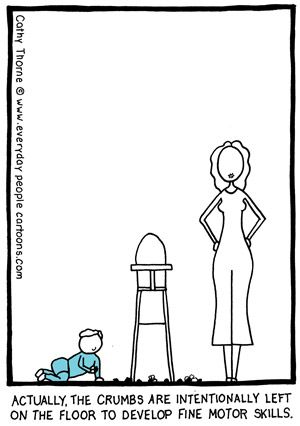
    joke about fine motor skills
    “Actually, the crumbs are intentionally left on the floor to develop fine motor skills.” –Source

    Jokes only an OT would understand:

    If you are an OT you probably chuckled at those occupational therapy jokes (memes). 

    funny occupational therapy meme
    “I’m glad you’re my valentine. How’d you know I like big hugs? I read your sensory profile.”

    The T-Rex holding reachers is an unstoppable OT joke. Perfect for recreating in the outpatient or hospital setting to bring a smile to a client’s face!

    T-Rex reacher joke for occupational therapy
    “Unstoppable!”

    What are some of the mishaps and near misses you have faced during your career?  

    • There was this time I saw a little girl jump on a therapy ball and fly across the room
    • The time I thought getting kids all hyped up during 8pm evening sessions was the right thing to do!
    • One little boy who ate a huge bite of shaving cream, thinking it was whipped topping, before I realized what was happening
    • Dozens of kids that have been covered head to toe in shaving cream during my sessions
    • Kids trying to work on dressing skills, stuffing both legs into the same pant hole.  Here comes the mermaid look!
    • Cooking errors like using salt instead of sugar, a cup of oil instead of a teaspoon, or egg shells in the batter. The teen who repeatedly did this just loved her cooking!
    When you meet a patient for the first time and they claim that they “don’t need” to wear the gait belt.
    I don’t always transfer a max assist X2 patient to a wheelchair…but when I do they’re sitting on their seatbelt.

    If you can’t laugh at yourself sometimes, right??

    When that shower transfer doesn’t go quite as well as you had expected.

    The level 2 jokes…Oh, we have to laugh at ourselves right? I can think of an “intervention” or two that were…interesting!

    When I think back on the “interventions” I came up with as a level 2 student.
    When that patient is currently max assist for ADLs asks if they are safe to go home alone. That’s a no from me.

    How about the fact that we never really get away from our profession? There are Occupational therapy memes and jokes about the fact that we are always wearing our OT hat!

    therapy joke
    I don’t always watch the Olympics. But when I do I kineseo tape all of my patients the next day.
    You know you’re an Occupational Therapist when you analyze children at the park based on the way they play in the sandbox.

    Who hasn’t done this on vacation?  I have to literally close my eyes when I go to the beach.

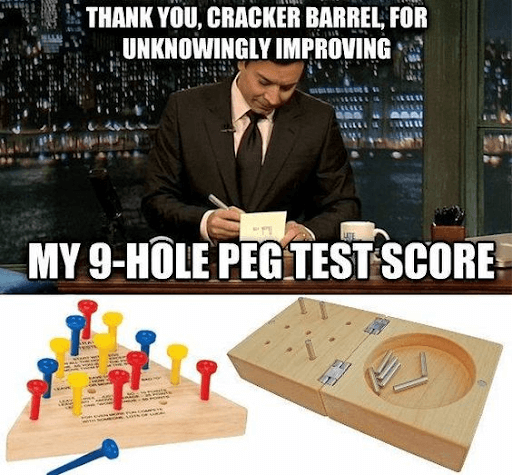
    Thank you Cracker Barrel, for unknowingly improving my 9-hole peg test score.

    Tell me you haven’t analyzed this task while dining at Cracker Barrel!

    OT’s even have pick up lines!!

    Hey girl, I saw you coloring inside the lines earlier and I’ve just got to say, you put the fine in fine motor!
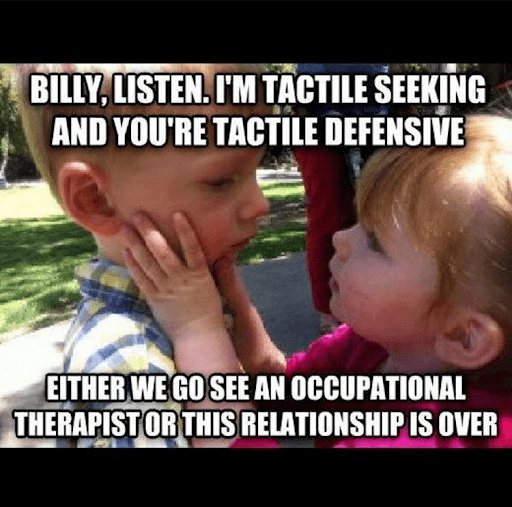
    Billy listen, I’m tactile seeking and you’re tactile defensive. Either we go see an occupational therapist or this relationship is over.

    How about some occupational therapy jokes only an OT would understand?

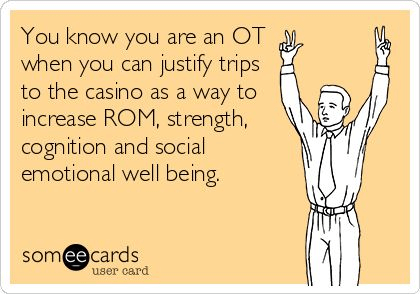
    You know you are an OT when you justify trips to the casino as a way to increase ROM, strength, cognition, and social emotional well being.
    Me: I should really go ahead and type some notes before lunch. Me to me: No save them all until the end of the day, surely you’ll remember everything.

    That moment when you realize your patient’s goal of preparing a 4 step meal is more advanced than any meal you’ve made last week.
    When you manage to build a rapport with the patient who hates everyone…

    Check out this website for cute Occupational Therapy Joke stickers!  It has sayings like:

    • No I’m not the physical therapist
    • OT, I thought you said Oh, tea
    • I’m nacho PT, I’m your OT
    • Nacho average occupational therapist
    • Yes I’m an occupational therapist, no I can not help you find a job
    • Occupational therapist, because FREAKING MIRACLE WORKER is not an official job title
    • No thanks, I’m on a sensory diet

    Believe it or not, the internet is FULL of jokes only occupational therapists will understand!

    The OT Toolbox has some past posts full of Occupational Therapy jokes  and quotes.  Check it out.  

    OT Quotes

    A tribute to Occupational Therapy Month

    A final thought as we celebrate, educate, advocate, commiserate, and tolerate (bad jokes) the occupational therapists in our lives:

    Occupational therapy meme. We do it all!

    Victoria Wood, OTR/L is a contributor to The OT Toolbox and has been providing Occupational Therapy treatment in pediatrics for more than 25 years. She has practiced in hospital settings (inpatient, outpatient, NICU, PICU), school systems, and outpatient clinics in several states. She has treated hundreds of children with various sensory processing dysfunction in the areas of behavior, gross/fine motor skills, social skills and self-care. Ms. Wood has also been a featured speaker at seminars, webinars, and school staff development training. She is the author of Seeing your Home and Community with Sensory Eyes.

    Autism Acceptance Month

    Autism acceptance

    April is Autism Acceptance Month! For school based therapists, the end of the school year is in sight.  But the start of Spring brings forth a chance for new beginnings and new growth, even as we start to wind down the school year.  Every April, we celebrate Occupational Therapy Month.  It is a chance for us to celebrate our profession, inspire each other to remember the reasons why we chose a career in occupational therapy, and to show the world the gifts we have to offer in supporting individuals with the things that matter the most! 

    Go for gold Autism acceptance month

    Autism Acceptance Month

    April is also Autism Acceptance Month. So, this is a perfect time to reflect on Occupational Therapy’s role in working with autistic individuals and how we can support neurodiversity acceptance in the places we work, with the clients and students we support, and in our world!

    Not only in April, but all year long is a great time to support, advocate for, and help others understand, embrace, and connect with the unique qualities of autistic individuals.

    Not sure where to start?  It can be overwhelming to take in all the information that comes at us each day through the news and social media, but occupational therapy practitioners can continue to do what we have always done…

    • listen to our clients and listen to the autistic voices that are in the media
    • use a strengths based approach
    • focus on environmental modifications
    • identify meaningful goals and work towards improving participation
    • use evidenced based practice
    • and advocate for our autistic clients

    We can also take a look at what we have done in the past and what we should look to do in the future.  Like the old saying goes, “When you know better, DO BETTER!”  So let’s take a look at what we know and what steps we can take to support neurodiversity.

    Autism Neurodiversity

    The prevalence of autism has significantly increased over the last 20 years, with the most drastic changes happening in the last 10 years.  Currently,  The CDC reports the prevalence of autism as 1 in 44 children in the United States.  It is the most rapidly growing developmental disorder and is more common in boys than girls.  

    Identity First Language

    Historically, occupational therapy practitioners were trained to use “person first” language, so you may have heard us say things like “my students with autism”.  Kenny, L. et al (2015) found that medical professionals, family members, and friends preferred using person first language.  However, autistics report that person first language doesn’t recognize that autism is part of their identity. 

    Although identity first language is preferred by many autistics, it is not the preference of all.  So, what can you do? 

    To know better and do better, you can ask the individual. You can ask and honor the preferences of your students.  You can educate yourself on the neurodiversity movement which suggests that brain differences can be challenges, but they can also be strengths.

    Going for gold in April instead of “lighting it up blue”

    Autism Speaks is the largest organization that claims to support autistic individuals and their families.  They are also probably the most widely known and started the campaign to “light it up blue”.  However, the work they have done to bring awareness to autism, has come with criticism from autistic adults for their focus on finding a cure. 

    Autistics are frustrated by the lack of representation within the Autism Speaks organization.  Much of the funding at Autism Speaks does not actually support autistic people. Most concerning is the lack of support for self-advocacy with a focus on the negative implications of living with autism.  

    Light it up Gold instead of Light it up Blue.

    The autistic community is trying to change the way we think about Autism awareness and acceptance.  While the color blue (seen as sad) or the puzzle piece symbol (seen as something is missing) has historically represented autism awareness, autistic adults have embraced using gold (whose chemical abbreviation is “Au”) to spread autism acceptance. 

    Gold is regarded as having high value and represents authenticity.  

    Here are some links to read more about promoting autism acceptance:

    How can we use this information to improve our practices?

    If you’re not sure what to do next, consider attending professional development opportunities or check out audiobooks for occupational therapists to learn how to support autistic clients and neurodivergent students. 

    As you grow in your knowledge, don’t forget that the domain and process of occupational therapy will continue to frame your work.  

    • Evaluate your students using a top-down, strengths based approach.  Use what we know about sensory preferences and visual supports to highlight the strengths of our autistic students.  Check out this resource: Sensory Strategies for the School Based OT.
    • Listen to your autistic students as individuals in order to develop meaningful outcomes.  What are their goals?  What aspects of school are important for them?
    • Support neurodiversity- Don’t forget to assess the environment and make modifications to support neurodiversity using Sensory Diet Strategies for the Classroom.
    • Promote and educate on neurodiversity- Expand our inclusive practices to educate and promote acceptance in the school community about autism and neurodiversity.  Perspective taking goes both ways.
    • Embrace interests of the individual. Find out what interesting, meaningful for a shared connection. Integrating interests into therapy is exactly what occupational therapy is!

    OT as an Autism Advocate

    Lastly, we must use our occupational therapy voices to advocate for autistic students and neurodivergent learners. 

    • Talk to the administrators at your school about inclusion, acceptance, and perspective taking amongst all students. 
    • Educate families with autistic children about resources and supports that are available to them. 
    • Start conversations with coworkers who may not be as familiar with current trends related to autism and neurodiversity. 
    • Most importantly, teach and support your autistic students to share their perspectives and self advocate for their needs. 

    Let’s honor autism and occupational therapy month by reflecting on the important work that we do and celebrate the amazing students we get to work with everyday!

    References:
    Kenny, L., Hattersley, C., Molins, B., Buckley, C., Povey, C. & Pellicano, E. (2015). Which terms should be used to describe autism? Perspectives from the UK Autism community. Autism: 1-21.

    Katherine Cook is an occupational therapist with 20 years experience primarily working in schools with students from preschool through Grade 12.  Katherine graduated from Boston University in 2001 and completed her Master’s degree and Certificate of Advanced Graduate Study at Tufts University in 2010.  Katherine’s school based experience includes working in integrated preschool programs, supporting students in the inclusion setting, as well as program development and providing consultation to students in substantially separate programs.  Katherine has a passion for fostering the play skills of children and supporting their occupations in school. 

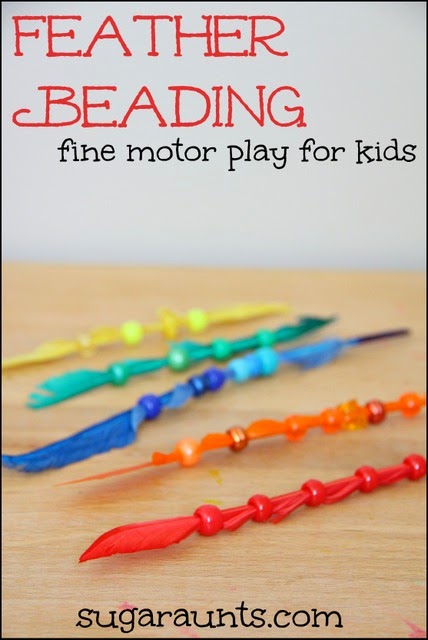
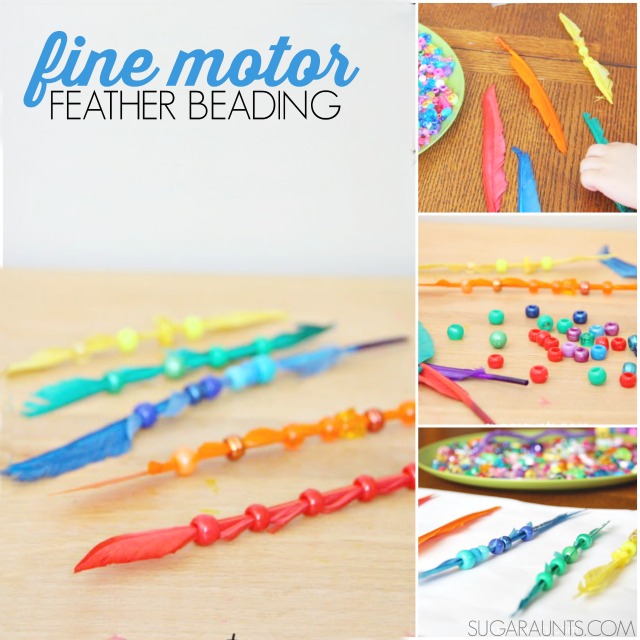
    Beaded Feather Fine Motor Activity

    beaded feathers fine motor activity

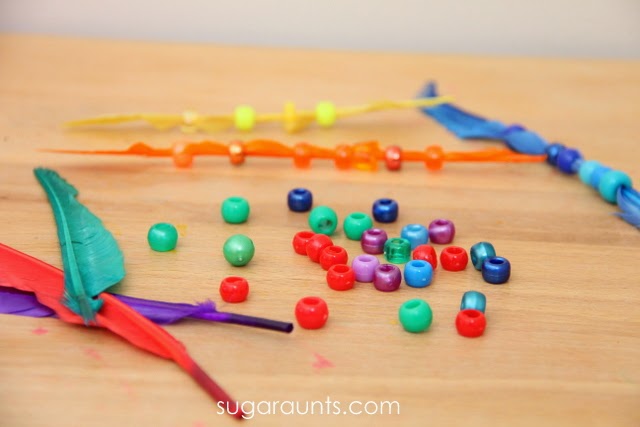
    This beaded feather activity is a fine motor task that we created YEARS ago. WE love it because beads and feathers are common craft materials found in many pediatric occupational therapy professionals’ therapy toolbox. In fact OTs love crafts as a fine motor strategy and this feather bead activity is a powerhouse!

    Beaded Feather Activity

    If you need a quick and easy little activity for the kids while you are making dinner, or just something fun for the kids to keep practice a few fine motor skills, then this is a great activity for you.  Simple to set up and easy to clean up, this one will get those little muscles going and moving with fine motor dexterity!
     
    This can be a great skill-building task to add to a STEAM activity or a STEM fine motor activity.


    Beading with feathers

    This activity works on several grasps, color awareness, counting, sorting, visual scanning, and eye-hand-coordination.  How can you beat such an easy activity with so many benefits??  


    Fine motor activity for kids using beads and feathers.


    This post contains Amazon affiliate links.
     
    You’ll need just two craft materials for this fine motor activity:


    Preschoolers and Toddlers can match beads to feathers to learn colors.
     
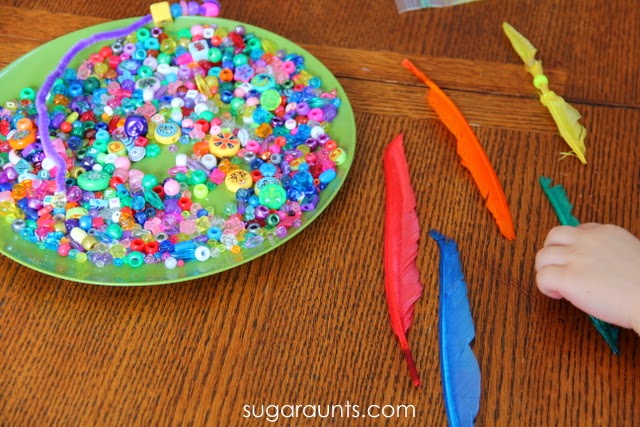
    Get your feathers and some coordinating beads and lay them out on the table.  I started a few feathers to show the kids what we were doing and had the invitation to start ready to go. 
     
    They came over to check it out and would bead a bit here and there throughout the day.  It was kind of like a therapeutic little break from bouncing off of couch cushions and each other. 
     
    Their little bodies needed a chance to slow down and re-group before getting back into the routine of regularly scheduled chaos.
     
    But maybe that’s just my kids?
      
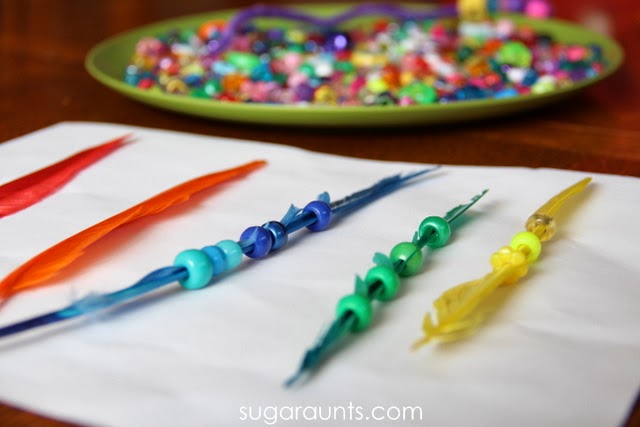
    Sorting colored beads to match colored feathers is a fun way to learn colors.


    Pincer Grasp Activity With Beads and Feathers

    You could also put out a big old tray of all kinds of beads with different colors, shapes, sizes to work with. 
     
    This slightly makes the activity just a little more difficult as the child has to visually scan for the colors needed and pick out the beads that they want with a neat pincer grasp
     
    Using the tips of the index finger and the thumb in a precision grasp to manipulate beads from a big tray of colors is great for eye-hand coordination
     
    Want more ideas to work on neat pincer grasp or eye hand coordination?  We’ve got plenty!
     
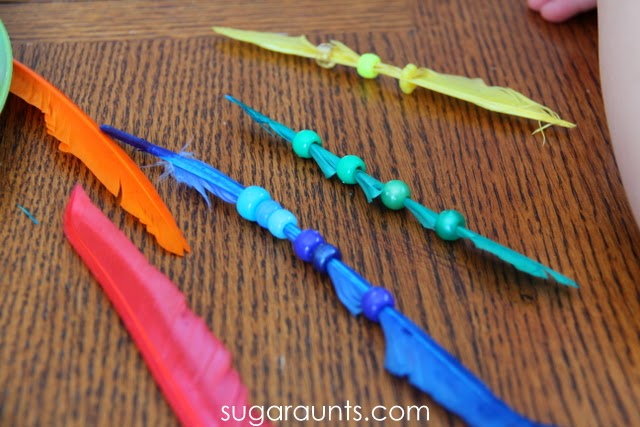
    Threading colored beads on feathers is a great way for prechoolers and toddlers to work on colors and fine motor skills.


    Beading Feathers Bilateral Coordination Activity

    Holding the feather and the beads requires two hands to work together in a coordinated way (bilateral hand coordination). 
     
    This is a great way to practice pre-writing skills and those requirements needed for self- care like managing buttons, zippers, shoe-tying, and scissor skills.
     
    Beads and feathers are a fun way to practice colors and fine motor skills with kids.


    Bead Feathers to learn colors

    Younger children (Baby Girl is just getting this!)  can learn colors and practice naming colors as they pick out the beads and match to the color of the feather. 

    How many other ways can you think of to make this a learning opportunity? 

    Patterns, sorting, counting…this is a fun learning op and a great way to get those little hands moving!

                                    Kids can work on fine motor skills and color matching awareness while beading feathers.

    Fine motor activity for kids using beads and feathers.
     
     
    More Fine Motor activities you will love:


    The beaded feather activity and the other fine motor tasks listed above are a great addition to our popular Fine Motor Kits:

    Working on fine motor skills, visual perception, visual motor skills, sensory tolerance, handwriting, or scissor skills? Our Fine Motor Kits cover all of these areas and more.

    Check out the seasonal Fine Motor Kits that kids love:

    Or, grab one of our themed Fine Motor Kits to target skills with fun themes:

    Want access to all of these kits…and more being added each month? Join The OT Toolbox Member’s Club!

    Colleen Beck, OTR/L has been an occupational therapist since 2000, working in school-based, hand therapy, outpatient peds, EI, and SNF. Colleen created The OT Toolbox to inspire therapists, teachers, and parents with easy and fun tools to help children thrive. Read her story about going from an OT making $3/hour (after paying for kids’ childcare) to a full-time OT resource creator for millions of readers. Want to collaborate? Send an email to contact@theottoolbox.com.
    Sensory Blanket Activity

    sensory tortilla blanket

    This sensory blanket activity is a simple home sensory diet activity that offers heavy work input using only a blanket. Did you know you can use a blanket as a calming sensory tool? One way that I love to help regulate and calm down over-responsive sensory systems is through heavy work activities

    Use a tortilla blanket (or any blanket) to make this sensory blanket burrito as a sensory tool for kids.

    Calming Proprioception Activity with a Blanket

    Using a blanket as a sensory tool is one of the easiest ways to offer heavy work , or proprioceptive input, through the whole body as a calming strategy.

    There are a few reasons why using a blanket works to calm the sensory systems.

    Rolling a child up in a blanket is a great way to provide deep input to a child’s whole body. This is calming and organizing.

    Additionally, the warm temperature helps to calm the body.

    A benefit to this sensory strategy is that every home has a blanket of some type. 

    Use this proprioceptive activity to offer calming input to help self-regulate emotions and sensory needs by rolling up in a blanket, either on the floor or with additional heavy work input. Check out all of our proprioception activities here.

    How to use a blanket for calming sensory input:

    1. Grab a blankets and spread it out on the floor.  
    2. Ask the child to lay down on the blanket, near one edge.
    3. Roll your child up like a burrito. Keep rolling until the whole blanket is used. Wrap the blanket tightly.  
    4. Add additional proprioceptive input for calming and regulating by piling pillows on top of your child after they’ve been wrapped up in the blanket.  Press evenly and gently, but firmly, with both hands to provide deep pressure input.


    Tortilla Blanket Sensory Activity

    Have you seen the (Amazon affiliate link) tortilla blankets? These are a great, fuzzy blanket to use in this sensory blanket activity! Kids can be the burrito as they are wrapped up in the tortilla blanket. Plus, the warmth from this fleece blanket is extra cozy and calming!

    Use the tortilla blanket to make a kid-sized burrito that adds calming sensory input!

    Another sensory activity using blankets is to use the blanket roll as a balance beam  or to lay on (without the child inside).

    For more heavy work activities using materials already found in the home, check out these low-prep heavy work exercises!

    Heavy Work Exercise Cards
    Heavy Work Exercise Cards- 50% off!

    Colleen Beck, OTR/L has been an occupational therapist since 2000, working in school-based, hand therapy, outpatient peds, EI, and SNF. Colleen created The OT Toolbox to inspire therapists, teachers, and parents with easy and fun tools to help children thrive. Read her story about going from an OT making $3/hour (after paying for kids’ childcare) to a full-time OT resource creator for millions of readers. Want to collaborate? Send an email to contact@theottoolbox.com.
    Cotton Swab Painting for Spring

    Spring themed cotton bud painting worksheets

    There are signs of Spring everywhere, and this Spring Cotton Swab Painting is one of them!  This spring themed Cotton Swab Painting activity will get you in the mood to change things up a bit, while developing important skills. This is a powerhouse Spring occupational therapy activity that builds many developmental areas through art. Add this idea to our list of creative art ideas for sensory painting!

    Using cotton swabs to paint is a creative painting strategy that builds more than just fine motor skills…read on!

    Spring themed cotton swab art to build fine motor skills

    Cotton swab painting

    Before diving deep into the why and how of cotton swab painting, let’s talk about cotton swabs (formerly known as Q-Tips) first:

    • They are great disposable tools to use when germs are a concern
    • Your learner is only going to gag themselves once with it, before learning a valuable lesson
    • If you learner is sticking it in their nose, eye, or anywhere else it does not belong, they need extra supervision
    • Sustainability a concern?  Last Swab makes (Amazon affiliate link) REUSABLE cotton swabs!  Check it out! In the FAQ it says these are appropriate for art projects
    • Cotton swabs come in different colors, sizes, shapes, varieties for pure enjoyment purposes, or to develop different skills

    Cotton Swab Art and Fine Motor

    In doing research on the connection between math and fine motor skills, the data suggests fine motor precision is just as important as visual motor skills. 

    Being able to cut on a line is not enough. An advanced learner needs to be able to cut intricate shapes. Science, technology, engineering, and math (STEM) learning is at the forefront of education.

    These specific subjects require fine motor skills beyond basic cutting, writing, and coloring. This post on Using Everyday Items to Build a Tripod Grasp is helpful and informative.

    The Spring cotton swab painting worksheet available at the bottom of this blog post develops fine motor skills while honing in on precision.  

    Not only do learners need to develop command over the cotton swab, they need to be able to precisely mark it into the correct circular space.  This does not rule out less advanced learners. 

    There is much to be gained from this task, without being able to make the dots in the correct places.

    There are too many skills to count that are developed using just this one task. 

    The benefits of cotton swab art in therapy to develop skills include:

    • Kinesthetic awareness – This means learning by doing. What better way to practice fine motor precision than with cotton swab painting!
    • Hand strength and dexterity – Dotting within the borders builds hand muscles and develops muscle control. 
    • Visual motor skills –combining what is seen visually and what is produced motorically.  This takes coordination to be able to translate information from visual input to motor output. Being able to dot onto a designated spot is more than just making random marks on paper.
    • Visual Perception – scanning to find all the dots, and visual closure to understand that dotted lines will create something. 
    • Sequencing – will your learner do the dots in order? Will they go in a haphazard pattern all over the page?  There really isn’t a right way in this task, but learning sequencing will be important in higher level tasks such as math
    • Proprioception – pressure on paper, grip on cotton swab
    • Social/Executive Function – Following directions, turn taking, task completion, orienting to details, neatness, multi-tasking, attending to task, compliance, task completion, and impulse control can be addressed using this Spring Cotton Swab Painting PDF
    • Bilateral coordination – remembering to use their “helper hand” to hold the paper while painting.  Using one hand for a dominant hand instead of switching back and forth is encouraged once a child is in grade school or demonstrates a significant strength in one or the other.
    • Strength – core strength, shoulder and wrist stability, head control, balance, and hand strength are all needed for upright sitting posture and fine motor tasks.

    Remember, you can address all of these skills at once, or focus on one or two.  Some skills above will be addressed without your conscious knowledge, while other skills will be directly worked on. 

    Using a cotton swab art activity for different levels

    It is definitely possible to use a cotton swab art activity for various levels and skills. One single activity can be used with a whole therapy caseload, while meeting different skills, needs, and developmental levels.

    How do I grade (make it easier/harder), change, or modify this task?  There are a million ways to use this cotton swab art in your treatment plans.  Below are just a few ideas to get you started:

    • Make this part of a larger lesson plan including gross motor, sensory, social, executive function, or other fine motor skills
    • Print in black and white or color for different levels of difficulty
    • Print on colored paper and use a hole punch to create this design
    • Talk about spring, clouds, flowers, seasons and more to further engage your learners
    • Enlarging the font may be necessary to beginning learners who need bigger space due to less accuracy
    • Vary the level of prompting to grade the activity to make it easier or harder.
    • Add a sensory element by using a finger tip instead of a cotton bud. 
    • Use different types of paint or shaving cream for alternate types of learning
    • Work in pairs or in a small group to address problem solving, turn taking, and negotiation skills.
    • Make baked cotton swabs to work on developing fine motor skills.  I wonder if these can be used as watercolor paints?  This would eliminate some of the mess
    • Add glitter!  Glitter makes everything wonderful

    The OT Toolbox has some great ideas for spring themes, fine motor precision, arts and crafts, treatment planning and more.  Start with this spring flower eye hand coordination activity.  What about more cotton swab activities?  Since you can buy these cotton buds in packs of thousands, you might as well use them in more than one activity.

    Feeling overwhelmed?  Starting something new can feel intimidating. Some people are able to plow through their apprehension, while others get stuck.  Either way, the OT Toolbox has just what you need. 

    An entire kit of Spring Fine Motor Activities!  This print-and-go Spring  fine motor kit includes no-prep fine motor activities to help kids develop functional grasp, dexterity, strength, and endurance. Use fun, Spring-themed, fine motor activities so you can help children develop strong fine motor skills in a digital world.

    What does spring mean to you?  Embrace the new season and take a risk.  Get out of your comfort zone and push your learners to get out of theirs.

    Free Cotton Swab Art Worksheets

    Want to add this resource to your therapy toolbox so you can help kids thrive? Enter your email into the form below to access this printable tool.

    This resource is just one of the many tools available in The OT Toolbox Member’s Club. Each month, members get instant access to downloadable activities, handouts, worksheets, and printable tools to support development. Members can log into their dashboard and access all of our free downloads in one place. Plus, you’ll find exclusive materials and premium level materials.

    Level 1 members gain instant access to all of the downloads available on the site, without enter your email each time PLUS exclusive new resources each month.

    Level 2 members get access to all of our downloads, exclusive new resources each month, PLUS additional, premium content each month: therapy kits, screening tools, games, therapy packets, and much more. AND, level 2 members get ad-free content across the entire OT Toolbox website.

    Join the Member’s Club today!

    FREE Spring Cotton Swab Worksheets

      We respect your privacy. Unsubscribe at anytime.

      NOTE*The term, “learner” is used throughout this post for consistency. This information is relevant for students, patients, clients, preschoolers, kids/children of all ages and stages or whomever could benefit from these resources. The term “they” is used instead of he/she to be inclusive.

      Victoria Wood, OTR/L is a contributor to The OT Toolbox and has been providing Occupational Therapy treatment in pediatrics for more than 25 years. She has practiced in hospital settings (inpatient, outpatient, NICU, PICU), school systems, and outpatient clinics in several states. She has treated hundreds of children with various sensory processing dysfunction in the areas of behavior, gross/fine motor skills, social skills and self-care. Ms. Wood has also been a featured speaker at seminars, webinars, and school staff development training. She is the author of Seeing your Home and Community with Sensory Eyes.

      How to Help Kids Organize Their Homework

      Disorganized homework tips

      Do you know a student that struggles to organize homework? Maybe you see a messy backpack and homework that is always lost. Here we are covering tips and strategies to address disorganized students so homework can get done, important papers aren’t lost, and kids can thrive in learning. Let’s cover some important organization tips.

      Today, I’ve got ideas and tips to help children with attention, executive functioning, focus, sensory, or learning difficulties get organized at home.  

      This is part of our Real Tips for Helping Your Sensory Child Get Organized series and a follow up to our post on Helping Sensory Kids Get Organized at School.

      Tips to organize homework

      Imagine a world where your body and brain are unsure of what’s happening next.  Imagine a world where your body and brain are unsure of what’s happening now.  There are noises coming at you from near and far, itchy socks scratching your toes, and a commanding urge to jump, fall, swing, and roll.


      Now, imagine that you have to recuperate from a high-sensory day at school, full of bells, school buses, students voices, chalkboards, crowded hallways, single-file lines, and laborious writing tasks.

      You now have to get off the school bus and fall into the evening home routine.  There are homework duties, schedules, dinner time patterns, bedtime tasks, and settling down.  The time at home is full of “Must-Get-Done” items that sometimes make the family time that is so precious more of a crazed 3 hours of “Non-Stop-Rushing”.


      The child with sensory needs often times have attention, behavior, visual perceptual, fine motor, and executive functioning problems.  Then there are the issues of fidgeting, distractibility, motor planning concerns, problem solving issues, and memory difficult.  All of these problem areas are a tornado of trouble when it comes to organization at home.


      When students pile off of the school bus or jump in the car in the school pick-up line (or even finish up their homeschool day), there is often times a sense of busyness and rushing.  It’s a race to get home, homework done, dinner prepared, eaten, and cleaned up, before it’s time to hurry off to appointments and activities.  

      We are a busy society and it’s almost normal to fill our hours with things to do.  Those commitments bring with them lists, dates, facts, and more commitments.  We are focusing on so many things at one that brains are on constant overload.


      And our kids are right there, feeling the burden of overwhelm.  For the child with sensory processing disorders or kids with learning difficulties, it’s a strain.


       
      How to help disorganized kids get organized at home with homework and after school to evening time.


      Tips for Disorganized Homework and Backpacks


      Full disclosure: This post contains affiliate links.


      For children with organization difficulties, it can be hard to stay in the moment of focus needed for the steps to just get started on their after school requirements.  “Do your homework” is a multiple step process that is overwhelming for disorganized kids to break down into small and manageable steps.  Kids with sensory issues often have executive functioning difficulties.  

      Executive functioning is the ability to plan, organize, and initiate a task while using working memory, impulse control, and self-monitoring.  It’s needed to manage and complete to-do lists.  It’s seeing the bigger picture of a project and taking the first step toward getting tasks like homework done.


      When these concerns are combined with other co-existing troubles like distractibility, behaviors, and fidgeting; the steps of pulling homework folders from the backpack, sorting papers and removing what is not needed, sitting down to focus on several homework assignments, and work through the tasks is difficult.  Then there is the putting away and focusing on other items on the after-school list.


      Getting started on homework can be a daily battle.  Then, once the initial task of starting on homework has been negotiated, there are the flexibility issues that a sensory child has.  Adapting to changes in situations like a homework assignments can further overwhelm the child with sensory concerns.


      Parents of children with these difficulties tend to over manage homework and after school tasks.  The needs of the child to get started on homework steps prevents them from prioritizing and planning the steps, and as parents, we get into a routine of micromanaging the process.  

      The overwhelmed child needs a parent’s guidance in organizing the steps of a task, but sometimes it is helpful to teach the child to build skills to improve organization.


      Organizing Homework and Working Memory

      Furthering after school organizational difficulties are deficits in working memory.  Working Memory is the ability to hold information in our brain while wing or retrieving other information to complete a task.  

      It is this mental juggling that allows us to multi-task and think through the steps of an assignment while simultaneously completing it.  This is a very difficult task for children with sensory needs.

      Working Memory is taking home the homework tracker, packing the backpack with the correct books, arranging items in the homework folder, and recalling homework assignments.  


      Does any of this sound familiar to you?  There are ways to help the child who is so overwhelmed by after school tasks, that they break down.  There are ways to build organization skills, adapt to problem areas, and to manage prioritization.  Try some of these tips for helping with the after school chaos:

       
      How to help disorganized kids get organized at home with homework and after school to evening time.


      Tips to help kids get organized with homework and after school tasks

      • Create an after-school Chill Out Zone.  The school day is overwhelming and a sensory place to self-organize is a great way to re-charge.  
      • Provide movement options like jumping, running, bouncing, and swinging.  A mini trampoline (affiliate link) is a great addition to the home.
      • Create an after-school plan.  It should include post-school day calm down time, snack, homework time with scheduled brain breaks, and built in time to transition from homework to dinner and after-dinner activities.
      • Stick to a homework start time.  Keep it consistent every day.
      • Create a homework location without distractions.  Consider a tri-fold poster board (affiliate link) if your homework space is in a high-traffic area like a kitchen.
      • Provide an uncluttered space away from toys or media.  
      • Create a reward system for completing the chart.  This might be something like a preferred activity.
      • Use a timer during homework tasks for movement breaks.
      • Provide fidgets toys during homework.  We made a homework fidget bag that can be used everyday.
      • Schedule an active task after homework.
      • Provide one homework folder for all classes instead of several. 
      • Modify tasks if handwriting is a difficult area for the child.  
      • Break down assignments into smaller parts.
      • Use a single plastic bin (affiliate link) to hold all required items for homework: pencils, pencil sharpener, crayons, ruler, erasers, etc.
      • Provide bins for school items.  The backpack and any needed items like the backpack, school shoes, equipment, hats, and gloves can be placed in the bin and are at easy access for the next morning.
      • Use a homework checklist.

      Homework Checklist

      A homework checklist is a good way to offer an after-school routine for ensuring homework is organized, the backpack is cleaned out, and important papers are addressed.

      A homework checklist can be presented in list format where the student checks off each item as it is completed. Other versions can be a visual schedule. Other children might benefit from a picture schedule.

      One suggestion is to place the checklist in a clear sheet protector and use a dry erase marker to check items off each day.  At the end of the day, wipe the clear sheet protector clean so it is ready for the next day’s homework. (affiliate links)

      Create a reward system for completing the chart.  This might be something like a preferred activity.

      Here are some important steps that can be added to a homework checklist:

      • Take out planner or folder from the backpack.
      • Check for all materials.
      • Remove unneeded papers.
      • Make a list of homework assignments.
      • Start working.
      • Check work.
      • Put homework back into planner or homework folder.
      • Get Mom or Dad’s signature on homework tracker.
      • Put planner and books back into backpack.  
      • Put the backpack in a location where it’s always placed.


      Organized homework and transitions

      Often times, kids have other activities or sports after school. It can be easy to get distracted after coming home and forgetting all about the homework. Being rushed doesn’t help with keeping homework organized.

      Transitions are often an area of difficulty for kids with executive functioning challenges, sensory processing differences, or learning disabilities.  The inflexibility and inability to initiate tasks interfere with the flow from homework to other functional tasks.  

      A child with different needs will often times need outside cues to comprehend transitions.    

      Try a few of these ideas to help with organizing kids in the after-school and home time before bed time:

      • Create evening schedules that include dinner prep times and eating times.  Include tasks that the child completes like helping to set the table and cleaning up after dinner.  
      • Create an organization center with white boards for after school commitments like appointments and activities.
      • Create bedtime routine checklists or picture schedules.
      • Provide a calm-down time before bed at a consistent time every day.  Encourage winding down with a darkened room and low lights.

      These organization tips might not work for every child that is disorganized.  Some kids might benefit from some of these organization tips and not others.  These ideas and tools will take time.  

      It is important to build a structure that becomes part of the daily routine in your home.

      Be sure to stop by and see tips for Helping Sensory Kids Get Organized at School to help your sensory child get organized at school.  These tips will help your child with the after school organization transitions, too.  

      How to help disorganized kids get organized at home with homework and after school to evening time.
      Impulse Control Journal the OT Toolbox

      The Impulse Control Journal…a printable resource for helping kids strategize executive functioning skill development. When saying “calm down” just isn’t enough…

      When a child is easily “triggered” and seems to melt down at any sign of loud noises or excitement…

      When you need help or a starting point to teach kids self-regulation strategies…

      When you are struggling to motivate or redirect a child without causing a meltdown…

      When you’re struggling to help kids explore their emotions, develop self-regulation and coping skills, manage and reflect on their emotions, identify their emotions, and more as they grow…

      Grab the Impulse Control Journal to build organizational strategies, planning, prioritization, habits, and mindset in kids.

      DIY Whisper Phone

      DIY whisper phone
      One of our more popular posts here on The OT Toolbox is our post on classroom sensory strategies. For kids who struggle with attention challenges, general sensory processing needs, auditory processing, self-regulation, or other needs, a whisper phone can be a power tool when it comes to reading or processing auditory information.
       
      Below, you’ll find information on how to make a DIY whisper phone for only $3 and how a whisper phone helps kids of all ages! Plus, we’re sharing where we got this awesome idea to make a whisper phone that kids will love! For more sensory play ideas, stick around!!
       
      Affiliate links are included in this post. 
       
      Make a DIY whisper phone to address reading comprehension, letter sounds, and sensory processing needs.
       

      DIY Whisper Phone

      When it comes to therapy tools and equipment, finding the best deals is ideal. But even better is when you can make your own therapy tools at a fraction of the cost and still benefit from the therapeutic benefits.
       
      This DIY whisper phone is just the example. In fact, a whisper phone on Amazon (affiliate link) costs more than $6 so when you are shopping to fill the needs of a classroom or caseload, the DIY version can be a fun alternative. 
       
      Auditory processing activities may include whisper and volume of voice, including using a whisper phone in therapy.
       

      What is a Whisper Phone?

      First, you may be wondering “What is a whisper phone“…read on to find out what exactly a whisper phone is and how they can be so beneficial to so many kids. 
       
      Typically, a whisper phone is a tube shaped like a phone that can be held at the child’s ear and mouth. They can whisper sounds and words and clearly hear individual sounds without background noise. 
       
      They are a great tool for kids with auditory needs AND kids without auditory processing issues. Whisper phones can be so helpful in teaching any child to recognize sounds of letters! Kids can use a whisper phone to hear themselves read, which helps them with comprehension and fluency through auditory feedback.
       
      A whisper phone is a tool that can be so helpful for kids with auditory processing needs or other concerns that interfere with a child’s ability to focus on auditory input. These kids sometimes struggle with pulling out important information from auditory input. 
       
      The whisper phone device can be used to address several areas of auditory needs. Auditory processing challenges can look like a variety of things:
      • Poor listening skills
      • Auditory attention challenges (distractions by sounds in a classroom or home)
      • Difficulty with language comprehension
      • Auditory sensory sensitivities
      • Other listening concerns
      Using a whisper phone can help with skills like:
      • Auditory discrimination
      • Auditory sequencing
      • Auditory memory
      • Auditory figure-ground
      Other times, a whisper phone is used in reading to help kids recognize sounds in words, including pronunciation, fluency, and reading comprehension. This can be helpful for kids without auditory processing needs too! 
       
      Make a DIY whisper phone to address reading comprehension, letter sounds, and sensory processing needs.
       

      How to use a Whisper Phone

      Sometimes a whisper phone is used in the classroom setting during reading tasks. To use this auditory feedback device, it is quite simple:

      1. Hold one end of the whisper phone up to your ear. 
      2. Hold the other end of the device up to your mouth. 
      3. Whisper into the phone and listen for the sound waves to move through the device to directly to the ear. 

      Some whisper phones require two hands like the one we created. Others can be held in one hand. These devices might be a U-shaped piece of tubing, or a few pieces of PVC pipe that are glued together. These types of whipser devices are nice for feedback during reading. 

      To use the whisper device, ask the student to experiment with a variety of sound levels. They can whisper, talk, hum to see how sounds are transferred directly to their ears. 

      As the student to read aloud into the device. Then ask them to read while there is background noise present. Let them experiment and see how loud they need to speak into the device to ensure auditory comprehension.

      Here are more auditory processing activities that can help.
       
      Make a DIY whisper phone to address reading comprehension, letter sounds, and sensory processing needs.
       

      A whisper phone can be used in many ways:

       
      Sound out letters to help kids recognize the sounds associated with each letter. This is SO important in kids whom we later see in therapy who can not associate letter formation and struggle with handwriting and formation!
       
      1. Sound out words to identify parts of words.
      2. Auditory feedback when reading.
      3. Provide a calming sensory diet activity.
      4. Improve self-confidence with reading skills.
      5. Discriminate between sounds and background noise.
      6. Identify tone and volume of speech.
      7. So much more!
       
      Make a DIY whisper phone to address reading comprehension, letter sounds, and sensory processing needs.


      How to make a DIY Whisper Phone

      We were inspired to make a DIY whisper phone when we saw a fun activity in the new STEAM Learn and Play Book. This whisper phone is not the traditional hand-held style, but more like the traditional can phones from the therapist’s childhood! 
       
      We made a whisper phone that can be used with two children and is a fun way to address the needs described above. 
       
      To make a DIY whisper phone, you’ll need just three items. We gathered these items at our Dollar store, making the DIY whisper phone a great deal! 
      • Two small funnels
      • One tube
      To make the DIY whisper phone, just connect the funnels to a tube. The bendy tube that we used was long enough to reach between two friends. 
       
      If the tube doesn’t fit exactly, use a bit of tape to hold the tube in place. 
       
      Then, play and learn! 
       
      Make a DIY whisper phone to address reading comprehension, letter sounds, and sensory processing needs.
       
      This whisper phone is so easy to make that kids can make it themselves. In fact, it would be a great group activity for a small group in a camp setting. 
       

      Auditory Feedback Phone (STEM Activity)

      I love that this auditory feedback phone is a STEM activity that kids can create themselves as a STEM and fine motor activity. 

      By making this auditory feedback device, kids are learning about science with the concept of the auditory processing system, the mathematics of sound waves, and engineering to create the technical ability to transport whisper sounds through the device the creates feedback in the way of sounds. 


      We got the idea to make a whisper phone from the new (Amazon affiliate link) STEAM Play & Learn book written by Ana at Babble Dabble Do. What a fun book this is for hands-on activities that kids will WANT to do while learning and playing. 
       
      Each page is full of colorful activities that teach.


      There are so many fun ways to explore science, technology, engineering, art, and math with this book. For parents or teachers looking for a complement to a specific curriculum, this book is it. Kid can explore so many areas while learning through hands-on play.
       
      The OT in my LOVES the tactile experiences shared in this book! Check out some of the ideas below:


      Looking for more ways to address sensory needs? 

      You will love our Printable Sensory Diet Cards that cover so many areas! There are activities and ideas to address auditory processing needs, plus every other sensory system. Grab our Sensory Diet Cards for a complete packet of sensory activities. You’ll find 24 pages of 345 sensory diet activities including:

      • Calming and alerting movement activities
      • Heavy work fine motor activities for pre-writing needs or fidgeting needs
      • Sensory activities
      • Sensory support cards
      These sensory diet cards can be used in the home, classroom, or clinic. They are available now for $9.99 on The OT Toolbox shop
      Use printable sensory diet cards to encouraging sensory input through play
       
       
      Fall Leaf themed auditory processing activities for sensory needs in kids.Auditory processing dominoes made with bells are perfect for a color matching activity, and can be graded to meet the auditory needs of all ages.Auditory processing sensory ideas for backyard summer sensory play, perfect for sensory diet ideas for kids.Baby Sensory bottles using recycled spice jars


      More ways to use a Whisper phone in auditory processing skills

      Many of the activities in the Auditory Processing Kit can be used with a DIY whisper phone or a commercial version.

      The Auditory Processing Kit is a tool to support learners by building skills in listening comprehension, auditory processing needs, and much more. The tools offer support to learners with hyper-responsive or hypo-responsive auditory systems. Therapists love the hands-on activities to support learning and active listening through play and handwriting tasks.

      • Listening Comprehension
      • Fine Motor Listening Skills
      • How to Improve Listening Skills Poster
      • Clap It Out Syllables Orthographic Activities
      • Beginning Sounds Letter Activity
      • Rhyming Words Activity
      • Activity Listening Activity
      • Hearing Skills Activity
      • Auditory Memory Strategies
      • What Does Active Listening Look Like?
      • Whole Body Listening Activity
      • Whole Body Listening Poster
      • Listening and Motor Skills Game
      • 2 Step Direction Cards
      • How to Support Hyper-Responsiveness of the Auditory Sense (handout and info sheet)
      • How to Support Hypo-responsiveness of the Auditory Sense (handout and info sheet)
      • Auditory Processing Tools Cards
      • Auditory Processing Speed -2 Digit Numbers
      • Auditory Processing Speed -3 Digit Numbers
      • Auditory Processing Speed -4 Digit Numbers

      Use the handouts and posters to teach about the auditory system and auditory sensitivities, with strategies to support individualized needs. Get your copy of the Auditory Processing Kit today.

      Colleen Beck, OTR/L has been an occupational therapist since 2000, working in school-based, hand therapy, outpatient peds, EI, and SNF. Colleen created The OT Toolbox to inspire therapists, teachers, and parents with easy and fun tools to help children thrive. Read her story about going from an OT making $3/hour (after paying for kids’ childcare) to a full-time OT resource creator for millions of readers. Want to collaborate? Send an email to contact@theottoolbox.com.