Colleen Beck, OTR/L is a pediatric occupational therapist and the owner and author of The OT Toolbox website. She manages all of The OT Toolbox social media accounts and runs the popular newsletter.
Read about Colleen's experience and career as an occupational therapist, including how The OT Toolbox began on our About The OT Toolbox page: https://www.theottoolbox.com/about-us/
Colleen created The OT Toolbox in 2011 and since then has written thousands of blog posts designed to support therapy providers, educators, parents, counselors, admin, and caregivers in promoting the healthy development of kids.
Check out Colleen's blog posts below:
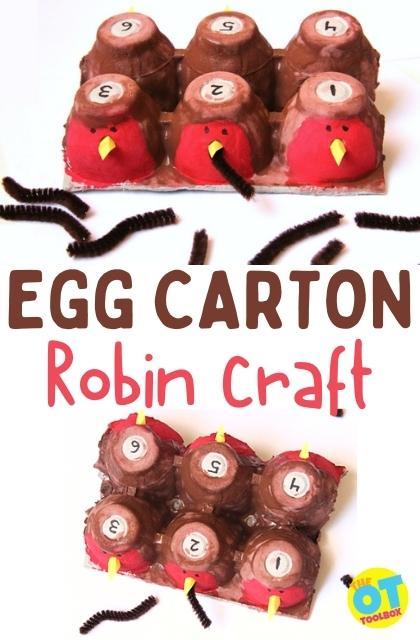
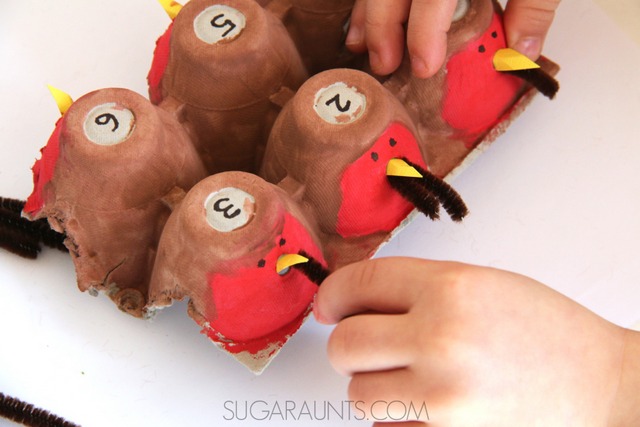
This robin craft is a fun activity for Spring that develops fine motor skills, bilateral coordination, eye-hand coordination, and precision skills. This is the perfect addition to the occupational therapist’s Spring fine motor activities and a great tool for kids to make that they also use to work on skills in occupational therapy. Plus, the worm activity is just fun for kids! Use this egg carton craft to work on so many fine motor skills!
Robin Craft with an Egg Carton
Spring and Robins go hand in hand. We made this Robin craft as a Spring Fine Motor activity one day and the kids were giddy with excitement to play!
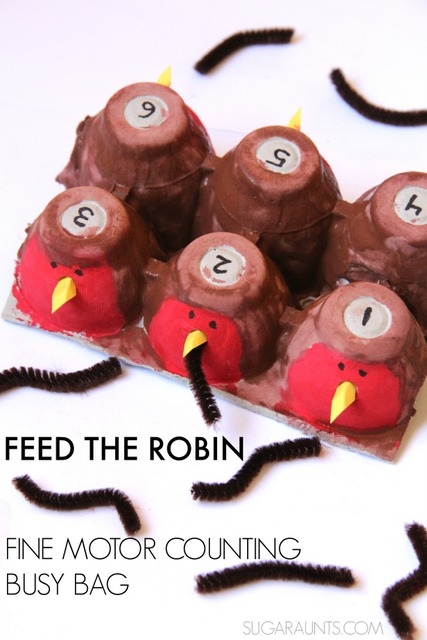
This robin craft is a busy bag type of activity will keep the kids busy and little fingers moving as they count worms to feed the Spring robins.
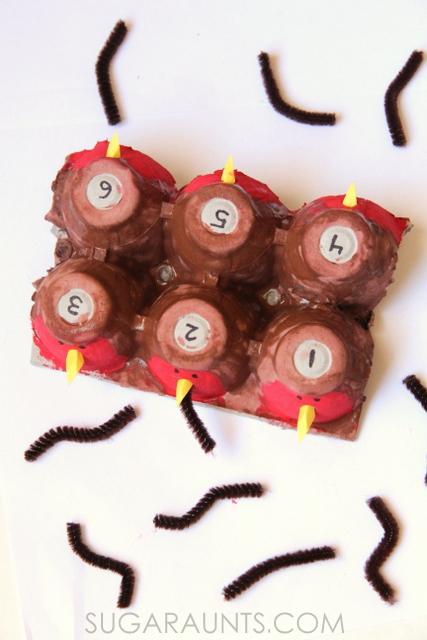
This egg carton family of robins was fun to make with the kids and even more fun to watch them play.
We used a cardboard carton so the paint would stick. You’ll need a clean and dry egg carton. Cut off the lid off the egg carton. You’ll want to keep the egg sections for this robin craft.
Paint the egg carton.
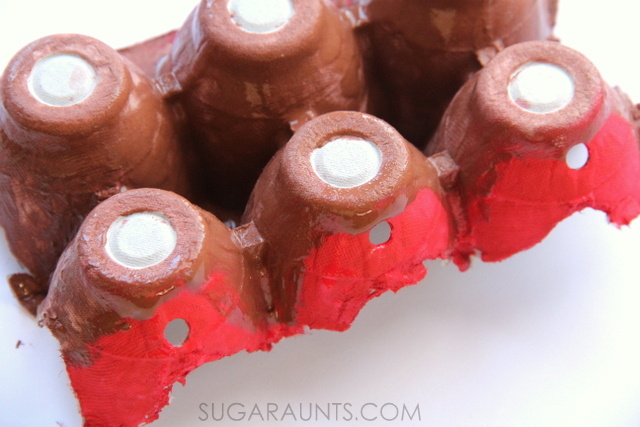
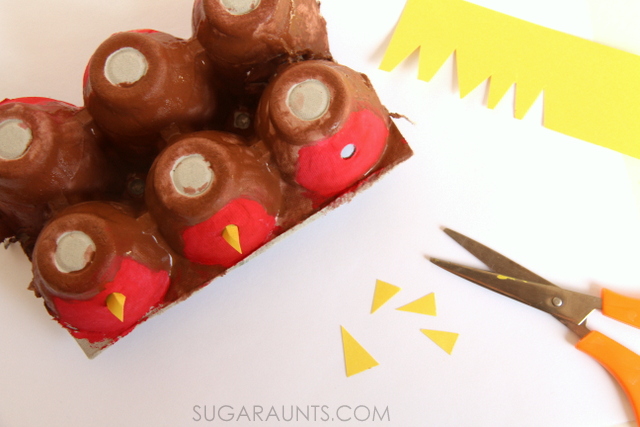
Paint a red belly on each egg compartment. Paint the sides and back of each robin with brown paint. You can paint the whole egg section or you can leave a space at the top to add a number, depending on if you are making a family of robins, or each student is making a single robin.
Punch a hole in each egg carton compartment.
Use a hole punch to punch a hole towards the top of the robin. This will be the beak of the robin, and where students will “feed” pipe cleaner worms to feed the birds. Little Guy (age 5) got a big kick with this part. He wasn’t able to squeeze the hole puncher to make the holes, but he really liked watching!
Make paper beaks for the robin craft.
Cut small triangles from yellow cardstock. Drag the wide end of the triangles in glue and press into the holes. These will be the beaks for the robins. Let the glue dry.
Make pipe cleaner worms!
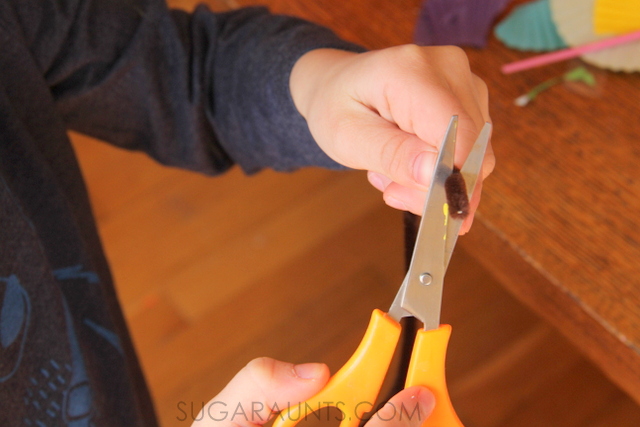
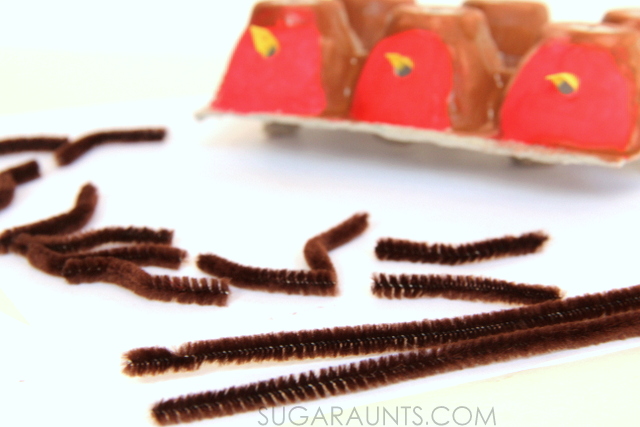
Cut brown pipe cleaners into small sections. The worms can be as small as an inch or two or much longer. Show the student how to bend the pipe cleaner slightly to create wiggly worms. This is a simple worm craft of it’s own! This is also a great bilateral coordination and scissor skill activity for Spring. Kids love making pipe cleaner worms!
Draw Eyes on the Egg carton robins.
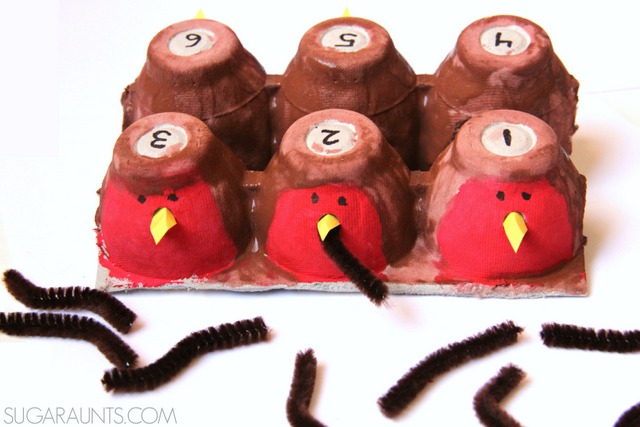
Use a permanent marker to make two small dots for eyes for the robins. You can also add a number on the top of each robin. Now it’s time to count and play!
Now it’s time to play and feed the robins!
Pipe Cleaner Worm Craft
Three is just something about those pipe cleaner worms. Kids love making them and using them to feed the robins. Let’s take a look at skills that are being developed with this fine motor task.
Little Guy enjoyed cutting pipe cleaners and bending them into little bendy worms. Cutting and bending the pipe cleaners is a bilateral coordination task that requires using both sides of the body with different motor plans and degrees of strengthening. This task is a great one for building motor plans and focusing on graded strength.
Cutting the pipe cleaners is a scissor skills task that requires and develops hand strength. What a great hand strengthening activity this is! Squeezing the scissors requires a lot of hand strength to snip the pipe cleaners.
Make a bunch of worms; You will need them!
Feed the Robins Craft
If you draw numbers on the top of each robin, you can feed each bird the correct number of worms. But, if you are working with a whole caseload or class of students, collecting many egg cartons can be difficult. You could always use just one egg carton section for each student so they have their own individual bird craft to make and feed.
In that case, skip adding a number to the top of the egg carton. Users can roll a dice and feed the bird that number of pipe cleaner worms.
This activity builds several fine motor skill areas:
Eye-hand coordination
Bilateral coordination
Separation of the sides of the hand
Pincer grasp to pick up the pipe cleaner
Tripod grasp, or a refined tip to tip grasp to thread the pipe cleaner into the bird
In-hand manipulation- Pick up several pipe cleaners at once and hold them in the palm of the hand. Then, feed one worm pipe cleaner at a time to “feed the robin”!
Robin Math Activity
To expand on the eye-hand coordination skill work, and to make this a great multisensory learning activity, use this as a one-to-one correspondence task for preschoolers. Young children can count the number of pipe cleaner worms, match the number to the works, and build pre-writing skills through play.
Little Sister (age 3.5) counted out the number of worms for each bird (She needed help with one-to-one correspondence). She was able to press the worms into the robin mouths using a tripod grasp.
It was fun to watch her play and count for a long time. I overheard a little dramatic play happening as she talked to the robins and pretended they were a family eating their lunch.
Use the Robin Craft to Build Skills Over and Over Again
This egg carton robin was a tool we made once and then used over and over again, making it a great fine motor activity for the occupational therapy toolbox.
Use it in a robin sensory bin! Add the pipe cleaner worms to a sensory bin and kids can find the worms and then feed them into the robin. There are so many ways to build skills with this one craft.
Spring Fine Motor Kit
Score Fine Motor Tools and resources and help kids build the skills they need to thrive!
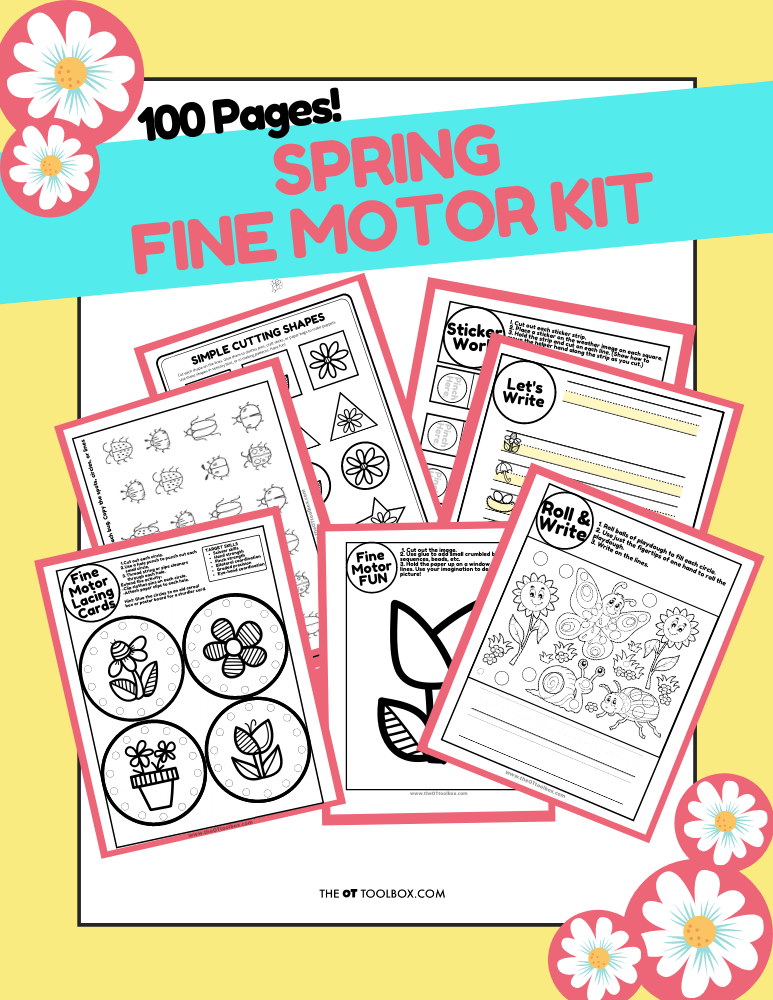
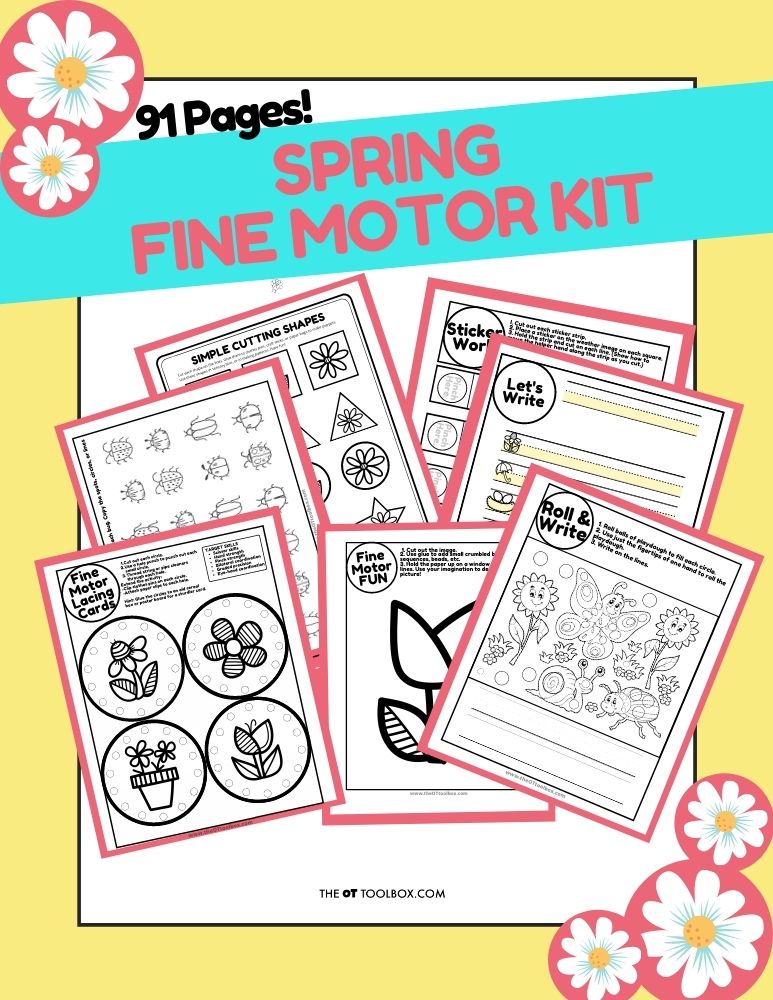
Developing hand strength, dexterity, dexterity, precision skills, and eye-hand coordination skills that kids need for holding and writing with a pencil, coloring, and manipulating small objects in every day task doesn’t need to be difficult. The Spring Fine Motor Kit includes 100 pages of fine motor activities, worksheets, crafts, and more:
Colleen Beck, OTR/L has been an occupational therapist since 2000, working in school-based, hand therapy, outpatient peds, EI, and SNF. Colleen created The OT Toolbox to inspire therapists, teachers, and parents with easy and fun tools to help children thrive. Read her story about going from an OT making $3/hour (after paying for kids’ childcare) to a full-time OT resource creator for millions of readers. Want to collaborate? Send an email to contact@theottoolbox.com.
April is OT month, and we are celebrating what it means to be an occupational therapist with the best occupational therapy quotes. Although every therapist is unique, and every setting poses its own challenges and opportunities, we are all united in this wonderful profession. To help us celebrate OT month and share the love of OT, let us present 10 of the most inspirational quotes for occupational therapy professionals!
Occupational Therapy Quotes
Seasoned OTs will be reminded of why we do our work, new graduates can share what their work actually means, and maybe we will even get a few new recruits along the way.
You’ll also love these to use these occupational therapy memes in sharing to social media. And best of all, lets celebrate the field of OT! One of my favorites has to be Mr. Roger’s quote about play because it has such a connection to occupational therapy!
OT Quote #1: “Medicine adds days to lives, occupational therapy adds life to days.”
Unknown
In our number 1 spot is one of my absolute favorite sayings. It presents such a simple way to show how OT differs from traditional medicine and highlights what occupation means to us: the meaningful bits of one’s life.
OT Quote #2: “Occupational Therapy. Hopeless into hope. Can’t into can. Impossible into possible.”
Valerie Pena, OTR
Simple yet effective; this quote symbolizes the change that OTs make in their patients’ lives. We are highly skilled in increasing functional independence and provide the tools and education needed for doing so.
OT Quote#3: Occupational therapy practitioners ask, “what matters to you?” not, “what’s the matter with you?”
AOTA President, Virginia “Ginny” Stoffel, Ph.D., OT, BCMH, FAOTA
This is one of those quotes that makes me so proud to be an OT. The best OTs will first discover with the patient what is most meaningful to them and go from there. We do not focus on the deficits but on the goals.
OT Quote #4: “As pediatric occupational therapists, you are supporting mental health.”
Tiffany Northrop, OTR/L
Here is a reminder for us all: occupational therapists support mental health! Some work exclusively in mental health settings, but we all greatly consider mental health as a service provider.
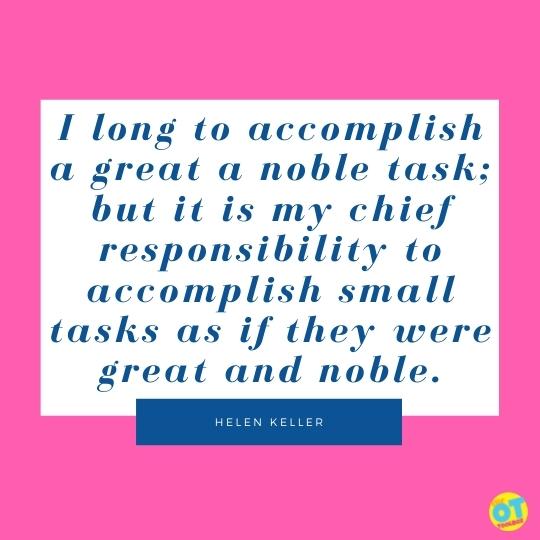
OT Quote #5: “I long to accomplish a great a noble task; but it is my chief responsibility to accomplish small tasks as if they were great and noble.”
Helen Keller
She was not an OT, but her words ring true for our profession. The “little things” like brushing your teeth, writing your name, and buttoning your shirt become very important when you cannot easily do them.
OT Quote #6: “Man, through the use of his hands, as they are energized by mind and will, can influence the state of his own health.”
Mary Reilly, OTR, Ed.D.
Shout out to all the certified hand therapists out there! The hands are used in just about every occupation, and their healthy function is integral to our experiences with daily activities.
OT Quote #6: “Occupational Therapy is where science, creativity, and compassion collide.”
Jessica Kensky
As a Boston Marathon survivor, and an oconology RN, Jessica has seen both sides of rehabilitation. During a keynote speech for the AOTA, Jessica offered this quote to describe her experience of receiving occupational therapy after her below knee amputation.
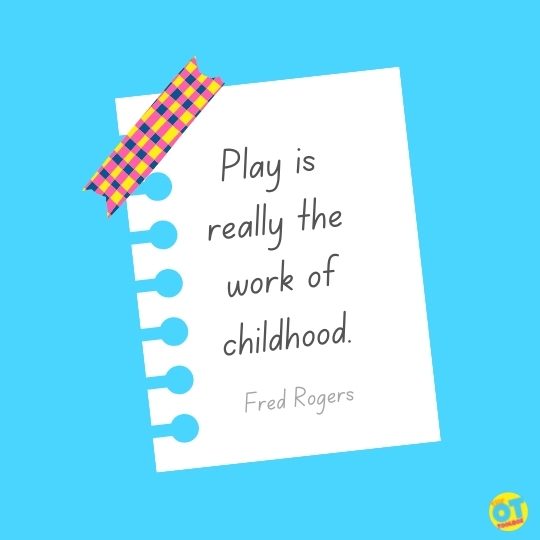
OT Quote #7: “Play is really the work of childhood.”
Fred Rogers
Mr. Rogers was an amazing advocate for many important causes, but he especially cared for the children of the world. Occupational therapists often may look like they are “just playing”, but play is crucial! Play is not only the work of a child, but it is the way that they learn and the pathway to growth.
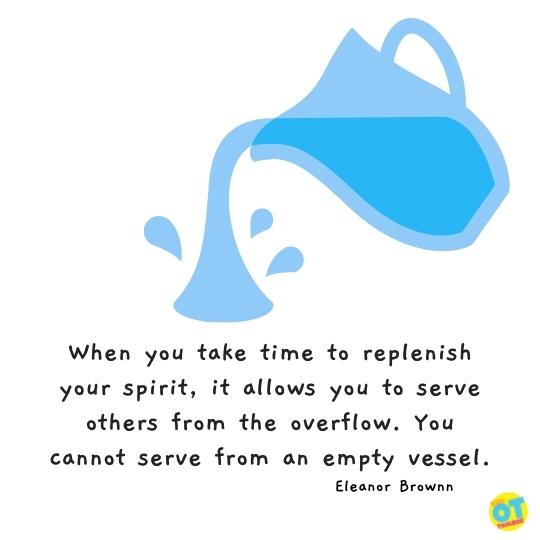
OT Quote #8: “When you take time to replenish your spirit, it allows you to serve others from the overflow. You cannot serve from an empty vessel.”
Eleanor Brownn
Self-care is integral (crucial, necessary, essential, fill-in-the-blank) to the ability to provide for others. Burn out occurs when we do not take the time to care for ourselves, or allow ourselves to be cared for. Although it is not in our nature, occupational therapy practitionners, like many others, need to prioritize themselves in order to give to others.
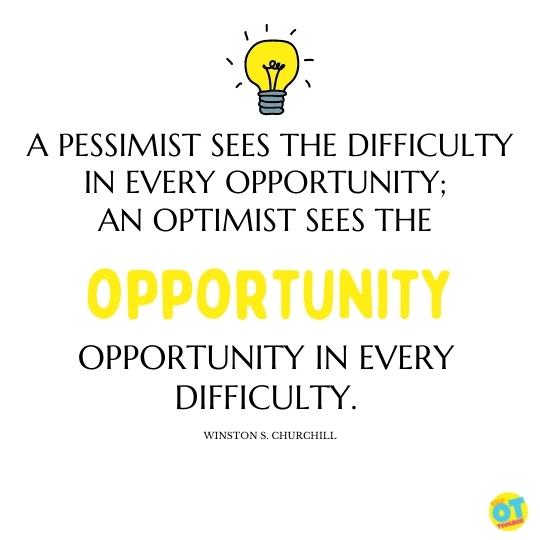
OT Quote #9: “A pessimist sees the difficulty in every opportunity; an optimist sees the opportunity in every difficulty.”
Winston S. Churchill
This is just another way to say that we see abilities and not disabilities. OTs use activity analysis to break down all the little details that make it possible to complete a task. Through this, we can see the strengths and provide supports based on them.
Quote #10: “Occupational therapy is more than a job. For many it is a calling. We felt drawn to it.”
Amy Lamb, OTD, OT/L, FAOTA
To close out our list, we have a quote from Amy Lamb that describes how much our profession means to us. This is not just a job, but a vocation. It may not always be perfect, but we love being occupational therapists! Happy OT month!
For more occupational therapy month resources, check out the free downloads that we’ve shared to promote the profession and celebrate all that we do:
Sydney Thorson, OTR/L, is a new occupational therapist working in school-based therapy. Her background is in Human Development and Family Studies, and she is passionate about providing individualized and meaningful treatment for each child and their family. Sydney is also a children’s author and illustrator and is always working on new and exciting projects.
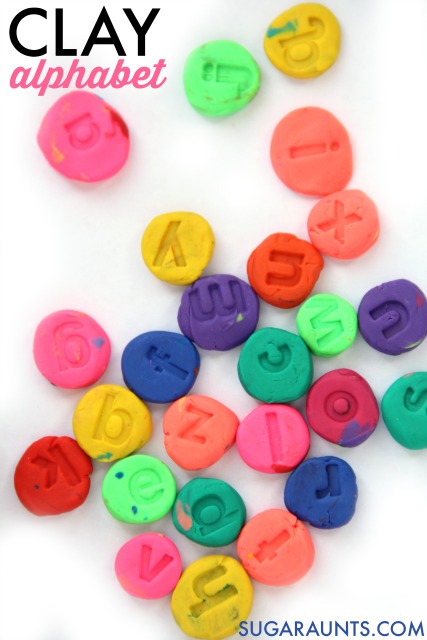
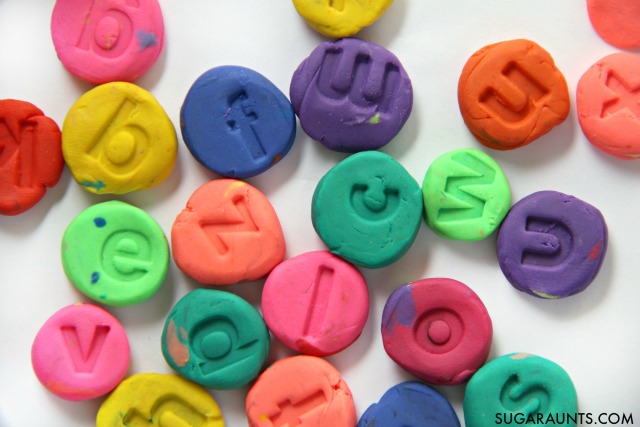
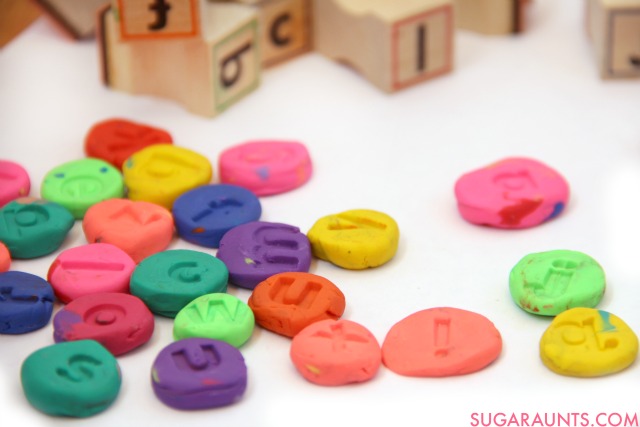
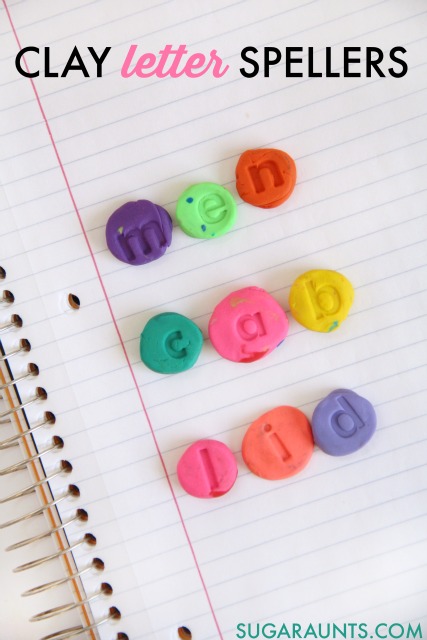
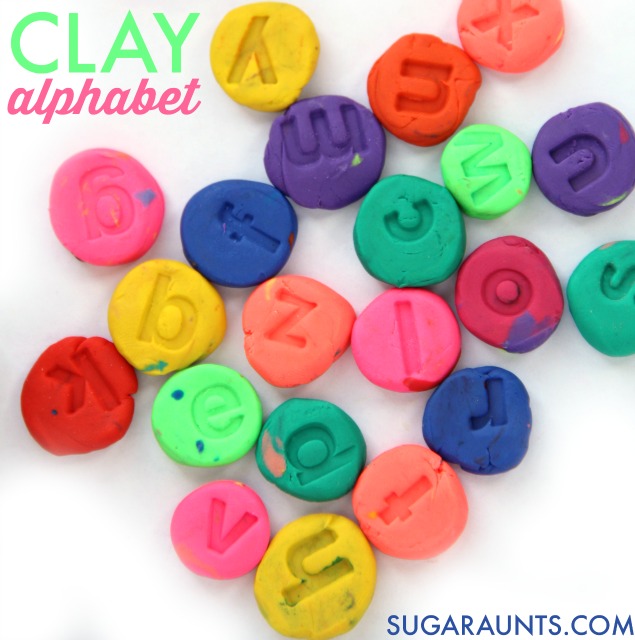
These clay letters are a fine motor activity we made years ago, but we still use them today in multisensory learning activities. In fact, the clay alphabet is such a great tool for sight word and spelling word manipulatives. This week, we used two of my top Occupational Therapy recommendations in a combined fine motor power activity…to make stamped letters for learning!
We used clay and alphabet stamps to make our own clay letters for hands-on learning, including practicing spelling words, sight words, letter identification, and letter order. This was the perfect learning tool for my second grader, kindergartner, and preschooler!
Clay Letters for multisensory learning
As an Occupational Therapist, I often times recommended using clay as a therapeutic tool. It’s resistive and provides proprioceptive feedback while working on hand strength. Combined with letter stamps, we were able to make our own movable and colorful letters.
You’ll need to start with alphabet stamps for pressing into the clay, and some colorful clay. You’ll want to get the type of clay that quick dries.
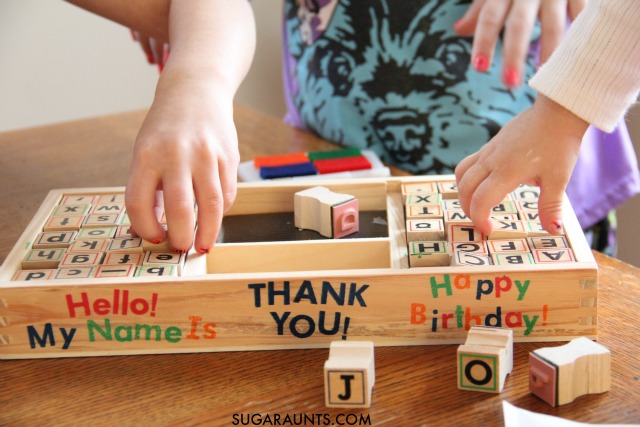
We used our Alphabet Stamp Setto press lower case letters into small, rolled balls of modeling clay. I love the bright colors of THIS brand.
To make he clay letters, kids are really strengthening the hands.
First, ask your child to first pull off small pieces of clay from the long rolls. Roll the clay into small balls and gently press them into disks.
Then, have your child find the letters of the alphabet in alphabetical order. Using the Melissa and Doug Alphabet Stamp Set was a great way to further our fine motor work. The size and shape of the letter stamps in this set are perfect for working on intrinsic muscle strength and tripod grasp.
Pressing the stamps into the clay is a nice way to address precision.
Press too hard, and the clay disk is too thin.
Press to lightly, and the letter’s impression is not deep enough in the clay. This precision of grasp requires proprioceptive awareness.
The brand of clay that we used does not harden. This makes a nice activity for kids, but if you want to keep your letters, use a modeling clay that does dry out.
Learning Activities with Clay Letters
We used our clay letters in a bunch of different activities. Try some of these hands-on letter activities:
Practice spelling words.
Practice spelling sight words.
Arrange letters on the table. Ask kids to visually scan for letters to find in alphabetical order.
Practice letter identification.
Copy the letters to work on letter formation.
Arrange the letters on a table. Pull out a letter and ask your child to name a word that starts with that letter. Ask them to write the words to practice handwriting.
Practice decodable reading and word building with the clay letters.
More Letter Fine Motor Activities
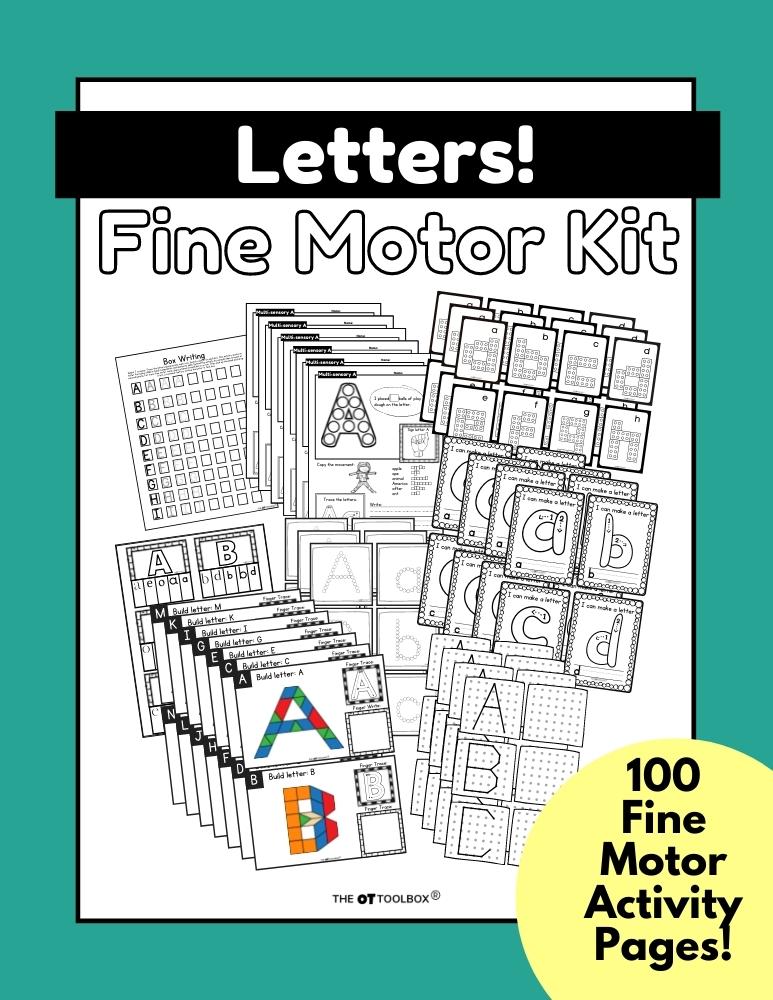
You’ll love the fine motor activities in our Letters Fine Motor Kit. The printable kit is loaded with letter activities that build fine motor skills. You can grab it and all of the other themed fine motor kits below, to build skills through play.
Working on fine motor skills, visual perception, visual motor skills, sensory tolerance, handwriting, or scissor skills? Our Fine Motor Kits cover all of these areas and more.
Check out the seasonal Fine Motor Kits that kids love:
Colleen Beck, OTR/L has been an occupational therapist since 2000, working in school-based, hand therapy, outpatient peds, EI, and SNF. Colleen created The OT Toolbox to inspire therapists, teachers, and parents with easy and fun tools to help children thrive. Read her story about going from an OT making $3/hour (after paying for kids’ childcare) to a full-time OT resource creator for millions of readers. Want to collaborate? Send an email to contact@theottoolbox.com.
This pre-writing skills resource is a resource for anyone working with preschoolers. The fact is that in the preschool years, developmentally, preschoolers should not be writing. Rather, pre-writing is the area of focus. A huge topic of discussion for pediatric occupational therapy professionals is the fact that preschool pre-writing skills are developed rather than introducing handwriting at this young age. Developmentally, there is a lot of progression in the preschool years and pre-writing skills are just one of the many areas. Our resource on fine motor activities for preschoolers covers more on these areas. Refer to more information on preschool activities for other developmentally appropriate activities.
Pre writing Skills in Preschool
Many times, parents of very young children don’t think about handwriting skills. It’s not typical to think about holding a pencil, writing words and sentences, and copying letters when children are just mastering building with blocks, learning to pull on socks, and creating finger paint masterpieces.
But the truth is, when young preschoolers are playing, they are building the very important precursors to handwriting.
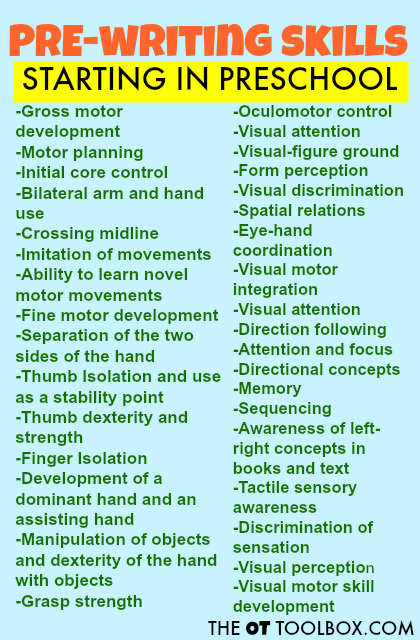
The skills needed for managing a pencil, copying letter forms, and managing pencil control when copying lists and paragraphs into a space on a page are initiated in the early childhood years. Below, you’ll find more about preschool pre-writing skills and the components of pre-writing skills that are developed through play.
Preschool is prime time to develop the underlying skills needed for handwriting. So often, the older, school-aged kids that are struggling with handwriting are missing the underlying areas that make up the skills of handwriting.
First, it’s important to recognize that handwriting is made up of so many areas. Handwriting is much more than holding a pencil (pencil grasp) and forming letters and numbers!
There are many pre-writing skills that transfer to accuracy in written work. These areas need to be developed and refined before handwriting can be successful. These skills are pre-requisites to even holding a pencil to form shapes and then letters.
Consider the following skill areas that relate to handwriting:
Sensory Motor Pre-writing skills
Fine motor pre-writing skills
Visual-motor pre-writing skills
Let’s go into each area separately.
Sensory-Motor Pre-Writing Skills- The sensory motor component is closely related. Consider the pyramid of learning and the developmental base that enables refinement in higher levels of development. The closely related areas of sensory and motor skills are pre-requisites for pre-writing before copying lines and shapes is even possible.
Fine Motor Pre-Writing Skills- From holding the pencil to moving and controlling the pencil when writing letter forms, handwriting requires a variety of motor movements that all must work together.
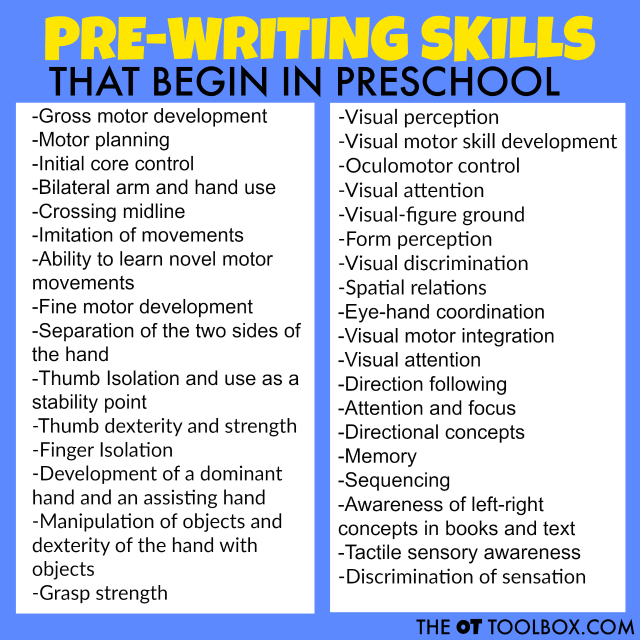
These fine motor pre writing areas of development include:
Note that preschool can begin as early as 2 years old with some preschool classes. There is a big difference in development from the 2-5 year range in all areas, including fine motor development. A young 2 year old will developmentally have more primitive fine motor skills than a 5 year old child.
Young preschoolers will develop precision and refinement of fine motor skills through play.
Visual Processing Pre-Writing Skills- Additionally, there are the eyes. What is seen and recognized needs to be coordinated with the hand. Visual processing has a huge component in written work!
During the preschool years, visual processing skills are developed through play. These components include:
Cognitive Pre-Writing Skills- In addition to the motor components are the cognitive skills. These include the ability to follow directions, pay attention, and focus. The cognitive areas are closely related to the motor skill prerequisites.
Awareness of left-right concepts in books and written work
When Preschoolers are asked to write letters
When young children are asked to write, trace, or copy letters before these skills are developed, bad habits can form. In these cases, you’ll notice that older students tend to have difficulty with handwriting.
There are many things happening all at once that develop poor motor plans and bad habits. Because preschoolers are not developmentally ready to write with a pencil, you may see these issues:
Immature grasp on the pencil/writing utensil
Inability to form diagonal lines
Forms letters from bottom to top
Forms letter segmentally and inappropriately
Weak grasp on the writing utensil
Inconsistent hand use
Weak pinch and base of support on the pinky side of the hand
Poor posture
Inattention
Difficulty identifying letters and copying complete parts
Many other issues!
These mentioned issues with starting handwriting in preschool is just the tip of the iceberg when it comes to introducing letter formation before kids are developmentally ready.
We have put this information into a video to further explain what happens when preschoolers are taught to write letters or write their name before they are developmentally ready. If you would like to view this video on YouTube, check it out on The OT Toolbox YouTube channel.
Pre-Writing Lines in Preschool
It is very important to mention pre-writing lines. These are the pencil strokes that precede formation of letters. Here are some resources you’ll want to read over and utilize in this important step in preschool development:
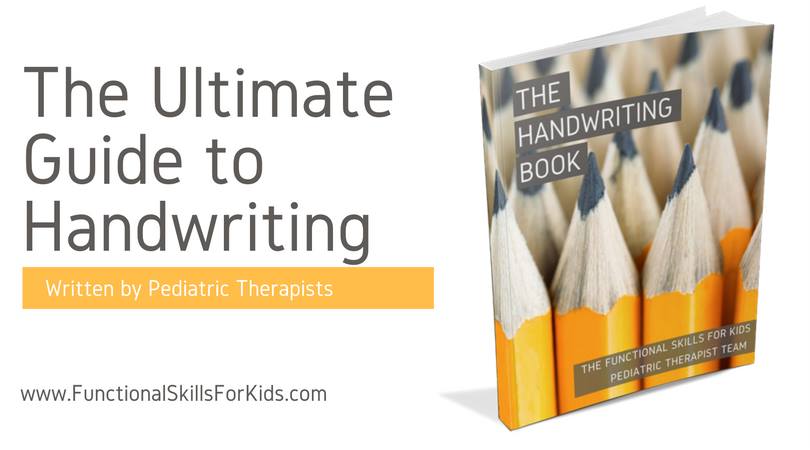
If any of these areas might be an issue for your child with handwriting troubles, consider grabbing The Handwriting Book as a resource that covers all of the underlying skill areas related to handwriting.
So how are all of these areas addressed as a pre-writing skill in preschool?
The answer is through play!
Can you believe that all of these areas are being addressed htrough play in the early childhood development stages? And that all of these areas are building and developing with a resulting use in handwriting? Amazing, right?
Stop by later this week to find out easy ways to encourage development of the above skill areas in group settings in the preschool environment. It can be difficult to address the needs of a preschool class when there are 16 four year olds that need reining in. I’ll have easy ways to encourage development of fine motor skills, visual motor skills, and attention skills in fun and creative ways…coming soon!
Want to know more about The Handwriting Book? Click on the image above to find out how to address every underlying area related to handwriting skills. Click here to BUY NOW.
Working on fine motor skills, visual perception, visual motor skills, sensory tolerance, handwriting, or scissor skills? Our Fine Motor Kits cover all of these areas and more.
Check out the seasonal Fine Motor Kits that kids love:
Colleen Beck, OTR/L has been an occupational therapist since 2000, working in school-based, hand therapy, outpatient peds, EI, and SNF. Colleen created The OT Toolbox to inspire therapists, teachers, and parents with easy and fun tools to help children thrive. Read her story about going from an OT making $3/hour (after paying for kids’ childcare) to a full-time OT resource creator for millions of readers. Want to collaborate? Send an email to contact@theottoolbox.com.
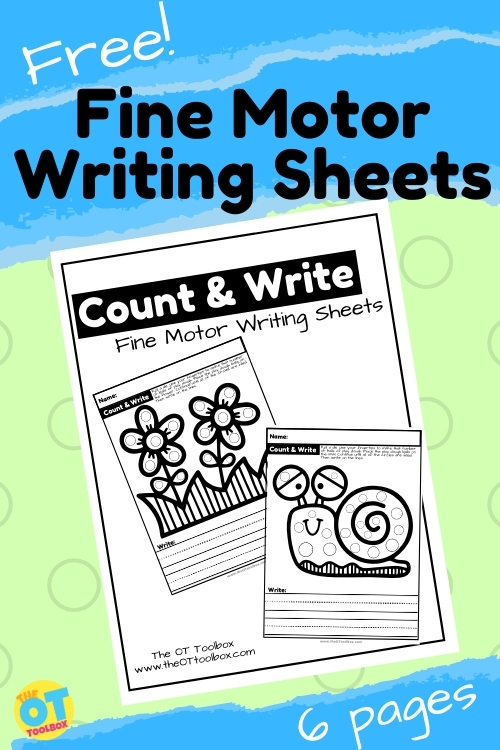
How would you like some free Spring worksheets? Today, I have a fun freebie that I’m excited to get into the hands of little ones…our popular fine motor skills handwriting worksheets! These fine motor precision worksheets are actually Spring themed worksheets, BUT they can definitely be used year-round to work on handwriting and fine motor precision. You can get your hands on these printable Spring exercises and help little ones develop stronger hands!
This is a great letter formation worksheet option: focus on one letter per sheet or use a page to write one letter based on the items in the picture.
Spring Worksheets
These free Spring worksheets for fine motor and handwriting skills are one of our popular printables for precision and dexterity (and handwriting). Here’s why: These Spring worksheets are a powerhouse in building fine motor skills. Kids can use play dough to build the fine motor strength they need to hold and write with a pencil, color, and complete fine motor activities all with more dexterity, precision, and endurance!
We have so many themed fine motor worksheets like this one in our OT Toolbox Member’s Club. You can log in, click the ones you need and print them right away, without entering your email address for each printable.
These printable worksheets are great for using in school based occupational therapy sessions, because you can cover a variety of OT goal areas:
Fine motor skills
Eye-hand coordination
Handwriting
Letter formation
Letter spacing
Letter size
Coloring
Spring Worksheets for Fine Motor Skills
Here’s how these Spring printable pages work: Kids can first roll a die (Great for in-hand manipulation, arch development, and separation of the sides of the hand!)
Then, they can use play dough to create that same number of balls of play dough. Be sure to ask kids to use just the fingertips for this part of the activiyt. Using the fingertips to roll balls of play dough is a powerful strengthening activity.
Using the finger tips and thumb of one hand at a time to roll a play dough ball is an intrinsic muscle workout that builds the muscles of the thenar eminence, hypothenar eminence, the interossei, and the lumbricals. All of these muscle groups make up the intrinsic hand muscles which are those located within the hands.
After working out the hands and getting them warmed-up for writing, the page asks kids to then write on the lines. I’ve left the writing portion open-ended so that kids can write words, letters, numbers, or sentences, based on their level, skills, and age.
The Spring themed worksheets come with a flower style and a fun snail activity page. But, each printable sheet is available in three different writing lines styles:
Double ruled lines
Single ruled lines
Double ruled lines with a highlighted bottom space
Print off these worksheets, slide them into a page protector sheet and start building those fine motor skills!
Free Spring Worksheet Set
Want to add this set of worksheets to your therapy toolbox? Enter your email address into the form below to access. NOTE- Due to changes in security levels, users have reported trouble accessing free resources when using a school district or organization email address. Consider using a personal email address.
For more play dough activities and fine motor worksheets, grab the Spring Fine Motor Kit:
Spring Fine Motor Kit
Score Fine Motor Tools and resources and help kids build the skills they need to thrive!
Developing hand strength, dexterity, dexterity, precision skills, and eye-hand coordination skills that kids need for holding and writing with a pencil, coloring, and manipulating small objects in every day task doesn’t need to be difficult. The Spring Fine Motor Kit includes 100 pages of fine motor activities, worksheets, crafts, and more:
Want to add this resource to your therapy toolbox so you can help kids thrive? Enter your email into the form below to access this printable tool.
This resource is just one of the many tools available in The OT Toolbox Member’s Club. Each month, members get instant access to downloadable activities, handouts, worksheets, and printable tools to support development. Members can log into their dashboard and access all of our free downloads in one place. Plus, you’ll find exclusive materials and premium level materials.
Level 1 members gain instant access to all of the downloads available on the site, without enter your email each time PLUS exclusive new resources each month.
Level 2 members get access to all of our downloads, exclusive new resources each month, PLUS additional, premium content each month: therapy kits, screening tools, games, therapy packets, and much more. AND, level 2 members get ad-free content across the entire OT Toolbox website.
Colleen Beck, OTR/L has been an occupational therapist since 2000, working in school-based, hand therapy, outpatient peds, EI, and SNF. Colleen created The OT Toolbox to inspire therapists, teachers, and parents with easy and fun tools to help children thrive. Read her story about going from an OT making $3/hour (after paying for kids’ childcare) to a full-time OT resource creator for millions of readers. Want to collaborate? Send an email to contact@theottoolbox.com.
Here we are covering behavioral issues with potty training and potty training problems that impact toilet training in kids. Teaching a child to potty train is a complex task. You’ve probably tried some of the common tips for potty training. But what happens when there are real problems? There are many components that can affect a child’s progression and retention of toileting independence. Let’s go deeper.
Behavioral issues with potty training
Parents often times seek out potty training help when they are working on building independence in this functional skill of childhood.
While there are many considerations that go into the developmental progression of independence, attention and behavior are key skills in function.
Behavioral issues with potty training can look like many different things:
Intentionally urinating on the floor
Impulsive actions in the bathroom
Hyperactivity during toilet training
Playing in the toilet
Using too much toilet paper in anger or frustration
Hitting
Aggression during toileting
Full disclosure: This post contains affiliate links.
Behavior and Potty Training
It is important to note that many times, behaviors that are seen with potty training are a result of potty training starting too soon.
When a child demonstrates behaviors, there is often times, a communication point that the child is trying to get across: Behaviors are many times just information.
Other times, behaviors are normal development of a child’s cognitive and imagination. Children who are potty training might refuse to take time to toilet, make urine or fecal messes on the floor intentionally, throw objects into the toilet, or refuse to use certain bathrooms, among many other behaviors.
It is important to take the behavior objectively and think about the behaviors as information. Information should be viewed objectively and without bias.
A behavior can be viewed as good or bad but in order to address the behavior, it is necessary to figure out the reason behind the behavior.
A child who has tantrums and hits an adult is considered to have bad behavior while a child who attends to a task is considered to have good behavior. This bias is a perception of behavior.
There are many reasons behind behaviors related to potty training and the act of toileting.
Problems with potty training and behaviors during toileting may be a result of:
These types of difficulties can result in reactions that lead to frustration and tension between the child and adult.
It is important to remember the causes of behaviors throughout the potty training process.
Once there is a potential reason identified for the cause of behaviors related to toileting, examine the behaviors and consider the following questions:
What is the child getting or not getting from the behavior?
What makes the behavior stop?
What makes the behavior continue?
What are precursors to changes in the behavior?
Does the child withhold toileting breaks to avoid going into the bathroom?
Does the child demonstrate cognitive, communication, sensory, fine motor, or gross motor difficulties that might interfere with steps of the potty training process?
How to support Children with potty training problems
Let’s talk tips to help with behaviors related to potty training.
Aggressive behaviors might include shouting or physically hitting and might occur suddenly as a result of frustrations perceived by the child. Other children might become upset in certain bathroom environments like public restrooms. Still others might overly focus on certain details. It is important to try and understand what is causing the child to become angry, upset, anxious, or agitated.
Some of these strategies can work to support children that struggle with potty training problems.
Modify the Task– One tip to adjust the precursors to behaviors in toileting is to modify the task or simplify the steps that you are asking the child to complete.
Begin where the child is consistently successful. A child who’s anxiety of entering a bathroom prevents further progression of independence may begin with the child walking into the bathroom, and staying in the bathroom for a count of five.
Continue practicing this portion of potty training until there is success. Then the child will be capable of moving on to other steps of toileting.
Gradual progression of potty training coincides with waiting to begin potty training until the child has shown readiness cues.
Take time to respond– Before responding or reacting, take a moment before you respond as the parent. Before reacting to potty training behaviors, consider:
Think about the cause of the aggression or anxiety.
Focus on the child’s emotions.
Be positive and reassuring.
Provide reassurance through calm a voice and phrases.
Reduce noise and distractions to help the child relax.
Follow the child’s lead.
Realize that some behaviors can indicate that the child isn’t ready and they are communicating a lack of readiness through their behaviors.
Keep it simple: reduce verbal cues.
Boys can sit to pee at first until they get the hang of the physical act of awareness of the urge to urinate and clothing management.
Use the same gender roles to make learning easier.
Begin potty training when it works for your family time-wise: don’t start potty training during a vacation or when other changes are happening in the household.
Also accept that there will never be perfect timing to start potty training.
Like the reasonings behind behaviors seen in potty training, children often times have a reason for inattention leading to poor carryover of skills or steps of toileting.
There are certain attention areas that should be achieved by children before attempting to begin potty training.
A child should have an attention span that allows them to respond appropriately to verbal instructions when they are given one step verbal cues:
Sit down in a chair.
Stand up.
Walk to another room.
Imitate a parent in a simple motor task.
Point to body parts when asked.
If a child is not able to attend to these tasks, they may not be ready to begin attention.
Strategies for Helping with Challenging Behaviors and Attention Difficulties during Potty Training
Potty Training Schedule
Visual Supports– These might include visual schedules, or visual supports are schedules, dry erase boards, and timers.
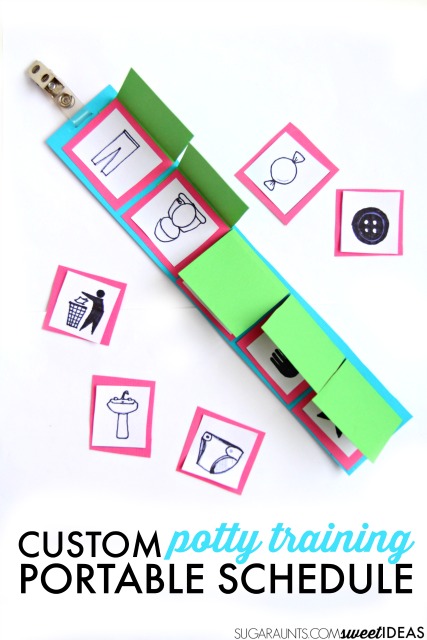
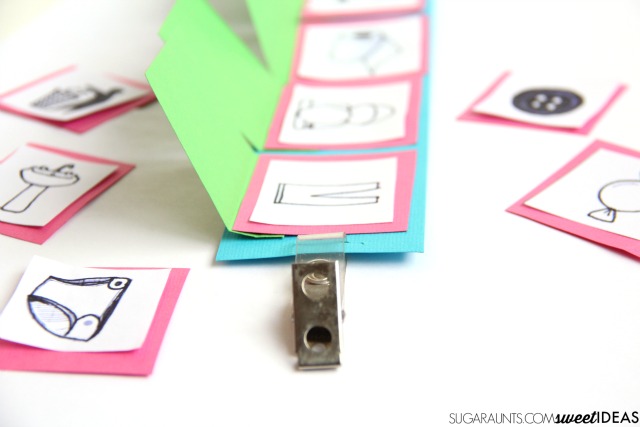
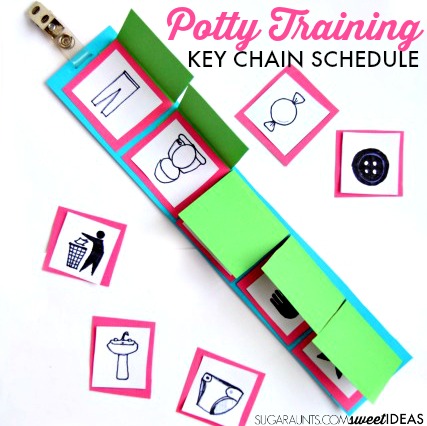
A schedule can be as basic as a “first-then” cue or complex and including each step of the potty training process. I have created a customized schedule card that can be attached to a key chain and taken to various bathrooms during outings as well as used in the home.
Use the steps printable to customize the schedule card to meet the needs of your child.
Another quick tip can include using an Alexa skill to create a timer or schedule for time to try the bathroom routine.
How to make a customized potty training schedule for kids:
Print the schedule images. Cut out the pictures that work best for your child’s needs. You can adjust the length or steps of the schedule based on your child. Changes to potty training schedules should be practiced for at least two weeks before giving up on a specific technique or schedule.
Using card stock, cut a 2 1/2″ by 9″ length.
Create 2 1/4″ x 2″ card stock squares for covers.
Fold and tape the covers to the back of a 2″ square card stock. This will hold the different steps of potty training.
Create a small slit and attach a badge clip. Use this clip-on schedule by attaching to clothing or hang it in a bathroom.
Choices– Incorporate choices into the potty training process. Choices might include:
Do you want to use this restroom or that one?
Do you want to use the paper towel or the hand drier?
Do you want to walk or hop into the bathroom?
Choices like these allow the child to feel in control of a situation that has to happen. Toileting is a task that must occur and the choice that a child makes can sometimes be withholding toileting or purposefully urinating on the floor instead of in the toilet.
Positive Reinforcement– Positive behaviors can be rewarded to provide feedback to the child with behaviors. Feedback is the information about the outcome of a response.
Internal feedback is the response of the sensory systems in respond to a task. A child feels better after toileting.
2. External feedback comes from a source. In potty training, external feedback might be visual cues or praise from a parent in response to completed tasks. A reward system is another type of external feedback.
Feedback can be provided after every completed step of potty training, or it can be varied to transition to the end of tasks. Feedback (like a small food reward) that is given after every step of potty training becomes a crutch.
Positive reinforcement should be transitioned to the end result of toileting, including hygiene, washing hands, and leaving the bathroom in order to help with skill retention.
Initially, a positive reinforcement such as a food or sticker reward should be given immediately after the child does the expected behavior. They can be given the reward every time they complete that part of potty training. Gradually you will increase the steps the child needs to accomplish before earning a reward. Parents should be specific with the behavior that is being reinforced. Say,“I like the way you are sitting on the toilet,” as they are given a tangible reinforcement.
Reinforcer Chart– A child who is working on multiple steps of potty training or who has moved on from single step positive reinforcement can use a reinforcer chart to earn a small prize after multiple successful attempts at toileting.
The child might earn a toy from a prize bin or a small treat at a store. Even a picking a sticker out of a basket and allowing the child to place the sticker onto a potty training chart is a great tool that offers positive reinforcement.
This type of reinforcement builds delayed gratification.
Positive Communication– When behaviors arise during potty training, it is important to use effective communication and not respond with criticism to behaviors or inattention.
Also important is avoiding the term “good job” as a reward to accomplishing desired behaviors. A child might not be successful but tried hard. Other more appropriate terms include words or gestures for encouragement or suggestions for “next time”.
Potty Training Tips to Help with Behavior and Attention Concerns:
Simplify when teaching new skills. Break down tasks into smaller, obtainable steps to allow success. Provide positive reinforcement to each step.
Use stronger reinforcers for more difficult tasks. This might include holding urine overnight for several nights or continuing potty training skills at different settings outside the home.
Verbal cues are more difficult to fade than physical cues. Limit the amount of verbal cues once a child has shown success with steps of potty training.
Potty Training Resources: Warwick, T. (2013, February). Effective Strategies for Decreasing Challenging Behavior in Individuals with Autism Spectrum Disorders. OccupationalTherapy.com, Article 2174.
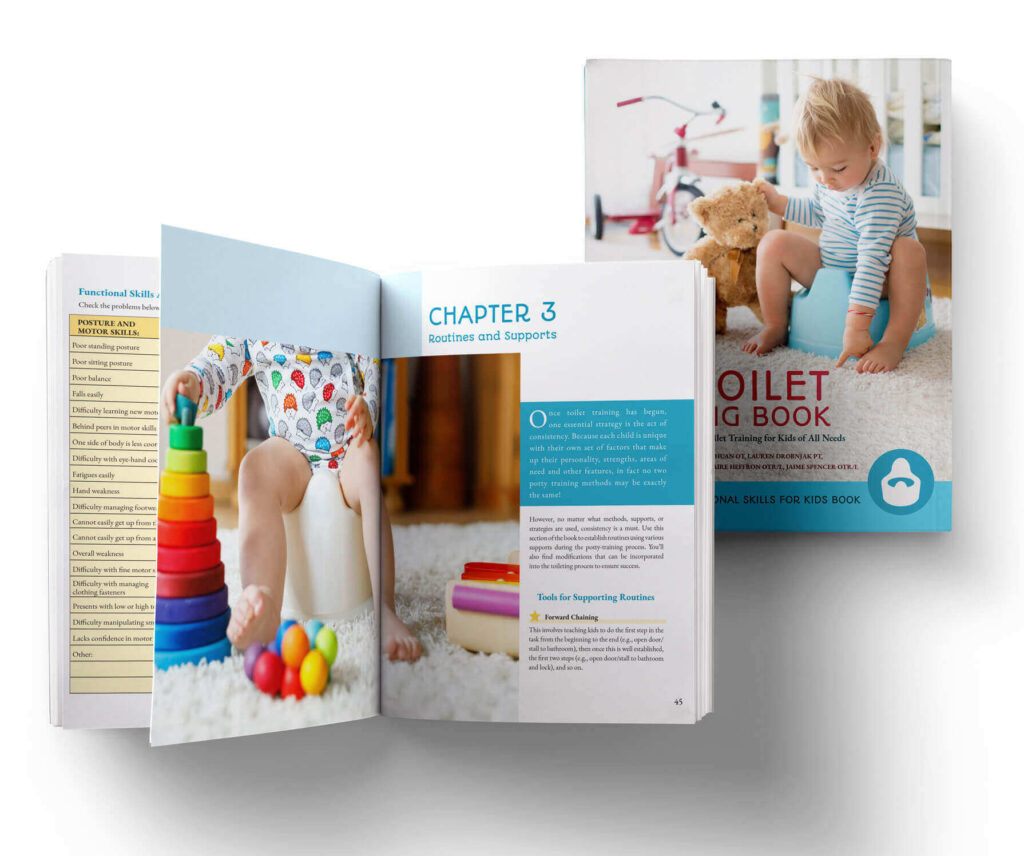
The Toilet Training Book is a developmental resource on potty training children of all abilities and skills. Created by occupational therapists and physical therapists, and guided by child development, this toilet training resource is like no other.
Tackling potty training is a challenge for all kids! What if you had the inside scoop on development in your back pocket?
In the book, you’ll find guidance, tips, and actionable strategies to support all aspects of toilet training, including tools and supports for kids with physicals needs, neurotypical individuals, and children of all needs and levels.
Written by a team of experienced pediatric occupational therapists and physical therapists with decades of experience
Packed with information on toilet training readiness and achievement of toileting success
Includes Toilet Training Guides for special populations (children with fine or gross motor needs, behavioral or cognitive challenges, physical disabilities, etc.) including Sensory Processing Disorder, Trauma-Informed Needs, Autism Spectrum Disorder, Cerebral Palsy, Spina Bifida, Spinal Cord Injuries
Provides information on interoception and the role this sensory system plays in potty training
Discusses common toileting equipment and special needs toileting tools
Includes tips and suggestions for individualized toilet training
Colleen Beck, OTR/L has been an occupational therapist since 2000, working in school-based, hand therapy, outpatient peds, EI, and SNF. Colleen created The OT Toolbox to inspire therapists, teachers, and parents with easy and fun tools to help children thrive. Read her story about going from an OT making $3/hour (after paying for kids’ childcare) to a full-time OT resource creator for millions of readers. Want to collaborate? Send an email to contact@theottoolbox.com.
Looking for Spring Fine Motor Activities to do with the kids this time of year? This is the space to find creative activities and ideas to promote fine motor skills like hand strength, dexterity, open thumb web space, arch development, and the precision grasp needed for functional tasks like pencil grasp, endurance in handwriting, scissor use, clothing fastener use, the ability to open containers, type with finger isolation, and every other fine motor task you can imagine!
The best thing about the Spring activities listed here are the use of everyday items, making therapy planning a breeze. Use some of these ideas in your Spring occupational therapy plans in the clinic or when coming up with a home program for your pediatric clients. It’s also a great way to sneak in fine motor work this time of year in a fun way!
Spring Fine Motor Activities
Other seasonal occupational therapy activities can be integrated with these sensory ideas. Include aspects of these Spring OT ideas to create a well-rounded lesson plan this time of year:
For a more exhaustive set of strategies, activities, and ideas, be sure to grab the Spring Fine Motor Kit (PLUS bonus kit which covers everything you need for Spring Break) that is on sale now for just $10. You’ll be loaded up on all kinds of tools that will last all season long.
Fine motor skills can be address through seasonal, Spring activities. Skills such as
One thing that makes a big difference in fine motor dexterity is addressing separation of the sides of the hand. This post explains more about motoric separation of the hand and here is another fun activity that really strengthens those muscles.
Quick Powerful Strategies to Build Fine Motor Skills
Use a cootie catcher– When kids use a cootie catcher, they work on so many fine motor skills: scissor skills to cut the paper, finger isolation, hand strength, and bilateral coordination to fold the cootie catcher, eye-hand coordination, bilateral coordination, and separation of the sides of the hands, and arch development to use and manipulate the cootie catcher. This is a powerful fine motor tool! You can print off our Spring cootie catcher here (free download).
Sort and manipulate small objects- Holding a small item like crumbled paper, a bead, or mini-eraser helps refine motoric separation of the sides of the hand. Motoric Separation of the Two Sides of the Hand refers to using a precision side of the hand and a stabilizing side of the hand. This ability is needed for pencil grasp, managing buttons, shoe tying, threading a needle, buttoning, and so much more.
Separation of the two sides of two sides of the hand is important for tasks like holding a pencil while stabilizing the hand along the table, cutting with scissors, and managing coins, among other activities.
Refinement of fine motor skills in the hand (the radial side) happens when the power half (the ulnar side) is stabilized. A functional fine motor grasp and manipulation of objects is more accurate when the ring and pinky fingers are flexed (bent) into the palm.
This positioning stabilizes the MCP arch and allows for control of the pointer and middle fingers. Separation of the two sides of the hand allow for more precise use of the thumb. Hand separation starts when a baby bears weight through their arm and ulnar side of the hand while carrying a toy in the radial side.
This simple activity developmentally lengthens the muscles of the ulnar side.
Try these quick Spring ideas to work fine motor skills:
Pick petals from leaves
Sort Spring mini-erasers into egg cartons
Crumble tissue paper to make tissue paper art
Tear small strips of paper and glue them to paper to build letters, spelling “SPRING”
Hand Dominance-Hand dominance in children is important for refining the skills needed to perform functional tasks. While Toddlers begin to show a hand preference, a true hand dominance doesn’t typically develop until 2 to 3 1/2 years. A toddler can show a hand preference, however hand usage is many times, experimented with during different activities throughout the Toddler and Preschool years. There is typically variability in hand preference as toddlers and young preschoolers poke, pick up, throw, color, and play.
These OT activities using tongs are great for developing and strengthening the arches of the hands for improved intrinsic strength.
In fact, the intrinsic muscles are the muscles in the hand that define the arches of the hands, bend the knuckles, and oppose with the thumbs. Activities like this intrinsic muscle strengthening activity can easily be replicated at home or in the therapy room.
Among these muscles are a group called the lumbricals. The lumbrical muscles have a job to bend (flex) the MCP joints and extend (straighten) the PIP and DIP joints. When the lumbricals are in action, the hand might look like it is holding a plate with the big knuckles bent and the fingers extended. Read more about strengthening the intrinsics here.
These are just a few examples of fine motor skills that are essential for functional development and effective manipulation of tools.
Use tongs to help build fine motor skills with these Spring ideas:
Use tongs to color sort objects into baskets or bins
Use tweezers in a Spring sensory bin
Pick up items in a Spring obstacle course
Place colorful craft pom poms along a fine motor path on paper
These ideas are part of our Spring Week here on The OT Toolbox. Be sure to stop back each day this week to find more Spring occupational therapy activities and ideas to use all season long
Today is all about Spring Fine Motor Activities. Check the out below!
Spring Occupational Therapy Activities
Try some of these ideas to promote fine motor skills this Spring:
Use this cherry blossom activity to promote hand strength, precision, opening of the thumb web space, thumb stability, arch development and intrinsic muscle strength. Kids can make the cherry blossom activity, but also work on visual motor skills and patterns. Read more about this spring activity and how it promotes hand strength in so many ways.
Love cherry blossoms and want to go with a cherry blossom theme while boosting those fine motor skills? Try this Cherry Blossom Tree Craft and strengthen pinch, grip, arch development, separation of the sides of the hand, thumb stability, bilateral coordination, and other skills.
Perfect for the Spring season, this Easter activity builds the underlying skills needed for accuracy and precision with scissor skills.
Work on pincer grasp, hand strength, dexterity, and mobility with this robin craft. Kids will love feeding worms to the robins that they make from egg cartons. Best of all, it uses recycled materials and can be used over and over again!
Looking for tons of Spring craft ideas to last the whole season long? You’ll find loads of ideas from around the web!
This cupcake liner flower craft is a great (easy) craft idea to promote scissor skills. I love that it helps kids to work on precision when cutting with scissors and graded snips to stop at a specific point when cutting. This is a hard skill to master! Kids will love to see the flowers they create when cutting up to a point and then stopping the scissors to create the flower!
Another Spring fine motor activity that promotes scissor use is this butterfly craft. Kids can learn to cut curved lines and improve precision by cutting with a thinner material using cupcake liners to help with precision and accuracy. What a fun spring craft for kids!
Take a different spin on Spring activities and celebrate Earth Day by making crafts and activities using recycled materials. There’s something for everyone here…all while promoting fine motor skills!
One easy way to work on hand strength is to create a Spring Play Dough Press Activity. Simply pull out the play dough and some Spring items like cookie cutters, flowers, feathers, small animal toys, and other Spring-themed items. Create a sensory table experience and press those items right into the play dough. Kids can hide items and find them again or match up the impressions to the toys. It’s a great way to strengthen the intrinsic muscles, promote endurance in the hands, and to do it with a Spring theme!
This Spring Sensory Seek and Find Activity is an old one on the website, but it’s still a great way to promote fine motor skills like separation of the sides of the hand and finger isolation! It’s a good way to work on finger isolation and separation of the sides of the hand. Not to mention, moving the materials in the sensory bag around promotes hand strength, along with visual motor skills and visual perception. All you need is a plastic bag, clear hair gel, some food coloring, and Spring stickers!
Need some quick ideas to celebrate Easter? These bunny activities should spark some ideas!
One of our favorite ways to work on fine motor skills this time of year is with our good, old bunny tongs. This Spring fine motor activity promotes the skills needed for scissor use, as well as hand strength, eye-hand coordination, and more. You should be able to find the bunny tongs at the dollar store this time of year!
Work on scissor skills with this Recycled Artwork Spring Flower craft. It’s a great way to use up that artwork that you don’t know what to do with, too!
Spring Fine Motor Kit
Score Fine Motor Tools and resources and help kids build the skills they need to thrive!
Developing hand strength, dexterity, dexterity, precision skills, and eye-hand coordination skills that kids need for holding and writing with a pencil, coloring, and manipulating small objects in every day task doesn’t need to be difficult. The Spring Fine Motor Kit includes 100 pages of fine motor activities, worksheets, crafts, and more:
Colleen Beck, OTR/L has been an occupational therapist since 2000, working in school-based, hand therapy, outpatient peds, EI, and SNF. Colleen created The OT Toolbox to inspire therapists, teachers, and parents with easy and fun tools to help children thrive. Read her story about going from an OT making $3/hour (after paying for kids’ childcare) to a full-time OT resource creator for millions of readers. Want to collaborate? Send an email to contact@theottoolbox.com.
Today, we’re talking about all things Spring sensory activities. When it comes to spring and the change in the weather (hopefully), a few sensory-themed activities can be a tool for working on a variety of skill areas, all through play and sensory exploration. These ideas are just one aspect of Spring OT activities that develop skills through play.
Today, we’re going to discuss using sensory activities to address corresponding needs. Because when it comes to sensory processing, there can be related areas that are impacted as a result of sensory information being poorly processed and resulting in functional skills and development being impacted.
Spring Sensory Activities
For the child with identified sensory processing difficulties, an effective treatment plan needs to be established, so that the individual can more effectively participate in functional activities.
In today’s blog post, you’ll find some activities and modifications that can be used in the home, classroom, or therapy clinic. These are Spring sensory activities to add to a therapy plan this time of year. Add them to some of the other ideas being shared this week on our website and in our newsletter to create a themed set of interventions that meet the needs of a full caseload!
Other seasonal occupational therapy activities can be integrated with these sensory ideas. Include aspects of these Spring OT ideas to create a well-rounded lesson plan this time of year:
For a more exhaustive set of strategies, activities, and ideas, be sure to grab the Spring Fine Motor Kit (PLUS bonus kit which covers everything you need for Spring Break) that is on sale now for just $10. You’ll be loaded up on all kinds of tools that will last all season long.
Spring Sensory Activities
Let’s go over aspects of play for this time of year that incorporate much-needed sensory input for various areas. We’ll break down the activity ideas by sensory system to get you started.
Spring Proprioceptive and Vestibular Activities
These Spring Sensory Activities are designed to improve discrimination of Vestibular and Proprioceptive Information:
Some kids with poor discrimination of sensory input, especially vestibular and proprioceptive input, may present with poor coordination, posture, balance, attention, and clumsiness, and/or constant fidgeting.
These kiddos may benefit from some resistive work activities.
Try some of these Spring themed ideas to work on these areas:
Spring Heavy Work- Heavy work can be calming as a self-regulation tool. Use these free Spring themed heavy work cards to add activity ideas. They are great for brain breaks and to use in obstacle courses or a transition activity in a visual schedule.
Spring Sensory Stations- Our popular sensory stations printables are great to add movement, heavy work, deep breathing, and mindfulness to the classroom, school hallway, clinic, or home. Print them off, slip them into a page protector, or laminate them, and hang them in a highly trafficked area in the school or classroom. Or, use them in a quiet calm-down corner. These sensory stations offer a chance for self-regulation and sensory input for brain breaks and calming input when kids need them.
Bunny Wall Push-ups- Cut out a pair of bunny paw prints and tape them to the wall. This is a place to hop over to and then perform wall push-ups.
Egg Rubber Bands- Provide heavy work to the hands by wrapping rubber bands around plastic Easter eggs. Kids can try to unwrap the rubber bands and then re-wrap the eggs. Use the bands as a hand exercise for the fingers in extension and in finger flexion.
Tug-of-War- Use a rope or sturdy jump rope to pull heavy items from one location to another. Some ideas include a basket or bin full of books or weights. Transport a stuffed animal or plastic Easter eggs in the basket or bin. Sit or lay on a therapy ball to pull the objects out of the bin. Kids can lay in supine on the therapy ball while pulling the rope, too.
Make a Spring Trail Mix- Add in crunchy and chewy items such as dry cranberries, small, chopped carrots, fruit leather, small pretzel pieces, bunny crackers or bunny pretzels.
Make a Spring Crash Zone- Use heavy blankets, couch cushions, and pillows to create a crash pad area. Hide fake flower tops (remove the stems) in the pillows and blankets. Kids can jump and find various flowers. Give them a specific number or specific color to locate in the jumping area.
Leap Frog- Remember the classic leap frog game? It’s a great Spring sensory activity! Kids can jump over small items or paper lily pads. In a pinch for time? Just use paper plates for your lily pads.
Spring Sensory Ideas for Discrimination of Tactile System
These Spring sensory activities are designed to bring awareness to and to improve a decreased or impaired discrimination of tactile sensory input:
A poor body scheme is common in kids with sensory processing needs. As a result, praxis and fine motor skills can be difficult.
Kids may seek out additional input through their hands by touching everything they see.
Other kids can’t discriminate between light and heavy tactile input.
Here are some spring-themed sensory activities to encourage tactile discrimination:
Use craft sheets and draw flowers or “grass” lines with a ballpoint pen. Then, the child can use a felt tip marker to trace the lines in the craft sheet. Allow them to trace with the ball point pen, too. Using the different writing tools provides various feedback in the resistive surface of the craft sheet. This is a great pre-writing lines activity for younger kids. You can see how we used craft sheets to work on pencil control using this sensory technique in a previous activity post.
Use a vibrating pen- Create a flower shape or egg shape with Wikki Stix. Then, use the vibrating pen to draw lines or color in the parts of the flower/egg. Use cookie cutters to encourage bilateral coordination of an assisting hand and the dominant hand. Vibrating pens provide great sensory feedback to the hands.
Use hot glue or regular school glue to create tracing forms. Write spring words like “sun”, “bee”, “flowers”, “grass”, etc. or trace Spring coloring pages with the glue. Allow the glue to dry and then place another sheet over the hardened glue. Use crayons to shade over the raised lines. Here is an example of how we used glue to practice sight words with DIY crayon rubbings with an emphasis on tactile sensory input.
Spring Sensory Ideas for Somatodyspraxia
Somatodyspraxia is a common occurrence in those with sensory processing challenges.
Somatodyspraxia is seen via frequent falling, poor posture, balance, tripping, running into or bumping into others or objects, trouble managing small items or manipulating objects as a result of poor fine motor skills, along with poor body scheme and organization.
Kids who struggle to process tactile input and vestibular information can be challenged with praxis concerns.
Here are some Spring Sensory Activities designed to address somatodyspraxia:
Spring obstacle course- Make an obstacle course that requires various motor movements, motor planning, changes in body position, and organization of body actions. This can easily be accomplished with pillows, couch cushions, chairs, laundry baskets or buckets, and everyday items. Use colored Easter eggs or fake flowers to carry through the obstacle course while challenging praxis.
Bean Bag Toss- Use several small baskets or buckets to work on motor planning with bean bags. Use visual and verbal instructions to place or toss the bean bags into the targets with either one hand or the other (or a foot by placing the bean bag on the toes!). Use simplified instructions to follow instructions. Downgrade the activity by having the child repeat instructions and steps of the direction.
For more assistance with somatodyspraxia, add more cues, simplified instructions, visual cues, and single-step motor tasks.
Spring Sensory Activities for Bilateral Coordination
Bilateral coordination difficulties are common for the child with sensory processing challenges.
This looks like uncoordinated movements in hopping, jumping, jumping jacks, kicking a ball, catching a ball, running, climbing, etc.
This might carryover to fearfulness when challenged to complete these tasks. You may also see trouble with hand dominance or left/right discrimination.
Here are some Spring Sensory Activities that can help:
Play Simon Says with a Spring Theme- Encourage bilateral coordination movements and alternating motions to follow directions. Use a Spring theme by saying “hop like a frog”, “crawl like a caterpillar”, etc. Use stickers or a stamp to identify the left or right hand and foot for these actions. Use our free Spring Heavy Work cards in a Simon Says activity this time of year.
Play Hopscotch- Draw a hopscotch board and draw lily pads or spring flowers on the board. Kids can hop onto the squares. Also try jumping with one or both feet onto the target square.
Spring sensory Activities to Address Tactile Defensiveness
Tactile defensiveness can present in many ways, including a refusal to touch certain materials, resistiveness to certain clothing fabrics, food preferences, or avoidance of certain materials or activities.
Adding heavy input or slow, calming vestibular input can be helpful in some individuals.
Try some of these Spring themed sensory activities:
Deep Pressure- Add weights to the wrists or a weighted lap pad along with heavy work to the hands. Try using a large eraser to erase flowers drawn on construction paper. Ask the child to erase the flower completely. Try using lighter pencil strokes and reducing the amount of erasing needed. This is one way to work on pencil pressure, too.
Flower-Push- Add proprioceptive input to a gross motor activity that provides heavy work through the whole body. Draw a flower or sun on two paper plates. Place them on the floor and ask the child to place their hands on the flower picture while they get into a push-up position. The child can push the flowers across the floor.
Caterpillar Roll- Use a blanket to roll the child up in a log position. The child is now a caterpillar! Add slow and heavy input through up and down the length of the child, using whole hands and slow movements.
Spring Sensory Activities to Address Gravitational Insecurity
Sensory challenges sometimes present with gravitational insecurity. This might look like the child that has trouble being positioned off the ground, such as on a raised surface like a swing, bleachers, on an elevator, or escalator, etc. Calming proprioceptive input can be helpful.
Here are some Spring Sensory Activities that can help:
Add Spring stickers to a weighted lap pad or wrist/ankle weights. Make it fun!
Flower Breaths-Try deep breathing activities such as imagining blowing a dandelion fluff across a field. Use deep and slow breaths to imagine moving those flower fluffs away. This can be helpful before participating in an activity that requires motion that can be a challenge for the child, such as when riding in a car.
More Spring Sensory Activities
Looking for more ways to promote sensory activities through movement and play? The Spring Fine Motor Kit gets kids moving in just the right ways to build strong and efficient hands. When you grab the kit now through the 22nd, you’ll also get a BONUS resources full of sensory strategies to meet all sensory processing needs.
Spring Fine Motor Kit
Score Fine Motor Tools and resources and help kids build the skills they need to thrive!
Developing hand strength, dexterity, dexterity, precision skills, and eye-hand coordination skills that kids need for holding and writing with a pencil, coloring, and manipulating small objects in every day task doesn’t need to be difficult. The Spring Fine Motor Kit includes 100 pages of fine motor activities, worksheets, crafts, and more:
In this BONUS set, you’ll find: Spring Visual Perception Worksheets- Print these off and slide them into a page protector. Use them to work on visual perceptual skills like form discrimination, visual closure, figure ground, and visual processing skills like tracking, scanning, etc. Use manipulative items to work on fine motor skills with these worksheets such as play dough, slime, Wikki Stix, yarn, craft pom poms, or other items.
Spring Fine Motor and Gross Motor Activities- Add these ideas to therapy home programs to work on pencil grasp or core strength. Use these ideas in therapy warm-ups, or to add movement to a child’s day.
Spring Themed Brain Breaks- Cut up these cards and use them to add movement and motor skills into the classroom or home. It’s a great way to re-charge!
Spring Themed Handwriting Practice Prompts- There are two pages of writing prompts that are ONLY in list form. That means kids don’t need to write out sentences while working on letter formation, spacing and size. They can work on all of the handwriting skills they need in a short list that is interest-based, making it motivational for them. And, the list format is a quick way to sneak in handwriting practice!
OT Homework Sheet- Sometimes, it takes extra practice to make skills “stick”. When parents help in practicing therapy activities, it can make a difference in carryover. You’ll find a done-for-you OT homework sheet to use in weekly homework activities OR for use as a home exercise program!
Client-Centered Worksheet- When our kiddos have a voice in their therapy, carryover and goals can be more meaningful to them. Use this worksheet to come up with Spring activities that meet the needs of a child, while taking into considerations that child’s interests and strengths to make activities meaningful.
Sensory Activities and More- All of these extras were added to the already well-rounded Spring packet that includes activities designed around each of the sensory systems. You’ll find 13 pages of proprioception activities, vestibular activities, tactile activities, oral motor activities, etc. And, they include ideas to extend the activity to include eye-hand coordination, body scheme, oculomotor control, visual perception, coordination, and motor planning.


Colleen Beck, OTR/L has been an occupational therapist since 2000, working in school-based, hand therapy, outpatient peds, EI, and SNF. Colleen created The OT Toolbox to inspire therapists, teachers, and parents with easy and fun tools to help children thrive. Read her story about going from an OT making $3/hour (after paying for kids’ childcare) to a full-time OT resource creator for millions of readers. Want to collaborate? Send an email to contact@theottoolbox.com.
In this blog post, you’ll find Spring handwriting activities that kids can use to work on letter formation, copying skills, line use, spacing, and overall legibility of written work with a fun Spring theme! This is a great set of handwriting activities that are part of our Spring Occupational therapy activities.
Spring Handwriting Activities
These are handwriting activities that you can use to work on letter formation, spacing between letters and words, size awareness, and line use. All of this reflects back on handwriting legibility! And, when it comes to working on handwriting, we’re striving to make practice fun and NOT boring! Read on for some Spring handwriting ideas the kids will love!
Other seasonal occupational therapy activities can be integrated with these sensory ideas. Include aspects of these Spring OT ideas to create a well-rounded lesson plan this time of year:
For a more exhaustive set of strategies, activities, and ideas, be sure to grab the Spring Fine Motor Kit (PLUS bonus kit which covers everything you need for Spring Break) that is on sale now for just $10. You’ll be loaded up on all kinds of tools that will last all season long.
Now, onto the handwriting ideas!
Spring Handwriting Activities
When it comes to handwriting, sometimes you just have to make it fun. Practicing letter formation or copying skills can be downright boring.
For the child that struggles with these skills, self-confidence can really play into practice. When a child knows they struggle with certain aspects of written work such as letter formation or reversals, it can be hard to get them to want to practice, making home programs or any written work a real struggle.
Spring Handwriting Ideas
That’s why I wanted to pull together some extra-creative and fun ways to practice written work.
Spring Pre-Writing Lines- Kids will like this pre-writing lines activity that doubles as a way to work on letter formation and spatial awareness. We created eggs with wikki stix, but you can definitely modify this activity to a slower theme for those working in schools who can’t cover anything egg or Easter.
2. Spring Cookie Cutters- Do you have any Spring cookie cutters? If not, you can usually find them in dollar stores this time of year. Use butterfly and flower cookie cutters to work on handwriting skills like spatial awareness and line awareness needed for legible written work. This is a great writing warm-up activity this time of year.
3. Use grass seeds or other seeds- This time of year is all about growth, seeds, and new development. Pull together a spring theme with seeds and work on pincer grasp, in-hand manipulation, separation of the sides of the hand with letter formation! Kids can manipulate small seeds like grass seed to form letters or work on the letters of their name like we did in this Grass Seed Handwriting Activity. Then, lay the paper on newspaper, sprinkle dirt on top and see if it grows name-shaped grass in a week or so!
4. Celebrate Spring with rainbows! Pull out the colored chalk to work on letter formation with rainbow writing. On a warmer Spring day, go on out to a sidewalk, driveway, or blacktop surface to gain the resistive input of drawing with chalk on the ground. It’s a great way to really incorporate the motor planning needed for letter formation!
5. Write Spring Lists- A great way to work on handwriting is with lists. With a list of writing practice, kids who struggle with written work tend to not feel so overwhelmed. Writing out a list of words to practice aspects such as letter formation. line use, spacing, and letter size can be more beneficial than copying a few sentences. Granted, there is a time and place for copy work, too. It’s an exercise in visual motor skills, visual tracking, visual memory, and so many other skills. Print off these free Spring List Writing Prompts and start there.
6. Use a Spring writing tray! Writing trays are a fun way to incorporate the senses into letter formation and copying skills. Here are writing tray ideas to spark your imagination. What can you add to give sensory writing an extra Spring-y touch? Maybe write with a fake flower stem, or scatter petals in the sensory tray. In the Spring Fine Motor Kit, you’ll find lots of sensory bin materials to work with. The options are limitless.
7. Write in shaving cream for a multisensory experience with practicing letters. Use the write the room cards in the Spring Fine Motor Kit for words and letters to copy.
8. Use Spring stickers in handwriting. Do you have flower stickers, rainbows, or Easter stickers? Use them as writing prompts. There are so many benefits to using stickers in occupational therapy interventions. So, place them on a page and start writing while focusing on letter formation. Or, use them in a sensory writing bag like we did here. Kids can find the sticker and then write the name out on paper.
9. Spring Write the Room Activity- Use this Spring Write the Room slide deck to work on handwriting skills over the computer. Kids can write the words on paper or on the screen using an app like Jamboard.
10. Use a cootie catcher- We shared this free cootie catcher to develop fine motor skills, but there are handwriting benefits, too. Kids can write in words, phrases, and sentences while working on spatial awareness and handwriting in a given space. Print off the free template and go! There are several versions included: ones with writing prompts and some with pictures to work on pencil control skills as well.
More Spring Handwriting Activities
In the Spring Fine Motor Kit, you’ll find Write the Room and handwriting tasks designed to help kids with handwriting legibility, letter formation, size awareness, number formation, and so much more.
In just this portion of the kit, you’ll find: 3 pages of handwriting paper in modified lined paper, 8 lowercase copy cards, 8 uppercase copy cards, 8 lowercase tracing cards, 8 uppercase copy cards, 8 cursive writing copy cards.
Extend the activity: Use to copy words from near and far point copying skills. Use the words in creating sentences, writing lists, or as writing prompts. Incorporate words into scavenger hunt, and obstacle course activities.
TARGET SKILLS: Letter formation, pencil control, visual motor skills, visual attention, visual memory, line placement, functional handwriting at all levels and stages.
Spring Fine Motor Kit
Score Fine Motor Tools and resources and help kids build the skills they need to thrive!
Developing hand strength, dexterity, dexterity, precision skills, and eye-hand coordination skills that kids need for holding and writing with a pencil, coloring, and manipulating small objects in every day task doesn’t need to be difficult. The Spring Fine Motor Kit includes 100 pages of fine motor activities, worksheets, crafts, and more:
Colleen Beck, OTR/L has been an occupational therapist since 2000, working in school-based, hand therapy, outpatient peds, EI, and SNF. Colleen created The OT Toolbox to inspire therapists, teachers, and parents with easy and fun tools to help children thrive. Read her story about going from an OT making $3/hour (after paying for kids’ childcare) to a full-time OT resource creator for millions of readers. Want to collaborate? Send an email to contact@theottoolbox.com.