Spring Visual Perception Activities

Spring themed visual perception activities for kids

Have you been following along with the Spring Occupational Therapy activities this week? All week long we’re covering various aspects of development and function with fun and creative spring-themed ideas. Today you’ll find Spring Visual Perception Activities. These are ways to promote visual perceptual skill development and the visual components that are needed for skills like reading, writing, and functional tasks.

Spring Visual Perception Activities

 
Working on visual perceptual skills in kids to help with handwriting, reading, or other skills? These spring themed visual perception activities will help.

If you missed the other posts this week, you can check them out here:

For a more exhaustive set of strategies, activities, and ideas, be sure to grab the Spring Fine Motor Kit (PLUS bonus kit which covers everything you need for Spring Break) that is on sale now for just $10. You’ll be loaded up on all kinds of tools that will last all season long.

Each Spring theme includes activity ideas. To see all of the posts from this week (and to see what we’re coving tomorrow), head over to our Spring Occupational Therapy Activities page.

For more creative strategies and ideas to use in therapy this time of year, you will want to grab the Spring Fine Motor Kit that includes our Spring Occupational Therapy Activities Packet. It’s loaded with tools and ideas to put into place in therapy sessions starting today. 

For OT Toolbox readers and newsletter subscribers, you can access both of these materials in our Spring Fine Motor Kit DEAL which includes the bonus materials at the time of your purchase.

Use the ideas in fine motor or gross motor warm-ups, or add them to a home program. You’ll find more visual perceptual activities and worksheets that can be used over and over again. You’ll also find handwriting prompts in list form so you can really focus on things like letter formation, spacing, and line use in short writing tasks. You’ll love the Spring themed brain break cards that can be used in the classroom or at home.

Grab the Spring Occupational Therapy Activities Packet and bonus Spring Break Kit here.

Working on visual perceptual skills in kids to help with handwriting, reading, or other skills? These spring themed visual perception activities will help.


Spring Visual Perception Activities

When we breakdown the term “visual perception”, you will see that there are many sub-areas that are needed for functional skills like reading, handwriting, spelling, coordination, and many functional tasks.

Below, you’ll find an explanation of visual perceptual skills that impact function, as well as Spring-themed activities to help improve these areas.  

Read more about how visual perception impacts handwriting here.  

Visual Perceptual Skills

Visual Memory- This visual perceptual skill allows us to store information that we see and use that information for future use. In order to recall visual information, we need visual attention.

The selection and perception of visual input requires that information is perceived via the eye’s visual fields, and in coordination with oculomotor control, is processed through the visual cortex in the brain. This is how visual processing happens.

Visual memory allows for discrimination of details of such things as letter discrimination, sight word identification, etc.  

Spring Visual Memory Activities-

  • Use different colored plastic eggs or other items such as mini erasers. Put them in a series of three and show the student. You can then cover up the objects and then ask the student to replicate that series.
  • Create a Spring Memory game. Use pictures or stickers of flowers, chicks, bunnies, caterpillars, butterflies, etc. to create a DIY Memory game.
  • What’s Missing Game- Use those mini erasers from a dollar store to create a What’s Missing Game. Place a handful of erasers on a tray. Allow the child to memorize the items. Then cover them and remove one or more. The child needs to recall and identify the missing items.
  • Spring Memory Game (Free download)– print off this free printable and play memory games with a Spring theme.

Visual DiscriminationThis visual perceptual skill allows us to identify the features of a form/object/letter/number so we can tell the difference between objects.

Using visual discrimination, we can identify similarities and differences related to the objects and use that information in conjunction with visual memory.  

Spring Visual Discrimination Activities- 

  • Cut a spring picture or card into pieces. Kids can position the pieces to recreate the whole picture. Make this activity easier or more difficult as needed by the child.
  • Use a packet of spring stickers. Many times there are several sheets that contain the same stickers. Use them to make small cards. Mix up all of the cards and ask the child to find the matches.

Form Constancy- This visual perceptual skill allows for recognition of objects in various environments or with attention to details and orientation.

This allows us to recognize letters or numbers no matter their font or size.  

Spring Form Constancy Activities-

  • Write lists of spring words on index cards in different sizes or fonts, or upper case/lower case letters. Hide the cards around the room. The child can look at one card and go off to find the matching font and word.
  • Using plastic eggs, draw shapes that are similar in form, but are different sizes on each half of the egg. Then, mix up the eggs and as the child to find matches and put them together.

Visual Closure This visual perceptual skill enables the identification of objects or forms and allows us to identify an object by viewing just a portion and using mental skills to complete the object’s form in our mind.

Visual closure is a skill necessary for reading and recognizing words by viewing just the beginning letters. Visual closure is related to and requires visual memory and visual attention.

Spring Visual Closure Activities- 

  • Gather several Spring-themed items such as small animal figures, flowers, cookie cutters, plastic eggs, etc. Place them on a tray and cover half of the items. Ask the child to name each item without seeing the whole object.
  • Make an “I Spy” Frame- Cut a hole or rectangle in an index card. Place it over a spring picture or item. Ask the child to name the object or item by seeing only a portion.

Visual Figure Ground- This skill enables us to locate items in a busy background.  Finding hidden items in a hidden pictures puzzle works on this skill by visually scanning and identifying items within a busy scene.  

In handwriting, visual figure ground is necessary for copying written work from a model and locating the place left off when shifting vision.

Spring Visual-Figure Ground Activities-

  • Use small items such as mini-erasers of various shapes like bunnies, carrots, and flowers. Spread them out on a table in a pile. Ask the student to sort the like shapes into piles.
  • Go on an “I Spy” nature walk and look for signs of Spring.
  • Flip through a catalogue or grocery flier to find specific items on a list. These can be items needed for a Spring event like Mother’s Day or Easter, or items needed for a recipe. 

Visual Sequential Memory- This visual perceptual skill is the ability to visually take in and then later recall the sequence or order of items in the correct order. This skill is important in reading and writing.

Visual sequential memory is important in spelling words correctly and recognizing that words are not spelled correctly.

Spring Visual Sequential Memory Activities- 

  • Make an order of three or more items like three flowers. Ask the student to memorize the order and then to replicate it.
  • Talk about the steps to complete a task such as planting a flower seed. Write out or draw the steps. Cut the paper so the steps are separated. Mix up the order by spreading the various steps on a table surface. Ask the student to place them back into order. 

More Spring Visual Perception Activities

Spring Fine Motor Kit

Score Fine Motor Tools and resources and help kids build the skills they need to thrive!

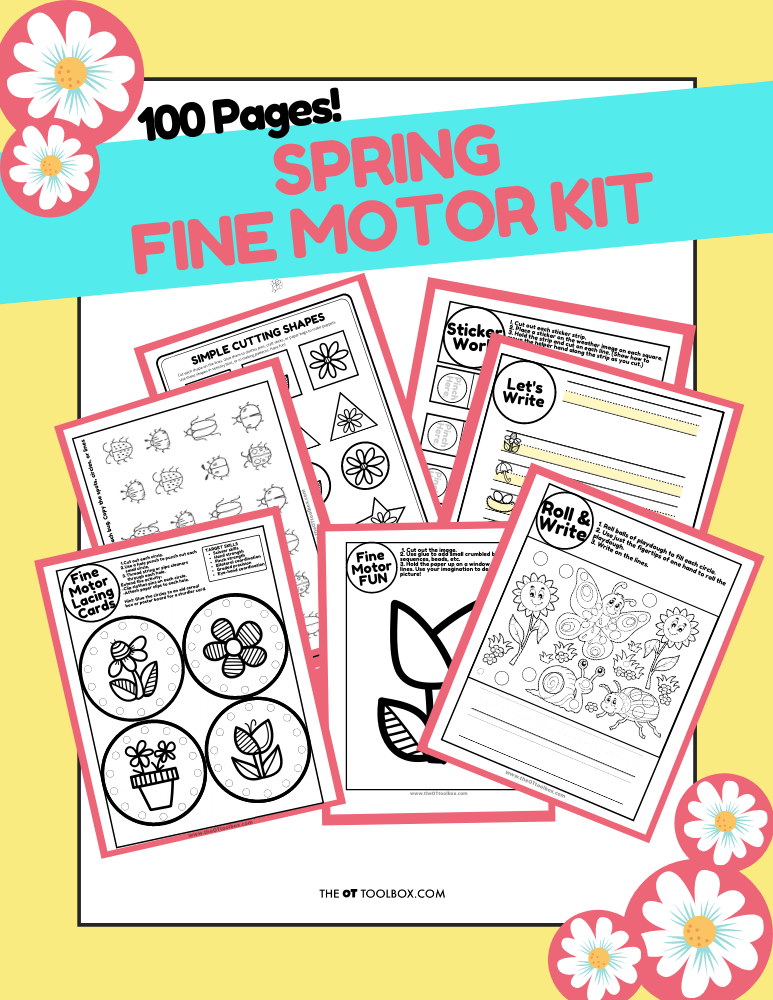
Developing hand strength, dexterity, dexterity, precision skills, and eye-hand coordination skills that kids need for holding and writing with a pencil, coloring, and manipulating small objects in every day task doesn’t need to be difficult. The Spring Fine Motor Kit includes 100 pages of fine motor activities, worksheets, crafts, and more:
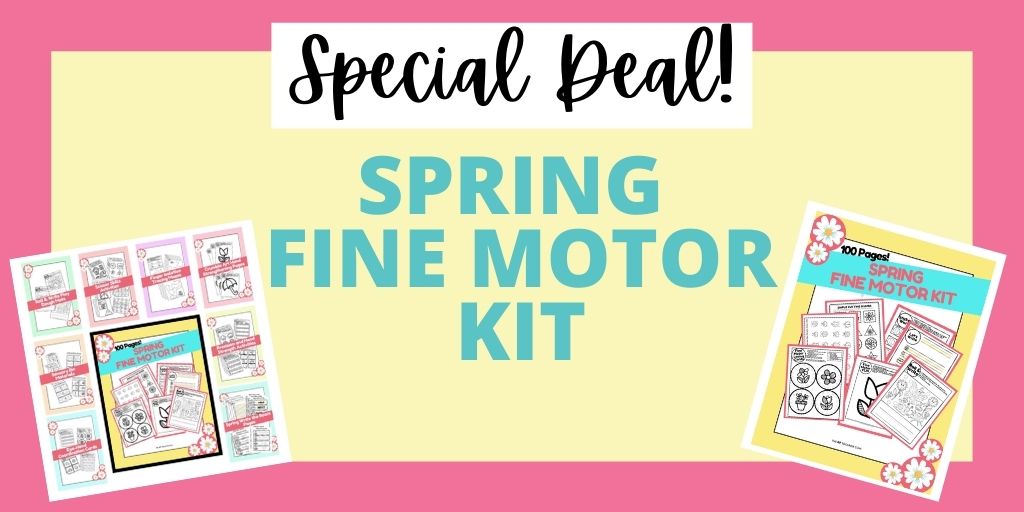
Spring fine motor kit set of printable fine motor skills worksheets for kids.
  • Lacing cards
  • Sensory bin cards
  • Hole punch activities
  • Pencil control worksheets
  • Play dough mats
  • Write the Room cards
  • Modified paper
  • Sticker activities
  • MUCH MORE

Click here to add this resource set to your therapy toolbox.
Spring Fine Motor Kit
Spring Fine Motor Kit: TONS of resources and tools to build stronger hands.

Grab your copy of the Spring Fine Motor Kit and build coordination, strength, and endurance in fun and creative activities. Click here to add this resource set to your therapy toolbox.

Colleen Beck, OTR/L has been an occupational therapist since 2000, working in school-based, hand therapy, outpatient peds, EI, and SNF. Colleen created The OT Toolbox to inspire therapists, teachers, and parents with easy and fun tools to help children thrive. Read her story about going from an OT making $3/hour (after paying for kids’ childcare) to a full-time OT resource creator for millions of readers. Want to collaborate? Send an email to contact@theottoolbox.com.
Spring Gross Motor Activities

Spring gross motor activities

This blog post on Spring gross motor activities is part of our collection of Spring activities for occupational therapy. Here, we’ve got gross motor ideas that have a Spring-theme, including balance, coordination, stability, and gross motor coordination tasks like skipping, hopping, jumping, and throwing. You’ll find throwing activities, ways to work on the eye-hand coordination needed for catching a ball, bilateral coordination ideas, core strengthening activities, and more.

These are the gross motor skill ideas that you can use in so many ways to address the skills kids need to succeed at home, at school, and in the community! Get the ideas below!

These spring gross motor activities are great ways to build strength in kids, including posture, stability, core strength, shoulder stability, and coordination, balance, and posture.


Spring Gross Motor Activities


Before we cover the gross motor ideas for Spring, be sure to check out  our Spring Fine Motor Activities collection. You can add ideas from each of our Spring Occupational Therapy Activities… because we’re loading you up on different ways to address developmental skill areas with a Spring-theme!

Remember, if you are looking for fun ideas to incorporate into therapy sessions, at home, or in the classroom, our Spring Fine Motor Kit is on sale right now. It’s 100 pages of spring ideas for addressing sensory processing, gross and fine motor skills, visual motor skills, visual perceptual skills, handwriting, and more. The packet will last you all season long and can be used over and over again. 


Grab the Spring Fine Motor Kit here. AND get the bonus Spring Break Kit, filled with handouts for Spring break activities, handwriting prompts, brain breaks, and a Spring homework sheet.

Spring Gross Motor Activities


Let’s get right to those Spring-themed Gross Motor Skills.

Shoulder and wrist stability are such a necessary part of fine motor control and precision. You’ve probably seen it before; a kiddo that writes or colors with their arm “floating” up off the table surface.

You probably know a child that writes with their whole arm as opposed to moving those fingers. You might recall a child manipulating small items like beads with their elbows smashed into their sides in order for them to have support and control…It’s all shoulder stability that is lacking!

We’re also talking about core stability, postural control, and balance. You might know a student that slouches at their desk.

What suffers? Handwriting legibility, reading comprehension, and the ability to copy materials without missing items.

 You may have seen a kiddo that is fearful on uneven surfaces like when maneuvering on bleachers, or struggles with active games in gym class. What may be the culprit to these coordination skills?
It just might be postural control, core strength, and stability.

The gross motor activities below provide opportunities to improve bilateral coordination, core strength as part of improving  postural stability, balance, coordination, shoulder stability, and shoulder girdle strengthening.
The activities follow a Spring-theme to use this time of year. 


These general activities combine movement combinations and motor planning that can be used as a fun brain break in the classroom, or a party game idea:


Create a Bunny Hop Gross Motor Game much like our Dinosaur Gross Motor Game! Just make the activities actions like Hop like a bunny, jump like a bunny, stomp your bunny feet, etc. You can add other spring animals too, like a lamb, baby chicks, or robins.


Make a DIY Dance Stick using ribbons, crepe paper, and string. Then, practice forming letters or writing spelling words with the dance stick. It can be decorated like a May Pole, too. Incorporate bilateral coordination and eye-hand coordination to wrap the stick with ribbon all the way up and around a dowel rod. 


Bean Bag Activity- We made ice cream cones, but carrots would be super easy, too…or just pretend the bean bags are carrots 🙂  Here are some bean bag games to use when working on midline crossing, core strength, motor planning, and other gross motor areas.

Build shoulder and wrist stability 

Shoulder stability is an area that so many kids can struggle with! Writing with their arm “floating” up off the table surface, using the whole arm to manipulate and move a pencil, and other small motor actions. Sometimes, kids that do activities and tasks quickly are compensating for weakness in the shoulder girdle. 


Use Wikki Stix to build Easter Eggs by sticking them to a wall. Position the child at a seated position facing the wall so shoulder flexion occurs at eye height. This is a great way to work on shoulder and wrist stability and mobility. 


Use Spring cookie cutters and small pieces of chalk on a chalkboard or easel. This activity is great for drawing and writing at shoulder height and uses both hands at midline. Working at the vertical surface promote core strength as well as shoulder stability and wrist extension. Bunnies, Easter eggs. hearts, and colorful circles or rainbows are fun this time of year.


Try Spring Yoga- There are some Yoga positions with a Spring theme described and listed in the Spring Occupational Therapy Activities Packet. Add fun animal names and positions to basic yoga positions.


Use a scooter board in prone. Push and pull the scooter board across the floor to transport Spring items into a basket. The dollar store is a good place to find small items. Better yet, use bunny tongs or other tools to transport the items.


Roll a small ball or a therapy ball up and down a wall. Use painters tape to make a ball maze or a strait line like the stem of a Spring flower. “Walk” the ball up the wall to shoulder height and then back down again. Get the ball to the top of the step to create the flower!


Spring Animal Walks- Do the bunny hop, frog jump, and lamb crawl from one side of the room to the other. Think: wheelbarrow walks, crab walks, donkey kicks, and bear walks with a Spring theme!


Color or play on the ground- Use Easter grass to create a sensory space on the floor. Use a large, low tray such as a jelly roll pan to create a sensory bin. Kids can use tongs to find hidden items such as mini-erasers.

Spring Posture and Balance Activities

Posture and trunk stability is essential for positioning in the classroom and in functional tasks in general. Postural control is needed to enable the student to sit upright at their desk, allowing for better handwriting, reading, and copying skills.

Kids who struggle with postural control and balance will be uncoordinated in fine motor tasks, activities requiring sustained positioning, have trouble with motor planning, and may be fearful of tasks that require mobility or uneven positioning such as maneuvering on bleachers or during active play.


Try some of the Spring themed gross motor activities below to improve postural control and balance:

Spring Obstacle Course- Use the printables in our Spring Sensory Stations (free download) to create motor planning tasks that build balance and coordination. Add in jump ropes to hop over, sand buckets to navigate around, and brain breaks (from our Spring Break Kit bonus) to make gross motor planning tasks.

Spring Heavy Work Activities- Add heavy work that challenges motor planning, balance, endurance, positioning changes, and motor skills. These can be used in Simon Says games, obstacle courses, and gross motor play. Print off a copy of these free Spring heavy work cards and get started. You’ll also like these therapy Simon Says commands.

Spring Caterpillar Pose- Assume the “superman pose” on the floor, but call it a caterpillar pose! You can be a caterpillar in the Springtime, gaining strength to start crawling and munching on leaves. Relax rest but then return to the extended arms, legs, and head positioning as you wake up again! 


Balloon Pass- Lie on your back and pull the hips and knees into flexion, toward the belly. Try to hold a ball or balloon between your feet. Then, pass the ball to a friend lying opposite on the floor. Pass the ball into a hoop or large basket. 


Egg Pass- Sit on a partially inflated beach ball and try to balance a plastic egg on a spoon. Try to pass the egg to a friend and then drop it into a basket. 

These spring gross motor activities are great ways to build strength in kids, including posture, stability, core strength, shoulder stability, and coordination, balance, and posture.

Spring Fine Motor Kit

Score Fine Motor Tools and resources and help kids build the skills they need to thrive!

Developing hand strength, dexterity, dexterity, precision skills, and eye-hand coordination skills that kids need for holding and writing with a pencil, coloring, and manipulating small objects in every day task doesn’t need to be difficult. The Spring Fine Motor Kit includes 100 pages of fine motor activities, worksheets, crafts, and more:

Spring fine motor kit set of printable fine motor skills worksheets for kids.
  • Lacing cards
  • Sensory bin cards
  • Hole punch activities
  • Pencil control worksheets
  • Play dough mats
  • Write the Room cards
  • Modified paper
  • Sticker activities
  • MUCH MORE

Click here to add this resource set to your therapy toolbox.

Spring Fine Motor Kit
Spring Fine Motor Kit: TONS of resources and tools to build stronger hands.

Grab your copy of the Spring Fine Motor Kit and build coordination, strength, and endurance in fun and creative activities. Click here to add this resource set to your therapy toolbox.

Colleen Beck, OTR/L has been an occupational therapist since 2000, working in school-based, hand therapy, outpatient peds, EI, and SNF. Colleen created The OT Toolbox to inspire therapists, teachers, and parents with easy and fun tools to help children thrive. Read her story about going from an OT making $3/hour (after paying for kids’ childcare) to a full-time OT resource creator for millions of readers. Want to collaborate? Send an email to contact@theottoolbox.com.
Spring Activities for Executive Functioning

Spring activities for executive functioning

Here, we’re covering spring activities for executive functioning skills. Executive functioning has recently become a bit of a buzzword. There’s good reason: parents, teachers, and therapists are more aware of the developmental processes that impacts learning, social emotional skills, functional tasks, safety, and even handwriting. Buzz like a bee, spring into executive functioning, and learn more about this concept and how you can integrate it into your Spring occupational therapy activities!

spring executive function activities

Spring activities for Executive Functioning

Other seasonal occupational therapy activities can be integrated with these sensory ideas. Include aspects of these Spring OT ideas to create a well-rounded lesson plan this time of year:

For a more exhaustive set of strategies, activities, and ideas, be sure to grab the Spring Fine Motor Kit (PLUS bonus kit which covers everything you need for Spring Break) that is on sale now for just $10. You’ll be loaded up on all kinds of tools that will last all season long.

Spring is such a great time of the year. Flowers blooming, the smell of freshly fallen rain, and increasingly temperate weather for those of us who live in snowy winter areas! This is an opportunity to enjoy some more play outdoors. The start of Spring also can mean a time to develop new goals in the way of executive functioning.

Play is incredibly important for development, especially in the area of executive functioning. Take the opportunity to encourage more complex play in your dialogue with a child. This article discusses the value of open-ended play for executive functioning development.

Interested in learning more about executive functioning? Check out this list of books about executive function.

For a fun way to get kids involved in creating goals and targeting specific executive functions, grab the Impulse Control Journal, a printable pages to document working memory, prioritization, planning, and other executive functioning skills.

Outdoor Spring Activities for Executive Functioning

Going into the outdoors is an amazing spring-time opportunity for executive functioning growth. Simple games like hide and seek encourage children to utilize working memory (remembering where they already looked when in the role of seeker), prediction (where a challenging hiding spot might be), and self-monitoring and impulse control (not giving away hiding spots).

Spring Nature Walk- A sensory nature walk for the family incorporates all aspects of sensory processing but also offers opportunities for building executive functioning experiences in the ways of attention, focus, impulse control, working memory, planning, prioritization. All of these skills can be addressed through conversation, hands-on play, movement, and experiencing the outdoors.

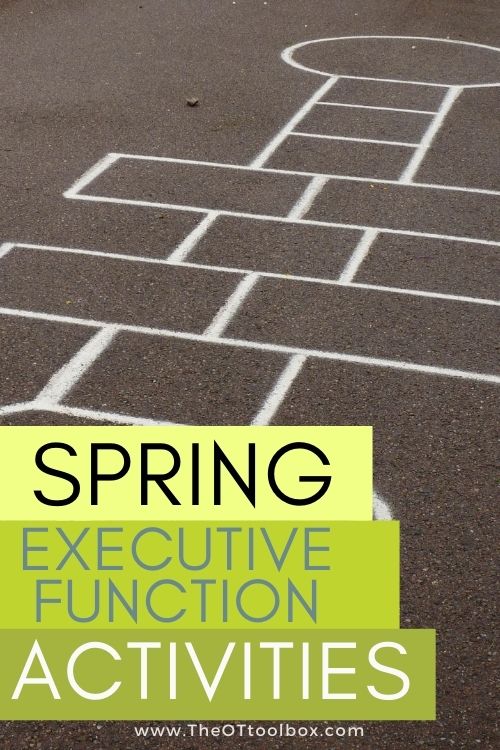
Outdoor Springtime Play- Other activities like hopscotch also present an opportunity to utilize working memory (try increasing the challenge by requiring that they only jump on the odds!) initiation.

Encourage opportunities for open-ended play, such as pretend play using items found during a scavenger hunt. Speaking of, scavenger hunts are a great way to encourage the use of executive functioning skills outdoors! Working memory, planning and organizing, impulse control, initiation, self and task-monitoring, and so on.

Outdoor play is always encouraged, but it gets a lot easier in spring without the need to bundle up in cold climates! There are so many ways to work on executive functioning skills outdoors, so get outside and play!

Spring Indoor Activities for Executive Functioning

Weather sometimes becomes an obstacle to playing outdoors in spring. However, there are many ways to integrate executive functioning into indoor play on rainy days.

Play Memory– This free Spring memory game is a great way to work on executive functioning skills- task completion, planning, working memory, attention, organization, and more. Just print off the free memory game and go!

Scavenger Hunts- Sure, scavenger hunts can be more challenging outdoors, but try making one indoors! You could even require that all of the items start with a certain letter of the alphabet or be a certain color to make it more difficult!

Board games- Board games are another great way to work on executive functioning skills. Some favorites include Outfoxed, cribbage, Ticket to Ride, and Magic Labyrinth.

Cook Spring recipes- Cooking can be another fun activity for executive functioning skills when stuck indoors! Find a recipe that the whole family can make. Split up the components into age-appropriate “jobs” for everyone.

If cooking sparks the interest of a child or teen, try these Spring flower themed recipes and snacks. You can incorporate the benefits of healthy heating with executive functioning skills in the kitchen.

Spring Cleaning- Spring cleaning, anyone? While kids may not love cleaning, it can certainly be helpful for families and a good life skill to learn! Something like cleaning a bedroom is a great age-appropriate task for many kids: taking the items off of the floor and putting them in their respective locations, staying on task, and deciding what “clean” looks like and when to be done!

Spring Chores- Incorporating chores into the daily to-do list might require a chore list or a screen-time list with required tasks before fun activities are done. Try this free screen-time list to monitory chores as part of daily activities.

Whether outdoors or indoors, spring into executive functioning!

Engaging Ways to Improve Executive Functioning Skills

In a previous post , we talked about the use of strategy games as a method to improve executive functioning (EF) skills. While this is a great tool that children and teens can participate in both in and out of the clinic, there are many other everyday activities to promote EF skill development! Here are some more engaging ways to improve executive functioning skills.

Executive functioning skills are an important client factor contributing to successful participation in daily occupations. EF is currently a buzzword, but it isn’t a new idea. Check out a few ways that you can help children and teens develop their EF skills!

Cooking for Executive Functioning Skill Development

Cooking is a great way to work on executive functioning with a treat at the end! Cooking requires many executive functioning skills. Kids need to use impulse control to complete one step at a time and pace themselves, avoid ingesting raw ingredients or eating all of their hard work, as well as prevent injury with sharp or hot tools. They also need to use working memory to recall what ingredients they need after looking at a recipe, as well as recalling the quantity of that ingredient.

Crafts and Projects for Executive Functioning Skill Development

Crafts and projects are another great way to work on executive functioning skills. Does your client have a special interest in the U.S. Presidents? Have them create a board game related to this interest! They will need to keep track of their materials, manage their time appropriately, and consider the perspectives of others who might play their game!

Executive Functioning and Gross Motor Activities

Gross motor and executive functioning activities can go hand in hand. Almost any activity can be adapted to integrate gross motor play! In a large room, a child could look at a list of items, then race to the other side of the room on their scooter to find an object, just like “I Spy” books and games!

Many kids love to make obstacle courses, allowing for the development of initiation (getting started on building, instead of making grand plans and running out of time to make the course), impulse control (try changing the rules on them halfway through! “No touching red pieces!”), and metacognition (have them evaluate what went well, what did not go as well, and what they would change).

Executive Functioning and Daily Routines

Daily routines are a natural opportunity for the development of executive functioning skills. However, this also goes the other direction, because executive functioning is critical for independence in daily routines. Have clients create visuals to support their attention and sequencing of multiple step routines. If a child takes a significant amount of time to complete their routine, have a race to see who can get ready the fastest!

Try a few of these activity ideas to integrate executive functioning skill development in an enjoyable, approachable way! Most of all, have fun!

More Spring Resources for therapy

Spring Fine Motor Kit

Score Fine Motor Tools and resources and help kids build the skills they need to thrive!

Developing hand strength, dexterity, dexterity, precision skills, and eye-hand coordination skills that kids need for holding and writing with a pencil, coloring, and manipulating small objects in every day task doesn’t need to be difficult. The Spring Fine Motor Kit includes 100 pages of fine motor activities, worksheets, crafts, and more:

Spring fine motor kit set of printable fine motor skills worksheets for kids.
  • Lacing cards
  • Sensory bin cards
  • Hole punch activities
  • Pencil control worksheets
  • Play dough mats
  • Write the Room cards
  • Modified paper
  • Sticker activities
  • MUCH MORE

Click here to add this resource set to your therapy toolbox.

Spring Fine Motor Kit
Spring Fine Motor Kit: TONS of resources and tools to build stronger hands.

Grab your copy of the Spring Fine Motor Kit and build coordination, strength, and endurance in fun and creative activities. Click here to add this resource set to your therapy toolbox.

Colleen Beck, OTR/L has been an occupational therapist since 2000, working in school-based, hand therapy, outpatient peds, EI, and SNF. Colleen created The OT Toolbox to inspire therapists, teachers, and parents with easy and fun tools to help children thrive. Read her story about going from an OT making $3/hour (after paying for kids’ childcare) to a full-time OT resource creator for millions of readers. Want to collaborate? Send an email to contact@theottoolbox.com.
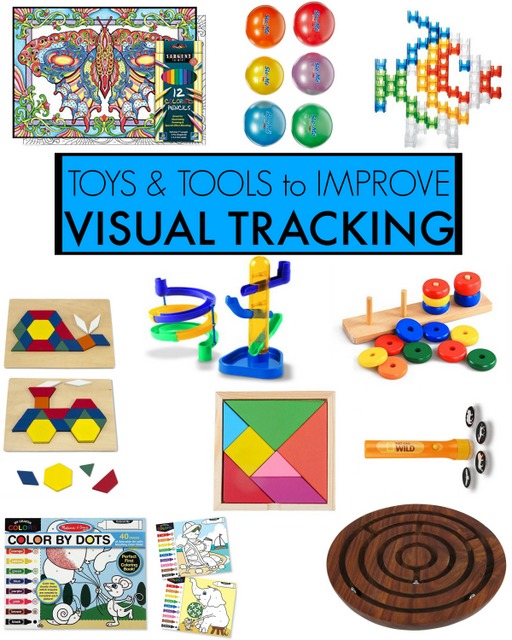
Visual Tracking Games

toys for visual tracking

Visual Tracking is an important part of everything we do and visual tracking games can be a valuable resource to improving visual tracking skills! For tasks such as reading and writing, however, the ability to track visually across a line of written text is essential for reading and fluency in reading.

When kids read across a line of text in a book, they are using visual tracking skills to follow the line from word to work. When they follow a finger along lines in a book they are using visual tracking skills. When they shift their vision from one point to another, they use a combination of visual scanning and visual tracking skills. Visual tracking is a multi-faceted topic and you can read more about visual tracking and all that it entails in functional tasks here on the website.

These visual tracking games will be a useful tool in helping kids with visual tracking needs to read, write, visually scan and complete other visual motor tasks, using fun tracking games and visual tools that kids will love to use in occupational therapy activities or as part of a therapy home program for visual tracking!
 

Visual Tracking Games and Visual Tracking Activities for Kids

So when visual tracking is such an important part of function and skills, how do you address this skill area? There are adaptations that can be put into place to help, such as prompting, cues, physical assists, and other tools. One way to work on visual tracking needed for functional tasks is to use visual tracking games in play and activities.

Visual tracking games and activities can be a valuable asset for increasing this skill area in kids with visual tracking skill deficits or needs.

Read on to find out more about visual tracking games and activities that may help  kids improve their visual tracking skills.

But first,

What does a Visual Tracking Problem Look Like?

The games and activities listed below are important for kids who struggle with tracking of words and letters when reading, writing, or completing math. Visual Tracking problems may also present as difficulty with sports or coordination. Visual tracking may be evident in learning. There are many ways that a visual tracking concern can become evident. If one of these areas or functional abilities is a problem for your child, student, or client, then a visual screening can be very useful in identifying specific needs.

Need help addressing visual problems in the classroom? Here are classroom accommodations for visual impairments

Occupational Therapy Vision Screening Tool

Occupational Therapists screen for visual problems in order to determine how they may impact functional tasks. Visual screening can occur in the classroom setting, in inpatient settings, in outpatient therapy, and in early intervention or home care.
 
This visual screening tool was created by an occupational therapist and provides information on visual terms, frequently asked questions regarding visual problems, a variety of visual screening techniques, and other tools that therapists will find valuable in visual screenings.
 
This is a digital file. Upon purchase, you will be able to access the 10 page file and print off to use over and over again in vision screenings and in educating therapists, teachers, parents, and other child advocates or caregivers.


Visual Tracking Games for Kids

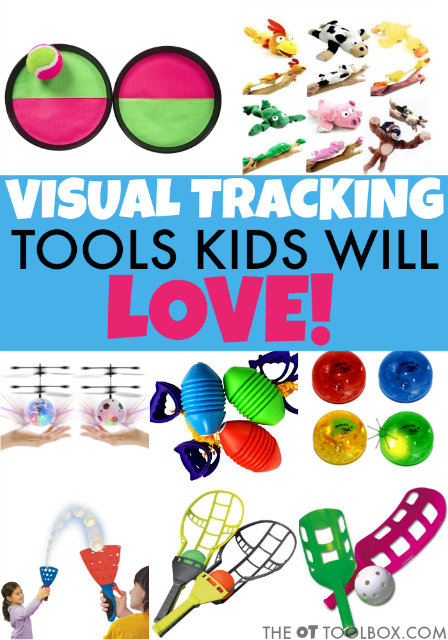
Kids can play visual tracking games that are free or are fun games out on the market to address this skill area and improve visual tracking skills so that reading and writing are easier.

Try some of these fun visual tracking games to help kids improve their visual tracking skills and they won’t even know they are “working”!

Amazon affiliate links are included below.

Badminton Game – Physical games and gross motor games like this one can help promote visual tracking across all visual fields including peripheral and in all directions (horizontal, vertical, circular, and diagonal).

Pop and Catch Game – Combining fine motor skills like this Pop and Catch game can bring the target close to the body to challenge convergence in kids with visual tracking needs in a visual tracking activity that the whole family can enjoy.  

Velcro Ball and Mitt – This visual tracking game combines gross motor and sensory components with resistive work that kids can use to challenge upper body strength while playing. Follow the target ball as it sails toward and away to challenge convergence of the eyes. This activity can easily be modified to meet various needs by using a brightly colored ball or moving closer or farther away. is a game kids can play indoors or outdoors while working on their visual tracking skills.

Scoop ball -Try to scoop the ball while moving, while seated or while in a variety of positions and planes to add a graded component to this visual tracking game.

Wham-O Track Ball -This classic visual tracking game is traditionally an outdoor lawn game for kids or adults, but it makes an awesome visual tracking game! When kids struggle with visual tracking skills, they can benefit from watching a moving target and challenges in visual tracking across various fields of vision. Play this visual tracking game indoors or outdoors. Why not add a prone component by playing while crawling or laying on the floor or while on a scooter board?

Light Up Bouncy Ball – While any ball could potentially be used as a visual tracking tool, this light up ball can be used in a dark room or at night for a visual tracking game that kids can’t resist! Play a slow rolling game of catch or try to invoke spontaneous visual tracking skills by bouncing the ball against a wall in a darkened room. What fun!

Glow in the Dark Ring Toss – This is another glow in the dark game that kids can play in a darkened space. The room doesn’t need to be completely dark to encourage visual tracking with this glowing game. Just close the blinds or play at night with a low light on and the glowing visual tracking can still happen! Ask the child to watch as the ring is tossed away from them. They child can also position themselves on the sidelines when they are waiting for their turn while others play, allowing for visual tracking across planes.

Zoom Ball – This is a great therapy tool because the child can control and feel when the moving target is moving toward them and away from them. Zoom ball games can target visual tracking because the toy requires convergence as the child watches the target move between them and another player.

Rocket Launch – There are many rocket launch toys on the market and any would work as a visual tracking tool. But this one is nice because it has the ability to change the angle so the rocket can be sent higher or at different angles. Kids can watch the brightly colored rocket as it sails through the air into unpredictable tracks and various fields of vision, including the peripheral.

Slingshot Creatures – These fun creatures can be sent at targets or at any plane as a visual tracking tool. Kids will love shooting these creatures or watching them sail across the room!

Parachute Toy – Parachute toys, flying discs, and other flying target toys are great for addressing visual tracking skills. Kids can toss them up or watch as they drop while following the target. This set includes lots of fun extras!

Glowing Finger Slingshots – Flinger slingshots are a fun tool for targeting visual tracking skills. This visual tracking activity is one kids will love to engage with! Try them in a darkened room to encourage visual tracking as the glowing toy flies across the room!

Flying slingshot copter – This is another slingshot activity that kids can shoot themselves while visual tracking as the target soars. Play indoors or outdoors. Visual tracking tools like this are motivating and a fun addition to goody bags or as a small gift idea.

Need a resource to address visual tracking or need to know where to start with identifying visual tracking concerns?

The Visual Tracking Screening Tool can help therapists screen for and identify visual problems that interfere with visual tracking, convergence, and other visual skills.

Colleen Beck, OTR/L has been an occupational therapist since 2000, working in school-based, hand therapy, outpatient peds, EI, and SNF. Colleen created The OT Toolbox to inspire therapists, teachers, and parents with easy and fun tools to help children thrive. Read her story about going from an OT making $3/hour (after paying for kids’ childcare) to a full-time OT resource creator for millions of readers. Want to collaborate? Send an email to contact@theottoolbox.com.
Pencil Pressure When Writing

If you’ve worked with kids teaching handwriting or fixing handwriting issues, they you probably have come across a common handwriting problem area…Pencil pressure when writing. Handwriting pressure can play a huge role in legibility, whether pressing too hard when writing or writing too lightly. 

Pencil Pressure in Handwriting

Some kids press too hard on the pencil. They may press so hard on the pencil that the pencil tears the paper when they write. When they try to erase, there are smudges that never really go away.

Other students use too little force when writing. Or, you might see pencil pressure that is so light that you can’t discern letters from one another.

Either way, pencil pressure plays a big part in handwriting legibility.

Here are tips for pressing too hard when writing…and tips for helping kids write darker. Scroll down for everything you need to know about writing with that “just write” pencil pressure…Typo intended  🙂

These writing tips are great for kids that press too hard when writing or write too lightly.


Pencil Pressure with Writing

Learning to write is a complex task.  Choosing a hand to hold the pencil with, pencil grasp, managing the paper with the assisting hand, sitting up straight.

And then there is the physical task of marking letters: letter formation, line awareness, letter size… this is multi-level functioning for a child!  

Yet another aspect to consider is the pressure one exerts on the paper when writing.  Press too lightly and the words are barely able to be seen.  Press too hard, and the letters are very dark, the pencil point breaks, lines are smudged, and when mistakes are erased, they don’t really erase all the way, the paper tears, and frustration ensues!  

Sometimes, when it comes to pencil pressure, simply helping kids become aware that they are writing too lightly or writing with too much pressure can make a big difference. Here is one simple activity to work on pencil pressure. All you need is a sheet of foam crafting paper. 

Pencil pressure is dependent on proprioception, one of the sensory systems.  With October being Sensory Processing Awareness month, this is the perfect time to talk sensory and handwriting!
 
As an occupational therapist in the school setting, I’ve come across many school-aged children showing difficulty with pencil pressure.  There are reasons for these dark pencil marks and some tips and tools for helping with this handwriting difficulty. 


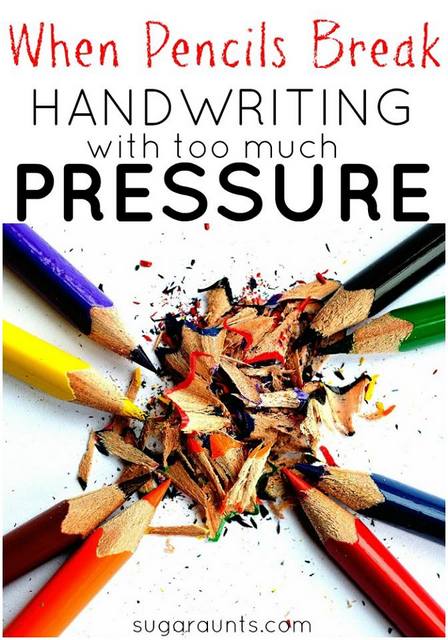
Tips and tools for kids who write with too much pressure in handwriting.  Does your child write or color so hard that the pencil breaks?  Writing too hard makes handwriting difficult to read and effectively write.


This post contains affiliate links.  


Proprioception and Handwriting


The proprioceptive system receives input from the muscles and joints about body position, weight, pressure, stretch, movement and changes in position in space.  Our bodies are able to grade and coordinate movements based on the way muscles move, stretch, and contract. 

Proprioception allows us to apply more or less pressure and force in a task. Instinctively, we know that lifting a feather requires very little pressure and effort, while moving a large backpack requires more work.  

We are able to coordinate our movements effectively to manage our day’s activities with the proprioceptive system.  The brain also must coordinate input about gravity, movement, and balance involving the vestibular system.


When we write, the pencil is held with the index finger, middle finger, and thumb, and supported by the ring and pinkie finger as the hand moves across a page.  

A functioning proprioceptive system allows us to move the small muscles of the hand to move the pencil in fluid movements and with “just right” pressure.  

We are able to mark lines on the paper, erase mistakes, move the paper with our supporting arm, turn pages in a notebook fluidly, and keep the paper in one piece.

Heavy Pencil Pressure

When students press too hard on the pencil, handwriting suffers. Sometimes, children hold their pencil very tightly. Other times, they are seeking sensory feedback.  You’ll see some common signs of heavy pencil pressure:

  • They press so hard on the paper, that lines are very dark when writing.  
  • The pencil point breaks.  
  • When erasing, the pencil marks don’t completely erase, and the paper is torn.  
  • The non-dominant, assisting hand moves the paper so roughly that the paper crumbles.  
  • When turning pages in a notebook, the pages tear or crumble.
  • Movements are not fluid or efficient. 
  • Handwriting takes so much effort, that the child becomes fatigued, frustrated, and sore.  
  • It may take so much effort to write a single word, that handwriting is slow and difficult. 

All of these signs of heavy pencil pressure are red flags for pencil pressure issues. They are not functional handwriting

Below, we’ll cover ways to reduce  pencil pressure? 

Writing Pressure: Too Light

The other side of the coin is pencil pressure that is too light.

Writing with too little pencil pressure is another form of non-functional handwriting. Some signs of too little pencil pressure include:

  • Kids may write so lightly that you can’t read the overall writing sample.
  • You can’t discern between certain letters.
  • The writing pressure is just so light that the child’s hand or sleeve smudges the pencil lines and the writing sample is totally not functional or legible.
  • The student starts out writing at a legible pencil pressure, but with hand fatigue, the writing gets lighter and lighter.

All of these signs of too light pencil pressure and too much force when writing can be addressed with some simple tips. Working on proprioceptive input and hand strengthening can help with too light pencil pressure. Try some of the writing tips listed below.

Pencil pressure and Messy handwriting

Messy handwriting can be contributed to many factors.  Decreased hand strength, Visual motor difficulty, motor planning issues, visual memory difficulties, or impaired proprioception. 

Difficulty with grading the movements required in drawing or making letters in a coordinated way may present as messy, smudged, illegible handwriting.
 

Writing Tips for Pencil Pressure

Bringing the writer aware of what’s occurring is one way to support pencil pressure issues. Proprioceptive activities allow the muscles to “wake up” with heavy pressure.

Moving against resistance by pushing or pulling gives the muscles and joints an opportunity to modulate pressure.  

Resistive activities before and during a handwriting task can be beneficial for children who press hard on the pencil. 


Pencil Pressure Activities:

Some of these pencil pressure activities are writing strategies to help kids become more aware of the amount of pressure they are using when writing.

Others are tools for helping the hands with sensory needs. Still others are tools for strengthening the hands. Try some or a mixture of the following ideas to addressing handwriting needs.

  • Stress balls or fidget toys can help to strengthen pinch and grip strength. 
  • Use carbon paper or transfer paper to help kids become more aware of the amount of pressure they are exerting through the pencil when writing. Here is some easy ways to use a Dollar Store find to use carbon paper to work on handwriting. (affiliate link)
  • resistive bands (affiliate link)- Use these as an arm warm-up to “wake up” the muscles of the whole upper body. They are great for positioning warm ups too. 
  • theraputty (affiliate link) with graded amount of resistance (speak to a license occupational therapist about the amount of resistance needed for your child. An individual evaluation and recommendations will be needed for your child’s specific strengths/needs). Use these theraputty exercises for ideas to get started.
  • hole puncher (affiliate link) exercises before a writing task 
  • Gross grasp activities- These activities can be a big help in adjusting the grasp on the pencil, helping the hands with sensory input and strengthening the hands to help with endurance when writing. 
  • Some children will benefit from using a liquid gel pen for fluid handwriting marks. The gel ink will provide feedback when gobs of ink are dispensed when writing too hard.
  • Still others will benefit from a gel pen, marker, or using a dry erase marker on a dry erase board. This can be beneficial as a tool for teaching about pencil pressure or as an accommodation for those writing too lightly.
  • Pencil Weights (affiliate link) or Weighted Pencils (affiliate link)- Weighted pencils can be helpful in providing sensory feedback through the hands.
  • A vibrating pen (affiliate link) provides sensory feedback to the fingers and hand and helps to keep children focused on the task. 
  • Practice handwriting by placing a sheet of paper over a piece of sandpaper. The resistance of the sandpaper is great heavy work for small muscles of the hand. 
  • Practice writing on a dry erase board with dry erase markers to work on consistent pencil pressure- Pressing too hard will make the marker lines wider and press down on the tip of the marker. Can the learner keep a consistent line with their writing or drawing?
  • Use a grease pencil- These pencils are commonly used to marking wood or used in construction. The lead of the pencil is very soft and can be a great alternative for those that press too hard on pencils.
  • Cheap eyeliner pencil- One cheap alternative to a grease pencil is using an inexpensive eye liner pencil from the dollar store. Get the kind that you sharpen with a turn sharpener (almost like a hand held pencil sharpener). Kids can use that pencil to draw lines and match the amount of pressure they are using. This is a good activity for those that press too hard when writing, too.
  • Practice Ghost Writing: Encourage the child to write very lightly on paper and then erase the words without leaving any marks. The adult can try to read the words after they’ve been erased. If the words are not able to be read, the writer wins the game. 
  • Hand exercises are a great way to “wake up” the hands before a handwriting task. Encourage the child to squeeze their hand into a fist as tight as he can. Then relax and stretch the hand and fingers. Repeat the exercise several times. Practice holding the pencil with the same type of tight and relaxed exercises Practice writing on tissue paper. A very light hand is needed to prevent tears. Discuss the amount of pressure needed for writing on the tissue paper. 
  • This will provide the child with awareness and words for the way they are holding the pencil. 
  • Wrap a bit of play dough or putty around the pencil as a grip. Encourage the child to hold the pencil with a grasp that does not press deeply into the dough. Encourage using a “just right” pressure. 
  • Provide terms for they way they write. Encourage “just right” writing and not “too hard” or “too soft” marks. 
  • Use a lead pencil to color in a small picture, using light gray, medium gray, and dark gray. Talk about how using different amounts of pressure changes the shade of gray. 
  • Instead of writing on a notebook, pull a single sheet from the pages and place on a hard table or desk surface. The firm surface will limit the amount of pressure. You can also slip a clipboard between pages of a notebook to provide that hard surface, if sheets must remain in a notebook.
 
Help kids with pencil pressure and handwriting problems with these writing tips to work on heavy pencil pressure or writing too light.

Need more tips and tools for addressing handwriting needs? Be sure to check out all of our handwriting activities here on The OT Toolbox.

More Handwriting Tips

For a comprehensive resource on handwriting, check out The Handwriting Book. This e-book was written by pediatric occupational therapists and physical therapists who focus on function and take a developmental look at handwriting.

In The Handwriting Book, you’ll find practical suggestions to meet all needs that arise with messy or sloppy handwriting. The developmental-based approach to teaching handwriting focuses on strategies to support common issues with written work.

Click here for more information on The Handwriting Book.

The handwriting Book

Colleen Beck, OTR/L has been an occupational therapist since 2000, working in school-based, hand therapy, outpatient peds, EI, and SNF. Colleen created The OT Toolbox to inspire therapists, teachers, and parents with easy and fun tools to help children thrive. Read her story about going from an OT making $3/hour (after paying for kids’ childcare) to a full-time OT resource creator for millions of readers. Want to collaborate? Send an email to contact@theottoolbox.com.
Olfactory Sensory Activities

olfactory sensory activities

Here, you’ll find olfactory sensory activities and Scented ways to play and learn this week. The sense of smell is a great way to impact learning, and scented activities are not just fun. You can add these scented play ideas in smell sensory activities for toddlers, preschoolers, and older ages. Use the sense of smell in learning!

Olfactory sensory activities can be used in learning and play.


What is The Olfactory System

The olfactory system, or the system that enables the sense of smell, has receptors in the tissue of the nose that are connected by pathways to the brain.  Connections occur via two pathways, one being a direct route to neurons in the brains and the second being a path that passes near the roof of the mouth.  This channel is connected to the taste of foods.

There is some evidence indicating that the sense of smell is more associated with memory than the sense of vision or the other senses.  The connection of the olfactory sense to the emotional part of the brain and previous experiences, as well as hypersensitivity or hyposensitivity to smells can cause anxiety or sensory related breakdowns in children with sensory processing difficulties. 

There are many different ways to approach therapeutic intervention related to the olfactory sense. 

  • Different scents can be used in therapeutic manners. The child who is hypersensitive to scents can use unscented soaps and lotions. 
  • Try calming scents to soothe or relax: vanilla, floral, chamomile
  • Try alerting scents to stimulate or alert: citrus, peppermint
  • Use caution with essential oils and scents in general with children. Not all scents are safe for kids.

Hyper-responsiveness of the olfactory sense may present in a child as over-responsiveness or overreaction to olfactory sensation. This may look like:

  • Overly sensitive to smells
  • Notices smells others don’t
  • Anxious around certain smells
  • Holds nose in response to certain scents

Adaptations/Accommodations to address hyper-responsiveness of the olfactory sense:

  • Provide the child with tools scented with preferred scents (Wooden pencils can have a scent that interferes with a child’s attention. A plastic mechanical pencil may be a better option.)
  • Trial various laundry detergents/soaps to find a preferred scent (Unscented detergent can still produce a noxious scent for some individuals.)


Hypo-responsiveness of the olfactory sense may present in a child as under-responsiveness or underreaction to olfactory sensation. This may look like:

  • Smells unusual items like paper or certain materials
  • Prefers strong scents

Adaptations/Accommodations to address hypo-responsiveness to the olfactory sense:

  • Preferred tools for use in the classroom and home
  • Preferred laundry detergents/soaps

Olfactory Sensory Activities

We love sensory play of all kinds and the olfactory sense is such a great way to explore through the senses.  Olfactory sense (or the sense of smell) is such a powerful sense.  

There is a lot to know about the sense of smell.  The sense of smell brings strong memories and so pairing scented play with learning is a great way to use that strength.  Looking for a few scented activities?  

Check out these fun scented olfactory sensory activities children will love:


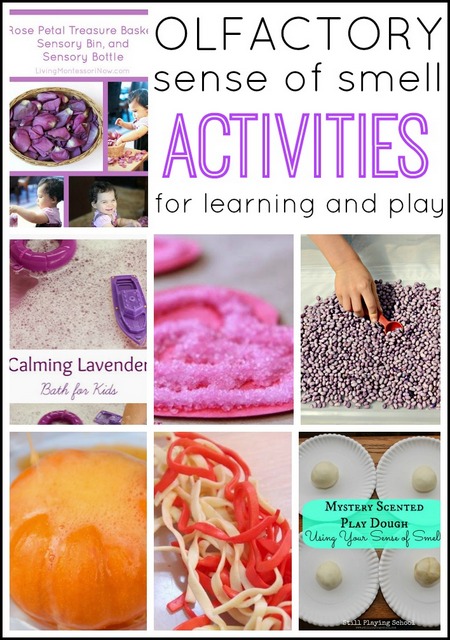
Sensory play ideas for the olfactory sense. Sense of smell activities for kids


Scented sensory play ideas


Scented Sensory Play with Pumpkins and pumpkin spice scent from Frogs and Snails and Puppy Dog Tails.
Rose Sensory Bin with rose petals from Living Montessori Now
Lavender Bath with scented water from Frogs and Snails and Puppy Dog Tails
Scented Play Dough from Still Playing School


Some of our favorite scented ways to play and learn:


More olfactory sensory activities for kids

In the Sensory Lifestyle Handbook, you’ll find sensory strategies that are easily integrated into everyday life. Grab this resource to learn more about the olfactory sense and how this sensory system impacts functional tasks.

Colleen Beck, OTR/L has been an occupational therapist since 2000, working in school-based, hand therapy, outpatient peds, EI, and SNF. Colleen created The OT Toolbox to inspire therapists, teachers, and parents with easy and fun tools to help children thrive. Read her story about going from an OT making $3/hour (after paying for kids’ childcare) to a full-time OT resource creator for millions of readers. Want to collaborate? Send an email to contact@theottoolbox.com.
Audio Books for Occupational Therapists

audio books for occupational therapists

Today, I’ve got a list of free audiobooks for occupational therapists. These occupational therapy audiobook ideas can be used to develop, learn, and grow as a therapist. These occupational therapy books are audiobooks, making them great tools for learning new skills while on the go.

Therapists are short on time, so occupational therapist audio courses and audiobooks are the way to go when it comes to learning. One of the best things about growing as a professional is the ability to continue to learn. As therapists, we strive to develop in our profession to meet the needs of our ever-changing client list. Reading or listening to books for occupational therapists is just one way to learn and grow professionally.

Here, we’re covering parenting books on Audible, or audio books that OTs can recommend to parents to better understand parenting and child development.

These audiobooks for occupational therapists are great for the travelling OT, or listening to while on a commute to work, covering a variety of areas that can improve your occupational therapy practice, in educating OT clients, advocating for occupational therapy patients, and improving OT practice areas.

Audible Books for Occupational Therapists

Amazon affiliate links are included below.

Amazon has some great mindfulness audiobook resources for parents and professionals available on Audible and other formats. Audiobooks are a great alternative to paper books, as they can be listened to almost anywhere.

There are tons of resources on mindfulness in audiobooks. I tried to find ones that had good reviews, were accurate and easy to read/listen to, and provided useful strategies.

If you are an Amazon Prime member, You’re eligible to claim 2 free titles from our entire selection (one title per month thereafter) with a free Audible 30 day trial. A standard trial includes 1 credit for an audiobook download. After the Audible trial period, all members receive 1 credit per month.

Click here start your free Audible Trial Period.

Recently, I came across a few books on Amazon that are perfect for therapists looking for books to grow and learn in different aspects of occupational therapy.

These are audiobooks that can help OTs grow as a practitioner by staying on tap of hot topics. As therapists, we strive to advocate for our clients, educate parents, teachers, or others on the child’s tribe or team. These are audiobooks for occupational therapists that can help us grow as therapists!


Best of all, they are available as audiobooks for those of us looking for books to listen to while commuting, cooking, or working out!

Free Audio Books for Occupational Therapists

This post contains affiliate links.


Audible is a subset of Amazon and offers free books to members. While the membership does have a fee, there is a free 30 day trial, where books can be listened to anytime and anywhere. 


There’s more: When you sign up for the free trial of Audible, you’ll get two free books. In addition to the 2 Free audiobooks, you’ll also get 2 Free Audible Originals to get you started. 


After your free trial ends, if you do choose to continue with the membership, you’ll get 1 audiobook and 2 Originals per month after trial. You can cancel anytime and keep all your audiobooks. You’ll also get 30% off the price of additional audiobook purchases. 


So, after reading this, I had to check to see what books are available on Amazon’s Audible that would be interesting as an OT. How cool to grab a free audio book on a topic I wanted to learn more about!
 

Parenting Books on Audible

Balanced and Barefoot: How Unrestricted Outdoor Play Makes for Strong, Confident, and Capable Children– Written by occupational therapist, Angela J. Hanscom, describes children of today who have more sedentary lifestyles and desperately need outdoor play in order to develop their sensory, motor, and executive functions.

The book describes nature as the ultimate sensory experience, and helps you discover little things you can do anytime, anywhere to help your kids achieve the movement they need to be happy and healthy in mind, body, and spirit.

Sensory Processing Disorder: Not Just a Strong-Willed Child, Book 1– This audiobook is a resource for parents that therapists can recommend for those looking for more information on Sensory Processing Disorder or those striving to empower their child.

By listening to this audiobook, you’ll learn more about what is sensory processing disorder, common behaviors of different types of SPD, differences between SPD and some other look-alike conditions like ADHD, OCD, ODD and anxiety disorder, tips on how to manage SPD at home, school, and community.

Overcoming Dyslexia– This book on dyslexia helps us to understand, identify, and overcome the reading problems that so many kids struggle with in schools. In this audio book, you’ll learn exactly what dyslexia is and how to identify dyslexia in preschoolers, schoolchildren, young adults, and adults.

You’ll discover how to work productively with the teacher of a child with dyslexia or reading challenges. Included are exercises to help children use the parts of the brain that control reading, including a twenty-minute nightly home program to enhance reading. There are also ways to improve a child’s self-esteem and more.

Also be sure to check out our blog post on dyslexia and occupational therapy.

The Smart but Scattered Guide to Success: How to Use Your Brain’s Executive Skills to Keep Up, Stay Calm, and Get Organized at Work and at Home– This audiobook helps the listener identify their executive skills profile and shares effective steps to boost organizational skills, time management, emotional control, and nine other essential skills.

This is a resource for parents and therapists who may be struggling with executive functioning skills or those working with teens or older clients. 

Smart but Scattered Teens: The “Executive Skills” Program for Helping Teens Reach Their Potential– This audiobook describes research-based strategies for promoting teens’ independence by building their executive functioning skills in order to get organized, stay focused, and control impulses and emotions.

Bright Kids Who Can’t Keep Up: Help Your Child Overcome Slow Processing Speed and Succeed in a Fast-Paced World– This audiobook is geared toward those kids who struggle with processing speed in tasks like classwork, homework, caring for themselves, motor tasks, or following directions.

Ten Things Every Child with Autism Wishes You Knew– This audiobook describes 10 characteristics that help illuminate, not define,  children with autism. The book describes and helps listeners  understand the needs and the potential of every child with autism. It’s been said that “Every parent, teacher, social worker, therapist, and physician should have this succinct and informative audiobook in their back pocket”.

1001 Great Ideas for Teaching and Raising Children with Autism or Asperger’s– This book shares tons of tips, strategies, tools, and resources that can be helpful to parents, teachers, and therapists working with kids with autism or Asperger’s syndrome. There are modifications for older kids to help children achieve success at home, in school, and in the community. 

The Autistic Brain: Thinking Across the Spectrum– This book by Dr.  Temple Grandin teaches listeners the science of the autistic brain, and with it the history and sociology of autism.

The Loving Push: How Parents and Professionals Can Help Spectrum Kids Become Successful Adults– This book is described as an essential roadmap for parents, teachers, therapists, and anyone working with the child with autism. Another resource by Dr. Temple Grandin, psychologist and autism specialist Dr. Debra Moore share insight in helping kids  build on their strengths to improve motivation in real life strategies.

What’s Going on in There?: How the Brain and Mind Develop in the First Five Years of Life– This book by a research neuroscientist describes how the baby’s brain is formed, and when each sense, skill, and cognitive ability is developed from conception through the first five years.

The book shares development of motor skills, social and emotional behaviors, and mental functions such as attention, language, memory, reasoning, and intelligence. 

The Emotional Life of the Toddler– This audiobook covers the emotional development of kids through the toddler years, with the latest research on this crucial stage of development. This is a great resource for the pediatric OT.

Raising an Emotionally Intelligent Child: The Heart of Parenting– Dr. John Gottman shares strategies to teach their children self-awareness and self-control and to foster good emotional development. This audiobook is a resource for parents and those working with families with young children.

Raising Your Spirited Child, Third Edition: A Guide for Parents Whose Child Is More Intense, Sensitive, Perceptive, Persistent, and Energetic– This audiobook is the very same as the book that has been voted one of the top 20 parenting books out there. It’s a tool therapists can use to provide parents with the tips and tools they need based on research and practical strategies for raising spirited children. It’s a book for anyone who knows meltdowns, behavior, and spirited kids!

  What are your favorite audiobooks for occupational therapy? You know, those audiobooks you LOVE that advance your practice knowledge, improve your advocacy for OT clients, and help to educate parents or teachers of  occupational therapy clients?

These audiobooks for occupational therapists are great for advancing as an occupational therapist by reading the hot topics in the field, so that you can advocate for OT clients, educate the parents and teachers of kids on an occupational therapy caseload.

Colleen Beck, OTR/L has been an occupational therapist since 2000, working in school-based, hand therapy, outpatient peds, EI, and SNF. Colleen created The OT Toolbox to inspire therapists, teachers, and parents with easy and fun tools to help children thrive. Read her story about going from an OT making $3/hour (after paying for kids’ childcare) to a full-time OT resource creator for millions of readers. Want to collaborate? Send an email to contact@theottoolbox.com.
Creative Sight Word Activities for Kindergarten

multisensory reading and hands on activities for kindergarten sight words.

We’ve been doing a bunch of fun sight words in the past few months and here, you will find all of our favorite sight word activities for kindergarten.  This is a collection of all of our sight word activities, or multisensory learning activities focused on reading skills. The best thing about these hands-on reading activities is that they can be used for sight words as well as decodable words. These multisensory reading activities are perfect for beginning reading for kindergarten.  Learning and practicing sight words can be fun, creative, and NOT include just repetition with flash cards.  A little creativity and lot of fun are happening on this page.  Get ready to learn through play.  And have fun!  

{Note: This post contains affiliate links.}

Creative Ways to Practice Kindergarten Sight Words

Creative activities to learn kindergarten sight words, and hands on activities for multisensory reading.


sight word activity using ping pong ballsearly literacy activity using a sticky easel
 

Sight Words and Decodable Words

When my older kids were learning to read, they came home with lists of “sight words”. They also came home with small stapled books where they inserted the sight word into sentences driven by pictures. They were “reading the pictures”.

Since then, sight words have shifted slightly to include common lists, but more of the decodable reading. 

These hands on activities can be used with any early reading! 

Sight words are not necessarily always irregular words. They may only be taught as sight words until the sounds in the word have been taught… then it becomes decidable.

Some sight words are truly words that are known by sight…there is no way to sound them out. Other sight words can be decoded. 

High frequency words and not words that can be learned through decoding. For example… “what” is a sight word and should be learned as such.

Multisensory Reading Activities

The multisensory reading activities listed below incorporate whole body movement, heavy work input, and even vestibular input. These are just SOME ways to use all of our senses in learning high frequency words.

Other multisensory reading strategies can be used to decode parts of a word, or even sight words that are decodable. This is done by breaking apart the sounds that make up the word, or orthographically mapping the word. 

Other multisensory reading strategies include:

  • pounding words and parts of words
  • tapping of words
  • moving cubes
  • moving chips  or manipulatives like mini erasers or balls of play dough for sounds
  • using a red word/heart word for the tricky part of a “trick word” or sight word
  • spelling and arm tapping
  • writing on a bumpy screen and then feeling the bumps while spelling it aloud
  • sky writing (crossing the midline)
  • writing words on the palm
  • writing on a foam sheet
  • Check out all of our ideas and strategies for name practice for kindergarten

The multisensory reading strategies below are creative ways to work on sight words

Use fun materials like ping pong balls like we did in  our Sight Words Ping Pong Bounce Game.  (That was an activity that Little Guy LOVED…and he’s not even learning sight words yet!  Use those ping pong balls again for Sight Word Scooping and incorporate fine motor skills into sentence building. 

learn words and phonics with string and a multisensory reading task.

Something that you find in the junk drawer can be a learning tool.  String!  We used string to review sight words in Creative Sight Word Practice with String


Creative Sight Work Activities for Kindergarten

The senses are an essential part of daily life.  Incorporate the senses into learning with a few fun ideas:


We got moving with our Word Scavenger Hunt

More movement based learning happened when we incorporated the easel in Sight Word Sticky Easel.

A few more creative ways to learn:  Does your Kindergartener love all things art?  Try some stamping with Sight Word Bottle Cap Stampers

We hope you’ve found some fun ways to learn and play with sight words with this list.  Stop back often, because we’re adding new activities all the time.  We’ll be sure to update this page with all of our latest sight word activities.

Need more ways to develop skills through play? Grab one of our Fine Motor Kits!

Working on fine motor skills, visual perception, visual motor skills, sensory tolerance, handwriting, or scissor skills? Our Fine Motor Kits cover all of these areas and more.

Check out the seasonal Fine Motor Kits that kids love:

Or, grab one of our themed Fine Motor Kits to target skills with fun themes:

Want access to all of these kits…and more being added each month? Join The OT Toolbox Member’s Club!

Colleen Beck, OTR/L has been an occupational therapist since 2000, working in school-based, hand therapy, outpatient peds, EI, and SNF. Colleen created The OT Toolbox to inspire therapists, teachers, and parents with easy and fun tools to help children thrive. Read her story about going from an OT making $3/hour (after paying for kids’ childcare) to a full-time OT resource creator for millions of readers. Want to collaborate? Send an email to contact@theottoolbox.com.
Play Dough Recipe Without Cream of Tartar

playdough without cream of tartar

This play dough recipe without Cream of Tartar is one of our favorite playdough recipes because it omits cream of tartar, so the dough ingredients are commonly found in the home.

If you’ve been following this site over the years, you’ve seen many of our play dough recipes, one of them being this play dough recipe without cream of tartar. This easy play dough recipe is one that kids can help to make, and to use in occupational therapy interventions. Read more on how play dough benefits child development, and making the play dough is half of the fun!

Use this homemade play dough without cream of tartar to work on fine motor skills, executive function, cognitive development, and more.

Homemade Play Dough without cream of tartar

Homemade play dough is a childhood staple. When kids are part of the playdough making process, they are active in the kitchen and can incorporate many executive functioning tasks as well as other skill-building.

But most homemade play dough recipes include cream of tartar as an ingredient. However, purchasing this ingredient is just expensive, and there really aren’t many common uses for cream of tartar except in the playdough recipes.

So, we decided to do some experimentation and come up with a play dough recipe that omits cream of tartar.

Our recipe uses a common ingredent that is inexpensive, but also can be used in other kitchen recipes. So, when you purchase this ingredient, you can use it for other recipes as well, making the purchase a good buying decision.

So? What is our substitute for cream of tartar in homemade playdough?

Lemon juice!

Lemon juice makes a great substitute for cream of tartar in homemade play dough recipes because it’s an easy to find ingredient in most stores and you can use it in so many other recipes. Plus, the lemon juice adds pliability to the play dough just like cream of tartar does.

why is play dough good for child development

Over the years, we’ve used many ingredients to make play dough as a sensory tool. These are all wonderful ways to incorporate various sensory input through sensory play.

One of our most popular playdough recipes is our crayon play dough recipe. But other homemade dough recipes you’ll love include:

All of these various doughs offer sensory experiences through play, using different scents and textures. We’ve strived to create sensory tools through easily accessible and inexpensive materials, mainly using ingredients that are on hand in the kitchen.

When sensory and fine motor play is easily accessible, kids develop skills!

And, playdough is a great tool for developing math skills, too.

Making homemade play dough is a great occupational therapy activity for the clinic, school-based session, or a home recommendation to carryover skills in a family time activity.

Play dough and hand strength

Play dough is a fantastic easy and inexpensive tool to work on hand strength and pinch strength. We previously covered over 30 ways to improve fine motor skills with play dough.

These are great ways to use playdough can be used as a warm up activity or to incorporate palm strengthening exercises into therapy through play.

Another aspect of homemade playdough and fine motor skills includes the mixing and kneading aspects. Pouring, scooping, stirring, and kneading are all very functional tasks that

Whether you are developing fine motor skills, addressing cognitive skills like direction following, or incorporating sensory play into occupational therapy interventions, a simple homemade play dough is the way to go. Play dough has many benefits and there are many ways to use a simple dough recipe into therapy.

Playing with playdough improves fine motor skills such as:

  • Pinch strength
  • Eye-hand coordination
  • Intrinsic muscle strengthening
  • Separation of the sides of the hand
  • Pincer grasp
  • Opposition
  • Tripod grasp
  • Wrist extension
  • Bilateral coordination

All of this occurs through play!

Try these fine motor activities using play dough:

  1. This homemade play dough recipe is great for easy play dough activities like our play dough snakes.
  2. Match colored paper clips with play dough. This is a great pincer grasp, tripod grasp, and separation of the sides of the hand activity.
  3. Improve thumb opposition and address a thumb wrap pencil grasp using play dough and beads in this thumb IP joint activity.
  4. Explore all of the fine motor play dough activities.
ice cream play dough mat

Grab our free play dough mats available here on the website (or log into your Member’s Club dashboard to grab these in an instant download).

play dough and cognitive development

Play dough can be a great cognitive skill tool, too.

Play dough is a multi-step task. It involves following a recipe, following directions, planning, prioritization, impulse control, working memory, and other executive functioning skills.

Play dough is a great way to develop executive functioning skills while cooking.

Kids can work on safety skills while working in the kitchen to prepare this recipe. There is the heat of the play dough after cooking, and stove safety to consider.

Some users would benefit from using a stove to make the playdough and others may benefit by using an electric skillet in place of the stove.

So, let’s get to the recipe making with our play dough recipe (without cream of tartar)!

Playdough without cream of tartar

To make this playdough without cream of tartar, first gather your ingredients, cooking items, and get started. This is a great play dough recipe to make with kids!

You’ll need just a few ingredients in this playdough recipe withoug Cream of Tartar:

  • 3 cups flour
  • 1 and 1/2 cup salt
  • 3 and 1/4 cup water
  • 3 Tbsp oil
  • 3 Tbsp lemon juice
  • food coloring

How to make playdough without cream of tartar:

  1. Mix the flour and salt in a bowl, using a fork to stir. Add the water, oil, and lemon juice and stir until the dough pulls together. Move the wet playdough lump to a sauce pan and cook over low heat for 3-4 minutes until the dough forms. 

2. Plop the dough onto a clean surface and knead for a few minutes. 

3. Separate the play dough into portions and add food coloring.  Knead the dough to mix the food coloring. If you are making just one color of play dough, you can add the food coloring to the dough before cooking.

Many times, we want a variety of play dough colors, though, so mixing the food coloring in after the dough has been cooked is one way to get several colors of play dough.

4. Remember that the dough will be very hot to the touch after cooking. Use a dishtowel to mix the baggie so the color is absorbed throughout the dough.

5. Keep the homemade play dough in covered containers/sealed plastic bags.  Dough does not need to be refrigerated.  

Playdough with cream of tartar

If you do have a jar of cream of tartar, use this play dough recipe:

  • 3 cups flour
  • 1 and 1/2 cup salt
  • 3 and 1/4 cup water
  • 3 Tbsp oil
  • 2 Tbsp cream of tartar
  • food coloring

The same cooking process listed above can be used to make this dough recipe, using cream of tartar instead of lemon juice.

How to get Vivid Colors in Homemade PlayDough

Want the secret to really bold and vivid colors?  Use (Amazon affiliate link) Wilton’s gel food coloring.  I have a bunch of these that I use for my cookies, and Big Sister had fun picking out the colors she wanted to mix up.  

  A lot of times, you can find these color sets on clearance (plus add coupons) for a Great discount!

Little Guy had SO MUCH FUN playing with little straw pieces in the red play dough.   What a great

Fine Motor Activity for a three year old

This easy safe play dough recipe is great for toddlers and preschoolers, but also younger if closely watching young children.

We used the play dough recipe above, and some cut straw pieces to create a toddler-friendly play dough activity that builds fine motor skills.

Cut the straws into pieces. You can get preschoolers involved with this part of the activity for a scissor skills task.

 Then, show your toddler how to poke the straws into the play dough.

He played with this one for a long time…hiding the straw bits in the dough, poking circles, bending the bendable part of the straw… So much fun!   

Playdough Play Mats

Use this easy playdough recipe (without cream of tartar) with our playdough mats to add play dough as a handwriting warm-up and then incorporate handwriting skills!

Colleen Beck, OTR/L has been an occupational therapist since 2000, working in school-based, hand therapy, outpatient peds, EI, and SNF. Colleen created The OT Toolbox to inspire therapists, teachers, and parents with easy and fun tools to help children thrive. Read her story about going from an OT making $3/hour (after paying for kids’ childcare) to a full-time OT resource creator for millions of readers. Want to collaborate? Send an email to contact@theottoolbox.com.