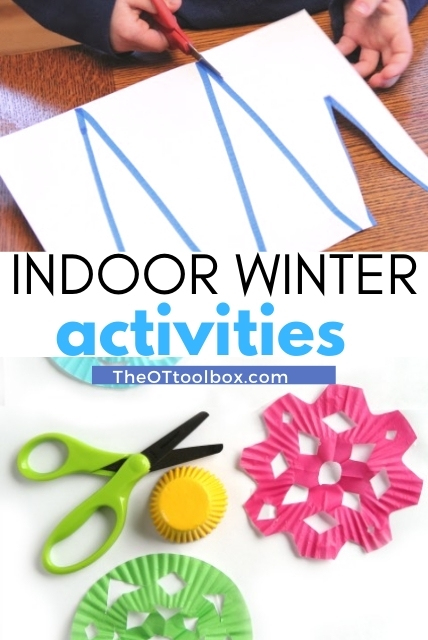
Indoor Winter Activities for Kids

indoor winter activities

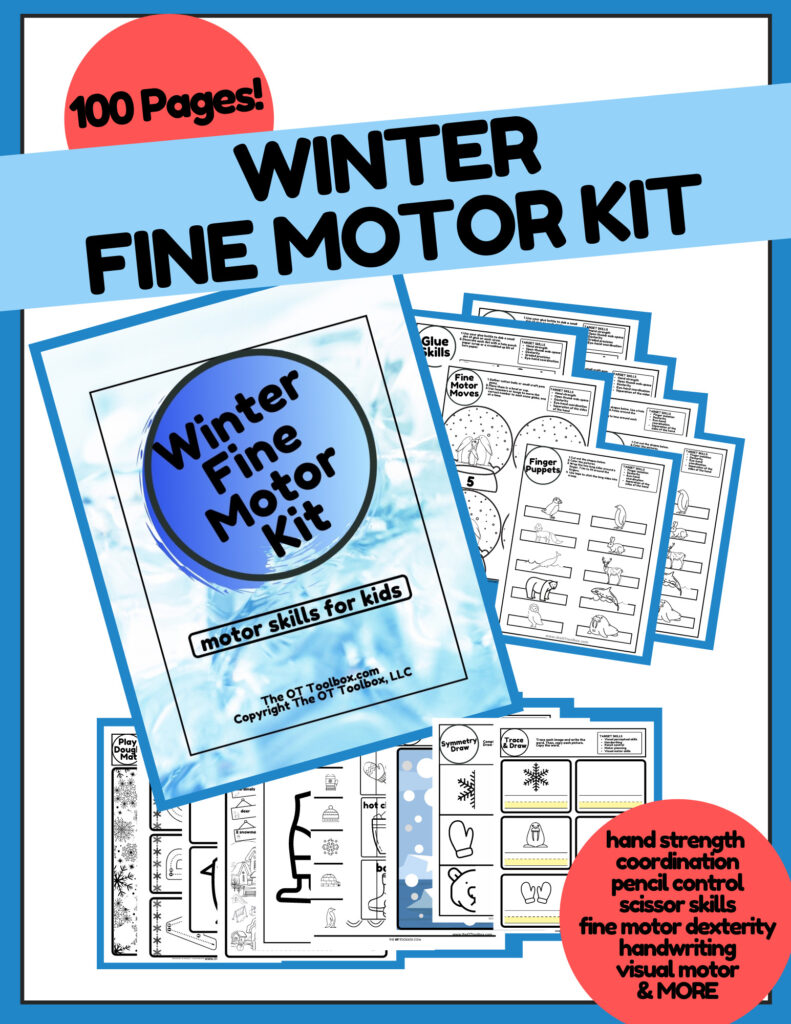
Here you will find indoor winter activities for kids and indoor winter activities for families. These indoor activities are designed to help kids develop skills when it is too cold to go outside. We’ve used many of these occupational therapy activities when the weather is icy or frigid outside. Fun indoor winter activities can be essential to help kids get their energy out during winter days. This year, indoor therapy ideas may be needed to meet teletherapy needs, as well. Related: Add our Winter Fine Motor Kit to your daily toolbox, to help kids develop fine motor strength and dexterity with easy, no-prep activities.

An indoor winter activity like a winter crossword puzzle is a fun way to spend a winter day, while building skills. Let’s cover a few more indoor ideas…

Indoor winter activities for kids and indoor activities for families to help kids develop skills.

Indoor Winter Activities

I’ve sorted these activities into areas so that you can find activities to meet therapy needs. Included below are indoor activities designed to boost fine motor skills, gross motor skills, visual motor skills, sensory input, regulation, and more.

Winter Activities for Fine Motor Skills

Here are a bunch of winter fine motor activities that we’ve shared in the past.

Use these winter crafts to develop fine motor dexterity and strength.

Here are winter bird crafts and activities.

This icicle craft builds visual motor skills and scissor skills, too.

Use these winter books to pair with a fine motor craft or activity based on the book.

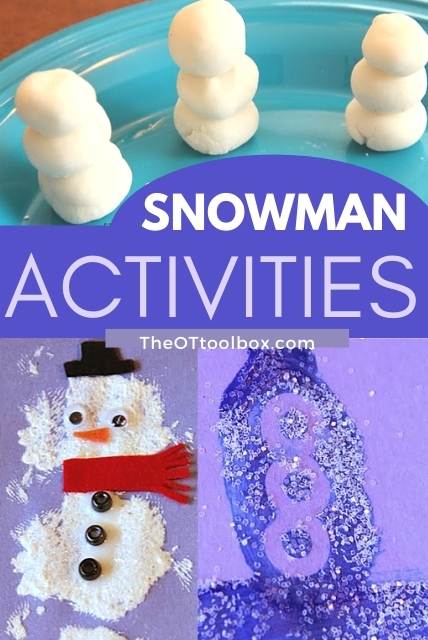
Make this snowman painting craft to build precision and dexterity.

Cut mini snowflakes for a fine motor activity that builds hand strength and heavy work input.

Play tic tac toe with miniature snowflakes. This is also a great sight word activity, too.

This winter snowflake stamp art is a fun fine motor activity that looks great and the kids love.

The Winter Fine Motor Kit has materials to print-and-go, including arctic animal finger puppets to develop finger isolation, toothpick art activities with winter themes, crumble art pages, coloring and pencil control activities for building strength and endurance in the hands. All of these materials are included in a 100 page packet with winter themes: snowmen, mittens, snowflakes, penguins, polar bears, arctic animals, and more.

Indoor Winter Activities for Gross Motor Skills

Here are winter-themed bilateral coordination activities to work on motor planning and coordination skills.

Here are indoor recess activities to use during the winter months

Use these winter brain break activities to add movement and gross motor work during the indoor months.

Try this snowflake theme balance beam for indoor play, balance, coordination, and motor planning.

Use this indoor snowball fight to work on eye-hand coordination skills.

Winter Sensory Activities

Try these snow and ice themed activities.

Here is a snowflake themed proprioceptive activity that helps kids develop motor planning skills, coordination, and strengthening.

This indoor snowball activity adds vestibular input as well as eye-hand coordination skills.

Use a blanket to create a sensory winter themed heavy work activity.

These winter mindfulness activities can help with self-regulation, awareness, and social emotional skills.

Use these January occupational therapy calendars for vestibular and proprioceptive sensory input.

Try these snowball theme activities to incorporate movement and learning during winter months.

Here are winter science experiments that incorporate the senses and hands-on learning.

winter fine motor kit

Click here to access the Winter Fine Motor Kit and develop fine motor skills and dexterity with winter themes.


Colleen Beck, OTR/L has been an occupational therapist since 2000, working in school-based, hand therapy, outpatient peds, EI, and SNF. Colleen created The OT Toolbox to inspire therapists, teachers, and parents with easy and fun tools to help children thrive. Read her story about going from an OT making $3/hour (after paying for kids’ childcare) to a full-time OT resource creator for millions of readers. Want to collaborate? Send an email to contact@theottoolbox.com.
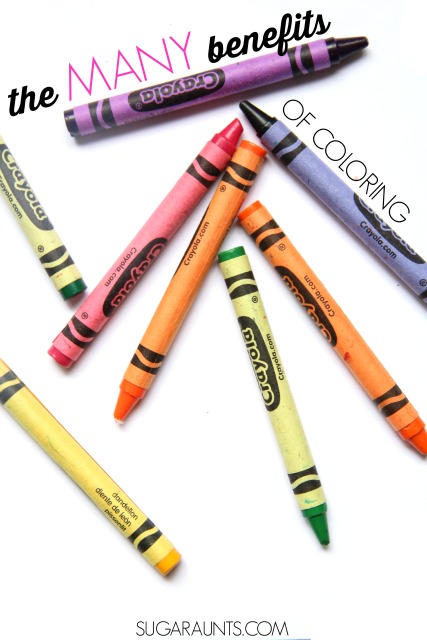
The Many Benefits of Coloring with Crayons

Fine motor skills with coloring

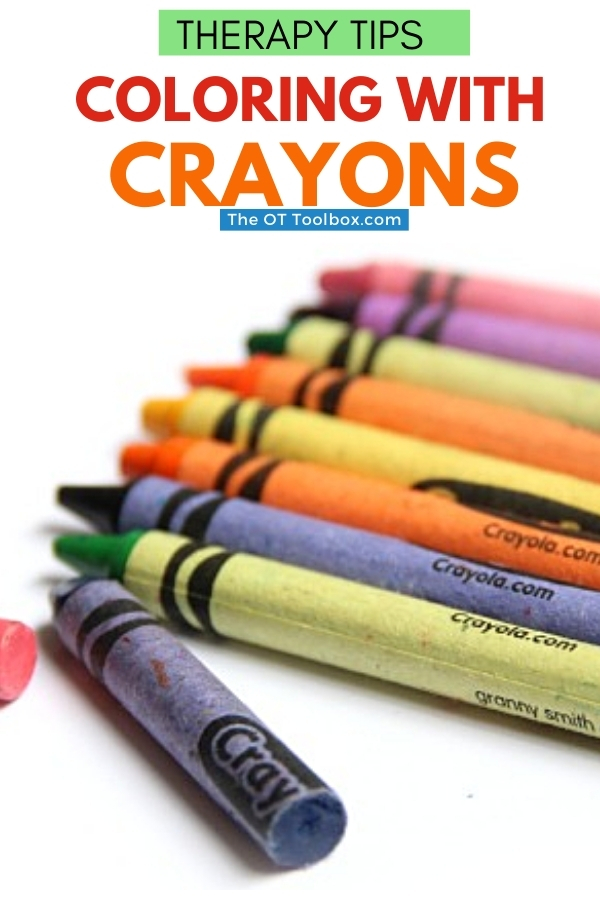
There are many benefits of coloring with crayons in occupational therapy interventions. Coloring with crayons is a fine motor skill that builds other skills. Did you know that the act of coloring with a crayon can help children develop fine motor strength, dexterity, grasp, and endurance in their hands? Be sure to check out this resource on the best crayons, based on development and fine motor skills.

And, coloring skills develop by more coloring. Here’s the thing: occupational therapists use crayons to help children develop fine motor skills, but they also work on the development of coloring skills as a functional task that is part of play, and typical child development. Let’s talk about all of the coloring skills that occupational therapy addresses with a simple box of crayons.

Benefits of coloring in child development

You know that smell, right? It’s kind of waxy and flaky (if that’s a smell…) and so distinctive! If you open a box of crayons that have the little marks of each crayon inside the cardboard box, it has an even stronger smell.  Crayons smell like childhood! This post on coloring skills is part of my 31 Days of Occupational Therapy series, where each day is a creative activity using OT treatment materials that are free or almost free.  

Fine Motor Skills with Crayons

Crayons are something that most homes have in a pencil box, in an old tin, or in a drawer somewhere.  Did you know those childhood memory sticks (aka Crayons) can be used in SO many skill areas?  

Consider fine and gross motor strength, tool use, sensory processing, pencil grasp, line awareness, hand-eye coordination, dexterity, endurance, self-confidence, creativity, task completion, and learning objectives like color identification, and color matching.  Crayons develop the very skills needed for pencil grasp and carryover of that pencil grasp. Whew!  No wonder crayons get worn down to nubs with all of those areas that they are working on!  

One tool I love is our color by letter worksheet to support fine motor skills while coloring in a small space.


Coloring is a fine motor skill and it helps kids develop other areas.

Benefits of Coloring for Children

There are so many developmental benefits to coloring! It’s more than creating a colorful preschool work of art.

Related Read: Read about how we worked on carryover of pencil grasp and strengthened fine motor skills and so many other areas with our 3 Crayon Challenge activity.

There are so many benefits to coloring for kids: hand strength, visual motor skills, visual perception, tool use, creativity, endurance, creativity, self-confidence, task completion, and learning objectives!  Tips from an Occupational Therapist for working on coloring and handwriting in school and at home.

Coloring with crayons Improves Tool Use


Coloring with crayons improves a child’s ability to manipulate tools such as pencils, scissors, utensils, grooming and hygiene tools, and other functional tools with ease. By developing coloring skills, kids have a natural opportunity to explore a writing utensil in a way that is fun and creative.  

They can use different colors by placing crayons back into the box with a coordinated manner.  To further develop tool use with children, offer a crayon pencil sharpener, a small bin or zippered pouch that needs opening or closing, and a variety of crayon sizes and shapes. All of these can extend fine motor skills with more practice in tool use as well as dexterity.

Coloring with Crayons improves Bilateral Coordination

Bilateral Coordination is a fine motor skill needed for so many tasks. Using both hands together in a coordinated manner is a skill needed for handwriting, scissor use, and many functional tasks.  When coloring, a child needs to hold the paper as they color.  Using the assisting, non-dominant hand as a stabilizer allows a child to build strength and dexterity in their dominant hand.  This skill will carry over to writing tasks, and makes coloring a great activity for kids who are switching hands in activities.

Coloring with Crayons Improves Endurance


Building on the fine motor skill areas, coloring can deepen a child’s endurance in completing writing tasks.  

Many times, kids will complain of hand fatigue while coloring.  They can build muscle endurance by coloring with the small muscles of their hands and allow for greater endurance when writing, too. To help a child develop hand strength, use coloring!

You can help kids improve hand strength with this simple coloring exercise: Instruct a child how to color in small circles to work on the strength and endurance of the intrinsic muscles.  Ask them to fill in the complete circle. To extend the activity, create more circles. This exercise can be extended further by working on a vertical surface such as an easel or by taping the page to a wall. This develops proximal stability at the shoulder girdle as well as core strength, allowing for postural stability in written work.

If a child needs to work on this area, you can show the student how to color on a slanted surface like a slanted table surface or elevated surface. Here is an easy way to create a DIY slant board.

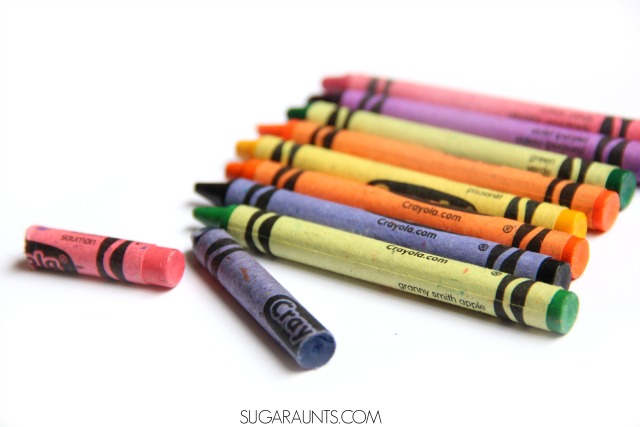
Broken Crayons help with hand strength! 

Fine motor skills with coloring

Coloring develops Tripod Grasp


Coloring is a fine motor strengthening tool that many Occupational Therapists recommend and use in treatment sessions.  Coloring is a resistive task that provides the small muscles in the hand to work the waxy crayon onto coloring sheets.  When a child holds a crayon, they are working on the strength of the intrinsic muscles of the hand.  

Using broken crayons requires more work and is a greater strengthening task for kids who need to work on their tripod grasp. For more strengthening, encourage your child to color more resistive surfaces such as construction paper, cardboard, or even sand paper. 


Coloring offers sensory input


Coloring with a crayon can be an opportunity to add heavy work through the hands. This sensory feedback is proprioceptive input that “wakes up” the muscles of the hands and can be calming input.

Unlike a marker, children can color lightly or very dark by exerting more pressure.  The proprioceptive system comes into play when a child attempts to vary the amount of pressure they are exerting through the crayon.

Coloring with markers just doesn’t provide that resistive feedback that coloring with a waxy crayon does. Markers are smooth and don’t give kids the sensory input that help with learning letters.  For a fun twist on letter formation activities, grab a box of crayons!  

To help kids write with heavier or lighter pencil pressure when writing, encourage children to shade and combine colors by being aware of how lightly or darkly they are coloring.  There is also that crayon scent that children are aware of, either consciously or unconsciously.  If you recall the scent of crayons from your childhood, then you know what I’m talking about here!

Coloring Skills Develop Spatial Awareness


Coloring skill development progresses as children gain experience in coloring. By developing coloring skills, kids can improve visual perceptual skills. Spatial awareness is an aspect of perceptual skills.

Visual perception is so important to many functional skills in handwriting: awareness of the body’s position as it moves through space, line awareness, using margins on a page, and writing within a given space.  Coloring is a great tool in working on these areas as children color within lines and given spaces.  

But sometimes, kids have trouble staying in the lines or coloring in areas without leaving large spaces uncolored.  Verbal prompts, highlighted lines, bold lines, thick coloring lines, and physical prompts like raised lines can improve spatial awareness in coloring.

There are so many benefits to coloring for kids: hand strength, visual motor skills, visual perception, tool use, creativity, endurance, creativity, self-confidence, task completion, and learning objectives!  Tips from an Occupational Therapist for working on coloring and handwriting in school and at home.

Coloring Skills and Eye Hand Coordination

One reason that coloring in occupational therapy sessions is so well-used as an intervention strategy is the development of eye-hand coordination skills. There are benefits of coloring with crayons when it comes to coordinating vision and motor skills. When writing or coloring, children must coordinate their physical movements with information received from their visual system.  

Controlled movements are essential for handwriting, letter formation, and neatness in handwriting.  Coloring helps with practicing coordination of the visual input with physical movements of the hands in very small spaces or large areas.

Providing smaller areas of coloring require more controlled movements and dexterity.  For difficulties in this area, consider adding boundaries to coloring areas, with darkened and thicker lines or raised boundaries like using Wikki Stix around the coloring area.

Coloring Benefits Creativity and Self-Confidence


Another of the benefits of coloring with crayons involves self-confidence. Coloring inspires creativity in kids.  A blank piece of paper and a box of crayons can inspire stories and pictures.  Being creative allows a child to build their self-confidence in other areas, especially handwriting and pencil tasks. If you’ve ever received a coloring masterpiece from a child, then you know the pure delight they have when giving a creation they have made.  That boost of self-confidence will entice them to complete other paper/pencil tasks.

Coloring helps with Color Identification and Color Matching


Crayons are color!  Kids can be encouraged to practice color identification with the bright and vivid colors in a crayon box.  Use a color by number activity to work on color matching skills.

These visual discrimination skills, visual scanning, visual attention, and visual memory needed to identify and match colors are part of the visual perceptual skills we talked about above. All of these are needed skills for reading, writing, math, and other higher level cognitive skills.

Coloring with crayons in occupational therapy helps kids develop fine motor skills

Coloring in occupational therapy teletherapy

All you need to develop the skills listed above is a simple box of crayons. This makes coloring a powerful tool in occupational therapy teletherapy, because many homes have crayons available.

Working on fine motor skills in teletherapy can be difficult because so many of an occupational therapist’s favorite fine motor tools might not be available. This is where using crayons to work on a variety of skills can be so powerful.

Try some of these teletherapy activities using crayons:

So, now you know the many benefits of coloring with crayons.  How can you use crayons in developmental and functional tasks?  Let’s explore crayons for various ages and stages.

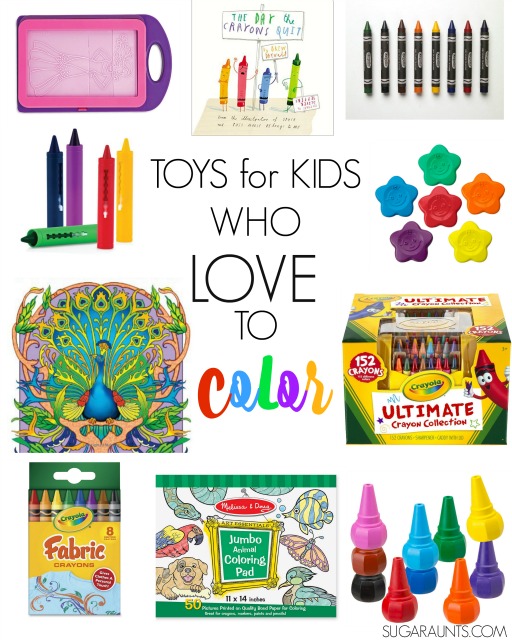
Toys and tools for kids who love to color and ways to incorporate coloring into kids daily lives to work on so many functional skills like fine motor, grasp, visual perceptual.

Toys for Coloring Skills

You’ll want to start by reading this article on the best crayons for toddlers. There, we cover crayons for building coloring skills from the youngest age, and highlight therapist-recommended crayons based on development.

First, start with our free President’s Day coloring pages (great for any US holiday!) and use the coloring therapy toys below.

Here are some creative learning and play ideas that kids will love.  Some of these are more pricey than just a box of crayons, but your crayon fan will enjoy using these toys and games and won’t even realize they are working on so many skills!

(We’re including affiliate links.)   One of our favorite books is The Day the Crayons Quit by Drew Dewalt. This is a book for crayon fans! We grab this book from the library anytime we see it, and it’s got a great message, too. Kids will be inspired to color after reading this book about crayons. 

 It’s no secret that crayons are a fine motor powerhouse when it comes to developing that tripod grasp! You can use larger crayons for smaller kids or children who need to work on other grasps, like a lateral key grasp, or children who need to work on thumb adduction in functional tasks like scissoring. These ALEX Jr. Tots First Crayons are just the thing to try! 

 Work on more fine motor skills, like finger isolation when using Finger Crayons.

Kids can get creative and explore sensory play while using crayons in the bathtub. 


 These Bath Time Crayons are on my list to try!

Do you remember rubbing crayons over fashion design kits as a kid? There is a reason to do this play activity with kids! 


This Fashion Design Activity Kit provides proprioceptive input and strength to little hands in a fun and creative way. 


 With 152 colors, this Crayola Ultimate Crayon Case will give your kiddo a color for every creative whim. This looks so inviting! 


 There is a coloring book out there for everyone! Even adults can get in on the coloring fun with creative coloring like this Art Nouveau Animal Designs Coloring Book . Color alongside your child for calming and relaxing art time. 


 I love the large size and big pictures of the Melissa & Doug Jumbo Coloring Pads. They are perfect for the youngest colorers. 


For more creative fun, try Dry Erase Crayons right on a dry erase surface. This is a great way to practice spelling words on a resistive surface. 


Little artists will love to create their own t-shirt designs using Fabric Crayons
. This is a fun way to work on fine motor strength and bilateral coordination. Holding down that cotton t-shirt is a bilateral coordination workout!

There are so many benefits to coloring for kids: hand strength, visual motor skills, visual perception, tool use, creativity, endurance, creativity, self-confidence, task completion, and learning objectives!  Tips from an Occupational Therapist for working on coloring and handwriting in school and at home.

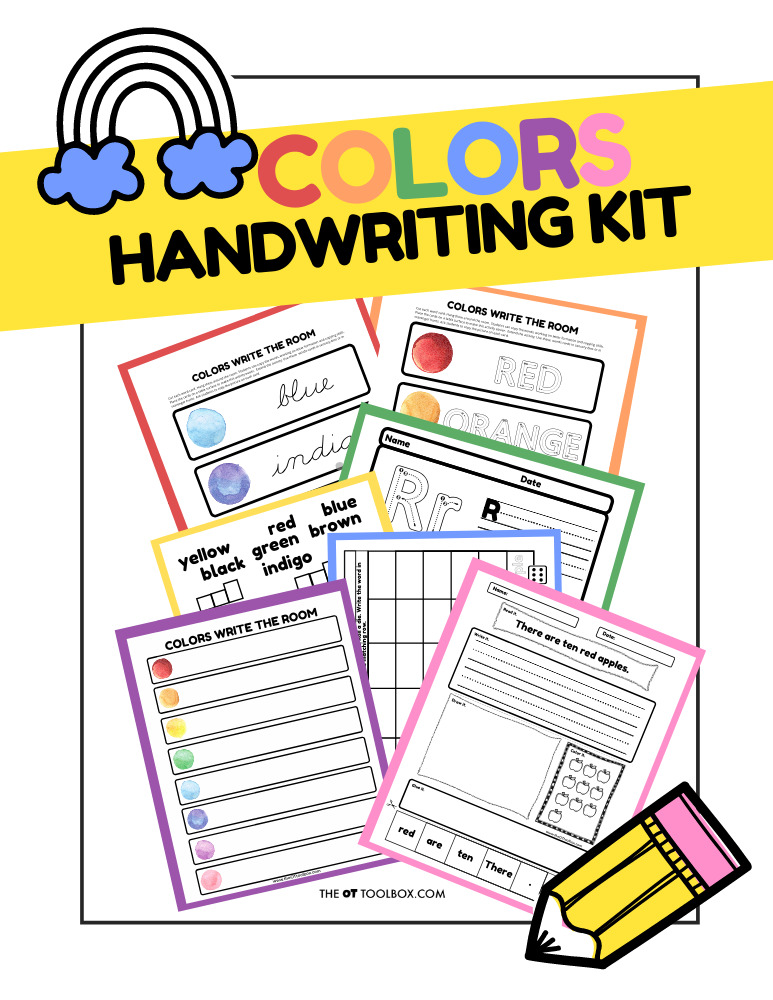
Colors Handwriting Kit

Working on handwriting skills in occupational therapy sessions?

Need to help your child with handwriting legibility, letter formation, spacing, and sizing in written work?

Working on handwriting in the classroom and need a fun colors of the rainbow theme for motivating handwriting tasks?

The Colors Handwriting Kit has you covered!

In the 60 page printable kit, you’ll find handwriting worksheets, fine motor activity pages for A-Z, colors “write the room” cards for uppercase letters, lowercase letters, and cursive letters. This kit has evertyhing you need for helpiing kindergarten-2nd grade students with handwriting skills.

Click here to access the Colors Handwriting Kit.

Colors Handwriting Kit
Colors Handwriting Kit for working on handwriting with a colors theme.

More Crayon activities

Metallic Crayon Dough

Shades of red crayon play dough 

Harold and the Purple Crayon play dough 

Rainbow Crayon Play Dough

Colleen Beck, OTR/L has been an occupational therapist since 2000, working in school-based, hand therapy, outpatient peds, EI, and SNF. Colleen created The OT Toolbox to inspire therapists, teachers, and parents with easy and fun tools to help children thrive. Read her story about going from an OT making $3/hour (after paying for kids’ childcare) to a full-time OT resource creator for millions of readers. Want to collaborate? Send an email to contact@theottoolbox.com.
Reindeer Games Gross Motor Slide Deck

Christmas gross motor activities

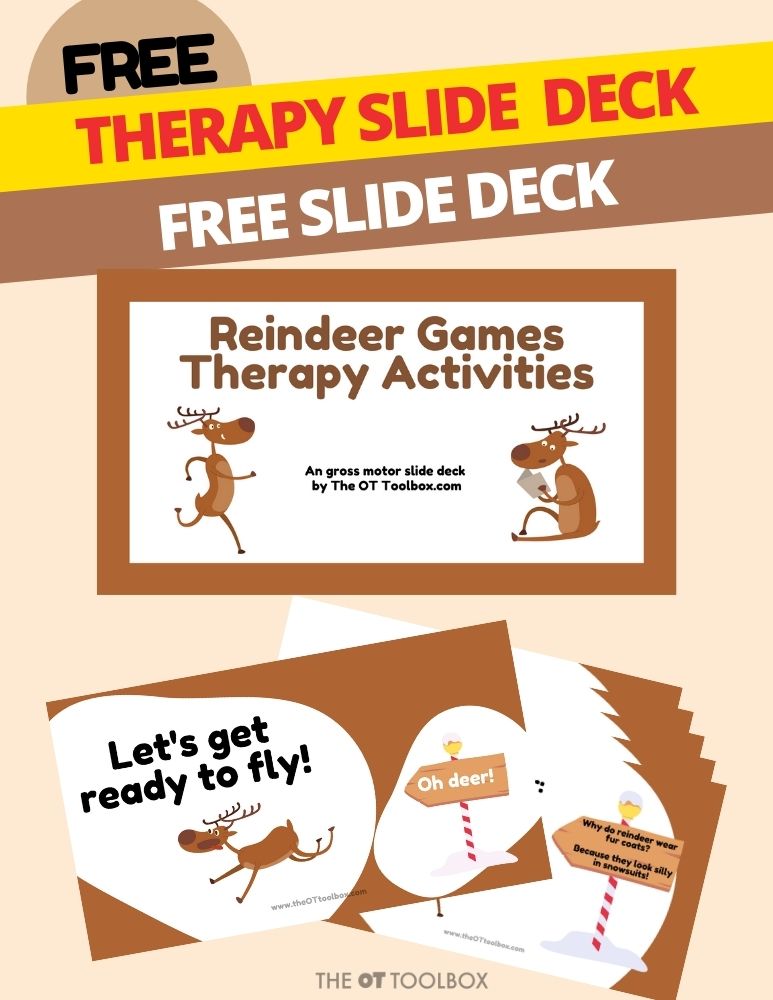
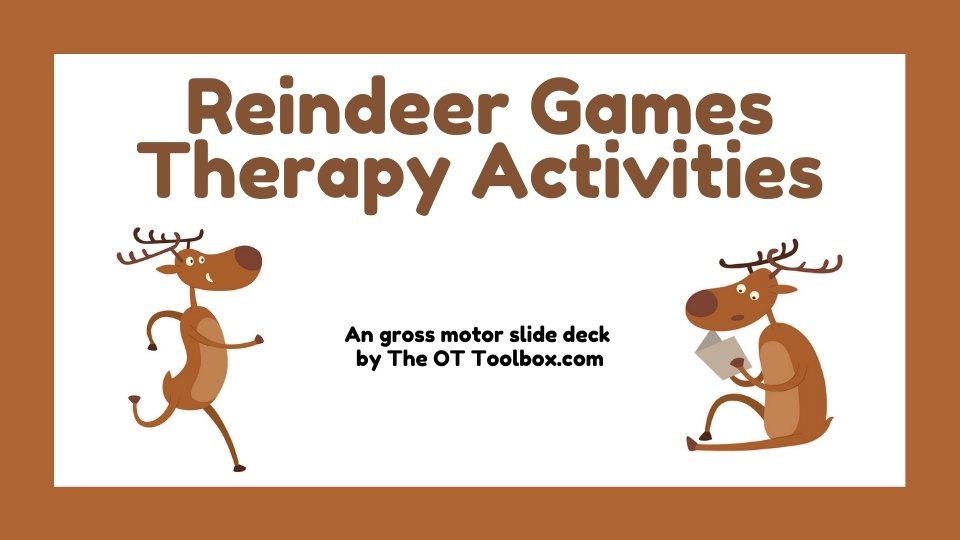
I am so excited to share this gross motor slide deck for teletherapy. It’s a reindeer games theme that allows kids to support gross motor skills in teletherapy, which is sometimes difficult to facilitate via a virtual therapy setting. These reindeer games activities are FUN for kids and they will be excited to see and do the gross motor activity on each slide of the therapy slide deck. Let’s explore reindeer games!

Pair these with our reindeer activities to address other goal areas, and these free fine motor reindeer printables.

Reindeer games activities for kids in a gross motor teletherapy slide deck.

Reindeer Games Activities

These reindeer games are fun for kids, and I am excited to use the therapy slide deck with my own kids at home. With colder temperatures and less kids’ sports activities this year, getting the kids active and moving can be tricky.

So, that’s where these reindeer games for kids come in…we’ll use the reindeer games for a Christmas party at home as a way to get the whole family moving with a reindeer theme.

Kids can use these reindeer games in teletherapy gross motor activities.

Christmas Gross Motor Activities

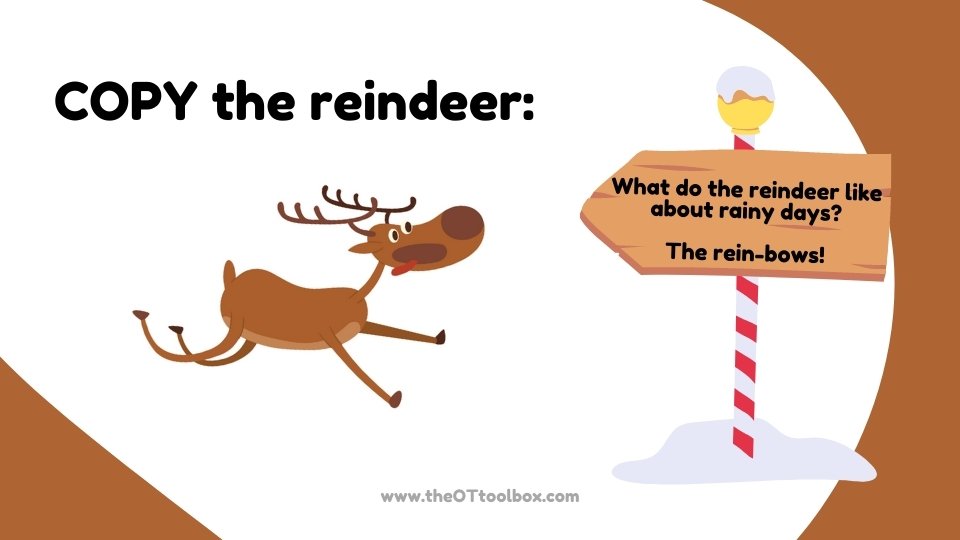
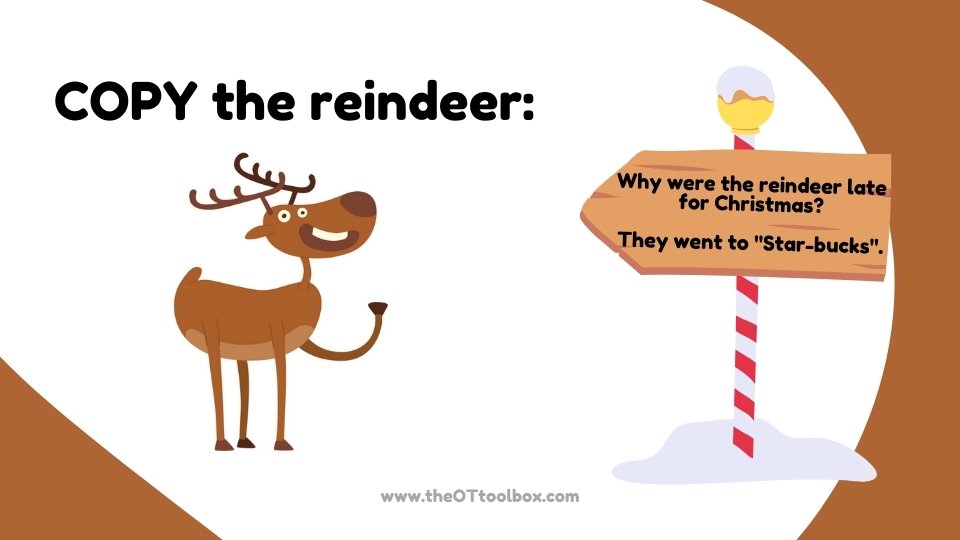
I wanted to use reindeer in the gross motor activities and challenge kids to move in different positioning, much like yoga positions. The gross motor challenges require kids to copy an image and hold that image.

The slides can be graded to each child’s needs. Can they hold the position while reading the reindeer joke on the slide? Can they read just the response to the reindeer joke? Adjust the slide in a way that meets the needs of each child.

The Christmas jokes are a fun way to encourage various positions and movement with themed Christmas gross motor activities.

This Christmas slide deck goes great with our Gingerbread Man Teletherapy Slide Deck, our Decorate a Gingerbread House Teletherapy Slide Deck, and our Holiday Cookies Slide Deck.

Use this gross motor teletherapy slide deck with a reindeer theme for Christmas gross motor activities.

Gross Motor Slide Deck for Teletherapy

Because incorporating gross motor skills in teletherapy is sometimes a challenge (especially to find interesting and new ideas!) this gross motor slide deck was desined for teletherapy in a way that instructs kids to copy various postions as they balance and strengthen their core.

Included are some slides to incorporate propriocepetion and vestibular input as well.

All of these skills can be addressed with this gross motor slide deck in teletherapy sessions:

  • Core strength
  • Stability
  • Balance and equilibrium skills
  • Coordination
  • Range of motion
  • Flexibility
  • Motor planning
  • Crossing midline
  • Movement patterns
  • Posture and postural control
  • Muscle tone
  • Proprioceptive input
  • Vestibular input
Use these Christmas gross motor activities with a reindeer theme in teletherapy movement activities.

Want this Free Gross Motor Slide Deck?

This slide deck is not interactive. It has no movable parts on the slide deck. Because it is static slides in the activity, you can use the slide deck on any devices, including tablets and phones.

Be sure to make a copy of this slide deck and not change the url to indicate “edit” at the end. When you make a copy of the slide deck onto your Google drive, you will end up with your own version that you are free to adjust in order to meet your student’s needs. By changing the url to “edit”, you can potentially mess up the original version that many other therapists and The OT Toolbox users are given.

ou can grab a copy of this Google slide deck and use it to work on specific skills.

Enter your email address below and you will receive a PDF containing a link to copy the slide deck onto your Google drive. Save that PDF file, because you can come back to it again and again and send it to the kids on your caseload (or classroom) so they can make their own copy on their Google drive.

Please use the copy of the slide deck and do not change the url.

FREE Reindeer Games Gross Motor Therapy Activities!

    We respect your privacy. Unsubscribe at anytime.

    MORE VIRTUAL LEARNING SLIDE DECKS?

    Would you like more therapy slide decks? Grab the others to add to your therapy toolbox!

    Kids are loving this Decorate a Gingerbread House slide deck.

    Try this Gingerbread Man Slide Deck.

    Use this Holiday Cookies Activities to address working memory, visual perception, and direction following.

    Here is a Community Helpers Theme Slide Deck.

    Here is a Football Theme Slide Deck.

    Here is a slide deck for a Social Story for Wearing a Mask.

    Here is a Space Theme Therapy Slide Deck.

    Here is a Therapy Planning Interactive Slide Deck.

    Here is a Back to School Writing Activity Slide Deck.

    Here is an Alphabet Exercises Slide Deck.

    Here is a Self-Awareness Activities Slide Deck.

    Colleen Beck, OTR/L has been an occupational therapist since 2000, working in school-based, hand therapy, outpatient peds, EI, and SNF. Colleen created The OT Toolbox to inspire therapists, teachers, and parents with easy and fun tools to help children thrive. Read her story about going from an OT making $3/hour (after paying for kids’ childcare) to a full-time OT resource creator for millions of readers. Want to collaborate? Send an email to contact@theottoolbox.com.
    Reindeer Fine Motor Cards

    reindeer fine motor cards for kids

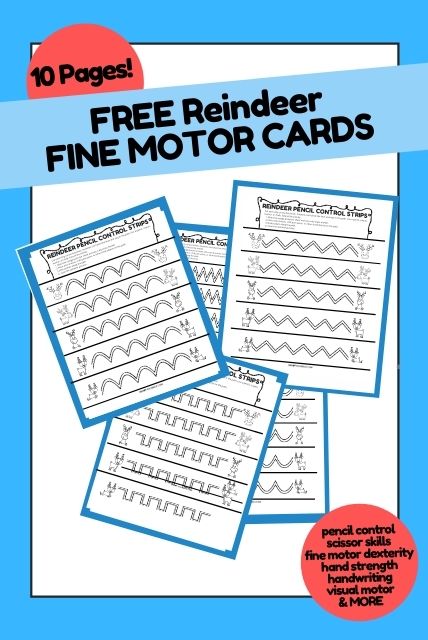
    Did you see the reindeer activities ideas listed here on the website last week? It’s a Christmas occupational therapy plan that can work on so many different areas. Today, I’ve got another fun holiday activity for kids to do…Reindeer fine motor cards! This newly created Christmas activity is a free pack of reindeer theme activity cards. Use them to work on fine motor skills such as pencil control, precision, eye-hand coordination, motor planning, and more.

    reindeer fine motor cards for kids

    Reindeer Fine Motor Cards

    You can print these off and use them over and over again. I created these reindeer theme fine motor cards for the purpose of multi-use, meaning that you can use them to work on several different areas:

    Work on pencil control with these free printables.

    Reindeer Theme Pencil Control

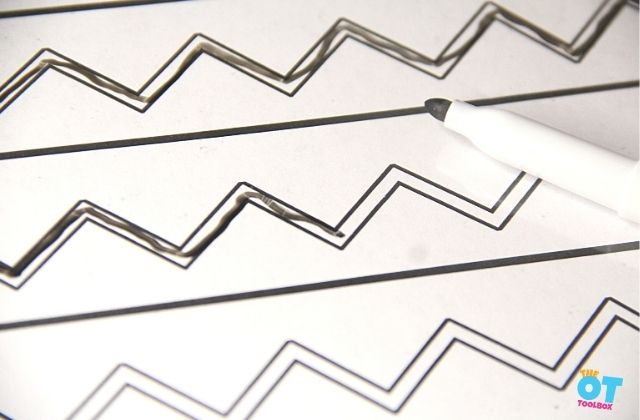
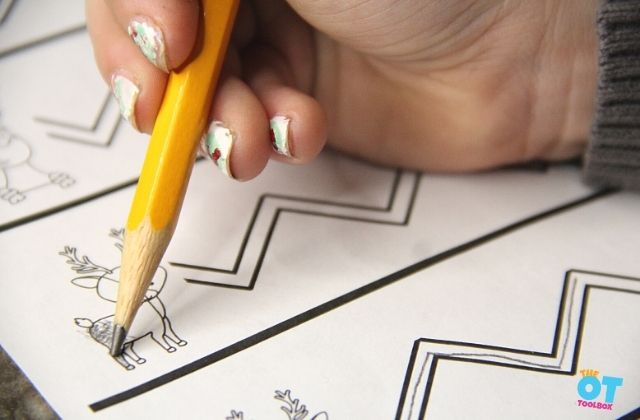
    Print off the reindeer cards for a pencil control activity where you can ask children to trace along the paths. In this way, kids work on pencil accuracy and motor planning to control the pencil. With each path, there are several repetitions, allowing children to work on these skills and accuracy. Use the sheets to collect data in therapy sessions. Kids can complete the path with accuracy on 3/5 attempts, (or other ratio) using these cards.

    Use the fine motor printables to work on precision, eye-hand coordination skills.

    Reindeer Activity for Fine Motor Skills

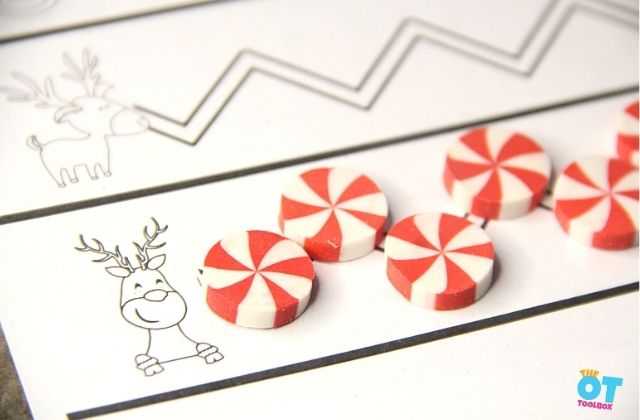
    Use the cards to work on fine motor skills such as precision, eye-hand coordination, pinch, dexterity, finger isolation, and motor planning. Print off the cards and ask students to place manipulatives along the lines to connect the reindeer. Try using these cards in a variety of ways:

    • Place stickers along the path
    • Trace the path to work on finger isolation
    • Place craft pom poms, mini erasers, pebbles, or small objects along the path.
    • Use a bottle of squeeze glue and ask students to create a glue path in the lines. They can crumble up small pieces of paper and glue them along the path.
    Pencil control and pencil pressure with coloring a reindeer on these free fine motor printables.

    Reindeer Coloring Activity

    Use the cards to work on fine motor skills in the ways listed above, but also by addressing coloring skills. Coloring is a fantastic way to work on precision, hand strength, arch development, as well as eye-hand coordination. Coloring also benefits visual perceptual skills as well. Here are all of the benefits that coloring offers. Children can use the cards to color in the path and work on pre-writing lines as well as line awareness. Use the cards as repetition trials to work on accuracy and consistency with visual perceptual skills, line awareness, and small motor movements when coloring in a small space. Each coloring card can be used to collect data.

    Use the cards to work on pencil pressure by asking children to color in the reindeer images with their pencil.

    Reindeer Cutting Strips

    The pencil control strips are set up in a way that allows them to be used as cutting strips as well. Ask children to cut along the bold lines and work on cutting skills. To grade the activity up, ask children to cut along the path on the curved and angled lines. Then, each strip can be used to collect data in the repetitions. Children can work on keeping the scissors within in the path. You can cut the left side of the page off to remove the reindeer on the left for cutting strips that start from the edge of the paper. Here is more information on scissor skills.

    Free Reindeer Printables

    Would you like to get a copy of these printable pages to use in working on a variety of fine motor skills? Enter your email address below and the file will be delivered to your inbox.

    FREE Reindeer-theme Fine Motor Cards

      We respect your privacy. Unsubscribe at anytime.

      Colleen Beck, OTR/L has been an occupational therapist since 2000, working in school-based, hand therapy, outpatient peds, EI, and SNF. Colleen created The OT Toolbox to inspire therapists, teachers, and parents with easy and fun tools to help children thrive. Read her story about going from an OT making $3/hour (after paying for kids’ childcare) to a full-time OT resource creator for millions of readers. Want to collaborate? Send an email to contact@theottoolbox.com.
      Reindeer Activities

      reindeer activities for kids

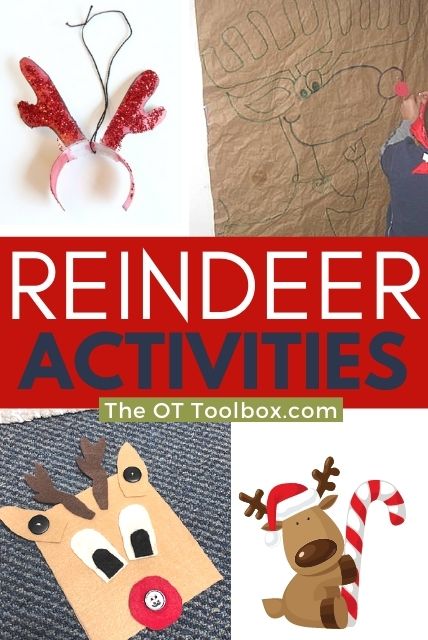
      If you love Dasher, Dancer, Prancer, Vixen, Comet, Cupid, Donner, Blitzen, and of course, Rudolph, then you’ll love all of these fun reindeer activities!  The reindeer crafts and movement activities you see here will get kids grasping, pinching, jingling, buttoning, writing, sniffing, moving, creating, and partying. All of these developmental skills are included with the completion of these fun and festive reindeer activities. Kids will be engaged and motivated to do even the most difficult of tasks. These reindeer play ideas cover a variety of skills. So, let’s get to it! 

      reindeer activities, reindeer crafts, and reindeer art for kids

      Reindeer Activities

      I’ve broken these holiday activities up into sections: sensory activities, fine motor activities, movement, and reindeer crafts. These should help you with therapy planning this time of year. These reindeer fine motor cards will be a fun way to play, too.

      Reindeer Sensory Activities

      First, are some fun SENSORY activities, do you need some sensory tools with a festive reindeer theme? Then here ya go!

      Chocolate Scented Reindeer Play Dough gives you the recipe to create a yummy smelling play dough and when it’s in use as part of an invitation tray, children work on fine motor strengthening as well as tactile tolerance while building fun reindeer faces and more.

      Rudolph Jingle Bell Sticks gives you a fun way to incorporate music jingling into your daily activities.  The sticks include the creation of a unique musical instrument that can be used when working on dance moves, gross motor exercise, or even as a fun reading tracking stick. 

      Reindeer Food Writing Tray provides you a recipe for reindeer food that children create while working on eye-hand coordination to pour, shake, scoop, and stir while creating the food mixture.  Once made, it provides a fun sensory tool for children to work on letter, number and shape formation.  

      Christmas Sensory Bottles includes a reindeer-themed sensory bottle that can be used as a calming tool for use in a sensory or calm down corner. Super cute!

      Reindeer Crafts

      Next, are some fun FINE MOTOR and ART and CRAFT activities that can help if you need festive ideas for building fine motor strength, pincer grasp, bilateral coordination, hand dominance, fastener manipulation, tool use, and sequencing skills.  Use these reindeer crafts to help kids develop fine motor skills in a big way. Take a look: 

      Add these reindeer fine motor cards to your therapy toolbox to work on a variety of areas: pencil control, writing lines, coloring, scissor skills, precision, hand strength, spatial skills, and more.

      Olive, the Other Reindeer Book Ornament is a cute ornament craft that uses a recycled toilet paper roll to create a set of antlers. The ornament is based on the book, Olive, The Other Reindeer, who is a dog-reindeer, that’s right a dog-reindeer.  She thinks she’s a reindeer and goes to the North Pole to help Santa and the reindeer save Christmas. Olive earns her own set of antlers from Santa, so, why not create her antlers after reading the book? 

      Reindeer Antler Match includes matching and clipping multi-colored, miniature clothespins onto foam reindeer heads with the matching nose color. Works on pincer grasp and color recognition. 

      Reindeer Buttoning involves the use of felt and buttons to build a reindeer’s face while working on buttoning or unbuttoning skills, sequencing, and following directions.

      Feed Rudolph the Reindeer will work on pincer grasp and eye-hand coordination while children pinch small pieces of pipe cleaner to push through the holes of a recycled spice bottle. 

      Cocoa Pebbles Reindeer Craft includes the use of Cocoa Pebbles to fill a reindeer outline. Have kiddos pinch small piles of pebbles from a bowl and sprinkle onto the outline to work on fine motor pinch skills. Note: With the yummy smell of this cereal while doing the activity, it just might make it a little difficult not to sneak a nibble while creating this cute craft! 

      Toilet Paper Roll Reindeer includes the tracing of hands and cutting them out to create antlers for pasting onto a recycled toilet paper roll. Finish with adding cute googly eyes and a red pom-pom nose. Easy, but really cute and what great skills are worked on with tracing and cutting!

      Yarn Wrapped Reindeer Craft is really a fine motor activity that turns out to be a cute craft when completed. Children wrap yarn around a cardboard triangle, add googly eyes and a pom-pom nose, and then clip on two clothespins that are wrapped with pipe cleaners to create antlers. 

      Preschool Build a Shape Reindeer is a fun way to have prechoolers work on shape recognition by building a fun construction paper reindeer with use of precut shapes. You can easily have a child work on cutting skills with this activity, if you have them cut out the shapes and then assemble the reindeer. 

      Handwriting Reindeer Activities

      Next, are some multisensory HANDWRITING reindeer activities that help children to work on handwriting mechanics along with other skills in a fun and unique way that will motivate them to engage in the task!

      Reindeer Multisensory Handwriting Freebie involves a multisensory approach to handwriting that includes tracing, cutting, pasting, moving, scanning, visual discrimination, and handwriting. Check it out. 

      Meet My Pet Reindeer is a holiday craftivity that includes cutting, tracing, gluing and writing. 

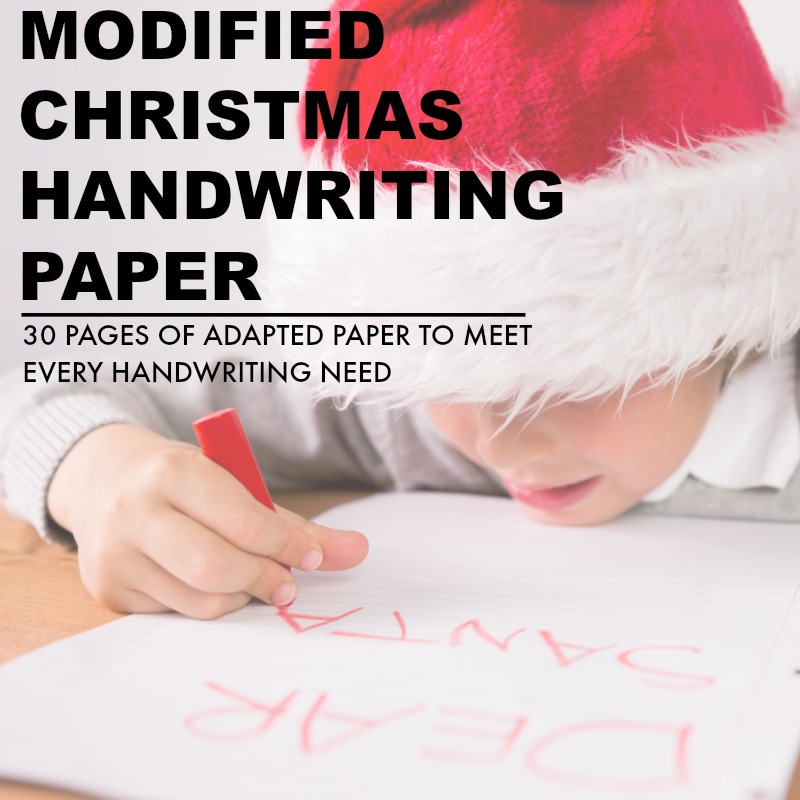
      But, if you just need some festive holiday handwriting paper that is modified to help a variety of children with their handwriting needs, check out this Christmas Modified Handwriting Paper, by The OT Toolbox. 

      Gross Motor Reindeer Activities

      Next, are some super fun GROSS MOTOR Reindeer Activities that could be used for transitions while building gross motor skills and working on motor planning too!  Fun activities that can be used at home, at school, and during remote learning or therapy. 

      Try the pin the nose on the reindeer activity in our Reindeer Party Games for a gross motor game with the whole family.

      Reindeer Brain Breaks is just that, a break for the brain with a reindeer theme! Each of Santa’s reindeer has a brain break card and children can use them while at home, during a transition, in the classroom, or while online. These brain break moves can easily be done in small spaces making them perfect for most anywhere! 

      Reindeer Testing will get kids moving as they perform some fun reindeer moves that may be needed when pulling Santa’s sleigh! This fun resource helps to get kids moving while testing their reindeer skills with running, jumping, stomping, and prancing. 

      Reindeer Boot Camp is an excellent source for gross motor activities and they are perfect for either a classroom, home party or just to get kids moving! The reindeer training activities include balancing, galloping, leaping, scooter pulling, and tossing bean bags at a target. Don’t have been bags? That’s okay, use some stuffed animals. 

      Reindeer Games Camp is a boot camp that works on a variety of gross motor skills. Children will pull sleighs, do agility drills, do hoop and cone training, practice reindeer moves, and work on present stacking. These skills are important when you’re a reindeer!

      Lastly, do you need a resource that literally has all you need in one place?  Try this fun resource by The OT Toolbox called, Reindeer Playdate Party. There is food, activities, snacks, and reindeer games! This will give you all you need to party like the Reindeer! Have fun!

      Try these ideas for more Christmas activities that help kids develop skills…Just click on the images below for holiday fun!

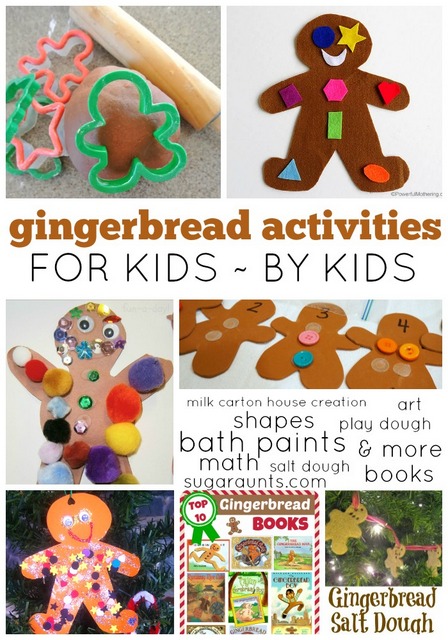
      gingerbread man activities
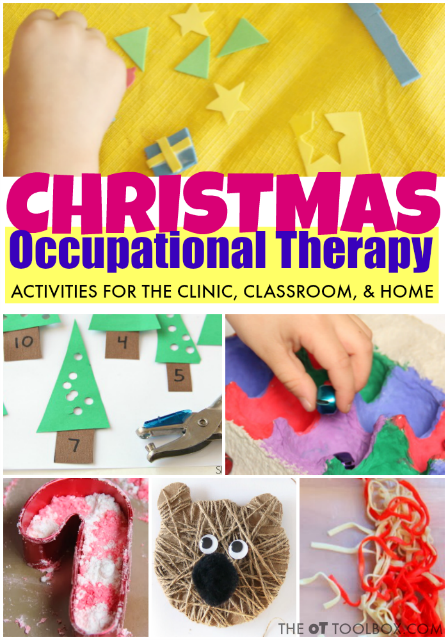
      Christmas occupational therapy interventions
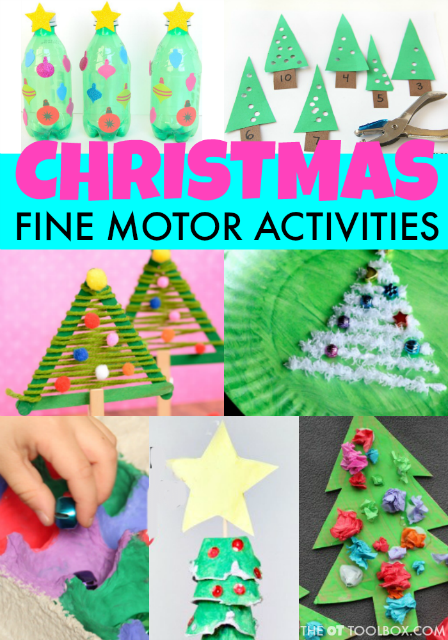
      Christmas Fine Motor activities

      Colleen Beck, OTR/L has been an occupational therapist since 2000, working in school-based, hand therapy, outpatient peds, EI, and SNF. Colleen created The OT Toolbox to inspire therapists, teachers, and parents with easy and fun tools to help children thrive. Read her story about going from an OT making $3/hour (after paying for kids’ childcare) to a full-time OT resource creator for millions of readers. Want to collaborate? Send an email to contact@theottoolbox.com.
      Gingerbread Man Activities

      gingerbread man activities

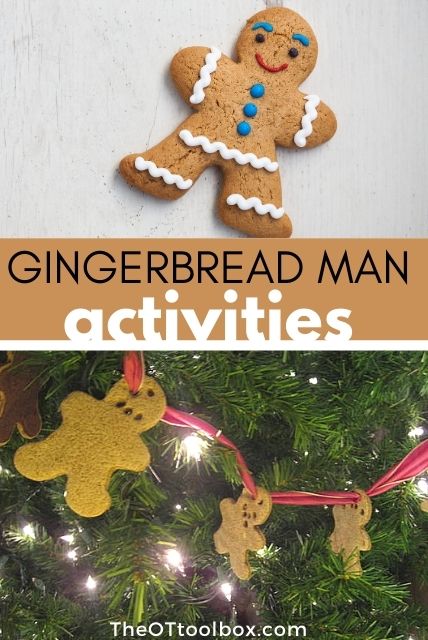
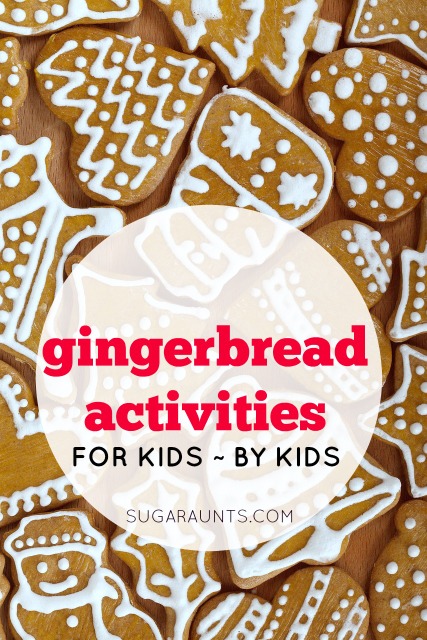
      Looking for gingerbread man activities? We’ve got you covered. From gingerbread men to gingerbread houses to gingerbread cookies, it’s the theme of gingerbread for this festive season! Can you smell the ginger? Ah, it’s so cozy and the theme of gingerbread is so classic and fun! Browse an old blog post from The OT Toolbox to find gingerbread activities for kids by kids. Lots of fun ideas in that post as well as some new ideas in this post! You can also find a Cardboard Gingerbread House idea.

      Use these activities with our decorate a gingerbread house slide deck and our gingerbread man handwriting and fine motor slide deck.

      Gingerbread man activities for kids

      GINGERBREAD MAN ACTIVITIES

      Included below are gingerbread man books that you can pair with hands-on activities. The gingerbread man ideas below build fine motor skills, gross motor skills, motor planning, direction-following, and sensory exploration. Let’s get started with the holiday activities!

      You can’t go the season without reading at least one gingerbread man book. So grab one or more of these gingerbread-related books and work on critical thinking and early literacy skills!

      GINGERBREAD MAN BOOKS

      Take a look at these gingerbread man books: (Amazon links included below.) These are great books to use along with therapeutic activities.


      The Gingerbread Man
      Gingerbread Baby
      Gingerbread Friends
      Gingerbread Christmas
      The Gingerbread Man Loose at School
      The Gingerbread Boy
      The Gingerbread Girl
      The Gingerbread Cowboy
      Gingerbread Mouse
      The Gingerbread Pirates

      This Gingerbread Man book activity from Fun-A-Day pairs well with these books.

      GINGERBREAD MAN CRAFTS

      Do you have visions of colorfully decorated gingerbread houses or some icing covered gingerbread men? Crafts are the supreme skill builder for kiddos and highly motivating.

      Crafts can work on scissor cutting, drawing, coloring, tool grasp, glue management, direction following, and sequencing. Now, let’s craft some gingerbread goodies.


      This fun gingerbread man stapling craft is a super fun way to build a gingerbread man while working on stapler use that incorporates strength, bilateral coordination, visual motor control, and precision handling.

      Craft a fun paper bag gingerbread house using office stickers galore! Stickers are an easy way to work on pincer grasp, bilateral coordination, spatial awareness with placement, and hand dominance.


      Craft a fun plate of gingerbread cookies using a paper plate and paper bag being sure to decorate with crayons. Don’t forget broken crayons color too and they can be better for kids to work on their tool grasp!


      Maybe a collage art gingerbread man is more what your kiddos would enjoy. Providing a tray of decorating goodies can give a child the opportunity for creativity and independence. But if you’re looking for more therapeutic benefits, you can incorporate body awareness and multiple fine motor skills.

      Provide a fun gingerbread man lacing craft that automatically incorporates fine motor precision, pincer grasp, motor planning, eye-hand coordination and bilateral hand use.

      Here is a baby gingerbread house from Pre-K Pages that works fine motor skills, too.

      Plus, they turn out super cute.

      Gingerbread Man Gross Motor

      Maybe you have the need for some energy consuming gingerbread movement! So many gingerbread books provide action words that can easily be utilized for movement exercises. Try substituting these actions with various movements you need your child to practice.

      Use these Gingerbread Man gross motor activities as a brain breaks for a physical break in the classroom, at home, or during a transition. Brain break movement activities can involve so many different body moves with a wonderfully festive theme!

      Here’s an activity that you can try called, Gingerbread Man Gross Motor Activity. It combines the simple idea of gross motor skills and literacy skills.

      You can also try these fun Gingerbread Man Gross Motor Dice printables to further incorporate movements related to the book. Read and move together!

      Try Gingerbread Passing to work on core strength, coordination, motor planning, and social skills. It’s a great team work activity or it can be simplified to have one child work on passing a gingerbread man from one place to another.

      Try this fun idea of some Gingerbread Hokey Pokey using a classic game with a gingerbread theme to work on body awareness and motor planning.

      Gingerbread Man Fine Motor

      Feeling the need to focus on fine motor or visual motor skills, maybe? How about drawing, handwriting or visual perception? Read on to find some great activity ideas.


      Here are some fun Gingerbread Letter Tracing Sheets or Gingerbread Prewriting Strips or Gingerbread Letter Tracing Strips to work on pencil control, letter formation and letter size.

      Need a low prep Gingerbread Man Cutting activity to work on bilateral hand skills and eye hand coordination along with scissor grasp? Try this fun idea! Maybe cardboard is too difficult for your kiddos to cut, so simply change to paper or even sandpaper for a fun approach.

      Maybe using scissors is not the skill level of your child so try a Gingerbread Pom-Pom Match activity and use tongs as a pre-scissor skill.

      How about a Gingerbread Man I-Spy activity that is perfect for visual scanning and discrimination? It’s a simple print and go for therapeutic fun!

      Do you have a child working on spoon use? Try this fun Feed the Gingerbread Man printable to set up a low prep scoop and pour activity or use tongs to feed the gingerbread man.

      Maybe simple Gingerbread Theme Play Dough Mats are all you are looking for to have kiddos work on fine motor hand skills.

      Gingerbread Sensory Activities

      This post started with a list and now it’s ending with a list! There are always children who need the sensory input or need to work on sensory tolerance provided by multiple sensory-related activities. Take a look at the list below and click on each item to read the details of how to create these varied sensory goodies all within the gingerbread theme!

      Gingerbread Salt Dough
      Gingerbread Play Dough
      Gingerbread Slime
      Gingerbread Rice
      Gingerbread Oobleck
      Gingerbread Cloud Dough
      Gingerbread Salt Tray
      Gingerbread Paint
      Gingerbread Sensory Bottles
      Gingerbread Sensory Bags

      Now, run, run, as fast you can…and prepare some fun gingerbread activities for the kiddos in your life as all of these activities are super skill builders for children at all levels of development! There’s something about this time of year and gingerbread.  The scent of ginger in the kitchen makes this time of year so warm and cozy!  

      Gingerbread Christmas activities for kids and by kids


      gingerbread activities for kids

      Christmas Handwriting Activities

      Writing out that Christmas wish list is a difficult task that brings out tears instead of holiday excitement.  I’ve got a solution for your kiddo with handwriting difficulties: a packet of modified paper for all of the Christmas handwriting tasks that come up each year.  Use this handwriting pack to help kids who struggle with handwriting to participate in holiday traditions while even working on and developing their handwriting skills!
      Working on handwriting with kids this Christmas season? Grab your copy of the Christmas Modified Handwriting Packet. It’s got three types of adapted paper that kids can use to write letters to Santa, Thank You notes, holiday bucket lists and much more…all while working on handwriting skills in a motivating and fun way! Read more about the adapted Christmas Paper here.   

      Decorate a Gingerbread House

      Decorate a gingerbread house activity for kids

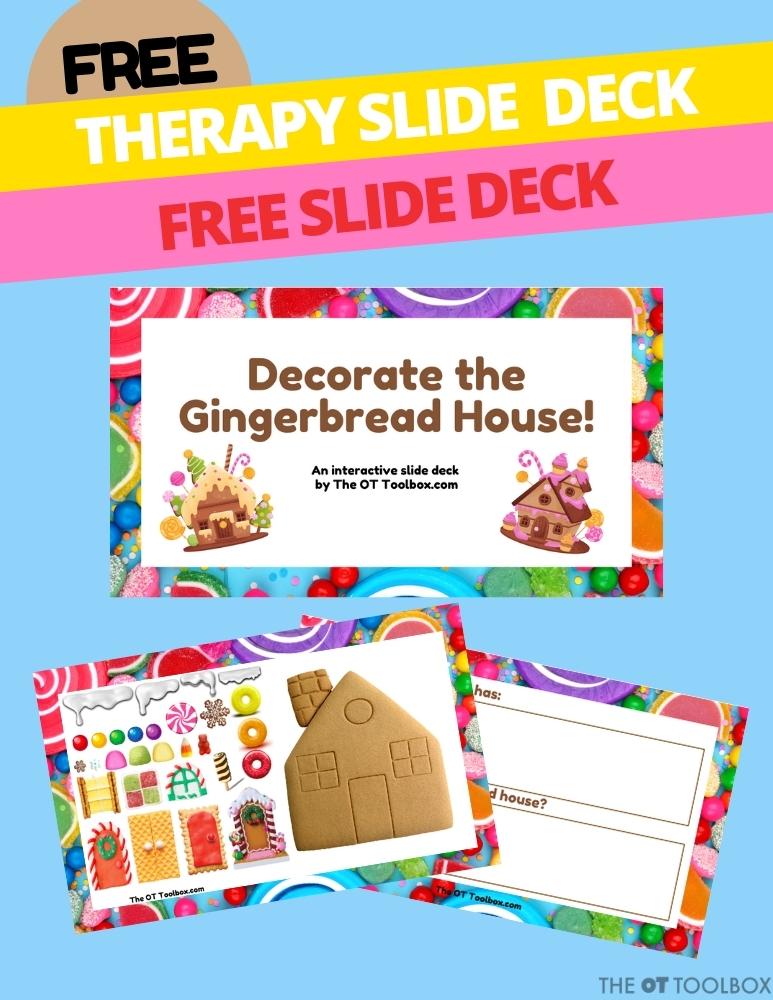
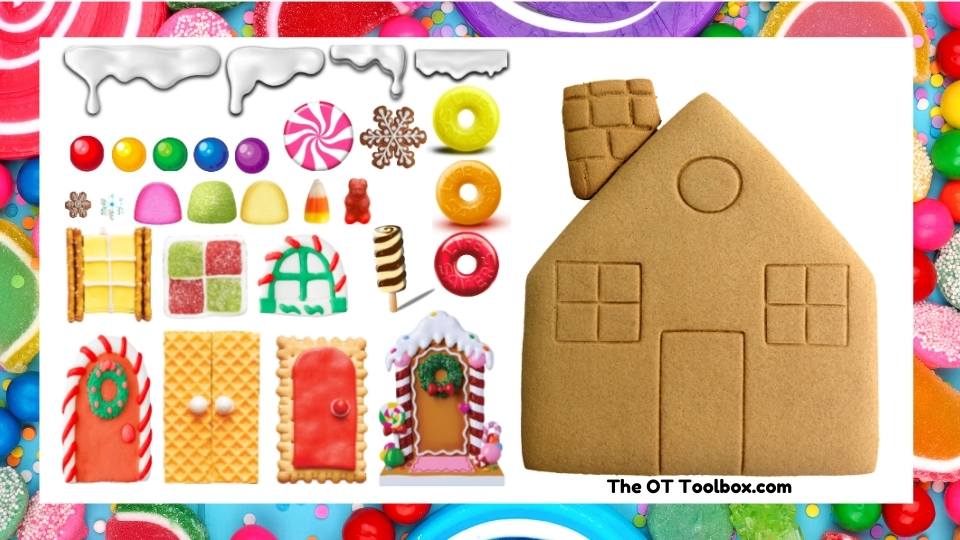
      Today, I have a fun occupational therapy teletherapy activity for kids to do this time of year. It’s an interactive therapy slide deck where kids can decorate a gingerbread house! With this digital gingerbread house activity, kids can move the gingerbread decorations onto the house to decorate in any way they wish! This interactive Google slide deck is a fun way to incorporate therapy goals with a fun holiday activity. Pair this Christmas activity with our gingerbread man slide deck for more therapy fun.

      Decorate a gingerbread house virtual activity for occupational therapy interventions and fun therapy ideas.

      Gingerbread activities are fun this time of year, and this one is a fun twist on holiday activities. Add this to your Christmas Occupational Therapy Activities.

      Decorate a Gingerbread House

      Many kids make a real gingerbread house this time of year. Some lucky kids make a cardboard gingerbread house! But, for virtual therapy sessions, I thought it would be fun to make a FUN activity for therapy in the weeks leading up to Christmas. I know this year has been difficult with virtual learning and learning all that teletherapy requires. It’s been a difficult year for all of us! So, maybe a fun therapy activity is just what the doctor ordered!

      Use this virtual gingerbread house activity in several different ways to incorporate occupational therapy goals in a way that kids won’t even realize they are working on specific goal areas.

      Gingerbread House Therapy Activity

      When kids move the interactive Google slide pieces, they can develop skills such as:

      • Eye-hand coordination
      • Visual scanning
      • Motor planning
      • Visual discrimination
      • Figure ground
      • Form constancy
      • Visual convergence
      • Visual attention
      • Laterality
      • Visualization
      • Finger isolation
      • Computer use/mouse use
      • Direction-following
      • Planning, prioritization, working memory, impulse control and other executive functions
      • Self-confidence

      As you can see, a “fun” therapy activity like decorating a gingerbread house can work on so many areas even if it seems like an extra activity or a reward activity!

      Use this decorate a gingerbread activity in occupational therapy teletherapy sessions.

      Decorate a Gingerbread House Teletherapy Activity

      This slide deck includes two different activities: One is a slide where students can move the candy decorations onto the slide deck.

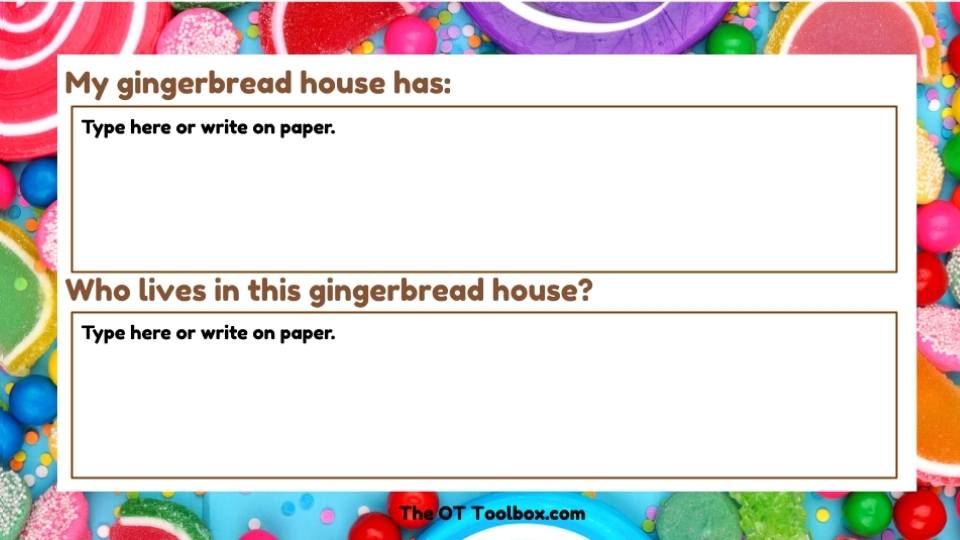
      The second slide is a gingerbread house writing prompt. Kids can either type into the text box, or they can write their responses on paper and work on handwriting, letter formation, and other areas they might be addressing in therapy or distance learning.

      Tip: to revert the slide to it’s original state, use the history option. This is located on the top dashboard in the link, “last edit was”. When you click on that, you will see a list of edits made on the right side of your screen. Click on the edit titled, “Blank Gingerbread House”. This should move all of the movable candy pieces and decorations back to their original location on the slide deck. Note that you can delete edits from that list, so if several students are using the slides, you can keep the organization simple and delete edit versions that you no longer need.

      Another Google Slide ninja tip: Be sure to make a copy of this slide deck and not change the url to indicate “edit” at the end. When you make a copy of the slide deck onto your Google drive, you will end up with your own version that you are free to adjust in order to meet your student’s needs. By changing the url to “edit”, you can potentially mess up the original version that many other therapists and The OT Toolbox users are given.

      Gingerbread house writing prompts are in this decorate a  gingerbread house activity.

      Free Decorate a Gingerbread House Slide Deck

      Does this looks like a fun way to spend a therapy session while working on skills?

      You can grab a copy of this Google slide deck and use it to work on specific skills.

      Enter your email address below and you will receive a PDF containing a link to copy the slide deck onto your Google drive. Save that PDF file, because you can come back to it again and again and send it to the kids on your caseload (or classroom) so they can make their own copy on their Google drive.

      Please use the copy of the slide deck and do not change the url.

      Decorate a Digital Interactive Gingerbread House!

        We respect your privacy. Unsubscribe at anytime.

        MORE VIRTUAL LEARNING SLIDE DECKS?

        Would you like more therapy slide decks? Grab the others to add to your therapy toolbox!

        Try this Gingerbread Man Slide Deck.

        Use this Holiday Cookies Activities to address working memory, visual perception, and direction following.

        Here is a Community Helpers Theme Slide Deck.

        Here is a Football Theme Slide Deck.

        Here is a slide deck for a Social Story for Wearing a Mask.

        Here is a Space Theme Therapy Slide Deck.

        Here is a Therapy Planning Interactive Slide Deck.

        Here is a Back to School Writing Activity Slide Deck.

        Here is an Alphabet Exercises Slide Deck.

        Here is a Self-Awareness Activities Slide Deck.

        Colleen Beck, OTR/L has been an occupational therapist since 2000, working in school-based, hand therapy, outpatient peds, EI, and SNF. Colleen created The OT Toolbox to inspire therapists, teachers, and parents with easy and fun tools to help children thrive. Read her story about going from an OT making $3/hour (after paying for kids’ childcare) to a full-time OT resource creator for millions of readers. Want to collaborate? Send an email to contact@theottoolbox.com.
        Baby Push Walker for Development

        Radio Flyer Wooden Walker Wagon Toy

        Today, I am very excited to share information on a baby push walker toy that can help with babies who are learning to walk. The Radio Flyer Walker Wagon is a push wagon that helps babies with sit to stand and that next step of taking steps with support. Not only that, but the classic walker wagon is a developmental toy that babies love to push around the home!

        An important resource to read is our blog post on baby container syndrome. Push toys support movement and development for older babies but it’s important to understand the considerations with containers and positioners.

        A Baby push walker toy is such a great toy for baby! This wooden walker toy helps kids develop motor skills.

        But first, let’s talk more about developmentally appropriate gross motor skills for baby and inspiring active play that also builds skills. When is a push toy appropriate…and what are the benefits of a push walker?

        I love sharing resources and tools that help children accomplish developmental tasks. Kids today need more active play because there is simply less outdoor play and less creative play happening. It has been fun to share creative ways to help children achieve functional tasks, AND by providing caregivers and therapists with the resources needed.

        Use a push toy to help baby develop motor skills.

        Benefits of a Push Walker

        A push toy can be used much earlier than the walking stage. The thing is that a push toy can be used to promote floor play. Playing on the floor helps baby build skills in coordination and visual processing skills, as well as upper body and shoulder strength and stability.

        Playing with a walker toy as a baby has so many benefits in building core strength and the ability to push up onto hands and knees. When the older baby is sitting, a push walker makes a great toy because babies can move from various positions in sitting to prone as they manipulate toys. This is especially apparent with a bin type of toy like the Radio Flyer Walker Wagon toy.

        Using a push toy has other benefits as well:

        • Bilateral coordination
        • Motor planning
        • Eye-hand coordination
        • Wrist extension
        • Visual scanning
        • Visual attention
        • Rotation
        • Crossing midline

        Baby sit to stand

        So, let’s talk about using a baby push walker to help babies accomplish developmental tasks like sit to stand and coordinated first steps.

        This is often times a question that new parents have for occupational therapists: When will my baby stand up? Parents also ask when baby will take their first steps.

        This resource has information about baby development, including how to incorporate baby play into development of skills such as pulling to a stand and first steps.

        The age range of 9-10 months, baby begins to explore their environment more and will demonstrate pulling up to a stand. This is the perfect time to incorporate a standing toy that incorporates play with sit to stand. A sit to stand toy like a push walker for baby offers the opportunity to pull up to a stand with a safe toy.

        Now is the perfect time to offer baby a place to stand where they can drop toys into a bin or onto the push toy like in the walker wagon.

        Baby first steps walker

        In that same age range of 10-12 months, baby will begin to take their first steps as they gain coordination of the core, and lower body. They gain more coordination as they move from various positions while holding onto a surface like with a push walker.

        Using a push along walker is a fantastic transition toy that allows baby to hold onto a walker handle and move from cruising on furniture to supported first steps.

        Baby Push Walker

        And, when baby drops toys into containers and then bends to pick them up from a push wagon, they are working on skills that transition further in their development.

        Bending to squat and pushing back up to stand again as they grab items from a baby push walker’s bin allows toddlers to further develop strength and coordination.

        This is all part of purposeful play!

        That purposeful play builds the strength and motor planning needed for first steps without support.

        Radio Flyer Walker Wagon

        Would you like to think of various ways to use a push wagon in your therapy practice or at home to help kids develop motor skills? This wooden walker wagon for baby development is a push toy with benefits! The walker wagon would be a great addition to your therapy toolbox or home!

        Check out the blog comments below for activity ideas to promote baby motor developmental skills. (movement for baby!)

        Colleen Beck, OTR/L has been an occupational therapist since 2000, working in school-based, hand therapy, outpatient peds, EI, and SNF. Colleen created The OT Toolbox to inspire therapists, teachers, and parents with easy and fun tools to help children thrive. Read her story about going from an OT making $3/hour (after paying for kids’ childcare) to a full-time OT resource creator for millions of readers. Want to collaborate? Send an email to contact@theottoolbox.com.
        Vision 101 Course

        Vision 101 course for occupational therapists

        You might know that there is a lot of vision information and resources on visual processing here on the website. Today, I’m excited to bring you all of those vision resources in one place and to to share information on Vision 101, a new vision course that you will find useful.

        The Vision 101 course is a giveaway item today in the Therapy Tools and Toys Giveaway series. (Giveaway now closed)

        Vision 101 for vision resources, visual efficiency, and occupational therapy resources and OT interventions for visual processing in kids.

        Vision 101

        Vision problems are very common in children that receive occupational therapy.

        If you are looking for information on visual processing and vision in kids, then you are in the right place. Check out the various resources and tools available here on The OT Toolbox:

        Free Visual Perception Packet– Print and go! These free visual perceptual skills worksheets cover a variety of topics and themes. Work on visual closure, visual scanning, visual discrimination, and more.

        Vison Screening Packet– Use this vision screening packet to screen for vision issues that impact occupational performance and education in learning and school tasks.

        Vision Information– Check out all of the vision blog posts here on the website.

        Vision Activities– Let’s break down vision! These vision activities address specific skills in fun and creative ways. You’ll find information on vision definitions and activities to work on each aspect of visual processing.

        Free Visual Processing Lab– This free email course covers tons of information on visual processing and breaks down this massive topic into visual motor integration, visual perception, and visual efficiency…and then explains each aspect.

        Visual Processing Checklist– This printable checklist is perfect for screening visual needs in the school setting.

        Vision’s Impact on Learning– The fact is that children with vision issues are impacted in their learning. Here’s what you need to know.

        Visual Motor Skills– Let’s face it. Much of what we do on a daily basis involves visual motor integration. Here is all of the info and resources to address visual motor skills in kids.

        Visual Processing Bundle– This resource is a must-have for all things vision. It includes 17 products that you can use in therapy sessions to work on vision needs impacting occupational performance.

        Want to gain continuing education credits while you learn how to apply vision interventions into your school-based practice? Vision 101 is your resource!

        Vision 101 course for occupational therapy practioners

        Vision 101 Course for School-Based OTs

        Vision 101 is a course created by my friend Jaime at Miss. Jaime OT. She’s created this AOTA-approved course as a tool to help you improve your skills as a school-based occupational therapist. In the course, you can learn how to detect, screen for, and treat the visual difficulties that impact students’ learning

        Vision 101 for School-based Occupational Therapy Practitioners is a tool to help you understand how vision deficits impact a child’s ability to learn and participate in school work.

        The course offers resources on how to help students learn and participate in school tasks.

        Included in the Vision course is information on:

        • Vision and the school-based therapist
        • Recognizing possible visual impediments to learning
        • Understanding visual diagnoses
        • Assessing and documenting eye movements
        • Visual characteristics of common pediatric diagnosis
        • Treatment Ideas
        • Vision and telehealth

        Vision in the school setting

        Check out the blog comments below for common questions about vision in the school setting.

        Colleen Beck, OTR/L has been an occupational therapist since 2000, working in school-based, hand therapy, outpatient peds, EI, and SNF. Colleen created The OT Toolbox to inspire therapists, teachers, and parents with easy and fun tools to help children thrive. Read her story about going from an OT making $3/hour (after paying for kids’ childcare) to a full-time OT resource creator for millions of readers. Want to collaborate? Send an email to contact@theottoolbox.com.