Cookies Activities for Therapy

Cookies activities for occupational therapy intervention

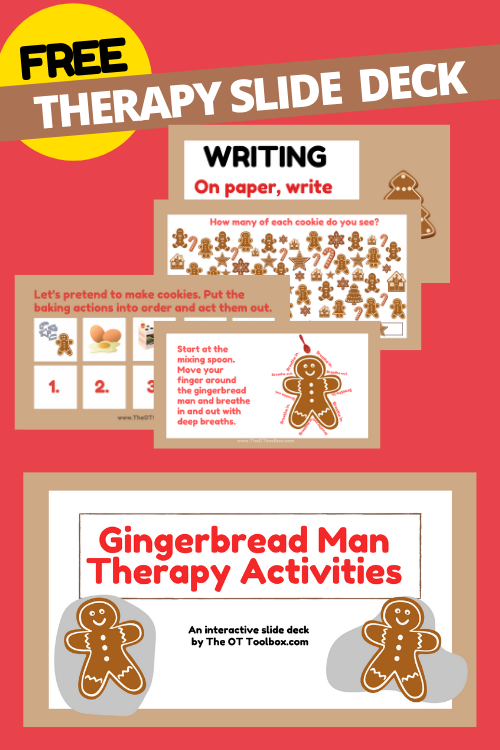
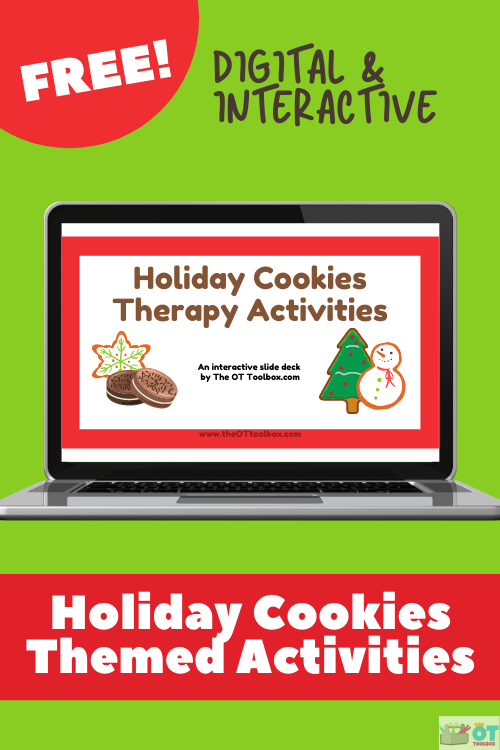
I am excited to share another free slide deck for virtual occupational therapy! This cookies activities slide deck includes cookie themed activities for building skills in therapy. The virtual slide deck goes nicely with our recent gingerbread man virtual activity slide deck. It’s a free slide deck that is interactive AND addresses areas such as working memory, eye-hand coordination, visual motor skills, visual attention, and other areas.

Cookie activities for occupational therapy with a virtual therapy slide deck.

Cookies Activities

This is the time of year for holiday baking. Because perhaps this year needs a little more of the comfort that holiday cookies bring, I thought that a Christmas cookies theme would be appropriate.

These cookies activities are meant to be motivating and an encouraging way to work on specific therapy skills.

This year, especially, it’s all about getting creative with motivating strategies to work on the skills kids need support with.

These Cookies Activities are therapy activities that work on the following therapy areas:

  • Working Memory
  • Visual Attention
  • Visual Memory
  • Visual Perception (visual figure ground, visual discrimination, form constancy, visual spatial relations, form constancy, visual closure)
  • Visual Efficiency (visual scanning)
  • Visual Motor Skills
  • Handwriting
use this holiday cookies activities for therapy planning using a cookie theme in teletherapy.

Cookie Theme for Therapy

This therapy slide deck is an outline of therapy activities for this time of year and addresses different areas that can be worked on in occupational therapy sessions, and even speech therapy!

Cookie activities for working on working memory, visual perception, handwriting and more.

Working Memory Activity with a Cookie Theme

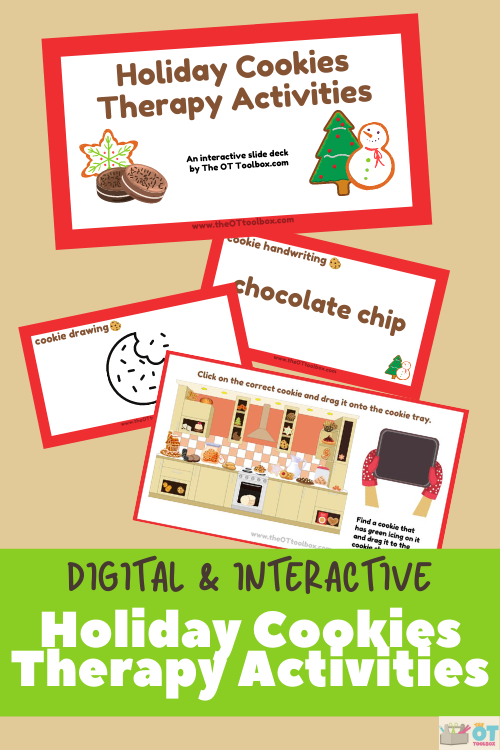
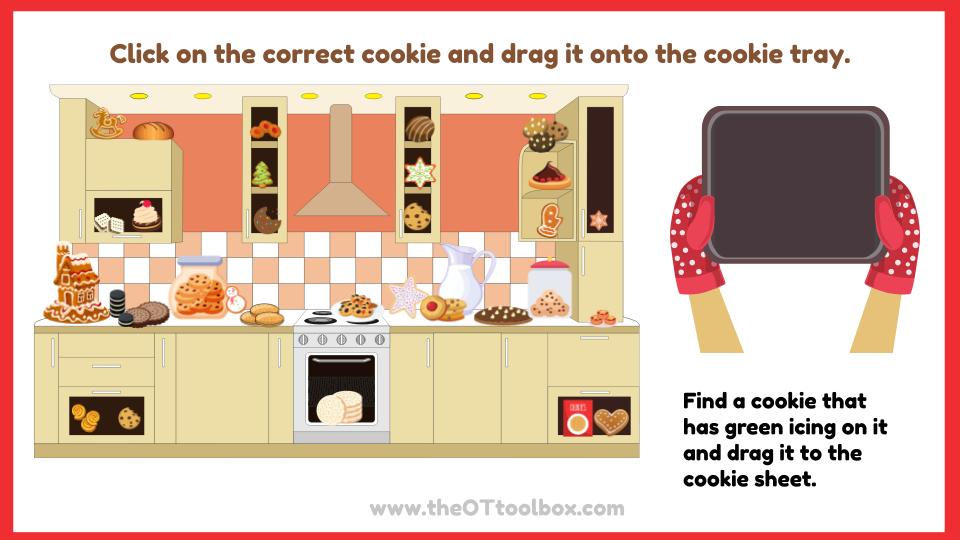
The first several slides include “I Spy” cookies activities, with a direction to locate specific cookies in the kitchen. Students can follow that direction and move the interactive cookie pieces to drag that specific cookie onto the baking sheet.

The directions are text boxes, so that therapists using this slide deck can adjust the directions as needed. You can make the directions more complex or easier, depending on the needs of your client, student, or child. Add 2 or multi-step directions or work on positional terms, too.

The cookies are in the same place on each slide so that children can work on working memory as they look for specific details according to each slide’s directions.

TIP: After your child’s therapy session, click on history at the top of Google slides and reset the slide to it’s original state so that all of the cookies are positioned at the original placement.

Visual Perception Cookie Activities

There are many visual perceptual skills that children can work on with this slide deck:

Visual figure ground– Scanning the image and identifying and locating items hidden in a busy background. This is a skill needed for reading, finding items in a drawer, locating a paper in a homework folder, and other similar tasks.

Visual discrimination– Students can visually scan the kitchen slide deck and identify differences and similarities between the cookies to locate the correct item. Visual discrimination is a skill needed for handwriting, reading, math and other skills.

Form constancy– This visual perceptual skill allows us to recognize similarities and differences between forms and images. This skill is needed for reading, writing, math, and functional tasks.

Visual spatial relations– Understanding positional terms is an important skill. This slide deck works on this area by moving the cookies to different places on the slide. Therapists can make this part of the activity more or less difficult to grade the activity to meet the needs of the child by adding additional directions to the slide to work on positional concepts. Try adding directions that ask the child to move a specific cookie to a different place in the kitchen on the slide.

Form constancy– Students that need more work with this visual perception skill can have several of the cookies duplicated and added to the slide. Then, work on size differences and positional concepts by moving the cookies to different places. You can adjust the directions to ask the child to find all of the same cookie.

Visual closure– Students can work on this visual perception skill by moving some of the cookies to partially hide behind other items on the slide.

Cookie activity for handwriting with kids.

Handwriting Cookie Activity

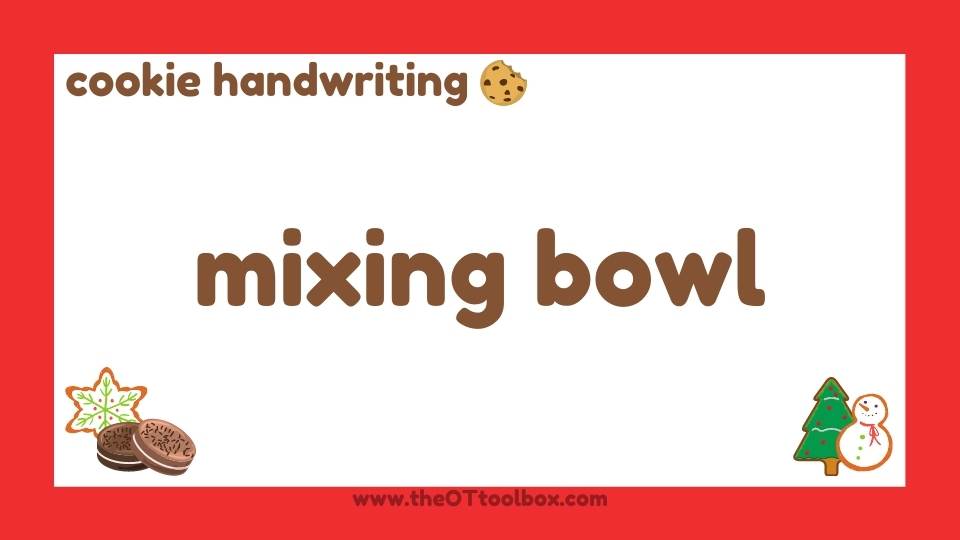
The next part of the slide deck is handwriting prompts in a write the room style of handwriting practice. Students can copy the word in print or cursive, depending on their needs. They can write a sentence using the word, if writing sentences is something they need to work on. Work on letter formation, legibility, and copying skills.

Use this cookie activity for visual motor skills in kids.

Visual Motor Cookie Activity

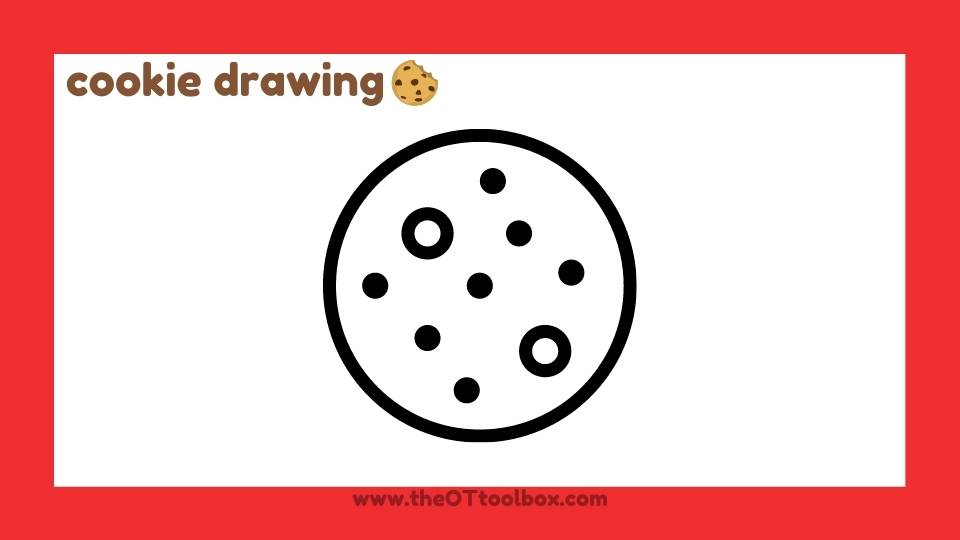
The last part of the cookie activity slide deck includes figure copying tasks. The slides include basic cookie forms that students can copy while working on visual motor skills. This is a nice activity to help children with the visual motor skills needed for forming letters and numbers.

This cookie slide deck should be a motivating a fun way to work on so many areas!

Free Cookie theme Slide Deck for therapy

Want to add this cookie slide deck to your therapy toolbox? Enter your email address into the form below and a PDF will be sent to your inbox. Save that PDF, because you can use this slide deck each year to work on therapy goals with a holiday cookie theme.

When you click the link in the PDF, you will be prompted to make a copy of the slide deck onto your Google drive. Make a copy for each student on your caseload so they have their own slide deck and you can adjust the slides according to their needs.

Get this Holiday Cookie Theme Therapy Activities Slide Deck

    We respect your privacy. Unsubscribe at anytime.

    Enjoy!

    Want more VIRTUAL LEARNING SLIDE DECKS?

    Don’t miss this Gingerbread Man Slide Deck.

    Here is a Community Helpers Theme Slide Deck.

    Here is a Football Theme Slide Deck.

    Here is a slide deck for a Social Story for Wearing a Mask.

    Here is a Space Theme Therapy Slide Deck.

    Here is a Therapy Planning Interactive Slide Deck.

    Here is a Back to School Writing Activity Slide Deck.

    Here is an Alphabet Exercises Slide Deck.

    Here is a Self-Awareness Activities Slide Deck.

    Here is a Strait Line Letters Slide Deck.

    Here is a “Scribble theme” Handwriting Slide Deck.

    Teach Letters with an interactive Letter Formation Slide Deck.

    Here is a Community Helpers Theme Slide Deck.

    Here is a Football Theme Slide Deck.

    Here is a slide deck for a Social Story for Wearing a Mask.

    Here is a Space Theme Therapy Slide Deck.

    Here is a Therapy Planning Interactive Slide Deck.

    Here is a Back to School Writing Activity Slide Deck.

    Here is an Alphabet Exercises Slide Deck.

    Here is a Self-Awareness Activities Slide Deck.

    Here is a Strait Line Letters Slide Deck.

    Here is a “Scribble theme” Handwriting Slide Deck.

    Teach Letters with an interactive Letter Formation Slide Deck.

    Colleen Beck, OTR/L has been an occupational therapist since 2000, working in school-based, hand therapy, outpatient peds, EI, and SNF. Colleen created The OT Toolbox to inspire therapists, teachers, and parents with easy and fun tools to help children thrive. Read her story about going from an OT making $3/hour (after paying for kids’ childcare) to a full-time OT resource creator for millions of readers. Want to collaborate? Send an email to contact@theottoolbox.com.

    Art Play

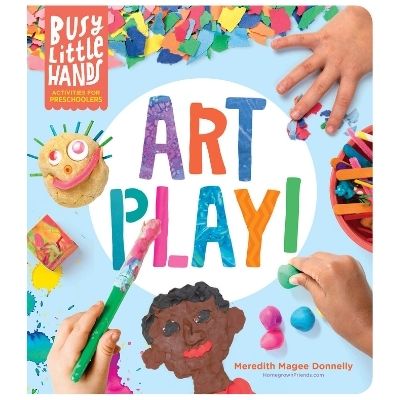
    Art Play book

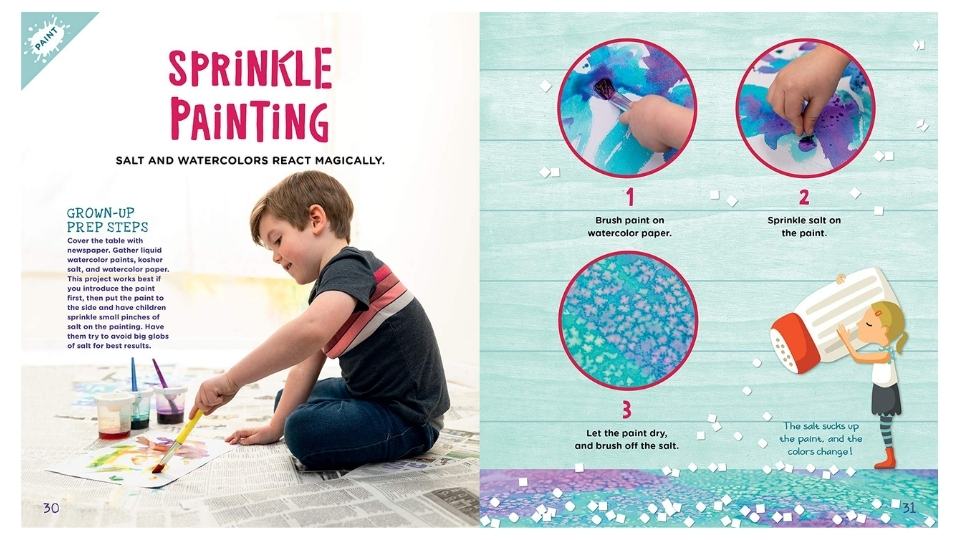
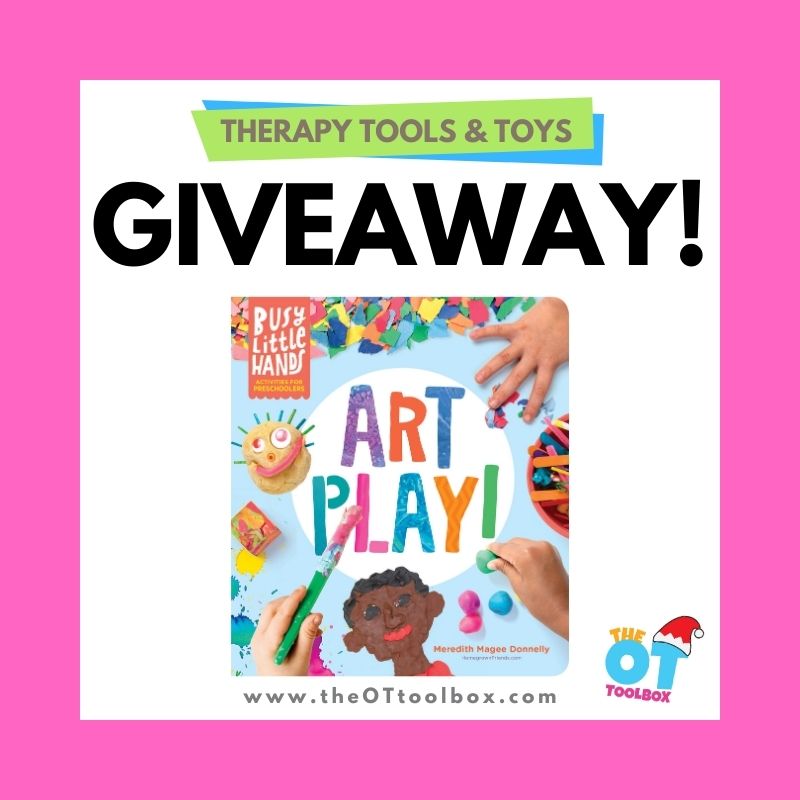
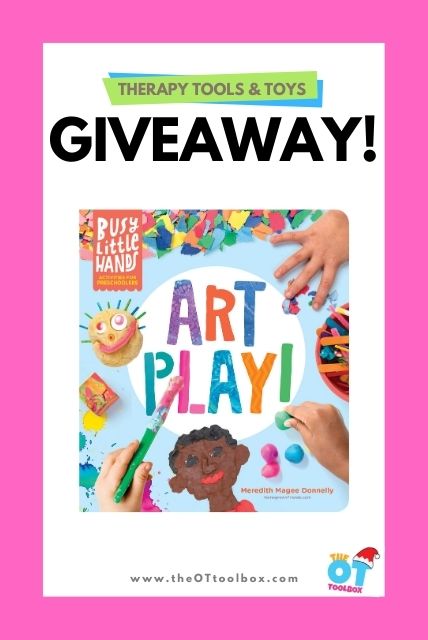
    Today, I have an amazing resource to share with you. Art Play is a new book that has been recently launched, and is a creative art activity book that is also a sensory and fine motor goldmine. Children can use art activities to create while developing skills and making an art project they can be proud of! Art Play is a process art creation book that focuses on developmentally appropriate art projects for kids, using sensory experiences and allows children to explore art materials at a level that is comfortable for them…without expectations for the “perfect” end product.

    Also be sure to check out our creative art ideas for more art play!

    Art play combines play and art so children can develop skills through creating art in play.

    Art Play

    This post contains Amazon affiliate links.

    Years ago, I created a children’s activity book with my friend Meredith, an educator and author of the website, Homegrown Friends. Meredith’s new book, Art Play, is my new favorite children’s art and activity book.

    In the book, you will find easy to set-up art projects that focus on the child.

    So often, we see crafts and art activities that are product focused. And, while the end-product focused craft has it’s time and place, especially when working on data collection or achieving specific goals in scissor skills or other areas, there is a place for process art in therapy as well.

    And, this book has got you covered in child-friendly art projects that pull in a very important area: play!

    We know that play is the job of the child. Play is a child’s primary occupation after all! And, it’s through play that these art projects allow a child to participate in creative, making activities. These are activities that allow a child to develop age-appropriate skills…through play!

    This book is beautifully and thoughtfully written and includes step-by-step instructions that are easy to follow. The pages of the book are wipeable and durable, meaning the book can be right there in the play activities and the pages are kid-friendly with thick paper that kids can manipulate.

    Art Play book review

    Just some of the skills that can be developed through the art projects in this book:

    • Pinch and grip strength
    • Eye-hand coordination
    • Motor planning
    • Visual motor skills
    • Direction following
    • Dexterity
    • Visual scanning
    • Visual memory, figure-ground, visual attention, and other visual perceptual skills
    • Tool use
    • Precision
    • Gross motor skills
    • Tactile experiences
    Art play includes sensory painting that builds fine motor skills.

    The art projects in the book focus on play, so there are so many play experiences for children to incorporate into art. Just some of the art play activities include:

    • Dramatic play
    • Pretend play
    • Building with blocks
    • Playing with cars/vehicles
    • Drawing
    • Painting
    • Inventing
    • Creating while upside down
    • Constructing
    • Dancing
    • Picking and collecting nature

    When you combine art with play, you get a lot of movement-based activities that help children develop whole-body skills!

    Process Art Activities

    Would you like a copy of Art Play so you can add these hands-on activities to your therapy practice or home?

    Check out the blog comments below which are loaded with reader’s favorite ways to create art with kids.

    Colleen Beck, OTR/L has been an occupational therapist since 2000, working in school-based, hand therapy, outpatient peds, EI, and SNF. Colleen created The OT Toolbox to inspire therapists, teachers, and parents with easy and fun tools to help children thrive. Read her story about going from an OT making $3/hour (after paying for kids’ childcare) to a full-time OT resource creator for millions of readers. Want to collaborate? Send an email to contact@theottoolbox.com.

    Emotional Development Toys

    emotional development toy

    Today, I’m excited to share information on emotional development toys that you can add to your emotional skills toolbox! Occupational therapy toys are used to develop skills through play and emotional development is just one of those areas. Toys and play are powerful tools to teach children about emotions. Add these emotional skills toys to support social emotional learning in kids.

    emotional development toys

    Emotional Development Toys

    When you take a look at social emotional skills, there is a lot to it! Emotional development contributes to one’s ability to regulate behaviors, participate in learning or social situations, make and keep friends, and management of emotions in everyday situations. Also, social emotional development is a precursor to learning and has been linked to academic performance.

    Here are more friendship activities to use as well in promoting development of these skills.

    Emotional development occurs from a very young age. In fact, social emotional learning develops from infancy!

    This site has some great graphics that break down development of emotional skills by age.

    Social Emotional Development Examples

    When you think of emotional development, you probably think about a child’s ability to react and respond to situations with emotional maturity. But, in fact, that part of emotional development occurs much later in childhood. Social emotional development looks like many things leading up to emotional maturity!

    Emotional development examples include things such as:

    • Facial expressions in response to interactions
    • Positive attachments at the infants and toddler stage
    • Eye contact (but not always an indicator for all children)
    • Identifying different expressions in others
    • Identifying and labeling emotions based on words, expressions, actions in others
    • Identifying emotions and feelings in self based on situations or responses to situation
    • Paying attention and using self-control
    • Expression of a variety of emotions
    • Copying facial expressions
    • Uses words to express feelings
    • Empathy for others (with sequential progression through the stages of empathy development)
    • Having and recovering from temper tantrums
    • Pretend play with emotions
    • Using and identifying a variety of emotions
    • Making friends
    • Social awareness
    • Positive self-image
    • Healthy self-talk or inner voice
    • Managing emotions
    • Emotional regulation
    • Asks for help when needed
    • Impulse control in social situations
    • Identifying emotions in the situation and responding with functional regulation strategies

    How to support emotional development

    There are many ways to support social emotional skills using emotional development toys and activities. Some examples include modeling emotional regulation and strategies a child can use. Using describing language to put words to emotions and feelings is another strategy parents can use to support emotional development.

    One important way to support a child’s social emotional skills is through play.

    Play and emotional development

    Through play, it is possible to identify emotions, practice emotions, model interactions, and show empathy. Play offers the chance for children to practice skills in a “safe” environment.

    Try this free social emotional learning worksheet with children to help them identify emotions.

    Children can learn so much about emotional development through play! Try these strategies to use play as a medium for developing social emotional skills:

    • Use imaginative play to practice emotions and responses- Imaginative play offers a variety of situations where emotions, feelings, empathy, and responses can be practiced. Practicing emotions, language, and regulation strategies by playing “house”, doctor, school, shopping, pretend kitchen, or pretend construction, or any other pretend play environment offers so many opportunities for development of skills.
    • Play games to build emotional skills- Games offer children the chance to win or lose, where they can respond to that status in different ways. This offers a great opportunity to talk about expectations, impulse control, attention, turn-taking, expectations, and responding to other’s wins or losses.

    A printable set of emotions play dough mats can be used to build emotional skills in kids, through play.

    • Read books to support emotional development- Books offer a chance to put yourself in another’s place. Reading books with children offers an opportunity to open up conversations on how a character acted in a situation and what the child might have done in that situation. It’s a great way to practice social responses, empathy, and self-regulation strategies. Here are great children’s books (and fun activities based on the books) related to social emotional learning:

    Exploring Books Through Play uses children’s literature as a theme to engage in fun, hands-on activities that help children and adults delve deeper into the characters and lessons, bringing the stories to life and falling further in love with literature. Read a story and then bring the characters to life while learning and building skills. Each story offers unique activities designed around central themes of friendship, empathy, and compassion.

    Each chapter in Exploring Books through Play includes 5 activities for each of the 10 children’s books. The activities are perfect for children ages 3-8, can be used in small groups or as a whole class, and are easily adapted to a home or classroom setting.

    • Talk about choices, emotions, and responses in play- Using play as a means to work on development of these skills. Play offers a chance for children to make choices and opens opportunities to practice sensory regulation strategies for emotional responses.
    • Use emotional development toys– Toys that offer a way for children to identify facial expressions, practice empathy in imaginative play, and the opportunity to practice regulation are powerful tools.

    Want to help kids learn more about complex concepts such emotions, empathy, compassion, and differences?

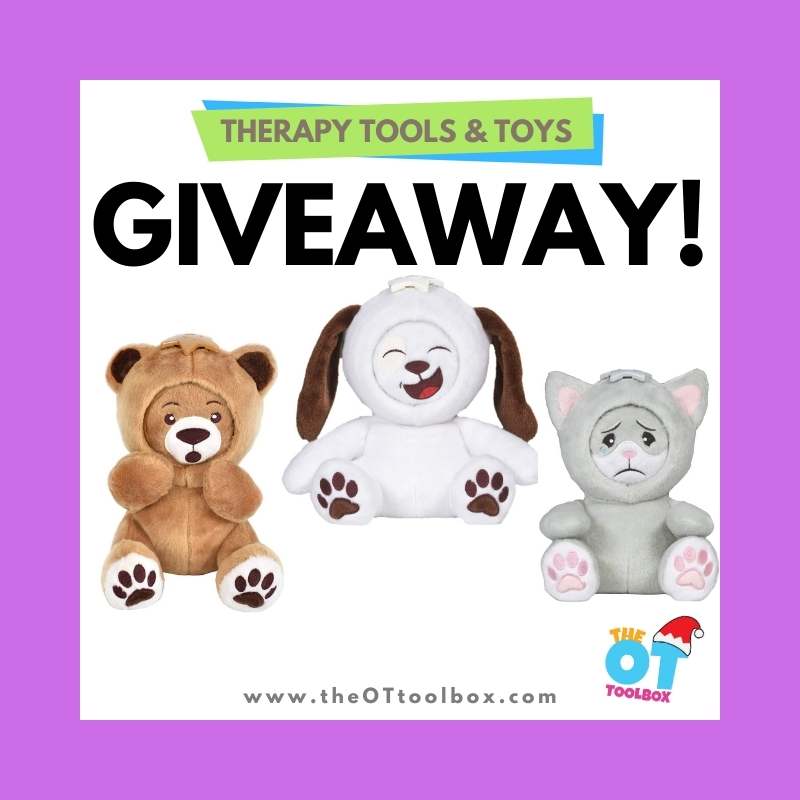
    Whatsitsface Emotional Development Toy

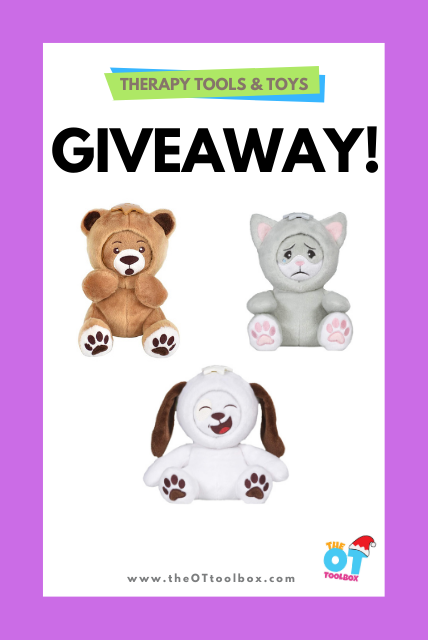
    Recently, I came across the Whatsitsface plush toy on Instagram. This emotional development toy helps children develop emotions through imaginative play. Kids can adjust the moveable parts to change the toy’s facial expression and practice emotional development skills through play.

    Kids can practice their understanding of emotions in a safe and interactive way. Whatsitsface allows children to put emotions into a language they understand and provides a chance to practice management of emotions.

    The plush emotional development toy has 6 different facial expressions that children can easily change themselves in two different ways.

    Check out the blog comments below to learn about reader strategies for teaching children about emotions and emotional development.

    Colleen Beck, OTR/L has been an occupational therapist since 2000, working in school-based, hand therapy, outpatient peds, EI, and SNF. Colleen created The OT Toolbox to inspire therapists, teachers, and parents with easy and fun tools to help children thrive. Read her story about going from an OT making $3/hour (after paying for kids’ childcare) to a full-time OT resource creator for millions of readers. Want to collaborate? Send an email to contact@theottoolbox.com.
    Occupational Therapy Entrepreneurs

    occupational therapy entrepreneurs

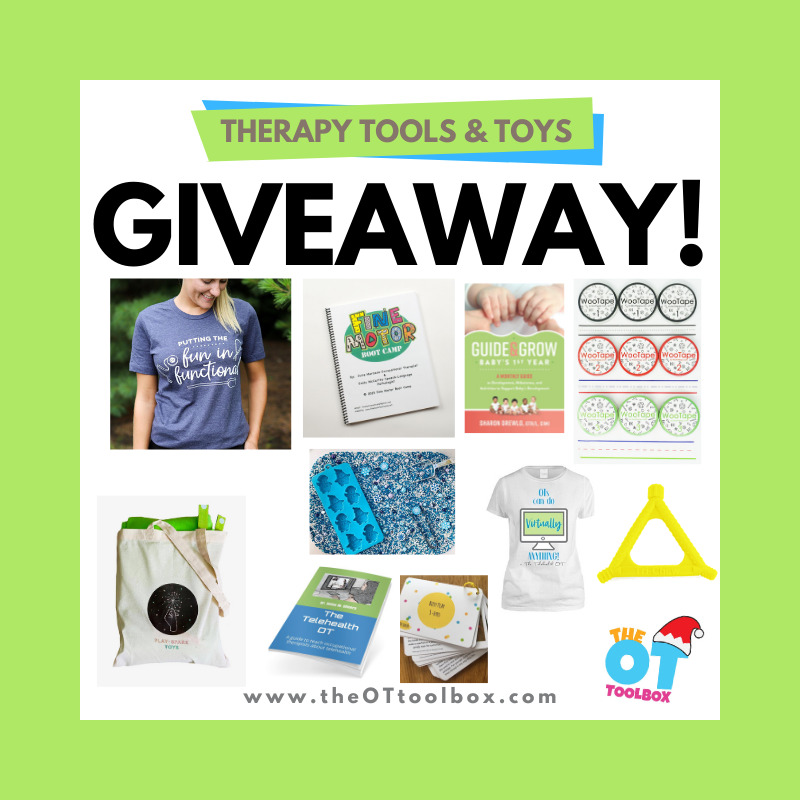
    Today’s giveaways in our annual Therapy Tools and Toys Giveaways series (Giveaway is now closed) holds a special place in my heart. Today, I’m featuring occupational therapy entrepreneurs who are creating resources, occupational therapy gifts, and toys that promote the profession of occupational therapy. These are occupational therapists and COTAs who have created a nontraditional therapy business that offer resources, private practice, and out-of-the box entrepreneurship!

    Each of the OT businesses featured here promote products and resources for others using their knowledge and experiences as occupational therapy practitioners. With all that this year has brought our way in the need for virtual therapy, and an astonishing impact on small businesses, it is my absolute pleasure to promote and feature these occupational therapy small businesses.

    Traits of an occupational therapy entrepreneur

    Occupational Therapy Entrepreneurs

    There is just something about occupational therapists and the profession of OT that makes it a natural in the business world. Occupational therapists are natural entrepreneurs for so many reasons!

    As occupational therapy professionals, we have the unique ability to impact and change lives with a whole-body approach to addressing clinical needs. What if, as professionals, we took that holistic viewpoint and inner drive to see people thrive… and coupled it with the zeal and ambition of an entrepreneur?

    Therapists are innovators and motivators. We make evidenced-based decisions and have a compelling public image in facilities, schools, clinics, and the community. We have the ability to influence the marketplace and in collaboration with other professionals.

    These elements of business creation are outlined as some of the eight vision components in AOTA’s Centennial Vision and Executive Summary. (American Occupational Therapy Association, 2007). That same creative excitement can be applied to one’s own entrepreneurial goals. In fact, “occupational therapy has great entrepreneurial potential, with relatively low risk for entry” (Anderson & Nelson, 2011).

    Connecting the dots from the traits of an OT to the traits of a business owner is pretty easy when you think about it. We have many of the very skills engrained in us.

    Therapists, in most cases, excel at these skills:

    • Bravery
    • Creativity
    • Innovation
    • Confidence
    • Persistence
    • Organization
    • Time Management
    • Goal Mindedness
    • Confidence
    • Humbleness to ask for help when needed
    • Friendly and honest
    • Able to set and maintain schedules
    • Open to new ideas
    • Skilled in networking
    • Calm and level-headed under pressure
    • Aware of personal weaknesses and able to ask for help
    • Willingness to learn and learn some more!

    These are attributes of business owners. These skills are needed to conceptualize, create, and run a business. These are the skills needed for entrepreneurship!

    Those are also quite a lot of “OT traits”, right??

    These are essential traits of therapeutic use of self. These are the skills that allows us to connect with our clients, pivot on a dime, and reach functional outcomes.

    It’s no wonder that occupational therapists are naturals at entrepreneurship.

    Occupational Therapy Businesses

    So, now that we’ve talked about the attributes that therapists have making them naturals at business, let’s celebrate and support our fellow OTs who have taken steps to start a business.

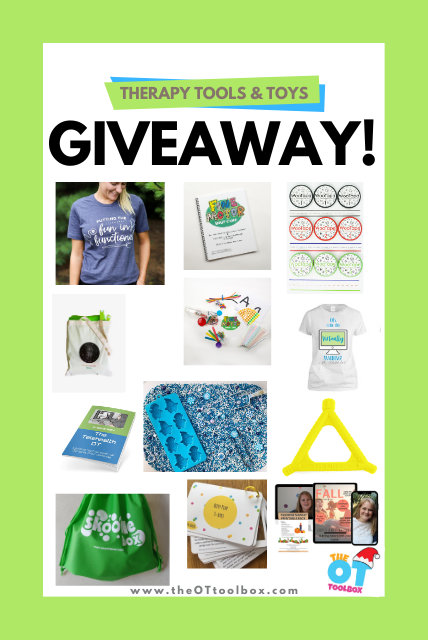
    Below are OT-created/owned businesses that are creating, sharing, and providing resources designed to help others. They are using their OT hats to create a business and make it work!

    Check out these OT innovators and occupational therapy businesses! Let’s support your fellow occupational therapy entrepreneurs by following them on social media and browsing their products.

    Occupational therapy business prize from a business created by occupational therapists.

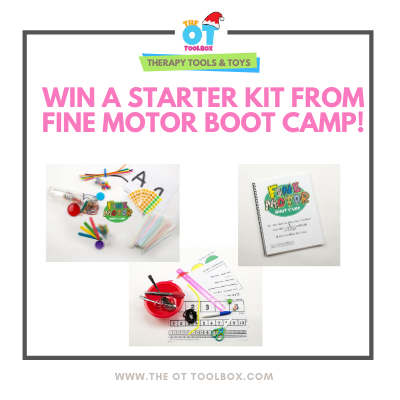
    Fine Motor Boot Camp- Developed by a Speech-Language Pathologist and Occupational Therapist, Fine Motor Boot Camp was developed to meet cognitive, language and fine motor needs in under 15 minutes a day using simple, inexpensive materials. 

    Support Fine Motor Boot Camp by following Fine Motor Boot Camp on Instagram.

    Occupational therapy business prize from a business created by occupational therapists.

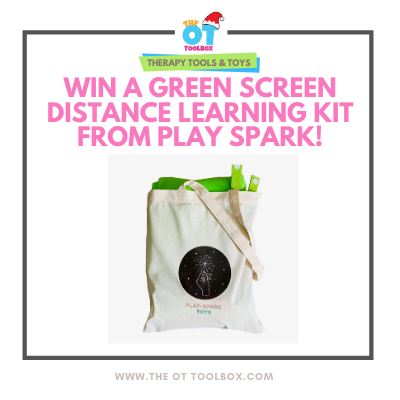
    Play Spark- Play Spark is a new business created by a speech language practitioner and an occupational therapist who offer green screens and materials to foster therapeutic interventions in virtual therapy sessions.

    Support Play Spark by following Play Spark on Instagram.

    Occupational therapy business prize from a business created by occupational therapists.

    Telehealth OT Services– Created by occupational therapist, Reina Olivera, Telehealth OT Services is a resource providing training and education to OT providers on all things teletherapy.

    Support Telehealth OT Services by following Telehealth OT Services on Instagram.

    Occupational therapy business prize from a business created by occupational therapists.

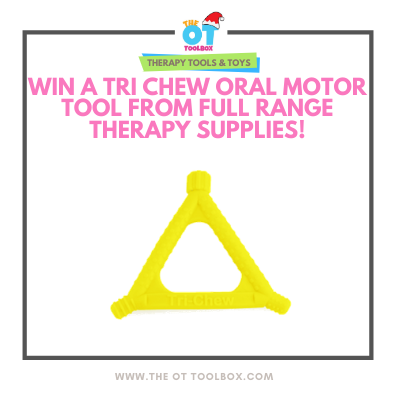
    Full Range Therapy Supplies- Full Range Therapy Supplies offers therapeutic materials and supplies such as h as Nosey Cups, Nuk Massage Brushes, Chewy Tubes, Sensory Brushes, and feeding equipment.

    Support Full Range Supplies by following Full Range Therapy Supplies on Facebook.

    Occupational therapy business prize from a business created by occupational therapists.

    Forward Therapy Solutions- With over 30 years of experience in guiding parents in their child’s development, pediatric occupational therapist Sharon Drewlo brings you “GUIDE & GROW: Baby’s 1st Year“. This book is an easy-to-navigate monthly guide to understanding and supporting your baby’s development throughout the first year with monthly milestones and developmental information to support your little one’s development through their first year. Check out the book Guide & Grow: Baby’s 1st Year: A Monthly Guide to Development, Milestones and Activities to Support Baby’s Development

    Support Forward Therapy Solutions by following on Forward Therapy Solutions on Facebook.

    Occupational therapy business prize from a business created by occupational therapists.

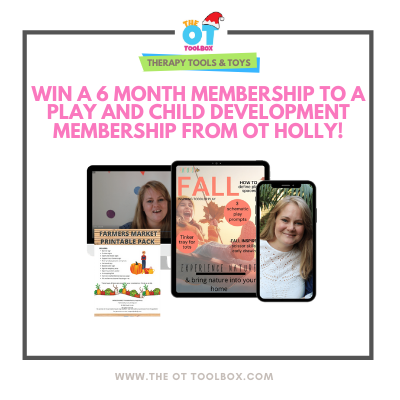
    OT Holly- OT Holly is an OT small business created by an occupational therapist who provides and shares opportunities for toddler play and child development. These activities and educational resources are specifically designed for parents of 1-4 year old children and includes trainings, printables and a month play digital magazine.

    Support OT Holly by following on OT Holly on Instagram.

    Occupational therapy business prize from a business created by occupational therapists.

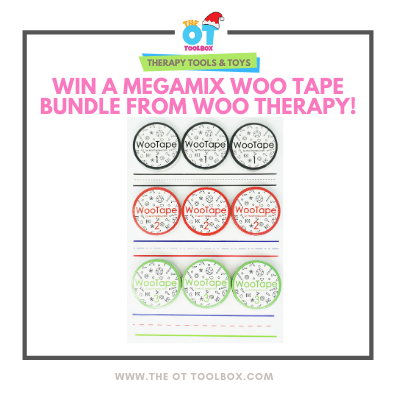
    WooTherapy- WooTherapy is the maker of Woo Tape, a handwriting tool for kids. Created by occupational therapist, Meghan, this handwriting tape allows children tactile feedback and visual cues for handwriting on any type of paper.

    Support WooTherapy by following WooTherapy on Instagram.

    Occupational therapy business prize from a business created by occupational therapists.

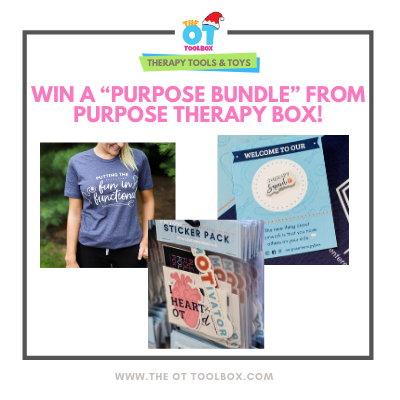
    Purpose Therapeutic BoxPurpose Therapy Box is a subscription box created by two COTAs, Holi and Ali. Together they created Purpose The Therapeutic Subscription Box in order to decrease sadness and loneliness within the older adult population using products and encourage aging in place. The boxes inspire positivity and enhance quality of life through personalized products that encourage independence, well being, and improve overall health. 

    Support Purpose Therapy Box by following Purpose Therapy Box on Instagram.

    Occupational therapy business prize from a business created by occupational therapists.

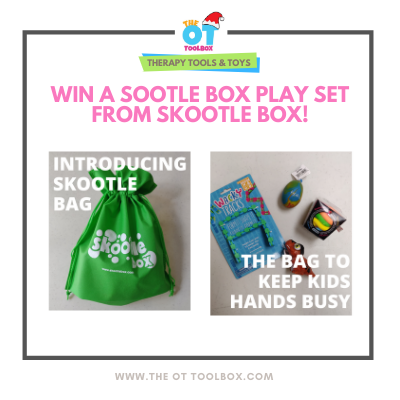
    Skootle BoxSkootle Box is a subscription box containing toys and materials to help parents help their children succeed. Items are carefully chosen and come with guided therapy inspired instructions on how to use the activities with your child and what skills it is working on. 

    Support Scootle Box by following Skootle Box on Instagram.

    Ot entrepreneurs

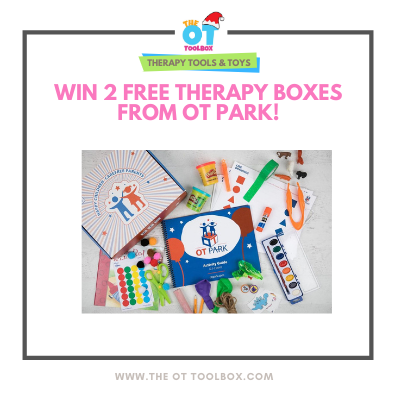
    OT Park- OT Park Box is a kids subscription box designed by a pediatric OT. The monthly boxes include age appropriate and developmentally correct activities for kids age groups 0-3 years and boxes have categories: 0-6 months, 6-12 months, 12-18 months, 18-24 months, 2-2.5 years and 2.5-3 years

    Support OT Park Box by following OT Park Box on Instagram.

    Occupational therapy business prize from a business created by occupational therapists.

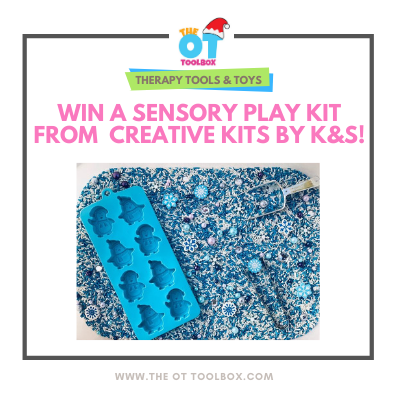
    Creative Kits by K&S- Started by occupational therapist and preschool teachers, Kelly & Sara, Creative Kits by K& S offers themed sensory kits for toddlers & preschoolers. These sensory activities are thoughtfully designed sensory play and small world play kits for young children.

    Support Creative Kits by following on Creative Kits on Instagram.

    Occupational therapy business prize from a business created by occupational therapists.

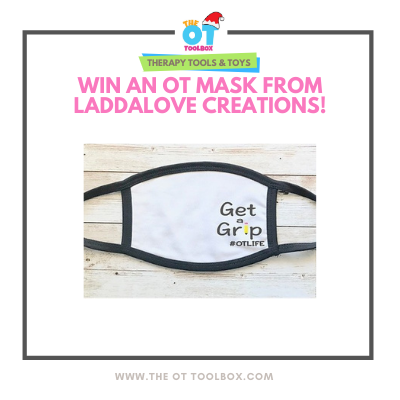
    Laddalove Creations- Created by a COTA, Laddalove Creations offers custom t-shirts, mugs, masks, and wooden creations, especially for occupational therapy practitioners. These items are designed to spark joy and brighten the day of an occupational therapist!

    Support LaddaLove Creations: Follow on Ladda Love Creations on Instagram.

    Occupational therapy business prize from a business created by occupational therapists.

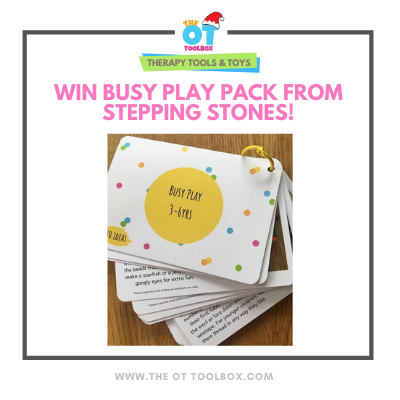
    Stepping Stones- Created by an educator, Stepping Stones offers activity cards using everyday materials and centers on fine motor skill development for children aged 3-6 years of age. These activity cards are carefully designed to use things that you ordinarily have at home.

    Support Stepping Stones: Follow on Stepping Stones on Instagram.

    Support occupational therapy entrepreneurs!

    Want to support occupational therapy entrepreneurs AND fill your emotional toolbox with prizes, resources, and therapy materials?

    Let’s support occupational therapy small businesses!

    Colleen Beck, OTR/L has been an occupational therapist since 2000, working in school-based, hand therapy, outpatient peds, EI, and SNF. Colleen created The OT Toolbox to inspire therapists, teachers, and parents with easy and fun tools to help children thrive. Read her story about going from an OT making $3/hour (after paying for kids’ childcare) to a full-time OT resource creator for millions of readers. Want to collaborate? Send an email to contact@theottoolbox.com.
    Gingerbread Man Virtual Activity

    Gingerbread man virtual activities

    This gingerbread man virtual activity is perfect for occupational therapy teletherapy activities, and just one more teletherapy activity that we’ve got lined up for you here on The OT Toolbox. Add this Christmas activity to your therapy plans, along with some gingerbread man activities and maybe making a little gingerbread salt dough for holiday fun with gingerbread themed development and learning!

    This is a fun addition to our weekly therapy themes for themed occupational therapy sessions.

    Gingerbread Man Virtual Activity

    This slide deck covers various areas with a gingerbread theme:

    • Mindfulness
    • Fine Motor Skills
    • Handwriting
    • Gross Motor
    • Self-Regulation Check In

    Use this list and the gingerbread man activities on this slide deck to help kids develop certain skills in virtual therapy sessions.

    CGingerbread man Therapy SLIDE DECK

    If you’ve been following The OT Toolbox, then you may have seen a few of our other interactive slide decks. Therapists are LOVING these therapy slide decks for their themed activities that help kids build skills, while in virtual or hybrid environments.

    This gingerbread man therapy activity can be adjusted to meet the needs of your clients or students. Use it as an outline and add prompts, or adjust the activities as you need.

    Gingerbread Themed Mindfulness Activity

    Students can use the gingerbread man image with deep breathing activity to work on deep breaths in and deep breaths out as a mindfulness activity with a gingerbread man theme.

    Gingerbread Man Writing Prompts

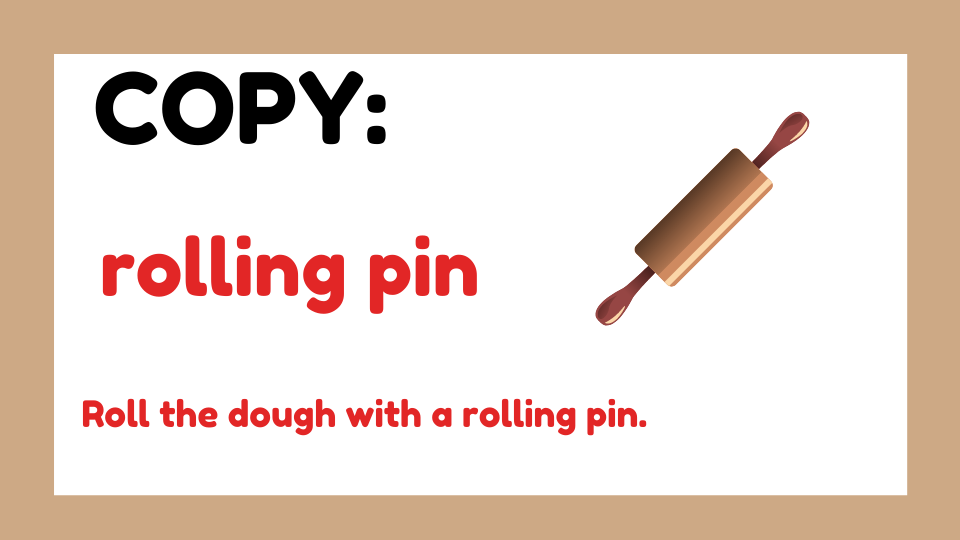
    Included in this therapy slide deck are gingerbread words writing prompts. These are set up as a copying activity for students. Work on letter formation, legibility, and copying skills. Kids can use this to work on printed or cursive writing, based on their specific needs.

    Gingerbread man Visual Perception Activity

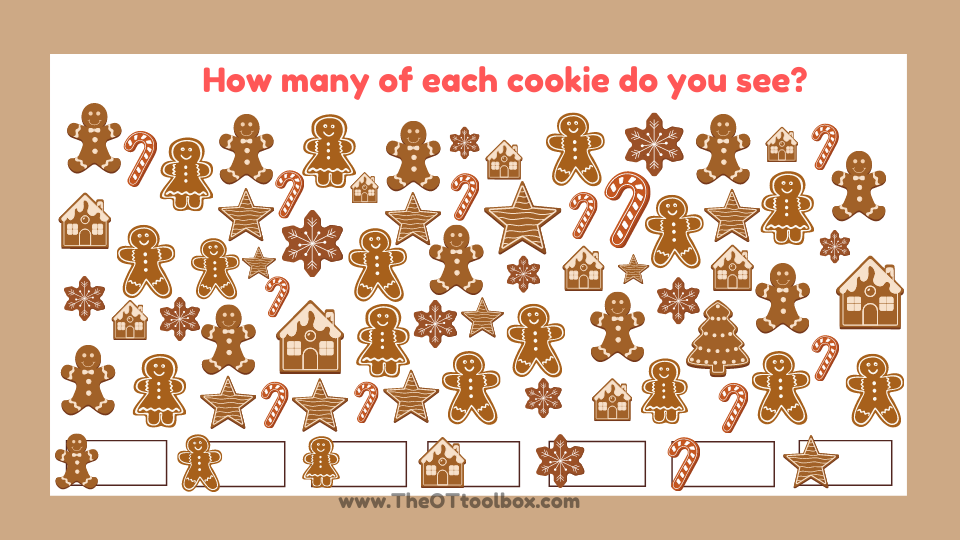
    Children will love the gingerbread man visual perception activity as they visually scan to count the number of each cookie. Kids can type right into the Google slide deck when they find the correct number of each gingerbread man.

    Gingerbread Man Fine Motor Activity

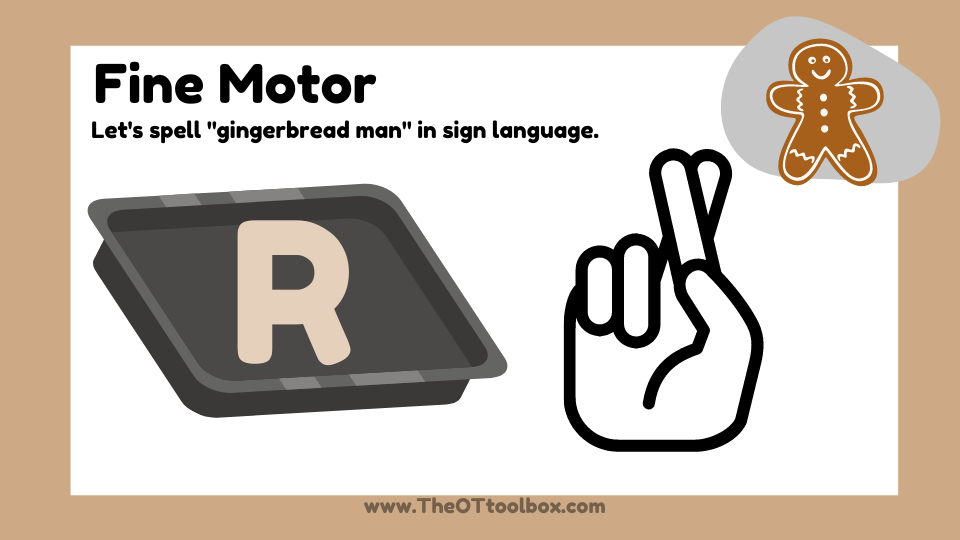
    The no-prep gingerbread man fine motor activity asks children to work on fine motor skills such as finger isolation, dexterity, motor planning, and eye-hand coordination as they spell the word “gingerbread man” in sign language.

    Gingerbread man Gross Motor Activity

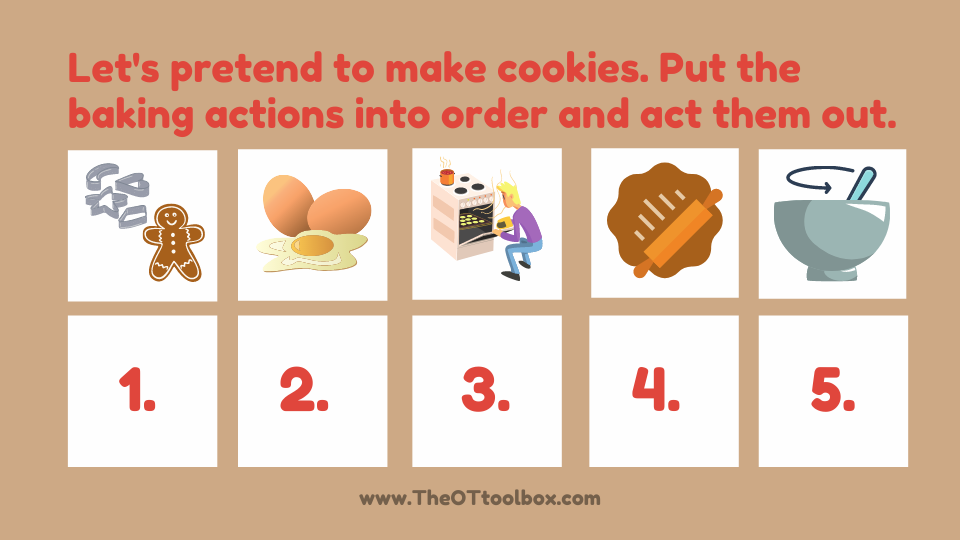
    Next, kids can work on core strength, gross motor skills, balance, and motor planning with a gingerbread man gross motor activity. This activity asks children to move the movable slide pieces into the correct order. They can then act out the images and work on gross motor skills as well as sequencing.

    Gingerbread Man Self-Regulation Activity

    The final activity in this interactive slide deck is the self-regulation activity where children can move the gingerbread man to identify and match their body’s feelings. Work on self-regulation strategies and coping tools as needed.

    Does this looks like a fun way to spend a therapy session while working on skills?

    You can grab a copy of this Google slide deck and use it to work on specific skills.

    Enter your email address below and you will receive a PDF containing a link to copy the slide deck onto your Google drive. Save that PDF file, because you can come back to it again and again and send it to the kids on your caseload (or classroom) so they can make their own copy on their Google drive.

    Please use the copy of the slide deck and do not change the link.

    Get this Gingerbread Man Therapy Activities Slide Deck

      We respect your privacy. Unsubscribe at anytime.

      MORE VIRTUAL LEARNING SLIDE DECKS?

      Would you like more therapy slide decks? Grab the others to add to your therapy toolbox!

      Here is a Community Helpers Theme Slide Deck.

      Here is a Football Theme Slide Deck.

      Here is a slide deck for a Social Story for Wearing a Mask.

      Here is a Space Theme Therapy Slide Deck.

      Here is a Therapy Planning Interactive Slide Deck.

      Here is a Back to School Writing Activity Slide Deck.

      Here is an Alphabet Exercises Slide Deck.

      Here is a Self-Awareness Activities Slide Deck.

      Colleen Beck, OTR/L has been an occupational therapist since 2000, working in school-based, hand therapy, outpatient peds, EI, and SNF. Colleen created The OT Toolbox to inspire therapists, teachers, and parents with easy and fun tools to help children thrive. Read her story about going from an OT making $3/hour (after paying for kids’ childcare) to a full-time OT resource creator for millions of readers. Want to collaborate? Send an email to contact@theottoolbox.com.
      Growth Mindset

      mindset strategies

      Tools to support growth mindset can come in all shapes and sizes. From journals, to coping toolkits, to targeting self-awareness, putting growth mindset strategies into action supports self-regulation, learning, and everyday functioning! Understanding when and how to use growth mindset strategies is the beginning of self reflection. A lot of this has to do with metacognition!

      If there’s one thing that we all need, it’s a positive outlook and a growth mindset. Our children especially, would benefit from resilience, coping skills, and coping with big life changes. Supporting kids of all ages with growth mindset tools such as a growth mindset sorting activity can help to put those tools into action.

      Growth Mindset

      Amazon affiliate links are included in this post.

      Since we are talking all things growth mindset, and and resilience…and resilience seems to be a common topic this year, I thought I would run through some common terms when it comes to growth mindset and developing the skills of resilience in children.

      mindset definitions and other skills such as empathy, mindfulness, resilience,

      Growth Mindset Definitions

      Let’s start with a definition of growth mindset and then break it down.

      A growth mindset refers to the belief that one’s abilities and intelligence can be developed through dedication, hard work, and learning. Individuals with a growth mindset perceive challenges as opportunities to learn and improve rather than as obstacles that define their capabilities. This concept, popularized by psychologist Carol Dweck, contrasts with a fixed mindset, where individuals believe their abilities are innate and unchangeable.

      Embracing a growth mindset fosters resilience, a love for learning, and a willingness to face challenges, making it a valuable perspective in various aspects of life, including education, career, and personal development.

      Empathy– Empathy is the ability to recognize and understand the feelings and perspective of others.

      Mindset– Our mindset is the way that we think about ourselves and the world around us. It’s the attitude that we have about ourselves and the world. It’s our mood and the way with think about problems or tasks that we need to accomplish. Mindset is a way of looking at the problems or situations in front of us. Addressing difficult tasks and mistakes is part of mindset. Executive functioning skills play a part in mindset.

      Growth Mindset– Growth mindset is the ability to confront challenges, view hard tasks as an oppourtunity and a process. Someone with a growth mindset believes they are not limited by their abilites or intelligence. When we use a growth mindset, we believe our abilities or our ability to learn new things can improve given effort.

      Fixed mindset– Fixed mindset is a limiting belief that impacts our ability to solve promblems, learn new skills, react to situations, and respond to daily situations. Fixed mindset can impact wellness and well-being, as well as learning and task completion.

      Mindfulness– Mindfulness is our ability to focus on our awareness and presence in any given moment. It’s our ability to acknowledge and accept our feelings, thoughts, body sensations and the world around us in any given task or activity.

      Resilience– resilence refers to one’s ability to have a mental toughness, and the ability to recover quickly from difficult tasks or situations. Resilience offers the ability to bounce back or respond and react in the event of adversity, trauma, tragedy, threats, or stessful situations.

      Coping Skills– Coping skills are the specific steps one might take to react and respond to events, internal thouhgts, emotions, and daily tasks. It’s the strategies a person can use to consciousely solve personal or interpersonal problems. Coping skills can be physical methods, self-talk, sensory strategies, and other specific skills that allow for wellness and wellbeing.

      Self-talk– Self-talk is that internal dialogue that is constantly running in your mind. Self-talk can be a coping skill, and it can impact mindset. This internal dialogue is influenced by your subconscious thoughts as well as conscious thoughts.  Self-talk can be both positive and negative and has the ability to impact resilience and mindfulness.

      You can see how all of these terms are inter-related and how they all impact one another. When these skills are growing and developing children can accomplish tasks and not limit themselves in learning and developing as an indiviual.

      All of these mindset definitions can be strengthened, using tools and specific strategies. And, by working on these various areas, children (and ourselves) can respond to challenging situations (like distance learning, for example) that require us to pivot and change.

      Also connected to all of these areas are social emotional learning, executive functioning skills, and the emotional regulation part of executive functioning skills.

      Critical thinking plays a big part in development of mindset and the other growth areas listed above.

      So how to work on these areas to foster a growth mindset, positive self-talk, coping tools, and resilience in kids?

      Mindset strategies for kids

      Strategies for Mindset

      Specific strategies can help, along with a plan. Below are some strategies to address mindset and the other areas listed above.

      • Work on wellness and wellbeing- Check out these wellness strategies
      • Practice mindfulness
      • Help others
      • Focus on positive self-talk
      • Identify goals and work on those areas
      • Breaking down goals into smaller, achievable steps
      • Work on perspective
      • Create a toolbox of strategies
      • Foster a positive outlook
      • Practice working memory strategies and learn from mistakes
      • Focus on the present and mindfulness

      One method for working through these skills is with the (Amazon affiliate link) Big Life Journal.

      Children can use the journal as a working tool to foster specific strategies and methods for developing persistnece, growth mindset, and a positive perspective. These stragies can be a powerful way to help kids accomplish tasks, believe in themselves, and grow and develop as a person.

      You can get a copy of the Big Life Journal here. (Ages 7-10)

      And the resource for older kids: Big Life Journal for Teens and Tweens (Ages 11+)

      As well as the adult-version: Big Life Journal for Adults (Ages 18-99)

      Big Life Journal PRintables

      Want to add a Big Life Journal to your toolbox? Let’s get kids developing resilience, social emotional learning, and mindset.

      I love that the Big Life Journal is available as a printable PDF on the company’s website, making the printables easy to print off and use with your students or children.

      OT providers often support students and clients with mindset, and we know that Mindset is everything! The Big Life Journals help your child, tween/teen, or even YOU to develop the mindset of growth, resilience, gratitude, and positivity.

      Check out the blog comments below for ideas to help kids to develop skills in empathy, resilience, mindset, self-talk, and mindfulness.

      This product was featured in our Therapy Toys and Tools Giveaway Series. (Giveaway now closed.)

      Colleen Beck, OTR/L has been an occupational therapist since 2000, working in school-based, hand therapy, outpatient peds, EI, and SNF. Colleen created The OT Toolbox to inspire therapists, teachers, and parents with easy and fun tools to help children thrive. Read her story about going from an OT making $3/hour (after paying for kids’ childcare) to a full-time OT resource creator for millions of readers. Want to collaborate? Send an email to contact@theottoolbox.com.
      Therapy Tools Giveaway 2020

      Therapy giveaway for occupational therapists, teachers, and parents.

      2020 has been a year like no other. This year calls for a mega giveaway! Let’s celebrate therapists, teachers, and parents with the 2020 Therapy Tools Giveaway!

      Giveaway is now closed.

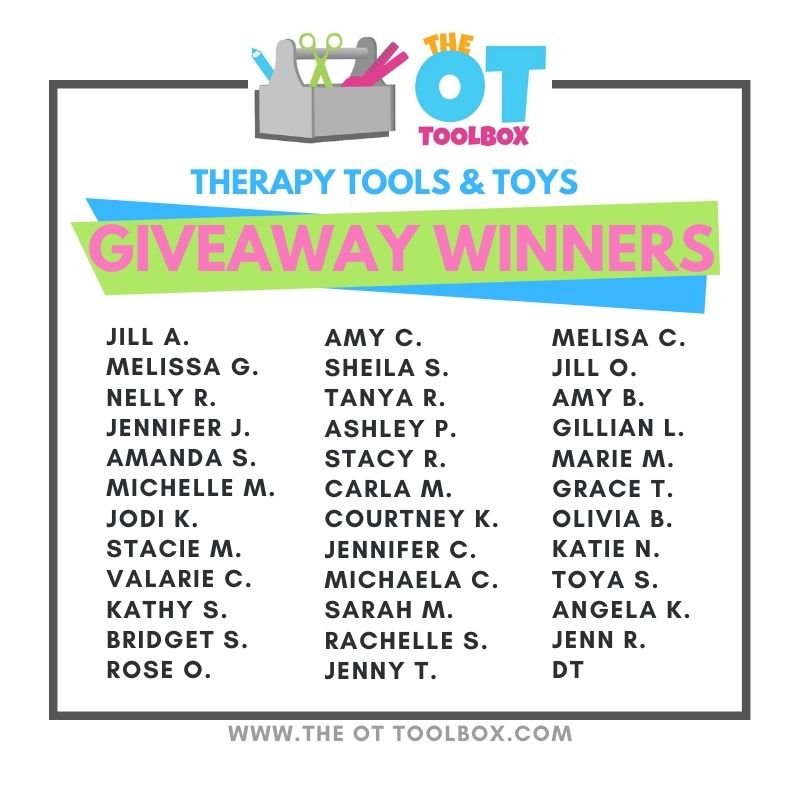
      The winners are…

      I wish I could send a big toy or tool to each and every therapist, educator, and parent out there, because you are all stars in my book!

      Here are the winners of this year’s giveaways…

      1. Parachute- Jill A.
      2. Carpet Markers-Melissa G.
      3. Agility Cones- Nelly R.
      4. Ball Launcher- Jennifer J.
      5. Bucket Stilts- Amanda S.
      6. Zoom Ball- Michelle M.
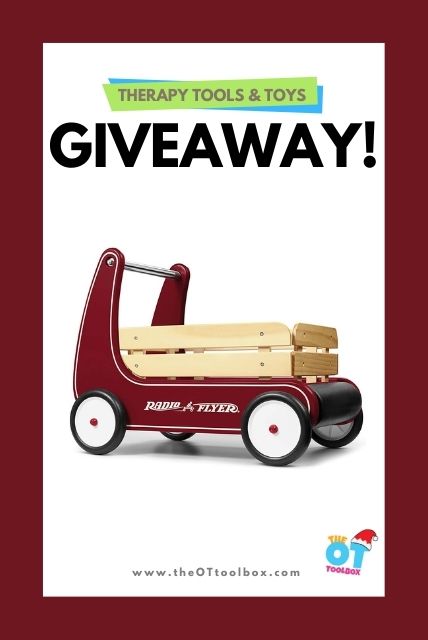
      7. Radio Flyer Push Walker- Jodi K.
      8. Vision 101 Course- Stacie M.
      9. Art Play Book- Valarie C.
      10. Whatsitsface toy-Kathy S.
      11. OT Park Box- Bridget S.
      12. Telehealth OT pack- Amy C.
      13. OT Holly- Sheila S.
      14. Fine Motor Boot Camp- Tanya R.
      15. Play Spark- Ashley R.
      16. WooTape- Stacy R.
      17. Purpose Therapeutic Box- Carla M.
      18. Skootle Box- Courtney K.
      19. Laddalove Creations- Jennifer C.
      20. Stepping Stones- Michaela C.
      21. Forward Therapy Solutions- Sarah M.
      22. Full Range Therapy Supplies- Rachelle S.
      23. Creative Kits- Jenny T.
      24. Big Life Journal- Melisa C.
      25. Sensory Meltdowns Course- Jill O.
      26. Radio Flyer Balance Bike- Amy B.
      27. Avalanche Fruit Stand- Gillian L.
      28. Pop Tubes- Marie M.
      29. Spike the FM Hedgehog- Grace T.
      30. Bucket of Perler Fuse Beads- Olivia B.

      I had so much fun bringing these giveaway items each day. Stay tuned for next year’s series! Check out the items that were a part of this year’s fun below.

      I wanted to celebrate and honor all of the work that you’ve done this year and bring something fun and exciting this year…maybe a change from the sales emails that you may be seeing in your inbox during this holiday season.

      Therapy tools giveaway for occupational therapists, teachers, and parents.

      It’s been YOU, the therapists, educators, and parents that are working with children who are feeling the impact of 2020 in major ways. It’s been YOU that are feeling burnout, overworked, and exhausted.

      And, we all know that therapists and teachers, many times, purchase materials with their own money to use in their work and that fact often doesn’t often get recognized.

      Each day, I am blessed to serve therapists, parents, and teachers all over the world while promoting the profession of OT. During all that this year has brought, it is my hope that The OT Toolbox has made things just a little easier.

      Each year around this time, I partner with brands and services to bring giveaway items to fill therapist’s/parent’s/teacher’s toolboxes with resources and toys. This year, I am excited to say that the Annual Therapy Tools and Toys Giveaway is bigger than ever!

      Therapy Tools Giveaway

      I am so grateful and incredibly proud of the readers of The OT Toolbox. You are professionals, advocates, and servants, defenders, and counselors. You are leaders, educators, and supporters of those looking for their ability to do and be. You are the manager of function and the chief of ability. By using your sincere empathy, insight, judgement, and expertise, you are the means for guiding those you serve towards capability. The profession is proud to have you. You are an instrument to build up others and the system to establish function.

      You are the reason that so many flourish with their daily occupations. You are the roadmap to ability in the day to day skills that make up our classrooms, clinics, and communities. You deserve so much more than these items. These giveaways are just a simple way to express gratitude for you and all you do on a daily basis.

      Celebrating Therapists, Teachers, Parents

      So, to kick off the holiday season with gratitude and thanks, I’m excited to announce the Annual Therapy Tools and Toys Giveaway!

      This is the place you will need to come back to each day over the course of the next 10 days. Each day, you will find a new therapy giveaway item “turned on”. If you missed entering any of the past giveaways, don’t worry! Just go back and enter those giveaways. All giveaways end on December 6th at 11:59 pm PST. Winners will be notified by email. Prizes will be fulfilled by the brand or company offering the giveaway. For some prizes, a full name and physical mailing address will need to be obtained via email so the prize can be mailed out.

      Scroll through the images below and enter each one beginning on the day indicated. I’m excited to share each of the items below.

      You’ll find therapy items that you can use in your practice, in the clinic, classroom, or home. There are sensory tools, handwriting products, massive therapy resource bundles, amazing therapeutic toys, and so much more. You are going to love each item!

      Giveaways are now closed.

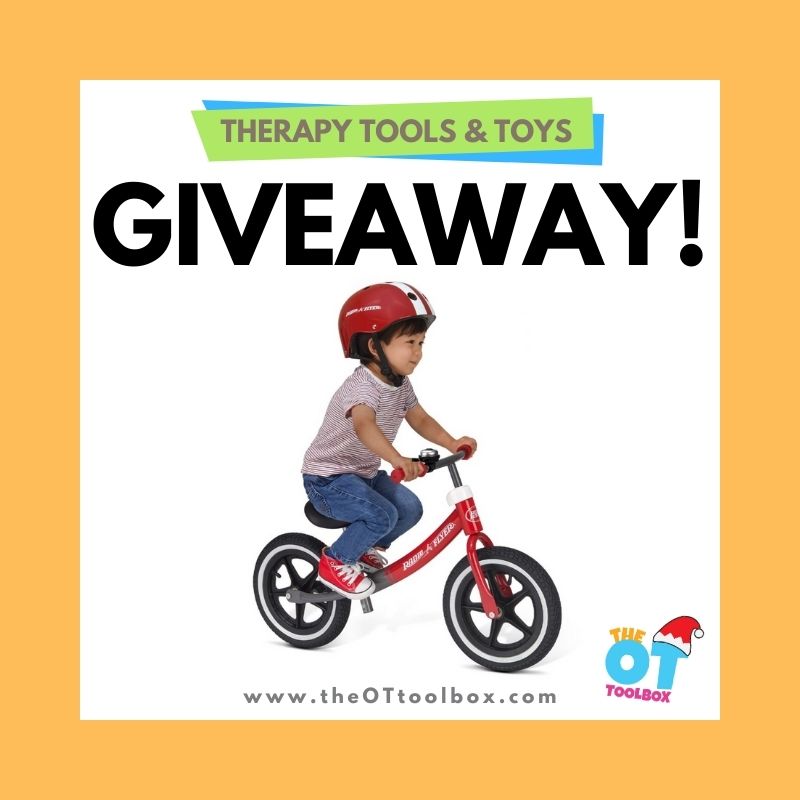
      THERAPY Tool #1: Radio Flyer Air Ride Balance Bike

      Click HERE to enter for a chance to win a Radio Flyer Air Ride Balance Bike!

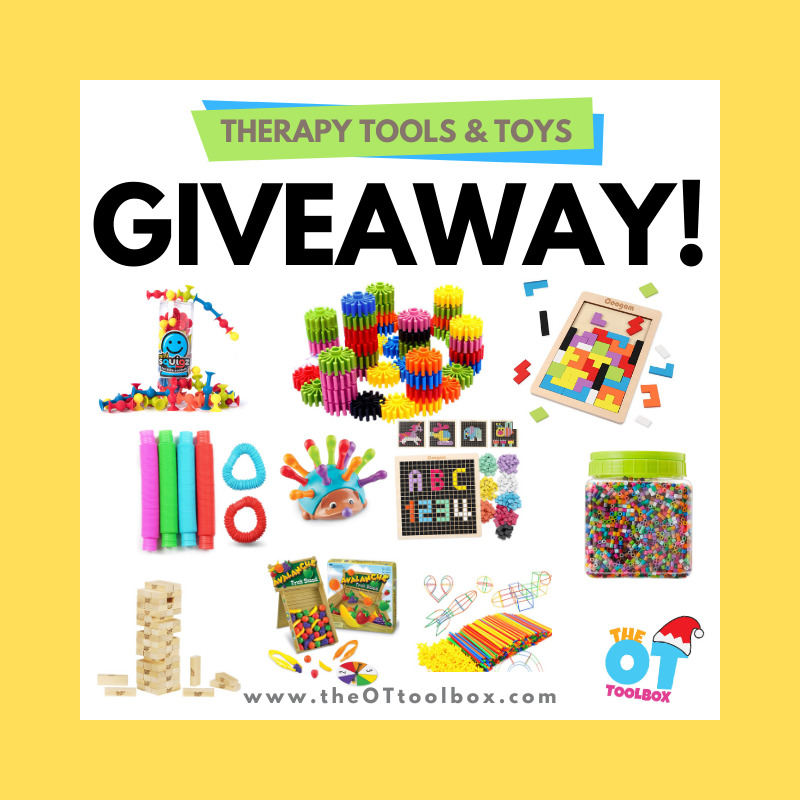
      Therapy Tool #2: Fine Motor Toys!

      Click HERE for a chance to win a fine motor toy!

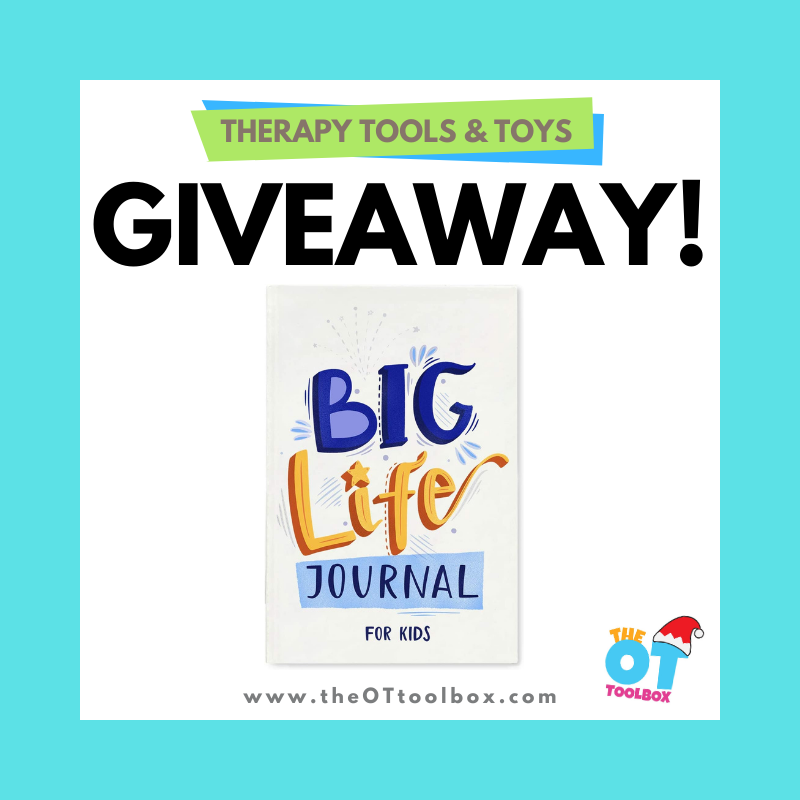
      THERAPY Tool #3: Big Life Journal!

      Big life journal giveaway

      Click HERE for a chance to win a Big Life Journal!

      THERAPY Tool #4: OT Business Owners & Entrepreneur Prizes

      occupational therapy giveaway

      Click Here for a chance to win these prizes and more from occupational therapy entrepreneurs and small businesses!

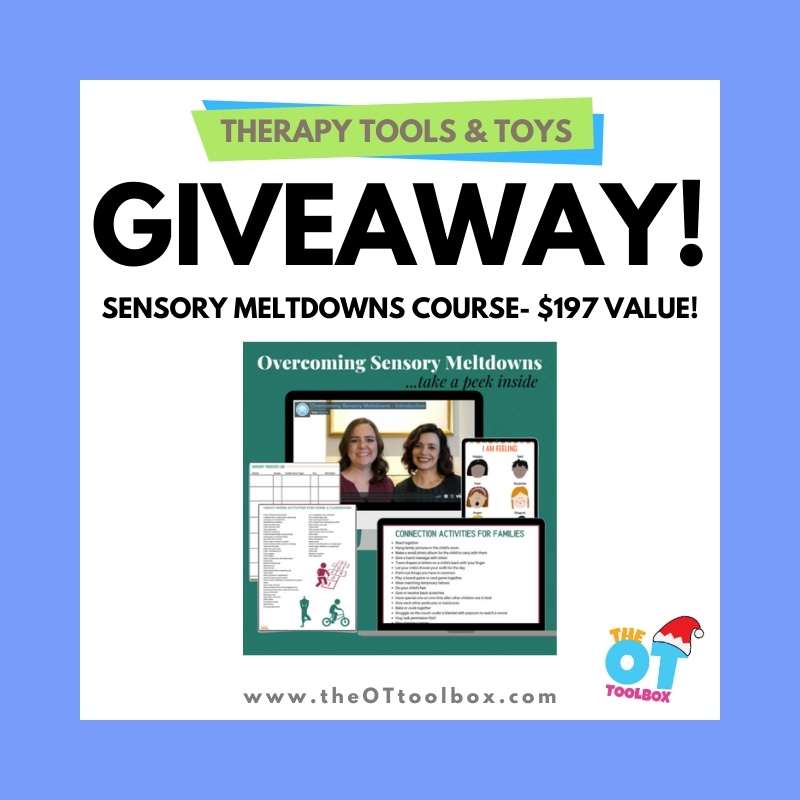
      THERAPY Tool #5: Sensory Meltdowns Course

      sensory meltdowns course

      Click HERE for a chance to win the Overcoming Sensory Meltdowns course!

      THERAPY Tool #6: Emotional Development Toy

      Emotional Development Toys

      Click HERE to enter to win a WhatsitsFace Emotional Development Toy!

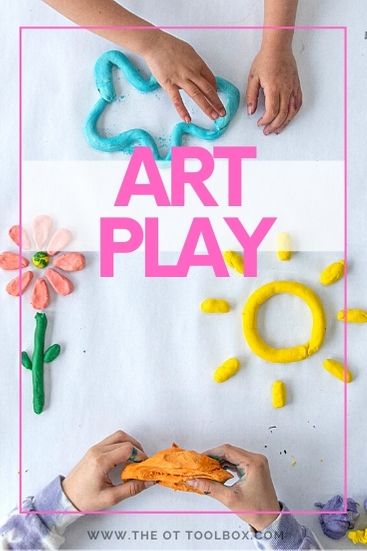
      THERAPY Tool #7: Art Play!

      Art play activities for kids

      CLICK HERE to Win a copy of Art Play!

      THERAPY Tool #8: Vision 101 Course

      Vision 101 course for occupational therapy practitioners.

      CLICK HERE TO WIN Access to the VISION 101 Course!

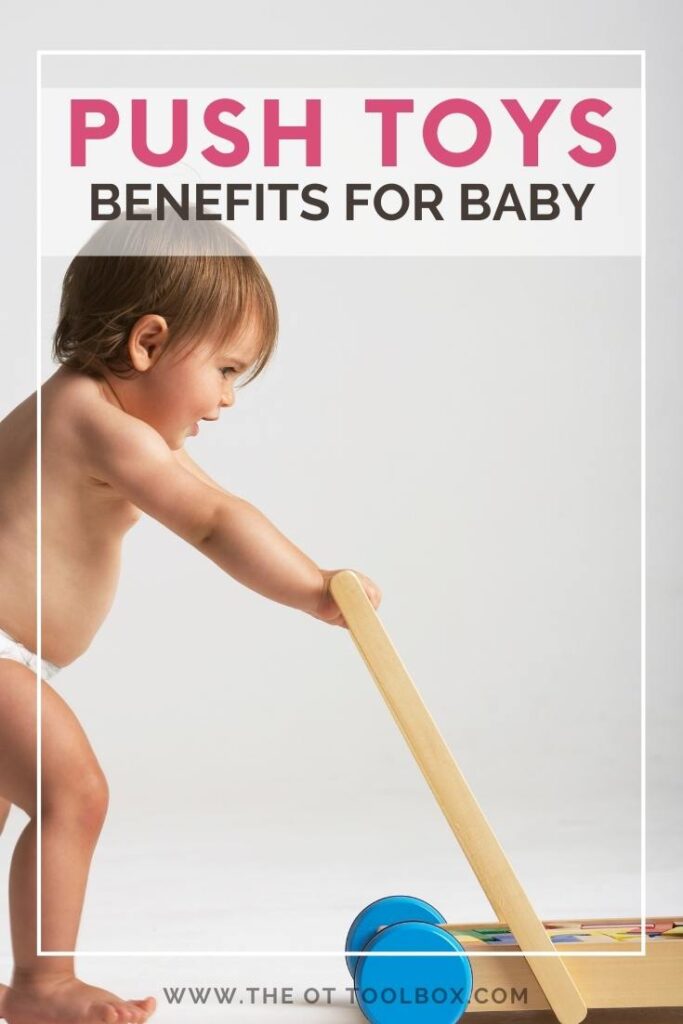
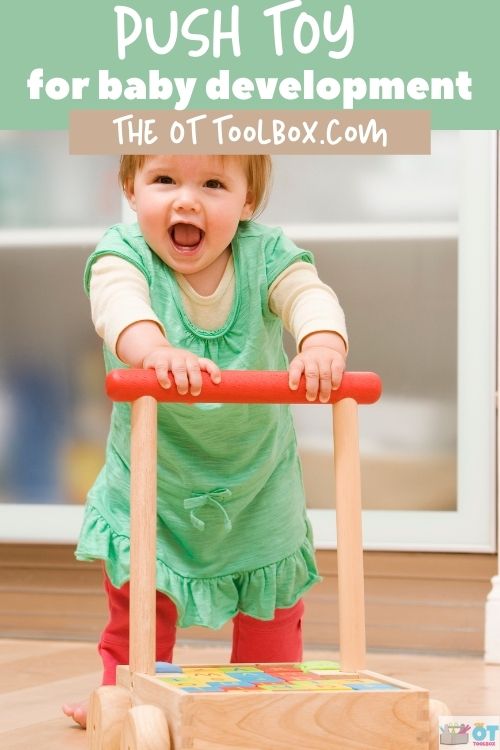
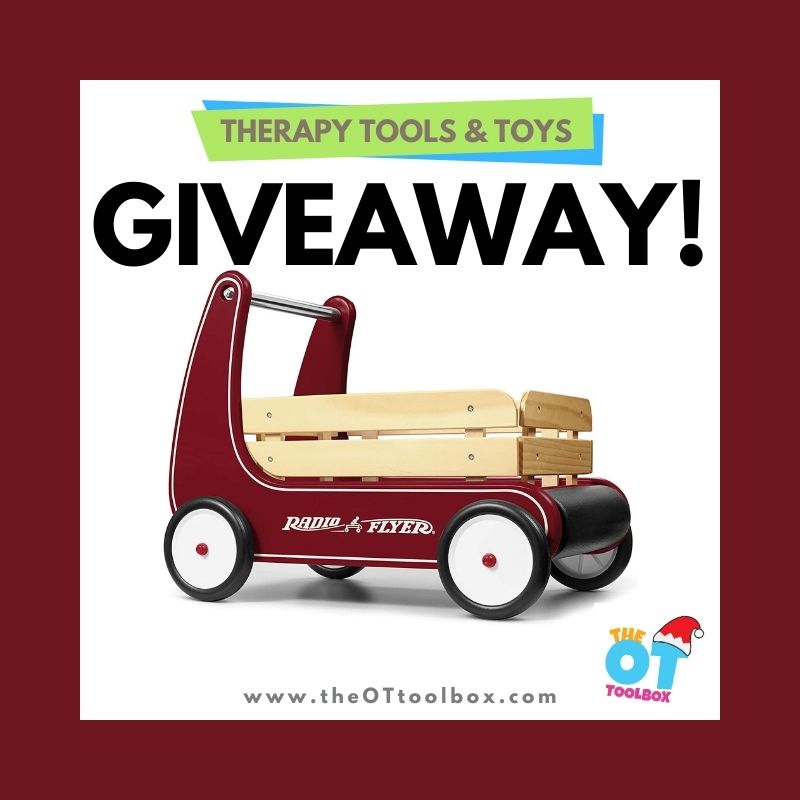
      THERAPY Tool #9: Radio Flyer Push Toy

      CLICK HERE to win a Radio Flyer Push Toy!

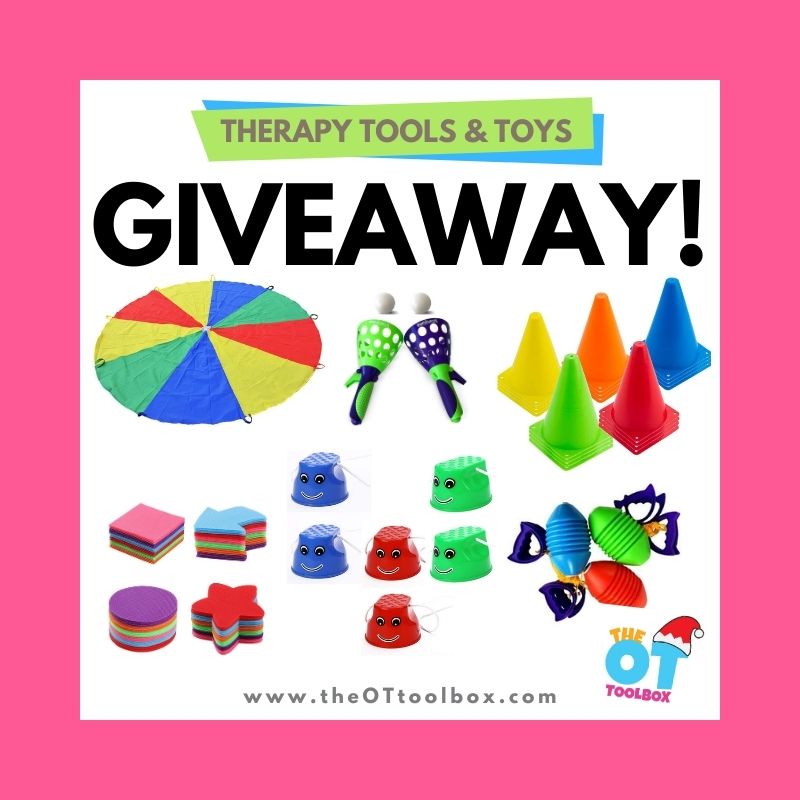
      THERAPY Tool #10: Gross Motor Toys

      CLICK HERE to win one of these Gross Motor Toys!

      Colleen Beck, OTR/L has been an occupational therapist since 2000, working in school-based, hand therapy, outpatient peds, EI, and SNF. Colleen created The OT Toolbox to inspire therapists, teachers, and parents with easy and fun tools to help children thrive. Read her story about going from an OT making $3/hour (after paying for kids’ childcare) to a full-time OT resource creator for millions of readers. Want to collaborate? Send an email to contact@theottoolbox.com.
      Peppermint Moon Dough Recipe

      Moon dough recipe is a peppermint dough recipe for Christmas sensory play.

      Have you ever played with moon sand, or moon dough? This moon dough recipe is an old post here on The OT Toolbox, and one that we loved looking back at. Have you made your own moon dough?  This stuff is seriously messy and majorly fun!  We made our Peppermint Moon Dough recipe a little different than the usual moon dough recipe that is out there.  This moon dough recipe is very soft and fun even for moms to play with!  It’s a great companion to our peppermint play dough recipe from years ago, and our free printable candy cand puzzles, too.

      Moon dough recipe is a peppermint dough recipe for Christmas sensory play.


      Moon Dough Recipe

      We started with what we had on hand.  When it comes to kid-related messy play and making these sensory play activities, we love to use something that otherwise would be thrown away.  Likewise, waste in these activities is not something we are big fans of.  So, when ever possible, we’ll re-use sensory play materials for other activities and save things like dyed pasta and rice for future sensory activities.  

      Note: This post contains affiliate links.  

      This moon dough recipe used something that would otherwise be headed to the trash bin…I had some scented lotion that I had for a while… I really didn’t care for the scent.  That and some corns starch were all that were needed to make the base of our moon dough!  

      Moon Dough Ingredients

      There are only four ingredients in this easy moon dough recipe. You could even omit the food coloring and make this a 3 ingredient moon dough recipe!


      To make the consistency of moon dough, use a 4:1 ratio of corn starch to lotion.  This will make a nice and fluffy, but moldable moon dough. 

      We added a few drops of peppermint extract and some red food coloring.  We used the gel type of food coloring, but only because that is all we had on hand.  I’m sure liquid food coloring would work just as well, although with the added liquid of scent and food coloring, a little extra corn starch might be needed. 

      Also to note when making your moon dough recipe is that different brands of lotion may effect this recipe.  As you mix the ingredients together, you many need to use more or less corn starch depending on the consistency.

      Moon dough recipe that kids can make for a Christmas sensory activity. Make this candy cane scented sensory dough with kids.

      Half of the moon dough, I kept plain white and the other half got the red food coloring for a very candy cane look.   Add a few little bowls and spoons for scooping, and a couple of Candy Cane cookie cutters, and we were ready to play!

      Peppermint dough for Christmas sensory play with an easy moon dough recipe.

      We all got busy scooping, fluffing, and mixing.  This was such a fun sensory play experience (for mom, too!)  The lotion made this dough very soft and with the peppermint scent, you could no longer smell the lotion’s scent.

      Peppermint moon dough recipe that kids can use to scoop and pour for fine motor work.

      Baby Girl (age 2) especially loved to scoop the moon dough.  She used the spoons and filled one cup after another.  And what great fine motor skills this was for her!  She liked to mix the red and the white colors together, dump it all out, and start scooping again!  Here is information on the developmental benefits of scooping and pouring with toddlers.

      We played right on the hard wood floor of our dining room for an easy clean up.  Any stray moon dough bits were easy to broom right up.  

      Moon dough activity for kids to scoop and pour for a holiday sensory activity.

      Little Guy’s favorite part was making the candy cane molds.  We packed the moon dough into the cookie cutters and then pulled it up.  The moon dough would hold it’s shape of the candy cane.  There were a bunch of little moon dough candy canes before we finished!

      Candy cane moon dough is a sensory material that smells so fresh for holiday family fun.

          The scent of peppermint candy canes filled the room!  We had so much fun playing with this moon dough!   

      Christmas sensory dough with a 4 ingredient moon dough recipe.

      When we were finished playing, I poured all of the moon dough into a storage bad and saved it to make a new play activity.  We’ll be using it again, soon!

      Have you made moon dough? How about candy cane scented moon dough? 

      Looking for more fun candy cane scented sensory play? 

      More Christmas sensory ideas

      You’ll find more Christmas sensory activities here, but be sure to try some of these sensory dough materials this holiday season.

      Christmas modified paper

      Christmas Modified Paper Pack

      Colleen Beck, OTR/L has been an occupational therapist since 2000, working in school-based, hand therapy, outpatient peds, EI, and SNF. Colleen created The OT Toolbox to inspire therapists, teachers, and parents with easy and fun tools to help children thrive. Read her story about going from an OT making $3/hour (after paying for kids’ childcare) to a full-time OT resource creator for millions of readers. Want to collaborate? Send an email to contact@theottoolbox.com.
      Egg Carton Snowman Craft

      Egg carton snowman craft

      This egg carton snowman is such a cute Christmas craft to work on fine motor skills. And, better yet, this styrofoam egg carton craft uses materials you might already have on hand. You might know that we love fine motor crafts around here, right? Christmas crafts are no exception.  Why not make a festive holiday snowman craft and sneak in a few fine motor skills while decking the house in homemade decorations like this fine motor snowman craft? It’s a great winter occupational therapy craft that kids will love!

      I got the idea for this fine motor snowman after we pulled out our Christmas decorations and and found our fine motor Christmas tree that we made a few years ago (also from egg cartons).  My son still remembers how much fun he had making that tree, and tells us about it every year we pull that cutie out of dusty attic boxes. I love that this fun craft helps in so many fine motor areas: tripod graspintrinsic hand strength with arch development, and an open web space.

      Check out these Christmas Fine Motor Activities for more creative ways to work on fine motor skills and address development of skills this Christmas season. 


      Egg Carton Snowman

      This post contains affiliate links.

      You’ll need these materials to make an egg carton snowman craft:
      White styrofoam egg carton (OR paint a cardboard egg carton with white paint)
      Scissors
      Black crafting pom poms

      Craft glue

      Black permanent marker

      Bamboo skewer

      Recycled K-cup or other small cup, like a drinking cup

      Black felt


      Styrofoam Egg Carton Craft

      Make this egg carton snowman craft and work on fine motor skills with the kids this year.

      To make the egg carton snowman, first cut three sections from the styrofoam egg carton.  Cutting styrofoam is a great way to practice scissor skills.  It takes a bit more “oomph” to cut the egg carton and is a nice way to practice hand strengthening.


      Poking the bamboo skewer into the stryofoam egg carton provides an opportunity to work on tripod grasp, intrinsic hand strength with arch development, and an open web space.

      Kids can make a egg carton snowman craft with Styrofoam egg cartons.

      More Christmas Activities

      Writing out that Christmas wish list is a difficult task that brings out tears instead of holiday excitement.  I’ve got a solution for your kiddo with handwriting difficulties: a packet of modified paper for all of the Christmas handwriting tasks that come up each year.  Use this handwriting pack to help kids who struggle with handwriting to participate in holiday traditions while even working on and developing their handwriting skills!


      Working on handwriting with kids this Christmas season? Grab your copy of the Christmas Modified Handwriting Packet. It’s got three types of adapted paper that kids can use to write letters to Santa, Thank You notes, holiday bucket lists and much more…all while working on handwriting skills in a motivating and fun way! Read more about the adapted Christmas Paper here.     

      Make this egg carton snowman craft and work on fine motor skills like tripod grasp, intrinsic hand strength with arch development, and an open web space with the kids this year.


      Try these Christmas crafts for more fine motor fun:

      Fine Motor Egg Carton Christmas Tree

      Homemade Fine Motor Christmas Card

      Jingle Bell Fine Motor Sort

      Egg Carton Nativity Set

      Want more ways to boost fine motor skills with a snowman theme or winter theme? The Winter Fine Motor Kit is on sale now!

      This print-and-go winter fine motor kit includes no-prep fine motor activities to help kids develop functional grasp, dexterity, strength, and endurance. Use fun, winter-themed, fine motor activities so you can help children develop strong fine motor skills in a digital world.

      This print-and-go winter fine motor kit includes no-prep fine motor activities to help kids develop functional grasp, dexterity, strength, and endurance. Use fun, winter-themed, fine motor activities so you can help children develop strong fine motor skills in a digital world.

      winter fine motor kit


      Colleen Beck, OTR/L has been an occupational therapist since 2000, working in school-based, hand therapy, outpatient peds, EI, and SNF. Colleen created The OT Toolbox to inspire therapists, teachers, and parents with easy and fun tools to help children thrive. Read her story about going from an OT making $3/hour (after paying for kids’ childcare) to a full-time OT resource creator for millions of readers. Want to collaborate? Send an email to contact@theottoolbox.com.