Colleen Beck, OTR/L is a pediatric occupational therapist and the owner and author of The OT Toolbox website. She manages all of The OT Toolbox social media accounts and runs the popular newsletter.
Read about Colleen's experience and career as an occupational therapist, including how The OT Toolbox began on our About The OT Toolbox page: https://www.theottoolbox.com/about-us/
Colleen created The OT Toolbox in 2011 and since then has written thousands of blog posts designed to support therapy providers, educators, parents, counselors, admin, and caregivers in promoting the healthy development of kids.
Check out Colleen's blog posts below:
Have you ever played with moon sand, or moon dough? This moon dough recipe is an old post here on The OT Toolbox, and one that we loved looking back at. Have you made your own moon dough? This stuff is seriously messy and majorly fun! We made our Peppermint Moon Dough recipe a little different than the usual moon dough recipe that is out there. This moon dough recipe is very soft and fun even for moms to play with! It’s a great companion to our peppermint play dough recipe from years ago, and our free printable candy cand puzzles, too.
Moon Dough Recipe
We started with what we had on hand. When it comes to kid-related messy play and making these sensory play activities, we love to use something that otherwise would be thrown away. Likewise, waste in these activities is not something we are big fans of. So, when ever possible, we’ll re-use sensory play materials for other activities and save things like dyed pasta and rice for future sensory activities.
Note: This post contains affiliate links.
This moon dough recipe used something that would otherwise be headed to the trash bin…I had some scented lotion that I had for a while… I really didn’t care for the scent. That and some corns starch were all that were needed to make the base of our moon dough!
Moon Dough Ingredients
There are only four ingredients in this easy moon dough recipe. You could even omit the food coloring and make this a 3 ingredient moon dough recipe!
To make the consistency of moon dough, use a 4:1 ratio of corn starch to lotion. This will make a nice and fluffy, but moldable moon dough.
We added a few drops of peppermint extract and some red food coloring. We used the gel type of food coloring, but only because that is all we had on hand. I’m sure liquid food coloring would work just as well, although with the added liquid of scent and food coloring, a little extra corn starch might be needed.
Also to note when making your moon dough recipe is that different brands of lotion may effect this recipe. As you mix the ingredients together, you many need to use more or less corn starch depending on the consistency.
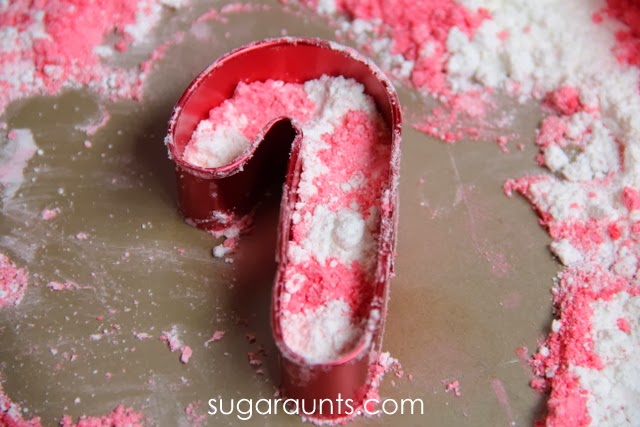
Half of the moon dough, I kept plain white and the other half got the red food coloring for a very candy cane look. Add a few little bowls and spoons for scooping, and a couple of Candy Cane cookie cutters, and we were ready to play!
We all got busy scooping, fluffing, and mixing. This was such a fun sensory play experience (for mom, too!) The lotion made this dough very soft and with the peppermint scent, you could no longer smell the lotion’s scent.
Baby Girl (age 2) especially loved to scoop the moon dough. She used the spoons and filled one cup after another. And what great fine motor skills this was for her! She liked to mix the red and the white colors together, dump it all out, and start scooping again! Here is information on the developmental benefits of scooping and pouring with toddlers.
We played right on the hard wood floor of our dining room for an easy clean up. Any stray moon dough bits were easy to broom right up.
Little Guy’s favorite part was making the candy cane molds. We packed the moon dough into the cookie cutters and then pulled it up. The moon dough would hold it’s shape of the candy cane. There were a bunch of little moon dough candy canes before we finished!
The scent of peppermint candy canes filled the room! We had so much fun playing with this moon dough!
When we were finished playing, I poured all of the moon dough into a storage bad and saved it to make a new play activity. We’ll be using it again, soon!
Have you made moon dough? How about candy cane scented moon dough?
Looking for more fun candy cane scented sensory play?
More Christmas sensory ideas
You’ll find more Christmas sensory activities here, but be sure to try some of these sensory dough materials this holiday season.
Colleen Beck, OTR/L has been an occupational therapist since 2000, working in school-based, hand therapy, outpatient peds, EI, and SNF. Colleen created The OT Toolbox to inspire therapists, teachers, and parents with easy and fun tools to help children thrive. Read her story about going from an OT making $3/hour (after paying for kids’ childcare) to a full-time OT resource creator for millions of readers. Want to collaborate? Send an email to contact@theottoolbox.com.
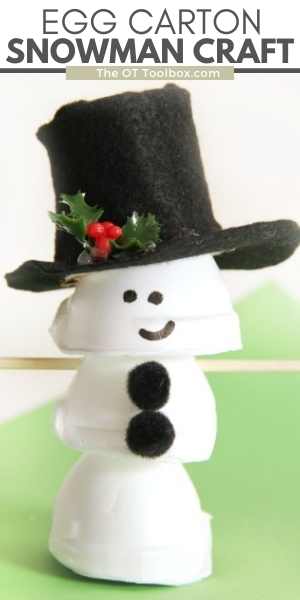
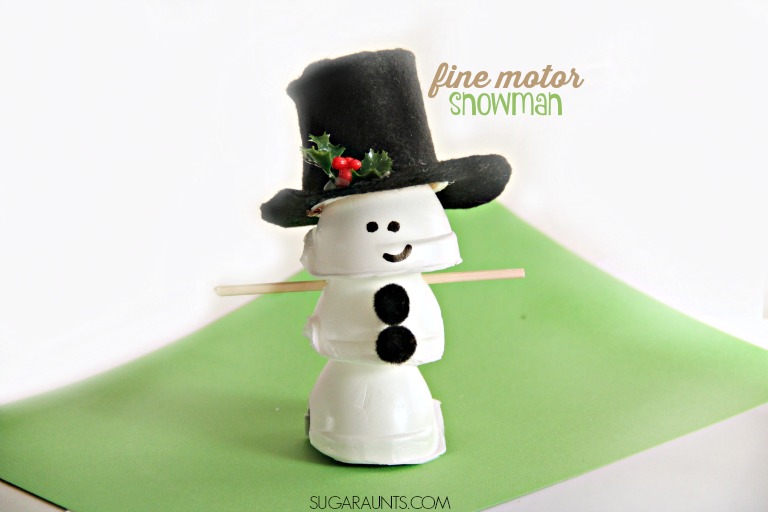
This egg carton snowman is such a cute Christmas craft to work on fine motor skills. And, better yet, this styrofoam egg carton craft uses materials you might already have on hand. You might know that we love fine motor crafts around here, right? Christmas crafts are no exception. Why not make a festive holiday snowman craft and sneak in a few fine motor skills while decking the house in homemade decorations like this fine motor snowman craft? It’s a great winter occupational therapy craft that kids will love!
I got the idea for this fine motor snowman after we pulled out our Christmas decorations and and found our fine motor Christmas tree that we made a few years ago (also from egg cartons). My son still remembers how much fun he had making that tree, and tells us about it every year we pull that cutie out of dusty attic boxes. I love that this fun craft helps in so many fine motor areas: tripod grasp, intrinsic hand strength with arch development, and an open web space.
Check out these Christmas Fine Motor Activities for more creative ways to work on fine motor skills and address development of skills this Christmas season.
Egg Carton Snowman
This post contains affiliate links.
You’ll need these materials to make an egg carton snowman craft: White styrofoam egg carton (OR paint a cardboard egg carton with white paint) Scissors Black crafting pom poms
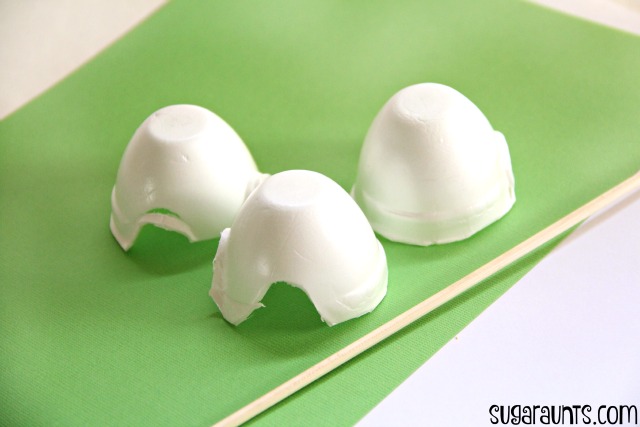
To make the egg carton snowman, first cut three sections from the styrofoam egg carton. Cutting styrofoam is a great way to practice scissor skills. It takes a bit more “oomph” to cut the egg carton and is a nice way to practice hand strengthening.
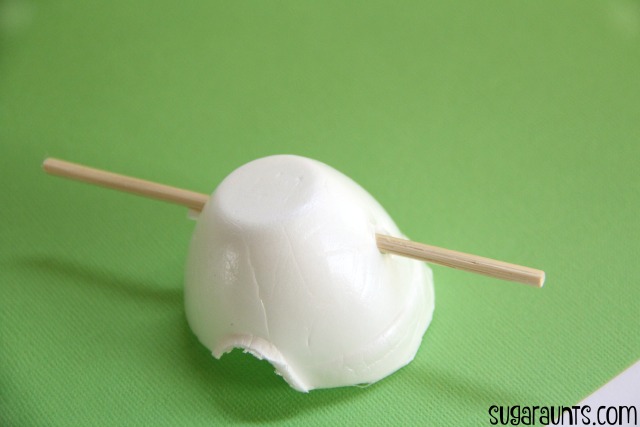
Poking the bamboo skewer into the stryofoam egg carton provides an opportunity to work on tripod grasp, intrinsic hand strength with arch development, and an open web space.
More Christmas Activities
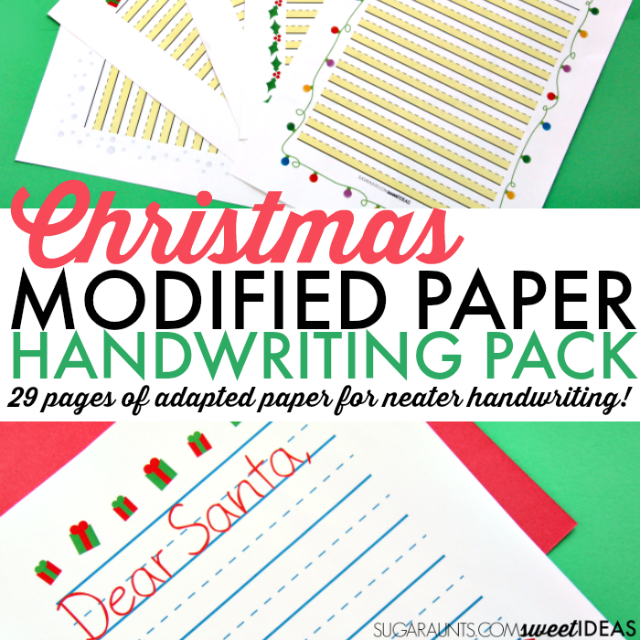
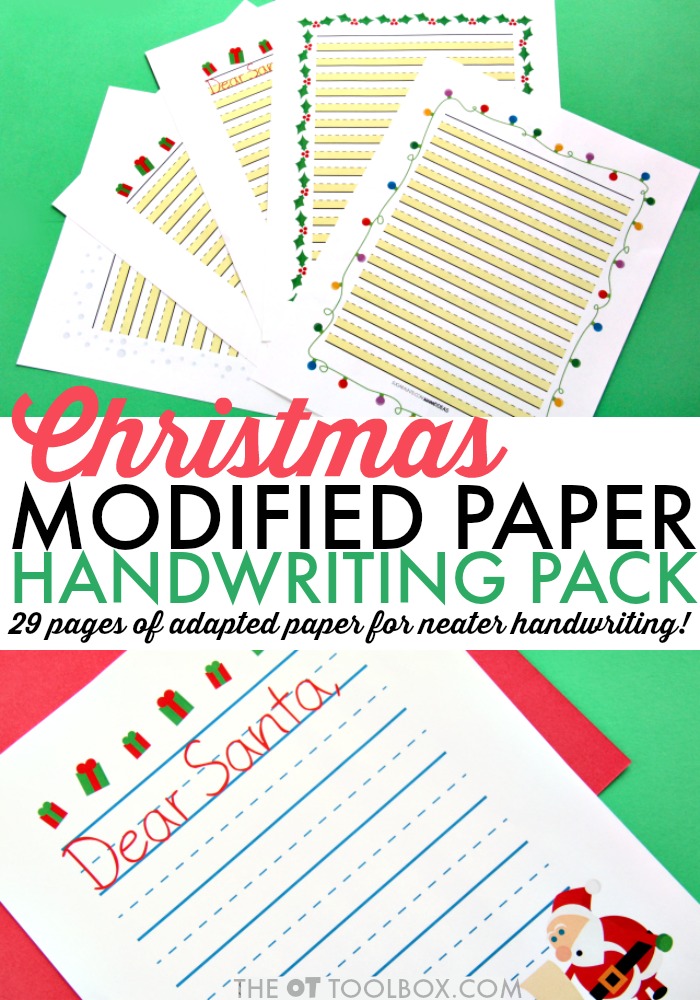
Writing out that Christmas wish list is a difficult task that brings out tears instead of holiday excitement. I’ve got a solution for your kiddo with handwriting difficulties: a packet of modified paper for all of the Christmas handwriting tasks that come up each year. Use this handwriting pack to help kids who struggle with handwriting to participate in holiday traditions while even working on and developing their handwriting skills!
Working on handwriting with kids this Christmas season? Grab your copy of the Christmas Modified Handwriting Packet. It’s got three types of adapted paper that kids can use to write letters to Santa, Thank You notes, holiday bucket lists and much more…all while working on handwriting skills in a motivating and fun way! Read more about the adapted Christmas Paper here.
Try these Christmas crafts for more fine motor fun:
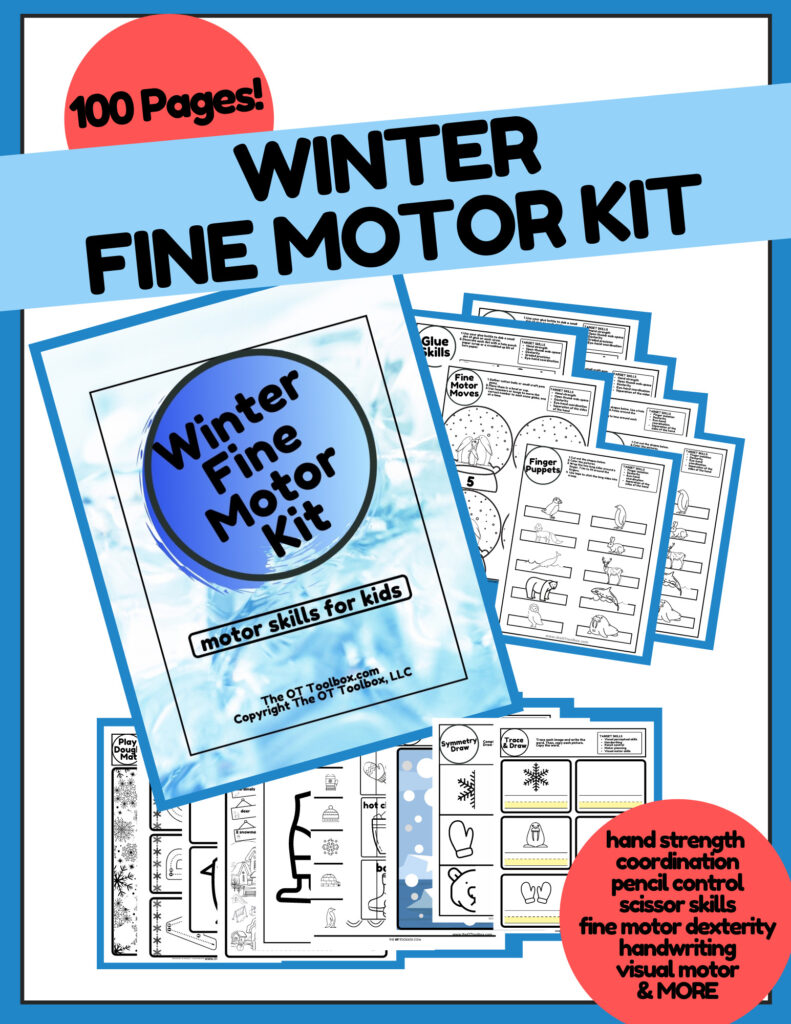
Want more ways to boost fine motor skills with a snowman theme or winter theme? The Winter Fine Motor Kit is on sale now!
This print-and-go winter fine motor kit includes no-prep fine motor activities to help kids develop functional grasp, dexterity, strength, and endurance. Use fun, winter-themed, fine motor activities so you can help children develop strong fine motor skills in a digital world.
This print-and-go winter fine motor kit includes no-prep fine motor activities to help kids develop functional grasp, dexterity, strength, and endurance. Use fun, winter-themed, fine motor activities so you can help children develop strong fine motor skills in a digital world.
Colleen Beck, OTR/L has been an occupational therapist since 2000, working in school-based, hand therapy, outpatient peds, EI, and SNF. Colleen created The OT Toolbox to inspire therapists, teachers, and parents with easy and fun tools to help children thrive. Read her story about going from an OT making $3/hour (after paying for kids’ childcare) to a full-time OT resource creator for millions of readers. Want to collaborate? Send an email to contact@theottoolbox.com.
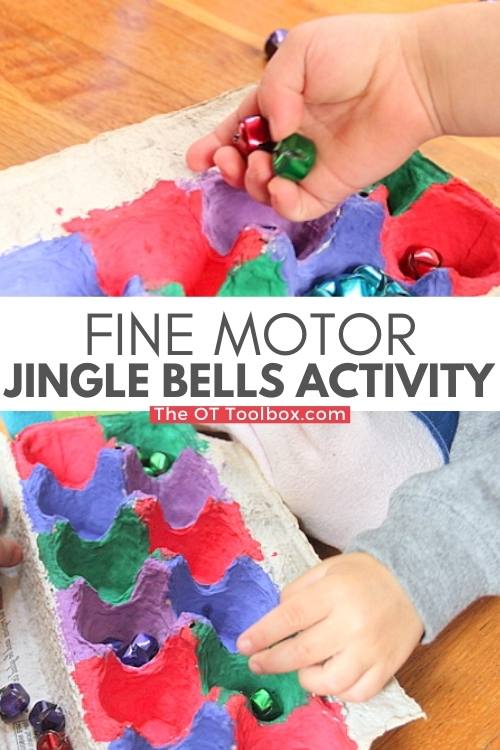
Christmas is just around the corner, and we’ve got some fun ideas in store for you! This Jingle Bell Kid’s Activity can be a jingle bell game or a Fine Motor Christmas activity that kids will not forget! Use an egg carton and jingle bells kids can manipulate for a color learning and fine motor activity.
We’ve done our share of Christmas play activities and this Jingle Bell Sorting activity is just one way to play and learn with a Christmas theme. We’re joining a bunch of other bloggers in a busy bag series where each month, we’ll bring you a busy bag activity to keep the kids busy and occupied (and learning!) In-hand manipulation activities are a great way to boost fine motor skills needed for tasks like managing clothing fasteners, using a pencil when writing, manipulating items like coins or beads, and more.
This jingle bell activity would be fun to incorporate into a Christmas sensory bin, too.
This post contains affiliate links. See our full disclosure here.
Jingle Bell Kids Activity
This jungle bell kids activity is a Christmas busy bag that helps children build fine motor skills, as well as other learning components in a game format.
We’ve done quite a few “busy” time of activities on this blog. These are the activities that kids can do on their own or with a little set up and explanation. They are kept busy and learning, creating, or exploring on their own. Busy bag activities are perfect for times when caregivers need to focus on other children, dinner preparation, or while waiting. Modern day busy activities might be smart phone apps for some kids, as they “busy themselves” as they wait in a restaurant or doctor’s office. A busy bag activity that is easy to set up might be something as simple as manipulating small items, or sorting sugar packets by color.
Jingle Bell Activity for Kids
Independent learning is important to a child’s development. When a child is learning on their own, they are able to come up with questions and ideas independently. They develop problem solving skills, and exploring during the process of the activity. When a child has an adult participating in an activity with them, they often times focus on the end product or goal rather than the process of the task. Children become aware of their own strengths and weaknesses during independent play and can gain a sense of satisfaction when they do a task on their own. Busy bags are great for independent learning!
Color Sorting with Jingle Bells
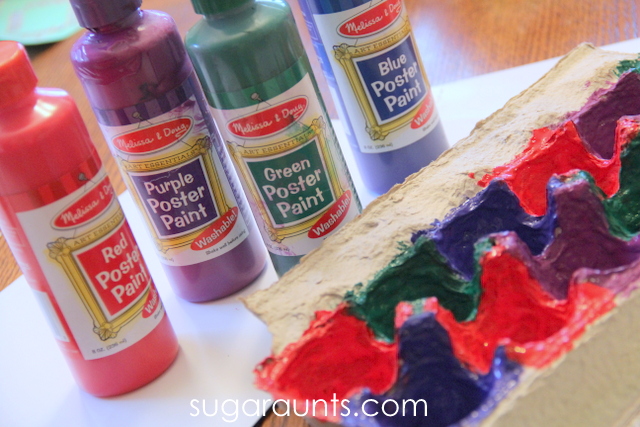
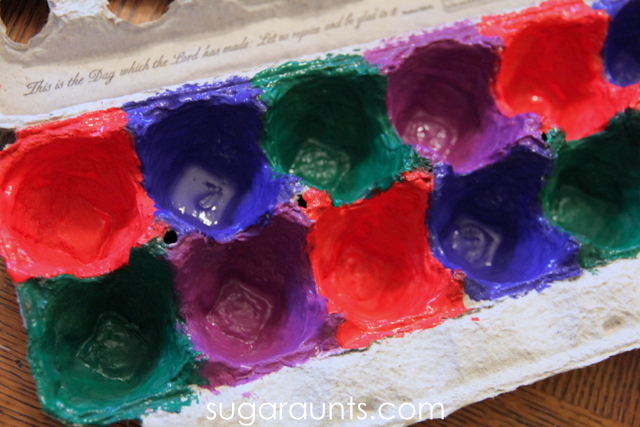
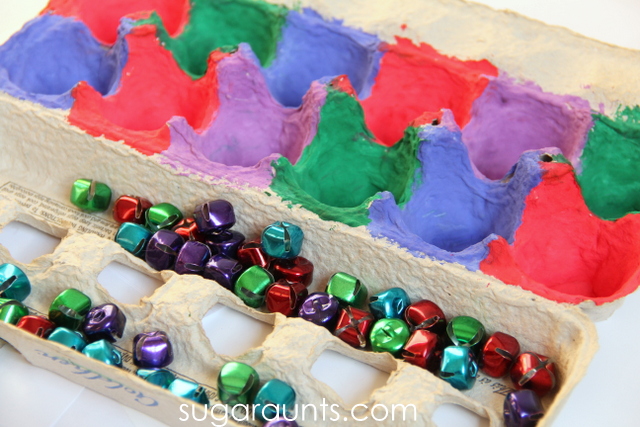
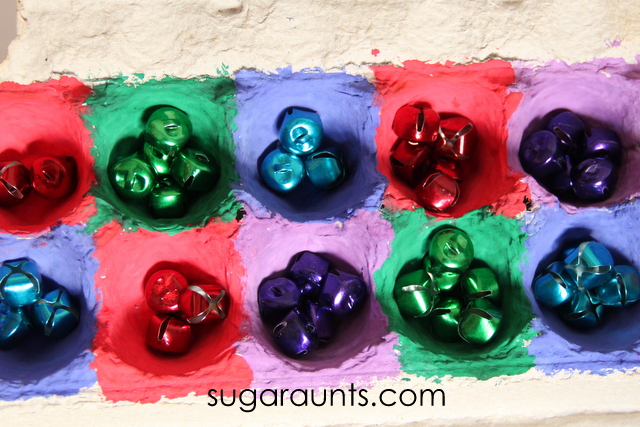
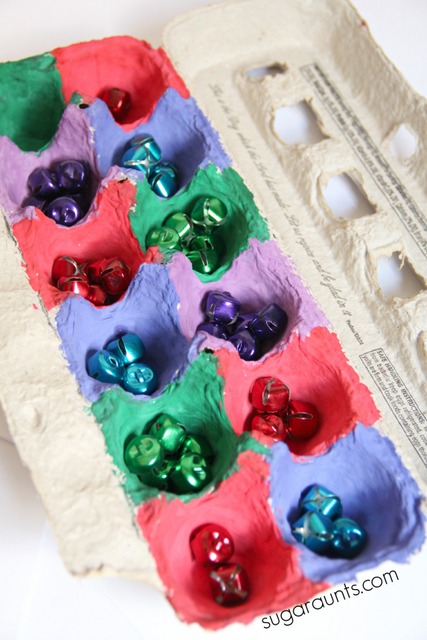
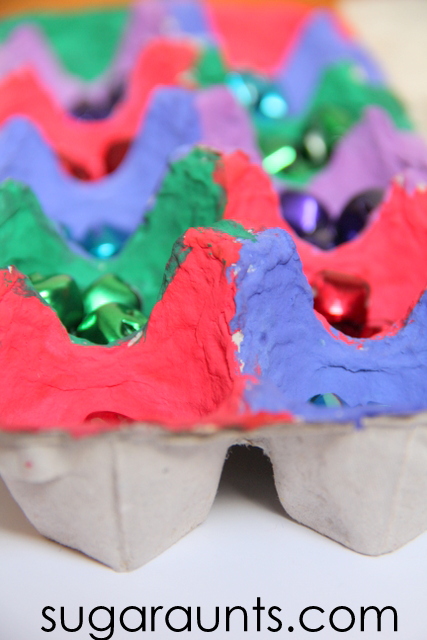
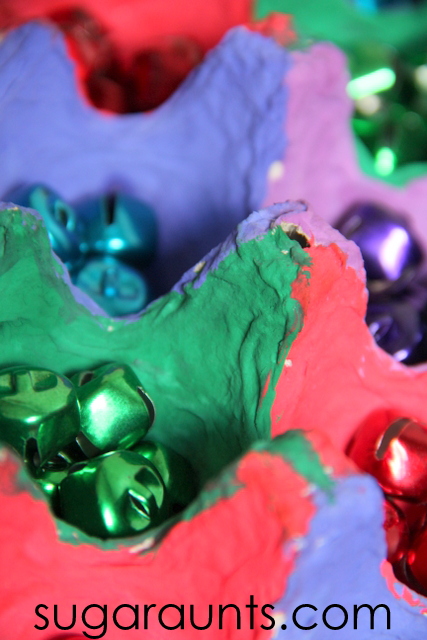
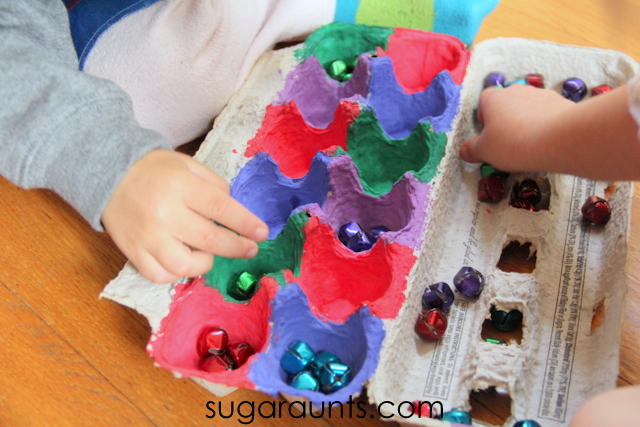
We started with a recycled egg carton. Technically, this isn’t a busy BAG since we made our activity in an egg carton…but it is a busy activity, and I love that it can fold up and stow away with the sorting material inside the carton. The cardboard type was needed for this activity, in order to get the paint to “stick”. I painted the sections of the egg carton in four colors. I LOVE these poster paints for their bold colors.
Little Sister (age 3) helped me paint the sections, and we let them dry overnight…because when Little Sister helps, a lot of paint is used.
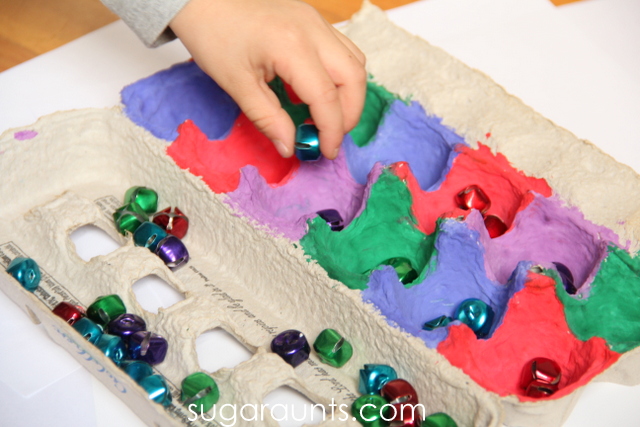
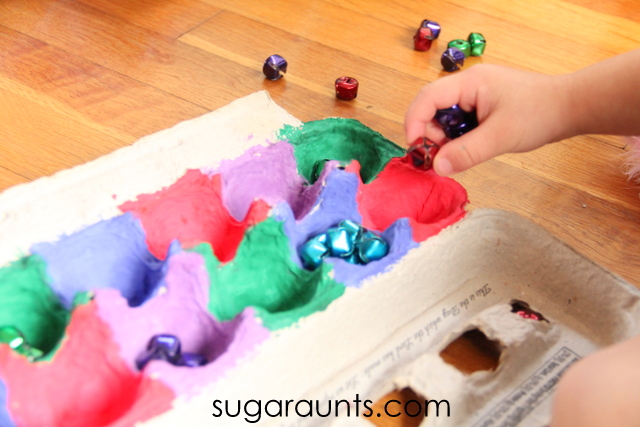
The next day, we were ready for our jingle bell sorting activity. We used jingle bells that we received from our friends at www.craftprojectideas.com (Thanks so much!!) I poured the bells into the top section of the egg carton, and showed Little Sister how to sort them.
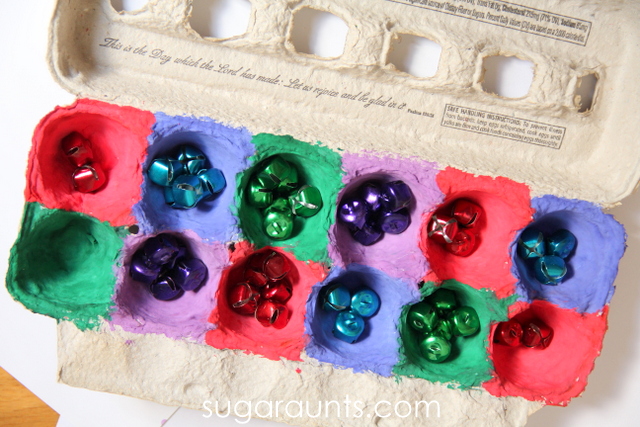
This is such a great activity for color identification, fine motor skills, scanning, hand-eye coordination, and early math.
The colors are so bright and the jingle of the bells gives a great sensory input to this activity. Little Sister sorted and sorted while I changed diapers, swept the floor, and watched her sort.
One of the cousins came over one day and these two three year olds had fun sorting together. I showed them how to extend the play by counting the number of bells in each section.
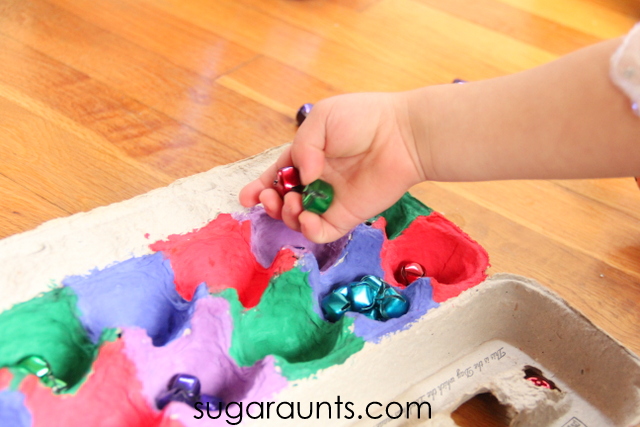
I love this activity for it’s fine motor aspect, too. Managing the jingle bells as they picked them up and sorted them into the sections works on many skills. You can encourage your child to pick up a few bells at a time and pocket them into the palm of the hand as they sort the bells one at a time.
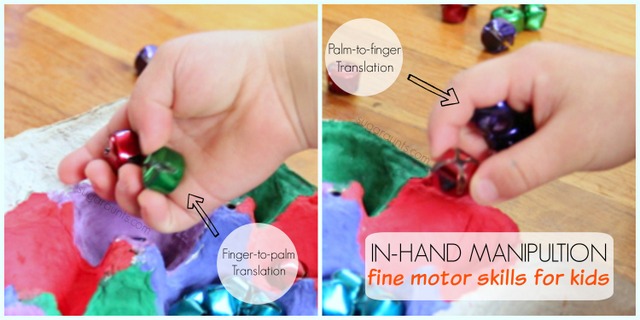
Picking up several bells works on in-hand manipulation, specifically the skill of translation. Moving the bell from finger tips to palm as they “squirrel away” bells into their palm is a difficult task for many kids. This is a task needed in order to manage coins or other small items.
Placing the bells into the sections requires the child to use in-hand manipulation to move the bells from the palm to the finger tips. This is also the skill of translation and is needed for pushing coins into a piggy bank or vending machine, or managing small items like marbles.
Translation is a complex task requiring strength and dexterity of the intrinsic muscles of the hand. It’s fun to watch these skills develop in an activity like this one!
With this activity and any other on our blog, please be sure to supervise your children when small items are involved. If your child is one who puts items into their mouth, you may want to hold off on this activity for a while. Use caution with this activity as it involves small parts.
Christmas Handwriting Activities
Writing out that Christmas wish list is a difficult task that brings out tears instead of holiday excitement. I’ve got a solution for your kiddo with handwriting difficulties: a packet of modified paper for all of the Christmas handwriting tasks that come up each year. Use this handwriting pack to help kids who struggle with handwriting to participate in holiday traditions while even working on and developing their handwriting skills!
Working on handwriting with kids this Christmas season? Grab your copy of the Christmas Modified Handwriting Packet. It’s got three types of adapted paper that kids can use to write letters to Santa, Thank You notes, holiday bucket lists and much more…all while working on handwriting skills in a motivating and fun way! Read more about the adapted Christmas Paper here.
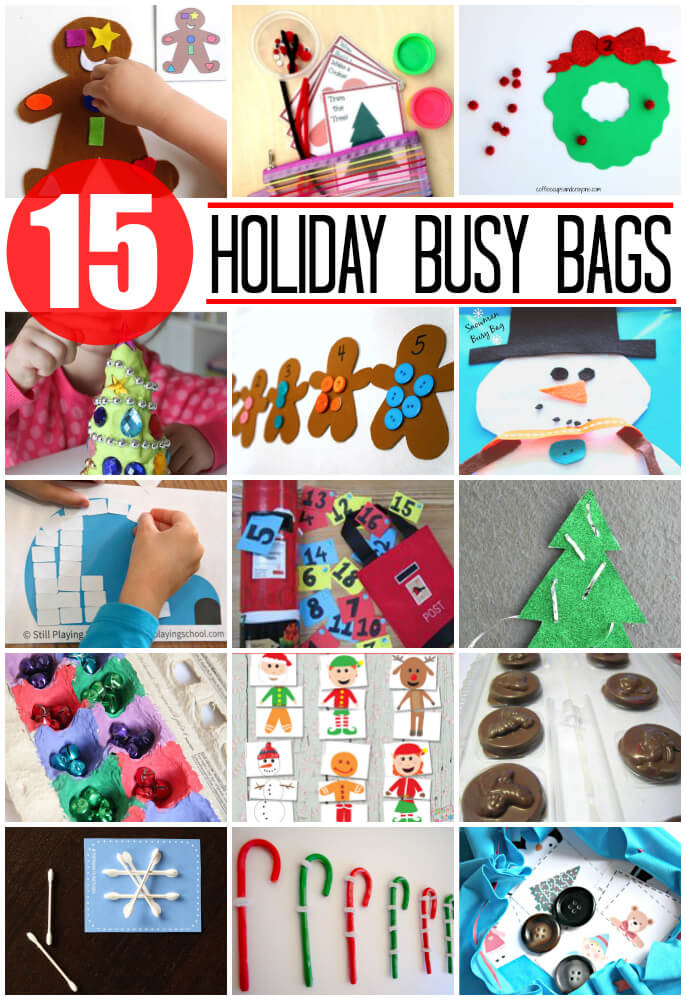
Check out some more busy bag activities for the holiday season:
Colleen Beck, OTR/L has been an occupational therapist since 2000, working in school-based, hand therapy, outpatient peds, EI, and SNF. Colleen created The OT Toolbox to inspire therapists, teachers, and parents with easy and fun tools to help children thrive. Read her story about going from an OT making $3/hour (after paying for kids’ childcare) to a full-time OT resource creator for millions of readers. Want to collaborate? Send an email to contact@theottoolbox.com.
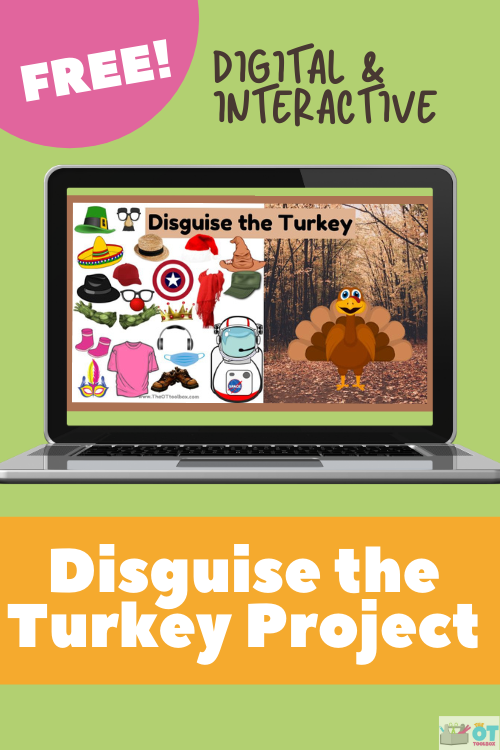
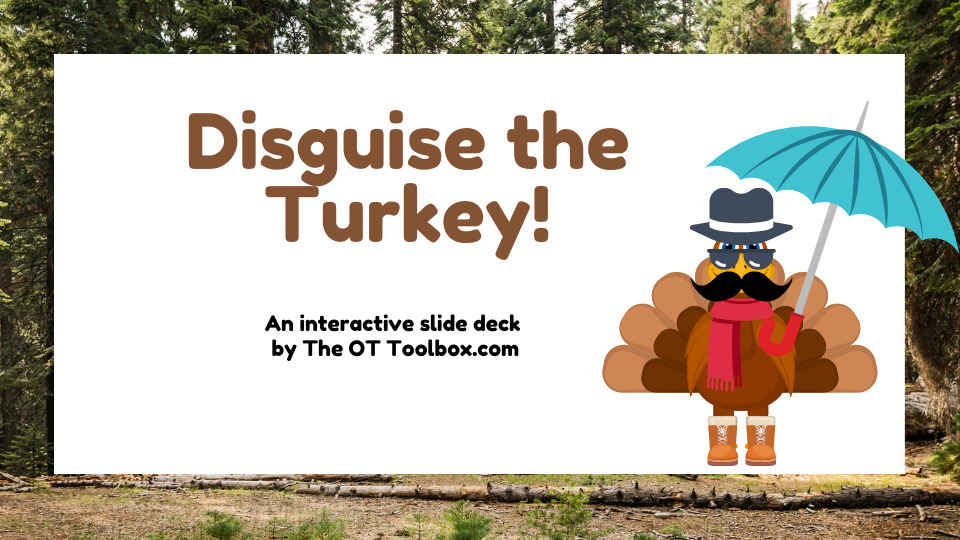
This Disguise the Turkey digital activity is an interactive Thanksgiving activity that kids can use to as a disguise the turkey project for this year. In a year when teletherapy and distance learning is the new way, digital activities are the way to go. Recently, I shared a free turkey theme slide deck for virtual therapy sessions. It was a HUGE hit. One thing that readers asked for was an interactive portion on one of the slides. On that slide, you’ll find a turkey with clothing items that students can write about. Today, I’m sharing this free occupational therapy slide deck for a disguise the turkey project in 2020.
So, what is disguise the turkey? This is a fun Thanksgiving activity that all of my kids have done each year in their elementary years. They typically come home with a turkey template and instructions to put on their thinking caps and use materials they find around the home to disguise the turkey, so that he can hide from becoming Thanksgiving dinner.
Students are instructed to use materials in the home, recycled materials, paints, crayons, and other items to glue onto the turkey.
Disguise the turkey usually involves children turning their turkey pal into another character such as Santa Clause, an army guy, a cowboy, fairy, or any topic a child can imagine! One of my own kiddos even dressed his disguise a turkey project into a fidget spinner a few years back. Another of my kids turned their turkey into the Chick-Fil-A cow, and another disguised their turkey into a disco ball. The point is to think outside of the box and make a fun and creative project.
Normally, these disguised turkeys are hung in the school hallway or somewhere in the classroom for all to see the creative turkey fun.
This year is a little different, however.
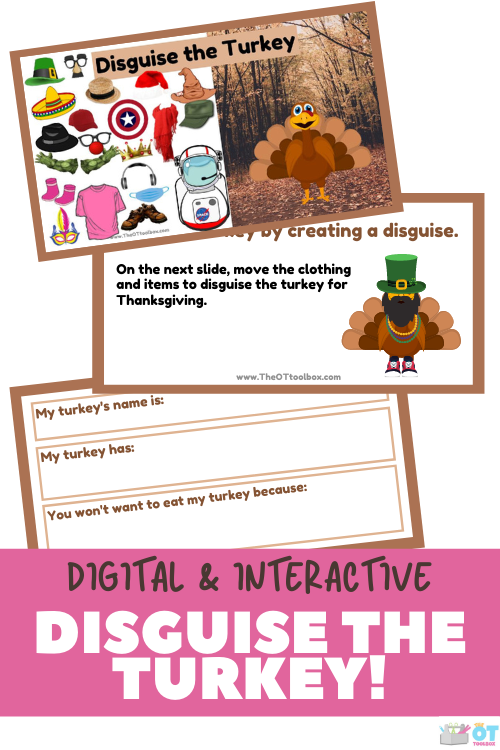
To add some fun and creativity, I made this digital disguise the turkey slide deck.
Disguise the turkey project
Take the disguise the turkey project a bit further. After students move the interactive pieces onto the slide, they can work on other areas of learning and development so that this turkey project adds to the learning curriculum.
If you are feeling like many parents out there right now, children are spending way too much time on screens. There is a motivating factor and a need for screen-based activities during this time, however.
That’s why this disguise the turkey project hits the ball out of the park. It’s a fun activity for kids. They will be engaged in disguising their digital turkey with the movable slide pieces. And, if they’ve done a disguise the turkey project in years past, there is a bit of nostalgia that they might experience.
Disguise the Turkey Extension Ideas:
However, you can then extend this project in a way that works for the individual child’s needs in therapy, or in the classroom (or home classroom).
Ask students to write out the items that they used on their turkey project.
Ask students to write a story about their turkey.
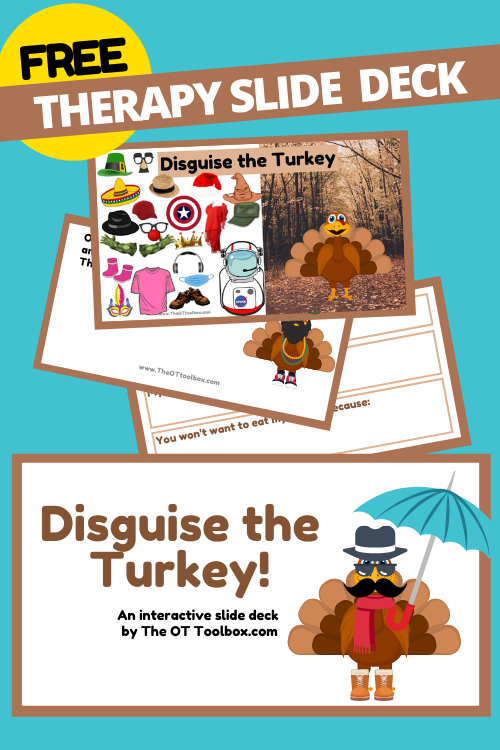
Use the prompts on the next slide and they can name their turkey, and fill in the blank about why their turkey is safe in the disguise they designed.
Use this slide to work on sentence composure and creative writing.
Work on typing skills as students type into the interactive text boxes on the slide.
Work on handwriting. Kids can write their responses on paper. This is a fun writing prompt for kids and they can work on letter formation, line use, spacing, letter sizing, and legibility.
You can use this as parents, therapists, and educators to work on all aspects of creative writing, typing, or handwriting.
Free Digital Disguise the Turkey Activity
Enter your email address below to access this free Google slide deck. Enter your email address in the form below and you will get a PDF delivered to your inbox. Click the button and you will be prompted to make a copy onto your Google Drive. Then, use that slide deck to teach gratitude to kids using movement and activities. Have fun!
Colleen Beck, OTR/L has been an occupational therapist since 2000, working in school-based, hand therapy, outpatient peds, EI, and SNF. Colleen created The OT Toolbox to inspire therapists, teachers, and parents with easy and fun tools to help children thrive. Read her story about going from an OT making $3/hour (after paying for kids’ childcare) to a full-time OT resource creator for millions of readers. Want to collaborate? Send an email to contact@theottoolbox.com.
Gratitude activities and specific ways to teach gratitude is an important part of child development. But gratitude can be a complex and abstract topic for kids. Sometimes, putting together a fewhands-on activities can be a helpful way to show children how to express gratitude for the people, things, and places in their lives that they are thankful for. There’s more; Gratitude is an early social-emotional skill that fosters children’s social emotional learning as well as a core skill that relates to successes and relationship skills later in life. Use the gratitude ideas described here to help children build this essential soft skill while targeting motor development, making activities for gratitude development fun and functional.
Gratitude Activities
These gratitude games, activities, and hands-on play ideas help children foster this soft skill.
I’ve tried to pull together several activities and ideas that help children understand thankfulness and see that feeling in action through play and activities.
You’ll find book-related thankfulness activities, gratitude games, thankfulness crafts, and other gratefulness activities to teach gratitude to children and even adults.
You’ll find a teaching gratitude therapy slide deck that occupational therapists and other child professionals can use in teletherapy to teach this skill, while targeting other areas like fine motor skills, gross motor, mindfulness, and even handwriting.
There’s more to it, though. Helping children foster gratitude helps them later in life.
Gratitude Activities Foster Social Emotional Learning
I mentioned in the first paragraph, the significance of teaching gratitude to children. This soft skill is a powerful one to start early with toddlers and preschoolers. But, teaching the ability to be self-aware, and cognizant of one’s well-being, even in difficult times is a powerful instrument in fostering grit and resilience.
More so, teaching gratitude to children allows them to build essential roadmaps to social emotional learning and prepares them for successes later in their life.
Social and emotional skills are founded on self-awareness, emotions, and the connection between the emotions, thoughts, actions that we see in children. The ability for children to manage their behaviors, thoughts, and actions (or behaviors) rests in perspective, impulse control, and self-awareness.
When children can connect the dots between other people’s perspectives and having empathy for others, they are able to maintain and build relationships. And, when children are in that mindset of being mindful of others and how their own actions, thoughts, behaviors, and actions impact others, social emotional awareness takes place. That ability to make responsible decisions about their choices can flourish when a child is grateful for what the have and their ownership in any given situation.
Gratitude leads to self-awareness, perspective of others, kindness, and empathy.
For children, having and expressing gratitude helps them to recognize the tools they have already as a way to be resilient against obstacles and challenges. When kids are aware of the things they have, the special skills they posses, or people they have in their corner, they can use those things so they are empowered, and not overwhelmed.
These are big concepts and deep connections for children!
Many adults struggle with these very same concepts. But, to say that these ideas are too deep or advanced for children doesn’t mean that we can’t work on gratitude as a building block for social emotional awareness and development. Instead, we can provide gratitude activities that help children build and establish these skills.
Research tells us that positive emotions, including gratitude, promote happiness and flourishing, creating an upward spiral (Fredrickson, 2009, Seligman, 2011). This upward spiral is a tool in a child (or adult’s) toolbox for learning, development, interaction with others, and day to day success.
Gratitude Activities for Children
So, how can we foster this appreciation for the world around us? Below, you’ll find gratitude activities and gratefulness activities to help children become genuinely more thankful for people, things, and their own self-awareness.
Discuss thankfulness- Talk with children about the things, people, situations, and skills they have available to them which are things to be thankful for. Expressing gratitude for the smallest gifts that we have in our lives, of any kind, helps children communicate and establish gratitude. Try this gratitude craft to help children count their blessings and to create a physical reminder of all that they have to be thankful for.
Model gratitude- Parents can express their gratitude and be a visible example to children so they can be thankful in any given situation, even when things seem difficult or challenging. Parental examples of thankfulness despite challenging situations is a powerful reinforcement that allows children to learn gratitude by “seeing” and “doing” as they learn to use the skills and “tools” they have available to them. In this way, kids learn in the moment and see gratitude in action. This can be shown in many ways:
Parents can tackle difficult situations with positivity.
By saying thank you to others, kids see an example of gratitude in action.
Say things like, “I’m so grateful for…”
Put a positive spin on difficult situations as an example of a positive mindset: “this is hard, but I am thankful I can…”
Express gratitude on a daily basis- Being consistent with thankfulness can help children learn this abstract concepts in very concrete ways. These gratitude printable worksheets and activities can be part of a daily gratitude exercise, as a family.
Incorporate books- This Bear Says Thanks activity helps children to see gratitude in action in a childhood book and then pair the book with a fine motor activity that allows them to count their blessings.
Make gratitude part of the home- Make a gratitude tree as a way to express family gratitude. The daily reminder will become part of the home and is a reminder of all the things in life that there are to be thankful for.
Teach gratitude- Helping kids to understand what gratitude means and looks like can involve the whole body. This teaching gratitude slide deck targets fine and gross motor skills, mindfulness, and even handwriting.
Journal gratitude- We know that writing down the things that we are thankful for promotes a better mindset and overall wellbeing. Keeping a daily journal with children can be a way wot foster the positive impact of daily gratitude. Ask children to write down just one or two things each day that they are thankful for. What would you add to that list for today?
The Impulse Control Journal is a child-friendly way to write down gratitude and to use that journaling to foster mindset and self-awareness through quick checklists where kids can write out their strengths, qualities, supports, and insights.
Fredrickson B.L. Crown; New York: 2009. Positivity: Groundbreaking Research Reveals How to Embrace The Hidden Strength Of Positive Emotions, Overcome Negativity, And Thrive. [Google Scholar]
Colleen Beck, OTR/L has been an occupational therapist since 2000, working in school-based, hand therapy, outpatient peds, EI, and SNF. Colleen created The OT Toolbox to inspire therapists, teachers, and parents with easy and fun tools to help children thrive. Read her story about going from an OT making $3/hour (after paying for kids’ childcare) to a full-time OT resource creator for millions of readers. Want to collaborate? Send an email to contact@theottoolbox.com.
Today, I have another occupational therapy teletherapy slide deck to share and it’s all about teaching gratitude, just in time for Thanksgiving. If you’ve been hanging around this site since about March of 2020, then you have probably seen quite a few teletherapy activities in the way of free slide decks. This one is perfect for helping kids understand gratitude and especially in hands-on, practical ways that they can learn gratitude and all that that means. Let me tell you about what all is in this free slide deck and then you can get your copy at the bottom of this blog post.
When it comes to teaching gratitude, there is nothing like being immersed in a sense of thankfulness. This gratitude activity helps kids better define what they are thankful for so they can show and express gratitude for the things they are thankful for, both to themselves in the way they understand gratitude, and as an expression to others.
I created these slide decks to help kids identify exactly what it is that they are thankful for, and in a way that helps them use their whole body through gross motor activities, and through fine motor work, as well as handwriting and verbal communication.
In this thankfulness activity, I broke down gratitude into different activities that builds on areas they might be working on in occupational therapy interventions.
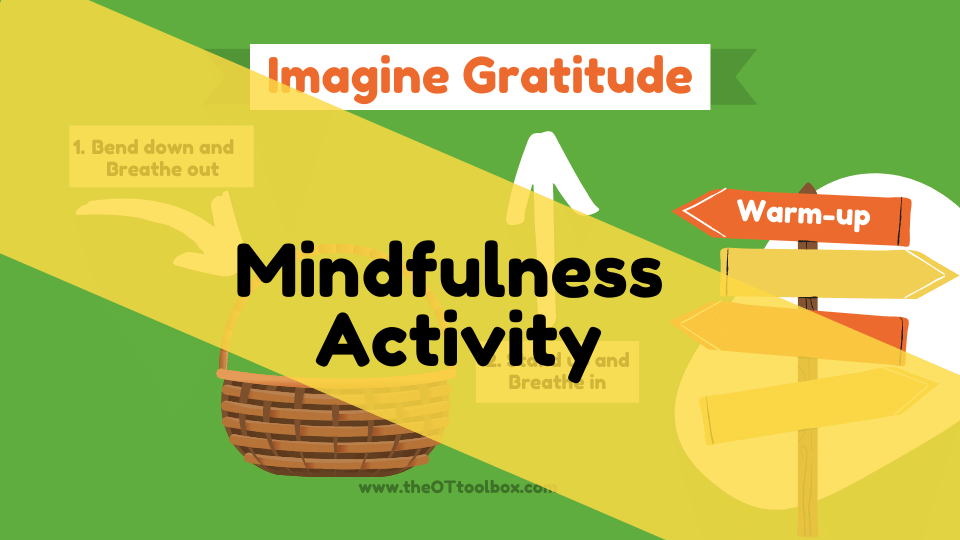
The slide deck includes several activities, one of them being a warm-up activity that encourages mindfulness and deep breathing.
Children can use whole-body movements with big deep breaths in and deep breaths out as they pretend to place imaginary items into a basket. This is a fun way to incorporate deep breathing concepts of mindfulness along with gross motor actions, core strengthening and expanded lung capacity with gratitude as children imagine and think of the things they are thankful for.
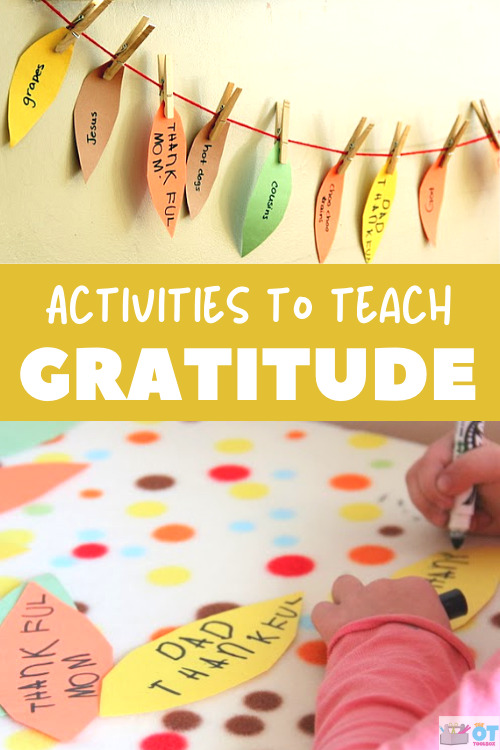
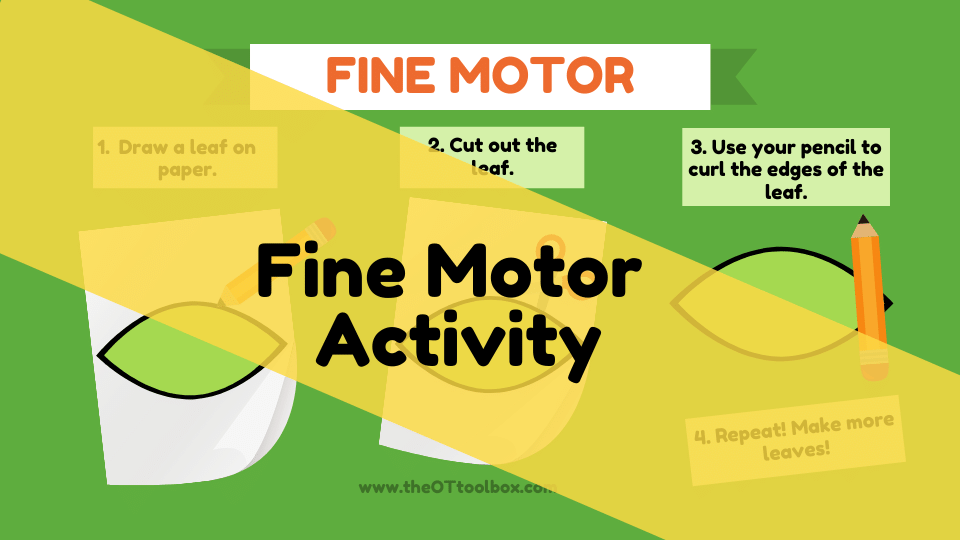
The next slide in this free slide deck asks children to draw and cut out paper leaves. This is a nice teletherapy activity using only paper, a pencil, and scissors.
Children can draw, cut, and then curl the edges of their paper leaves, working on fine motor skills such as hand strength, bilateral coordination, pincer grasp, eye-hand coordination, precision, and visual motor skills, as well.
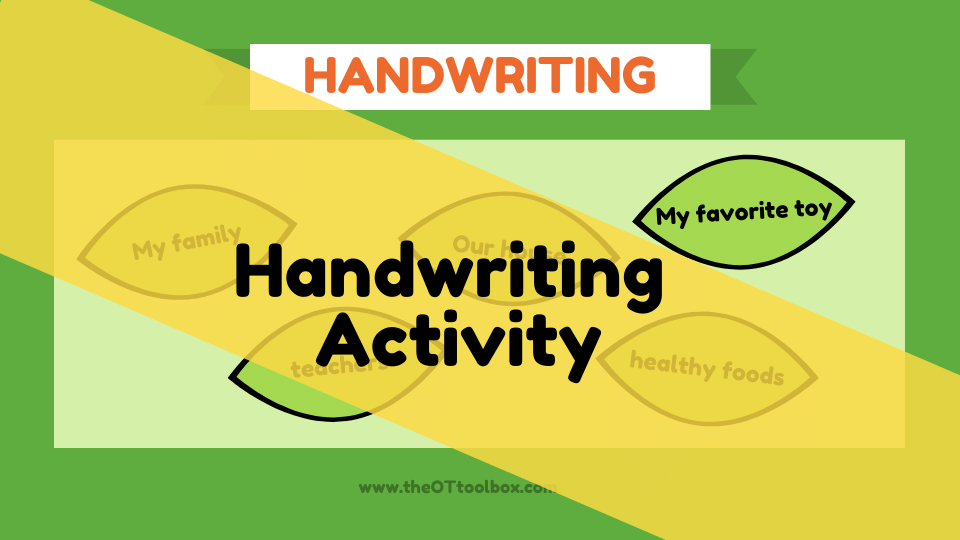
Children can then write out the things, people, and places that they have gratitude for. This action of writing down gratitude can be a way to make concepts real.
Adding in the handwriting piece makes this a great teletherapy activity for occupational therapy sessions.
Teaching Gratitude with Gross Motor
The next part of this free slide deck is a movement scavenger hunt. Children can go through the slides and find people, items, or things that they are thankful for, by moving around their home.
This is also a good way to work on visual perceptual skills such as visual attention, visual discrimination, and visual figure ground skills.
Want to get this free slide deck to teach gratitude?
Enter your email address in the form below and you will get a PDF delivered to your inbox. Click the button and you will be prompted to make a copy onto your Google Drive. Then, use that slide deck to teach gratitude to kids using movement and activities. Have fun!
Colleen Beck, OTR/L has been an occupational therapist since 2000, working in school-based, hand therapy, outpatient peds, EI, and SNF. Colleen created The OT Toolbox to inspire therapists, teachers, and parents with easy and fun tools to help children thrive. Read her story about going from an OT making $3/hour (after paying for kids’ childcare) to a full-time OT resource creator for millions of readers. Want to collaborate? Send an email to contact@theottoolbox.com.
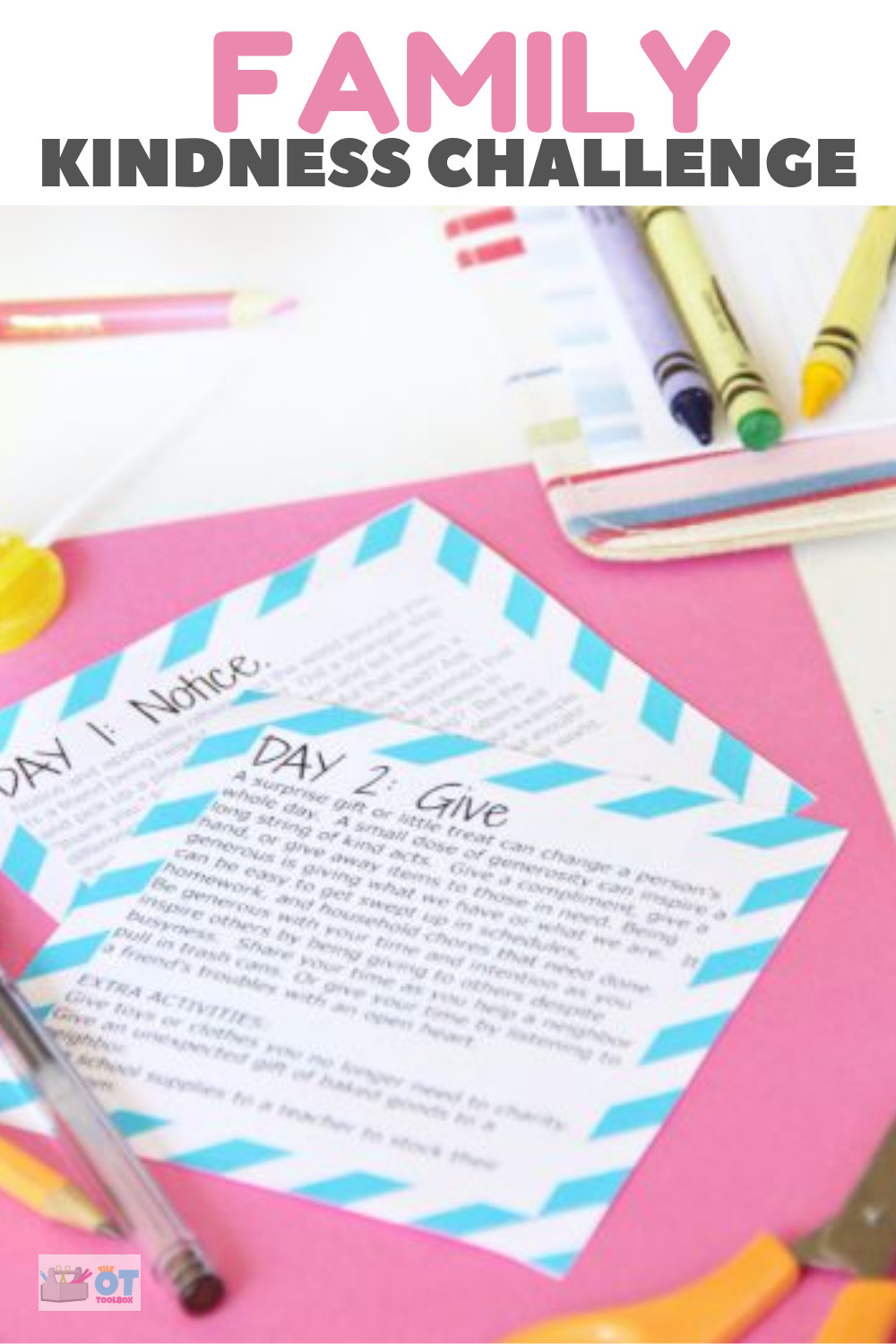
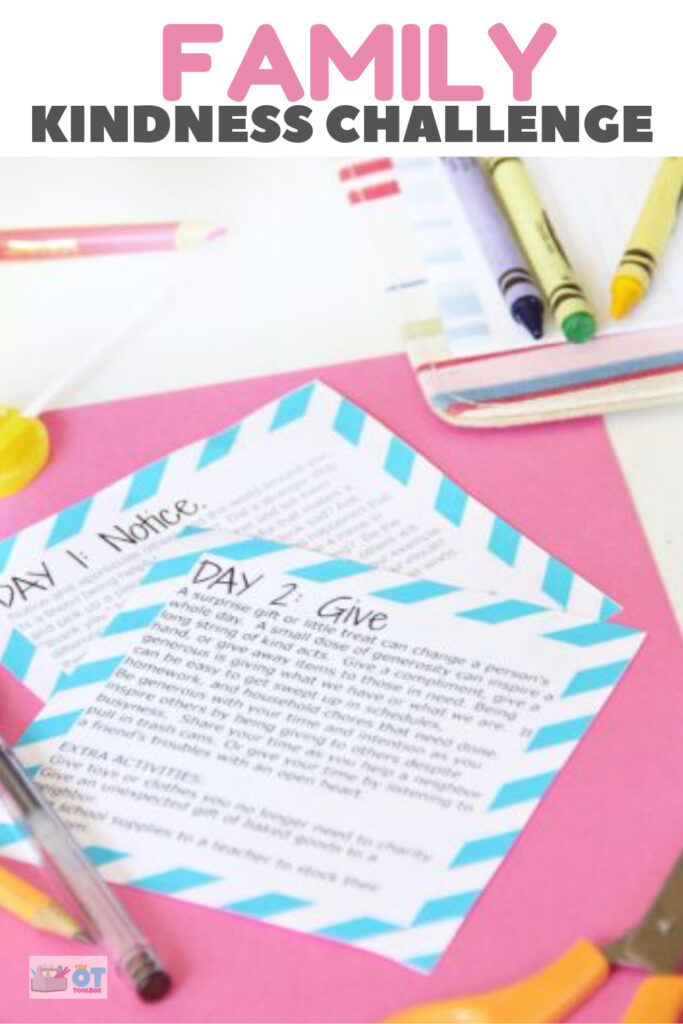
I was reminded that November 11th is World Kindness Day. It seems that the world needs a lot of kindness at the moment! This 7 day kindness challenge is an old family challenge that I had on this website. Today, you’ll find a free family kindness challenge, with free printable challenge cards, and extra kindness ideas and activities that the whole family can use in random acts of kindness. It’s cool to be kind, right? Pass on kindness and challenge the whole family to spread kindness!
Kindness Challenge
Going through the routines and schedules of family, work, school, commitments, family obligations, and all that being part of a family entails…it is exhausting. For families of young children, there might be online learning, middle of the night wake-ups, diapers, sticky fingers, crusty faces, and the general mayhem of family life. For parents of older children, it’s dealing with online learning, technology, and the daily changes of 2020! Motherhood is a beautiful and messy job.
Between all that is happening in the world and life in general, there can be moments of gratitude, empathy, laughter, snuggles and peace. Then there are the big whiffs of baby head and soft skin mixed with love. (Every Mom knows that scent, right??) The good hugely crushes the exhaustion and we keep going.
7 Day Kindness Challenge
When the outside world’s dangers and unpredictability nears the shelter of our homes, we can grow weary just when we need our strength…to smile through the difficulties. It is SO good to hear of positive work being done in the world. There are people who strive for kindness, bravely inspiring grace in the world. Our kids’ world needs the good.
We’ve got something very exciting to share today. Going on the theme of being the good in the world and inspiring others with kindness and graciousness, we’ve got a challenge for you. A challenge for your family. Make that a Challenge. (Capitalized makes it sound more “official”, right??) This is a Challenge for your family to take part in over 7 days, with kid-friendly kind acts and activities that will inspire good in you and good in others. Gratitude, joy, giving, kindness, awareness, patience, and a positive outlook can inspire others to be the good too. This is a short and easy challenge. One week of ideas that can be fit into your family’s schedules and needs. Get ready to inspire and be inspired.
But first, you’ll want to hear how we were inspired to inspire others!
To believe there is good in the world is to have ownership in that thought process and to be a part of the good. That’s what this family kindness challenge is all about. This is a challenge for your family, for kids, and for you to make a difference in small and meaningful ways, over a week’s time. This is one week challenge (because let’s face it, any longer than a week is a lot of commitment when it comes to family time and kids needs. Sometimes a commitment of 10 minutes is a lot to ask!)
The 7 Day Family Kindness Challenge
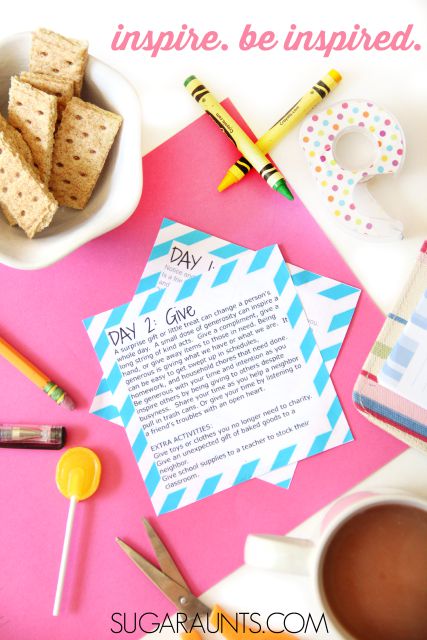
This challenge is simple. Gather your family and get ready to inspire and be inspired. Get ready to be the change and inspire the change in this world! Each day, you’ll open an envelope together as a family and inspire. Inspire each other, inspire others, and inspire yourself with good. Your week of challenges will be a time of growth and intention for your family. The great thing about growth is that growth doesn’t stop. Whether we’re talking about children or weeds, growing doesn’t end. And adults don’t stop growing either! This challenge is about being brave, being inspirational, and being full of intentional growth. Get ready to have fun, too!
First, print out the sheet above.
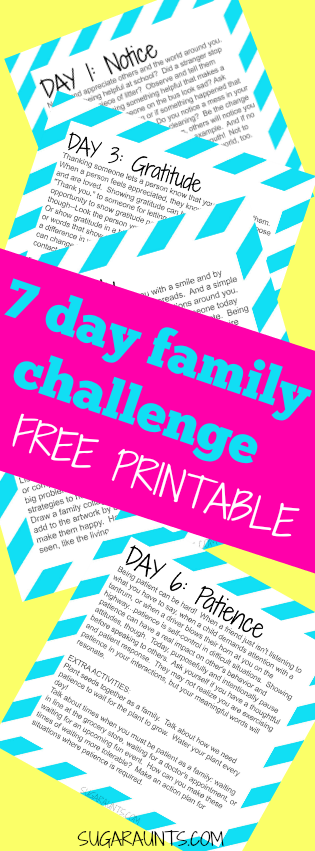
Next, get your printable challenge cards (above). You can find and print off this sheet for free, along with the other cards needed for this free 7 day challenge. Grab those at the bottom of this blog post.
Cut along the black lines and fold each section into a long rectangle. Place these, along with the printable daily instruction cards into an envelope. Each day, gather as a family and read through the cards. Be sure to allow time to do each day’s activities. This doesn’t have to be a stressful–allow time to fill these activities into your schedule. Remember that passing along positive changes to others is intentional and brave. You are the change and it is starting with your family!
Print off this challenge card and all of the others in the 7 Day Family Challenge by entering your email HERE. You will be directed to your free printable. OR just read from the info below 🙂
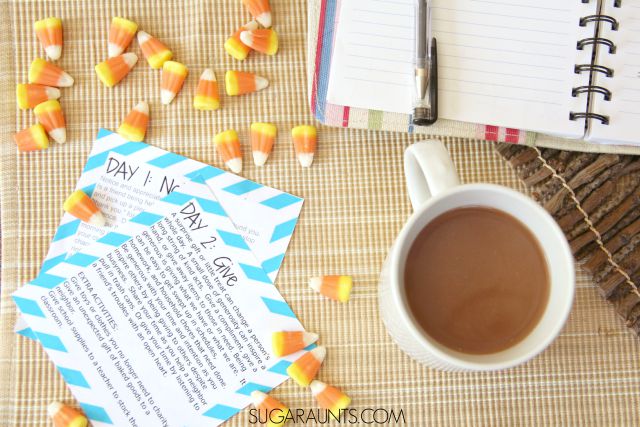
Kindness ChallengeDAY 1: Notice.
Notice and appreciate others and the world around you. Is a friend being helpful at school? Did a stranger stop and pick up a piece of litter? Observe and tell them “thank you.” for doing something helpful that makes a difference. Does someone on the bus look sad? Ask them how they are feeling or if something happened that morning to make them sad. Do you notice a mess in your classroom or house that needs cleaning? Be the change and go beyond the expected. Soon, others will notice you being the change and will follow your example. And if no one notices your attempts? Open your mouth! Not to brag, but rather, invite others to notice their world, too.
Extra Kindness Activities:
Make a card for someone you notice having a bad day.
Create a care package for a sick friend or neighbor.
Help a stranger by holding a door.
Kindness Challenge DAY 2: Give.
A surprise gift or little treat can change a person’s whole day. A small dose of generosity can inspire a long string of kind acts. Give a compliment, give a hand, or give away items to those in need. Being generous is giving what we have or what we are. It can be easy to get swept up in schedules, homework, and household chores that need done. Be generous with your time and intention as you inspire others by being giving to others despite busyness. Share your time as you help a neighbor pull in trash cans. Or give your time by listening to a friend’s troubles with an open heart.
Extra Kindness Activities:
Give toys or clothes you no longer need to charity.
Give an unexpected gift of baked goods to a neighbor.
Give school supplies to a teacher to stock their classroom.
We made candy jars and gifted them to neighbors and teachers.
Kindness Challenge DAY 3: Gratitude.
Thanking someone lets a person know that you appreciate them. When a person feels appreciated, they know they have a purpose and are loved. Showing gratitude can be as simple as saying “Thank you.” to someone for letting you go first. Don’t let an opportunity to show gratitude pass by without being a change, though–Look the person you are thanking in the eye and smile! Or show gratitude in a bigger way by writing a card with a drawing or words that show your appreciation. Tell them that they’ve made a difference in your life. Leaving a positive imprint on someone can change the whole course of their day and those they come in contact with. EXTRA
Extra Kindness Activities:
Thank your postal worker for their hard work. Give them a glass of water or a snack.
Thank your teacher. They work hard and many days, get little appreciation. Thank them with a jar of candy or a small gift along with a word of thanks.
Start a Gratitude Journal. Each night before bed, write down a few things that you are thankful for. This could be done as a family or individually.
Kindness Challenge DAY 4: Positivity.
Plant positivity in the lives of those around you with a smile and by going the extra mile. A small dose of positivity spreads. And a simple thing like a smile can inspire a wildfire of positive actions around you. Smile as you hold a door for someone. Compliment someone today with genuine words and leave conversations on a positive note. Being positive requires bravery. Choose to make a difference and inspire another person’s positive attitude as you hold open every door you come across today. Smile at and greet people as they come through.
Extra Kindness Activities:
As you sit down to dinner, go around the table and name 3 positive things that happened for each person that day. Discuss accomplishments and how you can help others in your family accomplish their goals.
Listen to a friend with a positive attitude. If you notice negative words or complaining, turn it around with optimism. Help your friend turn a big problem into a series of smaller, accomplish goals by writing down strategies to help.
Draw a family collage of happy thoughts. Each family member can add to the artwork by drawing pictures and writing down things that make them happy. Hang the collage art in a place that is always seen, like the living room wall. You can even frame it!
Kindness Challenge DAY 5: Kindness.
Small and random acts of kindness can change a person’s whole day. It is easy to do a kind act or say kind words to others in a way that will allow them to grow and spread kindness. It can be as simple as showing kindness to creatures by feeding the birds in your neighborhood or sharing bubbles with children at the park. You can do many acts of kindness together as a family.
Extra Kindness Activities:
Deliver flowers to a neighbor you don’t know that well.
Donate books to the library.
Write kind notes for siblings.
Kindness Challenge DAY 6: Patience.
Being patient can be hard! When a friend just isn’t listening to what you have to say, when a child demands attention with a tantrum, or when a driver blows their horn at you on the highway…patience is self-control in difficult situations. Showing patience can have a real impact on other’s behavior and attitudes, though. Today, purposefully and intentionally pause before speaking to others. Ask yourself if you have a thoughtful and patient response. They may not realize you are exercising patience in your interactions, but your meaningful words will resonate.
Extra Kindness Activities:
Plant seeds together as a family. Talk about how we need patience to wait for the plant to grow. Water your plant every day!
Talk about times when you must be patient as a family: waiting in line at the grocery store, waiting for a doctor’s appointment, or waiting for an upcoming fun event. How can you make these times of waiting more tolerable? Make an action plan for situations where patience is required.
Kindness Challenge DAY 7: Joy.
The best thing about this 7 day Family Challenge is that doing and being aware, giving, gracious, positive, kind, and patient will lend itself to joy. You will see joy in others around you and in yourself as you make and are the change in others. By helping and doing kind acts for others, you will find that joy doesn’t come from what you own. It is helping others. Showing gratitude for blessings and blessing others is joy. Your challenge for today is to show joy just by being you. Be brave and intentionally spread joy through kindness. How can you extend this seven day challenge to additional days in small and meaningful ways?
Extra Kindness Activities:
Turn someone’s negative outlook into joy with a kind word, a small gift and word of thanks, or patience.
Create Joy Art: Use watercolors, paints, and markers to create a work of art depicting joy. What means joy to you? Talk with your family about what Joy means to each family member and how possessions are not real sources of joy.
I recently saw a quote that really inspired me.
“Nearly every moment of every day, we have the opportunity to give something to someone else- our time, our love, our resources. I have always found more joy in giving when I did not expect anything in return.”-S. Truett Cathy
Get all of the challenge cards for free to print off and challenge your family again and again in these inspiring and brave ways.
Be intentional and be remarkable! Lick here to GET YOUR PRINTABLE 7 DAY CHALLENGE CARDS by entering your email. You’ll be added to our newsletter mailing list and will receive occasional emails from us with our latest blog posts.
Colleen Beck, OTR/L has been an occupational therapist since 2000, working in school-based, hand therapy, outpatient peds, EI, and SNF. Colleen created The OT Toolbox to inspire therapists, teachers, and parents with easy and fun tools to help children thrive. Read her story about going from an OT making $3/hour (after paying for kids’ childcare) to a full-time OT resource creator for millions of readers. Want to collaborate? Send an email to contact@theottoolbox.com.
Visual deficits and occupational therapy interventions go hand in hand. And, the connection between vision problems or attention issues impacts children when it comes to ADD and ADHD. In fact, the connection between visual deficits and attention is especially a factor in OT treatment. Trouble paying attention, difficulty with reading, finishing work on time and staying on task can be signs of both attention issues or a vision issue. So, how do you tell the difference, and what do you do about it? Knowing if a visual impairment is present can mean the difference between accommodating for vision difficulties and a different diagnosis, such as attention deficit disorder.
Vision or Attention Deficit Disorder
Children with vision deficits work twice as hard, and use more “brain” power to make their eyes work correctly as compared to peers without vision deficits.
Children with vision deficits may also experience fatigue more quickly, have frequent headaches, or blurry vision.
When they begin to experience the above symptoms, it is easier for the child to look away, leading them to appear to be “staring off into space” or lose focus. These behaviors are often mistaken for ADD in the classroom setting. Vision deficits that may be behind these symptoms and actions include:
Like kids with ADD, kids with vision deficits often appear to have poor social skills. Behaviors include a lack of response to their name, missing social cues or facial expressions, and not attending to others in the room.
This apparent “lack” of social skills is also related to how hard they are working on using their eyes. When this happens, the level of executive function left for other tasks significantly decreases.
This may also make the child appear “scatter brained” or disorganized.
Attention Deficit Disorder Symptoms
Vision concerns outside of acuity are FREQUENTLY missed due to limited vision screening protocols and the desire to quickly remediate behavior.
In addition to limited vision screening, vision deficits are not widely recognized as a potential reason for distracted or inattentive behavior.
Attention issues and vision Problems
If you have concerns, or concerns have been brought to your attention, regarding your child and ADD, rule out vision deficits first. A trip to a developmental ophthalmologist may help better explain your child’s behavior concerns and provide them the help they truly need.
WHAT IF YOU SUSPECT VISION PROBLEMS?
Now what? When vision problems are suspected after a screening by the OT, it is best practice to refer the family to a developmental optometrist.
A developmental optometrist will complete a full evaluation and determine the need for corrective lenses, vision therapy or a home program to address vision concerns.
As occupational therapists, it is imperative that we rule out vision problems before treating handwriting or delays in visual motor integration, to ensure the best possible trajectory of development and success for the child.
OCCUPATIONAL THERAPY VISION SCREENING TOOL
Occupational Therapists screen for visual problems in order to determine how they may impact functional tasks. Our newest Visual Screening Tool is a useful resource or identifying visual impairments. Visual screening can occur in the classroom setting, in inpatient settings, in outpatient therapy, and in early intervention or home care.
This visual screening tool was created by an occupational therapist and provides information on visual terms, frequently asked questions regarding visual problems, a variety of visual screening techniques, and other tools that therapists will find valuable in visual screenings.
This is a digital file. Upon purchase, you will be able to print the 10 page file and print off to use over and over again in vision screenings and in educating therapists, teachers, parents, and other child advocates or caregivers.
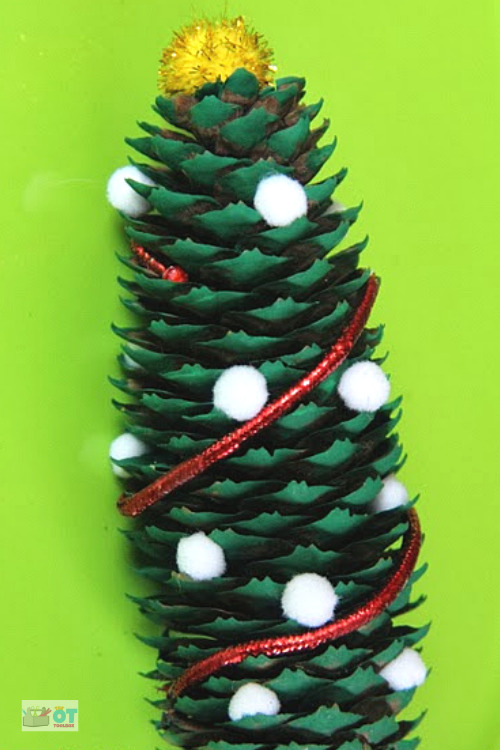
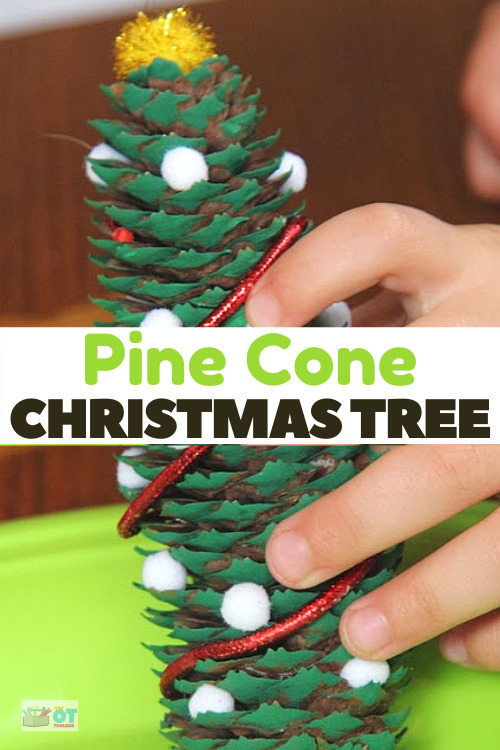
Today, I have a pine cone Christmas tree that was a big hit with my kids, but also a fine motor powerhouse. The pinecone ornament was a fun way to craft but the miniature Christmas tree craft helps kids with precision, pincer grasp, in-hand manipulation, and more. We made this Pine Cone Christmas Tree years ago, but it’s still a favorite ornament my kids love to pull out each year and hang on the tree!
Here are more Christmas crafts that help kids build fine motor skills.
Pine Cone Christmas Tree Ornament
We love to take hikes in the neighborhood and woods to collect pine cones and always have a few around that are ready for fun projects and crafts. Our pine cone Christmas Tree was fun for painting and even fine motor skills. Pressing all of the little pieces into the pine cone was a great way to work the small muscles of the kid’s hands during a Christmas craft! Our little pine cone Christmas tree is nestled in the branches of our tree looking pretty cute!
Check out these Christmas Fine Motor Activities for more creative ways to work on fine motor skills and address development of skills this Christmas season.
Pine
Pine Cone Christmas craft
Note: This post contains affiliate links.
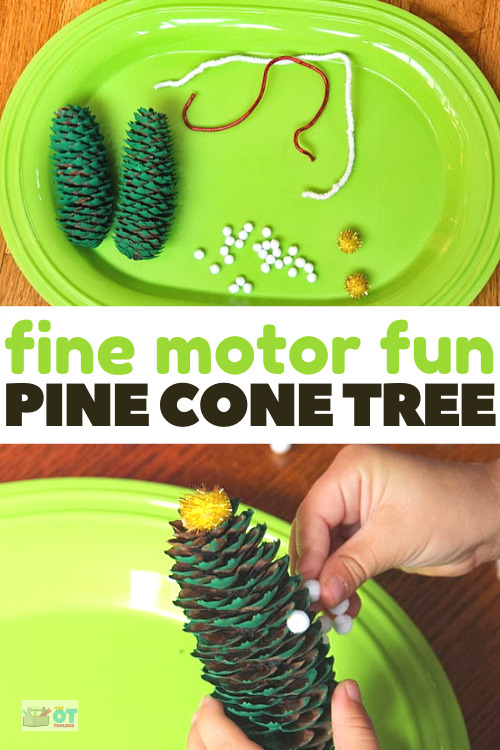
We started with some pine cones that we painted a nice green color. You might have seen the action on our Instagram feed. Once our pine cones were dry, we started decorating. For this craft, we used a little red cord and crafting pom poms in different sizes.
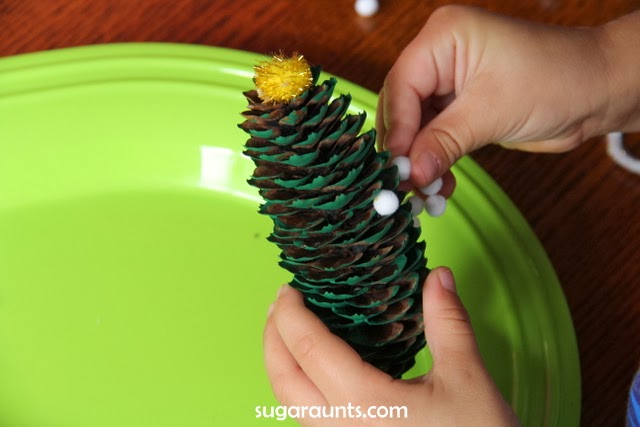
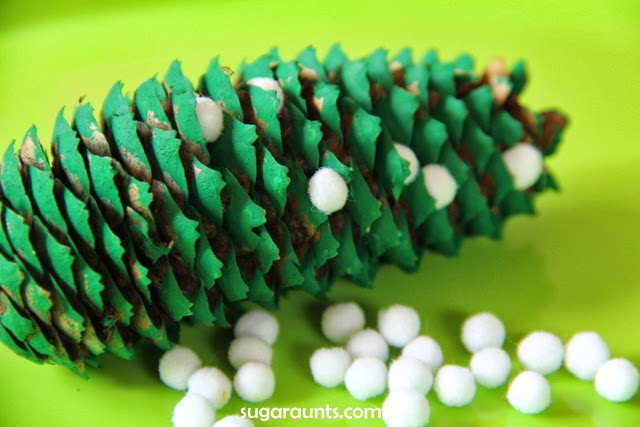
The decorating part was great for fine motor work. We used a little glue to glue on the yellow pom pom to the top of the pine cone tree. Little Guy liked pushing the small pom poms into the pine cone. We didn’t need any glue to make them stick…just a little finger muscle! Pushing those little pom poms into the pine cone was a great way to work on tripod grasp while holding the pom poms and making them stick in the pine cone.
We loaded that pine cone up with little white pom poms!
To finish the decorations, all we needed was a little of the red cord to make it all come together! We didn’t use glue for the cord either. Just winding it around the pine cone was enough to make it stick and stay in place. This was another fine motor dexterity task for Little Guy. He was pretty pleased with the way his pine cone turned out!
Colleen Beck, OTR/L has been an occupational therapist since 2000, working in school-based, hand therapy, outpatient peds, EI, and SNF. Colleen created The OT Toolbox to inspire therapists, teachers, and parents with easy and fun tools to help children thrive. Read her story about going from an OT making $3/hour (after paying for kids’ childcare) to a full-time OT resource creator for millions of readers. Want to collaborate? Send an email to contact@theottoolbox.com.