Bilateral Integration

bilateral integration

Bilateral Integration is an area that kids need for so many tasks…but it’s not a developmental milestone that stands out unless a problem is necessarily noticed unless there is a problem. What we do notice in as our kids grow and develop are the motor skills that impact functioning. We notice use of both hands, fluid and efficient movements in tasks like playing, getting dressed, and interacting with peers. Let’s take a look at bilateral integration and dissect how to support this essential sensory motor skill.

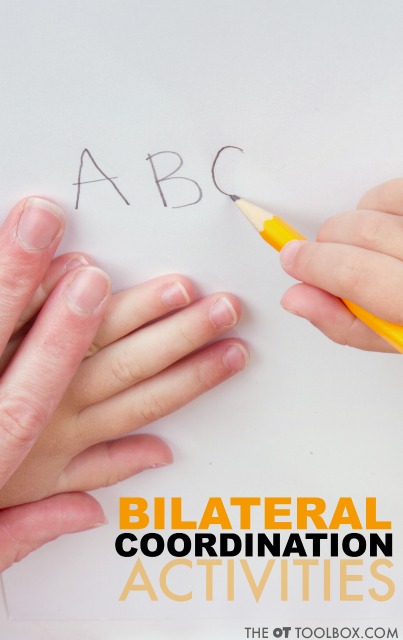
Another resource that supports this information is our blog post on bilateral coordination. You’ll find many bilateral integration activities in that blog post.

Bilateral integration resources and information

Bilateral Integration

From writing and holding the paper, to holding a art project and cutting with scissors, to zippering a jacket, coordinating both sides of the body in an efficient manner is a skill that is necessary for almost everything we do.

Bilateral coordination develops from a very young age. When babies begin to bring both hands together at their mouth, you are seeing coordinated efforts begin. When the infant pushes up on both arms while lying in a tummy time position, the integrated movements of both hands and legs occurs along with strength and control.

Research tells us that motor tasks like jumping, jumping jacks, riding a bike, hopping, etc. become easier and more fluid with age as children develop. It’s through play, sensory input, motor skill experience, and activities that these skills are developed.

Below, you will find bilateral integration activities that can be incorporated at various ages. Use these bilateral coordination activities to promote coordinated and efficient movements in meaningful activities.

What is Bilateral integration?

Bilateral integration refers to the ability of both sides of the brain to work together in a coordinated manner. We see this ability when the skills associated with the left side of the brain are done in conjunction with skills associated with the right side of the brain.

Skills associated with the left side of the brain:

  • Speech and language- Understanding using language (listening, reading, speaking and writing)
  • Comprehension
  • Math problems and facts
  • Handwriting
  • Linear thinking
  • Memory for spoken and written messages
  • Logic
  • Verbal language
  • Sequencing

Skills associated with the right side of the brain:

  • Creativity and imagination
  • Creative thinking
  • Spatial skills
  • Intuition
  • Art, drawing, and creative artistic skills
  • Musical skills

Then, when other aspects of functional performance are added to the mix and the individual is still able to complete the task, this is bilateral integration in action.

Those other considerations include:

  • Attention and focus
  • Proprioceptive input
  • Vestibular input
  • Visual information
  • Motor targets achieved, or motor control shown by fluid movements
  • Praxis- movements thought about and completed in coordinated manner

When both sides of the body work together in a coordinated manner so that the individual can manipulate objects such as cutlery with various amounts of force modulation, taking in sensory stimuli such as sights, sounds, tastes, and proprioceptive and vestibular input, and managing posture, coordination, and body awareness, bilateral integration is visible.

When bilateral coordination or bilateral integration is intact and progressing appropriately through development, it is an indicator that both sides of the brain are communicating effectively and sharing information during functional tasks. 

Tasks that require bilateral integration

Knowing what we covered above, it is easy to see how some daily tasks are impacted by coordinated and integrated motor skills requiring both sides of the body. Each of these skills requires and has input from other sensory systems and cognitive systems as well, such as proprioceptive input, executive functioning, attention, and even creative thinking and problem solving.

  • Writing and holding the paper in a stable position
  • Cutting and holding the paper steady and at an appropriate height
  • Putting on a coat while holding a backpack (or other item)
  • Tying shoes
  • Pulling up pants and not losing balance
  • Putting socks on
  • Jumping jacks with coordinated movements
  • Turning a page and writing or copying work
  • Typing
  • Squeezing toothpaste and brushing teeth
  • Flossing teeth
  • Playing an instrument
  • Using a knife and fork
  • Pouring water from a pitcher into a cup
  • Cooking skills: chopping, cutting, slicing, peeling, taking food out of packages, putting food into the microwave or stove, taking food out of the fridge
  • Reaching for objects
  • Stabilizing an object with one hand while manipulating another object with the other
  • Jumping rope
  • Catching a ball
  • Riding a bike
  • Swimming
  • Many more tasks!
These bilateral integration activities are creative ways to help kids with bilateral integration needed for fine motor tasks like handwriting, scissor use, and other functional skills.

Bilateral Integration Activities 

Amazon affiliate links are included in this post.

First, let’s talk about some ways that coordinated use of the arms and legs are needed for coordinated movements. These are skills and tasks that can easily be performed by some children. Others, who struggle with motor planning, core strength, posture needs, left-right discrimination, visual motor skills, or many other areas can struggle. It’s easy to see that simply addressing some areas won’t fix the issue when an underlying concern is present.

To promote the skills needed for these tasks, try some of the activities listed below to promote bilateral integration:

Related Read: Here are are some additional bilateral coordination activities with a winter theme.

Bilateral Integration Activities for Babies

Bilateral movements are part of everyday life for baby! From turning, creeping on the floor, rolling, sitting, crawling, cruising on furniture, and taking first steps, babies are developing bilateral integration skills from birth.

Read here about the types of crawling, all of which integrate bilateral coordination and motor planning.

Encourage these bilateral integration activities with babies:

There are ways to support child development at this stage through age-appropriate play that will support the child’s progression at later stages, too.

  • Provide various toys and objects appropriate for young babies. Include bold colored objects including black, white, and red items or contrasting colors, toys, or pictures on a blanket or play mat during tummy time. This black and white board book (affiliate link) can be propped up or used while on an adult’s lap.
  • Provide gentle infant massage during and after bath time, and on all extremities. Here is a resource book on infant massage. (affiliate link)
  • Provide toys and age-appropriate objects for reach and grasp. This banana toothbrush teether (affiliate link) has molded handles that make it a great teething item for little ones.
  • Provide teething toys as baby brings hands together at their mouth.
  • Provide toys that are appropriate for mouthing that can be held in both hands.
  • Provide hand-held toys while the child is seated in a high chair. This one (affiliate link) has a suction cup base to keep it stable, but has a black and white ring at the base that babies can grasp with one hand while manipulating with the other hand.
  • Provide toys of various weights when seated upright to provide resistance against gravity and to promote strengthening of the upper extremities. Blocks, rings, sorting toys, or something like this quality teething toy (affiliate link) made of heavier materials can be useful to provide variances in weight, while still allowing the baby to manipulate the item.
  • Provide toys available on a high chair or table surface at various distances to provide opportunities for depth of perception when reaching for toys and bringing them to the mouth.
  • Continue tummy time while playing in prone to promote strength and stability in upper extremities.
  • Use the ideas in our baby play library for more ideas.

Bilateral Integration Activities for Toddlers

Provide toys requiring one hand to stabilize a base while the other hands manipulates an object. Shape sorters are great for this.

Other toys include:

  • Peg Boards (affiliate link)
  • Blocks- These press and stay sensory blocks are perfect for encouraging one hand to use as a stabilizer and one hand as a
  • Play Dough
  • Drawing/coloring- Here is more information on the benefits of coloring.
  • Use these crayons for toddlers to support bilateral coordination skills during coloring.

Bilateral Integration Activities for Preschool

Preschool is a time for building hand strength, coordination, eye-hand coordination, and improving motor skills needed for the upcoming years. You can find many preschool activities here on our website, but some specific ways to support bilateral integration include:

  • Encourage kids to participate in cooking activities.
  • Use play dough to cut with scissors and roll out play dough snakes or balls of play dough.
  • Age-appropriate crafts and craft sets are great for this age.
  • Play with stickers of various sizes.
  • Make “snow angels” on a carpet or fluffy blanket
  • Simon Says is a great game for encouraging novel and varied motor combinations. Use these Simon Says Commands to get started.
  • Play various song and movement games such as the Hokey Pokey, Farmer in the Dell, etc. Here are movement and song activities that can be used in circle time, warm-ups, centers, or in group activities. All of these move and dance songs promote core strength and stability.
  • Climb on outdoor play areas at playgrounds and in low trees.
  • Add sensory! Try this table top bilateral coordination activity to draw shapes.
  • Draw with both hands! This four leaf clover activity is a powerful one as it covers a variety of skills.

Bilateral Coordination Activities for School-Aged Kids

In schools, development of bilateral integration is important for tasks like putting on a coat or jacket and backpack, holding a paper with the supporting hand and writing, and using scissors. There are many other bilateral integration tasks that happen throughout the day.

Some ways you can support development of these skills include:

Try these bilateral integration activities and coordination ideas to promote use of both hands together in activities such as handwriting, cutting with scissors and so many other tasks!

Last thoughts on encouraging bilateral integration

The best way to encourage and promote integration of both sides of the body? Movement and play! Get the kids active, moving, and experiencing various planes against resistance and with exposure to all types of sensory experiences.

The combination of proprioceptive input into a play experience that promotes strengthening in a fun way provides all of the benefits kids need to improve bilateral coordination skills. Add personal interests as the child grows. And finally, have fun!

Use these bilateral coordination activities to promote bilateral integration needed for skills like writing and holding the paper and any activity that uses one hand to manipulate an object while stabilizing with the other hand.

Feeding Developmental Milestones

feeding developmental milestones

Below, you will find resources on feeding developmental milestones and information on development of bilateral coordination that are needed for the feeding skills to use both hands together in a coordinated manner. These bilateral coordination milestones are needed for independent feeding skills, so let’s break this down.

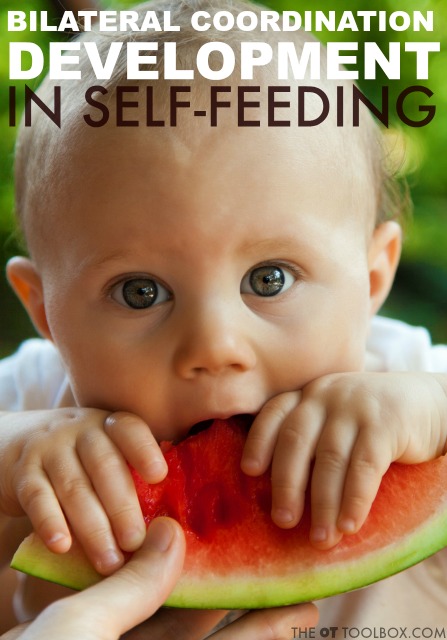
Development of bilateral coordination skills is necessary for improved self-feeding in toddlers and improves through the childhood years. Independence with feeding skills is an important part of child development!

Feeding developmental milestones in kids

Bilateral Coordination Development

When we talk about bilateral coordination development, we can also mean bilateral integration. Typically, bilateral coordination skills refer to the physical sensory motor use of both sides of the body in a coordinated and fluid manner.

However, bilateral coordination requires the overarching bilateral integration of the brain hemispheres and takes into consideration the ability to manage all of the functions listed above.

In fact, there are three components of bilateral coordination and these play a role in feeding developmental milestones:

  • Symmetrical movements- picking up a bottle with both hands to drink
  • Reciprocal movements- Using one hand to pick up food and another to pick up food the next time; we see this with babies and toddlers especially
  • Dominant hand/supporting hand movements- Using a knife to stabilize the food and the knife to stab the food. Or, holding a bowl with the supporting hand and the dominant hand to scoop the food from a bowl

Independence with feeding progresses from symmetrical movements to reciprocal movements, to dominant/supporting hand movements.

One way to really take a look at the developmental progress of bilateral coordination skills is through the functional task of feeding using cutlery, or utensils like spoons, forks, and knives and drinking tools: cups, bottles, etc.

When children learn to feed themselves and become more independent with self-feeding tool use with finger foods, utensils, or cups, development of bilateral coordination is one aspect that is necessary.

When we think about self-feeding, problems can arise based on a variety of areas. Upper extremity coordination is one of those aspects that are evaluated and addressed when self-feeding difficulties are present.

When thinking about development of self-feeding, consider the following issues related to bilateral coordination difficulty and try using some of the bilateral coordination activities based on development of bilateral coordination to improve feeding skills.

Related: For several ideas to support bilateral coordination skills while indoors, try our list of Winter Bilateral Coordination Activities that kids will love!

Discover typical development of bilateral coordination in feeding skills in kids, which are needed for improved independence in self-feeding.

Bilateral Coordination Milestones

Bilateral coordination development begins prior to birth, while in the womb with the physical movements felt by the mother. From there and immediately after birth, bilateral coordination milestones are achieved.

Amazon affiliate links are included in this post.

feeding developmental milestones

Development of bilateral coordination in self-feeding depends greatly on the child’s developmental level. Below, we’ll go through feeding milestones by age.

Development of feeding skills is just one skill that is a great way to to assess and analyze the development of bilateral coordination. Also, development of fine motor skills and visual motor skills have an impact on coordination of the hands in self-feeding.

In one blog post, we covered the skills needed for independence with functional tools, including holding a spoon, scooping with spoons, using forks, and other tools like toothbrushes, hair brushes, etc. That is a good place to start with understanding all of the other areas of development that go into tasks like feeding.

Throughout these ages, oral motor development plays a significant role in the manipulation of foods. Consider how these aspects of oral motor skills impact the developmental progression of feeding skills:

  • Rooting
  • Sucking
  • Swallowing
  • Gag reflex
  • Tongue movement
  • Jaw thrust
  • Jaw movements (moving jaw side to side to move food and movement of foods)
  • Lip closure during swallow phase of eating and drinking
  • Biting into foods
  • Tolerating different solid food and liquid consistencies

Development of bilateral coordination occurs at every stage of childhood and can be observed through feeding abilities.

Newborn Feeding Skills

At the newborn stage, primitive reflexes dominate movements. In particular the rooting reflex supports feeding at this age.

Babies aged 0-3 months will root, suckle, and swallow in feeding activities. This stage progresses as vision and motor control develop.

Related to this stage is our resource on the strategies occupational therapists can address when newborns are not sleeping through the night, as sleep impacts routine and feeding schedules.

Feeding milestones 4-6 months

In this stage, development of coordination between the eyes and motor skills are just developing. The child explores with their eyes, hands, and mouth and will start to reach for objects purposely around four months. Accuracy of hand use is limited.

Babies can be observed using both hands in play as they pick up objects in their line of sight. However, they typically will pick up items with the hand that is closest to the object or toy. 

During this phase, the baby is spoon fed and when presented with a spoon, makes a suckling movement with lips and mouth. The baby will show a gag reflex at this age. With foods on a spoon, the baby will thrust their tongue out at the presence of foods and push the spoon away at times.

Look for munching of the jaw, or movements in the jaw indicating a chewing pattern, even though the young child can not chew at this stage.

Feeding Skills at 6-9 Months

At this stage, the child is typically sitting up with or without support. The child’s hands are often times used in grasp with a clenched or a fist-like grasp.

The child will begin to separate the thumb from the rest of the fingers to use a gross grasp on objects. Babies at this stage will typically place everything in their mouth, using both hands together in symmetry.

The child will hold a bottle or cup with assistance, placing both hands on the cup/bottle, but are not able to hold the cup or bottle on their own.

The gag reflex is still present but it is less sensitive to foods and utensils.

The baby has a voluntary bite on soft foods, chew cookies, and baby teething foods. They will begin to hold those items independently using both hands together at their mouth.

You will see a raking motion from the fingers, but this movement is typically not successful in picking up small foods like baby puff snacks. the baby can , however begin to pick up small food pieces using the thumb and the side of the pointer finger to grasp items (not a pincer grasp)

Feeding Skills at 9-12 Months

The child is able to sit upright without support and develops proximal stability, allowing for increased development of distal extremities.

In this stage, babies are developing pincer grasp and thumb and finger opposition skills. This stage brings the ability to hold one object in each hand such as two blocks.

The baby will be able to bring both hands together at the same time. Children will be able to begin finger feeding skills around 9 months as they bring dry cereal foods to their mouth with a scraping motion.

Finger isolation on both hands begins as they poke foods and explore textures with their hands. Children will use both hands to smear food and bring soft foods such as wet foods like a cereal mix or applesauce to their mouth. The child will be able to hold a cup with both hands and bring it to their mouth.

This stage is when we begin to see functional performance related to arch development. As refined motor skills continue, this base will continue to include utensil use.

The child will start to hold a fork and spoon with a gross grasp, or a palmer grasp but without a dominant arm. At this stage, grasp of the spoon occurs with a palmer grasp. The child will not hold the bowl or plate with their non-assisting hand.

You may see the baby begin to take longer sips from a straw while managing the liquid in their mouth to show a true drink. Similarly, with cup use, there is more drinking patterns as a result of the increased jaw control. However, at this age, these drinking skills are with an adult present to hold and remove the cup or straw. The bilateral coordination skills are not present in order to engage the hands either symmetrical coordination or as a dominant hand/supporting hand along with the drinking aspect.

You will start to see more controlled use of the thumb and pointer finger in a true pincer grasp to pick up foods. This occurs between the tip of the thumb and the pointer fingers. The baby at this age can finger feed themselves.

Feeding Skills at 12-15 Months

In this stage, the child begins to dip their spoon into foods. They will have more accuracy with dipping as opposed to scooping foods.

The spoon is held with a digital grasp and the child will likely switch hands while holding the spoon. The child will lift and drink from a cup with one hand.

As toddlers progress in development, they will begin to establish a dominant hand and crossing midline. This ability to utilize a dominant hand and a non-dominant hand in activities indicates a maturation of the brain and lateralization in functional tasks, which is very important for motor planning, directionality, and visual motor skills

A scooper bowl with suction base (affiliate link) can be  help with scooping development and bilateral coordination at this stage.

The child at this age can hold a spoon with a gross grasp or palmer grasp with an inverted wrist. They will dip the spoon in food. The spoon will make it back to the mouth, but typically, the spoon is only touched to the lips. They will not likely remove all of the food from the spoon using their lips at this point. The motion of the spoon is entirely with the shoulder and elbow. The wrist is in one position so that the spoon is dipped into the food upside down. You’ll see increased shoulder abduction in order to get the spoon into the food. The spoon may be upside down in their mouth too.

Read more in a related blog post about how to hold a spoon.

Feeding Skills at 15-18 Months

The child is able to support the bowl with one hand while scooping with a spoon. Children can hold a small cup and pick out pieces of dry cereal or snacks.

Fine motor skills are developing quickly.

Drinking from a cup can move from a sippy cup to a spouted cup. Other young toddlers can drink from a straw. Holding the cup moves from a two handed grasp to a single grasp. You’ll see grasp on the handle of a sippy cup or spouted cup begins to move from a gross grasp to a pincer grasp. This grasp pattern development occurs in this later stage of toddler range because of the weight of the cup/drink.

By the end of this age range, the 18 month child can hold an open cup on their own to pick up, drink, and set the cup back down with just some spilling of the liquid.

Feeding Skills at 18-24 Months

As a child gets closer to two years of age, the variety of foods increases and this allows for greater exposure to textures of foods (mushy, crunchy, etc.) and types of foods (liquids, solid foods, mixed consistency foods).

The child will typically be able to drink from a cup with accuracy and with one hand but with more accuracy and precision. As the child moves toward two years, you can see a desire to drink from an open cup, but the accuracy of motor control and attention skills are not there for this type of cup.

There will be more coordination of the spouted cup or sippy cup and accuracy, with less spillage.

At this stage, the child will use a dominant hand in self-feeding and will begin to supinate the forearm when scooping with a spoon, resulting in greater accuracy. This looks like a typical spoon motion with the wrist, however there will still be a palmer or gross grasp on the spoon.

By two years, the toddler can use the spoon to scoop and feed themselves chunkier or thicker foods such as applesauce, mashed potatoes, etc.

Development of bilateral coordination for feeding skills is essential for accuracy and improving independence in self-feeding in kids.

Feeding Skills at 24-36 Months

During this stage, the child’s dominant hand is more established and the child can support with the non-dominant hand with greater accuracy.

There will be greater control of forearm supination so that the palm is facing upward when scooping. Typically, the child is able to self-feed without assistance.

Around 2.5 years, the child can drink from an open cup with one hand. A small, “pixie” cup or slightly larger small cup is great for this. They can also hold the spoon with a “palm up” position on the spoon. This allows for greater accuracy and ability to self feed thinner soups or cereals with milk.

By the end of this stage, around 3 years, the child can use a fork to pierce soft foods and they can brink the fork to their mouth and remove the food using their teeth and lips.

Feeding Skills at 3-4 Years

The child will begin to use a fork with improving accuracy. They can use a straw and hold the cup with one or both hands. They can also hold a cup while drinking from a straw on their own, and without assistance.

The child can use a pitcher to pour water into a cup, demonstrating bilateral coordination with advancement to the dominant hand/assisting hand stage.

The child will use both hands together with improving coordination in self-feeding. At this age, it’s a great time to get kids involved in helping to cook recipes. This experience in the kitchen along with an adult supports development of fine motor, sensory motor, and visual motor skills. Check out these cooking with kids recipes to support these areas.

Feeding Skills at 4-5 Years

Children will be able to use a knife to spread butter or peanut butter with the dominant hand while holding the plate or bread with their non-dominant hand.

Beginning use of child-friendly knives is appropriate. They will press with the knife rather than chopping or slicing.

In this stage, you’ll see a coordinated use of hands, in most cases. At this age, it’s important to expose the preschool child to lots of fine motor play and sensory motor play experiences to support development and exposure to motor activities. These promote development needed for fine motor skills and success in later years in the classroom.

Feeding Skills at 5-6 Years

Children will use a fork and spoon accurately. They will be able to scoop, poke, and stab with a fork using appropriate positioning and without use of the non-dominant hand to support the plate.

The child will begin to use a knife to cut foods.

Feeding Skills 6+ Years

The child will be able to cut meat with a knife with increasing accuracy and ability. As they develop, the child will increase coordination with knife and fork use in a coordinated manner.

Spilling of cups and foods decreases with age and development.

Attention in feeding tasks develops as children progress through the various stages, too. This makes a big difference in accuracy as well.

The video below shows how grasp patterns impact holding a spoon and fork in feeding tasks. This is important because we can promote more independence with self-feeding by implementing simple activities and specific cues to promote a functional grasp on the fork or spoon. If you can’t view this video, check out our video on YouTube: Using a Spoon-3 Activities to Target Grasp Patterns.

Trouble with Feeding Development

It’s important to remember that all children are different and the developmental milestones for feeding tasks listed above are not set in stone. There is always fluidity with development and feeding skills are no different.

If there are skills that seem to be delayed, be sure to reach out to the child’s pediatrician and a pediatric occupational therapist for individualized feeding evaluation and assessment as well as a specific treatment plan based on the individual’s needs.

Some things to consider that may be impacting feeding development include oral motor problems, determining if the feeding development issues are a result of sensory vs. oral motor considerations, or there is a need for specific adaptive feeding equipment.

Development of bilateral coordination skills in feeding occurs throughout childhood.

Matching Uppercase and LowerCase Letters

uppercase and lowercase letter matching

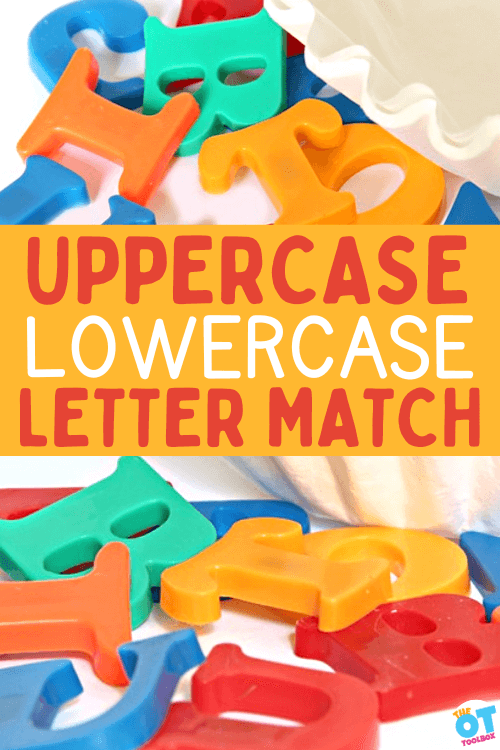
This interactive and hands on game to teach matching uppercase and lowercase letters is a fun gross motor game for preschool and kindergarten. Use this interactive letter activity along as an alphabet matching with objects and a sensory-motor learning activity!

Matching uppercase letters to lowercase letters is a literacy task that supports reading skills, but also challenges visual discrimination skills, form constancy, and visual scanning, all of which are visual processing skills needed for handwriting and reading comprehension. What’s fun about this activity is that it builds these skills in a fun way!

Be sure to grab our color by letter worksheet to work on letter matching, visual discrimination skills.

Uppercase and lowercase letter match activity

Matching Uppercase and Lowercase Letters

Learning letters and matching upper and lower case letters is a Kindergarten skill that can be tricky for some kids.  We made this easy prep letter identification activity using items you probably already have in the house.  If you’ve seen our blog posts over the last few days, you’ve noticed we’re on a learning theme using free (or mostly free) items you probably already have.  

We’re sharing 31 days of learning at home with free materials this month along with 25 other bloggers in the 31 days of homeschooling tips series.  

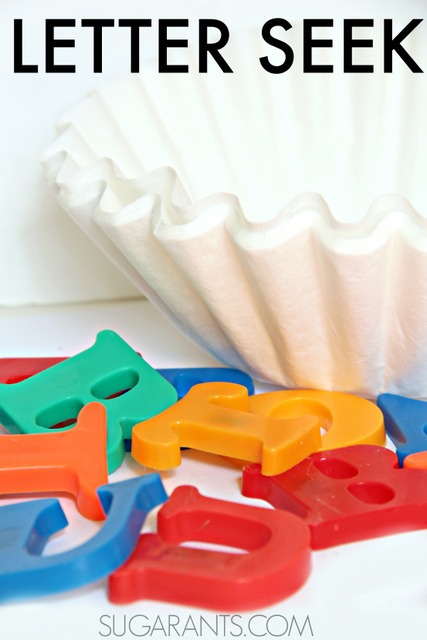
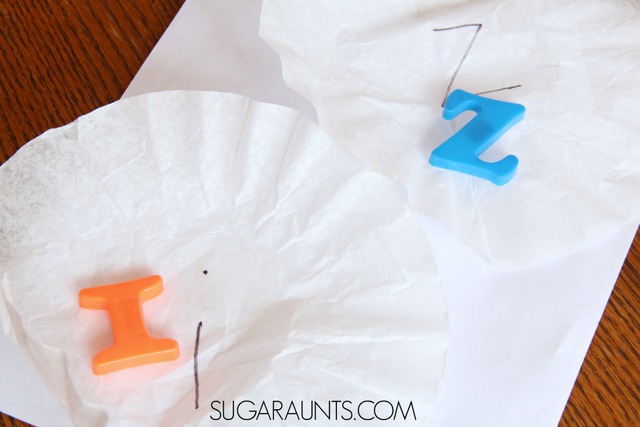
Today’s easy letter learning activity can use any letters you have around the house or magnetic letters and coffee filters.

Matching upper and lower case letters and alphabet letter identification can be difficult for kindergarteners.  Use this letter matching game to prepare for kindergarten skills and gross motor play along with visual scanning. Uses magnetic letters and coffee filters for easy prep and set-up.  Great letter matching ideas and activities here!


While this activity is almost free if you’ve got the items at home already, we’re sharing the affiliate links for the items in this post.

Matching upper and lower case letters and alphabet letter identification can be difficult for kindergarteners.  Use this letter matching game to prepare for kindergarten skills and gross motor play along with visual scanning. Uses magnetic letters and coffee filters for easy prep and set-up.  Great letter matching ideas and activities here!

How to play this interactive letter matching activity

You’ll need just a few items for this letter matching activity:

  • Magnetic letters
  • marker
  • coffee filters (but paper towels or recycled paper would work as well.

To set up the activity, there are just a few steps:

(Amazon affiliate links included below.)

  1. Grab the magnetic letters from the fridge and 26 coffee filters.
  2. Use a permanent marker to write one lower case letter of the alphabet on each coffee filter.
  3. With your child, match the magnetic letters to the lowercase letters on the coffee filters.
  4. Ask the child to help you crumble each letter inside the coffee filter that has its matching lowercase letter.
  5. Continue the play!
Matching upper and lower case letters and alphabet letter identification can be difficult for kindergarteners.  Use this letter matching game to prepare for kindergarten skills and gross motor play along with visual scanning. Uses magnetic letters and coffee filters for easy prep and set-up.  Great letter matching ideas and activities here!

More ways to match uppercase and lowercase letters

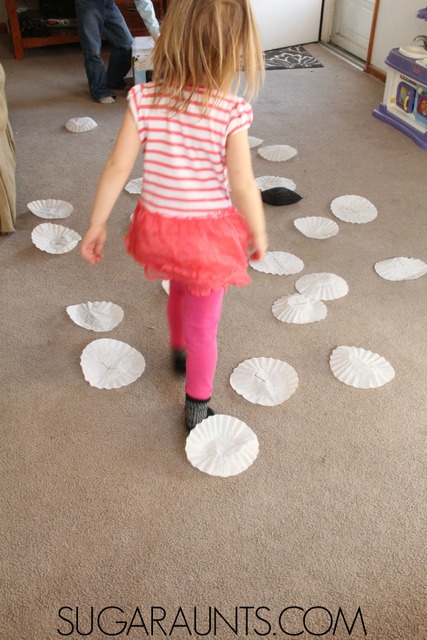
By matching the magnetic uppercase letter to the lowercase letter on the coffee filter, kids get a chance to incorporate whole body movements and gross motor activity while looking for matching letters.

With your child, first match up each lower case coffee filter letter to the upper case magnetic letter.  

You can spread the filters out to encourage visual scanning and involve movement in the activity, OR you can stack the coffee filters in a pile and one by one match up the letters.  This technique requires the child to visually scan for the upper case magnet letters.  

Try both ways for more upper/lower case letter practice!

We then wrapped the coffee filters around the magnets in a little bundle.  There are so many games you can play with these upper and lower case letters:

  • Match the same letter– match uppercase letters to uppercase letters and lowercase letters to lowercase letters.
  • Alphabet matching with objects– Match an object that starts with the letter of the alphabet. Use small objects inside the coffee filter and match it to lowercase letters written in the coffee filter with uppercase magnet letters.
  • Match the picture with the letter– Print off pictures of words that start with each letter of the alphabet. Then match the picture with letters of the alphabet using lowercase letters written on the filter and uppercase letters in magnetic letter form.
  • Play a letter memory game– Hide letters around the room and challenge kids to find the letters in order to match the uppercase letter to the lowercase letters.
  • Letter sound matching– Make a letter sound and challenge kids to find the letter that makes that sound.
  • Letter Hide and Seek- Hide the bundled up letters around the room while your child hides his eyes.  Send him off to find the letters and ask him to open the bundle and identify the letter.
  • Letter Toss Activity- Toss the coffee filter bundles into a bucket or bin.  Any letters that make it into the bin are winners!
  • Name the letters- Unwrap the bundles and name the letters.  Spread the coffee filters out around the room.  Toss magnetic letters onto the matching lower case letter.  
  • Letter toss game- Toss a bean bag onto the coffee filters.  The child can identify the lower case letter, then go to the pile of magnetic letters and find the matching upper case letter.  
Matching upper and lower case letters and alphabet letter identification can be difficult for kindergarteners.  Use this letter matching game to prepare for kindergarten skills and gross motor play along with visual scanning. Uses magnetic letters and coffee filters for easy prep and set-up.  Great letter matching ideas and activities here!

Can you think of any more ways to work on upper and lower case letter matching with coffee filters and magnetic letters? 

Matching Big and Small Letters

The nice thing about this activity is that you can teach the concepts of big and small letters. When we say “big letters” and “small letters”, we are showing the concept of letters that touch the top and bottom lines, or the upper case letters.

And teaching children the difference between those big letters and the small letters which touch just the middle point are part of the visual discrimination process that is needed for handwriting on the lines, or line awareness skills.

You will enjoy more alphabet posts from our archives:


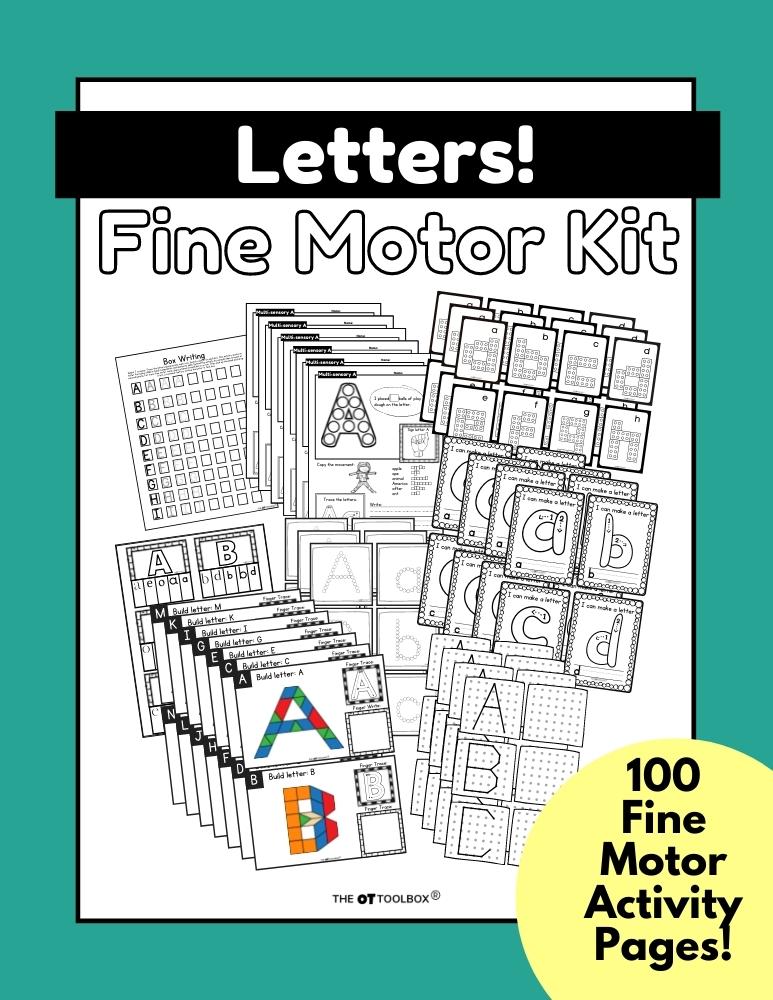
Looking for more interactive letter activities to match uppercase and lowercase letters? The Letters! Fine Motor Kit is for you!

Letters Fine Motor Kit
Letter Kit for fine motor, visual motor, and sensory motor play.

This 100 page printable packet includes everything you need for hands-on letter learning and multisensory handwriting!

This digital and printable packet includes these multisensory handwriting and letter formation materials:

  • A-Z Multisensory Writing Pages
  • Alphabet Fine Motor Clip Cards
  • Cut and place Fine Motor Mazes
  • A-Z Cotton Swab Cards
  • A-Z Pattern Block Cards
  • Fine Motor Letter Geo-Cards
  • A-Z Color and Cut Letter Memory Cards
  • Color By Size Sheets
  • A-Z Building Block Cards
  • A-Z Play Dough Letter Formation Cards
  • Graded Lines Box Writing Sheets
  • Alphabet Roll and Write Sheets
  • Pencil Control Letter Scan
  • Color and Cut Puzzles

Types of Scissors

Types of scissors

Did you know there are many different types of scissors to support development of scissor skills? It’s true! No matter the motor skill ability, there are different type of scissors that supports that ability or skill development. Cutting skills, like writing, are a foundational fine motor skill.  Just as you would spend time selecting the right pen/pencil, makeup, hair accessory, or pair of shoes, it is important to select the correct types of scissors.

Types of scissors and why each different type is used

Why do different types of scissors matter?  

What do you look for when selecting that perfect pair of shoes?

  • Fit
  • Size
  • Price
  • Durability
  • Reputation, reviews
  • Quality
  • Functionality 

Believe it or not, the same care can be placed in selecting the correct pair of scissors.  This is especially important if your learner has fine motor delays, hand weakness, difficulty with motor planning/coordination, small/large/irregular hands, or a diagnosis impacting their skills.

Here are a few real life examples:

  • Lula is 4 years old with dwarfism.  Her hands are tiny.  Her parents would be very unlikely to buy her shoes that fit a grown man.  At her school, Lula was provided with regular sized scissors, thus struggling to learn this important skill.
  • James is 7 and has Down Syndrome.  Not only are his hands weak, but they are small.  While care is taken to select the right shoes and clothes for him, selecting the right scissors is just as important.
  • Marcy is 5 year old and has cerebral palsy, limiting her hand and arm movements.  She too should have extra consideration in the type of scissors that she uses.
Different types of scissors

What are the options for types of scissors?

*Disclamer – Many of the following product recommendations are affiliate links from AmazonThis does not mean these are the best, just the easiest to find.  If you prefer another vendor, check out the examples below, then type them into your Google search bar.

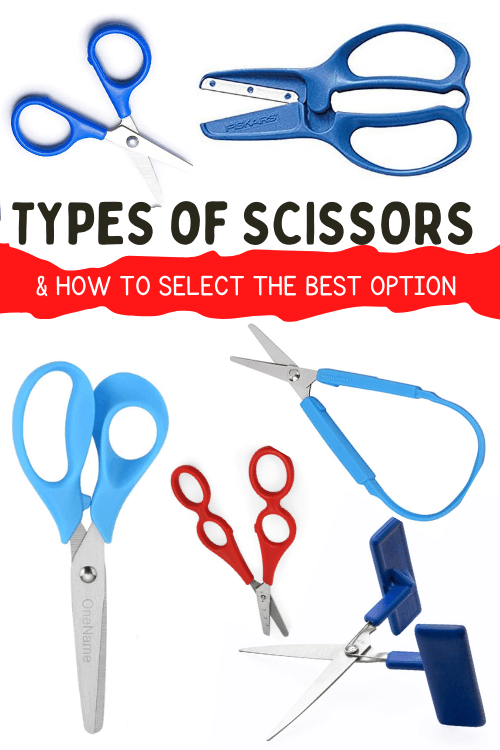
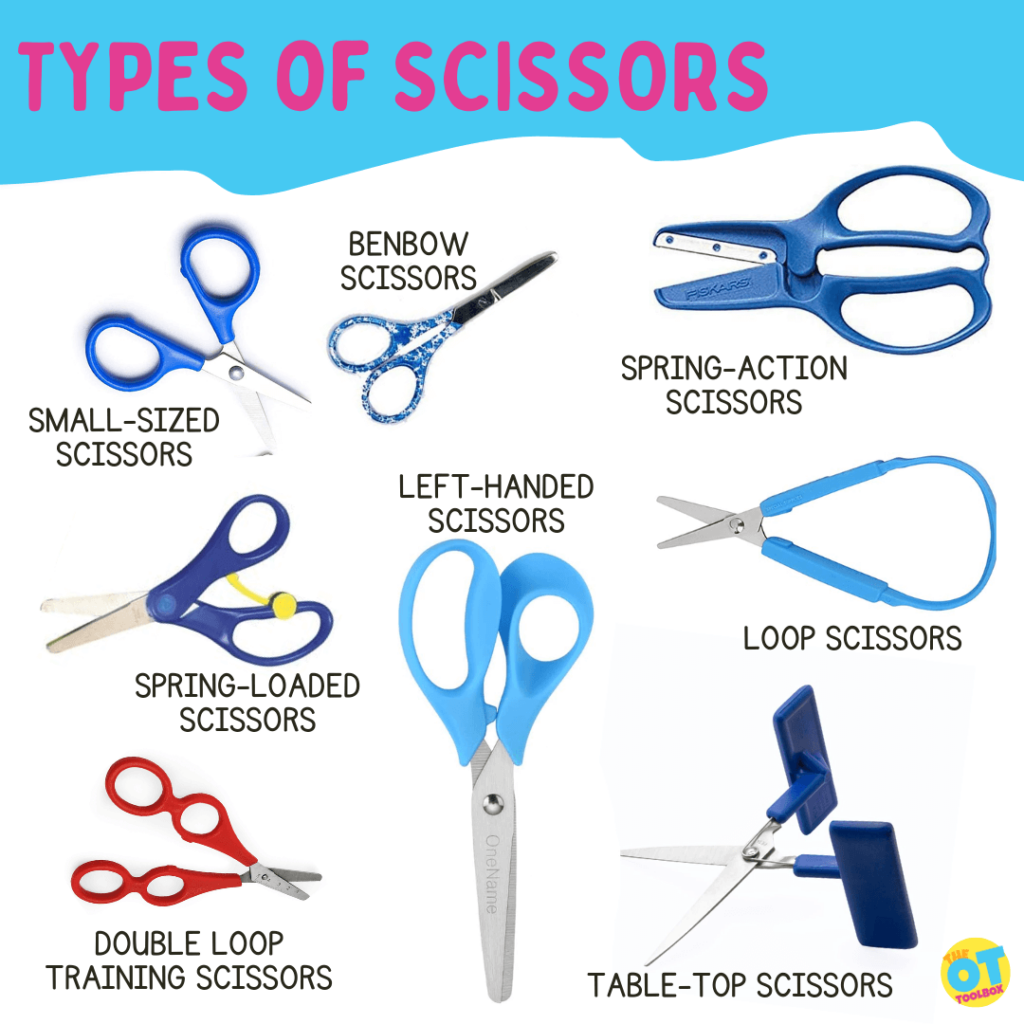
1. Small Sized scissors

Beginner small-sized scissors- These scissors are all small in size.  They are not just for small hands.  These are great for learners with all types of fine motor issues, and hand weakness.

These beginner scissors are Amazon affiliate links.

  • I like these toddler sized scissors because they are very small.  They are great for tiny hands, or learners with fine motor weakness.
  • This learning pack of scissors contains toddler sized scissors, as well as training scissors.  See below for more information about training scissors.
  • Sewing scissors are great because they are tiny, however, they are SHARP!  If you are going to use these, either dull the edges with a file, or be extra careful with your learners.
  • These Benbow Scissors, made by Mary Benbow are the gold standard of training scissors.  

2. Training Scissors

Training scissors should be used as a stepping stone to graduating to a higher level type of scissors, once they are mastered.  If training scissors are not mastered, your learner can use these indefinitely.

The training scissors listed below are Amazon affiliate links.

  • Self-opening scissors: many learners are able to pinch their fingers together long before they can open them during cutting at will. The key to motivation is success.  While using these scissors, the hands get valuable feedback of this cutting motion. These self opening scissors fit the price and durability category, but they do not fit the functionality definition. These blunt scissors, while inherently safer than sharp scissors, do not cut well, and cause more frustration than progress.
  • Spring-assist scissors- This pair of self opening scissors or these soft-grip scissors fit the function, and durability categories. They are more expensive, but cut better than safety scissors.  They are larger than the toddler scissors, so be sure that size is not a concern first
  • Double loop scissors – While I do not like that these are labeled “mother and child scissors” (because this is not inclusive), they work well.  People learn by doing.  Kinesthetic awareness is learning by moving.  These double loop scissors give your learner the feedback needed to practice and learn the cutting motion
  • Trialing two kinds of scissors- This scissor pack has double loop scissors and self opening scissors to trial different kinds of scissors with your learners, or progress forward as they develop skills.

3. Scissors for Special Needs

There are times when traditional scissors do not work and a specific adaptive scissor type is required. If your learner has weakness, a hand injury, tremors, increased/decreased muscle tone, or another long term condition, various scissors for special need areas are a good option. 

Scissors in this category include loop scissors, block scissors, tabletop scissors, and electric scissors.

For learners with small hands, or who are developing hand strength, I would recommend self opening scissors first, or using these adaptive scissor types for a very short period of time.

These different types of scissors designed to meet specific needs are Amazon affiliate links.

Loop scissors – These are also described as self-opening scissors.  Some learners can not isolate their fingers enough to work traditional scissors, or have a sensory aversion to sticking their fingers into the little holes on the handles of the scissors. These spring open once depressed.  They do take a fair amount of strength to grip for a prolonged amount of time, so these may not be the best choice for your learners with low tone or decreased strength (unless of course you are looking for a tool to increase strength).  

  • While these mini loop scissors at 5.5 inches are smaller and take less grip strength, they also do not cut very fast, instead making small snips.
  • These larger loop scissors at 8 inches are a great choice for stronger hands.
  • These self opening loop type scissors are popular. They require less dexterity than traditional scissors, but they do not cut very well.  Because the mouth of the scissors does not open wide, they do not make large cuts.

Scissors for Limited mobility –  For learners missing digits, or with limited grasp, such as amputees or quadruplegic patients, use of just one upper extremity, visual challenges, or other mobility and coordination concerns, these tabletop scissors can be fastened to a table with a clamp or velcro to assist in opening containers.  They are not great for intricate cutting, as they are labor intensive and can be frustrating, but more usable for self help skills. 

Power option – for learners with limited mobility or fine motor dexterity, electric scissors can be a motivating option for cutting.  They take some strength and coordination, but can be helpful for learners who can not use traditional scissors. These types of scissors take some practice to get used to them.

Left handed Scissors

Similar to questions on left-handed writing, teachers and parents are forever inquiring about left handed scissors and how to help with left handed cutting. 

What is the left handed scissors difference?

There is definitely a difference between left-handed scissors and right-handed scissors. Right-handed scissors have the right blade positioned on top, whereas left-handed scissors have the left blade positioned on top. This prevents unnecessary bending and tearing of the paper. This difference between left and right handed scissors also allows each user to maintain a clear visual view of the cutting line.


Scissor handles are often molded to accommodate either the left or right hand. When manufacturers claim they have created a pair of ambidextrous scissors, be aware that such a thing does not exist. They have simply created a “neutral” handle accessible for the both left and right hand. The blades are still right-hand oriented. Thus, left-handed users should not be given scissors marketed as being appropriate for both left-handers and right-handers.

True left handed scissors have the cutting blade positioned on the top. Neutral scissors or scissors that can fit both left and right hands may cause additional frustrations.

Read more on the term ambidextrous and what this means for functional tasks such as cutting with scissors.

There are several types of scissors for lefty’s available, but what are the best left handed scissors?

These basic lefty scissors (affiliate link) are ideal.  If it wasn’t such a right handed world, I would recommend these to all lefties. 

Being a lefty myself, I understand the benefit and fit of left handed scissors. The majority of scissors your learner will encounter will be right handed, so it is better to learn and adapt to traditional scissors. There are only a few left handed items that are necessary (can opener, ice cream scoop, binder, ladle, vegetable peeler.)

Tips for Left handed cutting:

  • Use sharp scissors – this way the blade has less chance of just bending the paper instead of neatly slicing through it
  • Don right handed scissors upside down – for some reason putting the thumb in the fingers hole changes the blade position, and makes cutting easier. 
  • Lefties cut CLOCKWISE.  Righties cut COUNTERCLOCKWISE.  This is important.  If your learner cuts in the wrong direction, this leaves them without the ability to hold onto and turn the piece of paper that is being cut.  Try it!

time to learn to cut

Now that you have selected the right fit, durability, functionality, and quality of scissors for your learner, it is time to learn to cut!  The OT Toolbox has multiple posts and products available for practicing scissor skills.  There is a comprehensive scissor skills guide available also.

The key to cutting skills

  • Thumb and middle finger in the scissor loops.  You can add ring finger into the loops if they are large.  Pointer finger stays out and points the way.  This adds to hand stability and opens the arches of the hand further.
  • Thumbs up!  The helper hand grips the object being cut, with their thumb facing up.  This gives the object being held greater stability, and ease of movement. All of the various types of scissors could have a sticker added as an additional adaptation to help with positioning.
  • How to hold scissors – check out this helpful post on the OT Toolbox
  • Steps of scissor skill development
  • Scissor Skills
  • Scissor Skills Crash Course

Guide to Types of Scissors

Want a printable guide to the various types of scissors? You are in luck. We have a one page printable guide that shows images of the different versions of scissors on the market. These are the different scissor types you might see in a therapists’ therapy bag!

Now you can quickly share information on why each type of scissor might be used and determine which type of scissor to use based on the individual needs of the learner.

To get your copy, just enter your email into the form below.

This handout set is also available in our OT Toolbox Member’s Club.

Current Membership Club members can log into your account and head to the dashboard toolbox labeled “Scissor Skills Downloads“. Print off the handouts without the need to enter an email address.

Want to add this resource to your therapy toolbox so you can help kids thrive? Enter your email into the form below to access this printable tool.

Want to add this resource to your therapy toolbox so you can help kids thrive? Enter your email into the form below to access this printable tool.

This resource is just one of the many tools available in The OT Toolbox Member’s Club. Each month, members get instant access to downloadable activities, handouts, worksheets, and printable tools to support development. Members can log into their dashboard and access all of our free downloads in one place. Plus, you’ll find exclusive materials and premium level materials.
Level 1 members gain instant access to all of the downloads available on the site, without enter your email each time PLUS exclusive new resources each month.

Level 2 members get access to all of our downloads, exclusive new resources each month, PLUS additional, premium content each month: therapy kits, screening tools, games, therapy packets, and much more. AND, level 2 members get ad-free content across the entire OT Toolbox website.

Join the Member’s Club today!

FREE Handout: Types of Scissors

    We respect your privacy. Unsubscribe at anytime.

    a final note on selecting the correct types of scissors

    Pamper your learner with a great pair of scissors, just like you do when you purchase those amazing shoes.  Fit and function over price. Quality always wins.  Fiskars are the gold standard for traditional scissors, and the one type almost every therapy provider has in their OT bag of tricks.  They cut paper well and come in tons of sizes and designs. 

    So…what are the worst scissors?  Most therapists agree that those “safety scissors” that don’t cut anything except maybe playdough are absolutely the worst.  Save those for playdough, and upgrade when it comes to cutting anything else. 

    Victoria Wood, OTR/L is a contributor to The OT Toolbox and has been providing Occupational Therapy treatment in pediatrics for more than 25 years. She has practiced in hospital settings (inpatient, outpatient, NICU, PICU), school systems, and outpatient clinics in several states. She has treated hundreds of children with various sensory processing dysfunction in the areas of behavior, gross/fine motor skills, social skills and self-care. Ms. Wood has also been a featured speaker at seminars, webinars, and school staff development training. She is the author of Seeing your Home and Community with Sensory Eyes.

    *The term, “learner” is used throughout this post for readability, however this information is relevant for students, patients, clients, children of all ages and stages, or whomever could benefit from these resources. The term “they” is used instead of he/she to be inclusive.

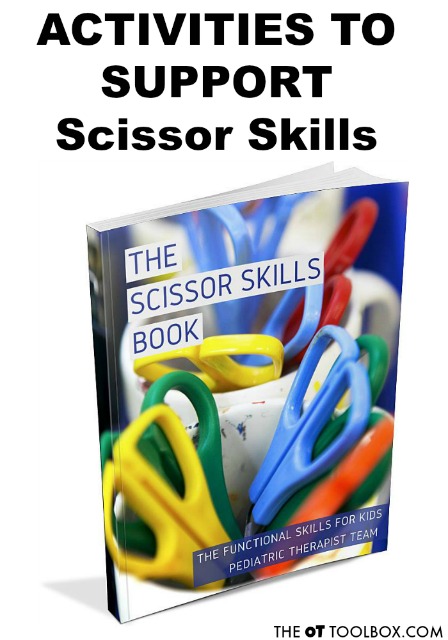
    Looking for tips, strategies, and activities to support development of scissor skills? Grab a copy of The Scissor Skills Book!

    The Scissor Skills Book breaks the functional skill of cutting with scissors into several developmental areas including:

    • Developmental progression of scissor use
    • Fine motor skill involvement
    • Gross motor development
    • Sensory considerations and visual perceptual skills

    Each section includes strategies and tips to improve these underlying areas.

    • Help for kids who struggle with cutting accurately
    • Creative tips to keep things interesting for kids who lose interest easily
    • Quick, practical strategies that can be put into action today!
    • Ideas for kids who cut too fast or too slow
    • Support for kids who can’t grasp scissors efficiently
    • Strategies for right-handed and left-handed children

    Click here to get your copy today.

    Apple Brain Breaks

    apple brain breaks for kids

    These Apple Brain breaks are a resource that has been popular on the site for many years. During the fall months, all things apple theme is the way to go, so when it comes to adding themed resources into a Fall, harvest, farm, or back-to-school theme, apple themed exercises and movement activities are the way to go!

    These apple brain breaks would be a nice addition to a Fall activity like our apple sensory bin or any of the items in our Apple Therapy Kit.

    Apple brain Breaks

    Many of you have used the brain break activities that we have here on the OT Toolbox help kids focus and pay attention in the classroom environment. Movement in the classroom is helpful for learning and helping kids with movement needs such as fidgeting or attention. The brain break activities listed below can go along really nicely with an apple theme. Try adding the Apple themed brain breaks in between activities, lessons, and other classroom tasks.
    Apple themed brain breaks can be a great way for kids to extend on an Apple theme activity while adding movement into the classroom.

    Other brain breaks you might enjoy include:

    Apple Theme Brain Breaks

    apple brain breaks for kids

    Looking for brain break videos for the classroom or home? Here are the best brain break videos on YouTube.

    Related read: These visual perception apple theme shape stamps are a perfect way to work on visual perceptual skills and fine motor skills with DIY stampers.

    Apple themed brain breaks for kids to use in the classroom or as part of an apple theme in learning and play.

    How to Use Apple Brain Breaks

    Get this list of apple theme activities as a printable sheet to use in the classroom. Print them off, glue them to cardstock or index cards and laminate for durability. Kids can complete apple brain breaks as a group or individually.      

    In the PDF below, you’ll find printable cards that you can cut out and use over and over again as a movement break for kids. Other ways to use these fall brain breaks?

    • Incorporate into an apple tree life cycle curriculum or any apple lesson plan
    • Use with talking about Johnny Appleseed during the Fall months
    • Use as a Johnny Appleseed game
    • Add to a harvest theme or visiting the Farm during the Fall
    • Use as a transition activity between classroom activities
    • Use along with our Fall sensory stations kit (another great Fall brain break!)
    • Indoor recess activities during the Fall months
    • Great for waiting activities or transitions in an apple themed classroom!
    • Use when waiting periods during classroom breaks
    • Add as sensory motor activities to promote attention, focus, re-direction, or needed heavy work input

    These apple theme exercises can be added to a weekly therapy theme when planning occupational therapy lesson plans, and then individualized based on the child’s needs and interests.

    Apple Exercises

    The brain break cards include activities like these ones. These apple theme exercises can be adapted or modified as needed to meet specific needs.

    Here are some apple think brain break activities that can be used at movement into the classroom using an Apple theme:  

    1.) Reach and climb- Ask students to stand up beside their desks and pretend to climb a ladder. Students can reach up high with alternating arms as they climb in place. Imagine climbing up a ladder to reach the top of an apple tree.

    2.) Pick apples- Ask students to imagine reaching up to grab an apple from an apple tree’s branch, and  then bend down to drop it into a basket. Ask students to repeat this motion repetitively reaching up high and then bending down low to the ground.
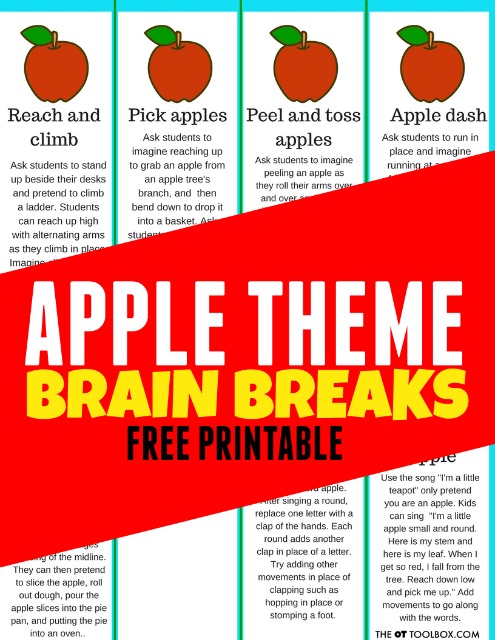
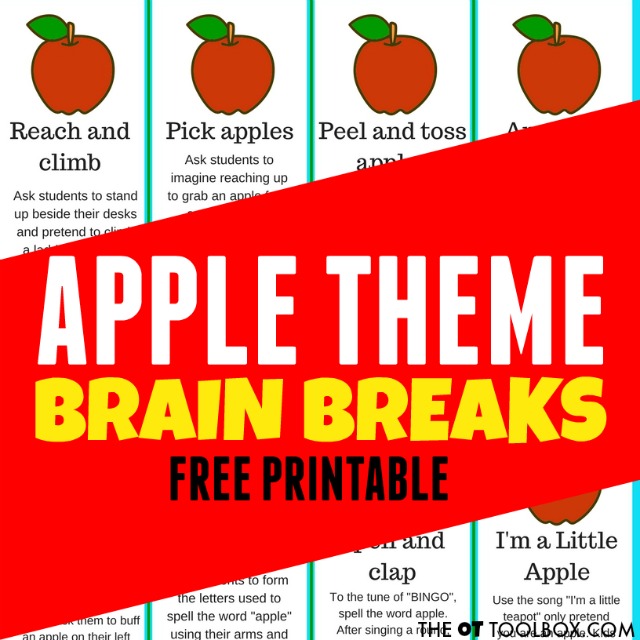
    3.) Peel and toss apples- Ask students to imagine peeling an apple as they roll their arms over and over again at the elbows. Then ask them to toss an imaginary apple into a bucket. They can imagine the buckets are at different levels and distances as they pretend tossing apples. Continue this exercise for one minute.

    4.) Apple dash – Ask students to run in place and imagine running at an apple farm. Students can pretend they are delivering bushels of apple from a tree to a barn as they run in place while carrying an imaginary bucket. Ask them to imagine hopping over logs or running faster or slower.

    5.) Make a pie- Ask students to imagine picking an apple and buffing it with their sleeve. Ask them to buff an apple on their left sleeve and then their right sleeve. Doing this activity encourages crossing of the midline. They can then pretend to slice the apple, roll out dough, pour the apple slices into the pie pan, and putting the pie into an oven.

    6.) Apple spell- Ask students to form the letters used to spell the word “apple” using their arms and legs. To make an “A”, the student can reach up over their head putting their hands in the middle and stretching their legs wide next. Next, make a “P” by standing with feet together and arms curved toward the side to create the bump of the letter. Complete the same movement again for the second P in the word apple. Next, form a letter L using by sitting on the floor and bending at the waist stretching legs out straight. Finally, create a letter E by sitting on the floor bent at the waist with leg s extended straight and feet together. Put one arm out at the waist and reach the other arm out overhead bent at the elbow.

    7.) Spell and clap- To the tune of “BINGO”, spell the word apple. After singing a round, replace one letter with a clap of the hands. Each round adds another clap in place of a letter. Try adding other movements in place of clapping such as hopping in place or stomping a foot.

    8.) I’m a Little Apple- Use the song “I’m a little teapot” only pretend you are an apple. Kids can sing  “I’m a little apple small and round. Here is my stem and here is my leaf. When I get so red, I fall from the tree. Reach down low and pick me up.” Add movements to go along with the words.

    Can you think of any other apple themed brain breaks?

    Squirrel Themed Brain Breaks may be another fun movement idea that you are looking to pair with a book.  

    Apple themed brain breaks for kids to use in the classroom or as part of an apple theme in learning and play.

    Free Apple Brain Break Cards

    Want a copy of these apple brain break cards to add to your toolbox? Enter your email address into the form below to access these printable tools.

    This freebie is also available inside our Members Club! Members have easy access to all downloads on the site, in one place, without the need to enter your email address for each item.

    Want to add this resource to your therapy toolbox so you can help kids thrive? Enter your email into the form below to access this printable tool.

    This resource is just one of the many tools available in The OT Toolbox Member’s Club. Each month, members get instant access to downloadable activities, handouts, worksheets, and printable tools to support development. Members can log into their dashboard and access all of our free downloads in one place. Plus, you’ll find exclusive materials and premium level materials.

    Level 1 members gain instant access to all of the downloads available on the site, without enter your email each time PLUS exclusive new resources each month.

    Level 2 members get access to all of our downloads, exclusive new resources each month, PLUS additional, premium content each month: therapy kits, screening tools, games, therapy packets, and much more. AND, level 2 members get ad-free content across the entire OT Toolbox website.

    Join the Member’s Club today!

    Member’s Club not for you? No worries. You can still access this free resource. Enter your email address into the form and the apple brain breaks will be delivered to your inbox.

    Free Apple Brain Breaks

      We respect your privacy. Unsubscribe at anytime.


      More Apple Theme Activities for Kids:

       
      You will love these apple activities to go along with an apple theme.
       
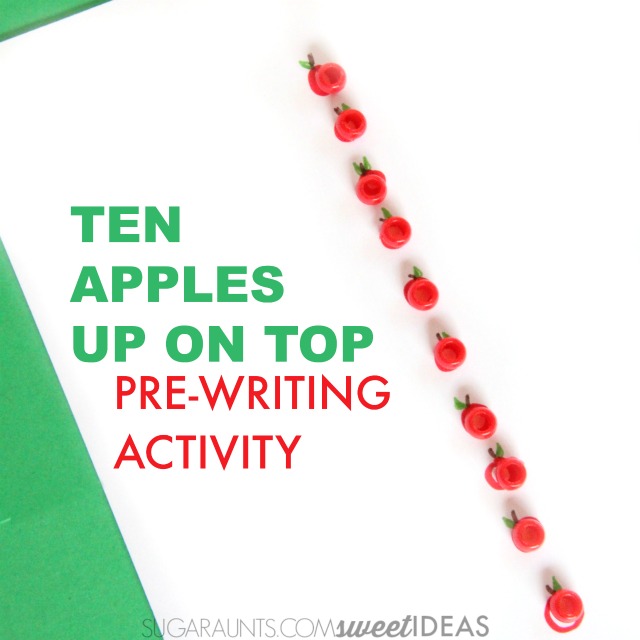
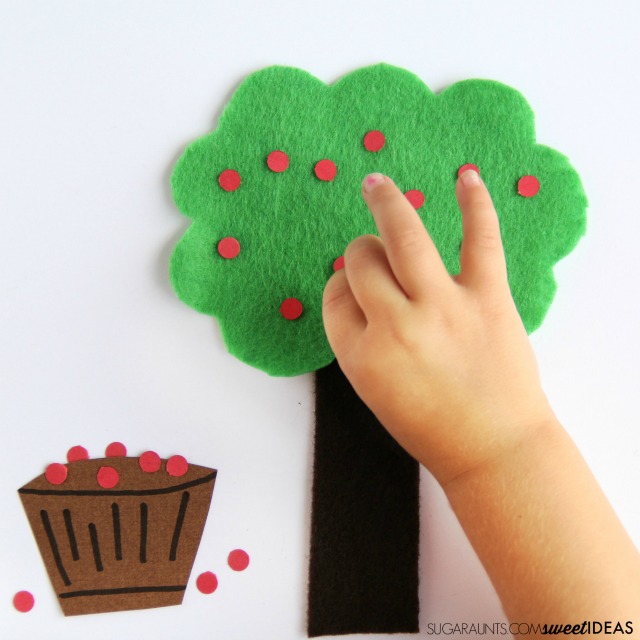
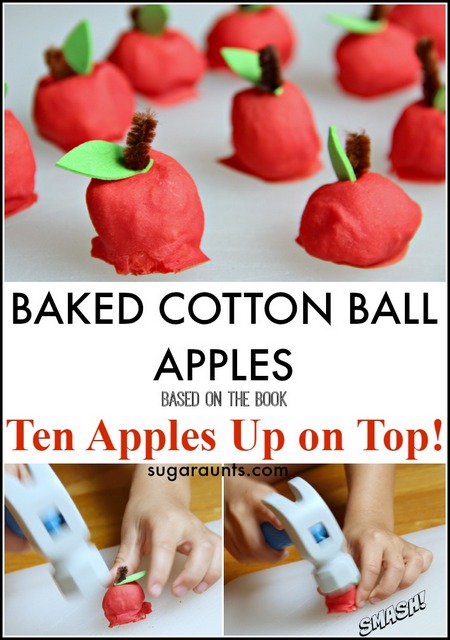
      Ten Apples Up on Top pre-writing activity
       
       
      Apple fine motor strengthening activity and fall math with hands-on learning.


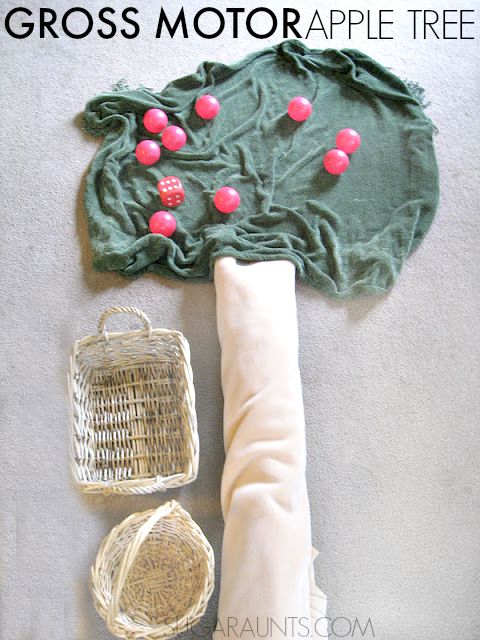
      Gross Motor Apple Tree activity for learning red and apples with toddlers and preschool children. Kids love this in the Fall!


      Colleen Beck, OTR/L has been an occupational therapist since 2000, working in school-based, hand therapy, outpatient peds, EI, and SNF. Colleen created The OT Toolbox to inspire therapists, teachers, and parents with easy and fun tools to help children thrive. Read her story about going from an OT making $3/hour (after paying for kids’ childcare) to a full-time OT resource creator for millions of readers. Want to collaborate? Send an email to contact@theottoolbox.com.

      Hand Clapping Games

      hand clapping games

      Do you remember hand clapping games and activities as a kid? I do! We didn’t have the time occupiers of video games and an abundance of technology, so it was bike riding, roller skating, basketball, board games, and well, hand clapping. Finger games and hand clapping games go “hand-in-hand”! This was done with a sibling or a friend, and definitely a go-to when there were sleepovers and visits to the neighbor’s house.  But, did you ever think about the eye-hand coordination benefits, or bilateral coordination, and even crossing midline benefits?

      Hand clapping games and activities using clapping rhymes

      Clapping Therapy?

      Hand clapping games are a fun and engaging way to interact with kids during therapy. Have you tried it? It’s a fun activity, whether it be to a classic game, a made-up song, or just as a quick transition between activities.

      There are so many benefits to hand clapping games, from motor skills, sensory motor, visual motor, and even executive functioning skill development. We cover how each of these areas (and the sub-skills) are developed through the simple clapping activity in therapy.

      But did you know there is a thing called “clapping therapy”? This was a new concept to me but one that piqued my interest. Essentially, the use of clapping therapy is the act of clapping hands to heal. This is considered a viable therapy because clapping the hands together activates skin and joint receptors in the hands (and upper extremities) to activate various systems within the body and brain.

      Some of this idea is linked to reflexology but other considerations can be connected to the proprioception. We know that heavy work or deep pressure through the joints brings awareness and “wakes up” the muscles and joints. So clapping hands is a great way to activate the sensory systems.

      Another consideration with clapping therapy is the fact that clapping stimulates blood circulation. This can be a potential way to promote healing.

      I wasn’t able to find research on clapping therapy, but these are some things to think about when using hand clapping games to build on therapy goals.

      hand clapping therapy games and clapping rhymes

      Build Skills with hand clapping Games

      Hand clapping actually does have many benefits to skill development, and can be a great way to work on specific skills with children. Why? Hand clapping activities are the ‘no-tools needed’ approach to building so many skills!

      In fact, research shows that hand clapping rhymes and games make an improvement in motor and cognitive skills. The study found that kids that participate in hand clapping games have neater handwriting, write better and make fewer spelling errors.

      Read on to see what skill areas the simple use of hand clapping can help develop:

      • Executive function skills– To complete a hand clapping activity, a child develops cognitive skills, but some of the softer skills might be overlooked. When playing a cooperative game like clapping together, there is a component of impulse control, task completion, working memory, attention, sequencing, self-reflection, emotional control, and self-monitoring. These skills can be carried over because of the confidence built up while playing with a friend in a low-stress situation.
      • Eye hand coordination skills– clapping hands together with a friend requires motor coordination to move and place hands together at the same time and positioning. Too far and you over-shoot the target. This is a great way to work with a friend on hitting targets and visual motor integration.
      • Bilateral coordination – hand clapping activities work on the use of both hands and arms to coordinate and reach with good timing either to a song, rhyme, a game with a partner, and even when hand clapping alone.
      • Motor planning – Most any clapping game involves a lot of motor planning to practice the movements needed repetitively. Once the movements are learned, they become more automatic.
      • Crossing midline – Let’s consider crossing midline for a moment: left to right, right to left, reaching diagonally across going up or down. Adding verbalizing the correct hand when in use, will help them to build left and right side recognition, and improve body awareness. 
      • Visual tracking – During hand clapping games with a partner, children must move their eyes continually from left to right, up and down. With a song or rhyme, children also learn to visually track with fluidity and rhythm. They need to watch and track their hands and their partner’s too.  
      • Sequencing – Many hand clapping games involve some sort of story telling in the sequence. This helps some children recall the lyrics more easily. When using hand clapping games and songs that tell a story, children develop important sequencing skills. They may also make a mental picture of that story in their minds as they play. Clapping along to a metronome app is excellent for building sequencing and rhythm.
      • Cognitive skills – The brain gets quite a workout when learning and doing hand clapping songs and games. You can use hand clapping to help children learn to spell a problematic word, or even learn the alphabet! Children can use a problematic word, or the alphabet as part of the song which can help them to recall the letters in sequence. They can also learn to sequence a storyline, making it easier to learn how to include a sequence when writing in the classroom. 
      • Social skills – Have a group in therapy? Hand clapping is ideal to help develop teamwork, collaboration, tolerance, and patience, which are all essential to successful socializing within a peer group. Switch it up and have kids work with varied partners, or work together as a larger group. These varied interactions can help build self-confidence, and proper interaction during play.
      • Memory – Let’s consider memory for a moment. Significant memory skills are needed when recalling simple to moderately complex hand clapping songs, these can require various levels of memory. Think about the lyrics and movements needed for: Patty Cake, A Sailor Went to Sea, Down, Miss Mary Mack, See See My Playmate, Miss Susie, etc.
      • Rhythm – Hand clapping is a great tool for rhythm and beat development, as the hands must develop a rhythm to match the lyrics and time with a partner.  Interactive Metronome is a popular program involving rhythm and timing.
      • Listening – It is a given that hand clapping games help work on listening skills, in order to learn the movements that match the lyrics. During this process, children are also developing the skills needed to combine memory, rhythm, and sequencing, as they listen attentively to follow the directions that are given within a song or rhyme.
      • Vocabulary skills – Many hand clapping rhymes or songs include singing the lyrics while clapping which can help build new vocabulary as the songs are learned. When working with a partner, communication skills can be addressed too. 
      • Proprioception– Hitting the palm of the hand against another hand offers feedback through the fingers, wrists, and whole upper extremity with heavy work input. This quick jolt of force through the upper body is a way to add proprioceptive input through play. The benefit for learning the clapping rhyme hand movements and positioning is through practice and that physical touch feedback is a loop that builds on itself.
      Miss Mary Mack hand game

      Hand Clapping Rhymes

      Below is a round-up list of hand clapping rhymes and/or games that you will probably recall from your childhood, but if not, there are links below to YouTube videos that will demonstrate them for you. It is a great idea to practice these before performing with your students.

      Patty Cake Patty Cake Baker’s Man

      Pat-a-Cake – Actually titled Pat-a-Cake, many children call this rhyme Patty Cake Patty Cake Baker’s Man. This one is instructed by a physical therapist and I love it because she adds great motor planning movements and does it with her 3-year-old co-instructor. 

      Here are the lyrics: 

      Pat-a-cake, pat-a-cake, baker’s man.
      Bake me a cake as fast as you can;
      Roll it, pat it, and mark it with B, (or any letter of your first name)
      Put it in the oven for baby and me.

      miss mary mack Hand Game

      Miss Mary Mack – This one is instructed by a K-5 music teacher. She makes the video using a complete tutorial to teach the lyrics and the movements slowly, and then in rhythm to the song by herself, and then with a partner. The Miss Mary Mack clapping game is a fan favorite among children.

      Here are the Miss Mary Mack lyrics: 

      Miss Mary Mack, Mack, Mack
      All dressed in black, black, black
      With silver buttons, buttons, buttons
      All down her back, back, back.

      She asked her mother, mother, mother
      for fifty cents, cents, cents
      To see the elephants, elephants, elephants
      Jump over the fence, fence, fence.
      They jumped so high, high, high
      they reached the sky, sky, sky
      And didn’t come back, back, back
      Till the 4th of July, -ly, -ly.

      rockin’ robin clapping game

      Rockin’ Robin – The Rockin’ Robin clapping game is demonstrated and instructed by a homeschool mom who gives a short demonstration of the hand movements needed to complete the hand clap patterns to the lyrics, in slow motion. It’s only four hand movements that stay repetitive to the lyrics of the song, so it’s an easier one to teach and to do.

      Here are the Rockin Robin lyrics:

      He rocks in the treetops all day long, hoppin’ and a-boppin’ and singing his song 

      All the little birds on Jaybird Street love to hear the robin go tweet-tweet-tweet 

      Chorus: Rockin’ robin, Rock-rock-rockin’ robin’ Go rockin’ robin ’cause we’re really gonna rock tonight 

      Every little swallow, every chick-a-dee, every little bird in the tall oak tree 

      The wise old owl, the big black crow flappin’ their wings singin’ “go bird, go” 

      Chorus: Rockin’ robin, Rock-rock-rockin’ robin’ Go rockin’ robin ’cause we’re really gonna rock tonight

      The size awareness concept of the tall oak tree and the little swallow can be carried over to work on tall, tail, and short letters, as well as body awareness considerations. Take the activity a step further with our tall and short worksheet which has a fine motor and visual motor component that can be incorporated into whole-body movement activities to teach these concepts that carryover into functional tasks.

      double this double that

      Double This Double That – This clapping hands rhyme is also demonstrated and instructed by the same homeschool mom who will show the simple hand movements needed, and discusses briefly how it can be used as a fun elimination game. You can do this one at various speeds, making it a super coordination activity in therapy. Use it with a partner, or part of a group activity. 

      Double This Double That Lyrics:

      Double, double this this,

      Double, double that that,

      Double this, double that,

      Double, double this that.

      twinkle twinkle little star

      Twinkle, Twinkle, Little Star – This one has a unique teaching approach performed by an occupational therapist using this familiar song to work on hand movements in three different patterns. Go OT! I like this one as it can be done on the table top, but you could easily do the same movements with a partner too. There are no actual lyrics with this version of the activity, but they can easily be added during game play. 

      Twinkle Twinkle Little Star lyrics:

      Twinkle, twinkle, little star
      How I wonder what you are
      Up above the world so high
      Like a diamond in the sky
      Twinkle, twinkle, little star
      How I wonder what you are

      clap RHyme

      Clap – This Clap rhyme activity uses hand clapping as an exercise that is great for a whole-body warm-up, or as a sensory break. It uses upbeat music that the instructor claps along with, showing other body movements that are used in coordination with the clapping to improve body awareness, motor coordination, and endurance too!

      There are few lyrics with the Clap rhyme activity, but there is a tune or beat that is played in the background as the video plays. 

      avocado Hand Game

      Avocado – This hand clap video is demonstrated by Miss Mortimer who is a K-5 Music Teacher. The video is funny because the dog feels left out, and wants to participate too!  She does a great job doing the demonstration of the Avocado hand game slowly, then along with the lyrics. Later Miss Mortimer shows an additional hand movement to make this clapping game more challenging. She also shows how you can speed it up, and then how you change the song when you lose the game. 

      Here are the lyrics to the Avocado hand game:

      Avocado, avocado, avocado, is the name of the game

      If you mess up you have to change the name

      a, b, c, d, e, f, g, h, i, j, k, l, m, n, o, p, q, r, s, t, u, v, w, x, y, z.

      Hot cross buns Rhyme

      Hot Cross Buns – This hand clapping demonstration is done by a homeschool mom with her child. They demonstrate how to do this hand clapping to the Hot Cross Buns rhyme in a variety of ways. I like the hand movements she uses as they incorporate a variety of motor planning skills. 

      Here are the lyrics to the Hot Cross Buns rhyme:

      Hot cross buns!
      Hot cross buns!
      One ha’ penny, two ha’ penny,
      Hot cross buns!
      If you have no daughters,
      Give them to your sons
      One ha’ penny,
      Two ha’ penny,
      Hot Cross Buns!

      Concentration Clapping Game

      In the concentration clapping game, you sit or stand across from a friend. Clap hands together after saying each line from the rhyme. This game supports development of attention, working memory, focus, and impulse control, as well as emotional control when the inevitable mistake happens. Players can list out numbers or they can substitute the numbers for different categories such as fruits, animals, sports, foods, etc. The slaps and claps can be hitting hands face to face followed by crossing the arms to clap. Then player one, continuing the rhythm, says a number or other word (colors, sports, foods, etc.) twice. Then the other player repeats those words and adds their own words in the same category. This goes back and forth as the players keep adding more words to the list.

      Here are the lyrics to the Concentration Clapping Game:

      Concentration (slap slap clap clap)

      Are you ready? (slap slap clap clap)

      If – so – (slap slap clap clap)

      Let’s – go! (slap slap clap clap)

      For example: cat, cat (slap slap)

      The other player then does the same, starting with their own number and following with someone else’s:

      cat, cat, dog, dog (slap slap clap clap)

      Use these clap games in therapy or at home

      So, do you feel inspired to get your hands clapping yet? Does this bring back memories of the playground songs, “Say Say my Playmate, Down Down Baby, or Miss Suzie? Once you view these fun videos, you’ll want to start using hand clapping as an intervention tool in your therapy sessions where you’ll start seeing children build important developmental skills while having some fun and getting a few laughs in too!

      Pair these concentration clapping games with hula hoop activities and backyard tag games for old school fun!

      Regina Allen

      Regina Parsons-Allen is a school-based certified occupational therapy assistant. She has a pediatrics practice area of emphasis from the NBCOT. She graduated from the OTA program at Caldwell Community College and Technical Institute in Hudson, North Carolina with an A.A.S degree in occupational therapy assistant. She has been practicing occupational therapy in the same school district for 20 years. She loves her children, husband, OT, working with children and teaching Sunday school. She is passionate about engaging, empowering, and enabling children to reach their maximum potential in ALL of their occupations as well assuring them that God loves them!

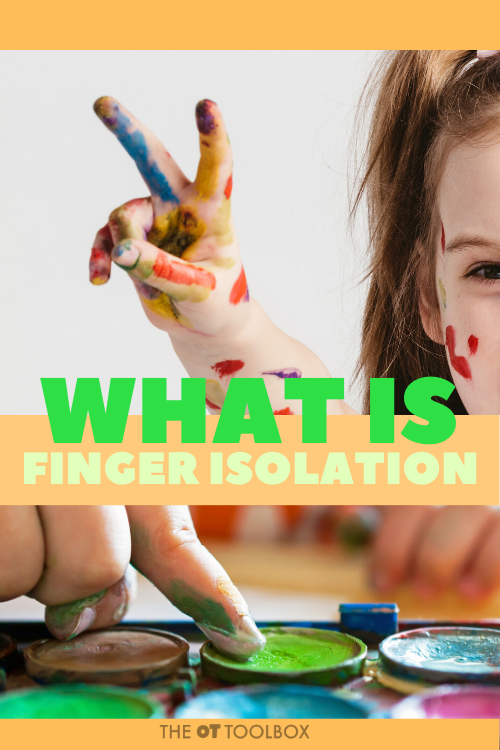
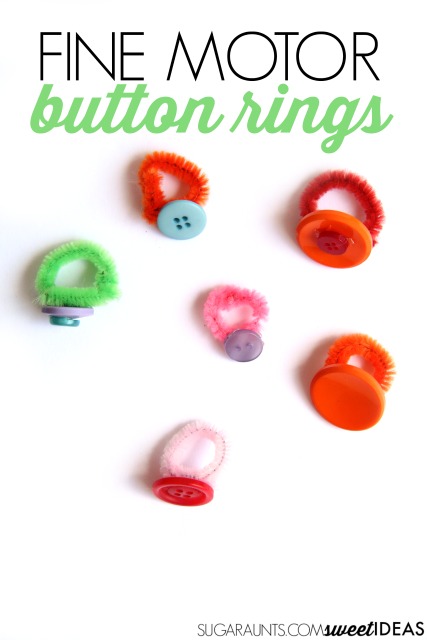
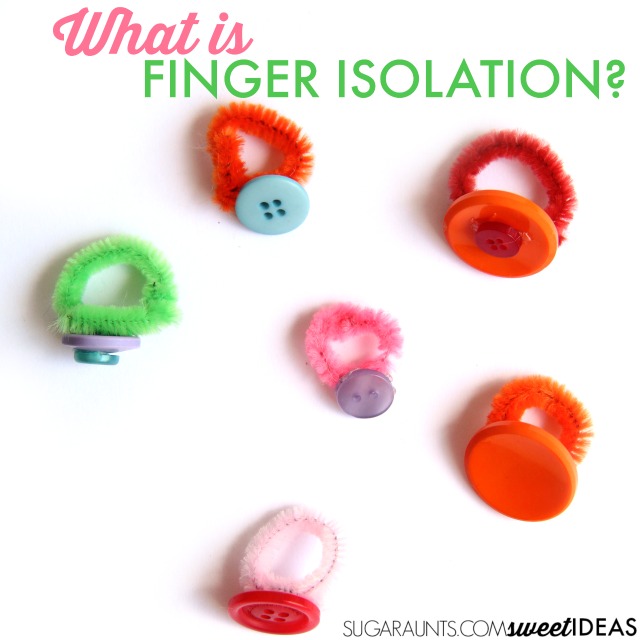
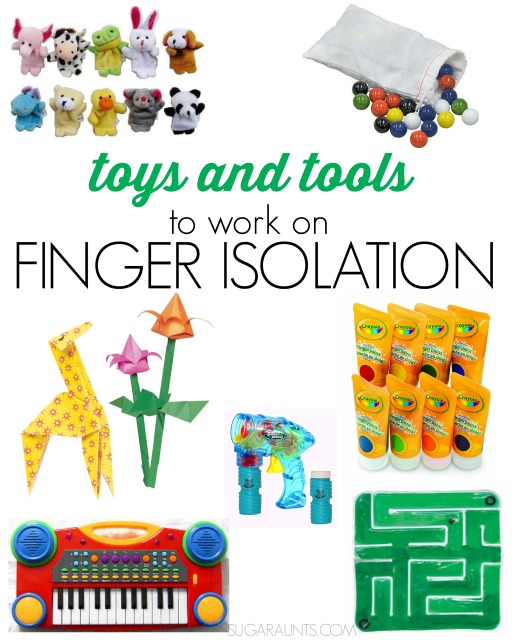
      What is Finger Isolation?

      finger isolation

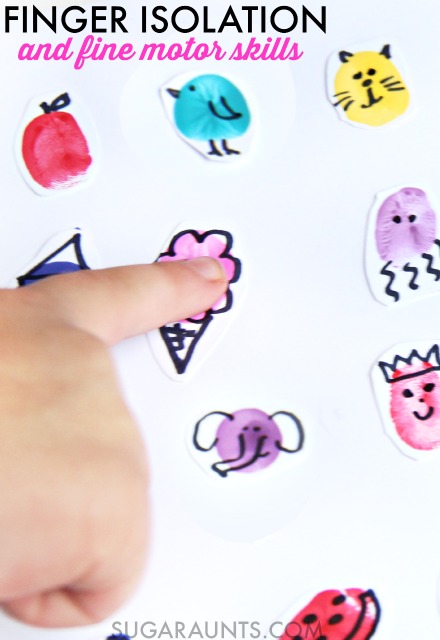
      Today’s post is all about finger isolation: what does finger isolation mean, why this fine motor skill is important, and even finger isolation exercises and activities to support precision and dexterity in the fingers. As children develop dexterity in fine motor skills, more precision and refined movements allow for coordinated skill work. It’s through this motor skill that one can do specific tasks that use only one finger or several fingers.

      Finger isolation is needed for daily tasks, and finger games are just one way to build this skill.

      You may have heard of finger isolation as a component of fine motor skills that kids need for dexterity and precision. Today, we’re discussing this important motor skill, how finger isolation impacts function, and activities to build finger dexterity. So, what is this motor skill that allows us to point, hold up a single finger, or make fingerprints? Let’s discuss!

      What is finger isolation? 

      Finger isolation is the ability to isolate and use the fingers one at a time in functional tasks. The fine motor skill of finger isolation is the development of being able to “isolate” or individually use each finger of the hand. Counting one finger at a time, tying shoes, typing on a screen or computer keyboard, finger games like “Where is Thumbkin?”, and opposing one finger to the thumb are examples of finger isolation. One way to target this is using typing programs to improve finger isolation.

      When children are developing they begin to use each finger individually; as infants, children tend to use the hand as one solid unit. Finger isolation is one of the first important developmental milestones that leads to children’s ability to write well with a pencil, type on a keyboard, play a musical instrument, tie shoes ect!

      If you’re wondering how to see if your child has good finger isolation, you can ask yourself:  

      • Does your preschooler or kindergartner avoid pointing?
      • Do they tend to gesture in the direction of an object instead of pointing?
      • Do they use their whole hand to grasp objects rather than one or two fingers when that makes more sense for the size of the object?
      • Do they struggle to manipulate coins, turn a page of a book, tie shoes, or other task requiring refined movements?

      Then adding a few finger isolation activities and games might be helpful for your child!

      Development of finger isolation

      Finger isolation typically develops in the baby at around 6 months of age as they begin to pick up small pieces of cereal. It progresses to pointing, and then separation of the two sides of the hand with in-hand manipulation. Finger isolation is so important in fine motor dexterity in every task that the hands perform.

      There are other components of fine motor skills that contribute to the precision of isolating fingers in activities:

      • Separation of the sides of the hand- Separating the sides of the hand isolates the precision side of the hand from the power side of the hand allows for, and requires isolation of fingers and joints during motor tasks.
      • In-hand manipulation- In hand manipulation includes moving objects within the hand and refined isolation of digits and joints on the fingers contribute to this skill.
      • Arch development This hand strength allows for fingers to move in isolation of one another.
      • Opposition- Finger and thumb opposition of the thumb to the fingers also plays a role in finger isolation. This ability to oppose the thumb to a single digit allows for more refined and precise grasps on objects.
      • Open thumb web space- Similarly, to oppose the thumb to the fingertips, an open thumb web space is necessary.

      Finger Isolation and Screens (apps and games)

      From a very young age, many small children are efficient at using tablets and phone apps with finger isolation to point, swipe, and move through images on the screen. However, when kids are scrolling the screen, and using their finger in isolation on a tablet, they typically use only one finger (the index finger OR the middle finger) and do not exert strength on the screen.  

      They are not receiving feedback through the muscles and joints of the hand (proprioception) to build motor plans for fine motor tasks. They are not establishing a “store” of fine motor experiences.

      You then may see that single finger is stronger and more dominant in tasks such as pencil grasp or tying shoes. This concept is similar to the dominance of a hand or side of the body. Equally of interest is this post on deciphering the difference between dominance and ambidextrous. It’s all related, and to the occupational therapy professional, so interesting to read about the connections!

      Read here for more symptoms of too much screen time.

      Finger isolation is a fine motor skill kids need for dexterity and precision. Here are ccupational therpay activities to work on fine motor skills.

      Development of fine motor skills includes finger isolation. Here is more information on finger isolation for dexterity and motor control.

      Finger Isolation Activities

      So, how can you build and develop finger isolation?  There are many ways to build finger isolation skills. You’ll also find more finger isolation activities along with a craft that can help kids become more aware of this fine motor skill. Below are small motor tools to help with development. Add these finger strength exercises to your therapy plans or home programs.

      One great way to develop precision in a single digit of the hand is to instruct the individual to tap each finger to their thumb (give them a demonstration so they can mirror you!),

      Isolation of the individual fingers really develops with hand strength and coordination through the use of hand clapping games and finger rhyming songs. Show the individual finger and hand games such as “Where is Thumbkin?”, “Itsy Bitsy Spider”, and other rhyming games that involve hand motions.  

      Overall, fingerplay songs are a powerful tool to support the development of finger isolation!

      • Pop bubbles
      • Play “I spy” with items around the house and encourage your child to point
      • Counting on fingers one at a time
      • “Itsy Bitsy Spider” (this is a great beginner motor plan with easy finger isolation hand motion)
      • Shadow hand puppets using a flashlight
      • Dampen fingers to pick up small items such as glitter, confetti, other small items
      • Teaching common finger expressions such as “A okay”, thumbs up, finger guns etc
      • “Lizard fingers”: this is one of my favorites that really makes kids laugh, stick small pieces of tape on each finger and have kids pretend to be a lizard and see what they can pick up around the room! (Make sure to have small items that can actually be picked up, we’ve had a couple failures with this activity!)

      Other finger isolation ideas here on The OT Toolbox:

      What is finger isolation? Use these button rings to work on using fingers one at a time in fine motor activities with kids!

      Finger Isolation Crafts

      • Make and play with finger puppets
      • Finger painting
      • Using a pointer finger to trace shapes in foam, slime, various sensory mediums
      • Make “spaghetti” strings by rolling play-doh between the index finger and thumb
      • Make a “finger soccer board” by folding up a small piece of paper into a triangular shape and have your child “flick” the “ball” into the goal

      If there is ever an easy craft that you and the kids make, this is it.  These button rings are as cute as they are effective in developing the skills needed for tasks like maintaining a pencil grasp, shoe tying, and managing clothing fasteners.

      This post contains affiliate links.

      You’ll need just a few items for this craft:


      These super cute button rings are a craft that my kids loved making.  They wore these rings every day for a while there. (This mom did, too!)

      What is finger isolation? Use these button rings to work on using fingers one at a time in fine motor activities with kids!


      1. To make the rings, cut the pipe cleaners into small pieces.  You’ll want them small enough to fit little fingers, but a little longer in order to add the buttons.
      2. Thread the buttons onto one end of the pipe cleaner.  
      3. Twist the two ends together and tuck the end of the pipe cleaner on the outside of the ring (so it won’t rub up against the skin).
      4. You can add extra buttons and layer different colored buttons for fun rings. 

      Finger isolation activity with rings

      • When wearing the rings, incorporate finger isolation by placing rings on different fingers.  
      • Ask your child to hold up the finger with a specific colored button or pipe cleaner.  
      • Try tapping fingers with the rings one at a time by calling out a colored ring and asking your child to play a “SIMON” type of memory game.
      What is finger isolation? Use these button rings to work on using fingers one at a time in fine motor activities with kids!

        You’ll love these fine motor activities, too:

      Working on fine motor skills, visual perception, visual motor skills, sensory tolerance, handwriting, or scissor skills? Our Fine Motor Kits cover all of these areas and more.

      Check out the seasonal Fine Motor Kits that kids love:

      Or, grab one of our themed Fine Motor Kits to target skills with fun themes:

      Want access to all of these kits…and more being added each month? Join The OT Toolbox Member’s Club!

      Colleen Beck, OTR/L has been an occupational therapist since 2000, working in school-based, hand therapy, outpatient peds, EI, and SNF. Colleen created The OT Toolbox to inspire therapists, teachers, and parents with easy and fun tools to help children thrive. Read her story about going from an OT making $3/hour (after paying for kids’ childcare) to a full-time OT resource creator for millions of readers. Want to collaborate? Send an email to contact@theottoolbox.com.

      Powerful Action Rhymes and Nursery Rhymes with Actions

      nursery rhymes with actions

      Kids love finger plays and action rhymes.  You know the ones, right?  Here, we’re sharing nursery rhymes with actions that support development including gross motor coordination, bilateral coordination, and body awareness. These movement and rhyme phrases and songs that fill every childhood, preschool classroom, and library story time are a classic  part of childhood. 

      Rhymes with action movements inspire rhythm and rhyming skills, but there is more than that: They are engaging, fun, and repetitive ways to work on motor development.

      These nursery rhyme actions are great additions to nursery rhyme crafts!

      nursery rhymes with actions


      But, did you know that action rhymes help with childhood development? Childhood development and action rhymes go hand-in-hand so to speak.  Kids learn and grow by moving and repeating and then independently saying and singing rhymes that many kids could sing along to.  

      What are some ways that childhood development and action rhymes help a child grow?

      Action rhymes are a great way to address skills such as:

      Use these creative and powerful nursery rhymes with actions to develop skills in OT sessions.


      This post contains affiliate links.


      Looking for brain break videos for the classroom or home? Here are the best brain break videos on YouTube.

      What are action rhymes?

      Action rhymes are movement songs or nursery rhymes with movement.  

      They might be gross motor activities like “I’m a Little Teapot” or “Duck, Duck, Goose”. Or, they might be a fine motor activity like “Eensy Weensy Spider” or “Where is Thumbkin”.  

      There are so many nursery rhymes with actions out there that preschool classrooms are using or even making up to suit their needs, but one thing is common with all action rhymes; They have sing-song phrases and involve movement.  

      Fine Motor Action Rhymes:

      1. Where is Thumbkin?
      2. Creep Them, Creep Them
      3. Bringing Home a Baby Bumble Bee
      4. 5 in the Bed
      5. Eensy Weensy Spider

      Gross Motor Action Rhymes:

      1. Wheels on the Bus
      2. I’m a Little Teapot
      3. Duck, Duck, Goose
      4. Farmer in the Dell
      5. If You’re Happy and You Know It
      6. Head, Shoulders, Knees, and Toes
      7. We’re Going on a Bear Hunt
      8. 5 Little Monkeys Jumping on the Bed
      9. Grand Old Duke of York

      How to use nursery rhymes with actions to build childhood development?
      Action rhymes and finger plays are perfect for the 18-24 month age range and the preschool years when so much development is occurring.  

      Consider all the ways a toddler or preschooler are developing: fine and gross motor skills, language, cognitive, social-emotional…these years are full of natural progression with development going through the roof!

      Childhood Development and Action Rhymes

      There are so many ways that nursery rhymes with actions help to build childhood development in a healthy way:

      • Fine Motor Skills– Use the fingers and hands to build dexterity, eye-hand coordination, and finger isolation through movement. Encourage kids to follow along with the fine motor action rhymes listed above to improve dexterity and fine motor control.
      • Gross Motor Skills– Using the trunk, legs, and shoulders builds strength in the limbs and core muscle strength needed for attention and focus. Read more developing core strength through movement rhymes here.
      • Social/Emotional Development– Striving for independence, asserting ones independence, engaging with peers, and an emerging awareness of ones own body and a sense of awareness of others is developing and growing in the toddler and preschool years.  Action rhymes in a group setting promote all of these areas. Encourage kids to connect with other children and adults by pairing up kids to perform action rhymes in small groups of kids.
      • Speech and Language Development– The toddler and preschool age sets are flourishing in language skills.  There is a huge opportunity for developing and building skills through repetitive action rhymes.  Children can be encouraged to develop these skills when encouraged to participate in verbal exchanges.  Further promote communication skills by asking questions about the rhymes.
      • Spatial Concepts– Important for awareness of ones self and position in space, as well as in visual motor integration tasks like handwriting, action rhymes allow children to explore position in space through movement. Encourage development and understanding of front/back, over/under, top/bottom, etc. Try this action rhyme trick: when a spatial term is mentioned in an action rhyme, try pointing in the direction instead of saying the words or phrases.
      • Attention Span– Action rhymes allow kids to focus for a period of time on a teacher as well as peers individual and group action rhyme activities. Encourage longer attention by increasing time spent singing action rhymes. Lead into a group activity with action rhymes or use them as a tool to take a break during seated tasks or classroom activities that require focus and attention. 
      • Cognitive Development– Using action rhymes, children are introduced to concepts such as numbers, colors, shapes, sizes, names, letters, and more. Concrete concepts of the toddler and preschool years can be enhanced to more abstract ideas through cognitive development using sensori-motor components of action rhymes.  Movement and learning are very well connected and action rhymes add a sing-song rhyming component as well. Additionally, concepts such as patterning, sequencing, and cause-effect are addressed through action rhymes.
      • Self-Concept– Action rhymes provide an opportunity to learn about body parts. Encourage kids to learn about their body parts with action rhymes like, “If You’re Happy and You Know It”
      • Behavior Development– Action rhymes promote movement and an appropriate opportunity for students to get wiggles and fidgets out in a classroom setting.  Following the rhyme actions, kids can discover how they can move their body in purposeful ways.
      Use these creative and powerful ideas to boost and build childhood development with action rhymes and finger plays with toddler and preschool kids in the classroom, home, or Occupational Therapy clinic.

        What are some favorite action rhymes in your classroom, home, or clinic?  

      More movement and development ideas you will love: 

      The Sensory Lifestyle Handbook walks you through sensory processing information, each step of creating a meaningful and motivating sensory diet, that is guided by the individual’s personal interests and preferences.

      The Sensory Lifestyle Handbook is not just about creating a sensory diet to meet sensory processing needs. This handbook is your key to creating an active and thriving lifestyle based on a deep understanding of sensory processing.

      Colleen Beck, OTR/L has been an occupational therapist since 2000, working in school-based, hand therapy, outpatient peds, EI, and SNF. Colleen created The OT Toolbox to inspire therapists, teachers, and parents with easy and fun tools to help children thrive. Read her story about going from an OT making $3/hour (after paying for kids’ childcare) to a full-time OT resource creator for millions of readers. Want to collaborate? Send an email to contact@theottoolbox.com.

      Star Wars Occupational Therapy Lightsaber

      star wars occupational therapy

      Today I have a fun Star Wars occupational therapy activity. This block light saber requires just one material, but you can use this Lightsaber for so many OT goals! We actually created this counting block light saber years ago (original blog post was written in 2015) for May 4th activities for occupational therapy. May the 4th be with you with this fine motor Star Wars activity!

      Star Wars occupational therapy activities for kids

      Star Wars occupational therapy

      Pediatric occupational therapy professionals know the power of using themes in OT therapy sessions. When we come up with a theme for fine motor, gross motor, visual motor, and sensory motor tasks, we can cover a wide range of OT goals while meeting the client (patient, student, etc.) where they are with a focus on their interests.

      Using interests in therapy fosters meaning and engagement.

      That’s where this Star Wars occupational therapy theme comes into play.

      How many children have you met that love all things Star Wars? When you bring up the topic of light sabers, Millennium Falcon, Chewbacca, and Luke, you may see a sparkle in the eyes of a child that could talk for hours on all things Star Wars. That’s when you know you have a great therapy theme on your hands.

      Using that Star Wars theme in therapy allows kids to focus on the tasks at hand, try new activities, and put themselves out there to try activities that might be just a little difficult on the range of “just right” tasks. The point here is to meet those goals but when working on goals is difficult, it can be easy to quit or give up. However, if there is a topic of interest that really sparks a light of engagement, then you have a tool to support goal development.

      This is when we see kids thrive!

      Let’s go over a few Star Wars occupational therapy activities focusing on fine motor skills, visual motor skills, gross motor skills, handwriting, and sensory play.

      Star Wars Fine Motor Activity- Build a Block Light Saber

      If your sons (and daughters) are anything like mine they love to make lightsabers out of anything.  Ever since they were introduced to Star Wars, the lightsaber is definitely a favorite in our house.  We built these blocks Star Wars lightsabers using counting blocks and wanted to share.  Because it sure is fun!

      The block light saber is a fine motor powerhouse. By snapping together the blocks, you’ll see:

      All of these fine motor skills are essential to functional tasks. Using the Star Wars theme adds a “4th” theme (force) that can’t be beat!

      Build a lightsaber using counting blocks or cubes for a Star Wars occupational therapy theme.

      How to Make a Star Wars Lightsaber with Blocks

      We are sharing affiliate links in this post.    

      To make build our lightsabers, we used one of our favorite toys; these snapping blocks (affiliate link) are a toy that is used almost every day in our house.  From building robots to spaceships, and now lightsabers…we love these blocks.  They are great when used as a counting manipulative for preschoolers.  Other counting blocks (affiliate link) could also be used.   

      Use math blocks or counting snap blocks to make a light saber for May 4th activities or a Star Wars OT theme.

      How to use this light saber in OT activities:

      Visual Motor Skills- Create a block light saber model. Ask the child to copy the light saber using pattern blocks or snap blocks. They can copy the colors and spacing of the blocks to work on visual motor skills.

      Other visual skills addressed with this activity include:

      • Visual scanning
      • Visual attention
      • Visual figure ground
      • Visual closure

      Gross Motor Skills- Use the light saber to copy gross motor movements and motor planning patterns. The therapist can make movements with a block light saber and the client can copy them. Work on adding a sequence of movement patterns to work on sequencing, balance, motor planning, and recall. You can use the light saber like a movement stick like we did with this cursive writing warm-up activity.   

      Other gross motor skills that are addressed with this Star Wars light saber therapy tool include:  

      • Crossing midline
      • Balance
      • sequencing
      • Motor planning
      • Visual tracking
      • Core strength and stability

      Handwriting- This is one way to use the blocks light saber that I really love. Once the light saber has been built, use it as a spacing tool to space between words!

      We’ve created a bunch of DIY spacing tools in the past: This light saber spacing tool joins the ranks of our popular space martian spacing tool, pipe cleaner spacing tool, craft stick and button spacing tool, and our craft stick (with a tracking dot) spacing tool.

      To use the light saber as a spacing tool, the child can build their light saber using the snapping blocks. Then, ask them to write sentences on paper or a dry erase board, focusing on copying or writing words accurately on the lines. Show the child how to place the light saber blocks between each word as a visual cue and a tactile support to add space after the words. When they are completed with writing the sentence, they will have words that are accurately and consistently spaced out, making handwriting legibility a breeze.

      Spatial awareness impacts handwriting legibility in big ways. The child can then recall using a light saber as their handwriting “force” each time they write, whether they have the actual light saber in hand or not. It’s a handwriting force that can’t be beat!

      Sensory Activities- By adding sensory play into therapy sessions, children can address self-regulation needs, sensory challenges, and play-based learning. Scatter the blocks in a sensory bin with scoops, tongs, and cups. You’ll need a sensory bin base material as well. The sensory materials offer a way to explore textures and create in therapy sessions.

      The student or child can find the needed items and then build their own light saber.

      This sensory Star Wars idea addresses various skill areas:

      • Tactile exploration
      • Sensory motor skills
      • Visual processing
      • Proprioception

      Build the lightsabers using a row of counting blocks(affiliate link).  Encourage your child to count out the blocks and match up the numbers when making a double lightsaber.  This is a fun way to encourage math through play and interests in Star Wars.  Have fun with your counting block lightsabers!  

      Add this activity to these other Star Wars occupational therapy activities:

      Star Wars Sensory Activities

      • Use Star Wars Moon Dough to encourage tactile hand sensory input, add heavy work through the hands with proprioceptive input.

      Star Wars Fine Motor

      • Incorporate bilateral coordination, hand strength, coloring skills, and heavy work through the hands to make this Crayon Resist Death Star.
      • Work on scissor skills, bilateral coordination, precision, glue use, and handwriting to make this Star Wars R2-D2 Craft. 
      • Incorporate wrist extension, fine motor precision, hand strength, grasp development, tool use, and scissor skills and Make a Toilet Paper Roll Yoda.
      • Address tripod grasp, neat precision grasp, separation of the sides of the hand, open thumb web space, eye hand coordination, and visual motor skills with this Star Wars Day Perler Bead Pattern.

      Star Wars Handwriting

      Use the light saber spacing tool above with these Star Wars handwriting ideas in occupational therapy sessions:

      • Incorporate letter formation, copying skills, line use, spatial awareness, and handwriting legibility in a functional and meaningful Star Wars craft using this May the Fourth Be With You Card.
      • Use these Star Wars Children’s Books to work on handwriting skills by asking kids to copy sentences from the books or to find specific letters in the book and then work on letter formation. They can even use the pictures as inspiration for creative writing with a Star Wars theme.

      Star Wars Executive Function Ideas

      All of the crafts and activities above involve aspects of executive functioning skills. Making a play dough or slime recipe involves planning, prioritization, and other EF skill work. Try this activity with your star Wars theme to add more executive function work to your occupational therapy session:

      • Make stop action creations and work on planning, prioritization, impulse control, task completion and other executive functioning skills. You’ll find inspiration in this  Star Wars stop action activity.  

      Colleen Beck, OTR/L has been an occupational therapist since 2000, working in school-based, hand therapy, outpatient peds, EI, and SNF. Colleen created The OT Toolbox to inspire therapists, teachers, and parents with easy and fun tools to help children thrive. Read her story about going from an OT making $3/hour (after paying for kids’ childcare) to a full-time OT resource creator for millions of readers. Want to collaborate? Send an email to contact@theottoolbox.com.