If you are looking for a fun Easter egg game that the kids will love, then you are in luck. Add this activity to your Easter activities and use up a few of those plastic eggs. This color scavenger hunt uses plastic Easter eggs, and it’s a very fun way to play and learn!
Use those plastic eggs to encourage gross motor skills, visual perception, and color learning in a way that kids won’t forget. While the kiddos are playing this Easter game, they are building cognitive skills AND underlying skill areas like visual scanning and other visual perceptual skills.
Easter Egg game
We set this Easter activity up years and years ago. (2013 to be exact!) However, it’s one of those activities that stands the test of time. If you’ve got plastic Easter eggs on hand, use them to build skills like the ones we worked on here!
COLOR SCAVENGER HUNT
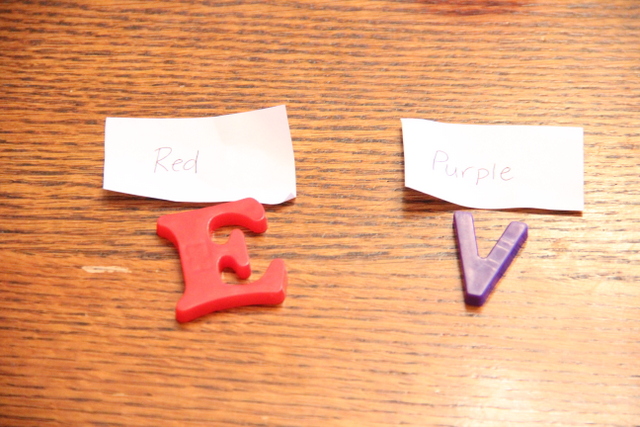
This color scavenger hunt is so easy to set up…and so much fun. Kids can work on identifying color names, and color matching. I wrote different colors on slips of paper and put them into plastic eggs. The kids got to pick an egg from the bowl and “sound out” the color on the slip of paper. Ok, my 5 year old sounded out the color with help. The other two said the first letter of the word and guessed the color. They were pretty excited to “read” the color on their slip of paper!
Another idea to expand this activity is to write words and do an Easter egg version of our word scavenger hunt.
An Easter Game Kids will Love
Now for the egg game…So then, they had to run off and find something that was the color of the written word on their slip of paper…and it had to FIT inside the egg. I sat and waited for them to run back and show me what they found while they tried to fit it in their egg. (completely genius way for this mom to finish a cup of coffee!)
They had a little trouble with some things, but this was a fun and different way to work on visual perceptual skills. Will that little doll fit in the egg? We weren’t sure by looking at it, but with a little fiddling, she did! Fitting the eggs together with the little objects inside was a great fine motor exercise.
Color Identification for Kids
They found something for each color!
Putting items into the eggs and then matching colors was a great way to work on color identification skills.
Matching colors requires visual motor skills to match colors and use that recognition in identifying the name of the color. It’s a skill that requires visual memory as well as working memory. This skill then carries over to so many other areas like letter recognition, and so much more.
This Easter themed play activity could be modified in so many ways for learning words, colors…have fun with it 🙂
Want more ways to play and learn this time of year?
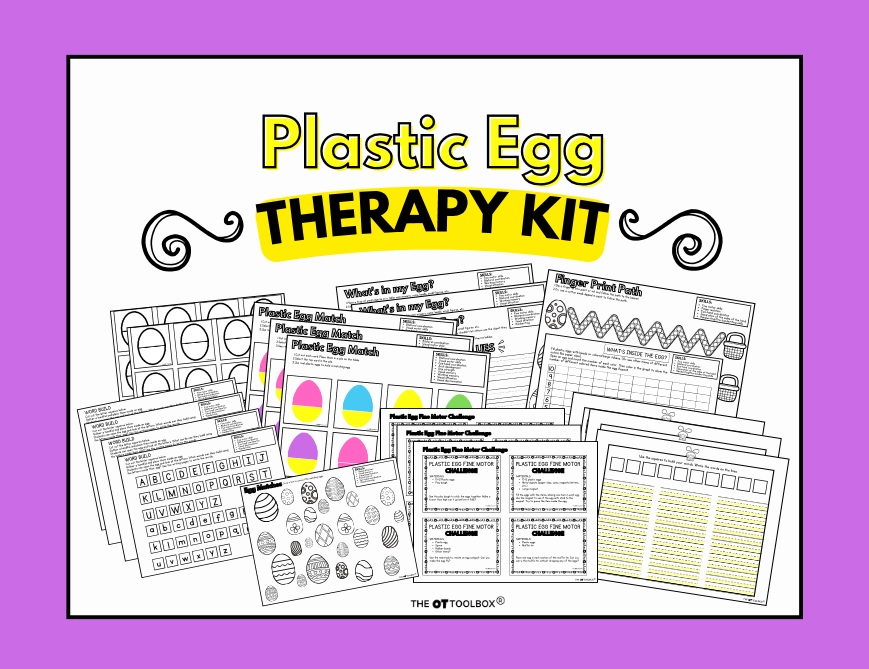
One resource we love is our $5 therapy kit…the Plastic Egg Therapy Kit! It has 27 printable pages of activities with an Easter egg theme. In the kit, you’ll find fine motor activities, handwriting prompts, letter formation pages, pencil control sheets, plastic egg activities, matching cards, graphing activities, STEM fine motor task cards, and more. There are several pages of differentiated lines to meet a variety of needs. This therapy kit has everything done for you.
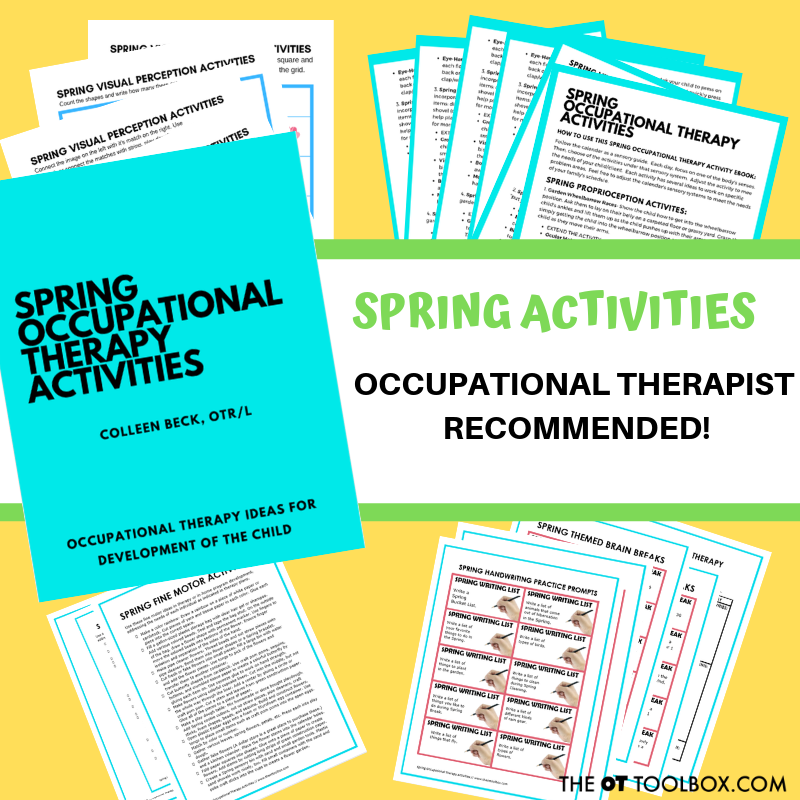
This time of year, one of our more popular products here on The OT Toolbox is our Spring Occupational Therapy packet. The best news is that, this packet has had a major upgrade from it’s previous collection of spring sensory activities.
Another great tool for supporting skills is the Spring OT packet…
In the Spring OT packet, you’ll now find:
Spring Proprioceptive Activities
Spring Vestibular Activities
Spring Visual Processing Activities
Spring Tactile Processing Activities
Spring Olfactory Activities
Spring Auditory Processing Activities
Spring Oral Motor Activities
Spring Fine Motor Activities
Spring Gross Motor Activities
Spring Handwriting Practice Prompts
Spring Themed Brain Breaks
Occupational Therapy Homework Page
Client-Centered Worksheet
5 pages of Visual Perceptual Skill Activities
All of the Spring activities include ideas to promote the various areas of sensory processing with a Spring-theme. There are ways to upgrade and downgrade the activities and each activities includes strategies to incorporate eye-hand coordination, bilateral coordination, body scheme, oculomotor control, visual perception, fine and gross motor skills, and more.
THE BEST THING ABOUT THE SPRING ACTIVITY PACKET:
One of my favorite parts of the Spring Occupational Therapy Packet is the therapist tool section:
Occupational Therapy Homework Page
Client-Centered Worksheet
These two sheets are perfect for the therapist looking to incorporate carryover of skills. Use the homework page to provide specific OT recommended activities to be completed at home. This is great for those sills that parents strive to see success in but need more practice time for achieving certain skill levels. This activity packet is 26 pages long and has everything you need to work on the skills kids are struggling with…with a Spring theme!
Colleen Beck, OTR/L has been an occupational therapist since 2000, working in school-based, hand therapy, outpatient peds, EI, and SNF. Colleen created The OT Toolbox to inspire therapists, teachers, and parents with easy and fun tools to help children thrive. Read her story about going from an OT making $3/hour (after paying for kids’ childcare) to a full-time OT resource creator for millions of readers. Want to collaborate? Send an email to contact@theottoolbox.com.
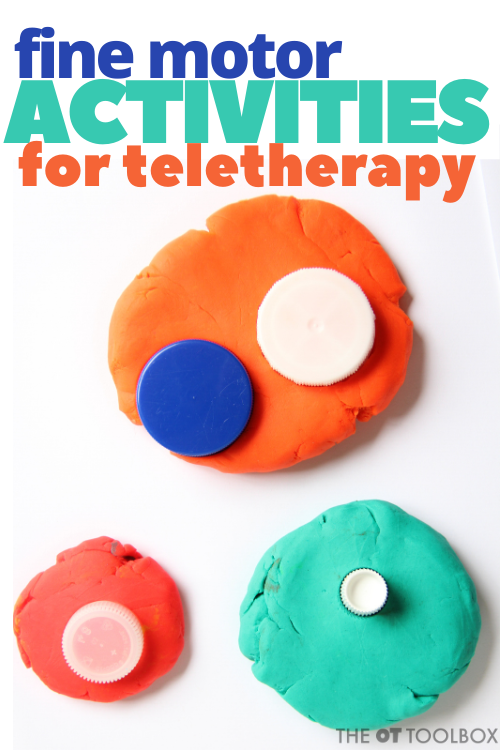
Working on fine motor skills in teletherapy services can be a strange thing to consider if you re used to face to face occupational therapy intervention. Helping a child to engage in fine motor activities in a virtual setting may seem downright strange. How to do you help kids work on areas like hand strength, dexterity, or other fine motor skill needs? The use of teletherapy fine motor activities, also known as manipulatives, may at first overwhelm therapists who do not understand how this would work virtually.
However, there are a range of ways to incorporate fine motor activities into teletherapy occupational therapy treatment sessions. Therapists can use extra creativity to develop fine motor activities for teletherapy sessions, but they can also use some of the same activities they would use in-person (with a bit of preparation and/or assistance from an “e-helper”).
A recent post here on The OT Toolbox explains the basics of understanding teletherapy and what this looks like. You’ll also want to check out this piece on occupational therapy activities in teletherapy for easy-to-implement ideas for children of all ages. What about the child who needs to work on fine motor skills?
Today, we’re discussing some popular, but effective fine motor activities for teletherapists.
How to work on Fine Motor skills in teletherapy
Using a teletherapy platform to provide therapy services doesn’t mean children can’t work on essential skill areas. Here are some ideas to get your creative brain started.
One everyday item found in most homes is paper clips. Use these games with paper clips to target specific skills.
Theraband Activities in telehealth
As you may already know, theraband or resistive bands are a trusty therapy tool that can be used by therapists to treat a variety of populations in a range of settings. Teletherapists can use theraband to strengthen a child’s fine motor skills in preparation for tasks such as handwriting, dressing, eating, play, and other self-care tasks. What’s more is that resistive band exercises can be included in a sensory diet that helps children to regulate themselves so they are able to participate in fine motor activities.
Some of the following theraband activities can assist with fine motor strength and coordination in children:
Grab each end of the theraband, make a fist, and pull the band apart at the same time (this works on general digit and wrist strength)
With smaller theraband elastics, place the band around the tips of all of your fingers, then spread all your fingers apart, and repeat (this works on digit abduction and adduction)
Rest your hand flat on the table, wrap a theraband elastic around one finger at a time while using your other hand to pull on the opposite end of the band; resist the pressure of the band by trying to move each finger to its resting state, which is flat on the table (this works on digit isolation and coordination)
Therapists can find more detailed videos that guide children through these exercises, or they can demonstrate for them during sessions. This often works best when children have “e-helpers” to assist in getting theraband and possibly helping children learn to use it during the first several times or as part of their home programs.
Use Pipe Cleaners in Fine Motor Activities during teletherapy sessions
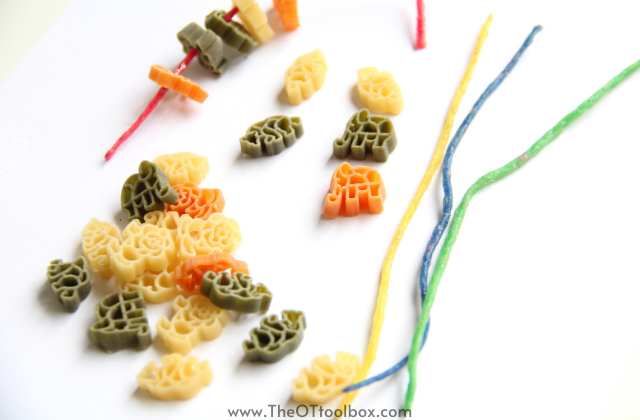
Children can use pipe cleaners to work on fine motor strengthening during a variety of tasks during teletherapy sessions. Pipe cleaners may most easily be utilized during treatment sessions to string beads or other small objects on them. This helps children develop fine motor precision, coordination, strength, digit isolation, and more.
Children can also use scissors to cut pipe cleaners into smaller pieces and make into certain objects, fill in pictures to add color, and more.
Another good way to use pipe cleaners in teletherapy sessions is to ask children to be creative and bend them into certain shapes, objects, or letters.
This is another example of materials that parents, guardians, and other loved ones can obtain and provide for their children to use during therapy sessions.
Use Tweezers during fine motor activities in teletherapy sessions
Therapists can have children use tweezers to improve their grasp pattern, fine motor coordination, and fine motor strength. This will help children form an improved grasp pattern and overall greater range of motion in the hand as preparation for handwriting tasks. Therapists can utilize tweezers along with small objects in a variety of ways:
Have children pick up beads or cotton balls with tweezers
Ask children to use tweezers to place small perler beads on glue or within a picture to add color or texture
Use tweezers to move small objects around on a table, but not pick them up
Therapists who use their creativity can easily incorporate manipulatives into teletherapy treatment. Again, the intermittent assistance of e-helpers can really improve a child’s performance and engagement in the teletherapy treatment process.
Here are additional ways to work on fine motor skills during teletherapy using items that are commonly found in the home:
Children who have previously received occupational therapy services in a face-to-face setting may feel a little confused or out of sorts when they now need to complete fine motor tasks at home (and with items that are way less fun than what they are used to their OT playing with alongside them. Here is a fun book to help explain why they are now working on hard things like fine motor skills with their therapist through a computer screen.
Affiliate links are included below.
Free Parent Handout for Teletherapy Materials
This free printable and handout will help parents understand basic, everyday materials that kids can use in their therapy sessions. Use this to help kids come to therapy sessions with just a handful of household materials.
Colleen Beck, OTR/L has been an occupational therapist since 2000, working in school-based, hand therapy, outpatient peds, EI, and SNF. Colleen created The OT Toolbox to inspire therapists, teachers, and parents with easy and fun tools to help children thrive. Read her story about going from an OT making $3/hour (after paying for kids’ childcare) to a full-time OT resource creator for millions of readers. Want to collaborate? Send an email to contact@theottoolbox.com.
This blog post was written byBrittany Ferri. Brittany is an occupational therapist, author, and teletherapy professional. She is passionate about education, health promotion, and disease prevention for all. Brittany currently practices in community-based teletherapy for two platforms, one that serves pediatrics (geared toward mental health diagnoses and developmental delays) and one that serves adults. For more information, visit her company’s website at www.simplicityofhealth.com
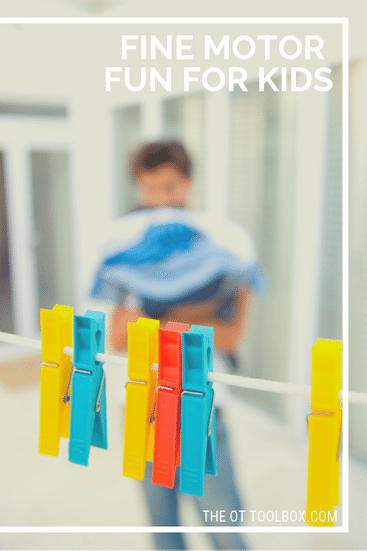
Looking for fine motor activities you can do with kids at home and using items you already have in the house? Today, I’ve got fine motor activities using clothespins. These are great finger strength exercises using activities that can be shared with families so they can work on skills at home or as part of an occupational therapy home program. These activities ideas need just clothespins, so it’s a great way to work on fine motor skills as part of teletherapy or virtual occupational therapy services. For more activities you can easily set up at home, check out some of the posts listed below. In all of them, we are talking about fine motor activities using items you already have in the home.
FIne Motor Activities Using Items You Have at Home
When using clothespins to work on fine motor skills, kids can address so many underlying skill areas. Fine motor skills like bilateral coordination, hand strength, arch strength, intrinsic hand strength, eye-hand coordination, motor planning, proprioceptive sensory input, and so many other areas. All of these components of fine motor skills are covered here on The OT Toolbox. Check out the menu drop down bar above for activities geared toward each of these specific skills.
Pinch onto the edge of a table when laying underneath for overhead reach. Hang up paper
Make a sheet fort
Squeeze onto craft wire to make a sculpture
Use to count in math centers
Pinch into clothing (sleeve) for a kindness count
We have created a video to show how to use clothes pins to support development of different grasp patterns. You can watch this video below. If you can’t view the video, check it out on The OT Toolbox YouTube channel.
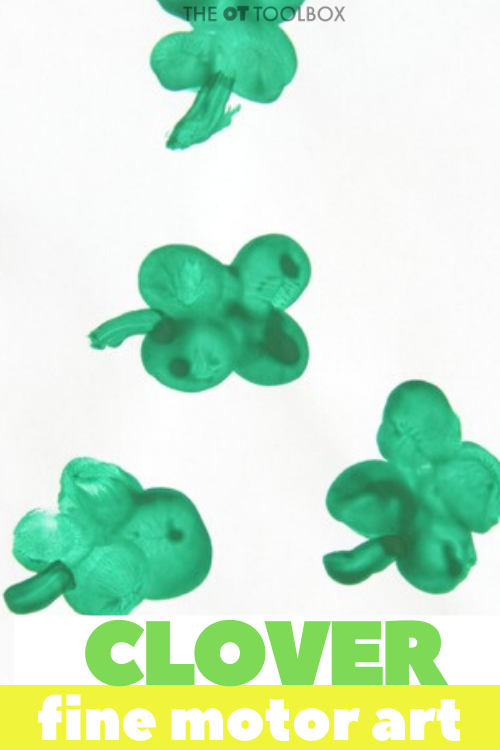
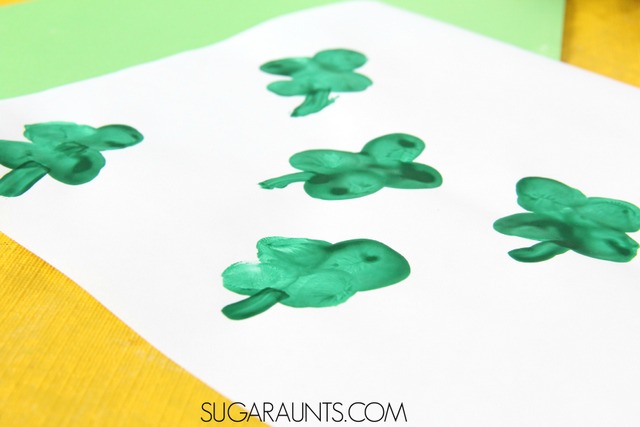
Here is a super easy St. Patrick’s Day craft and fingerprint art that builds skills. We made this simple clover thumbprint art one day as we geared up for St. Patrick’s Day. We made four leaf clovers, but you could make shamrocks too. The important part is that kids are getting a great experience with strengthening finger isolation…a much needed fine motor skill for functional tasks like tying shoes, typing, pencil grasp, and so many more dexterity tasks.
Help Kids with Finger Isolation
What is finger isolation? It’s an important fine motor skill! Here is a more detailed explanation of finger isolation and functional tasks, but in short, here’s what you should know:
Finger isolation typically develops in the baby at around 6 months of age as they begin to pick up small pieces of cereal. It progresses to pointing, and then separation of the two sides of the hand with in-hand manipulation. Finger isolation is so important in fine motor dexterity in every task that the hands perform.
Fingerprint art like the four leaf clovers in this St. Patrick’s Day craft promotes isolation of the index finger.
Fingerprint art like this one allows students to isolate one finger and bend (flex) the rest of the fingers into a fist. This is refinement from the fisted hand and “raking” motion that babies and young toddlers demonstrate. To create a fingerprint, the ulnar (pinkie side of the hand) are stabilized with the pinkie and ring fingers bent into the palm, or are positioned with the pinkie finger extended and abducted (spread apart).
This positioning allows the knuckle joints (metacarpals) to stabilize and allow the pointer and middle fingers to be used with more control. The separation of the radial and ulnar sides of the hand allows for more skilled fine motor manipulation.
Rainbow Finger Isolation Art
Take the finger isolation skills a step further by making a whole rainbow of fingerprint art. Here’s how you can make a rainbow craft to work on finger isolation:
Pour a rainbow variety of paint colors on a paper plate.
Ask your kiddo wot point their index finger into red. They can make a curved line of red dots on a piece of paper. Ensure the remainder of the fingers are tucked into the palm with the thumb holding them in place.
Ask them to wipe off their finger for proprioceptive input through the joints of the finger. Talk about awareness and heavy work!
Move on to orange. They can follow the curve of their rainbow to make each color in rainbow order.
Wipe off each finger in between colors for more feedback.
Simple St. Patrick’s Day Craft
This post contains affiliate links.
This craft needs just one item (besides the paper you’re printing on!) We love this green paint for it’s bright color. Pour a little on a paper plate and you are ready for fingerprint art.
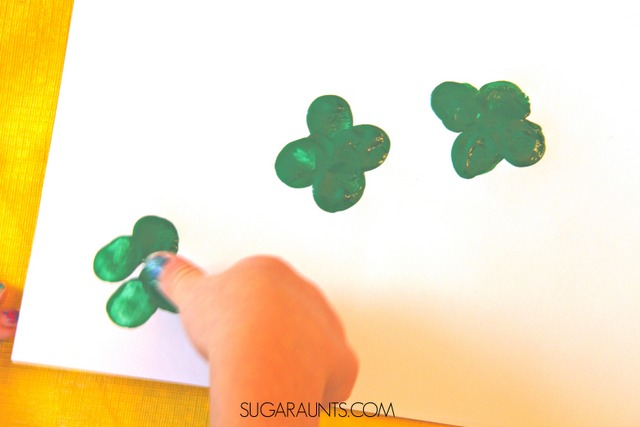
Show your child how to make a thumbprint using the green paint. Kids can use either their index finger or thumb to make these prints.
Make a little stem using the paint. The four leaf clovers are done! These would be cute on a fun St. Patrick’s Day card, or just for fun.
Colleen Beck, OTR/L has been an occupational therapist since 2000, working in school-based, hand therapy, outpatient peds, EI, and SNF. Colleen created The OT Toolbox to inspire therapists, teachers, and parents with easy and fun tools to help children thrive. Read her story about going from an OT making $3/hour (after paying for kids’ childcare) to a full-time OT resource creator for millions of readers. Want to collaborate? Send an email to contact@theottoolbox.com.
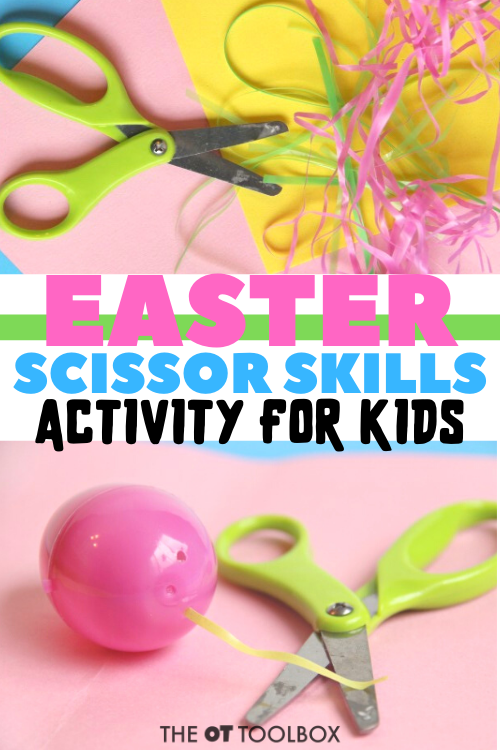
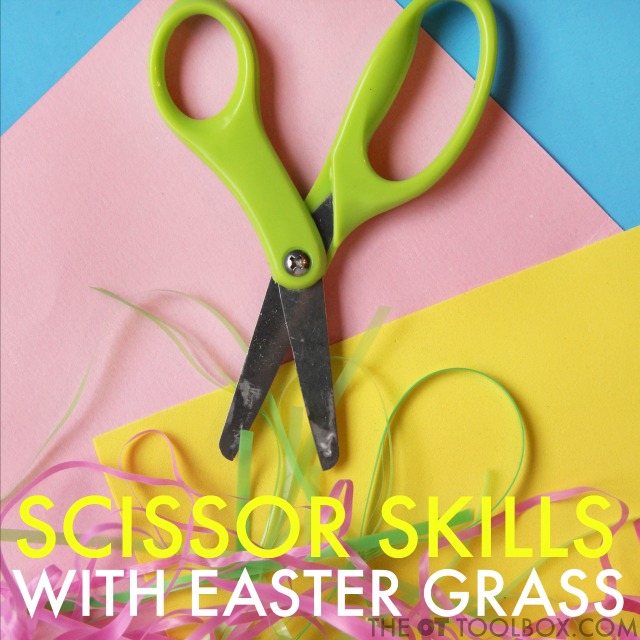
This Easter scissor skills activity for kids is a creative way to work on scissor skills with kids this time of year. Coming up with Easter ideas for kids doesn’t need to be difficult. Use a few items found at your dollar store to help kids address skills like bilateral coordination, graded precision with scissor control, and eye-hand coordination and other fine motor skills. In fact, adding this fine motor activity to an Easter or Spring craft session can be a fun way to build specific skills in a fun way.
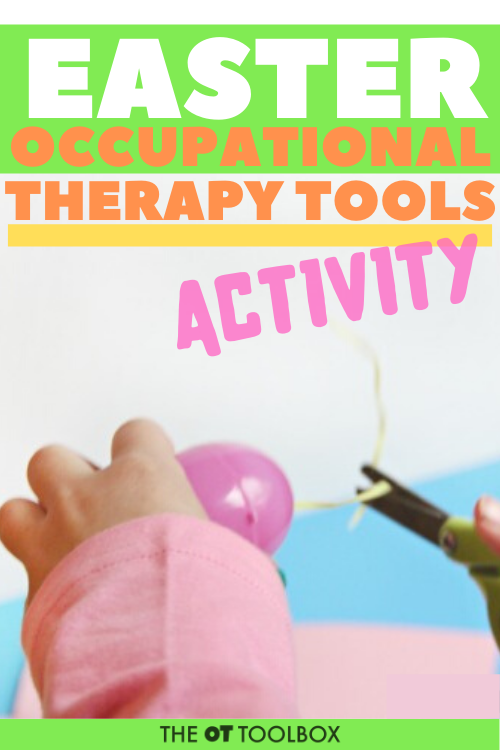
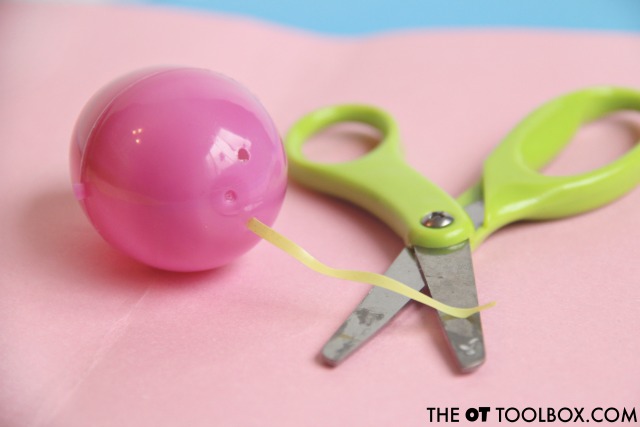
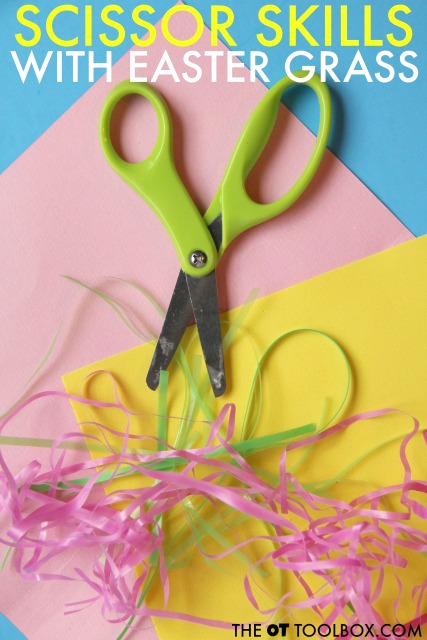
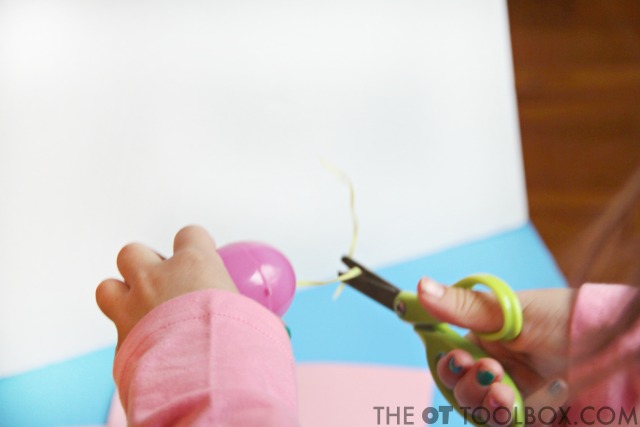
This is a quick and easy scissor activity to add to your occupational therapy toolkit. We used a plastic Easter egg and Easter grass (the kind that is used to fill Easter baskets) to work on basic scissor skills like opening and shutting the scissors and using the non-dominant helper hand in a fun cutting activity.
Easter Activity for Kids
This post contains affiliate links.
You’ll need just a few materials for this scissor activity:
Scissors (These are my favorite brand for helping kids learn to cut.)
A scissor activity that is easy to create is a great activity for the Occupational Therapist’s therapy toolkit. We used plastic Easter eggs from our Easter supply bin to hold a long strand of Easter grass. Both of these items can be found at your dollar store, making this a frugal way to address scissor skills.
To create this Easter themed scissor activity, open up the plastic egg. Then, place a long strand of Easter grass in the egg and thread one end of the grass through the hole in the egg. Most plastic Easter eggs have a small hole in one end. If yours doesn’t, then this activity won’t work. Simply look for an egg with the hole in one end of the plastic egg. And that’s it!
You now have an Easter-themed scissor activity ready for practicing basic scissor skills.
Occupational therapy Tools and SKills
There are a myriad number of skills that an occupational therapist can address in kids. Occupational therapists address the underlying skills that interfere with function and occupation. Those OT skills include of fine motor strength, dexterity, stability, coordination, visual perception, sensory processing…the list goes on and on when it comes to meaningful occupations and the occupational therapy tools that address these areas..
One such occupational therapy area that this OT tool addresses are independence with using scissor as well as precision with scissors in their dominant hand. Kids can hold the egg in one hand while managing bilateral coordination, precision, laterality and more. They can pull out the Easter grass through the egg and work on cutting bits of the grass. With a small piece of Easter grass sticking out of the egg, kids can address precision grasp and release when using scissors during cutting tasks. The egg makes a great grasping tool for younger kids. While use of scissors requires children to hold onto and manipulate paper with their non-dominant hand, holding the egg promotes a power grasp with arch development during this cutting with scissors.
Pulling the strand of grass out of the egg is a nice way to work on neat pincer grasp and threading more into the plastic egg’s hole is an excellent way to encourage fine motor development. Here are more Spring fine motor activities to keep your little ones busy and working on hand strength and dexterity this time of year.
Score Fine Motor Tools and resources and help kids build the skills they need to thrive!
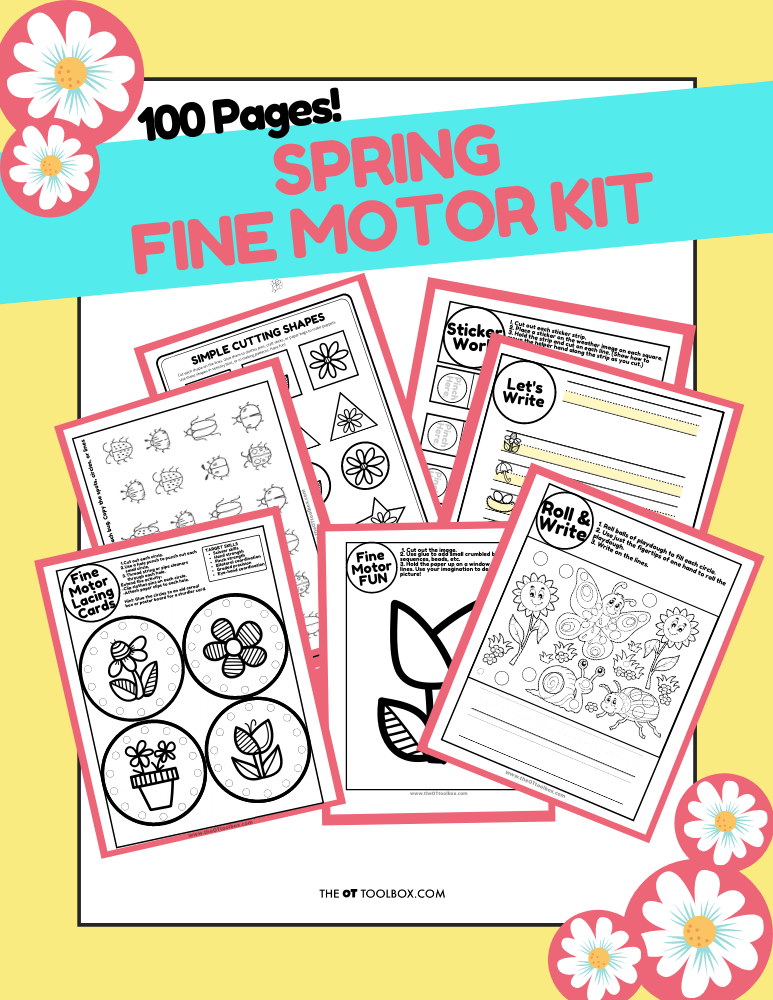
Developing hand strength, dexterity, dexterity, precision skills, and eye-hand coordination skills that kids need for holding and writing with a pencil, coloring, and manipulating small objects in every day task doesn’t need to be difficult. The Spring Fine Motor Kit includes 100 pages of fine motor activities, worksheets, crafts, and more:
Colleen Beck, OTR/L has been an occupational therapist since 2000, working in school-based, hand therapy, outpatient peds, EI, and SNF. Colleen created The OT Toolbox to inspire therapists, teachers, and parents with easy and fun tools to help children thrive. Read her story about going from an OT making $3/hour (after paying for kids’ childcare) to a full-time OT resource creator for millions of readers. Want to collaborate? Send an email to contact@theottoolbox.com.
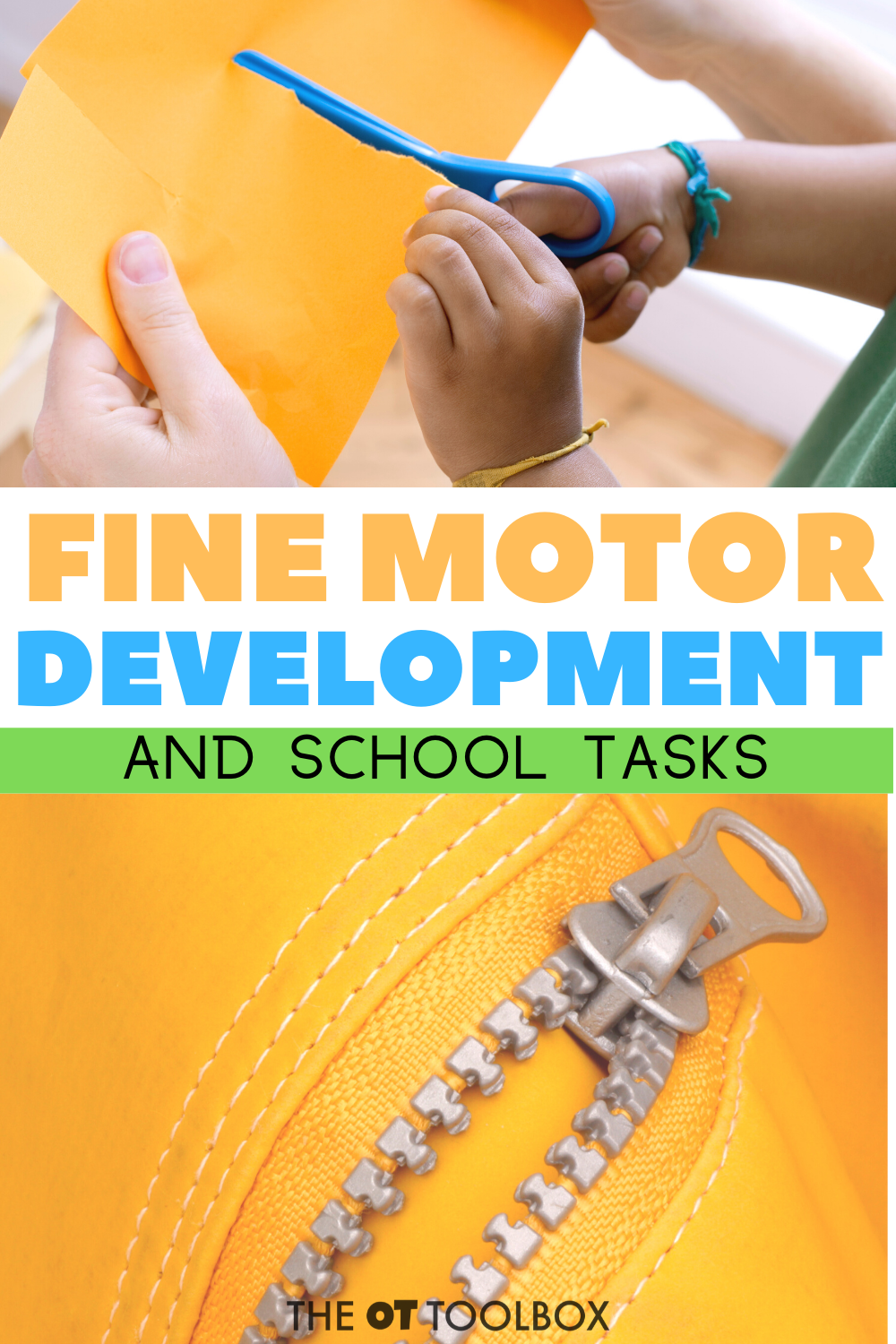
Occupational Therapists are often times consulted to assess a child for their fine motor skills that are needed in school and for resources to build fine motor skills in the classroom. When a child’s fine motor skills are lacking, classroom tasks can be difficult and result in delays in many aspects that are necessary for learning and functioning in the school environment.
Today, I’m sharing a breakdown of fine motor skills in the school environment and how to build these skills during the school day through simple strategies. One of these strategies is Finger Aerobics. Read on to learn more about finger aerobics exercises for a fine motor writing warm-up exercise.
Fine Motor Skills Needed at School
A recent article in the American Journal of Occupational Therapist called Fine Motor Activities in Elementary School Children: A Replication Study examined the motor and technology requirements of kindergarten, second-, and fourth-grade general education classrooms.
The study found that students spend between 37.1% to 60.2% of the school day performing fine motor activities, with handwriting accounting for 3.4%–18.0% of the day. Does that surprise you? We are talking about all of the fine motor tasks students complete during the school day in this post, but it certainly makes sense that a large portion of the school day includes fine motor work.
The study provides an updated information on the amount of handwriting, technology requirements, and fine motor work that children are taking part in during the school day.
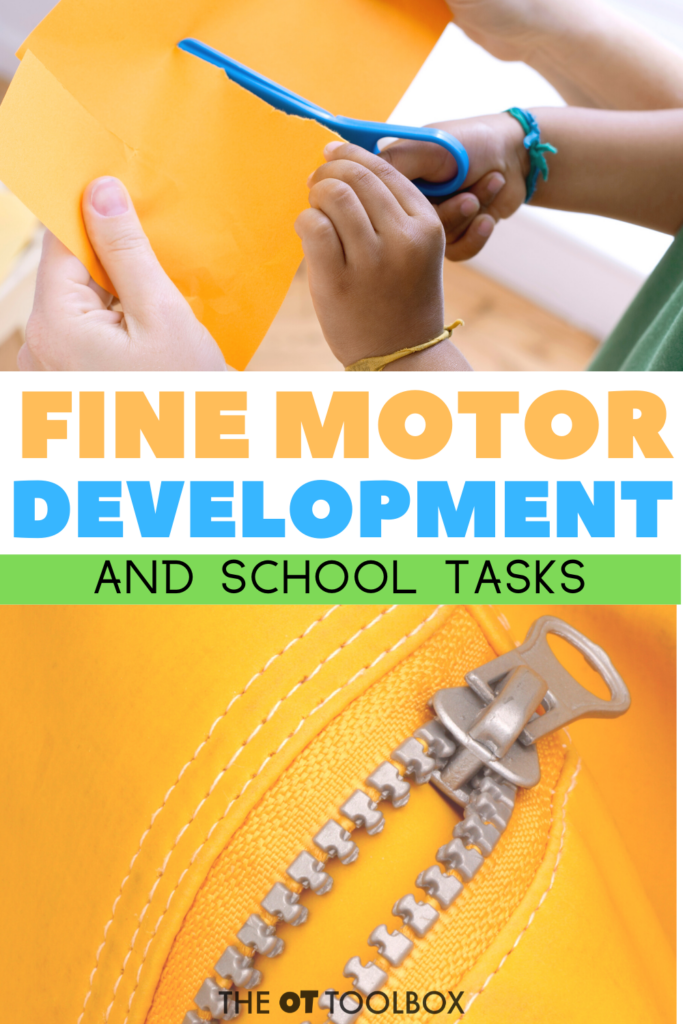
The study also found that fine motor skills were integrated into tasks throughout the day, including transitions to and from the classroom and between activities. tasks like unzipping a backpack to get out paperwork for the teacher, gathering materials, managing writing utensils such as pencils and markers, activities of daily living (e.g., zipping and buttoning jackets for recess), and technology use (e.g., using a finger to complete a maze on the Smartboard) all are included in the school day. These tasks require development and integration of fine motor skills. It should be noted that students who struggle with fine motor skills will likely struggle throughout the day.
When you stop and think about all of the contributing factors that impact fine motor development and strength, it is no wonder that kids are struggling more than they seemed to in the past (this is coming from personal experience, but I think most of you might agree that kids seem to struggle more with fine motor, pencil grasp, and visual motor skills than they did years ago.) There are so many considerations that play a part in fine motor woes. Check out the fine motor development considerations listed below.
Fine Motor Development Considerations
These are areas of childhood that impact the development of fine motor skills.
Skip crawling and move straight to walking
More time being rushed around in baby carriers
Time spent in “baby positioners”
Less “free play” and more scheduled activities
Less exposure to small parts and creative play (More structured and planned play)
Less movement-based and developmentally appropriate learning in preschool, kindergarten, and the younger grades
More time on screens
Early screen-time exposure
Less outdoor time and strengthening through heavy work/outdoor play
What would you add to this list?
Knowing all of this, we can empower our kiddos with support and fine motor activities integrated right into their classrooms and play. Here are some tools and resources to help with those fine motor struggles:
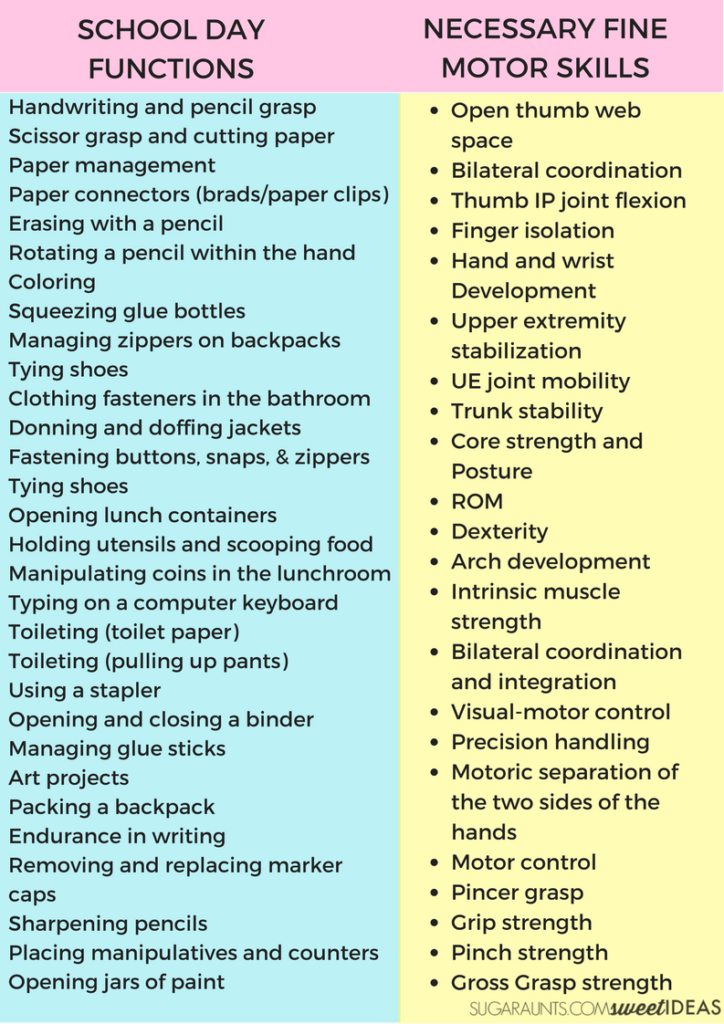
Fine motor skills are essential for independence and functioning within the classroom environment. Consider all of the areas where fine motor skills are needed for ease during the school day:
Handwriting and pencil grasp Scissor grasp and cutting paper Paper management including placing papers into folders Paper clip management Paper connectors (brads) management Erasing with a pencil Rotating a pencil within the hand Coloring Squeezing glue bottles Removing glue caps from squeeze bottles or glue sticks managing zippers on backpacks Tying shoes Managing clothing and clothing fasteners during bathroom breaks Donning and doffing jackets and coats Managing buttons, snaps, and zippers on coats and jackets Tying shoes Opening containers in the lunch room Holding utensils and scooping food to eat Picking up small pieces of food Manipulating coins in the lunchroom Typing on a computer keyboard Toileting (tearing toilet paper and wiping) Toileting (pulling up pants) Using a stapler Opening and closing a three ring binder Managing glue sticks Art projects Packing a backpack Endurance in writing Removing and putting on caps on markers Sharpening pencils Placing manipulatives and counters accurately in hands-on math activities Opening jars of paint
Fine Motor Skills Examples
Fine motor skills play a huge part of a student’s day! So what are fine motor skills? I explained in detail the various aspects of and examples of fine motor skills. For more examples of fine motor skills, check out the list below. These are the aspects of motor work that play a part in fine motor tasks during a child’s school day. All of these skill areas are types of fine motor skills that impact function, in big ways.
These daily functions within the school environment require many fine motor skills. Each daily task requires many fine motor skills:
Open thumb web space
Bilateral coordination
Thumb IP joint flexion
Finger isolation
Hand and wrist Development
Upper extremity stabilization
UE joint mobility
Trunk stability
Core strength and Posture
ROM
Dexterity
Arch development
Intrinsic muscle strength
Bilateral coordination and integration
Visual-motor control
Precision skills and graded fine motor skills in handling objects
Motoric separation of the two sides of the hands
Motor control
Pincer grasp
Grip strength
Pinch strength
Gross Grasp strength
Definition of Fine Motor Skills
Occupational therapists know the definition of fine motor skills. It’s an integral part of every therapy evaluation.
For a layman’s definition of fine motor, the Medical Dictionary defines fine motor skills as: “Any of the motor skills that require greater control of the small muscles than large ones, especially for hand eye coordination or for precise hand and finger movement. Fine motor skills include handwriting, sewing, and fastening buttons. Most movements require both large and small muscle groups, and there is considerable overlap between fine and gross motor skills, but distinguishing between the two is useful in rehabilitation settings, special education, adapted physical education tests, motor development tests, and aptitude tests in industry and in the military.”
When fine motor skills are delayed, a student’s success in the classroom can be greatly impaired.
There are many reasons that fine motor skills might be lacking, resulting in delays in functional skills: Muscle weakness Dysgraphia Low tone Delayed wrist and hand development Poor posture and core strength Insufficient somatosensory input with failure to develop kinesthesia Insufficient visual control Incomplete bilateral integration Incomplete utilization of proximal joints of the upper extremity including poor support Inadequate spatial analysis and or synthesis skills Insufficient visual-motor control Delayed or inadequate arch development Underdeveloped precision handling Difficulty with Motoric separation of the two sides of the hands.
Fine Motor Development
Fine motor development and successful use of refined motor skills in functional tasks relies on a sensorimotor foundation of trunk and arm stability, strength, manipulation, ability to motor plan, and effective coordination of visual motor information.
When kids are required to perform classroom and school activities without these foundations in place, difficulties arise, resulting in frustration, feelings of failure, and behaviors. So many times, there is a question of whether a student should be referred to the school-based OT for evaluation and assessment of fine motor skills for improved success in the classroom.
Teachers, parents, and school support staff should consider a referral to the school-based Occupational Therapist if the following fine motor conditions are observed and are effecting school occupations and learning.
Signs a Student Needs Occupational Therapy in the School for Fine Motor Skill Development: Difficulty holding scissors and cutting shapes when age-appropriate Trouble with letter/number formation or reverses letters Avoids fine motor activities Trouble using an effective pencil grasp Fatigue when coloring Difficulty erasing without tearing paper Writes too lightly or too dark and written work is illegible Difficulty putting on coat, managing buttons/zippers/snaps, or tying shoes (from what is age appropriate) Switches hands during activities
There are some easy ways to build fine motor skills right in the classroom. Try some of these strategies to accommodating for poor fine motor skills that might impact a student’s success in the classroom:
Classroom strategies for addressing fine motor skills at school
Try various writing utensils. Work on various writing surfaces (chalkboard, slant board, easel). Use a kneaded eraser for less required effort when erasing. Evaluate pencil grasp and try various pencil grips to modify for efficiency. Utilize techniques for organizing papers when motor planning is an issue. Manage papers and bilateral coordination by taping paper to the desk.
Finger Aerobics for Building Fine Motor Skills
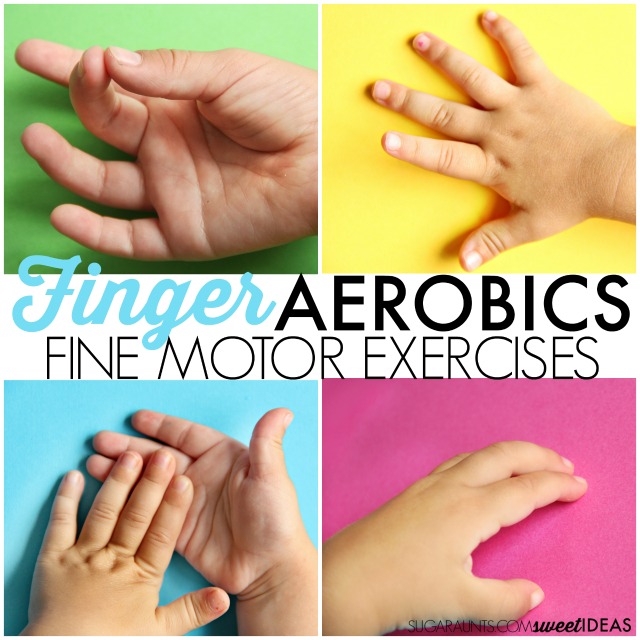
One strategy that is helpful in building fine motor skills in the classroom is finger aerobics. These finger motor movement exercises are activities that can be used by the whole classroom as part of a handwriting warm-up exercise. Kids with poor fine motor skills can oftentimes struggle with hand functions and tool use in the classroom. Finger dexterity activities like finger aerobics promote sensorimotor awareness and manipulation of the hands. Finger aerobics are ideal as a transitional movement activity for the whole classroom or a brain break type of activity.
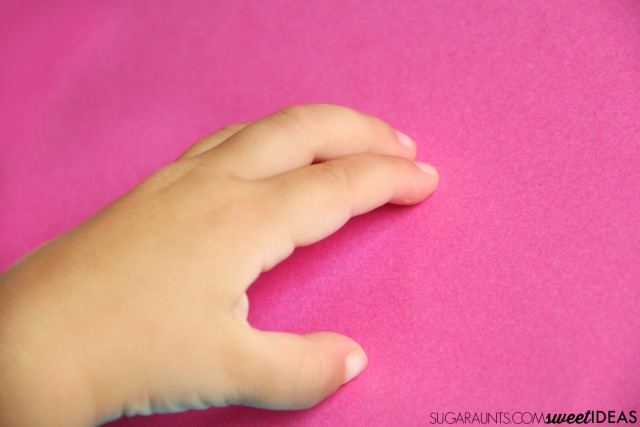
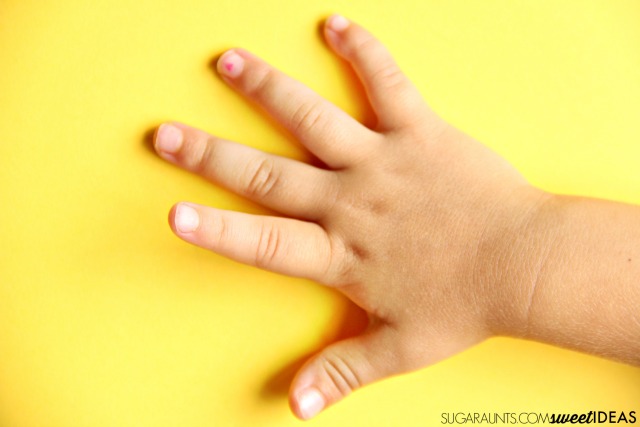
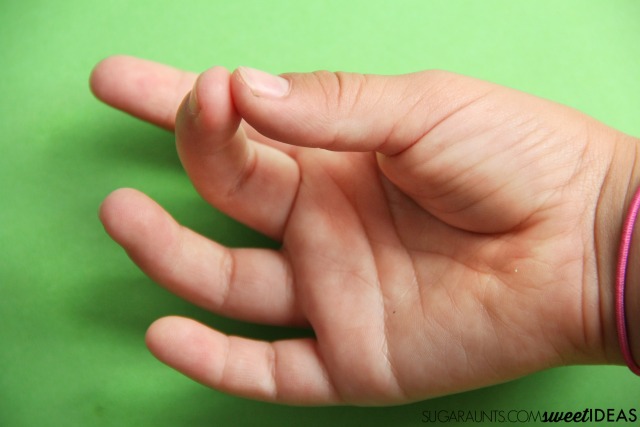
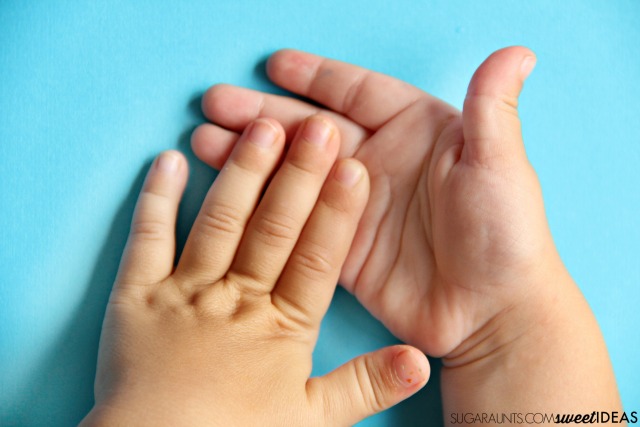
Check out the finger aerobics in the images and descriptions below:
Spider Push-Ups: Show the students how to place both hands together with palms and fingers touching. Then, show them how to push the hands away from each other at the palm. The fingertips should remain in contact.
Finger Pick-Ups: The students should stand at their desk and place their hands flat on the desk surface. They can then pick up each finger in isolation. Ask them to raise each finger from the desk surface 3 times and then pick up and hold each finger individually for several seconds.
Fingertip Touch: Ask the students to touch their thumbs to the tips of each of the fingers. They can do both hands at the same time or one hand at a time. Then, ask them to touch the tip of their thumb to the base of each finger. They can touch the tip or base of each finger at different speeds, as they spell words, or count in various increments. Next, ask them to touch the tips or bases of each finger with their hands held behind their back or out of their field of vision.
Finger Sounds: Ask the students to close their eyes. Then, the teacher or group leader can ask the students to listen carefully as she makes sounds with her hands. The teacher can make one sound and then ask the students to repeat the sound using their hands. Ideas include: rubbing the hands together to make a soft swishing sound, snapping, clapping, thigh slapping, finger tapping, or patting the desk. The students should keep their eyes closed as they repeat each individual sound.
Fist Squeeze: Ask the students to make a fist with both hands. Then, they should try placing their thumb in different positions and squeezing as hard as they can. Try the thumb at the side of the fingers, wrapped over the knuckles, and tucked under the fingertips. Show them how to stretch out the fingers and then repeat.
Spider Crawl: Ask the students to stand up behind their desks. They can then place both hands with the palm and fingers flat on the desk surface. Show the students how to make their hands “crawl” across the desk like spiders. They can move both hands together symmetrically and individually in different directions. Keep the palm lightly positioned on the desk surface.
Finger Muscles: Show the students how to use their other hand to provide resistance for squeezing. They can place their pointer finger or their pointer and middle finger of one hand on the outstretched fingers of the other hand. Ask them to squeeze their fingers and then to try to push against the fingers.
Writing Gloves: Ask the students to pretend to put a glove on their hands, slowly moving the glove over each finger. They should push each finger down individually. Then, they can remove that pretend glove, one finger at a time. This is an especially calming activity that provides proprioceptive input through joint compressions.
Finger Ducks: Ask the students to straiten the fingers and thumbs to create a “duck” puppet with just their fingers. They can make the duck open and close it’s mouth to spell words, count, or read. Then, ask them to pretend that the duck ate a lemon as they pull the finger tips into the palm. This is a great activity that strengthens the lumbrical muscles of the hands.
You can view all of the exercises here:
Be sure to visit the other Occupational Therapists and Physical Therapists who are writing about School Day Functions this month in the Functional Skills for Kids series.
More Fine Motor Activities that will build skills needed for Function and Learning in School:
Sierra Caramia, Amanpreet Gill, Alisha Ohl, David Schelly; Fine Motor Activities in Elementary School Children: A Replication Study. Am J Occup Ther 2020;74(2):7402345010. https://doi.org/10.5014/ajot.2020.035014
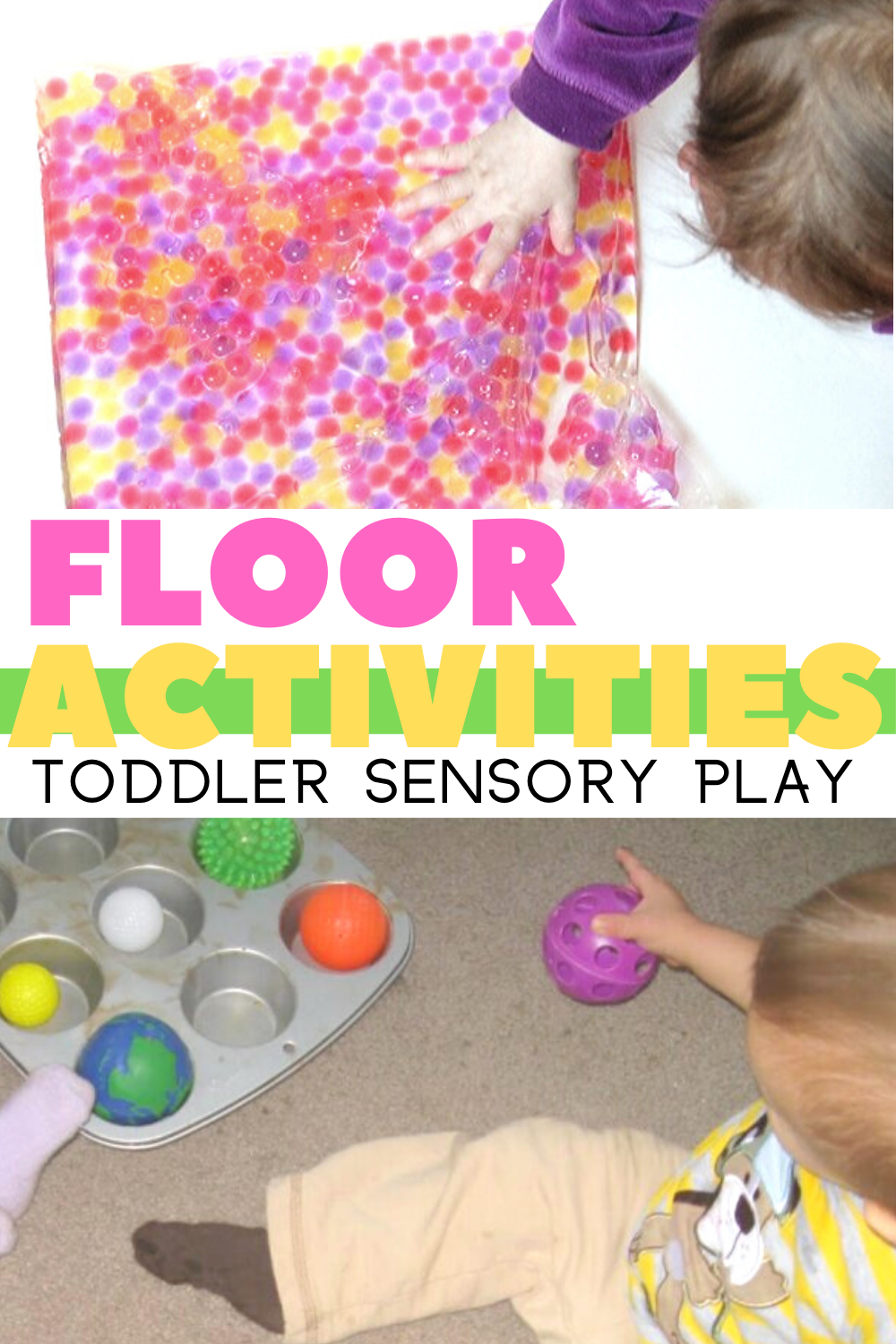
Baby floor play is one of those essential play activities that maybe kids are missing out on more than ever. Here we are talking about why babies need to get down on the floor to baby play, and how to set up floor play activities for babies and toddlers. Baby development depends on movement and play. These ideas will guide you in creating play activities that maximize child development through those early years.
Another great resource to check out is a new blog post on DIR Floortime.
What is Floor Play
Floor play and movement play is one of those things that not only help babies develop essential skills, it is a powerful way to help them excel with higher level tasks. There is so much more than just placing a baby down on the floor to play. Let me explain…
When little ones are on the floor in tummy time or in play activities, they are developing essential core strength and visual perceptual skills that will help them down the road in areas like reading, endurance in play, and even handwriting. Here is more information on how floor play and tummy time helps with the development of spatial awareness and other visual perception skills.
Time spent on the floor helps with kinesthetic intelligence as well. With tummy time play comes skills like body awareness and reasoning, eye-hand coordination, motor skills, and spatial ability for function.
Play For Babies
For babies, tummy time helps to build strength in the core, arms, neck, and shoulder girdle needed for sitting up, changing of positions, and coordination. Here are baby play ideas that can be incorporated into floor time activities. Movement like participating in play, changing positions, reaching, crawling, moving objects, and functional tasks require endurance and stability. Tummy time is an important task for infant babies as well as older babies for different reasons. In each stage, floor play encourages use of the body and eyes in coordinated motor plans.
More Floor Activities for Babiesand toddlers
Floor play for babies can look like toys placed in front of the infant. Using noise toys, rattles, and eye-catching toys encourages reach, visual tracking, neck and head movement, and development of visual processing and auditory processing.
Floor play for infants can look like a scattering of toys placed in a circle around the child. This positioning encourages turning, rolling, and creeping or crawling, especially when the little one is pushing up onf their elbows and hands.
For very small babies, floor play can look like getting very close to the child to encourage them to pick up their head and make eye contact.
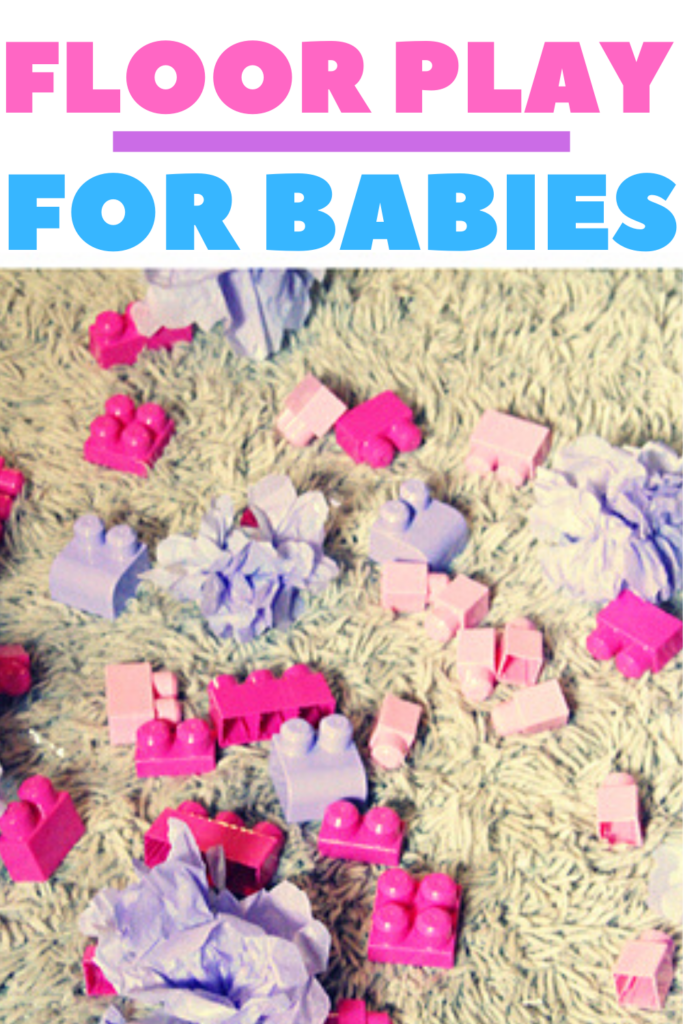
Older babies that are sitting up can benefit from a scattering of toys placed around them on the floor. Place pillows behind and around the baby and encourage them to pick up toys like large blocks as they bring the toy to their mouth to explore. Picking up and bringing items to the midline promotes endurance of core strength, stability in the core, and coordination as they reach and turn.
Playing on the floor can include baby mats or baby-safe mirrors. Check out this baby sensory play idea using mirrors for an easy way to encourage movement and endurance in floor play using everyday items such as cups, balls, and baby toys.
Babies that are beginning to crawl love play tunnels…and for good reason. Baby play tunnels are exciting and fun! But not only that, they develop skills like visual motor skills, cause and effect, visual scanning, visual convergence, and so much more. Here are more play tunnel activities for babies.
Try this indoor play idea that boosts development of skills such as fine motor skills, visual motor skills, and visual perceptual skills using toddler-friendly blocks!
Use large blocks or other baby toys in floor play for babies. Super easy!
Occupational therapists know the value of movement and playing on the floor has on babies. We know that babies need tummy time and a chance to move on the floor without use of the Bumbo seat, swing, and other baby positioners. We KNOW that play is the child’s primary occupation and that through play, they develop motor skills, cognition, language, and so much more.
That’s why I’m SO excited to share a valuable new resource for new and expecting moms.
Remarkable Infants is a HUGE resource for new parents. This online course, taught by 5 child development experts, is a 5 hour crash course on development of the whole child from birth through 12 months of age. It is literally everything that we WISH new parents knew about tummy time, positioners, developmental milestones, baby play, communication, sleep, and nutrition.
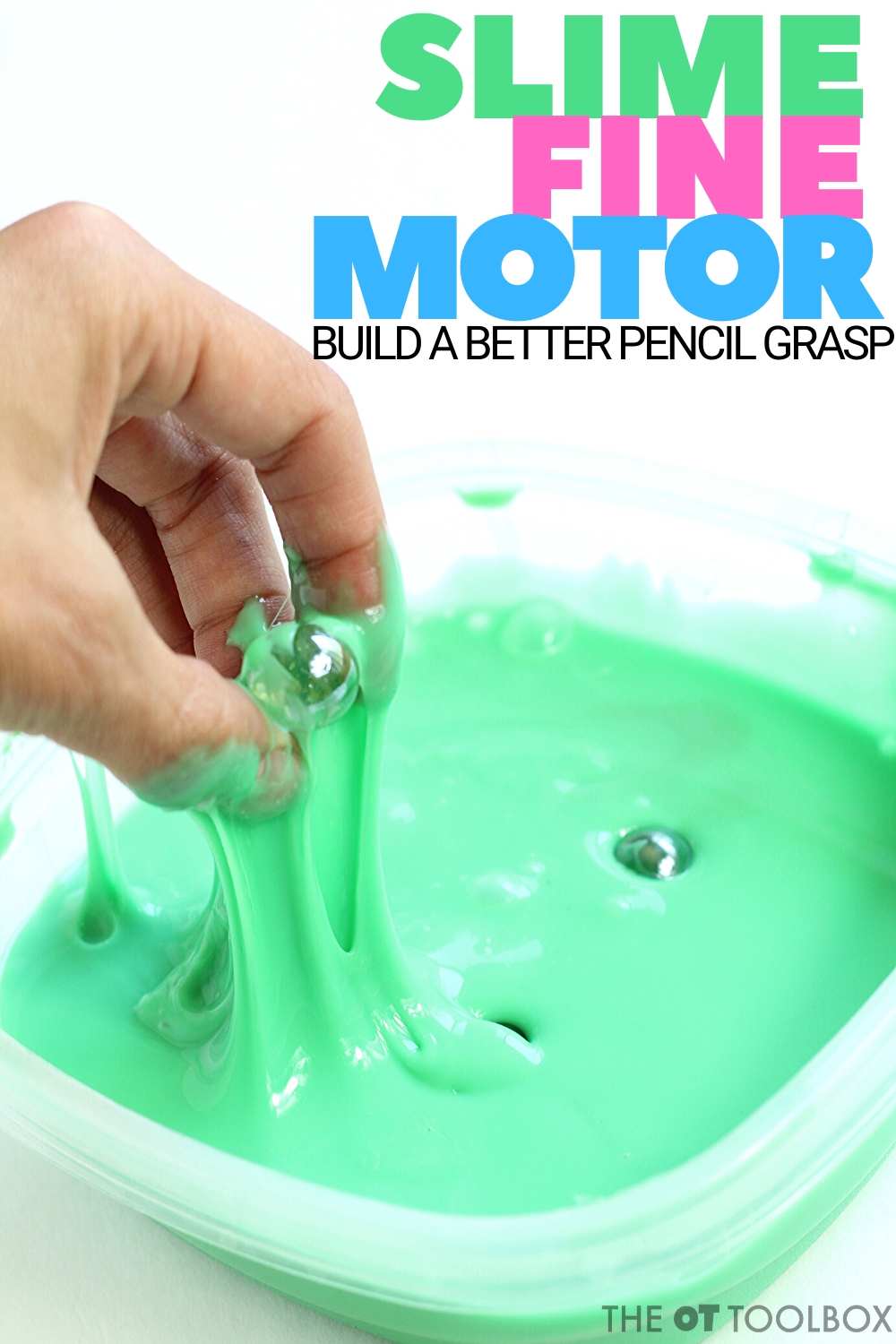
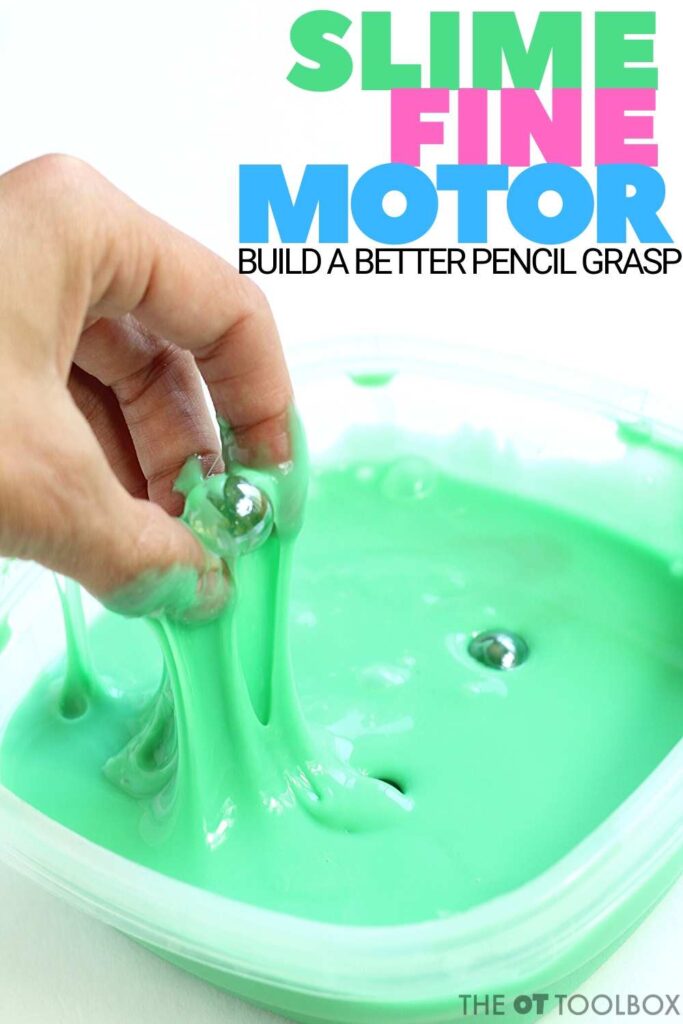
Working on pencil grasp? Or are you looking for a fresh fine motor activity that builds pencil grasp in kids? This slime fine motor activity is just that. It’s a fun and messy way to strengthen fine motor skills needed for a functional pencil grasp…using slime! You may have read the title of this blog post and thought “What does slime have to do with a pencil grasp activity?” Well, this slime activity sure does meet the requirements for fine motor activities that double as pencil grip activities. Read on!
Slime Activity
Do you have kids that are still loving slime? We’ve made a lot of slime activities in our days, including a slime exercises, a great way to build hand strength in a fun way. We’ve even practiced handwriting using cursive letter beads for our cursive letter slime activity. One of our favorite slime activities was cutting it with scissors as a scissor skills activity.
When it comes to working on writing and pencil grasp, however, some of these activities play a part in building a better pencil grasp. Slime is a great way to work on intrinsic hand strength and fine motor skill development. If you’ve ever played with slime, then you might know why.
Slime has a consistency that is a pretty sticky. It sort of molds to itself and spreads at the same time (weird, right?) so that when it’s near the edge of a table, it spreads and then strings down to the floor in a long strand. (Which if your table is over a rug or carpet, grab that carpet cleaner!)
Slime Activity to Build Fine Motor Skills
This slime idea uses any slime recipe. You can find tons of homemade slime recipes online. We made homemade slime when we made a slime writing tray, but this activity focuses on strengthening the fine motor skills needed for skills like pencil grasp, manipulating items like buttons and snaps, or other functional tasks.
This activity uses regular slime just two materials. Here are Amazon affiliate links so you can set this activity up:
Small Container– Use one with a lid. A smaller-sized container requires a smaller space to manipulate with the hand, providing a strengthening opportunity.
To set up this slime hand strengthening activity
Use slime to work on fine motor hand strength
Place slime into a container.
Use a reusable food storage container such as a Rubbermaid food storage container. This allows the activity to be used over and over again.
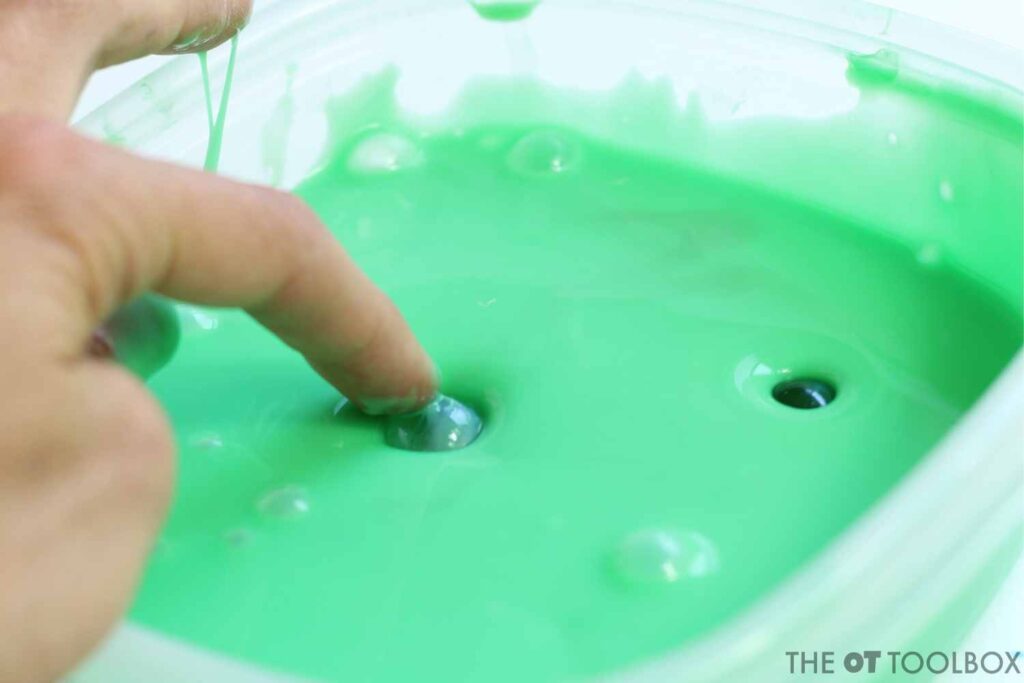
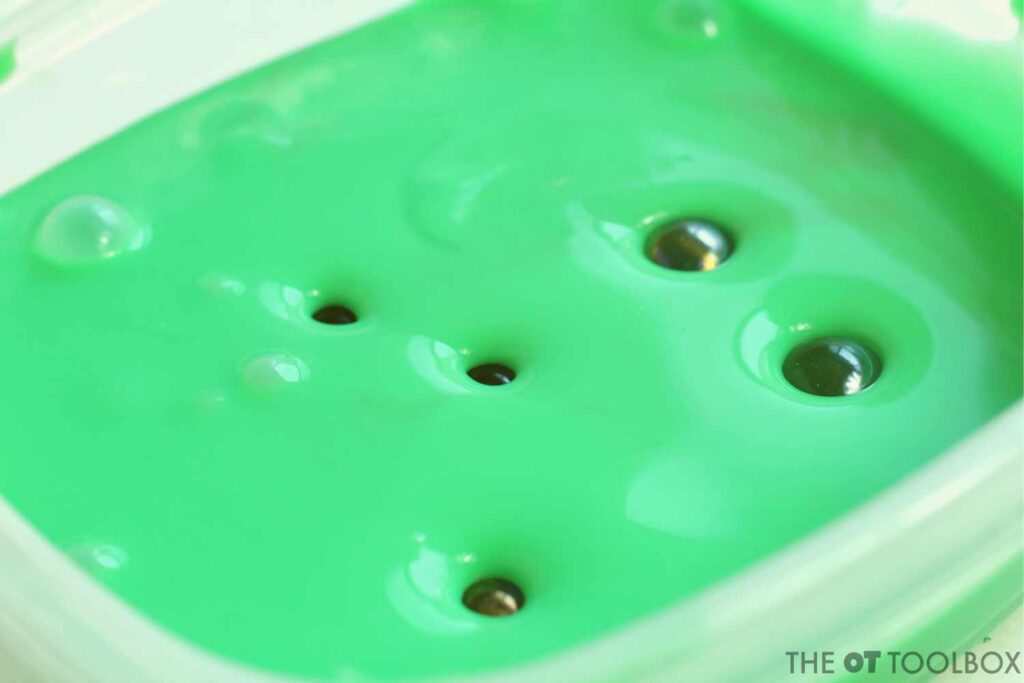
Add clear marbles to the slime.
Students can press the marbles down into the slime using one finger. This is a great finger isolation activity. Read more on what finger isolation is and why this important fine motor skill matters so much.
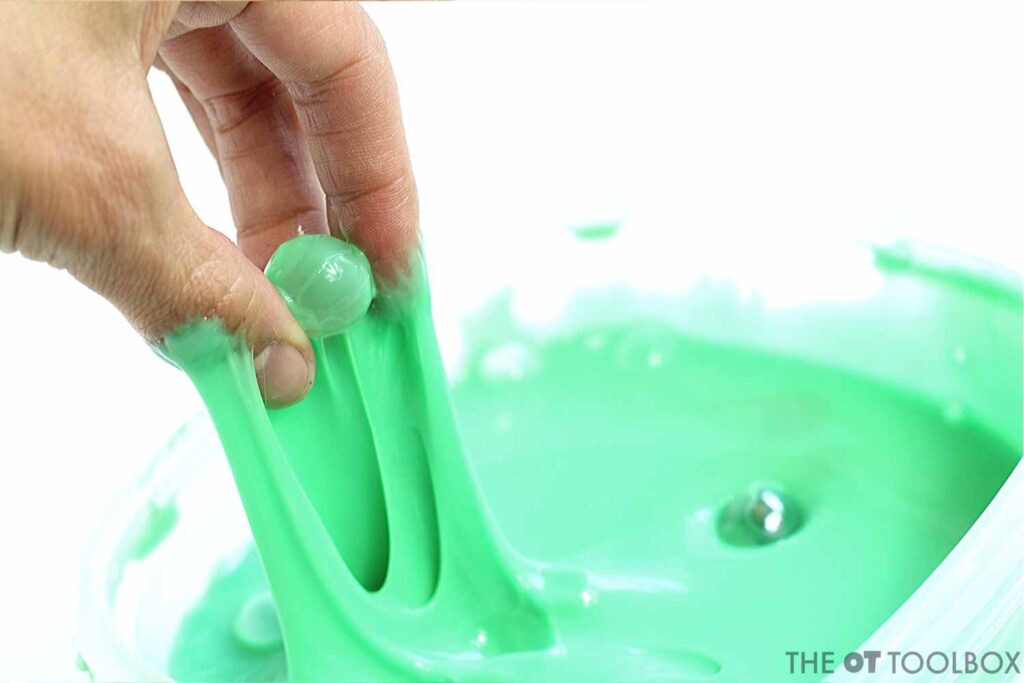
Move those marbles! Use the fingertips to find and locate a marble in the slime.
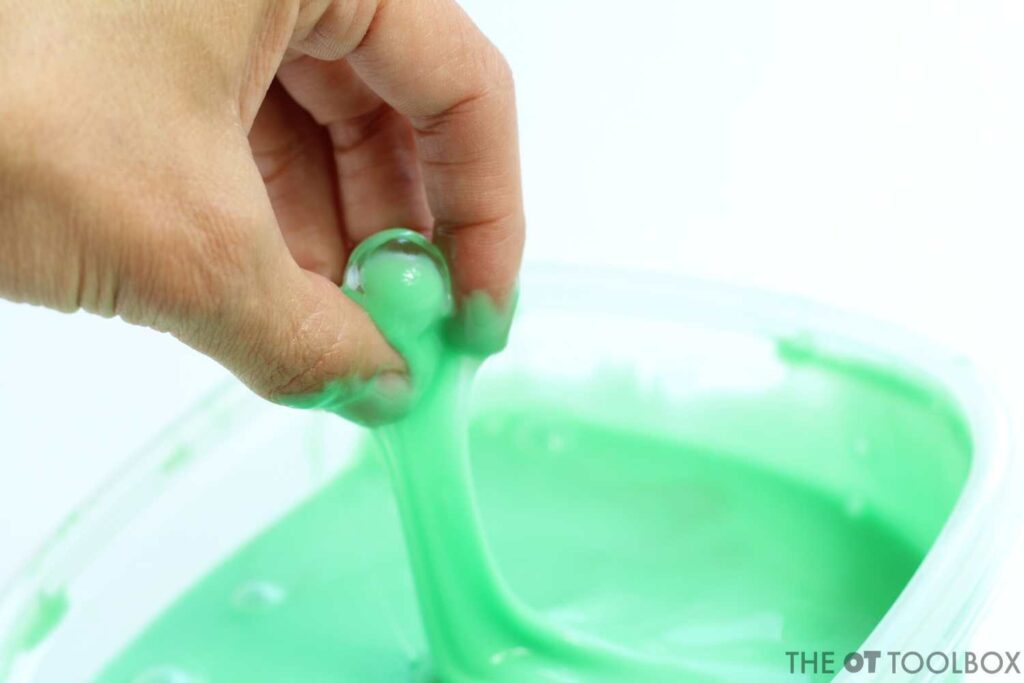
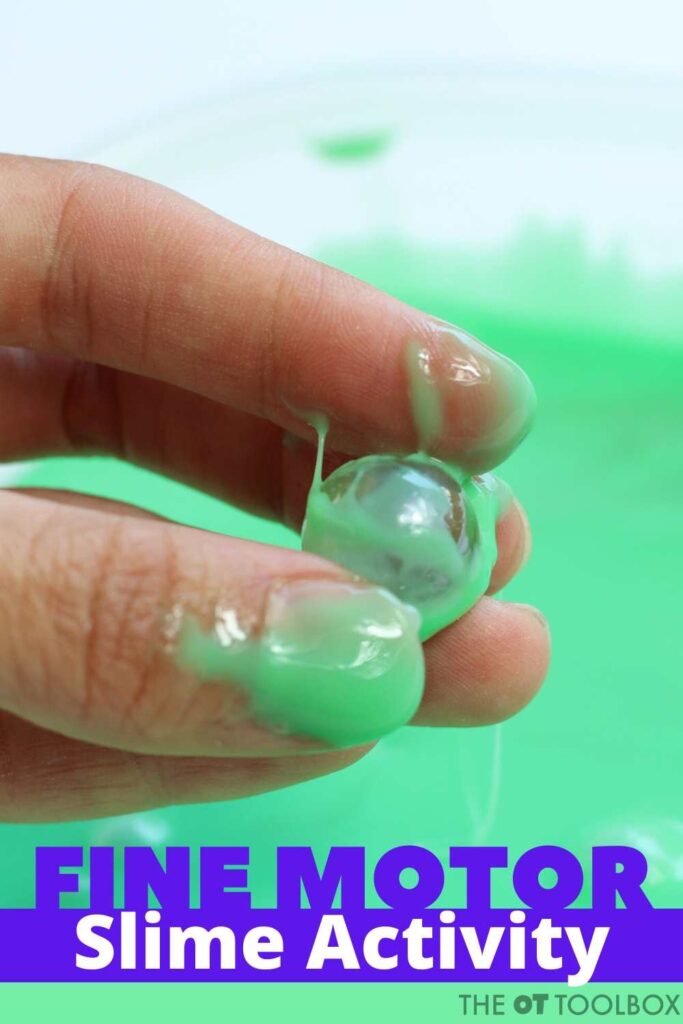
Once you find a marble, use the fingertips to pull it out of the slime. Pulling a marble from the slime requires strength, but also works to improve that hand strength. Because the slime is in a smaller container, the arches of the hand/intrinsic hand muscles have to work to maintain grasp against the pull of the slime.
Remove slime from the marbles.
This is the messy part…in a good way! Use the fingertips to pull and remove slime from the surface of the marble. This is another way to strengthen and improve endurance as well as dexterity in manipulating with the fingertips.
Do it again!
Once you’ve located all of the marbles, press them back into the slime. This is a great hide and seek activity that can be passed on to another client or to use in the next therapy session.
Use slime to work on finger isolation and other fine motor skills.Slime is a great way to work on arch development and intrinsic hand strength.
Grade this Fine Motor Strengthening Activity
You can adjust this activity to make it harder or more resistive for those building their hand strength. It can be downgraded as well to make it easier for those needing an easier fine motor activity.
Adjust the resistance of the slime- add more liquid to make the slime easier to manipulate. You could experiment with adding other materials to hold the slime, making it easier to remove from the marble. Some ideas include foam balls, glitter, flour, or other materials. This collection of slime add-ins is a good way to experiment.
Add resistance by leaving the slime exposed to air for several hours. This will make the slime more rubbery and harder to manipulate.
More Slime Pencil Grasp Activities
Working on the fine motor skills needed for a functional pencil grasp doesn’t need to be boring and predictable. Using slime to work on these essential fine motor skills can make pencil grasp tasks fun. We’ve used beads with cursive letters as a slime add in to help with fine motor skills. Kids can use beads like these ones to find and then remove the slime to work on those pencil grasp strengthening skills. Then, practice copying the letter. Extend the activity by asking them to write a word that starts with that letter. The options are endless with an open-ended slime activity like this one.
Want to Take pencil grasp to the next level?
Join our free, 5 day pencil grasp challenge! We’re talking all things pencil grasp with fun and easy activities designed to build a better pencil grasp. Join in on the fun!
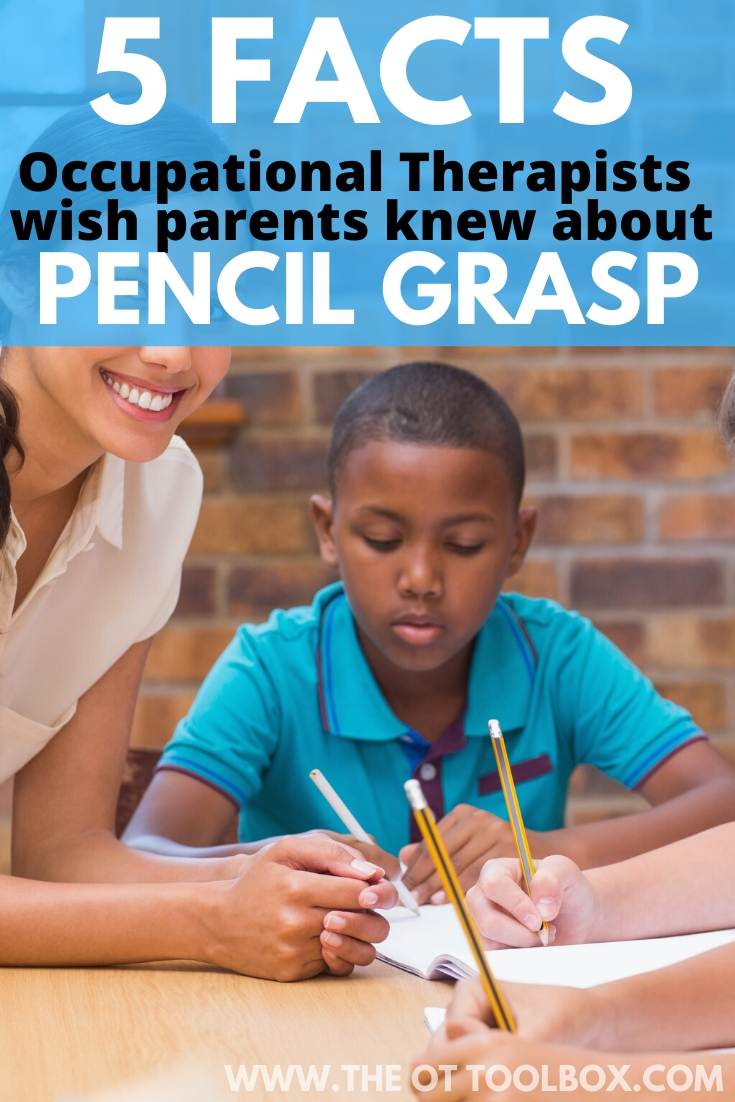
Pencil grasp recommendations is a question that comes up a lot when kids have trouble with handwriting. In fact, many times occupational therapists receive a referral to check on a child with handwriting challenges and one of the things the teacher mentions is the child’s pencil grasp. Parents may have a lot of questions about pencil grasp development, too. They may wonder if their child is on track with their pencil grasp or how to help kids that are struggling with holding a pencil. The thing is that there is a lot that goes into gripping a pencil! Here are the top things that pediatric OTs wish parents knew about pencil grasp.
Pencil Grasp Recommendations
If your eyes glaze over when it comes to pencil grasp, how your child is holding a pencil, and how to help them, don’t worry! Here are the main points you need to know about pencil grasp development:
#1 Pencil grasp is not clear-cut.
In typically developing kids, children progress from using their whole arm to move a crayon, to using their forearm and wrist, to using their fingertips. That progression indicates upper bodies that support the arm, strong arms to stabilize posture, and refined fine motor skills.
In children with physical, cognitive, or neurodevelopmental considerations, grasp may not follow the age progression or demonstrate delays in progression. Other children skip developmental stages of pencil grasp for a variety of reasons.
#2 Limit the screens and offer more play.
Kids today are exposed to a variety or play activities (or lack thereof). They are also exposed to technology and screens from a very young age.
Think about it this way: when a young child holds a screen, they are missing out on time that other generations would have had to experience play and activity through their hands. They are also spending hours of time in some cases with a “screen grasp”. When a young child holds a screen, there is heavy weight through the ulnar side of the hand. The pinky side of the hand curves over and is in constant active grasping position to hold onto the screen or device.
That allows for a lot of strength in the pinky side of the hand, and time spent in the same position. The hand isn’t getting a variety of experiences to stabilize, manipulate which are important for in-hand manipulation and separation of the sides of the hand.
Then, the child is typically using the pointer finger to swipe. There isn’t the variety of grasp, manipulation, pincer development, and precision occuring.
Likewise, with screen use, there is a shift to thumb swiping and movements of the thumb on the screen. The thenar eminence gets a lot of the same motions. All of this adds up to a perfect storm of limited fine motor experience and lack of fine motor skills.
#3 Functional writing is most important.
This is one of the biggest take-aways that therapists want parents to know: A functional pencil grasp might not look like the traditional tripod grasp. Kids can hold their pencil with a thumb-wrap, cross-over, modified tripod, quadrupod grasp, or any of the many other variations…and STILL write in a way that is legible and efficient.
Research tells us that pencil grasps do not impact skills like letter formation or legibility. In the child using a mature pencil grasp (the fingers and hands do the work to move the pencil), variations of pencil grasp do not impact writing speed.
When speed is an issue, there is probably something else going on such as the child is using a transitional grasp pattern, sensory issues like heavy writing pressure are present, or motor planning issues like letter formation are occuring.
#4 Kids need play! Yes, it’s worth repeating.
Coloring, play dough, climbing trees, tumbling in the grass, and manueving on the monkey bars are important parts of pencil grasp development.
It’s true! The underlying skills that kids need to grasp the pencil and write occurs through play. The early stages of child development includes lots of crawling, and that’s an important stage!
Many times, we see fine motor difficulties in kids that skip the crawling stage. Sometimes the connection between crawling, fine motor exposure, and play isn’t apparent when it comes to pencil grasp.
Children need fine motor play to develop hand strength for precision and using those fingers. Kids need to climb and move to gain stability and control in their upper bodies so their shoulders and arms are able to support and stabilize distal mobility.
#5 Don’t rush the “picture perfect” pencil grasp.
So often, kids are rushed to hold a pencil perfectly. This assumption happens in classrooms everyday. Kids begin to write letters before they are developmentally able to hold and manipulate a pencil at a level that “looks correct” and in the meantime, miss out on valuable progression through pencil grasp stages.
We are seeing children start to learn to write letters in preschool and are pushed to write letters, words, and sentences in kindergarten. Going by developmental progression, this is before a child is developmentally able to manipulate a pencil with precision and mobility in the fingers and hand.
It’s OK to see a pencil grasp that isn’t perfect in preschool, kindergarten, or even the early grades. Keep offering fine motor experiences, play, and activities!
Need more pencil grasp help?
Try some of these fine motor activities to promote the skills kids need:
Use small pencils. Broken crayons and golf-sized pencils are perfect!
Want to know how to fix a problem with pencil grasps? Need help knowing where to start when it comes to immature pencil grasps or a child hating to write because their hand hurts? The Pencil Grasp Challenge in open for you! In this free, 5 day email series, you’ll gain information, resources, specific activities designed to promote a functional, efficient pencil grasp.
The pencil grasp challenge is a free, 5 day mini course and challenge. During the course of five days, I’ll be teaching everything you need to know about the skills that make up a functional pencil grasp. You’ll learn what’s going on behind the inefficient and just plain terrible pencil grasps you see everyday in the classroom, clinic, or home. Along with loads of information, you’ll gain quick, daily activities that you can do today with a kiddo you know and love. These are easy activities that use items you probably already have in your home right now.
Besides learning and gaining a handful (pun intended) of fun ideas to make quick wins in pencil grasp work, you’ll gain:
5 days of information related to pencil grasp, so you know how to help kids fix an immature pencil grasp.
Specific activities designed to build a functional pencil grasp.
Free printable handouts that you can use to share with your team or with a parent/fellow teachers.
You’ll get access to printable challenge sheets, and a few other fun surprises.
And, possibly the best of all, you’ll get access to a secret challengers Facebook group, where you can share wins, chat about all things pencil grasp, and join a community of other therapists, parents and teachers working on pencil grasp issues.
Colleen Beck, OTR/L has been an occupational therapist since 2000, working in school-based, hand therapy, outpatient peds, EI, and SNF. Colleen created The OT Toolbox to inspire therapists, teachers, and parents with easy and fun tools to help children thrive. Read her story about going from an OT making $3/hour (after paying for kids’ childcare) to a full-time OT resource creator for millions of readers. Want to collaborate? Send an email to contact@theottoolbox.com.