Fall Leaves Printable tic Tac Toe Game

Fall leaves printable tic tac toe activity for occupational therapy home programs

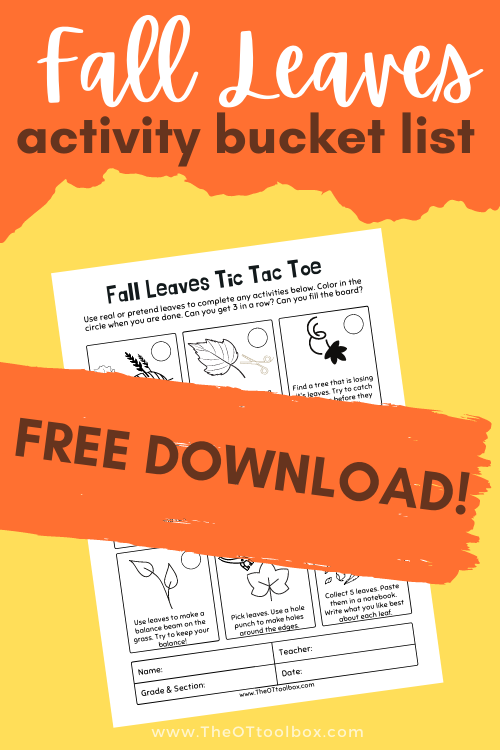
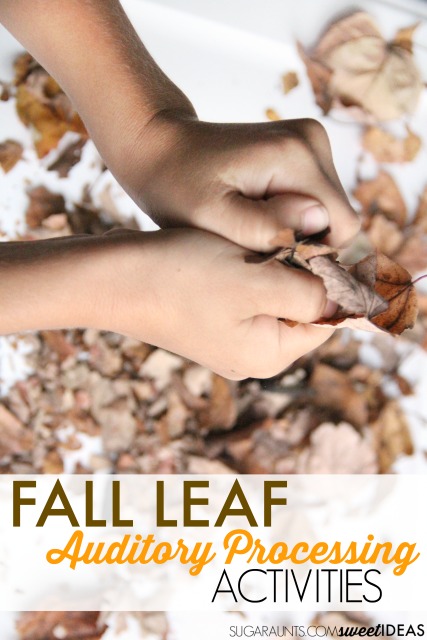
Getting this fall leaves bucket list has been on my to-do list for a few weeks now. Here in western Pennsylvania, fall leaves are just about at their peak colors. They are just starting to fall, and that means there are lots of colorful, crunchy leaves to explore and play in! As occupational therapists, we know the power of play. That means we know the power of using fall leaves as a tool to build strength, balance, sensory experiences, heavy work, and movement! Leaf activities are just part of Fall and all that the season brings in the way of fall fun! Use the free printable for occupational therapy home programs, or just a cheap fall bucket list of fall activities!

Fall Leaves Activities for a fall bucket list that builds skills! This fall leaves printable is a downloadable tic tac toe game that kids can use in occupational therapy activities.

Fall Leaves Printable

A lot of the leaf activities on this printable are activities that I’ve shared previously on this website. You can find the links to these ideas here, so you can read more about the “why” behind these activities and to understand the different ways to build development in kids.

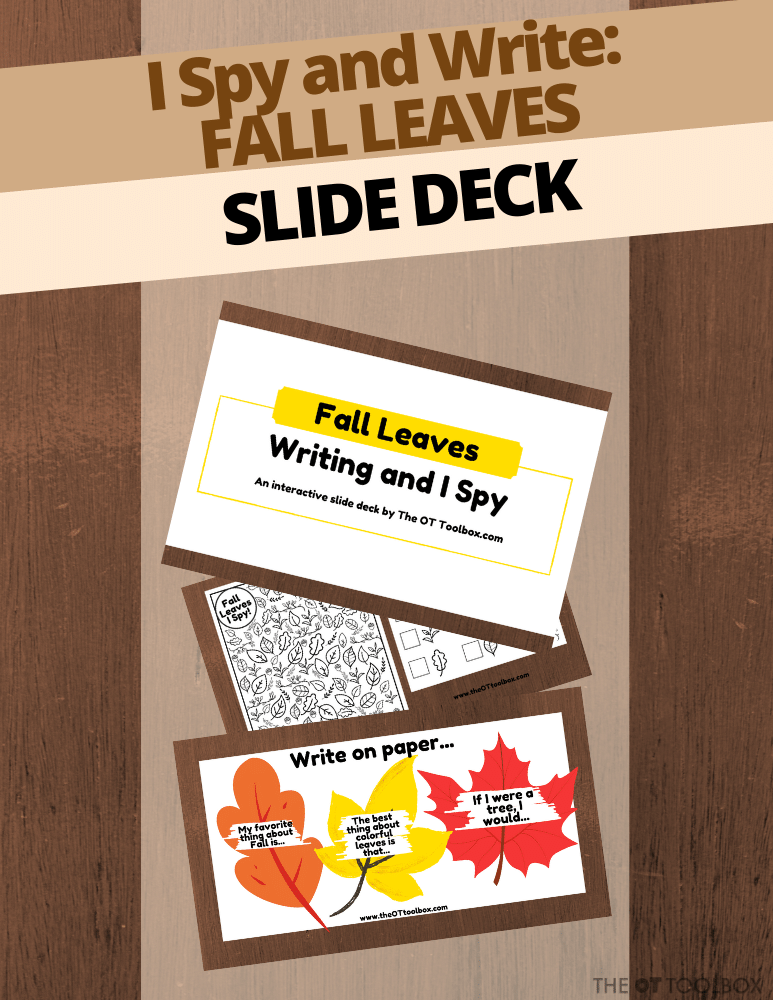
This fall leaves printable is a tic tac toe printable page. Use it to encourage movement, sensory exploration, fine motor skills, and gross motor skills. The images are small and just outlines, so kids can color in the pictures as they complete each activity, making it a great way to build fine motor strength, coordination, and pencil control.

Each fall leaf activity uses just leaves from outside, but if fall leaves aren’t available in your area, colored paper leaves work just as well.

Fall leaf tic tac toe activities encourage movement, so use this as a great occupational therapy home program or even one to use in OT teletherapy.

Leaf activities for occupational therapy and to build skills in fine motor development, sensory play, gross motor skills. Use fall leaves in therapy activities!

Fall Leaf Activities

Here are the fall leaf activities described on on this leaf printable. If you need more descriptions or a better understanding of how these fall leaf activities help kids build skills, be sure to save this page so you can come back to it.

Leaves for Scissor Skills– Improves scissor accuracy, bilateral coordination, eye-hand coordintion, fine motor precision.

Leaf collage art– Use real leaves to make a craft that builds bilateral coordination, heavy work proprioceptive input, and scissor skills.

Fall Proprioception Activities– Jumping in piles of leaves, raking leaves, and carrying a load of leaves in a bucket, wheelbarrow, or arms adds calming heavy work for the proprioceptive sense!

Fall Vestibular Activities– Run, dive, jump, swoop! Catching fall leaves provides input to the vestibular sense. These activities can be organizing and help kids regulate behaviors, emotions, and their sensory system.

Leaf Balance Beam- Do you know the power of a balance beam? The best news is that you don’t need fancy expensive equipment to replicate those benefits! Use leaves to make a homemade balance beam with all of the skill-building!

Leaf Hole Punch Activity– Grab a hole puncher and a handful of leaves. Those fine motor skills are about to grow! This activity builds eye-hand coordination, hand strength, arch development, separation of the sides of the hand, visual motor skills, and more.

Leaf Matching Activity– There are a lot of ways to develop visual processing skills like matching leaves during the Fall season.

Leaf Activities For therapy

Pre-Writing Lines: Pre-writing activity with real leaves– Use real leaves to work on eye-hand coordination, visual motor skills, and pre-writing lines with hands on fine motor work.

Bilateral Coordination: Leaf Craft- Use real leaves to make a craft that builds bilateral coordination, heavy work proprioceptive input, and scissor skills.

Craft for Older Kids:  Sewing Skills Craft– Use a needle and thread, wire, lacing cord to thread around leaf shapes. We used plastic canvas, but you could use cardboard, cereal boxes, or even laminated paper.

Hand Strength- Leaf Ten Frames– Use a hole puncher with leaves to work on hand strength and hands-on math.

Sensory Play- Nature Water Table– Use a bin, water table, or bowl to explore Fall’s colors and textures and challenge the senses.

Tactile Sensory Activity- Sensory Painting– Use leaves, corn husks, and grasses for sensory painting. Then, practice handwashing!

Heavy Work Activity- Play Dough Press– Use natural materials and play dough to add heavy work for the hands. This is a great visual perception activity, too.

Eye-Hand Coordination and Problem SolvingFall Tree Crafts– build eye-hand coordination and problem solving with a sensory experience to make these fall trees.

Scissor Skills Activity- Fall leaves scissor activity– Use leaves to work on line awareness, bilateral coordination, and visual motor skills.

MORE Sensory Processing Activities for Fall

Leaf Auditory Processing Activity– Use leaves to work on listening skills, auditory discrimination, and auditory challenges.

Fall Fine Motor Activities

Fall Visual processing Activities

Fall Tactile Sensory Activities

Fall Vestibular Activities

Fall Proprioception Activities

Fall Leaf Printable

Enter your email address below and this fall printable will be sent to your inbox shortly!

Get a free Fall Leaves Activities Tic Tac Toe Page

    We respect your privacy. Unsubscribe at anytime.

    For more fall leaf activities, try some of these:

    Colleen Beck, OTR/L has been an occupational therapist since 2000, working in school-based, hand therapy, outpatient peds, EI, and SNF. Colleen created The OT Toolbox to inspire therapists, teachers, and parents with easy and fun tools to help children thrive. Read her story about going from an OT making $3/hour (after paying for kids’ childcare) to a full-time OT resource creator for millions of readers. Want to collaborate? Send an email to contact@theottoolbox.com.

    Clothes Pin Pinch Grasp Exercises

    Use clothes pins in a pinch strength exercise to improve lateral pinch prehension, and other grasp patterns.

    Wondering about lateral pinch strength? Hoping to help kids build tip to tip strength? Trying to build pinch strength in general? Here, I am sharing pinch exercises to strengthen pinch strength so that tasks that require strong hands (like coloring without fatigue, or holding the pencil and writing with endurance) can maneuver and manipulate objects. Check out the pinch strength exercises listed here and add these to your hand strengthening activities toolbox. All you need are clothes pins to build muscle strength and pinch patterns in occupational therapy sessions.

    Related, here are more fine motor activities using clothes pins, to use these in your therapy planning, too.

    Before we get into the pinch exercises below, be sure to bookmark the popular series about Occupational Therapy activities that can be done using free or almost free materials. This post is included in that series, and you will find other activities designed to build skills using everyday materials.  

    (Affiliate links are included in this post.)

    Pinch Exercises for Kids

    Today, I’m going back to the early days of my OT career and sharing fun ways to work on a few different hand pinch grasps.  For this fine motor activity, we’re using wooden clothes pins…something you probably have in your house or could get for a dollar at the dollar store.  There are many pinch grasp tools on the market designed to build pinch strength, but having an easily accessible (and inexpensive) option is key to carryover, use, and feasibility in building strength.

    Types of Pinch Grips

    Ok, the basics:  When you use your hand to do …anything… you’ll use one or more of the different types of pinch grips. These pinch patterns are developed through use. Les cover the types of pinch grips, as well as some common terms when we talk about pinch.

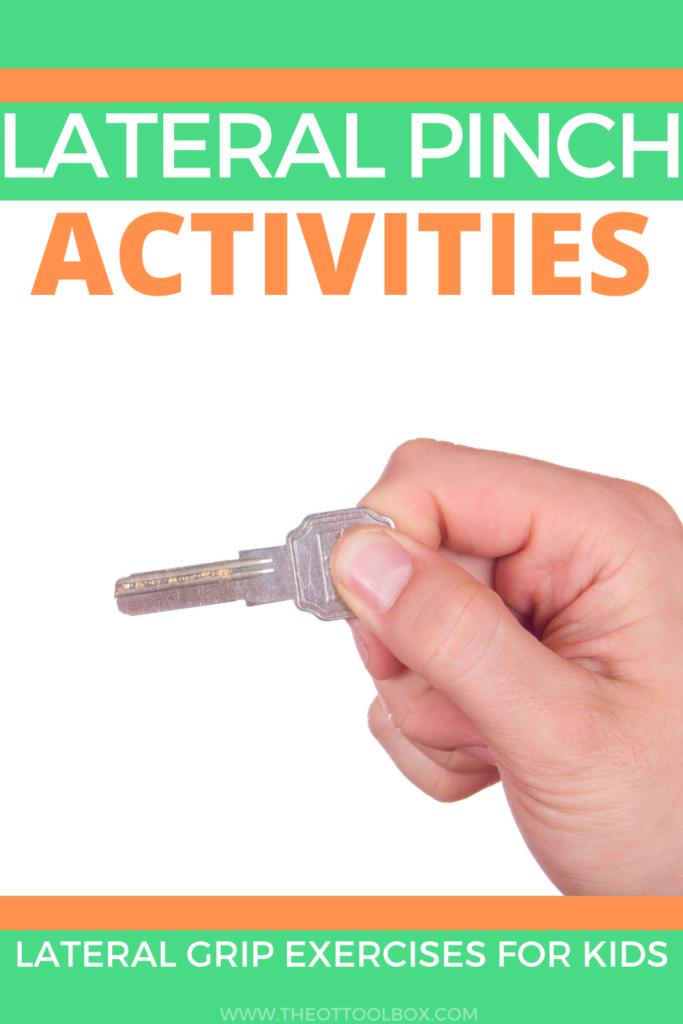
    Lateral Pinch Grip (aka Key Pinch Grip)- The thumb opposes the lateral side of the pointer finger.  This grasp is used when holding and using a key.

    Lateral Prehension Grip– A sub group of the lateral grip type of pinch is the Lateral Prehension Grip. In the lateral prehension grip, the thumb is flexed (bent) and it’s pad opposes the lateral side of the tip of the pointer finger. This grip is used to hold an index card or paper, sometimes.

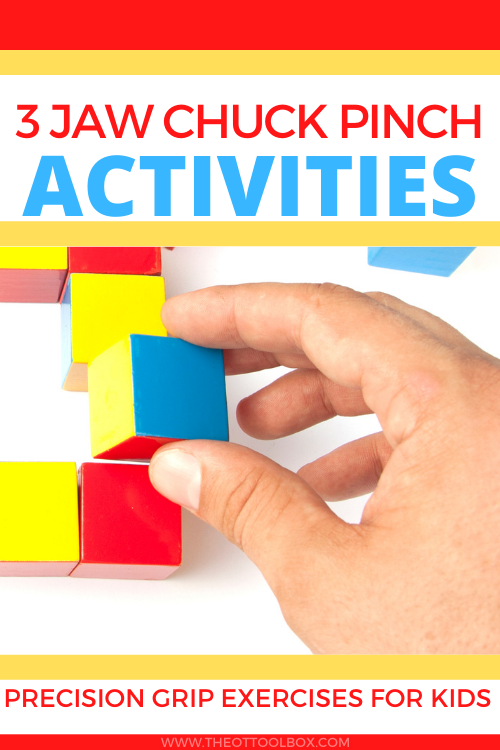
    Three jaw Chuck Pinch Grip– The thumb is flexed (bent) and opposes the pads of the pointer finger and middle finger. Holding a small cap like a toothpaste lid uses this grip. This is the grip used in holding a pencil.

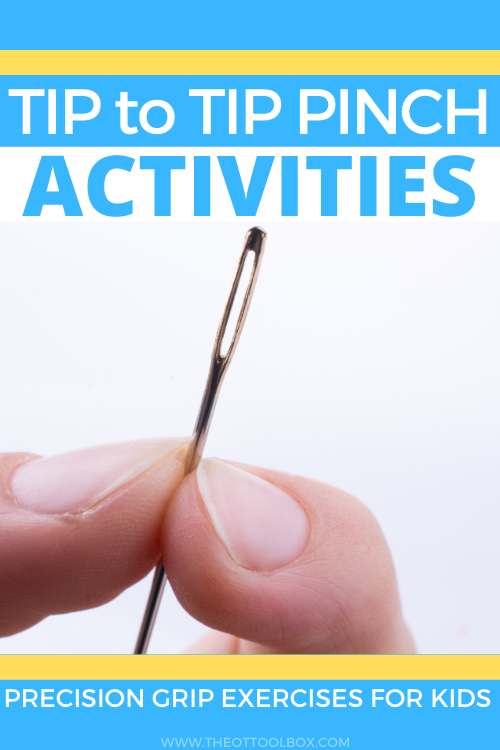
    Tip to Tip Grip– The tip of the thumb touches the tip of the pointer finger.  The thumb and pointer finger form an circle (or open thumb web space). This grasp is also called a pincer grasp.  It is used to pick up small items like cereal or beads.  If very small items are picked up (like a needle), a Neat Pincer Grasp is being used.

    Lateral Grip– Pinching an item between the pointer and middle fingers use this grip.  You would use this grip in holding a cigarette.  While this is not a functional grasp for kids (obviously), you might see kiddos fiddle with a pencil by holding it between two fingers.

    Prehension

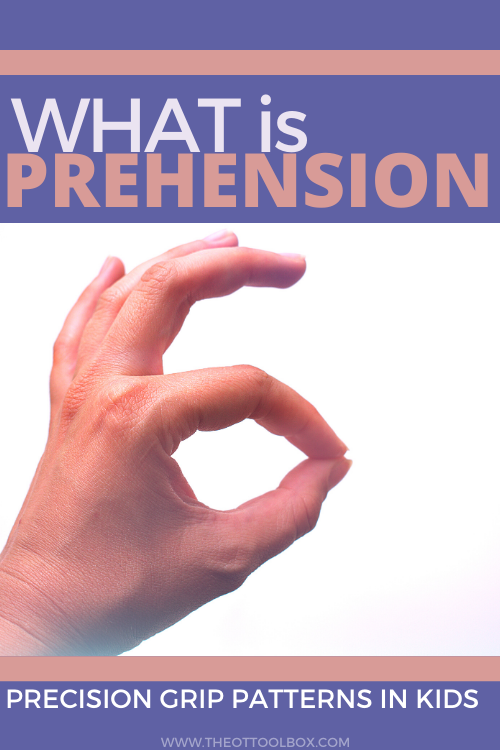
    Prehension is another common term that you may have heard mentioned. But what is prehension?

    The definition of prehension is the act of holding or grasping. The ability to hold and grasp an object in the hand requires prehension of the fingers. Prehension can also refer to the ability to hold a concept or idea in the brain to allow for understanding. Here, we are talking about prehension skills that allow us to manipulate items or objects. We are covering prehension patterns in the way of pinch grips.

    To break this down further, prehension can be identified in the different types of pinch grips.

    Tip prehension refers to the ability of the tip of the thumb, or the last joint of the thumb (known as the IP joint) to bend in isolation so that the rest of the thumb is stabile while just the last joint bends, or flexes. This tip prehension works in combination with opposition of the thumb as it rotates at the base, in order to oppose the tip of the index finger. Prehension can refer to the precision of grasp in the index finger as it bends at the PIP joint (proximal interphalangeal joint, or the middle joint of the finger), and the DIP joint (distal interphalangeal joint, or the end joint of the finger). This tip prehension is needed for small motor movements such as picking up a button or coin, threading a needle, etc.

    There are other types of prehension, like palmer prehension. This dexterity refers to in-hand manipulation, which we cover in other places on this website.

    Still other types of prehension are included in each of the pinch grasp patterns described above. Specific motions of the joints related to each pattern, and stability offered by related joints such as the wrist or metacarpophalangeal joints, and the arches of the hand allow for dexterity and precision of grasp…or prehension!

    We’ve created a video specifically showing how to target different grasp patterns using clothes pins. These clothes pin exercises are a great way to build hand and finger strength with a few repetitions. Simply clip the clothes pins onto the edge of a sheet of cardboard or cardstock paper for building pinch strength in the fingers.

    Watch this video for an example of how to position the fingers on the clothes pins for each pinch grasp: (If you can’t view the video due to blockers on your device, check out the video on The OT Toolbox YouTube channel.)

    Fine motor pinch grips and exercises to work on them using clothes pins, from an Occupational Therapist.

    Pinch Grip Exercises

    So, how can you work on these grips in a fun way?  Try using something you probably have in your home: Wooden clothes pins.  These are a therapy treatment bag staple.  You can work on each of the pinch grasps above to improve strength, arch development, open web space, and dexterity using clothes pins.   

    Lateral Pinch Exercises

    1. Hold the clothes pins between the thumb and the side of the pointer finger, like holding a key. Clip the clothes pins onto an index card.
    2. Hold the clothes pin between the thumb and the side of the pointer finger, like holding a key. Use the clothes pin to pick up an object like a craft pom pom to drop it into a color-coded bowl, cupcake liner, or onto a marked circle on a piece of paper.

    Tip to tip Grasp Exercises

    1. Hold the clothes pin between the thumb and the pointer finger. Be sure the tip of the thumb is doing the work. The IP joint of the thumb should be bent. Do several repetitions of this exercise to open and close the clothes pin.
    2. Holding the clothes pin between the tip of the thumb and the tip of the pointer finger, try to clip the clothes pin onto the single page of a book. Then, try to clip the clothes pin onto 10-20 pages of a book. Try to increase the increments and number of pages that are clipped between the clothes pin.

    3 Jaw Chuck Pinch Exercises

    1. Hold the clothes pin between the thumb and the pointer finger and middle finger. Clip the clothes pins onto a shirt or edge of clothing. Using both the index finger and the middle finger allows for more strength through the 3 jaw chuck grip pattern, so try clipping items of clothing together, like pairs of socks or two shirts. Clip several clothes pins around the edge of the clothing.
    2. Hold the clothespin between the thumb and the pointer finger/middle finger. Try to clip clothing to a string or clothes line.

    Prehension Exercises

    All of these exercises listed above can be completed in increasing repetitions. You might notice that the exercises listed include a functional component, like hanging clothes, or play. This is part of what makes occupational therapy, well, occupational! Try to include an aspect of function or daily tasks like painting, moving and manipulating objects with sorting for a learning aspect, or other aspect of independence.

    Fine motor pinch grips and exercises to work on them using clothes pins, from an Occupational Therapist.

    Here are more pinch activities clothes pins:

    Use the grips described above in the play and art activities below.  Try using different grips while completing the tasks, to work on the grips or skill areas appropriate for your child. Start with these fine motor activities using clothes pins.

    Like this activity?  Try some of these activities: 

    Colleen Beck, OTR/L has been an occupational therapist since 2000, working in school-based, hand therapy, outpatient peds, EI, and SNF. Colleen created The OT Toolbox to inspire therapists, teachers, and parents with easy and fun tools to help children thrive. Read her story about going from an OT making $3/hour (after paying for kids’ childcare) to a full-time OT resource creator for millions of readers. Want to collaborate? Send an email to contact@theottoolbox.com.


    Old Woman Who Lived in a Shoe Craft

    Shoe tying craft for there was an old woman who lived in a shoe craft

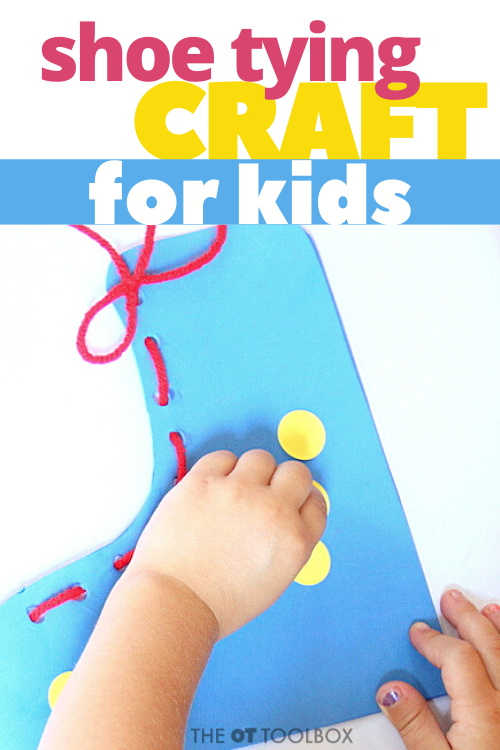
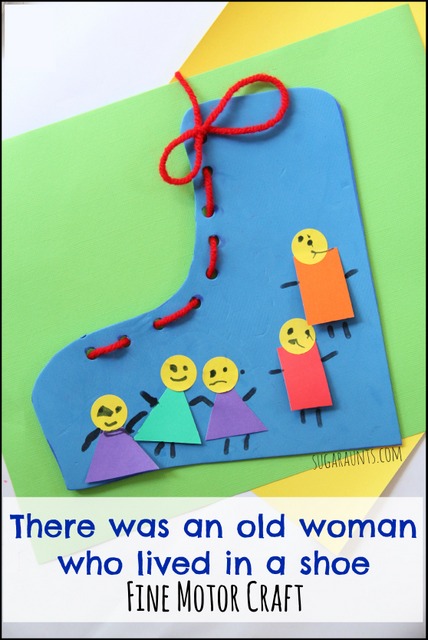
    This nursery rhyme craft is based on the classic nursery rhyme, “There was and Old Woman Who Lived in a Shoe”. We had a blast building fine motor skills with this kids craft. It’s a great way to work on shoe tying, too!

    Shoe tying craft based on the nursery rhyme, There was an old woman who lived in a shoe.
    Shoe tying craft for kids

    We are starting off the nursery rhyme craft and activity series with a timeless nursery rhyme…There was an old woman who lived in a shoe.  This is one of our favorite nursery rhymes to recite, although to be honest, in our house we love them all!  When we visit the library, we usually hit up the nursery rhyme shelf and come home with a book or two about nursery rhymes.    

    Nursery Rhyme crafts and activities for learning and play

    Nursery Rhyme Craft

    There is just something wonderful about reciting nursery rhymes.  The repetition of rhythm and rhyme teach kids about language, memory, and literacy.  They are fun to say over and over again.  And with this repetition, comes self-confidence in the child.  The timeless quality of nursery rhymes brings together generations of storytelling.  There is much to discover about how nursery rhymes help with learning, including pitch, imagination, sequencing, and phonics.    

    We recited “There was an Old Woman who lived in a shoe” and made a boot craft to explore the rhyme.     There was an old woman  Who lived in a shoe. She had so many children She didn’t know what to do. She gave them some broth And a big slice of bread, Kissed them all soundly And sent them to bed.   (We went with the Mother Goose version)  

    There was an old woman who lived in a shoe fine motor craft.

      This post contains affiliate links.  Thank you for your support of this blog.  

    Shoe Tying Craft

    This craft doubles as a shoe tying craft, too. Kids can build so many skills by making this craft, that are so important for shoe tying, including:

    • Bilateral Coordination
    • Lacing a shoe
    • Pincer Grasp
    • Eye-hand coordination
    • Tying a bow

    The best thing about this shoe tying craft is that kids will leave with a sense of accomplishment, allowing them to feel self-confidence with shoe tying.

    There was an old woman who lived in a shoe craft

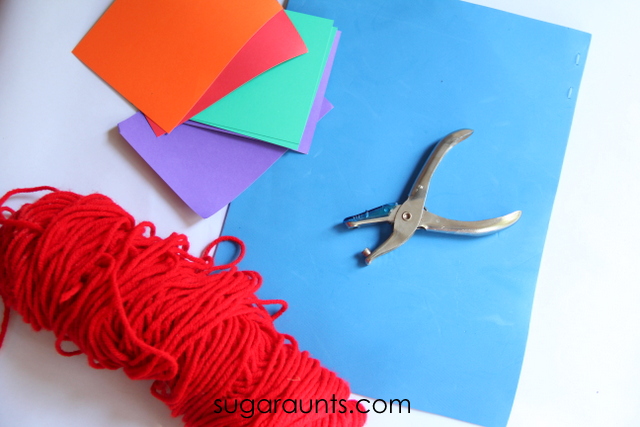
    Craft supplies for a nursery rhyme craft for kids.

    We started with a few supplies to make our nursery rhyme craft:

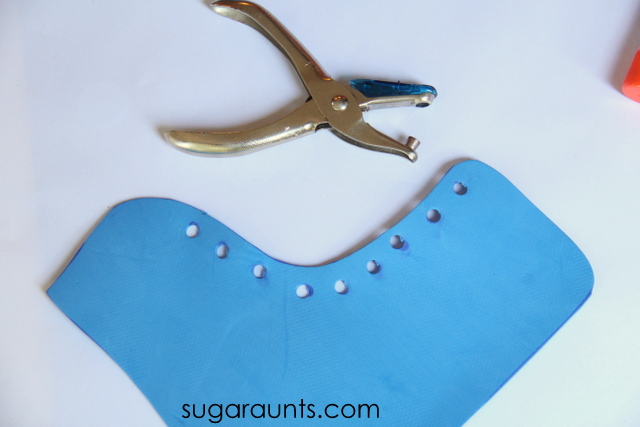
    blue foam craft sheet 
    red yarn 
    colored card stock 
    marker
    yellow circle label stickers 
    glue
    hole punch

    scissor skill craft shoe craft

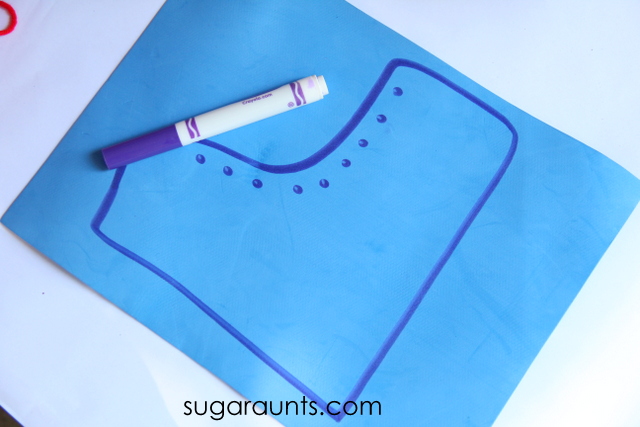
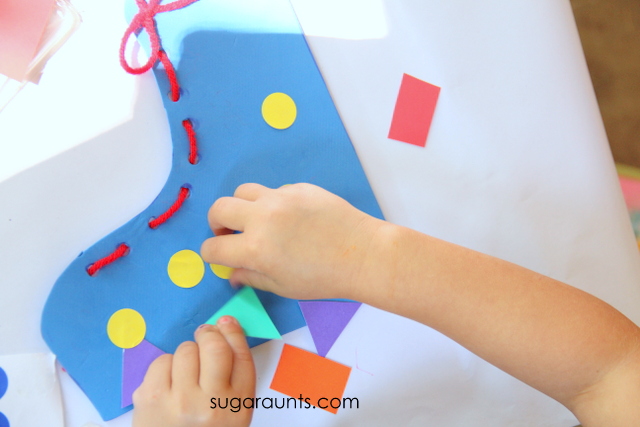
      Start by drawing a large boot shape on the craft foam sheet.  Draw dots with the marker for the lacing holes.

    Shoe craft for kids, based on the nursery rhyme, There Was an Old Woman Who Lived in a Shoe.

    Older kids can cut out the boot shape.  Crafting foam is a great material to snip with scissors and provides a different resistance when cutting.

    This shoe tying craft builds fine motor skills and bilateral skills that kids need to learn to tie their shoes.

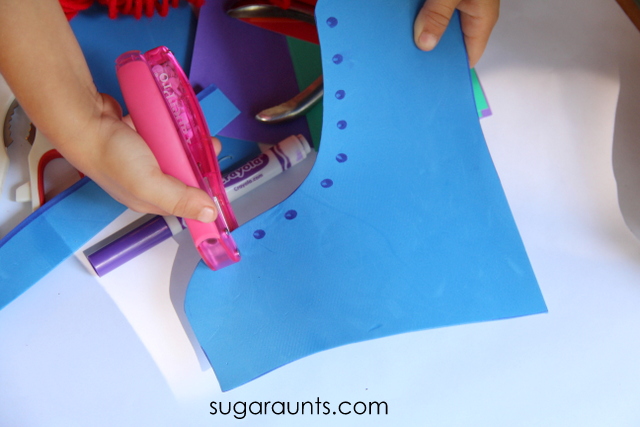
    Use the hole punch to punch the lacing holes.  We started with a kid friendly hole punch, but it didn’t work very well on the craft foam material.  The old fashioned hole punch worked better.

    Child holding scissors with two hands.

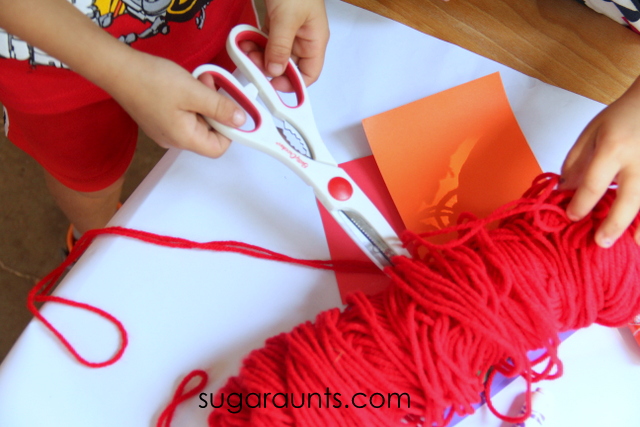
    Snip a long length of yarn.  Clearly Little Guy needs a little work on his scissor grasp. 😉  He was being silly with cutting the yarn.  

    Here is a guide to scissor skills, including the bilateral coordination needed for shoe tying AND cutting with scissors.

    Kids can use this shoe tying craft to build fine motor skills, lacing, and shoe tying.

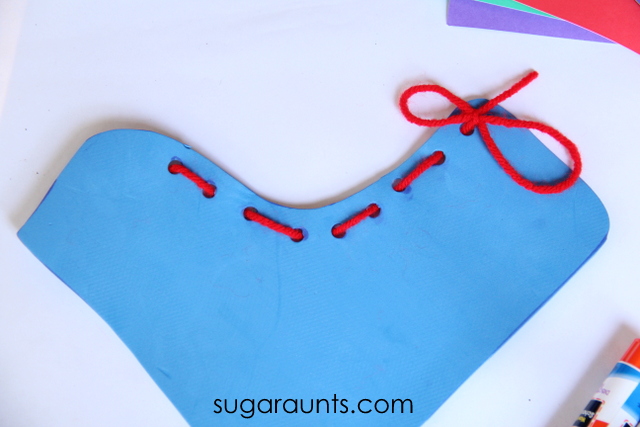
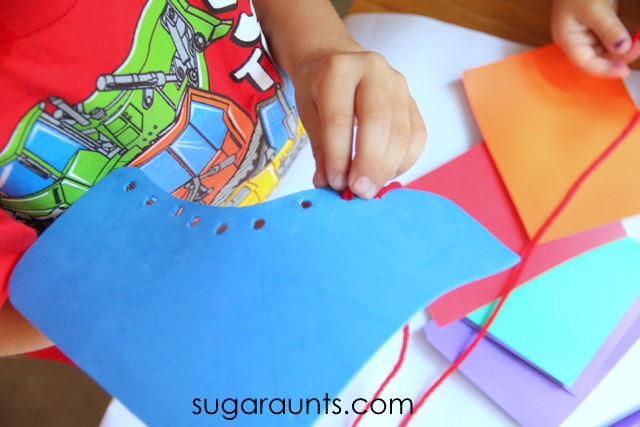
    Tape one end of the red yarn to the back side of the boot.  Get the kids lacing away on the boot.  This is a fantastic fine motor task for little fingers.  Tripod grasp, bilateral hand coordination, motor planning, eye-hand coordination…lacing is great for preschoolers!

    Fine motor lacing activity boot craft for kids

    This boot alone would make a very cute fine motor craft.  But it needs a little something extra for our nursery rhyme.

    Use this shoe tying craft to help kids with lacing and tying shoes.

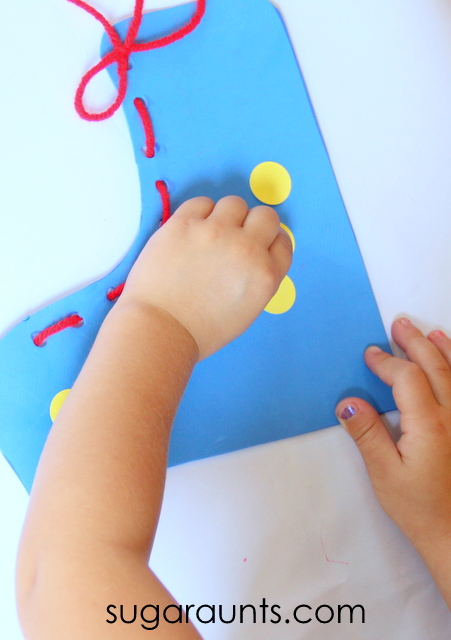
      We made a little old woman and many children on the boot.  Baby Girl loved sticking the yellow circle label stickers onto the boot.  These would be the faces.

    Shoe tying craft for kids

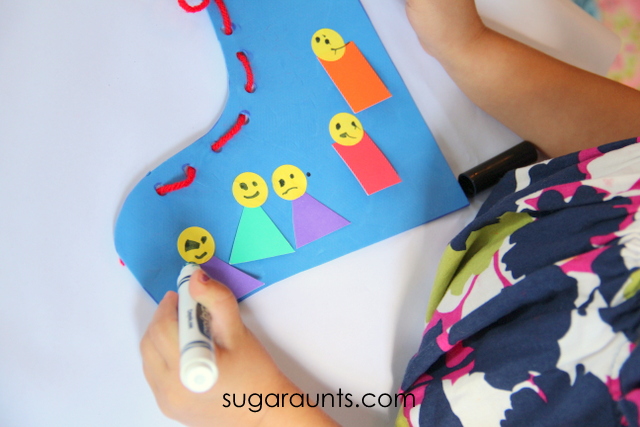
      Next, we cut our colored card stock into triangles and rectangles for the bodies.  More fine motor work with the snipping card stock.  A bit of glue holds these shapes in place.  Be sure to talk about shapes and colors with your preschooler while doing this part.  

    There was an old woman who lived in a shoe craft for kids

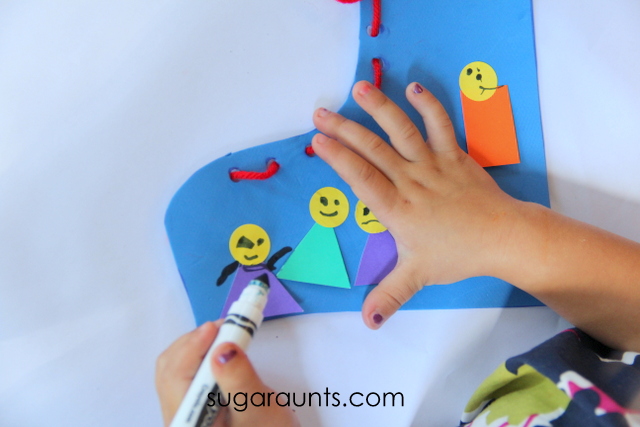
    Baby Girl used a marker and drew faces on each person.  Working in a small defined area is a great way to further develop pre-handwriting skills drawing and pencil control.

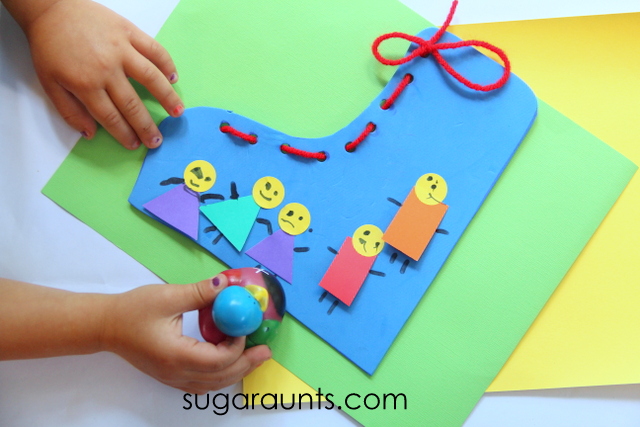
    She then drew arms and legs for the old woman and children.

    How cute is this nursery rhyme craft?  It brings the rhyme to life with imagination and creativity.  Baby Girl wanted to introduce a duck to the woman and children.


    Be sure to stop back tomorrow and the rest of this week and next week for the rest of the nursery rhyme series.  You can find them all of our nursery rhyme crafts here. 


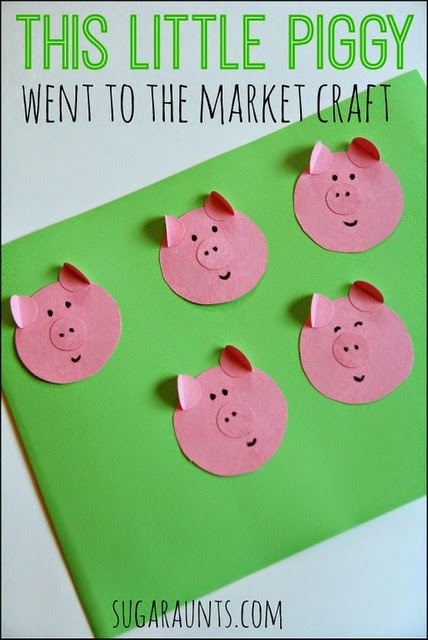
    This isn’t our first nursery rhyme craft.  Check out our This Little Piggy Went to the Market craft:

    Nursery rhyme craft for the Three Little Pigs

    Slide Deck to Teach Letters

    interactive slide deck to teach letters

    If you’ve been following along with the site over the past few months, you may have seen some of my free interactive slide decks and teletherapy resources. Today, I’m adding to those virtual therapy activities with this alphabet move and write slide deck that makes a nice addition to occupational therapy teletherapy activities. The letter slide deck is great for using in either virtual occupational therapy sessions or as a part of distance learning. With the uncertainty of the upcoming school year, I wanted to fill your therapy toolbox with digital resources like this one. Therapists can use the slide deck for teaching letter formation and handwriting with a fine and gross movement component.

    interactive slide deck to teach letters

    Slide Deck for Teaching Letters

    Therapists know the power of combining fine motor work, gross motor work…any movement…with learning. When teaching letters, that is no different!

    Recently, I created this alphabet exercise printable that went pretty wild among The OT Toolbox readers. There’s a reason why…kids need movement! And, combining activity with learning letters makes it a win-win for therapy, the classroom, or the home.

    That’s why I wanted to turn the worksheet into a letter-themed slide deck that can be used to teach kids letter formation, combining motor planning with gross motor activities, AND handwriting.

    Alphabet interactive slide deck to use in occupational therapy teletherapy sessions or to teach letters.

    Below, you’ll find a form to enter your email to grab this free interactive slide. But first, I wanted to explain how this slide deck works.

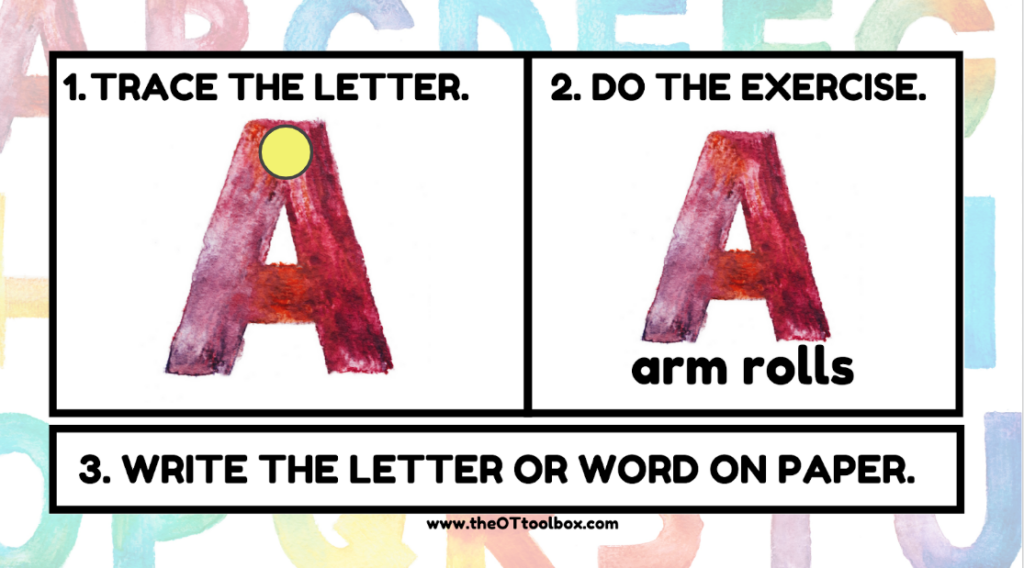
    Kids can work through the interactive slides and move the circle to form letters. I paired the letters with the exact same ones found on our alphabet exercise activity for consistency. (Upper case letters in this slide deck).

    Teach letters with an interactive slide deck.

    They can click on the yellow dot and move their mouse or finger to form the letter. They will trace along the lines of the letter on the slide, so they are gaining fine motor work, including finger isolation, separation of the sides of the hand, eye-hand coordination, and motor planning.

    Next, students (and a teacher if used in a live class) can complete the gross motor exercise that pairs with the letter. The exercises match the same ones on our letter exercise program. You can read more about each exercises on the Alphabet Exercise Activity page.

    The gross motor activity offers a brain break opportunity, while building strength, core stability, motor planning, and whole body motions like crossing midline, inversion, and a sensory break with proprioceptive and vestibular input.

    Finally, children can work on handwriting. I left this portion of the slide activity open-ended so that younger children can work only on writing the upper case letter. Older students can write a word or a sentence that contains a word starting with that letter.

    Free interactive slide deck

    Here’s how you can get the interactive slide deck to work on letters:

    Enter your email address in the form below. Check your email and click on the button to grab your resource. Save that worksheet so you can access these slide decks again.

    Sign into your Google account. Click on the big button in that PDF that you just accessed. It will prompt you to make a copy of the slide deck. That will be your master copy of this slide deck.

    Now the slide deck is on your Google account.

    Share the slide deck with students. You can make a copy for each student and upload it to their Google classroom or use it in Zoom. Here is a post on FAQ for troubleshooting any issues you might run across with using or accessing the slide deck.

    Be sure to sign up for other slide decks that we have to offer. You will have to enter your email address for each one so you can get the resource and make a copy of each slide deck.

    Get a free interactive slide deck: Alphabet Move & Write Cards

      Are you interested in resources on (check all that apply):
      We respect your privacy. Unsubscribe at anytime.

      Be sure to check out these other slide decks to use in OT teletherapy sessions, distance learning, or homeschooling:

      Here is a Space Theme Therapy Slide Deck.

      Here is a Strait Line Letters Slide Deck.

      Here is a “Scribble theme” Handwriting Slide Deck.

      Teach Letters with an interactive Letter Formation Slide Deck.

      You will also want to see all of our teletherapy activities here.

      Colleen Beck, OTR/L has been an occupational therapist since 2000, working in school-based, hand therapy, outpatient peds, EI, and SNF. Colleen created The OT Toolbox to inspire therapists, teachers, and parents with easy and fun tools to help children thrive. Read her story about going from an OT making $3/hour (after paying for kids’ childcare) to a full-time OT resource creator for millions of readers. Want to collaborate? Send an email to contact@theottoolbox.com.

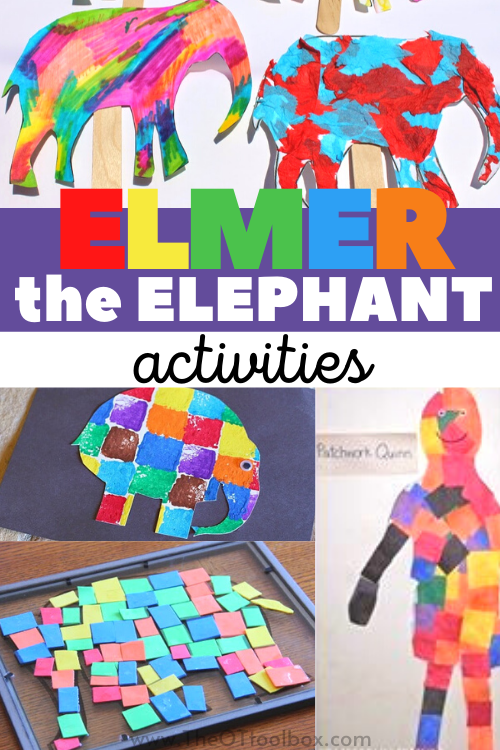
      Elmer the Elephant Activities

      Elmer the Elephant activities

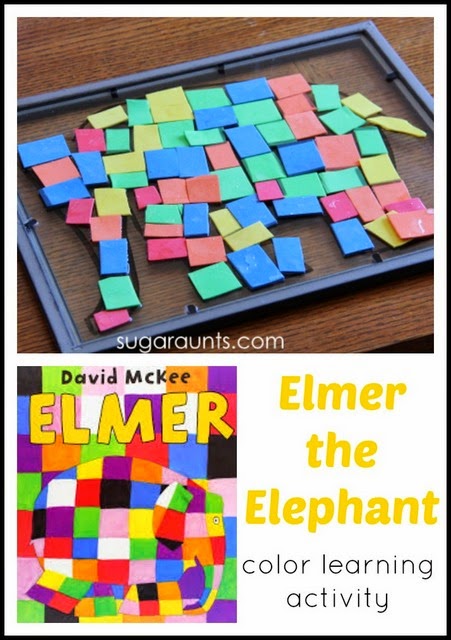
      Elmer the patchwork elephant looks different than his friends. Through stories and colorful pictures that depict everyday elephant life, Elmer the elephant teaches us about diversity and differences. Elmer teaches us about acceptance, friendship, and empathy. Check out the Elmer the Elephant activity below that builds a baseline for these important skills, but also helps kids with fine motor skills, visual perceptual skills, and visual motor skills.

      If you love the Elmer books as much as we do, then you will adore this Elmer the Elephant activity. We LOVE Elmer the Elephant…and all of the Elmer books. Every time we go to the library, we are sure to check the shelf for a new Elmer book that we may have missed. This week’s book activity was so much fun to do with the kids, because it involved one of our favorite books (ever) and a great visual perception activity. Add this book activity to your list of crafts based on children’s books that build skills through reading.

      Elmer the Elephant Activity

      This fine motor craft is a powerful one because it not only builds essential visual perceptual, visual motor, and fine motor skills, but it teaches as well. This Elmer the elephant activity can be used to illustrate differences, empathy, and friendship. Here are more books that teach empathy and friendship that can be used in therapy sessions or in the classroom or home.

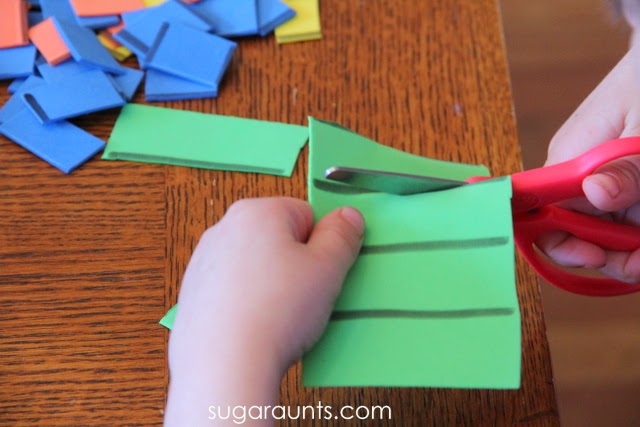
      They loved creating and building our very own Elmer craft. Elmer’s colors made for a great way to help kids build fine motor skills and visual motor skills, too. I loved throwing in the scissor work portion of the activity and working on a few important skills. My youngest daughter worked on her color identification and sorting.  The colors in Elmer’s patchwork skin are perfect for Toddlers to practice naming colors.  Little Guy was loving the puzzle-building portion of our activity.  The lines were a great way to work on a few visual perceptual skills needed for handwriting.  

      Elmer the elephant activity that uses the Elmer children's book as a guide and activity to help kids understand acceptance, differences, and diversity while building fine motor skills.

      Elmer the Patchwork Elephant Activity

      This post contains affiliate links.  

      If you haven’t read Elmer by David McKee, this is definitely a book you need to check out.  Elmer is a patchwork elephant with many colors.  He sticks out from the crowd of gray elephants. By exploring and interacting with his community of elephants, Elmer and the other elephants learn to accept and value his unique characteristics. Elmer is not only a colorful patchwork elephant. He is funny, smart, caring, and an individual. The book teaches us to accept differences because those differences are what make us who we are.

      Elmer teaches us about diversity. He teaches us about identity and tolerance. We all have different colors, shapes, interests, abilities, talents, and ideas. Those differences are what make us special. Let’s see those differences, accept them, and celebrate them!

      We made our own patchwork elephant with lots of colors and had a great time building and creating while talking about color names.  This was such a great activity for both Little Guy and Baby Girl.

      Try this Elmer the Elephant activity to teach children skills like scissor use and fine motor development with a wonderful children's book.


      We started with Foam Sheets in lots of different colors.  You might have seen our color sorting scissor activity post where we practiced our scissor skills.  These squares came in handy for this Elmer activity.

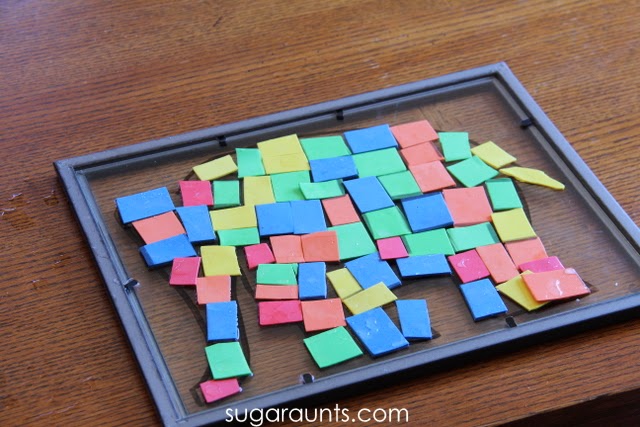
      Create an Elmer the Elephant activity using foam pieces to teach children about empathy and acceptance of differences in others while building fine motor and visual motor skills.

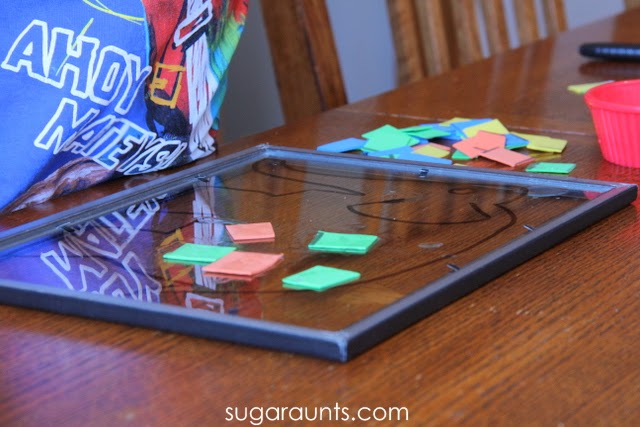
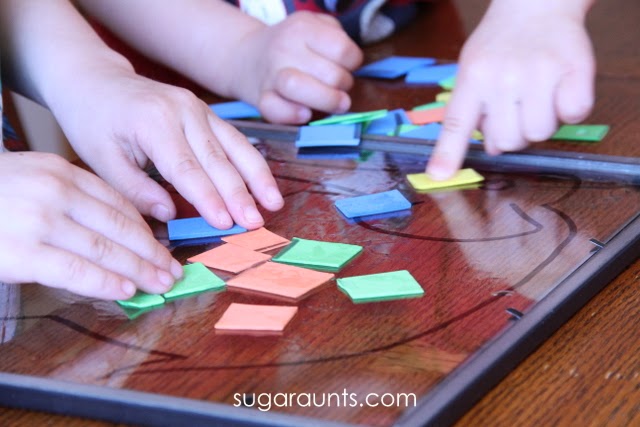
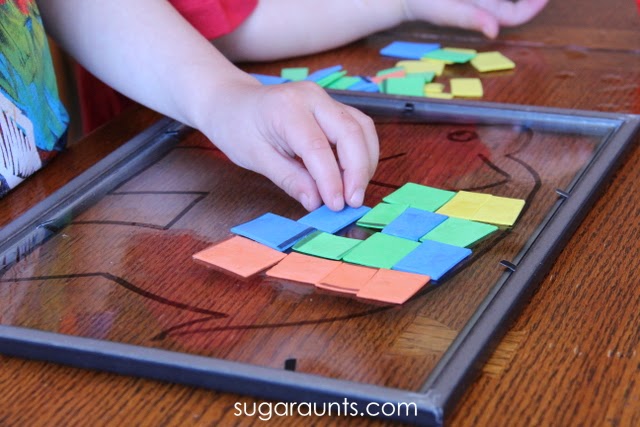
       I found a picture frame at the Dollar Store that has an acrylic front, instead of glass.  This is a great writing surface using a white board marker.  I drew an outline of Elmer with the marker.  We had a little bowl of water and started sticking the foam squares onto the surface to build our Elmer.  When the foam pieces are dunked into water, they stick really well to the picture frame surface.  We did a version of this way back when our blog began with our rainbow building activity.

      Fine motor activity for the book, Elmer the Elephant.

      Visual Perception Activity for Kids

      There were fingers everywhere, adding patchwork squares!  Little Guy and I quizzed Baby Girl on her colors as we worked.  It was a fun puzzle to get the squares fitting into the outline.  What a great way to work on visual perceptual skills, fine motor precision, dexterity, and line awareness!

      Visual perceptual skills in kids are necessary for so many things…from self-care to fine motor skills, to gross motor skills…all parts of a child’s development require visual perception.  There are many pieces to the giant term of “visual perception”.  This Elmer building activity works on quite a few of these areas:

      Visual Discrimination is determining differences in color, form, size, shape…Finding different sized squares to fit into the outline of our Elmer, discriminating the different colors, and shapes are a great way to work on this area. 

      Visual Closure is the ability to fill in parts of a form in the mind’s eye to determine shape or a whole object.  Filling in the missing parts of our Elmer works on this area.

      Visual Spatial Relations is organizing the body in relation to objects or spatial awareness.  This is an important part of handwriting.  Spacing those pieces amongst the others and in relation to the lines is one way to work on this skill.

      Visual Figure Ground is the ability to locate objects within a cluttered area (think “I Spy”).  Finding a red square among the pile of foam pieces is one fun way to work on this area of visual perception.

      Use this fine motor activity with the book Elmer the Elephant to help kids learn abstract concepts while building visual perception.

        Little Guy was really into this activity.  He loved lining up the squares to make our Elmer.

      Elmer the Elephant puzzle that kids can do to build skills in occupational therapy sessions or in the classroom or home.

      We loved how our Elmer turned out!  We’ll be using our frame again, soon.  I can think of so many fun ways to learn and play with this dollar store frame and a marker!

      Elmer the Elephant book and Elmer activity for kids

      More Elmer the Elephant Activities

      Elmer the elephant activities for kids based on the children's book, Elmer the Elephant


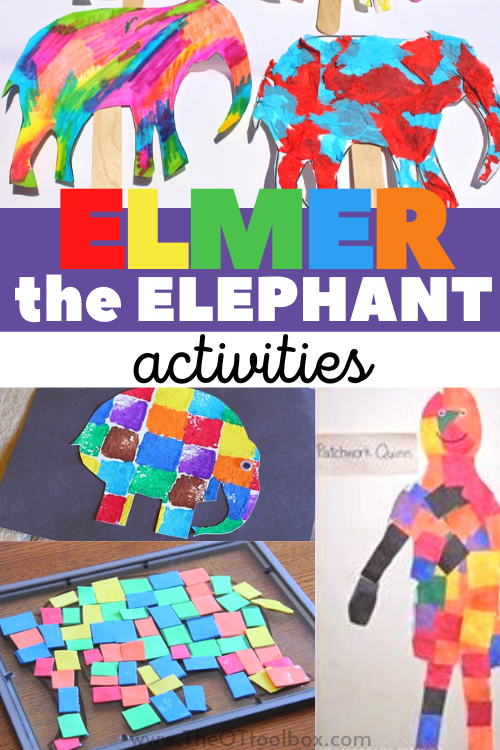
      Check out some of these Elmer the Elephant activities for kids. They are powerful ways to build awareness, acceptance, and friendship through the book and activity.

      Elmer the Elephant activity with facepaint

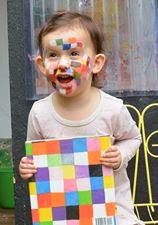
      Use face paint to celebrate friendship with a face painting party based on the Elmer the Elephant book.

      Elmer the elephant craft

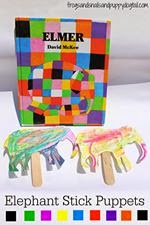
      Make an Elmer craft using puppets to celebrate differences, diversity, and uniqueness in a great lesson for kids, while building fine motor skills.

      Create an Elmer craft using stamp painting.

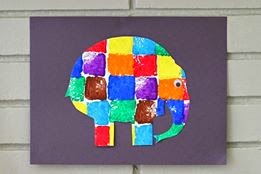
      Create an Elmer the patchwork elephant craft using paint to make a paint stamped elephant craft. What a great way to build fine motor skills!

      Elmer the elephant preschool craft

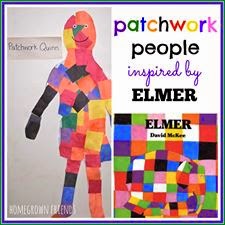
      Kids can trace their bodies with large pieces of paper and then fill the space with colorful paper squares to celebrate uniqueness in this Elmer the Elephant preschool activity.

      Teach Acceptance, Differences, and Diversity

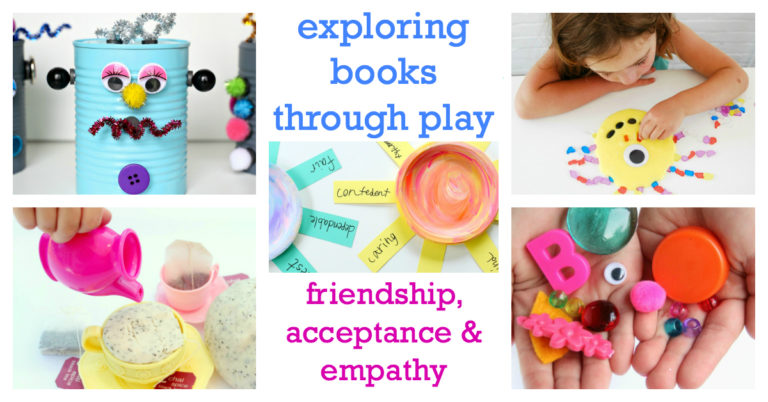
      Want to take complex and abstract concepts like empathy, acceptance, uniqueness, and diversity to the next level with kids? This digital, E-BOOK, Exploring Books Through Play: 50 Activities Based on Books About Friendship, Acceptance and Empathy is filled with hands-on activities rooted in interactive, hands-on, sensory play that focus on creating a well-rounded early childhood education supporting growth in literacy, mathematics, science, emotional and social development, artistic expression, sensory exploration, gross motor development and fine motor skills.

      Kids can explore books while building specific skills in therapy sessions, as part of home programs, or in the home. is an amazing resource for anyone helping kids learn about acceptance, empathy, compassion, and friendship.

      In this book, you’ll find therapist-approved resources, activities, crafts, projects, and play ideas based on 10 popular children’s books. Each book covered contains activities designed to develop fine motor skills, gross motor skills, sensory exploration, handwriting, and more. Help kids understand complex topics of social/emotional skills, empathy, compassion, and friendship through books and hands-on play.

      Click here to get the book and add children’s books based on social emotional learning to your therapy practice, home activities, or classroom.

      Exploring books through play is a guide to using children's books in therapy and while building developmental skills.

      More books to teach social emotional skills

      Check out our other posts in the Preschool Book Club Series for activities based on favorite books:

      Colleen Beck, OTR/L has been an occupational therapist since 2000, working in school-based, hand therapy, outpatient peds, EI, and SNF. Colleen created The OT Toolbox to inspire therapists, teachers, and parents with easy and fun tools to help children thrive. Read her story about going from an OT making $3/hour (after paying for kids’ childcare) to a full-time OT resource creator for millions of readers. Want to collaborate? Send an email to contact@theottoolbox.com.

      Kids Craft Supplies for Building Skills

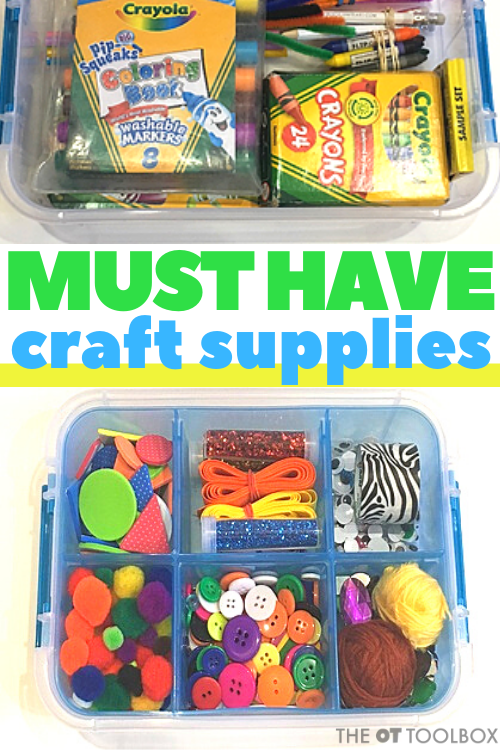
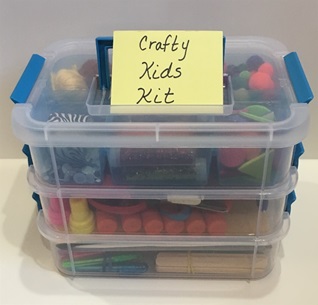
      These must have craft supplies are great for making a craft kit for kids

      While kids crafts offers children the chance to create through art or an opportunity to be creative, the fact is that crafting is a means to help children build skills. Because of that, I wanted to put together a resource detailing kids craft supplies and how simple craft items can be used to help kids improve fine motor skills, executive functioning, motor planning, and other developmental skills. There’s more; Kids can use crafts as a coping strategy. Crafts are one of the therapeutic activities for teens or children of all ages that not only allow children to express their selves, but to create. Let’s talk more about the specific craft supplies for kids and how they can be used as a therapy tool.

      These must have craft supplies are great for making a craft kit for kids

      Kids Craft Supplies In Therapy

      The therapeutic use of crafts has been the history of occupational therapy since the very beginning. The use of crafts began in mental health with a huge focus on basket weaving. Therapeutic crafts have sustained their relevance and continue to be utilized in many occupational therapy settings today to include pediatrics, mental health, outpatient and skilled nursing, among others.

      Why? Because crafts can work on many skills with a focus on functional skills, or meaningful activities. Most all craft activities have some type of motoric and cognitive skill component. Individuals can work on their fine motor control and manipulation, bilateral coordination, tool use, hand strength, visual motor and perception, motor planning, and grasping skills. Crafts allow for work on executive functioning skills to include attention, focus to task at hand, task initiation and completion, planning, sequencing, organizing, following multi-step directions, and problem solving. Craft activities can also provide a fun time for therapists to connect with clients and develop a special rapport.

      Crafts have recently regained their popularity and are back in style with increased vigor and emphasis across all populations.  Children and adults are participating in craft activities both available on social media as well as at craft events in local craft stores and art studios. Adults meet with friends to create and engage in social interaction while learning new skills and creating works of art from their own hands. For many, crafts are a form of occupation. Children likewise enjoy crafts for similar reasons as they are able to use their skills to create something they can share with others and take home to enjoy while having a sense of accomplishment and success.

      Children love to make crafts both in school and during their own time. They have fun exploring different materials and using them to create unique and original items which they can then share with others and display.  To see the smile on the face of a child when they have completed a craft, no matter the end product, is simply priceless.  Precious smiles with development of skills are the reward to pediatric therapists as they work with children every day. Perfection is not the goal, but the process. 

      use craft supplies in therapy

      Art Therapy for Children

      Art therapy for children is a powerful therapeutic activity. There is an entire profession dedicated to the use of art and crafts in therapy. In the occupational therapy profession, the use of arts and crafts offers a meaningful occupation to build essential skills for function. While it may seem like play, there is much happening behind craft activities! Crafts and art in OT sessions are the tools or the medium to improve functional skills in patients.

      Craft Kits for Kids

      Craft kits are one of the best tools for pediatric therapists.  These craft sets are a set of kids craft supplies selected to help kids build skills. Craft kits for kids can come in any shape or size and they offer a sense of intrigue and possibility for children.  Therapists use these motivational materials to address therapeutic goals while children develop confidence in their skills along with self-esteem and ultimately, product production.

      craft kits for kids to build skills in therapy

      Activity Kits for Kids

      When therapists choose a craft they are targeting specific child goals. Using craft supplies, selected activity kit for kids allow users to build skills through creating art or crafts. They address improving skills with scissor manipulation, grasp, fine motor coordination and manipulation, tactile tolerance and stimulation, organization, sequencing, or following multi-step directions.  Craft projects in a group lead to an opportunity for socialization and social skills development too.  Crafts can easily be downgraded or upgraded to address multiple skill levels. Furthermore, therapists can position materials during the process of crafting to facilitate crossing midline, hand dominance, left and right awareness, postural control, range of motion, and motor planning.  Again to reiterate, it is the process of the activity with skills addressed rather than the complete end product.

      Using craft kits can be so much fun and taking them a step further by creating themed kits are always the best!  Craft kit themes can include food items, craft items, sensory items, holiday items, or seasonal items.  Decide the craft kit theme you want to create and start off to the store to gather your materials. A simple, easily replenished, go-to craft kit should be a part of the pediatric therapist’s bag, cart, therapy room, or clinic. So many wonderful skills can be practiced and addressed with craft kit items while also allowing for child creativity and freedom to explore. Let’s take a peek at two fun craft kits that are cheap to create using everyday craft supplies for kids and use easy to find items. 

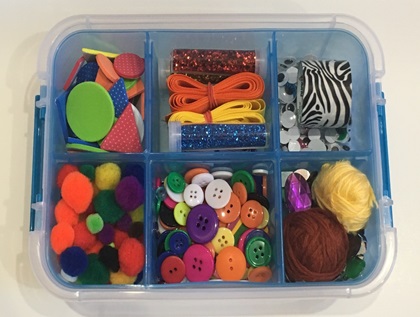
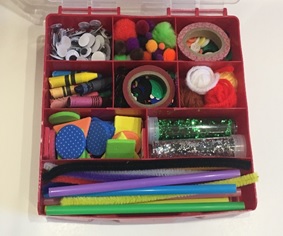
      Kids craft supplies in a craft kit

      Kids Craft Supplies Kit

      This small craft kit contains simple items for use in craft and art activities which can be found at a local dollar store, chain store, or craft store. It contains only the items for art pieces and crafts, but not the necessities such as paper, glue, and scissors.  This craft supply set may be more useful in the clinic setting as the other necessities are readily available for use. However, locating a set of must-have craft supplies for kids is as easy as an internet search.

      craft supplies for kids to use in art activities

      Below is a list of craft supplies that build skills. Click on the links to purchase the craft items.

      Amazon affiliate links are included below.

      Buttons – addresses size relations and fine motor coordination and manipulation. Buttons can also be used to string onto pipe cleaners for crafts which addresses fine motor control and precision, eye-hand coordination, perception, and bilateral coordination.

      Colored craft sticks – addresses fine motor coordination and manipulation. Adding other craft elements such as googly eyes, stickers, washi tape, etc. addresses fine motor precision, bilateral coordination, and eye-hand coordination.

      Crayons – broken pieces of crayon addresses grasp and distal control while the child colors or draws.

      Doilies – addresses fine motor manipulation, bilateral coordination, and patience as the child works to separate the doilies to obtain just one.

      Foam sticker shapes – addresses shape recognition, tactile tolerance, fine motor manipulation and coordination, pincer grasp and bilateral coordination. Removing sticker backs and applying to a surface are key components. In fact, stickers build a lot of skills in occupational therapy goal areas.

      Googly eyes – addresses fine motor manipulation and coordination and pincer grasp. Googly eyes can sometimes be challenging to pick up from a flat surface.

      Pipe cleaners – addresses bilateral coordination, fine motor precision, in-hand manipulation, eye-hand coordination, pincer grasp, and visual motor and perceptual skills. Pipe cleaners can be used for lacing straw pieces and buttons and creating shapes.

      Pom-pom balls – provides a tactile experience and works on pinch and eye-hand coordination for placement. Patterning can also be addressed.

      Regular craft sticks – these are great for creating fun “buddy” crafts.Use crayons to color and other elements for decoration such as googly eyes, sequins, and stickers which addresses fine motor coordination and manipulation, fine motor precision, visual motor, bilateral coordination, and grasp.

      Sequins – addresses fine motor control and manipulation. They are challenging to pick up and manipulate for placement onto glue dots. Patterning can be addressed.

      Small glitter tubes – addresses graded control for sprinkling. Tactile tolerance can be addressed if the glitter is sprinkled with a pincer grasp.

      Straw pieces – addresses bilateral coordination, scissors skills, fine motor coordination and precision, and pincer grasp. Cut straws into pieces for art an activity or for stringing onto pipe cleaners.

      Washi tape – addresses tactile tolerance, bilateral coordination, scissor skills, pincer grasp, size relations and pre-writing skills if used for shape formation.

      Yarnprovides tactile tolerance especially when placing onto glue and addresses fine motor manipulation and coordination, scissors skills, and prewriting skills if used for shape formation.

      craft supplies to help kids build skills in therapy

      Craft Kit for Kids

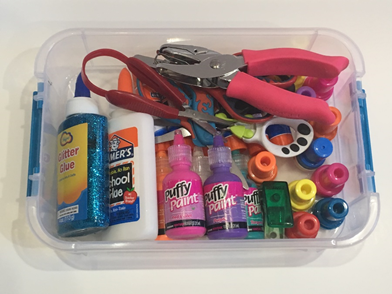
      This larger, three tier craft kit contains ALL that you need to work on art and craft activities with kids.  It houses all of the craft and art items found in the smaller craft kit with a few more additions.  It also allows storage for scissors, glue, paper, and more drawing and writing tools. With this kit, you simply grab and go as all items are there for use in completing the entire art piece or craft.  This kit would serve itinerant or traveling therapists well as they do not always have the necessities readily available in the settings they may be working. 

      Must have craft supplies to add to your therapy tools

      Here is a list of the additional craft supplies in the kit and the skills they can promote:

      Bottle and glitter glue – addresses school tool use, fine motor manipulation, hand/finger strength, bilateral coordination, graded control, and tactile tolerance. Partially closing the twist top can promote an opportunity for increased hand strength.

      Glue sticks – addresses school tool use, fine motor coordination, bilateral coordination, graded pressure, and tactile tolerance.

      Hole punches (thumb and hand) – addresses grasp, bilateral hand use, hand and finger strength, and eye-hand coordination. These small hole punchers are great for building thumb stability and strength in the arches. This reduced effort hole punch strengthens the hand and are ideal for children.

      Ink stampers – addresses fine motor coordination and manipulation, bilateral coordination, and graded control. Patterning can be addressed.

      Markers, pens, pencils, and colored pencils – provides options for color as well as drawing and addresses grasp, distal control, eye-hand coordination, and pressure regulation.

      Paper – a variety including construction paper, card stock paper, doilies, foam sheets, paper plates, and paste board (which can be recycled paste board food boxes).

      Puffy paint – addresses fine motor manipulation, hand and finger strength, bilateral coordination, graded control, and tactile tolerance.

      Ribbon – addresses fine motor manipulation and coordination, bilateral coordination, scissor skills, and eye-hand coordination.

      Scissors – regular and adaptive scissor options addresses scissor skills, grasp, bilateral hand use, hand strength, and eye-hand coordination.

      Using craft supplies to build skills is easy with a quick trip to the dollar store or online shopping session. What craft supplies do you have in your home already? Many times, thinking outside of the box can expand your craft supply. Try using these recycled materials to make crafts and build skills.

      Make a craft kit for kids to use in therapy or at home to build skills

      A final word on Kids Craft Supplies in Therapy

      With these two craft kit examples, you have a better understanding of what type of craft supplies to add to your home or therapy practice. Use the craft supply list to build kids craft kits you would find most beneficial according to your needs and the needs of your clients or children.

      Enjoy creating your craft kit for kids and have fun exploring the items with kids while building important skills and providing opportunities to build child self-esteem and confidence.

      Space Theme Activities Therapy Slide Deck

      space activities for kids to use in occupational therapy activities.

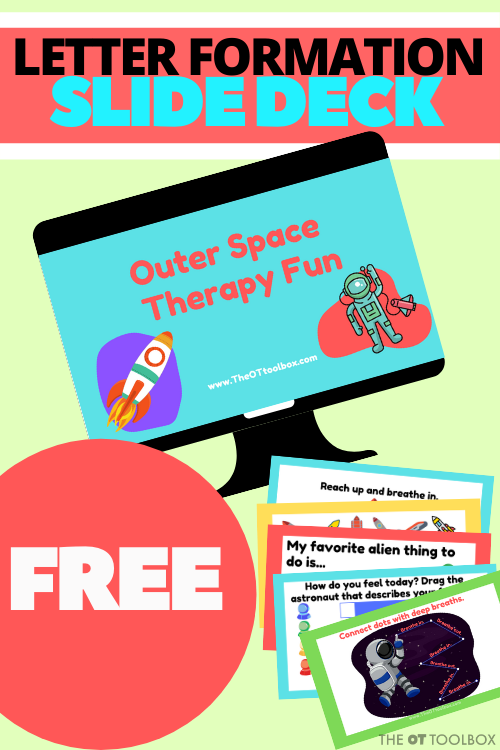
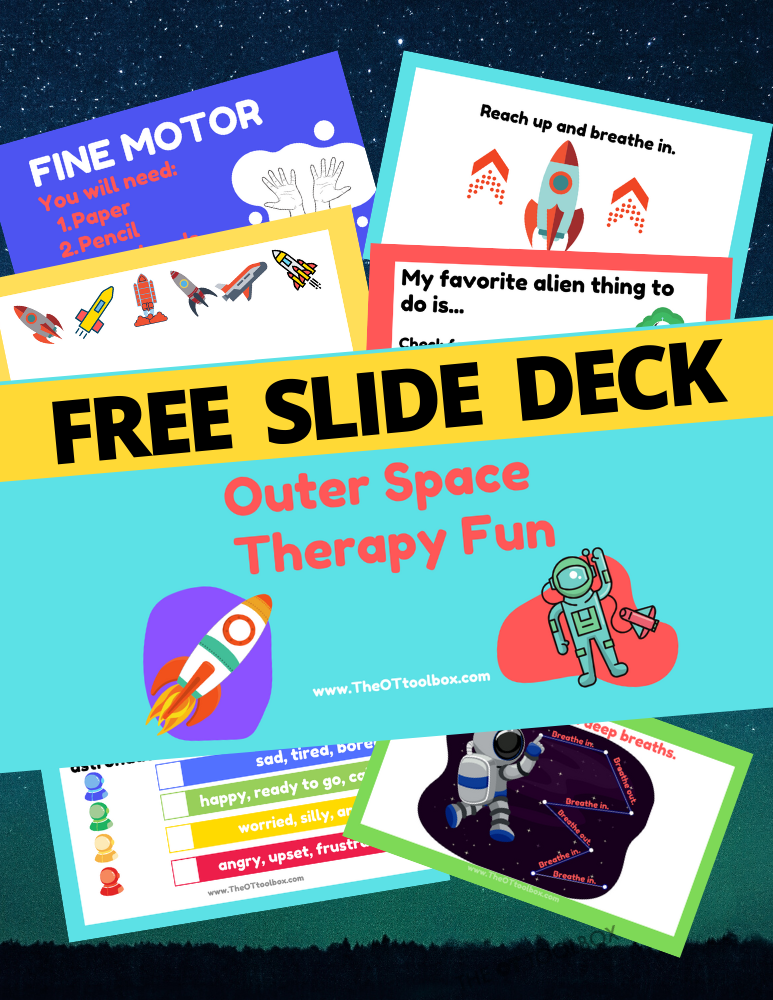
      Have you been enjoying the occupational therapy slide decks available here on The OT Toolbox? In case you’ve missed them, the virtual therapy slide decks have been a hit with therapists seeking out OT activities that can easily be used in occupational therapy teletherapy sessions or distance learning sessions using little to no equipment. Today, I’ve got a space theme activities therapy slide deck to share…perfect for the kiddo that loves a space theme in learning or therapy sessions and a therapist or parent who loves to see goal progress! Below, you’ll find access to a free OT slide deck to use in addressing specific OT goals. Just modify the activities to meet the needs of your clients or students. This slide deck is a lot like some of my other recent therapy slide decks...you’re going to love this one!

      The outer space activities cover a variety of areas: Fine Motor skills, visual perception, handwriting, and self-regulation…all with a space theme. Each activity in the collection involves movement activities that build specific skills. Scroll to the bottom of this post to enter your email to access the latest free occupational therapy slide deck.

      Space Activities for Kids

      This space theme activity set is great for younger kids who love all things rocket ships, astronauts, planets, and outer space. I know that there has been a lot of difficulty with getting some kids to pay attention during teletherapy sessions. Some kiddos run off during virtual therapy. Others turn off the screen or refuse to work on the session tasks. This space theme slide deck is great for the kids that need help focusing to work on various skill areas.
      Pair this free slide deck with some hands-on, multisensory activities for a space theme:

      AND, a new resource has been added to the shop: Outer Space Fine Motor Mini-Kit.

      Space Therapy Slide Deck

      This slide deck is interactive, too making it a fun way for kids to stay engaged during teletherapy sessions. Here’s what’s included:

      space activities for kids to use in OT activities

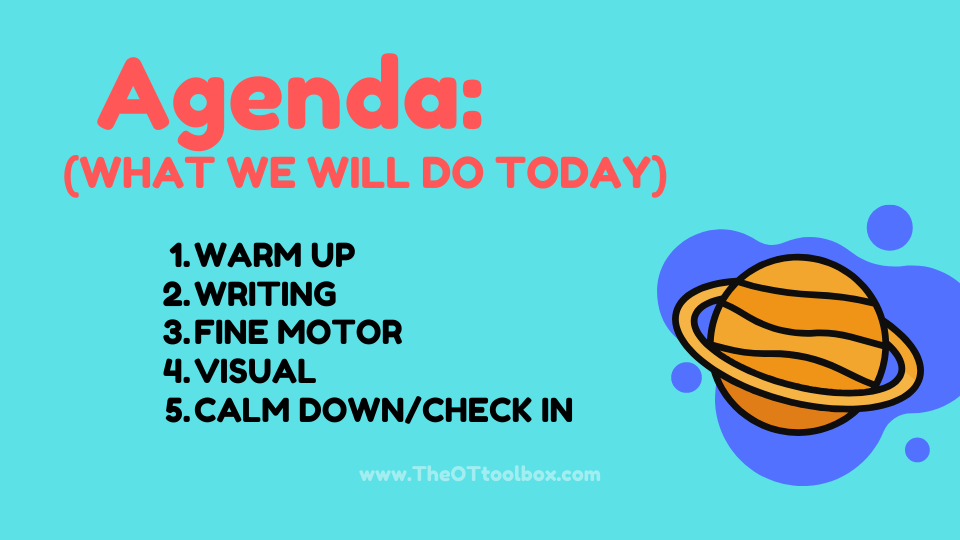
      The slides in this space themed virtual session include a warm up, a writing activity, a fine motor task, a visual perception session, and a calm down/self-regulation check in.

      Outer space deep breaths for kids

      Warm Up Activity- Kids can start the session with outer space deep breaths. This is one of my favorite slides on the slide deck because children can drag an interactive star along a path, working on visual motor skills, motor planning, eye-hand coordination AND deep breathing skills to help with worries or anxiety. This slide is a great way to start off a therapy session or a distance learning session.

      Space activities to work on handwriting with kids

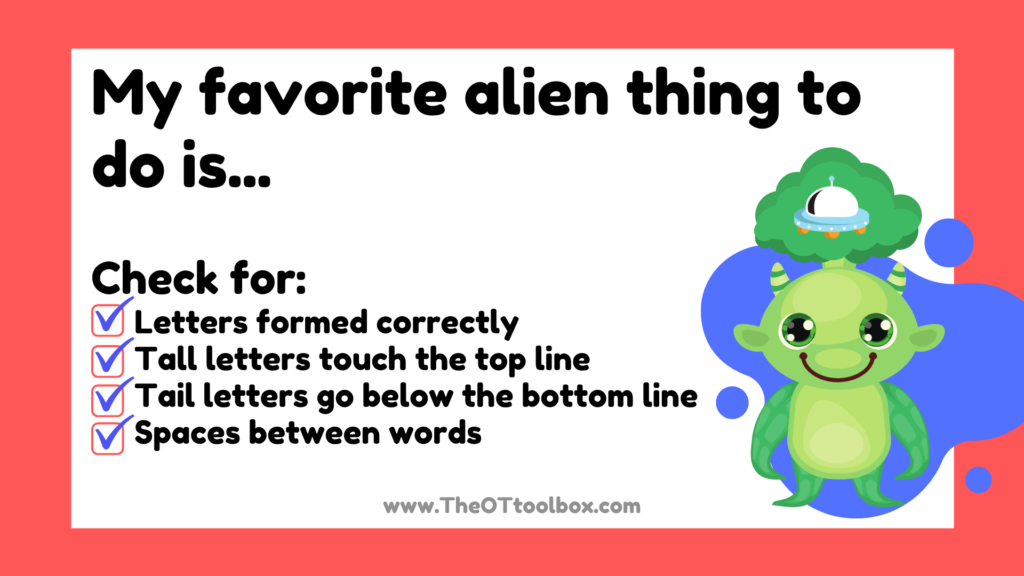
      Space Writing Activity- The handwriting portion of this OT slide deck includes three space themed writing prompts. There is a self-check component so children can assess their handwriting for each prompt. Kids working on letter formation, line awareness, spacing, and legibility will benefit from this section of the slide deck.

      Space handwriting activity for kids
      Space activities for kids to work on fine motor skills

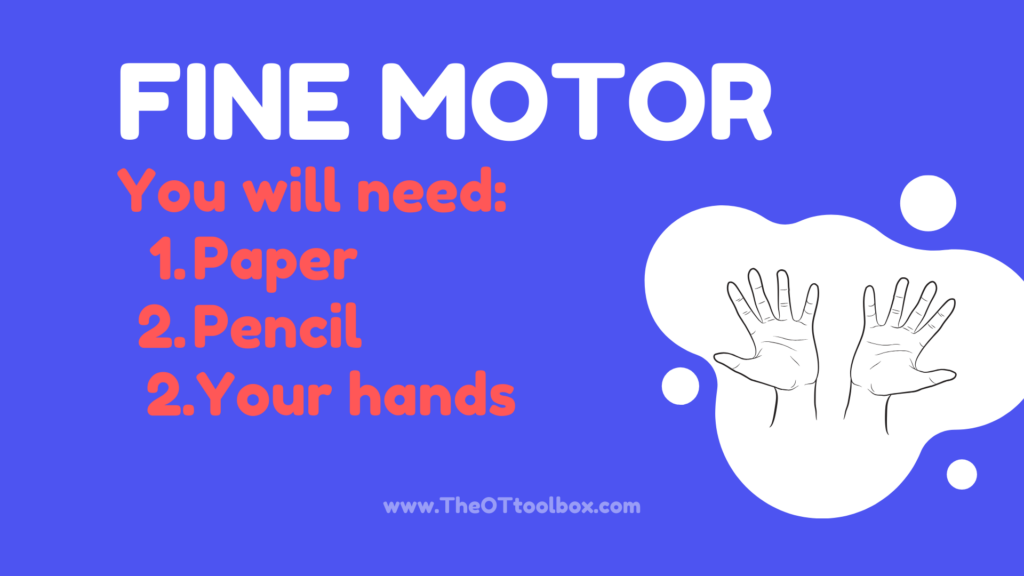
      Fine Motor Space Activity- This activity is a fun one, and it uses only a couple of items that children should already have in the home: paper, a pencil, and their hands. Children can follow the directions on the slides along with the therapist to complete a fine motor activity that builds hand strength, coordination, bilateral coordination, arch development, motor planning, precision, an open thumb web-space, and more.
      Visual motor activities for kids
      Rocket ship activities for kids to work on visual perception

      Space Visual Perceptual Skills- The next section of the slide deck includes two slides designed to build visual perceptual skills including form constancy, visual discrimination, figure-ground. Visual processing skills such as visual scanning and visual tracking, and eye-hand coordination are challenged with these slides as children can click on the colored images and drag it to to the shaded shadow match. There are two separate slides in the vision section.
      space activities for calming down and coping strategies for kids

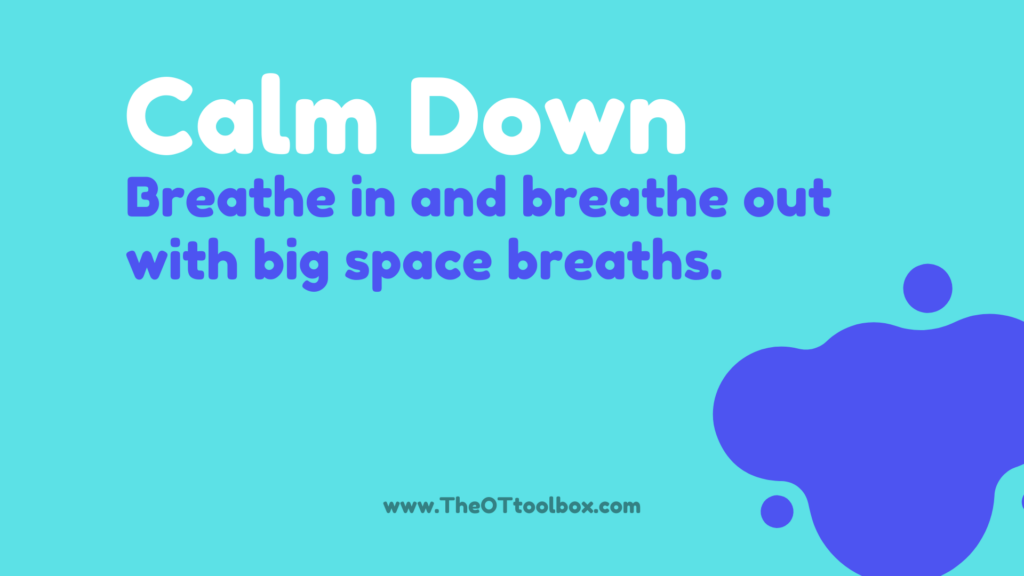
      Calm Down- This coping tools section of the outer space slide deck includes deep breathing tools to help kids focus on effective breathing and positioning.

      space activities for self-regulation

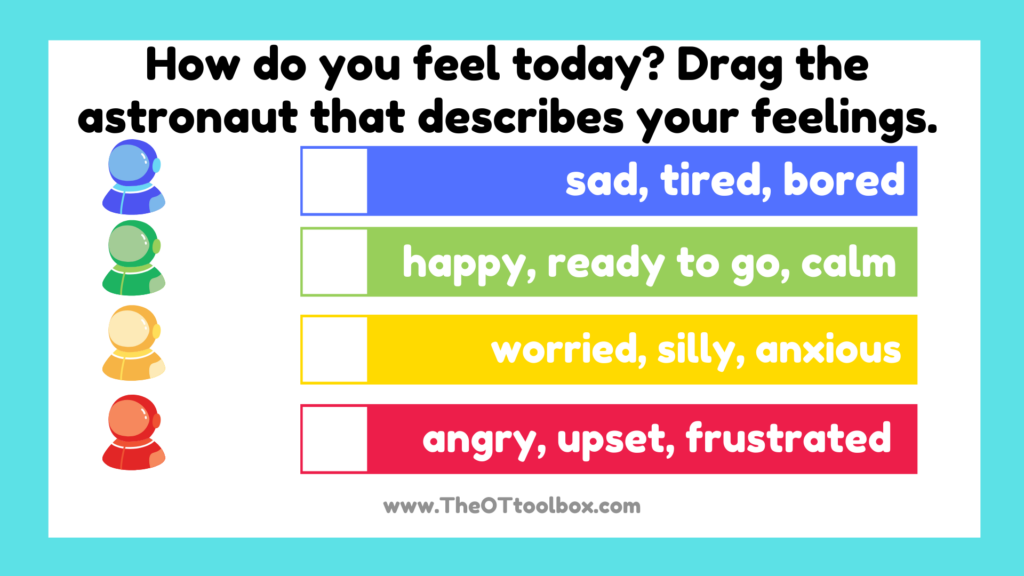
      Check-In- Lastly, you’ll find a calm down slide that incorporates the colors of the Zones of Regulation program. Children can complete the calm down movement activities shown on the slides and then choose a color to check in for their state of feelings. They can click on the colored astronauts and drag it to identify their current state.

      This free slide deck uses space activities and an outer space theme for kids

      Want this Space Theme Activity Set?

      Enter your email below. If you are currently on The OT Toolbox newsletter list, this will not add you a second time. It will simply send the slides your way. Enjoy!

      Get a free Outer Space Theme Slide Deck

        We respect your privacy. Unsubscribe at anytime.
        Powered By ConvertKit

        HERE ARE MORE MOVEMENT ACTIVITIES TO USE IN VIRTUAL OT SESSIONS

        Heavy work movement activity cards

        Monthly movement activities

        Teletherapy activities for kids

        Monster Movement Slide Deck

        Colleen Beck, OTR/L has been an occupational therapist since 2000, working in school-based, hand therapy, outpatient peds, EI, and SNF. Colleen created The OT Toolbox to inspire therapists, teachers, and parents with easy and fun tools to help children thrive. Read her story about going from an OT making $3/hour (after paying for kids’ childcare) to a full-time OT resource creator for millions of readers. Want to collaborate? Send an email to contact@theottoolbox.com.

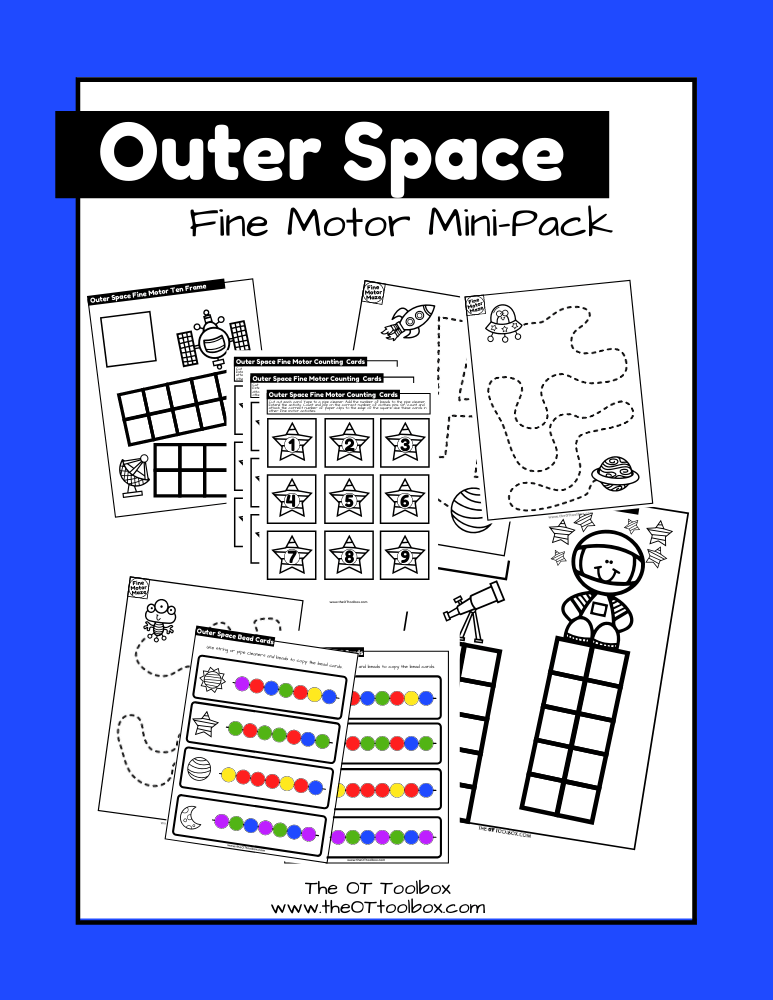
        Know a kiddo that loves all things space, astronauts, and planets? The Outer Space Fine Motor Kit is your chance to develop fine motor strength, dexterity, and coordination skills.

        Addressing hand strength, endurance, and precision is out of this world fun! The Outer Space Fine Motor Kit includes:

        • Fine Motor Mazes
        • Fine Motor Ten Frames for motor activities
        • 1-20 Star Counting Cards
        • Bead Copying Strips
        • Space Alien Directed Drawing Sheets

        This fine motor kit includes 24 pages of printable resources. Included in this printable pack are:

        1. Two pages of color coded bead copying strips
        2. Two pages of blank bead copying strips
        3. Four pages of “draw and write” directed drawing activities with a space theme (Includes 3 styles of handwriting lines: highlighted lines, single rule, and double rule)
        4. Nine pages of fine motor mazes
        5. 1-20 Outer Space Counting Cards
        6. Four pages of fine motor ten frames activities

        These printable activities extend to work on a variety of other functional areas, too: handwriting skills, numbers, math, adding, subtracting, one-to-one correspondence, scissor skills, coloring, and more.

        Click HERE to grab the Outer Space Fine Motor Mini-Kit.

        Outer Space Fine Motor Kit

        Easter Egg Game- Color Scavenger Hunt

        Easter egg game that kids will love while working on color matching, color identification, visual perception.

        If you are looking for a fun Easter egg game that the kids will love, then you are in luck. Add this activity to your Easter activities and use up a few of those plastic eggs. This color scavenger hunt uses plastic Easter eggs, and it’s a very fun way to play and learn!

        Use those plastic eggs to encourage gross motor skills, visual perception, and color learning in a way that kids won’t forget. While the kiddos are playing this Easter game, they are building cognitive skills AND underlying skill areas like visual scanning and other visual perceptual skills.

        Easter egg game that kids will love while working on color matching, color identification, visual perception.

        Easter Egg game

        We set this Easter activity up years and years ago. (2013 to be exact!) However, it’s one of those activities that stands the test of time. If you’ve got plastic Easter eggs on hand, use them to build skills like the ones we worked on here!

        This Easter egg activity helps kids learn colors and learning with a color scavenger hunt gross motor activity

        COLOR SCAVENGER HUNT

        This color scavenger hunt is so easy to set up…and so much fun. Kids can work on identifying color names, and color matching. I wrote different colors on slips of paper and put them into plastic eggs.  The kids got to pick an egg from the bowl and “sound out” the color on the slip of paper.  Ok, my 5 year old sounded out the color with help.  The other two said the first letter of the word and guessed the color.  They were pretty excited to “read” the color on their slip of paper!  

        Another idea to expand this activity is to write words and do an Easter egg version of our word scavenger hunt.

        Kids will love this Easter egg game using plastic Easter eggs in a color scavenger hunt activity.
        Use this color scavenger hunt with easter eggs to work on color matching and color identification with kids.

        An Easter Game Kids will Love

        Now for the egg game…So then, they had to run off and find something that was the color of the written word on their slip of paper…and it had to FIT inside the egg.    I sat and waited for them to run back and show me what they found while they tried to fit it in their egg.   (completely genius way for this mom to finish a cup of coffee!)  

        Kids can look for objects that match plastic Easter eggs in a color scavenger hunt that allows them them move and play with learning, too.

        They had a little trouble with some things, but this was a fun and different way to work on visual perceptual skills.  Will that little doll fit in the egg?  We weren’t sure by looking at it, but with a little fiddling, she did!   Fitting the eggs together with the little objects inside was a great fine motor exercise.

        Kids can look for matching colors in this plastic Easter egg game that helps them with color matching and visual scanning.

        Color Identification for Kids  

        They found something for each color!  

        Putting items into the eggs and then matching colors was a great way to work on color identification skills.

        Matching colors requires visual motor skills to match colors and use that recognition in identifying the name of the color. It’s a skill that requires visual memory as well as working memory. This skill then carries over to so many other areas like letter recognition, and so much more.

        Learning colors is a building block for learning in kids!

        Kids can play this color scavenger hunt game with plastic Easter eggs for a fun Easter game that can be played indoors or outdoors.
        Kids can learn color names and work on learning skills like visual scanning, fine motor skills, and gross motor skills with this Easter game.

        This Easter themed play activity could be modified in so many ways for learning words, colors…have fun with it 🙂

        Want more ways to play and learn this time of year?

        One resource we love is our $5 therapy kit…the Plastic Egg Therapy Kit! It has 27 printable pages of activities with an Easter egg theme. In the kit, you’ll find fine motor activities, handwriting prompts, letter formation pages, pencil control sheets, plastic egg activities, matching cards, graphing activities, STEM fine motor task cards, and more. There are several pages of differentiated lines to meet a variety of needs. This therapy kit has everything done for you.

        Get your copy of the Easter Egg Therapy Kit here.

        This time of year, one of our more popular products here on The OT Toolbox is our Spring Occupational Therapy packet. The best news is that, this packet has had a major upgrade from it’s previous collection of spring sensory activities.

        Another great tool for supporting skills is the Spring OT packet…

        In the Spring OT packet, you’ll now find:

        • Spring Proprioceptive Activities
        • Spring Vestibular Activities
        • Spring Visual Processing Activities
        • Spring Tactile Processing Activities
        • Spring Olfactory Activities
        • Spring Auditory Processing Activities
        • Spring Oral Motor Activities
        • Spring Fine Motor Activities
        • Spring Gross Motor Activities
        • Spring Handwriting Practice Prompts
        • Spring Themed Brain Breaks
        • Occupational Therapy Homework Page
        • Client-Centered Worksheet
        • 5 pages of Visual Perceptual Skill Activities

        All of the Spring activities include ideas to promote the various areas of sensory processing with a Spring-theme. There are ways to upgrade and downgrade the activities and each activities includes strategies to incorporate eye-hand coordination, bilateral coordination, body scheme, oculomotor control, visual perception, fine and gross motor skills, and more.

        THE BEST THING ABOUT THE SPRING ACTIVITY PACKET:

        One of my favorite parts of the Spring Occupational Therapy Packet is the therapist tool section:

        • Occupational Therapy Homework Page
        • Client-Centered Worksheet

        These two sheets are perfect for the therapist looking to incorporate carryover of skills. Use the homework page to provide specific OT recommended activities to be completed at home. This is great for those sills that parents strive to see success in but need more practice time for achieving certain skill levels.
        This activity packet is 26 pages long and has everything you need to work on the skills kids are struggling with…with a Spring theme!

        Here’s the link again to grab that packet.

        Use this Spring Occupational Therapy Activities Packet to work on occupational therapy goals and functional skills with a spring theme.

        Colleen Beck, OTR/L has been an occupational therapist since 2000, working in school-based, hand therapy, outpatient peds, EI, and SNF. Colleen created The OT Toolbox to inspire therapists, teachers, and parents with easy and fun tools to help children thrive. Read her story about going from an OT making $3/hour (after paying for kids’ childcare) to a full-time OT resource creator for millions of readers. Want to collaborate? Send an email to contact@theottoolbox.com.

        Working on Fine Motor Skills in Teletherapy

        these fine motor activities for teletherapy require items already in the home

        Working on fine motor skills in teletherapy services can be a strange thing to consider if you re used to face to face occupational therapy intervention. Helping a child to engage in fine motor activities in a virtual setting may seem downright strange. How to do you help kids work on areas like hand strength, dexterity, or other fine motor skill needs? The use of teletherapy fine motor activities, also known as manipulatives, may at first overwhelm therapists who do not understand how this would work virtually.

        these fine motor activities for teletherapy require items already in the home

        However, there are a range of ways to incorporate fine motor activities into teletherapy occupational therapy treatment sessions. Therapists can use extra creativity to develop fine motor activities for teletherapy sessions, but they can also use some of the same activities they would use in-person (with a bit of preparation and/or assistance from an “e-helper”).

        A recent post here on The OT Toolbox explains the basics of understanding teletherapy and what this looks like. You’ll also want to check out this piece on occupational therapy activities in teletherapy for easy-to-implement ideas for children of all ages. What about the child who needs to work on fine motor skills?

        Today, we’re discussing some popular, but effective fine motor activities for teletherapists.

        Use these fine motor activities to help students improve fine motor skills during teletherapy services.

        How to work on Fine Motor skills in teletherapy

        Using a teletherapy platform to provide therapy services doesn’t mean children can’t work on essential skill areas. Here are some ideas to get your creative brain started.

        One everyday item found in most homes is paper clips. Use these games with paper clips to target specific skills.

        Theraband Activities in telehealth

        As you may already know, theraband or resistive bands are a trusty therapy tool that can be used by therapists to treat a variety of populations in a range of settings. Teletherapists can use theraband to strengthen a child’s fine motor skills in preparation for tasks such as handwriting, dressing, eating, play, and other self-care tasks. What’s more is that resistive band exercises can be included in a sensory diet that helps children to regulate themselves so they are able to participate in fine motor activities.

        Some of the following theraband activities can assist with fine motor strength and coordination in children:

        • Grab each end of the theraband, make a fist, and pull the band apart at the same time (this works on general digit and wrist strength)
        • With smaller theraband elastics, place the band around the tips of all of your fingers, then spread all your fingers apart, and repeat (this works on digit abduction and adduction)
        • Rest your hand flat on the table, wrap a theraband elastic around one finger at a time while using your other hand to pull on the opposite end of the band; resist the pressure of the band by trying to move each finger to its resting state, which is flat on the table (this works on digit isolation and coordination)

        Therapists can find more detailed videos that guide children through these exercises, or they can demonstrate for them during sessions. This often works best when children have “e-helpers” to assist in getting theraband and possibly helping children learn to use it during the first several times or as part of their home programs.

        Here is a resistive band home program for kids that lends itself well to telerehab.

        Use noodles and string or pipe cleaners to work on fine motor skills in teletherapy occupational therapy sessions

        Use Pipe Cleaners in Fine Motor Activities during teletherapy sessions

        Children can use pipe cleaners to work on fine motor strengthening during a variety of tasks during teletherapy sessions. Pipe cleaners may most easily be utilized during treatment sessions to string beads or other small objects on them. This helps children develop fine motor precision, coordination, strength, digit isolation, and more.

        Children can also use scissors to cut pipe cleaners into smaller pieces and make into certain objects, fill in pictures to add color, and more.

        Another good way to use pipe cleaners in teletherapy sessions is to ask children to be creative and bend them into certain shapes, objects, or letters.

        This is another example of materials that parents, guardians, and other loved ones can obtain and provide for their children to use during therapy sessions.

        Use simple and everyday items to work on fine motor skills during occupational therapy teletherapy sessions

        Use Tweezers during fine motor activities in teletherapy sessions

        Therapists can have children use tweezers to improve their grasp pattern, fine motor coordination, and fine motor strength. This will help children form an improved grasp pattern and overall greater range of motion in the hand as preparation for handwriting tasks. Therapists can utilize tweezers along with small objects in a variety of ways:

        • Have children pick up beads or cotton balls with tweezers
        • Ask children to use tweezers to place small perler beads on glue or within a picture to add color or texture
        • Use tweezers to move small objects around on a table, but not pick them up

        Therapists who use their creativity can easily incorporate manipulatives into teletherapy treatment. Again, the intermittent assistance of e-helpers can really improve a child’s performance and engagement in the teletherapy treatment process.

        Here are additional ways to work on fine motor skills during teletherapy using items that are commonly found in the home:

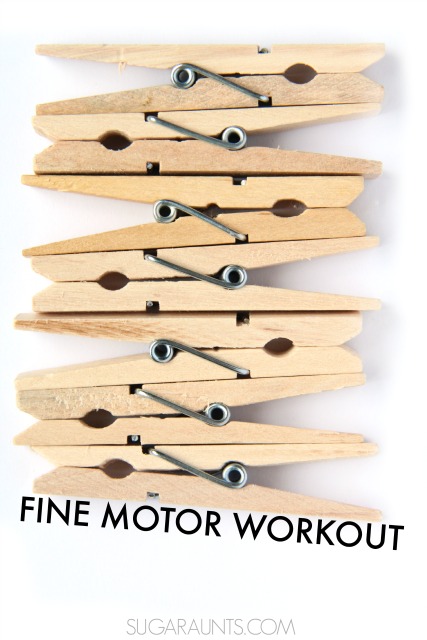
        Fine Motor Activities using clothespins

        FIne Motor Activities with Play Dough

        Fine Motor Activities with Paper Clips

        Fine Motor Activities with Craft Pom Poms or Cotton Balls

        Fine Motor Activities with Playing Cards

        Fine Motor Activities with Beads

        Fine Motor Activities with Chalk

        Crafts for Kids to work on various fine motor areas.

        Helping kids understand teletherapy

        Children who have previously received occupational therapy services in a face-to-face setting may feel a little confused or out of sorts when they now need to complete fine motor tasks at home (and with items that are way less fun than what they are used to their OT playing with alongside them. Here is a fun book to help explain why they are now working on hard things like fine motor skills with their therapist through a computer screen.

        Affiliate links are included below.

        Free Parent Handout for Teletherapy Materials

        This free printable and handout will help parents understand basic, everyday materials that kids can use in their therapy sessions. Use this to help kids come to therapy sessions with just a handful of household materials.

        List of OT Teletherapy Materials- Parent Handout

          We respect your privacy. Unsubscribe at anytime.

          Colleen Beck, OTR/L has been an occupational therapist since 2000, working in school-based, hand therapy, outpatient peds, EI, and SNF. Colleen created The OT Toolbox to inspire therapists, teachers, and parents with easy and fun tools to help children thrive. Read her story about going from an OT making $3/hour (after paying for kids’ childcare) to a full-time OT resource creator for millions of readers. Want to collaborate? Send an email to contact@theottoolbox.com.

          This blog post was written by Brittany Ferri. Brittany is an occupational therapist, author, and teletherapy professional. She is passionate about education, health promotion, and disease prevention for all. Brittany currently practices in community-based teletherapy for two platforms, one that serves pediatrics (geared toward mental health diagnoses and developmental delays) and one that serves adults. For more information, visit her company’s website at www.simplicityofhealth.com