Colleen Beck, OTR/L is a pediatric occupational therapist and the owner and author of The OT Toolbox website. She manages all of The OT Toolbox social media accounts and runs the popular newsletter.
Read about Colleen's experience and career as an occupational therapist, including how The OT Toolbox began on our About The OT Toolbox page: https://www.theottoolbox.com/about-us/
Colleen created The OT Toolbox in 2011 and since then has written thousands of blog posts designed to support therapy providers, educators, parents, counselors, admin, and caregivers in promoting the healthy development of kids.
Check out Colleen's blog posts below:
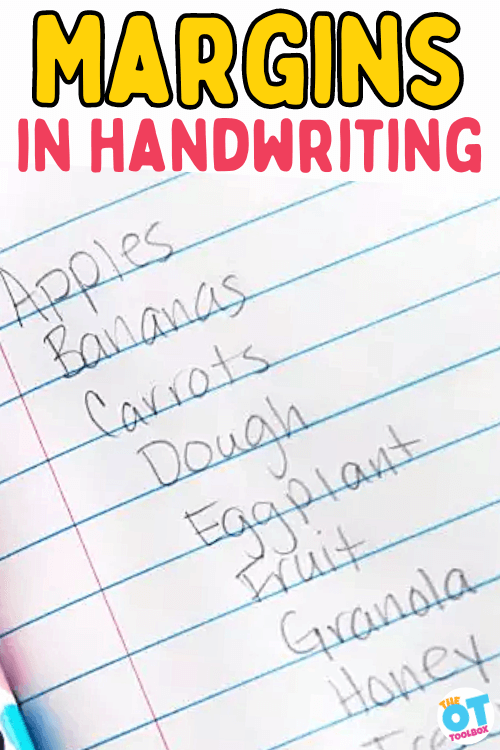
Occupational therapists work on many aspects of handwriting to ensure that legible writing is a functional means of communication for children and students. One aspect of that is addressing the margins in handwriting. When margins are omitted or neglected, handwriting moves from functional to difficult to read.
Poor use of margins when copying written material is a handwriting problem that looks like different things. When using margins is difficult in handwriting, it leads to illegibility and trouble copying written work.
Margins in handwriting
One thing that comes up frequently in school based OT, is the use of margins when writing. I’ve worked with many students that struggle with knowing to move their pencil to the next line when writing. Other students cram letters into the right margin of the page and then move to the next line only to slightly move over a bit. This means that the left margin slowly creeps across the page.
You’ve seen it before. A child is writing a journal entry or a writing response on a piece of paper and each line of the paragraph creeps in toward the center of the page.
The margins in their handwriting are just all over the place! By the end of the passage, the left margin is half way across the page. You might see them start halfway across the page and try to squash letters in by the time they get to the right side of the page.
It’s hard to read and even the kiddo has trouble reading back over their work. The thing is, the student may not even be aware they are writing like this…
When a child has poor use of margins when writing, there is typically a problem with spatial organization and page orientation.
Decreased spatial awareness can happen due to trouble with visual perceptual awareness.
It may carry over to handwriting that appears very messy with words that are squashed up against one another or spaced with very large spaces between letters.
what are margins in writing
Margins are the edges of the paper. When we write, we move our pencil up to the edge of the right side of the paper, but we stop before we move to the next line to continue writing.
The right margin on a page is where the student will stop writing, but so often, I’ve seen students that cram words right up to the edge of the paper because they can’t conceptualize how much space is needed to fit the word onto that line of the paper. They might end up cramming the whole word so the letters are very small or squished up to the edge of the page.
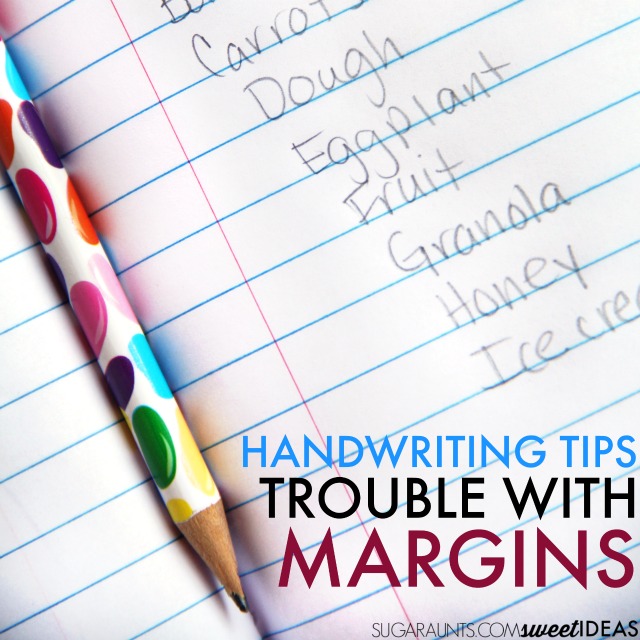
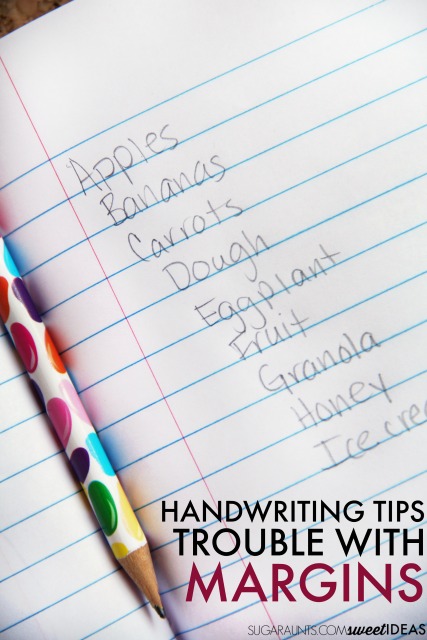
The left margin is the edge of the page where the next line begins on the paper. I’ve also seen many students who write or copy a list of words, or are writing a paragraph on lined paper. When they move to the next line, the move their pencil over just slightly because they are aligning the word with the written material on the line above. Eventually, you see a margin that creeps across the page toward the middle of the page.
Why kids struggle with margins in handwriting
So, why do we see those handwriting samples where the lines of written work slowly creep over to the middle of the page? With each line that the student writes, they start writing just a bit more away from the margin?
There could be a few different things going on here that impact margin use:
1. There could be a visual perception difficulty going on.Visual perceptual skills could lead to trouble with margin use. Specifically, it could be a problem with visual spatial relations. Spatial relations, or poor spatial awareness difficulties shows up frequently in handwriting.
This presents as poor spacing between letters and words, poor use of margins, or written work that drifts in toward the center of the page. Kids may struggle with knowing when to stop writing on the end of a line of the page and try to squash the material in rather than stopping to move to the next line.
Left to right use of paper or writing spaces on worksheets can be a problem. Other size aspects of handwriting including letter size, placement of letter “parts”, and consistency in sizing can be difficult for the child with visual spatial concerns.
Visual spatial relations can also impact placement of objects or the child’s body parts in relation to other objects, other people, or in movement. This can show up as poor coordination, poor balance, poor self-awareness, poor self-confidence, and even impaired social emotional relations.
Spatial awareness is the ability to perceive the world around one’s self and position themselves or objects accordingly. Awareness of space relates a lot to the proprioceptive and vestibular systems as well as the visual system.
A child who demonstrates poor spatial awareness in handwriting tasks most likely shows some variances of difficulty with gross motor movement, understanding directions, abstract concepts, and language.
2. There could be an oculomotor component. The movement of the eyes in activities is complex! When we see issues with margins, there could be a couple of oculomotor issues happening. At a basic level, the eyes move to take in information and process that information for use.
One oculomotor skill that may be in play with margin trouble are visual saccades/visual scanning. Saccades are the ability to visually scan information. Saccades require the ability to fixate on information in the visual fields.
Saccadic movement, or more commonly known as visual saccades, is the ability of the eyes to move in synchrony from point A to point B rapidly WITHOUT deviating from the path. When kids move their eyes to the next line of a paper, they jump to the nearest anchor (which will be the letter above on the last line of text they just wrote.) They will then scoot their pencil over and under that letter, resulting in written work that drifts in toward the middle of the page. Here is more information on visual saccades and learning.
We cover more about oculomotor skills and how they result in functional issues in reading, writing, and daily activities in the free Visual Processing Lab here on The OT Toolbox.
3. It might be developmental. In this case, kids just need more experience with writing paragraphs of text. They place their written material anywhere on the page or drift over on the line when starting to write. Visual and verbal cues…and more practice can help.
Even children without visual perception difficulties may tend to drift their handwriting in toward the middle of the page as they write paragraphs. This is especially apparent in free writing, journal writing, or writing prompts. You will see that children who are developing their ability to form thoughts in paragraph form. As they write, it is common to see the lines start to drift toward the middle of the page. Here is more information on development of eye-hand coordination.
3. It might be speed of writing or visual inattention. Basically, you might see a kiddo who just isn’t paying attention when they are writing. In this case, students might be writing so quickly that they are focusing on the content of the writing versus the layout of the page and where they are placing their written work.
This happens when kids are taking notes and trying to quickly get the information on the page. You may also see the lines of text drifting over during free writing or timed writing tasks. In these cases, a visual cue can help but it might just take a verbal prompt. Point out how the margins are creeping over and see if that helps. Here is more information on visual attention.
4. Look at reflexes. One thing that might be contributing to margin use is a retained ATNR reflex. Check out our resource on retained primitive reflexes. Here is information on primitive reflexes in general and how these movement reflexes impact function.
5. Look at midline crossing. Delays with crossing midline can impact movement across the page as the student writes. Read about midline and then try some of these midline activities. In this case, bringing attention to the margin can help. Use the strategies we have listed at the bottom of the page.
This visual processing checklist can be a helpful tool in screening for visual processing difficulties prior to a full evaluation. It can be a way to collect qualitative information to include in assessment write-ups as well.
Tips for Handwriting Margins
Today, I’ve got some tips for helping with spatial awareness in handwriting, including how to help with margins when writing. These tips can help kids with writing on the paper and using handwriting that is legible so they can come back and read what they’ve written. (And so the teacher or parent can read that handwriting too!)
Visual perceptual skills are needed for so many functional skills. You’ll find easy and fun ways to work on visual perceptual skills through play here. These are creative ways to work on the underlying issues that might be playing into trouble with margin use in handwriting as a result of spatial awareness difficulties.
This post contains affiliate links.
QUICK tips for improving spatial awareness:
For some of the issues mentioned above, such as an underlying visual perceptual or oculomotor problems, further help and interventions will be needed. Seek out assessment from an occupational therapist for individualized treatment and intervention plans. Use of our visual processing checklist to help to identify a specific area related to visual processing needs.
The strategies that I’ve listed below are tools for helping students use margins when writing and copying onto paper. I love using some of the visual prompts because it helps to draw visual attention toward the prompt. Some of the strategies below are fun for kids and unexpected, so that visual prompt helps them to remember where to start or stop their pencil along the margins.
Try some of these strategies to help with margins:
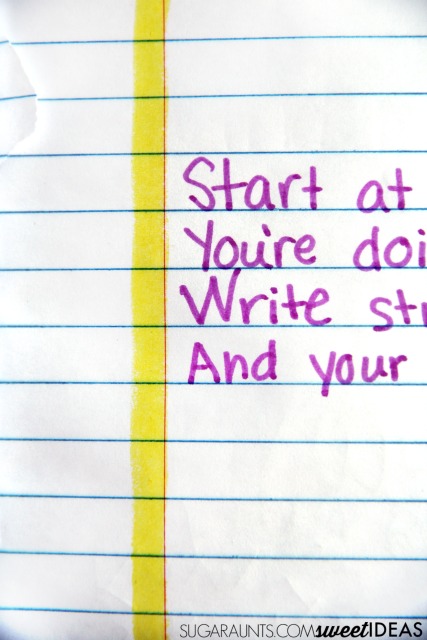
There are ways to accommodate for difficulties with spatial awareness. One quick tip is to use a highlighted left margin. This is a great way for those kids whose writing drifts over to the middle of the page as they write or kids who start in the middle of the page.
Use stickers placed along the right margin of to cue the student that they are nearing the edge of paper when writing.
Draw a line down the left margin for a starting point. Then use a different color to draw a vertical line down the right margin.
Place a thin piece of tape along the left margin. This can serve as a visual and physical cue as the place to start writing. It’s a visual anchor that helps with visual scanning.
Draw boxes for words on worksheets for them to write within.
Place small green dots on each line along the left margin. These are the “green lights” so students know where to start writing. Place small red dots on each line along the right margin. These are “red lights” so students know where to stop writing.
Take a look at the ATNR. This could also be an issue impacting margin use.
This activity is part of our month-long handwriting series where we are sharing creative and easy ways to address common handwriting issues in our 30 Easy Quick Fixes for Better Handwriting series.
Colleen Beck, OTR/L has been an occupational therapist since 2000, working in school-based, hand therapy, outpatient peds, EI, and SNF. Colleen created The OT Toolbox to inspire therapists, teachers, and parents with easy and fun tools to help children thrive. Read her story about going from an OT making $3/hour (after paying for kids’ childcare) to a full-time OT resource creator for millions of readers. Want to collaborate? Send an email to contact@theottoolbox.com.
The Handwriting Book is a comprehensive resource created by experienced pediatric OTs and PTs.
The Handwriting Book covers everything you need to know about handwriting, guided by development and focused on function. This digital resource is is the ultimate resource for tips, strategies, suggestions, and information to support handwriting development in kids.
The Handwriting Book breaks down the functional skill of handwriting into developmental areas. These include developmental progression of pre-writing strokes, fine motor skills, gross motor development, sensory considerations, and visual perceptual skills. Each section includes strategies and tips to improve these underlying areas.
Strategies to address letter and number formation and reversals
Ideas for combining handwriting and play
Activities to practice handwriting skills at home
Tips and strategies for the reluctant writer
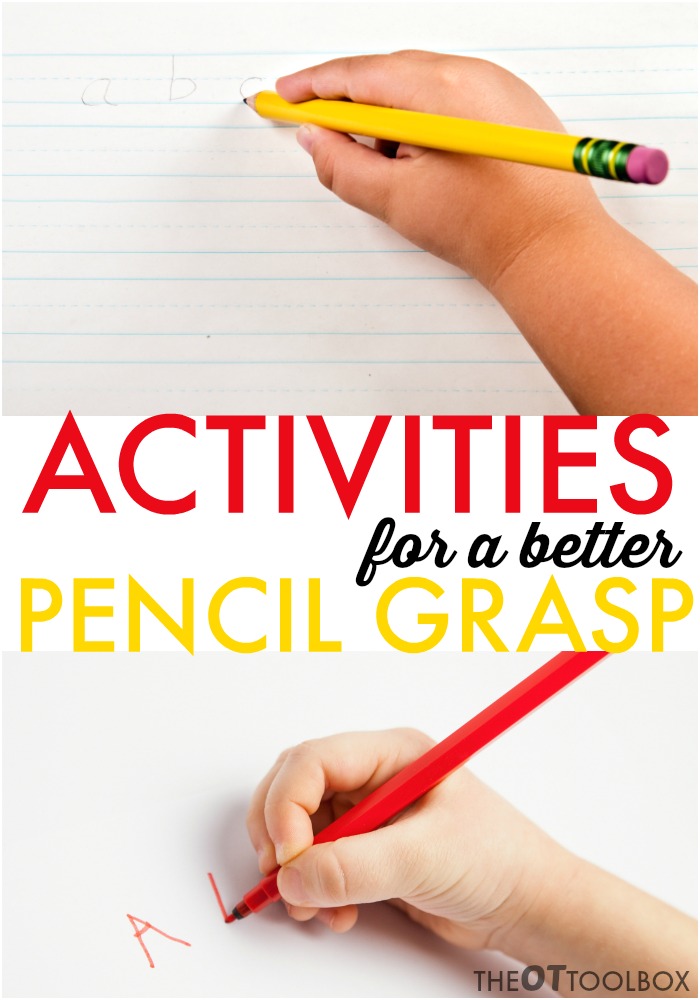
Tips to improve pencil grip
Tips for sizing, spacing, and alignment with overall improved legibility
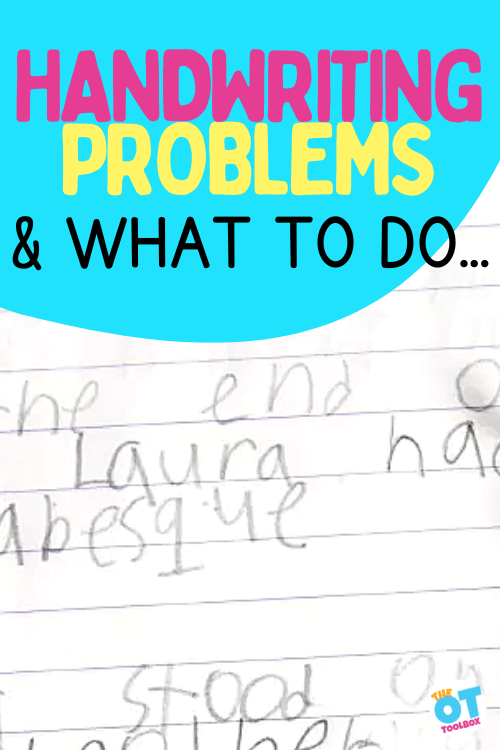
If you are looking for answers to common handwriting problems in kids, then this is the place to start for handwriting help, activities to help kids improve the skills they need for legible written work, and success when writing with a pencil. Handwriting problems are common for kids of all ages. There are many reasons for this (read more below) but the good news is that there are ways to address the underlying developmental need and to accommodate or modify to promote improved legibility. You can find all of our handwriting on the tab at the top of the site, but this is a headquarters for specific legibility problem areas.
Do you know a child with handwriting struggles? Handwriting issues typically show up around kindergarten, and the school based OT might tell you that there are underlying skills that are missing: the student can’t form pre-writing lines like diagonals, or have trouble with fine motor skills.
For older students, we see writing trouble show up in the way of letter reversals, poorly formed letters, letters crammed into a writing space, and many other factors that lead to illegible writing.
Does that sound familiar?
A parent might see their child battle the pencil every day as they try to write letters, erase completely, and read the homework they wrote down in school just an hour earlier. The see struggles with writing that lead to missed problems.
A teacher might see several students in OT sessions that reverse letters, write with little regard to the lines, uses a strange pencil grasp, or can not keep up with the rest of the class because of handwriting issues. Here are some important things that therapists wish parents and teachers knew about pencil grasp.
School based OTs and OTAs will work with kids one-on-one to meet handwriting goals and then cringe to see that same child not carrying over skills he’s seemed to master. You might be looking for ways to meet handwriting goals so that your clients can achieve success in the classroom.
Are you a homeschooling parent who knows their smart child isn’t learning as they should be because of handwriting issues?
Common Handwriting Problems
As any school based occupational therapy practitioner knows, handwriting is a functional skill that is needed throughout the school day to complete daily tasks. It contributes greatly to learning, even with the increased use of screens and technology in recent years.
Handwriting struggles are not a new thing. Kids have been writing with a sloppy John Hancock since the very first handwriting tool!
What is new, (and those of us working in schools can say this is true) is that there seem to be more and more occupational therapy referrals for handwriting issues. What might be causing handwriting struggles in students?
Some of the culprits might be less time for handwriting instruction in classrooms, more computer use in the classroom, more kids who come into the school lacking fine motor skills, more awareness of underlying skill areas like visual processing abilities, and higher expectations on our kids in school, after school activity schedules, and faster-paced national classroom standards.
Causes of Handwriting Problems
Most of us occupational therapy practitioners can come up with a list of reasons why handwriting problems are challenging written work legibility. The thing is that many of these issues won’t go away on their own…
Schools have handwriting curriculum in place, but limited time to truly focus on this aspect of learning.
Kids start writing before they’ve developed the underlying skills. We see this all the time, especially in preschool when young children are asked to write before they are ready.
Screens are not going away.
Whether it’s one of these issues that leads to challenges or another reason, we just know that handwriting problems result.
You’ve probably seen the student with pencil grasp issues. The “tight” or “too hard” grip that leads to hyperextension is a compensatory strategy to increase motor control and dexterity within the task. Due to the variety of pencil grips that children display, it is important to assess the functionality of the grip before attempting to change it.
Where we see the issues at work is when students miss problems on assignments because the teacher can’t read the writing. Or a student can’t read their own writing.
These are the functional problems that impact learning and classroom participation because of handwriting difficulties.
This is where we’ll see the “why” behind a reason for a student’s referral to occupational therapy. We’ll include these skill areas in our handwriting analysis because it’s the function that drives our OT goals.
School based OT practitioners- This list is the “functional handwriting” aspect that we talk about; it’s how handwriting is a daily life skill, or an occupation that our client or student needs to do during their day at school.
Some of the functional writing problems that we see include:
Missing spelling words due to letters resembling different letters.
Difficulty reading homework assignments.
Poor comprehension of learning materials due to illegible writing.
Frustration and decreased motivation to write.
Misinterpretation of a child’s understanding or abilities by teachers.
Incomplete or inaccurate assessment of academic performance.
Reduced confidence in academic abilities.
Increased reliance on verbal communication over written expression.
Difficulty organizing thoughts and ideas on paper.
Struggles with completing written assignments within allotted timeframes.
Limited participation in classroom activities requiring written output.
Challenges with note-taking and study skills.
Negative impact on overall academic achievement.
Increased stress and anxiety related to written tasks.
Reduced independence in completing written tasks.
Let’s take a look at some of the handwriting problems that we might see in written work. These can be the things we see that lead to occupational therapy referrals.
Poor letter formation
Poor diagonals in writing, like in letters A, K, V, W, etc. (a pre-writing skill)
Difficulty copying written work from a near point or a far point (such as the chalkboard or Smart board)
Slow writing speed
Heavy pencil pressure
Inaccurate margin use
Trouble writing across the page left-to-right pattern
Reversal of letters
Number reversals
Inconsistency with upper case/lower case letter use
Trouble carrying over handwriting practice
Sloppy writing during creative writing tasks
Trouble erasing completely
Difficulty paying attention when writing
Lack of awareness of pencil pressure
Writes in the wrong order (Left to right)
Messy writing
Poor use of margins on the paper
Cramming letters and words into a given space on worksheets or writing areas
Filling a given writing space with very large letters (sometimes seen in writing by Autistic individuals)
Writing over letters (another issue that comes up with Autistic individuals when writing. You might see the individual write a very large letter that fills the given writing space and then they write each following letter on top of the previous letters.)
Illegible handwriting can make it challenging for both the child and others to understand what has been written.
Children may skip or omit certain letters within words, leading to incomplete or unintelligible writing. This can occur when a child struggles with letter recognition or sequencing.
Some children may have difficulty maintaining consistent letter size and spacing, resulting in uneven or crowded writing. This can impact readability and overall presentation of written work.
If any (or many!) of these problem areas sound familiar, then you are in the right place. This is a place where I can lead you toward tips, strategies, and tools for better handwriting.
Be sure to bookmark this page because I will be sharing more ways to develop the skills needed for consistent, legible handwriting and preparing go-to resources so that you can find all of these handwriting strategies, tips, and tricks in one place.
Looking for more handwriting ideas? The Handwriting Book is a complete guide to everything handwriting. This is a resource by 10 Occupational Therapists and Physical Therapists that describes the underlying developmental areas related to handwriting and strategies, tips, and ideas to help.
How to address handwriting problems
There are many things we can do and try to target handwriting problems. Trying some handwriting accommodations can be done at home or in the classroom, and it doesn’t mean you need the involvement of an occupational therapy provider. We have many tips for legible writing here on the site, so check out those ideas, too.
Once you try some of these things and you still have struggles with writing, then it might make sense to reach out for OT interventions.
Try some of these strategies to support handwriting issues.
Try paper with bold top and bottom line and a dotted midline
Teach students about why we use each line in the writing space, including how “tall” letters reach from top to bottom line & small letters reach from dotted line to bottom line.
Try using bold lined paper. You can just trace over the baseline with a marker.
Try using standard wide-ruled notebook paper, have student write on every other line.
Try using graph paper, with one letter or space per box.
Tape a visual model of the upper and lower case alphabets to top of desk.
Colleen Beck, OTR/L has been an occupational therapist since 2000, working in school-based, hand therapy, outpatient peds, EI, and SNF. Colleen created The OT Toolbox to inspire therapists, teachers, and parents with easy and fun tools to help children thrive. Read her story about going from an OT making $3/hour (after paying for kids’ childcare) to a full-time OT resource creator for millions of readers. Want to collaborate? Send an email to contact@theottoolbox.com.
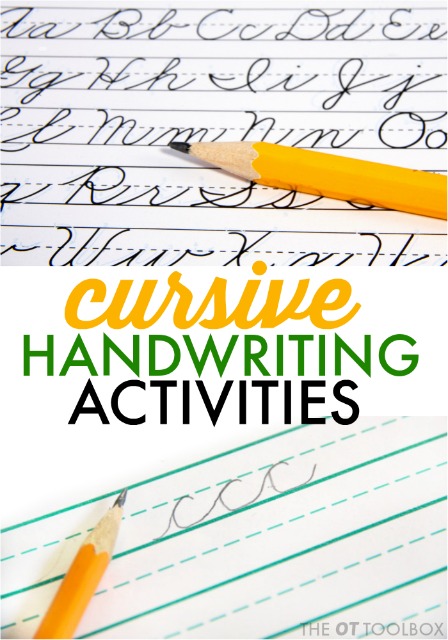
This blog post on creative cursive practice was originally written August 27, 2015. It was updated with more creative cursive writing solutions as of February 27, 2024.
One thing I wanted to share as a school-based occupational therapist is the use of creative cursive strategies to support cursive writing. So often, OT practitioners hear from parents and teachers that a student can’t write their name in cursive, when this is the only functional form of cursive writing they’ve had to retain. I’ve seen time and time again, where students are taught cursive letter formation one time, and then they are expected to use and retain that formation. One summer break (or even a weekend) and the formation pattern for the cursive letter is lost. Or, a student struggles with handwriting in general and cursive is a back up plan used as a handwriting accommodation. While this is completely appropriate for some students, if you don’t use it and practice it, you definitely lose it.
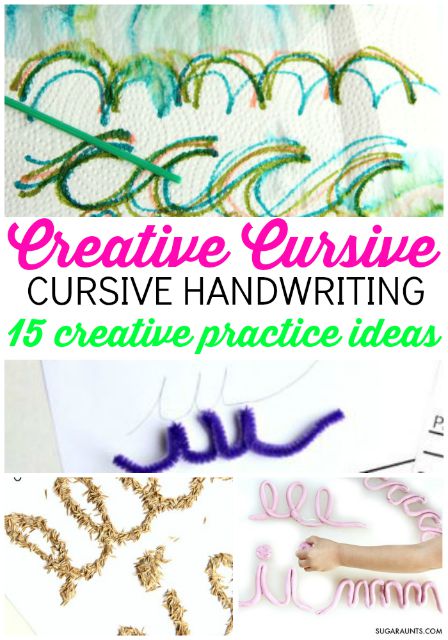
Using creative writing strategies to support letter learning is key to letter formation. This creative cursive journal fits the bill for practicing cursive in different and fun ways. These strategies are just some of the cursive writing tips we have on the site.
Creative Cursive
If you are starting to consider how to teach cursive writing, then having a toolbox of strategies in your mind is helpful. Creative cursive activities supports the motor plan needed to form cursive letters in handwriting automatically.
Learn to write cursive letters and words with this free cursive writing journal and creative cursive handwriting activities.
My daughter has made herself a goal for her second grade school year.
She wants to learn how to learn to write in cursive. Teaching cursive letters is a challenge, because you can learn it once, but if you don’t practice, it’s a skill that’s lost.
We’ve done a few cursive handwriting activities this summer, but have a long way to go as she learns to write letters in cursive, connect cursive lines, and write upper case letters.
Then there is reading cursive handwriting which can be a difficult processing task for some kids. Forming letters on lines with smooth pencil strokes and re-trace of lines requires practice.
I’ve got some fun and creative ways to learn and practice cursive handwriting to share with you.
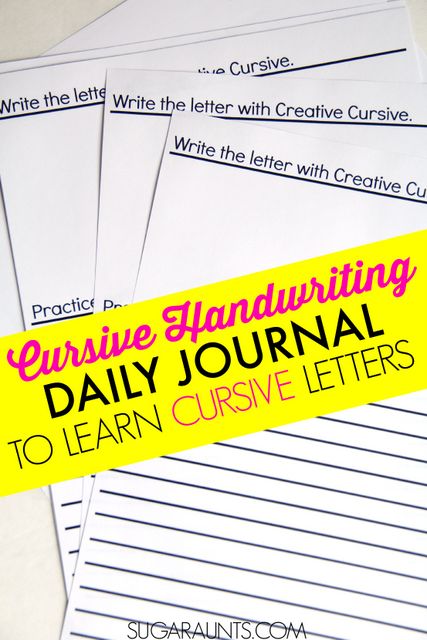
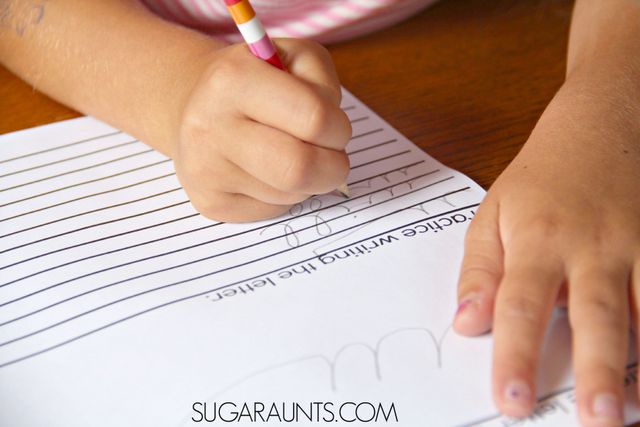
Today’s Cursive Handwriting Daily Journal is a creative way to practice letter formation and use learned letters in daily journaling.
Learn to Write Cursive with a Cursive Writing Journal
We made this Cursive Handwriting Journal to practice cursive letter formation on a daily basis. Using creative handwriting ideas are a fun way to practice letter formation.
These worksheets are great for practicing cursive letter formation in a variety of ways. (Try a new creative cursive technique each day!) They also have an area to use what your child has learned in a daily journal entry. You can print off the journal along with a tips and tools sheet for creative cursive handwriting.
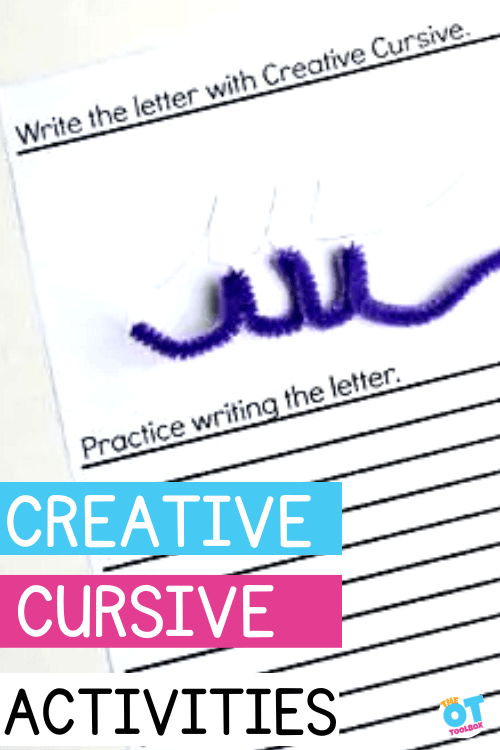
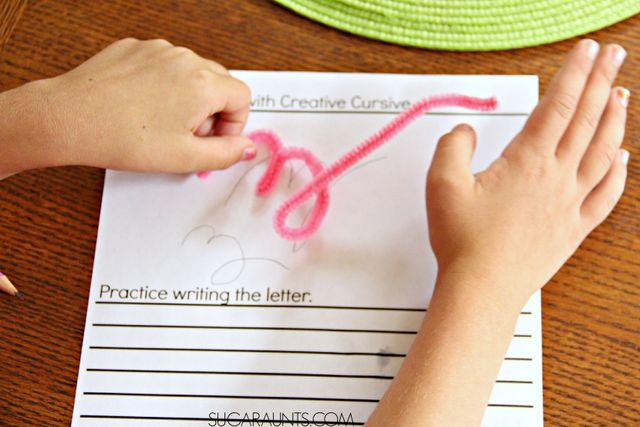
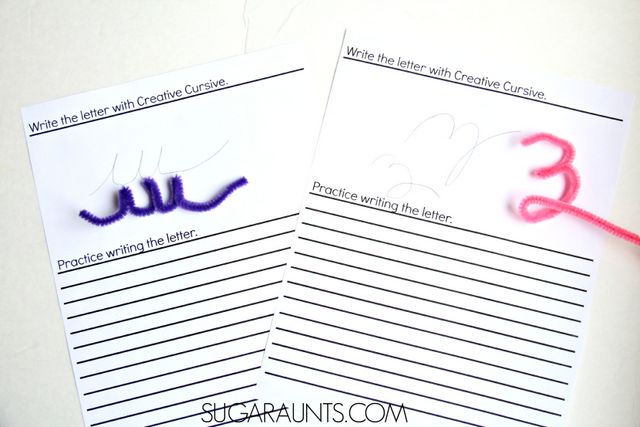
We used our journal worksheets to form a few new letters with pipe cleaners. Write the letter in the large space at the top of the page. Use a pipe cleaner to form the letter.
Encourage your child to use the written letter as a guide to correctly form the pipe cleaner letter.
You can create a permanently formed fuzzy letter by adding a dab of glue at the connecting parts of the pipe cleaner letters.
Then, trace the pipe cleaner with your finger to further practice cursive letter formation.
This is a hands-on way to practice and learn to write cursive letters.
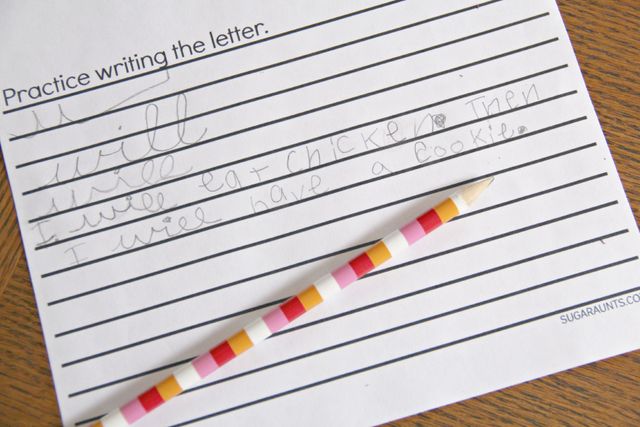
4. Next, practice writing the letter on the lines below. Encourage your child to write a few words using the letter and letters they’ve already learned. You can write a model word for them to copy.
You can then use the journal sheets to write sentences using the words that they’ve practiced and learned in cursive.
Creative Cursive Tips and Tools for Learning Cursive Handwriting
When I worked in a variety of upper elementary and middle school settings, cursive writing came up a lot. Some practice activities work well for some students and others work for other students. Having a variety of tools in mind is nice because I’ve found that you can try things once that don’t work for learning cursive takes a lot of work…and practice.
1. Cursive Writing Apps- Use tablets or touchscreen devices equipped with stylus pens for interactive cursive practice apps. These apps often provide engaging activities and games to make learning cursive more enjoyable for children. An example is “Cursive Writing Wizard” available on both iOS and Android platforms. Here is my list of favorite occupational therapy apps, which includes handwriting apps.
2. Cursive Art – Combine cursive practice with art by incorporating calligraphy techniques. Encourage learners to create artistic pieces using cursive writing, such as writing quotes or poems in cursive and decorating them with illustrations or borders. I love this handwriting art activity, and kids do too.
3. Multi-Sensory Cursive- Engage multiple senses by practicing cursive writing in different mediums, such as sand trays, shaving cream, or finger paint. This tactile experience can enhance muscle memory and retention. These multisensory letter mats are printed version, but a similar activity could be done with cursive.
4. Outdoor Writing Activities- Take cursive practice outdoors by using sidewalk chalk to write letters and words on pavement or by tracing letters in the sand at the beach or in a sandbox. This change of environment can make the learning experience more enjoyable and memorable.
5. Music and Movement– Integrate music and movement into cursive practice by playing instrumental music in the background and encouraging learners to write cursive letters in rhythm with the music. You can also incorporate gross motor movements, such as writing large cursive letters with arm movements in the air.
6. Cursive Handwriting Games– Create games that involve cursive writing, such as scavenger hunts where participants search for objects with cursive words written on them or relay races where teams write cursive letters or words on a whiteboard or chalkboard. I also love to use handwriting games to practice specific letter formations.
7. Letter Building– Provide materials like wooden blocks or clay and challenge learners to build cursive letters with them. The Handwriting Without Tears program offers This hands-on activity helps reinforce letter shapes and spatial awareness.
8. Storytelling– Kids love fun stories! If you do a writing prompt where students build on one another’s ideas. We love using this strategy for working on cursive because they can read their peer’s cursive. This not only provides practice and letter recognition skills with cursive writing. It also fosters creativity and narrative skills when writing in cursive.
9. Pen Pal Program– Pair learners with pen pals who communicate through handwritten letters in cursive. This real-world application of cursive writing can motivate learners to practice and improve their skills.
10. Collaborative Projects– Initiate collaborative cursive writing projects, such as creating a class mural or poster where each student contributes a cursive letter or word. This fosters teamwork and a sense of accomplishment. Our middle school journal prompts are a good place to start.
These out-of-the-box cursive practice ideas aim to make learning engaging, enjoyable, and effective for learners of all ages.
This blog post on creative writing practice was originally written December 16, 2016 and was updated February 26, 2024.
Today, we’ve got creative writing practice activities for supporting handwriting needs, both as fun ways to teach handwriting components, but also a multisensory learning tool for establishing a motor plan for handwriting. The automaticity that comes with writing speed is essential for written work, and using creative writing ideas with kids is key!
Creative writing Practice
I’ve pulled out a few of these motivating handwriting activities with my own kids! Here are more irresistibly creative ways to encourage handwriting in seriously fun ways.
I love to share creative handwriting activities. My own kids have varying levels of love when it comes to writing. Currently, my four year old is writing down everything she can think of. She’s still practicing letter formation but is often heard calling from the other room, “how do you spell…?” that she simply must write at that moment. My older kids write when they have to, sometimes a little more legibly than other times.
Read also these strategies for name practice for kindergarten to support underlying skills needed for handwriting at the beginning level. The creative writing ideas you find below are great for fun writing practice for kindergarten and all grades!
My own kids love to do all of the activities that I’ve shared for handwriting help, because honestly, the tips and tricks that I’ve shared here are geared more toward the underlying skills needed for handwriting instead of just plain old ways to practice handwriting. Improve those underlying skills in ways that can’t be beat!
Creative writing practice can look like sensory handwriting! Using a variety of writing tools and sensory mediums support formation skills.
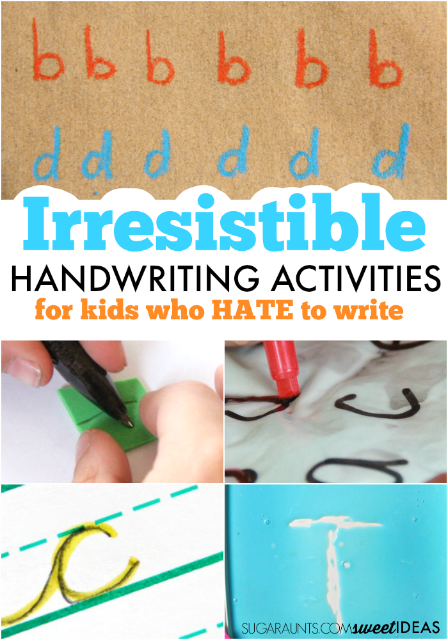
Handwriting Activities for Kids Who Hate to Write
I wanted to come up with a collection of unbeatable handwriting activities for kids who hate to write because let’s face it; Kids will complain and resist handwriting practice when they really just hate to practice written work!
Try these activities that I’ve found makes kids see the fun over the challenge to practice handwriting:
The great thing about using sensory trays in handwriting practice is that they really encourage sensory handwriting experiences. For more sensory handwriting experiences, try these creative writing activities below.
What are your favorite ways to make handwriting less of a chore and more of an irresistible handwriting activity?
Turn handwriting from being a chore to being fun with other sensory based writing activities. Adding a few creative writing practice ideas like the ones listed below can make kids smile when working on handwriting skills.
One tool in your handwriting toolbox is creative tracing strategies. Typically, we see tracing letter formation worksheets, or young kids tracing letters over and over again. However, there is more to tracing than just writing over the letter. Use these creative tracing activities to support the motor plan to form letters.
Practice letter formation by tracing over letters with these creative ideas:
Use a roll of masking tape or painters tape to create large letters on the wall or floor. Drive cars along the tape. If using this activity on the floor, place objects like craft pom poms on the tape letters.
In The Handwriting Book, you’ll find creative writing strategies based on development and the underlying skills needed in functional writing. A group of pediatric occupational therapists and physical therapists address handwriting tips, strategies, and tools that are used in occupational therapy to work on handwriting needs.
The Handwriting Book is a comprehensive resource created by experienced pediatric OTs and PTs.
The Handwriting Book covers everything you need to know about handwriting, guided by development and focused on function. This digital resource is is the ultimate resource for tips, strategies, suggestions, and information to support handwriting development in kids.
The Handwriting Book breaks down the functional skill of handwriting into developmental areas. These include developmental progression of pre-writing strokes, fine motor skills, gross motor development, sensory considerations, and visual perceptual skills. Each section includes strategies and tips to improve these underlying areas.
Strategies to address letter and number formation and reversals
Ideas for combining handwriting and play
Activities to practice handwriting skills at home
Tips and strategies for the reluctant writer
Tips to improve pencil grip
Tips for sizing, spacing, and alignment with overall improved legibility
Colleen Beck, OTR/L has been an occupational therapist since 2000, working in school-based, hand therapy, outpatient peds, EI, and SNF. Colleen created The OT Toolbox to inspire therapists, teachers, and parents with easy and fun tools to help children thrive. Read her story about going from an OT making $3/hour (after paying for kids’ childcare) to a full-time OT resource creator for millions of readers. Want to collaborate? Send an email to contact@theottoolbox.com.
This blog post was originally written in February 2023. We’ve updated the post February 2024 to target messy handwriting with a specific guide to move from sloppy handwriting to neat and legible written work.
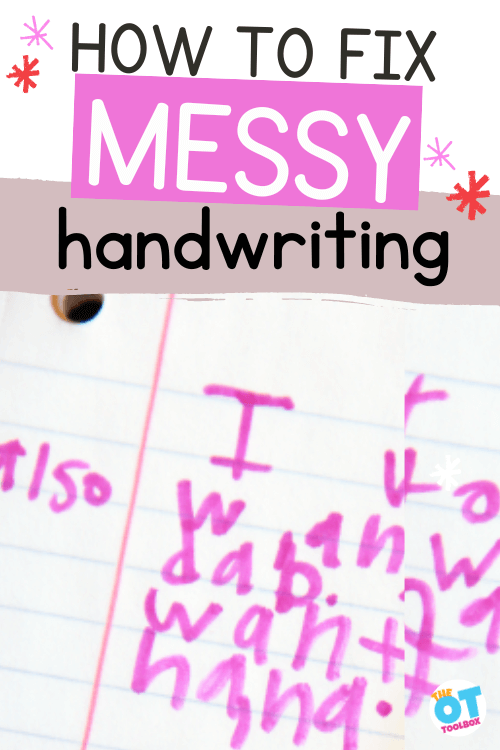
School-based occupational therapy practitioners often hear about students with bad handwriting. Similarly, pediatric OTs and OTAs in outpatient may hear that a new client has messy handwriting that impacts learning and the ability to read their own written work. Fixing handwriting is more than just writing drills, however. And, while we love all of the creative writing practice, it’s wonderful to know what’s really happening behind messy writing. Through occupational therapy interventions, OT professionals uncover what’s really happening behind the sloppy, illegible handwriting that we see from the surface.
So what’s really going on behind handwriting challenges? Let’s take a deeper look…
There are many things at play with messy handwriting: letter formation, placement of the letters on the paper, copying skills, speed, pencil grasp and pencil control, executive functioning, and more.
What is Messy Handwriting?
You might think one student has messy handwriting…but then you see another student’s written material that is completely illegible. When written output is illegible, we see many things that impact learning. Messy handwriting can look like:
Inability to read own writing: Students may struggle to decipher their own handwriting, leading to frustration and hindering their ability to review and study their notes effectively.
Difficulty for others to read: Classmates, teachers, or anyone else reviewing the student’s work may have difficulty deciphering the text, resulting in misunderstandings or delays in providing feedback.
Spelling errors due to messy writing: Teachers may mark spelling words or answers wrong due to illegible handwriting, even if the content is correct, impacting the student’s academic performance and confidence.
Misinterpretation of instructions: Messy handwriting can cause students to misinterpret instructions or miss important details written on the board or in handouts, leading to errors in completing assignments or assessments.
Incomplete or inaccurate notes: Students may struggle to keep up with note-taking during lectures or class discussions because of the speed of their writing or inability to form letters with automaticity, resulting in incomplete or inaccurate notes due to messy handwriting causing them to miss key points or details.
Trouble reading their own notes: Students may take notes in a lesson and not be able to read their work afterwards when they are studying because of the state of their writing. This can lead to missed questions on a test.
Difficulty with organizational skills: Illegible handwriting can contribute to difficulties in organizing thoughts and information on paper, leading to disorganized assignments, messy outlines, and challenges in structuring written work effectively.
Impact on peer collaboration: During group work or peer review activities, messy handwriting can impede effective communication and collaboration among students, leading to misunderstandings and inefficiencies in the collaborative process.
Low self-esteem and confidence: Students with consistently messy handwriting may experience lower self-esteem and confidence in their academic abilities, affecting their motivation and willingness to engage in written tasks.
Increased reliance on technology: Students may become overly reliant on technology for written communication (e.g., typing on a computer or using speech-to-text software) as a workaround for their handwriting difficulties, potentially limiting their development of handwriting skills and manual dexterity. Technology is a great handwriting accommodation, but there is a case for handwriting as well.
Social implications: In addition to academic challenges, messy handwriting can also have social implications, such as embarrassment or teasing from peers, further impacting the student’s overall well-being and classroom experience.
Illegible letter formations: Letters may be poorly formed, making it difficult to distinguish between similar letters such as ‘b’, ‘d’, ‘p’, and ‘q’.
Inconsistent sizing: Words may vary in size and proportion, with some letters being disproportionately large or small compared to others, leading to inconsistency in readability.
Crowded or cramped writing: Words and letters may be squeezed together, making it challenging to discern where one word ends and another begins.
Irregular spacing: Uneven spacing between words or letters can disrupt the flow of reading and comprehension.
Poor alignment: Lines of writing may not be straight or properly aligned with one another, causing difficulty in tracking text.
Poor use of margins: words may run over the edge of the paper where you see the student squishing letters together as they get to the edge of the paper. Or, you may see the student moving the letters over space by space at the new line, so that the left margin gets bigger and bigger as they go down the page.
Inaccurate baseline: The baseline, where the bottom of the letters should align, may be inconsistent, leading to a disjointed appearance and difficulty in maintaining horizontal alignment.
Overlapping letters or words: Letters or entire words may overlap, obscuring the text and making it difficult to decipher.
Sloppy or jagged strokes: Letters may be formed with shaky or jagged lines, resulting in unclear and messy handwriting.
Smudging or blotting: Excessive smudging or ink blotting can obscure letters and words, further complicating readability.
Difficulty with cursive or joined writing: Some students may struggle with connecting letters in cursive writing, leading to messy and illegible script.
The thing is that messy writing is so different and can look different depending on the individual or the task at hand.
Why do some kids have Bad Handwriting?
“OT’s are just handwriting teachers!” As an OT, this sentence totally irks me. Handwriting is an important occupation in childhood, so it is definitely something we focus on in OT. But as therapists, we know there is so much more to it than just “teaching handwriting!” Uncovering the culprits behind poor handwriting is part of the job of an OT practitioner. We start by targeting a diagnosis (or lack of diagnoses) and address the underlying considerations that lead to what we see: messy handwriting.
Some diagnoses that go hand-in-hand with sloppy penmanship may include:
Non-diagnosis (meaning there does not need to be a diagnosis in place for handwriting challenges to exist!)
There is more to it than just a diagnosis, however. There are many children (and adults…) that struggle with the fine motor movements required for dexterity in written work.
And the poor motor skills required for a functional grip is a whole other story!
There are many others that are limited in the visual motor skills required to form letters or place letters on the lines when writing. Any number of considerations can lead to what we see on the surface: bad handwriting.
That’s not to say that sloppy handwriting is the end of the world! Those in the medical field are used to deciphering illegible scripts written by the hurried physician. Somehow nurses, therapists, pharmacists, and other health care providers are able to decipher the chicken scratch the must teach in medical school!
However, when bad habits with written work leads to bad handwriting it can impact learning, educational performance in the classroom, and non-functional levels of written work (or bad grades as a result of illegible handwriting).
This is when we see a need to hone in on what’s really happening under the surface of written work.
Bad Handwriting Habits
Another part of the big picture of moving from illegible writing to good handwriting skills, is considering the age and grade expectations. There may be habits that are in place that lead to messy handwriting. These sloppy writing habits can begin even in good intentions. Writing curriculum and grade level expectations in schools, I’m looking at you!
Here are some things to consider about how bad handwriting might be established. This is all part of the bigger picture, so it’s important to cover these considerations:
Therapy providers take into consideration the development of the student based on age and other considerations. For example, in third grade, a student is expected to write on single rule lined paper, but they may not have the skills under their belt to form lowercase letters accurately in the given space with line awareness, spatial awareness, and letter size. This can mean a whole journal page is illegible because there are missing pieces in their writing experience.
Similarly, a kindergarten student may be expected to write sentences when developmentally, they are not ready for that. However, school and grade expectations don’t take this into consideration and you have a situation where the school curriculum zooms through handwriting instruction. The child forms bad habits and the muscle memory from practicing skills before they are developmentally ready.
Other things to consider in this realm of thinking:
Cursive handwriting is another monster- In schools, cursive letter formation is covered over the course of a few months. Depending on the curriculum, a teacher might spend one day teaching a letter. Then the student has practice pages to complete cursive practice in repetition. This is a huge area of forming a muscle memory for poor formations. They practice the letter in the classroom while copying from the board. Then one mistake on a writing worksheet leads to rows of improperly formed letters. Then, that letter is expected to be “learned” even when there is a lack of form in the practice!
Similarly, in most situations, cursive writing isn’t required so it’s not likely that the student loses the ability to form that letter. Cursive is essentially lost after that semester of practice one time in the second grade! This is especially true for uppercase cursive letters of the alphabet.
Preschool…Oh we can talk a lot about preschool and pre-writing that is used by preschool educators. In a word, prewriting should not be done in the preschool setting. That includes tracing, name writing, and pencil tasks of any kind. Preschool educators that are touting a writing or even a pre-writing curriculum are leading whole classrooms to a future of bad writing by establishing bad habits before the child is developmentally ready. Focus on play, coloring with crayons, and more play at this stage!
Finally, we know that handwriting is not an easy skill to teach because it is so complex. A child’s teacher is limited to a short period in the classroom to teach actual letter stroke formation and so the other components like line use, word spacing letter spacing, size awareness, rhythm of writing, are covered only when there is a problem. The child is expected to fix mistakes on their own, or self-check rather than practice these components from the start.
What Causes Messy Handwriting?
Messy handwriting can stem from various factors, both physical and cognitive, that influence the control and coordination of hand movements required for effective penmanship.
Here are some common underlying causes of sloppy writing:
Poor fine motor skills: Difficulties in fine motor skill, including fine motor control, which involve the precise coordination of small muscles in the hands and fingers, can result in irregular and messy handwriting. Children with underdeveloped fine motor skills may struggle to manipulate writing utensils with precision, leading to messy letter formations and inconsistent strokes.
Weak hand muscles: Weakness in the muscles of the hands and fingers can make it challenging for individuals to maintain a consistent grip on writing utensils and control the pressure exerted during writing. Students lacking finger dexterity as a result of hand weakness can result in shaky or uneven lines, smudging, and difficulty forming clear letters. Because of the development of skills and the fine motor milestones that children progress through, we can see handwriting issues when kids are asked to write before they are developmentally ready.
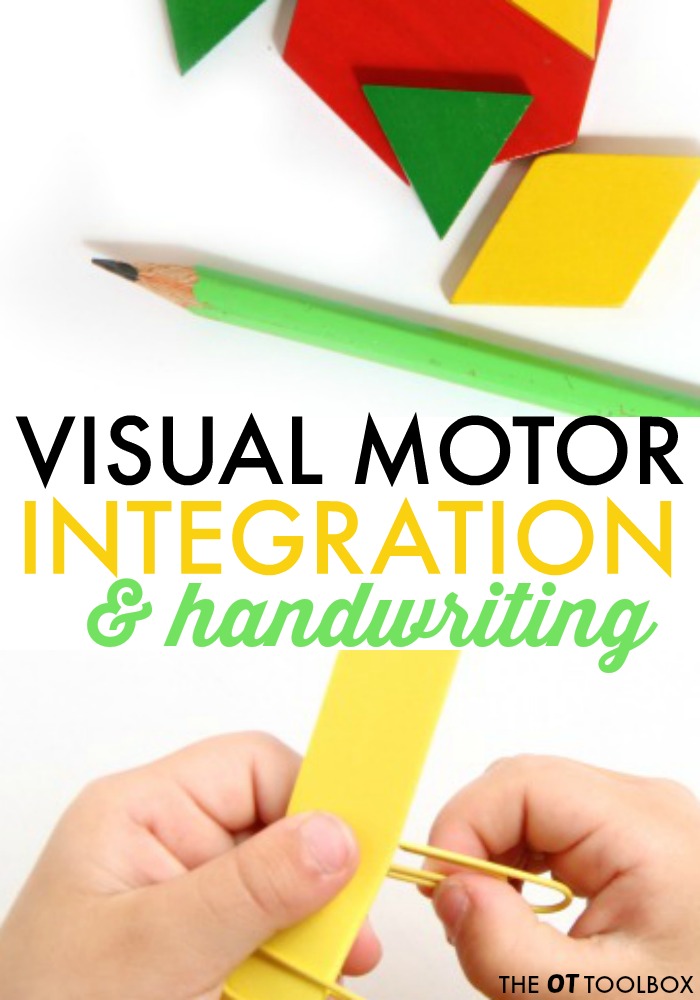
Visual-motor integration deficits: Visual-motor integration refers to the ability to coordinate visual information with motor actions, such as copying shapes or letters accurately. Difficulties in this area can manifest as poor spatial awareness and difficulty maintaining proper letter sizing, spacing, and alignment on the page.
Poor proprioception: Proprioception is the sense of the position and movement of the body and its parts. Individuals with poor proprioceptive awareness may struggle to control the force and direction of their writing movements, leading to inconsistent letter formations and difficulty maintaining a steady hand while writing.
Cognitive processing difficulties: Some individuals may experience challenges in cognitive processes such as attention, memory, and sequencing, which can impact their ability to organize thoughts and translate them into written form. This can result in disorganized and messy handwriting, as well as difficulties in spelling and grammar.
Lack of exposure or practice: Insufficient exposure to handwriting practice or inadequate instruction in proper letter formation techniques can contribute to messy handwriting. Without regular practice and feedback, students may develop inefficient writing habits that persist over time.
Emotional factors: Emotional factors such as stress, anxiety, or low self-esteem can also affect handwriting quality. Tense or anxious individuals may experience muscle tension and difficulty maintaining a relaxed grip on writing utensils, leading to increased hand fatigue and messy handwriting.
Developmental delays or disabilities: Children with developmental delays or disabilities, such as dysgraphia or developmental coordination disorder (DCD), may exhibit persistent difficulties with handwriting despite interventions and accommodations. These conditions can impact various aspects of handwriting, including letter formation, spacing, and legibility.
There are more components that play a role in messy writing. Any one or combination of these underlying skills may lead to sloppy, messy written work.
Others may not always realize the “behind the scenes” stuff going on with handwriting, or realize that a particular activity was chosen because it has many layers to it. But this is one of the reasons why I love being an OT – it’s in our nature to see the big picture!
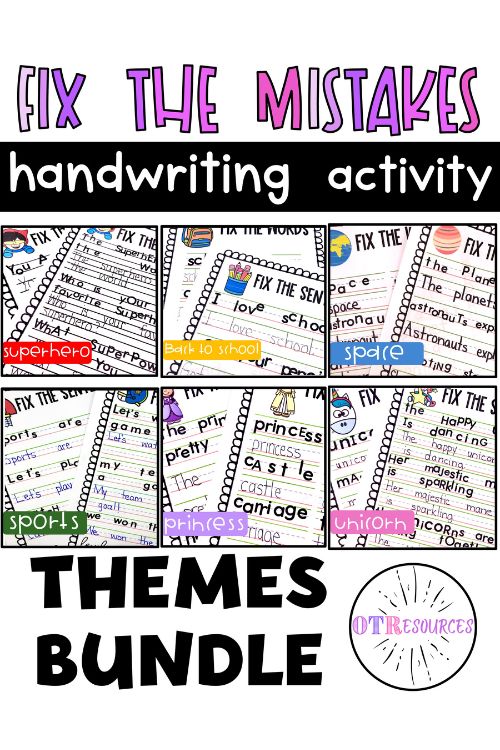
Now, sometimes it can be tricky to find handwriting activities that meet these criteria, but don’t feel like just another writing task. Luckily, my “Fix the Mistakes” handwriting activity checks ALL these boxes!
Addressing messy handwriting requires a comprehensive approach that addresses underlying motor, sensory, and cognitive factors through targeted interventions, accommodations, and practice-based strategies.
Pediatric OTs and OTAs take all of the underlying areas into consideration when planning therapy intervention activities. They focus on the underlying areas, but also function.
How to Fix Bad Handwriting habits
When it comes to fixing bad handwriting habits, we take a look at the underlying skills, the development of the individual, and individualized needs. We can assess what is “missing” or what bad habits might be used in written work.
Then, using specific strategies based on the needs of the child along with adaptations, modifications, and targeting specific goals can help to move from bad writing habits to functional and legible written work.
A huge part of that is self-awareness and self-correction.
Working on meaningful writing tasks and then self-correcting mistakes (or fixing mistakes) is often times the missing link in the classroom setting.
WHAT IS “FIX THE MISTAKES”?
“Fix the mistakes” is exactly as it sounds – the activity provides kiddos with handwriting mistakes, which they have to fix! Students will evaluate handwriting samples that do not adhere to handwriting rules (line placement, size, spacing & letter case). Students then rewrite the sample to fix the mistakes. So, how does it meet the above criteria?
• Students hone visual perceptual skills by focusing on differences in handwriting components and attending to spatial relationships.
• Students need to use their fine motor skills to put pencil to paper and fix the handwriting mistakes.
• Students utilize executive functioning to problem solve, sequence, and utilize working memory, just to name a few.
In order for students to know what proper handwriting looks like, it is important to explicitly teach handwriting rules (such as letter formation, letter size, spacing, line placement). This activity packet includes a visual “handwriting rules” guide to assist educators with this task.
There are several different themes and bundles of writing sheets to support various interests and to help make handwriting practice engaging and motivating.
Kids LOVE pointing out mistakes and being able to play the role of teacher. Not only do students enjoy it, but the concepts are more easily mastered when the kiddo is able to identify and point out the errors themselves.
Fixing handwriting mistakes at different levels
One thing therapy providers do is focus on functional, better handwriting at different levels. We can do this in various ways using the strengths of the student as well as by focusing on individualized needs. Supports like use graph paper, a slant board, or using special pens and pencils can support individual needs.
The Fix the Mistakes bundles allow the therapy provider to use one bundle with a whole caseload of students because it includes writing lines for each level.
As OT’s, we know that every student has different needs. Ranging from copying individual words to copying higher-level sentences, “Fix the Mistakes” activities support that differentiation so the activity can be easily tailored to the needs of each student.
In addition to different levels, handwriting lines can be a major difference. Personally, I have found that some students respond best to 3-lines, others work very well with 2-lines, while some do best with a simple single-lined piece of paper! Every level of “fix the mistakes” has a copy of each line style – all you have to do is choose the best worksheet for your student, then print and go. Easy peasy!
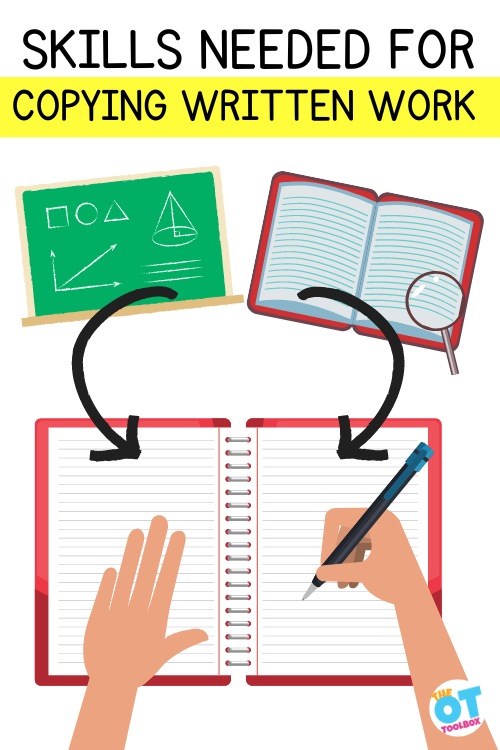
In the school setting, near point copying skills is a visual motor skill that enables students to copy written material from a book, workbook, or information source onto a paper. Copying material is a part of every grade. This is an area of functional handwriting that is covered in occupational therapy sessions through play because copying material at various levels is part of the educational process. In this blog post we are covering everything you need to know about near point copy skills.
Near Point Copying
Near point copying refers to the ability to write down and copy written material from a close point such as a desk surface. Close copy is a graded skill on the continuum of copying from a far point. Writing from a source is an essential stepping stone to far point copy.
Near point copying involves imitating or replicating what is seen in close proximity.
Far point copying, on the other hand, might involve copying from the board. Far point copying is more difficult than near point, because of the increase in working memory, visual attention, short term memory, visual saccades, and visual closure are involved.
Handwriting is a complex process and copying skills are just one step of the process.
Whether copying from a given space on a desk surface such as a book or notebook, there can be areas of breakdown that impact handwriting legibility:
This skill starts in kindergarten when young children copy words as in “write the room” activities. The ability to copy from a workbook, book onto a writing page develops with refined motor skills in older grades. In first grade or second grade, the copying skills move to workbook pages and lined paper. This skill becomes more efficient and fluent in middle school and high school, and then to college.
The ability to copy written material onto paper doesn’t stop there.
Copying from one point to another is a functional task used throughout the lifespan when copying words, lists, phone numbers, or other information onto a writing surface.
New skill acquisition has to start somewhere. It often begins with copying or mimicking. Babies smile in response to the smile of others. Children learn to catch by demonstration. Written expression starts by imitation, specifically near point copying.
copying from the board and occupational therapy
One functional area that an occupational therapy practitioner may address is copying from the board. In OT, this might mean working on progressively more challenging visual motor tasks so that the student can copy notes, homework lists, important information, etc. from a far point.
Copying from the board occupational therapy activities might include:
Assessing where challenges are stemming from (visual perception, visual shift, visual attention, working memory, etc.)
Targeting specific underlying skills
Progressive training to copy smaller chunks of information
Self-checking and self-assessment strategies
Tools for tackling the copying task
Practice with various tools and strategies
Copying from the board occupational therapy accommodations might look like:
Boxes drawn around the information on the board to draw attention to the information that needs to be copied
Different colored dry erase markers or chalk used for copying from the Smartboard or chalk board
More space between the information
A handwriting rubric can be a useful strategy used in occupational therapy to help identify where the copying skill is breaking down.
Skills needed for near point copying
As always, occupational therapy practitioners refer to the underlying skill components that play a role in functional tasks. In the task of copying handwriting material onto paper, there are specific skills that impact functional performance.
The following skills are necessary for near and far point copying:
Language skills – If a child has to copy letter by letter because he doesn’t know how to spell well enough, it takes a lot more time for him than for other students.
Working memory – A student with poor working memory may not be able to hold the information in his head long enough to get it down on paper. Read about working memory skills)
Pencil grasp – a learner with poor pencil grasp may take longer to write, fatigue easier, be inefficient, or spend extra mental energy trying to hold the writing tool
Coordination – coordination is necessary to write, hold the paper, sit in a chair, and shift the head and eyes to focus at different distances. Read about eye-hand coordination.
Muscle weakness – often leads to writing fatigue, inefficient grasping pattern, poor sitting tolerance, and difficulty with letter formation. Read about hand strengthening.
Vision – difficulty scanning and shifting focus from the board to paper, or top to bottom of the paper, convergence and divergence of the eyes as they focus on relevant information. Rule out possible visual acuity issues first like convergence insufficiency
Visual perception – a student who can not “see” what is written in front of them will have difficulty copying it correctly. Rule out visual perceptual difficulties by doing a motor free visual perception screener before addressing writing difficulties. Read about visual perceptual skills.
Visual motor skills- copying letter forms and letters require eye movements and the visual motor integration to copy letters and words. It’s a step up from copying shapes that we often use as a tool in occupational therapy sessions. Read about visual motor skills.
A word about near point copying
Near point copying is a stepping stone to independent writing. Copying is an excellent way to learn to draw and write, while focusing directly on visual and fine motor skills. It is important to understand and be confident at the basics before adding higher level cognitive skills such as spelling, remembering the formation of letters, and sentence generation. This is the same thought process that learners understand numbers and addition/subtraction, before heading on to fractions and multiplication.
In order for copying to be meaningful and lead to success, the learner needs to understand what they are copying. A learner who does not know their letters, will essentially be copying balls and sticks, rather than understanding the written word. This is why copying is a stepping stone that should eventually move forward to writing from dictation, memory, or original thoughts.
Near Point Copying Red Flags
Some of the areas you may see a when near point copying skills are a challenge:
Maladaptive behavior during handwriting. Frustration, fatigue, distraction
An awkward pencil grasp
Messy writing compared to their peers
Challenges with directionality
No awareness of the lines on the paper or borders during writing or coloring
Poor knowledge of the letters/shapes/numbers
They rush through their writing
They can not form the upper or lowercase letters
Reversals of letters and numbers frequently (this is common for young learners and not always a sign of dysfunction)
Do they avoid writing altogether?
Poor fine motor skills such as cutting, drawing, tying shoelaces, or stringing beads
Not all learners with poor or delayed handwriting have a learning disability or other disorder. Sometimes they need extra help because they never received appropriate teaching of letters and numbers. Other times they just fell behind, did not get enough high quality practice, or lack confidence in their skills.
How to develop Near Point Copying Skills
These intervention strategies can support near point copying skills:
If your learner is not ready to copy into these grids, try working on copying using a dry erase board, magnadoodle, their finger in the air, a table full of shaving cream, or a cookie sheet with salt
Vary the writing utensils to add to success.
Trialing various forms of adaptive paper can support visual scanning needs, particularly when transferring written information from a source onto paper. As the vision shifts from the material to be copied back to the paper, the eyes can “jump” around to find the place where material is to be written. Various forms of visual prompts such as highlighted lines, margin lines, etc. can bring awareness to the writing lines and support this need.
Use puzzles to complete a picture. Place puzzle pieces on a desk surface and place the box lid with a picture of the completed puzzle on the table surface. The student can then complete the puzzle using the picture as a visual guide.
Mazes are a tool for addressing pencil control while visually scanning on the page. This is a way to work on the visual motor integration needed for copying words or letters from a near point.
Use visuals to complete sequencing activities. Cut out pictures or use word labels and ask the student to put the words or visuals in order to match a picture or create a sequence for an end result.
Work on visual perceptual skills identifying same/different, hidden pictures, visual memory, and scanning
Memory board games- This is a great way to work on visual memory, visual attention, working memory, and other skills
Use a crayon or marker to copy coloring forms. One way to do this is using color by number activities.
Use a paper placed on the desk surface with letters of the alphabet. The student can point to letters with their index finger and name the letters. A letter-naming activity like this is a progression toward visual memory and recall to support writing the letter form.
Consider using a slant board to elevate the writing surface or the writing stimuli. A slant board can also be used for copying from a far point.
Check writing posture. When slouching or laying across a table surface, the visual motor skills are not able to copy accurately, relating to inconsistent use of letter size, line use, and copying without omissions or adding extra letters.
Teach letters and shapes through use of books, flashcards, manipulatives, games, or other tools
Have your learner practice remembering more than one letter at a time when copying from the board. They can start this by learning to retain information in near point copying as they do not have to retain the information as long.
Practice vision skills such as saccades needed for copying
Start by going back to the basics, re-teaching these skills, and putting in the practice to develop basic handwriting skills before moving on to higher level work. A learner who simply needs to have practice and confidence will learn very quickly. Someone who has a learning disorder or other diagnosis will take much longer to acquire these skills. Whatever the reason for the delay; practice, using effective tools such as the near point copying bundle, making writing fun, and using varied resources will help.
near point copying worksheets
Near point copying worksheets can be as simple as copying letters from the top of the page to the bottom of the page. It can also look like copying a sentence from a prompt at the top of the page.
There are graded progressions, too. These can be more functional and things that we do in everyday tasks:
Copying a list of information from one source to another side by side
Copying words to fill in blanks from a book to a worksheet
Copying dates and times onto a paper planner or calendar
Copying long form numbers from a computer screen to an accounting worksheet (checkbook or other tracker)
Copying from a near vertical position, requiring vertical shift as well as lateral shift
These skills can look like a wide variety of examples. Using near point copying worksheets is a nice way to work on this progression as well as practicing the functional task that the individual needs to improve upon.
With a near point copying worksheet, you can collect data and include modifications or grade the activity.
NEAR POINT COPYING Printable Packet
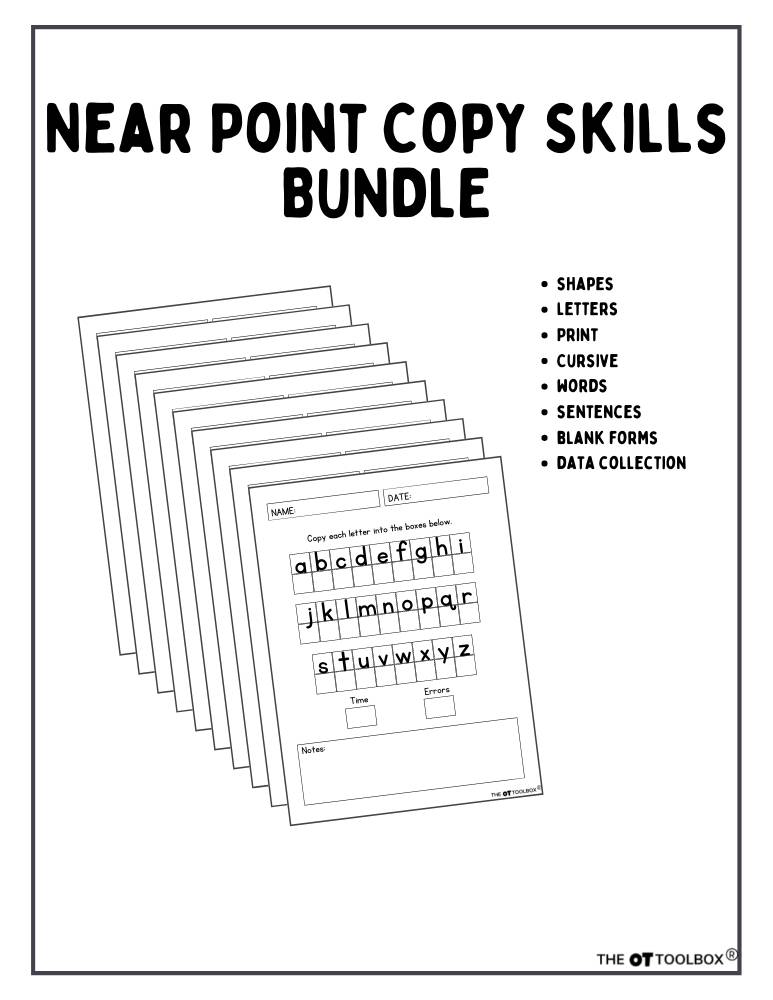
The OT Toolbox has a great tool for learning and practicing near point copying. The Near Point Copy Skills Pack addresses visual memory skills, visual attention, and visual motor integration skills so learners can copy material without missing information.
This essential handwriting skill can be a challenge for many, and leads to difficulties with copying written material from a distance, or with visual shift. It is full of printable worksheets for copying letters, shapes, words, cursive, and sentences. It also includes black worksheets and a data collection page. This Near Point Copying bundle is a great resource to add to your library. It is available HERE in the shop, or free as a level 2 member!
How to use the near point copying worksheets in the printable pack:
Start with the largest boxes first. New learners do not have the intrinsic musculature to draw in small spaces
Basic shapes and lines are important pre-writing skills
Change the sort order of copying tasks to limit memorization
Start at different points each time if your learner can not do all of the page in one sitting. This way they do not always fatigue at letter j, never finishing to z
Laminate for use with wipe off markers. Reusable tasks are more eco-friendly
Project onto a smart board to include written examples, far point copying, and working in a different perspective
And the next step is copying from a chalkboard for far point copying!
Victoria Wood, OTR/L is a contributor to The OT Toolbox and has been providing Occupational Therapy treatment in pediatrics for more than 25 years. She has practiced in hospital settings (inpatient, outpatient, NICU, PICU), school systems, and outpatient clinics in several states. She has treated hundreds of children with various sensory processing dysfunction in the areas of behavior, gross/fine motor skills, social skills and self-care. Ms. Wood has also been a featured speaker at seminars, webinars, and school staff development training. She is the author of Seeing your Home and Community with Sensory Eyes.
This packet of near point copy exercises includes data collection areas on each page, allowing users to identify needs in copying speed of written work and letter copying issues, as well as handwriting and letter formation needs.
This packet includes copying materials for:
Pre-Writing Shapes
Printed Letters
Cursive Letters
Upper case and lower case letters
Words
Sentences
Cursive Words
Cursive Sentences
Various grades of writing paper sizes
Data Collection Sheets
Use this printable packet to work on copying skills and visual processing integration from grades Kindergarten-through High School (and beyond).
Having an emotions check in for kids is a critical piece of the social emotional skills puzzle. We know the value of addressing emotions and self regulation in mental health. The simple act of checking in with our kids’ feelings and emotions is pivotal in benefiting overall mindset, emotional intelligence, and much more. Here, we’ll cover how and why an emotions check-in supports child development.
We’ve previously created a resource on using a feelings check in. Having these tools in your toolbox to support students is beneficial in meeting needs with affect modulation, mental health, and emotional well-being.
In this article, we’ll unpack what an emotions check-in is, why it matters, and how it can become a valuable tool in supporting our kids’ emotional regulation.
What Does An Emotions Check-In Mean?
An emotions check-in is a simple practice that involves where kids pause and take a moment to identify and express how they feel at a given moment. This can look like describing your emotions or selecting a current emotion from an emotions list. This can be different, yet similar, to a feelings check in.
Helping kids to understand the difference between feelings and emotions (and the similarities) is helpful in supporting social and emotional development. It’s key to helping kids to build self awareness.
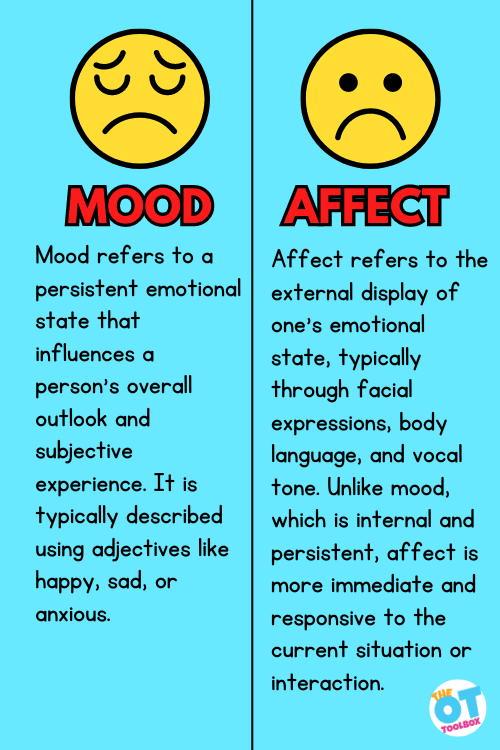
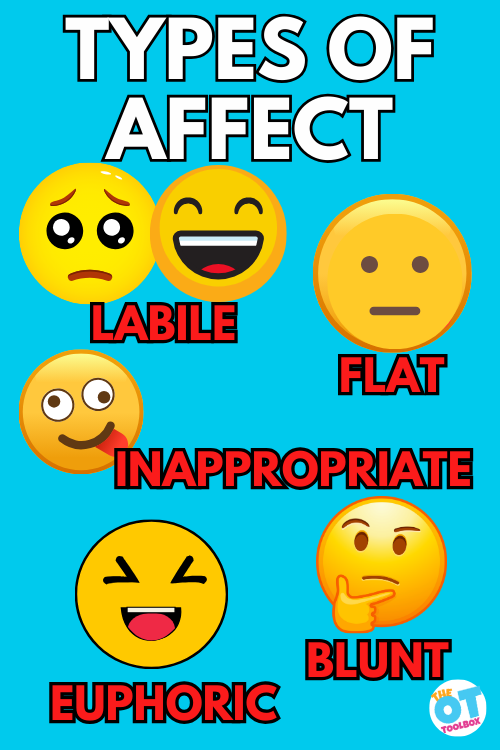
This can be practiced through tools or self regulation strategies like a feelings chart or a mood meter that gives kids a visual aid to pinpoint where they are on the emotional spectrum. Understanding mood and affect and how this relates to behavioral responses so these types of emotions tasks are great for development.
Imagine a tool that acts as a compass for a child’s emotional journey, aiding in everything from daily tasks to self-care and mindfulness. That’s where a simple emotions check-in comes in handy!
How Does Emotions Check-In Help Kids?
Now how does this simple practice help kids navigate the rollercoaster of emotions? Social skills development doesn’t happen overnight, and it’s so important to recognize the role that one’s own emotions play in empathy, co-regulation, and interacting with others.
Let’s break down each of these benefits of checking in on emotions:
Emotional Labeling
Ever had that feeling of being in a fog of emotions and not quite sure what’s going on? An emotions check-in is like turning on the headlights in that fog.
It gives the kids the vocabulary to put names to their feelings. Instead of just feeling a jumble, they can say, “Oh, that’s frustration,” or “Hey, look, I’m feeling excited!”
Recognizing Emotions
By recognizing their emotions, kids will be better equipped to regulate them. So, when the wave of frustration hits, they can ride it out instead of being swept away.
It’s not about suppressing feelings but understanding and managing them effectively like mastering the controls of an emotional rollercoaster.
Naming Emotions
In the long run, an emotions check-in can foster a culture of open communication about feelings.
So, instead of a kid saying, “I don’t know,” when asked how their day was, they can confidently say, “I felt a bit anxious during the math test, but I’m okay now.”
It’s also a way for them to communicate not just with themselves but also with others. As kids become familiar with their own emotions, they will develop empathy for the feelings of their peers, creating a supportive and understanding community.
Emotion Coping Tools
Through emotions check-ins, kids work with teachers or therapists to develop personalized emotion coping tools.
Feeling stressed? Let’s try deep breathing. Overwhelmed? How about a quick mindfulness exercise?
Whether it’s taking a deep breath, going for a walk, or talking to someone, these tools empower children to handle challenges constructively.
Emotional Self-Awareness
Emotions check-ins contribute to the development of self-awareness and emotional intelligence.
They will be able to understand their triggers, their joys, and their challenges. They also learn to be present in the moment and, if needed, engage in self-care strategies.
This foundation prepares kids to navigate relationships, understand themselves, and face life’s ups and downs with resilience.
Healthy Emotional Mindset
Imagine if kids grew up with a healthy mindset of thinking that all emotions are valid and part of being human.
It’s not about labeling emotions as good or bad; it’s about accepting them all and learning to navigate them. This sets the stage for a positive relationship with their own emotions.
One final area is executive functioning. It’s worth mentioning the role that emotions and cognitive skills have on one another. Read about the connection between emotions and executive functioning.
Emotions Check in strategies
So now that you know the specifics behind using an emotions check as a development tool, let’s look at some emotions check in strategies.
Emotions List: An emotions list serves as a valuable tool for children to identify and articulate their feelings effectively. By providing a comprehensive range of emotions, such as happiness, sadness, anger, fear, and more nuanced emotions like excitement or disappointment, children can better understand and express their emotional experiences (Plutchik, 2001). Encouraging children to use an emotions list during check-ins helps them develop emotional literacy and communication skills, fostering healthy emotional expression and regulation.
Daily Feelings Check-In: A daily feelings check-in is an essential component of promoting mental health and emotional well-being in children. This routine practice encourages children to reflect on and communicate their emotions on a regular basis (Hoyt, 2015). By setting aside time each day to check in with their feelings, children learn to recognize patterns in their emotional experiences and develop coping strategies for managing stressors effectively. Implementing a daily feelings check-in routine can contribute to a positive emotional climate and support children’s overall well-being.
Mental Health: Mental health encompasses the emotional, psychological, and social well-being of individuals, including children. It influences how children think, feel, and behave, affecting their ability to cope with stress, relate to others, and make healthy choices (World Health Organization, 2014). Prioritizing mental health in childhood lays the foundation for lifelong emotional resilience and contributes to positive outcomes in various areas of development. By promoting awareness and understanding of mental health, parents and caregivers can support children in maintaining optimal well-being.
Emotional Well-being: Emotional well-being refers to the state of being able to cope with the ups and downs of life, experiencing a sense of balance and fulfillment in one’s emotions. For children, emotional well-being encompasses feeling secure, valued, and supported in their emotional experiences (Keyes, 2002).
Fostering emotional well-being involves creating a nurturing environment that promotes self-awareness, emotional regulation, and healthy relationships. By prioritizing emotional well-being, parents and caregivers empower children to navigate life’s challenges with resilience and optimism.
Conflict Resolution: Conflict resolution skills are essential for fostering positive relationships and managing interpersonal conflicts effectively. Teaching children how to resolve conflicts peacefully and constructively promotes social-emotional development and communication skills (Cohen & Adelman, 2004). Encouraging children to express their feelings, listen actively, and work together to find mutually beneficial solutions builds empathy and promotes understanding. By equipping children with conflict resolution skills, parents and educators empower them to navigate conflicts in a respectful and productive manner.
Feelings Chart: A feelings chart is a visual tool that provides children with a range of emotions and corresponding facial expressions, helping them identify and label their feelings (Ekman, 1999). By referring to a feelings chart during check-ins, children can gain insight into their emotional experiences and learn to communicate their feelings effectively. Utilizing a feelings chart promotes emotional awareness and vocabulary development, empowering children to express themselves authentically and seek support when needed.
Something like emotions crafts can help with this, with the child population.
Build Self-awareness: Building self-awareness is a foundational skill for emotional intelligence and personal growth. Helping children develop self-awareness involves encouraging self reflection on their thoughts, feelings, and behaviors (Brackett et al., 2006). Engaging in check-in routines and activities that prompt children to describe their emotions and reflect on their experiences fosters self-awareness. By nurturing self-awareness, parents and educators empower children to recognize their strengths, weaknesses, and emotional needs, laying the groundwork for healthy self-esteem and personal development.
Check-in Routine: A check-in routine provides children with a structured opportunity to reflect on their emotions and share their experiences in a safe and supportive environment. Consistent check-ins help children develop a habit of self-reflection and communication, promoting emotional well-being and resilience (Denham & Brown, 2010). Establishing a check-in routine at home or in educational settings encourages open dialogue and strengthens relationships between children and caregivers. By making check-ins a regular part of daily life, parents and educators demonstrate the importance of emotional expression and connection.
Describing Your Emotions: Encouraging children to describe their emotions is a fundamental aspect of promoting emotional intelligence and self-expression. Providing children with language to articulate their feelings helps them understand and communicate their emotional experiences effectively (Gross & Levenson, 1997).
Prompting children to describe their emotions during check-ins fosters emotional literacy and communication skills, empowering them to express themselves authentically and seek support when needed. By validating and exploring children’s emotions, parents and educators promote emotional well-being and strengthen the parent-child or teacher-student relationship.
Another tool for describing emotions is using self reflection games that support this skill.
Another fantastic resource that can help develop social and emotional skills is the activity book, Exploring Books Through Play.
This digital E-BOOK is an amazing resource for anyone helping kids learn about acceptance, empathy, compassion, and friendship. In Exploring Books through Play, you’ll find therapist-approved resources, activities, crafts, projects, and play ideas based on 10 popular children’s books. Each book covered contains activities designed to develop fine motor skills, gross motor skills, sensory exploration, handwriting, and more. Help kids understand complex topics of social/emotional skills, empathy, compassion, and friendship through books and hands-on play.
The book Exploring Books Through Play, has 50 different activities based on popular children’s books. Each book is used for 5 different activities that cover a variety of areas: sensory play, crafts, gross motor activities, fine motor activities, handwriting, scissor skills, and so much more.
How to Use Emotions Check-In Practices?
It’s time to put the magic of emotions check-ins into action. Whether you’re at home, in school, or at therapy, here’s your guide to incorporating these practices:
Emotion Check-ins At Home
In the home, teaching key regulation strategies can support a lifetime of emotional wellbeing. During the day to day tasks is when we can see breakdowns because of stress, worries, frustration, or other things going on. Supporting the highs and lows of emotions with acceptance and love at home is key.
Daily Check-Ins: Make emotions check-ins a part of your daily routine. Set aside a few minutes, maybe during dinner or before bedtime, for each family member to share how they’re feeling.
Create a Feelings Chart: Get creative! Make a feelings chart together, using drawings, stickers, or even emojis to represent different emotions. Hang it up where everyone can see, making it a visual reminder to check in with their feelings.
Feeling Journals: Encourage kids to keep feeling journals, where they can jot down their emotions throughout the day. This not only reinforces the practice but also serves as a valuable tool for parents to understand their kid’s emotional experiences.
Morning Check-Ins: Start the school day with a quick emotions check-in. It could be as simple as a thumbs-up, thumbs-down, or in-between. Teachers can use this to gauge the emotional temperature of the class and address any concerns.
Integrate into Lessons: Incorporate emotions check-ins into various subjects. For instance, during a language arts class, students can express their emotions through writing, or in a science class, they can relate emotions to different states of matter.
Classroom Mood Meter: Implement a mood meter in the classroom, allowing kids to place their names on the section of the chart that best represents their current emotional state. It fosters a sense of community and allows teachers to be aware of the emotional needs of their students.
Collaborate with Parents: Keep parents in the loop by sharing the emotions check-in routine with them and encouraging them to continue the practice at home. This creates a bridge between the school and home environments.
Emotion Chck in At Therapy
Therapy sessions can support emotional wellbeing and self regulation goals through specific tools that the student, client, or patient can practice and then try during daily tasks.
Emotion Check-In Ritual: Start therapy sessions with a dedicated emotions check-in ritual. It could be a verbal check-in or using tools like a feelings chart or mood meter. This sets the tone for the session and helps the child and therapist understand the emotional landscape.
Emotion Exploration Activities: Incorporate activities that delve into emotions to help children express and explore their feelings in a comfortable setting. These activities can be tailored to the child’s age and interests.
Develop Coping Strategies: Based on the identified emotions, work together to create personalized coping tools. These can range from simple deep breathing exercises to more complex strategies tailored to the child’s needs.
Remember, the key is to make emotions check-ins a natural and integrated part of the environment, whether at home, in school, or during therapy.
Moreover, consistency and open communication lay the foundation for these practices to be effective in supporting emotional well-being.
In conclusion, emotions check-ins aren’t about fixing emotions but empowering kids to understand, navigate, and regulate their feelings.
Whether at home, in school, or in therapy, integrating these practices can lay the foundation for emotional intelligence and well-being.
Colleen Beck, OTR/L has been an occupational therapist since 2000, working in school-based, hand therapy, outpatient peds, EI, and SNF. Colleen created The OT Toolbox to inspire therapists, teachers, and parents with easy and fun tools to help children thrive. Read her story about going from an OT making $3/hour (after paying for kids’ childcare) to a full-time OT resource creator for millions of readers. Want to collaborate? Send an email to contact@theottoolbox.com.
Affect modulation may sound like a complex term, but it is a cornerstone for social and emotional development. When it comes to daily functional skills, interacting with peers, and learning, our affect plays a major role.
In this blog post, we will break down the concept of affect modulation and explore what it means to kids, as well as practical ways to support modulation skills at home and in school. We’ve previously covered sensory modulation, which is a slight variance. We’ve also previously discussed how to use swings in sensory modulation. Today’s post covers a variation of these topics.
Affect modulation techniques are different for every individual, just like the range of emotions we all experience.
What Is Affect Modulation?
Affect modulation refers to the ability to regulate and manage one’s emotions or affective states. Self-regulation is a vast concept and affect modulation is one component of self regulation.
To further break it down:
Affect refers to the emotional expression expressed by an individual in reaction to a specific situation. This can be facial expressions or emotions that are exhibited by body language, the eyes, or how the person physically displaces their internal feelings.
Modulation refers to the ability to regulate or adjust emotional input and arousal levels to adapt to the demands of the environment or specific task.
Emotional modulation refers to the ability to regulate one’s emotions in different situations. This involves recognizing and understanding emotions, as well as effectively managing and expressing them. Individuals who struggle with emotional modulation may experience difficulty controlling their emotions, leading to mood swings, impulsivity, or emotional dysregulation.
Putting together the terms, “affect” and “modulation”, this is the ability to response and organize internal with the external expression.
In simpler terms, it’s about controlling and expressing emotions in a way that is appropriate to the situation. Think of it as the emotional thermostat that helps us maintain a comfortable and balanced state.
Difference between affect modulation and emotional Regulation
Emotional regulation is a vital component of mental health and well-being. It involves the ability to manage and respond to an emotional experience with a range of strategies. As a pediatric occupational therapist, I’ve seen firsthand how mastering affect regulation can significantly impact daily life, especially in children. It’s not just about controlling emotions but understanding and using them in a way that benefits overall development.
One of the key distinctions I make in my practice is between affect regulation and emotion regulation. While they are closely related, understanding the nuances between them can provide deeper insights into how we process and respond to emotional experiences. This knowledge is crucial in developing effective strategies for managing stressful situations, which are an inevitable part of life.
The theory behind affect regulation is fascinating and offers a framework for understanding how emotions influence behavior and cognition. It also sheds light on the importance of developing regulation skills early in life. These skills are essential for navigating the complexities of emotional experiences and for fostering resilience and emotional intelligence.
Implementing supports to impact affect modulation in therapy involves a combination of grounding techniques, cognitive reappraisal, and other strategies aimed at managing emotions. These techniques are beneficial for all ages. They serve as powerful tools for enhancing emotional regulation and improving mental health outcomes.
Mood and affect are similar, but there are distinct differences.
Mood and Affect
Take a look at the image above. You can see that mood and affect are deeply connected. You can’t have affect without mood, and mood impacts affect. While we might consider the similarities between affect and mood, there are distinctions in that these two areas of emotional regulation impact our daily functioning abilities in different ways.
For example, when we have internal thoughts that make us happy, such as thinking about an upcoming exciting event, we have might smile or have a positive body language. We might move with confidence or be light on our toes.
When we have an upcoming test that we are nervous about, we might be quiet and a frustrated look on our faces, or have a tense posture, sweating, or a grimaced facial expression.
Let’s look at mood and affect based on feelings we experience.
Mood is the internal feelings that we all have:
sadness
nervousness
fear
happiness
irritation
frustration
hopelessness
excitement
etc…
Affect is the external expression of our mood and feelings and this includes:
facial expressions
body language
tone of voice
eye expression (the sparkle in the eye, or a flat look in the eyes)
Mood and affect definitely work together!
In the healthcare fields, “affect” refers to the outward expression of emotion or mood, typically through facial expressions, gestures, and vocalizations. These different types of affect will be documented in assessments and treatment.
Types of Affect
Because of the vast range of moods, and the range of expressions is wide as well. Then, there are several different types of affect. The affect types of those which describe a common response to emotional input or situations.
Broad affect- indicates a wide range and appropriate modulation of emotional input with expressed behaviors
Restricted affect- Indicates a narrow range of emotions
Blunted affect- indicates a reduced intensity of emotional expression or response
Flat affect- this term indicates a lack of emotional expression
Labile affect- indicates a rapidly shifting emotions
Inappropriate affect- indicates emotional response that is not appropriate for the situation
Euphoric affect- This affect is characterized by an intense feeling of happiness, elation, or joy. Someone with a euphoric affect may have a wide smile, bright eyes, and expressive body language indicating excitement or pleasure.
Dysphoric affect- Dysphoric affect is the opposite of euphoric affect and is associated with feelings of sadness, unhappiness, or discomfort. A person with dysphoric affect may appear withdrawn, with a downturned mouth, furrowed brows, and subdued body language.
The Science Behind Affect Modulation
The science of affect modulation delves into the neurological and psychological mechanisms that underpin our ability to regulate emotions. Research in this field has uncovered how certain brain regions, neurotransmitters, and hormonal responses are involved in the complex process of emotional regulation. This scientific understanding informs the development of effective therapeutic interventions that target these biological systems.
Studies have shown that practices such as mindfulness and grounding techniques can positively affect brain activity and emotional responses. These findings underscore the potential for therapeutic strategies to enhance emotional regulation and resilience, ultimately improving mental health outcomes.
By integrating insights from the science of affect modulation with practical therapeutic techniques, we can offer more effective support to individuals struggling with emotional regulation. This holistic approach not only addresses the symptoms but also targets the underlying causes of emotional dysregulation, fostering lasting change and well-being.
What Does Affect Modulation Mean for Kids?
When we talk about affect modulation in the context of kids, we’re focusing on their capacity to handle a wide range of emotions because, let’s face it, childhood is a whirlwind of new experiences and challenges.
It’s like having a built-in guide for emotions to help them understand and manage their feelings. It starts with recognizing what they’re feeling, happy, sad, mad, or anything in between, and just how much of an emotion to show in different situations
As they grow, affect modulation teaches kids when it’s okay to show big emotions and when it’s better to keep things more chill. For example, turning up happiness when playing with friends or dialing down frustration when faced with a tricky task.
This skill is essential because it helps kids understand their own feelings and handle the ups and downs of life. It also helps them navigate social situations and figure out how to respond appropriately.
How to Help Kids Understand Affect Modulation?
Explaining affect modulation to kids might seem like a tricky task, but breaking it down in simple terms and using certain strategies can make it more accessible for them.
Affect modulation refers to the ability to regulate one’s emotional states in a way that is adaptive and conducive to well-being. It involves understanding and managing the intensity and duration of emotions to navigate daily life effectively. As a therapist, I emphasize the importance of this skill, especially in children, as it lays the foundation for healthy emotional development and coping mechanisms.
Some strategies to help individuals in therapy to better understand affect modulation include:
Use Everyday Language: Start by using words and phrases that kids encounter in their daily lives. So, instead of saying “affect modulation,” you can talk about “feeling and mood management.”
Compare Emotions to Weather: Draw parallels between emotions and weather conditions. For example, explain that just as the weather changes, our emotions can change too. Sometimes it’s sunny (happy), and other times it might be stormy (angry or sad). This comparison helps kids grasp the idea that emotions come and go.
Storytelling and Role-Playing: Narrate stories or use role-playing to illustrate scenarios where affect modulation comes into play. Describe a character who successfully manages their emotions in a challenging situation and discuss why it was helpful.
Personal Examples: Relate it to their experiences, like how they handle different emotions during playtime, school, or family activities. You can also share stories from your life where you had to manage your emotions – both the successes and the times you learned from challenges.
Connect with Characters: If there are favorite characters from books, movies, or TV shows that deal with emotions, use them as examples. Discuss how the characters handle different feelings and ask kids what they would do in similar situations.
Check up on emotions and feelings as they fluctuate throughout the day and identify triggers or warning signs for behaviors. Tools include creating emotions check in activities or a feelings check in. This can be part of a group self regulation activity for a classroom or the whole family.
By incorporating these strategies, you’ll help kids not only understand but also embrace the concept of affect modulation as a valuable tool for navigating their emotional world.
Remember, the key is to make it interactive, relatable, and fun.
Factors That Influence Affect Modulation for Kids
Affect modulation in kids is influenced by a variety of factors that play a significant role in shaping their emotional experiences and responses.
Understanding these factors can help parents, educators, and caregivers provide effective support.
Let’s take a look at the things that impact affect modulation.
Past Experiences: A child’s previous experiences shape how they handle emotions. Positive experiences might make them more confident in expressing themselves, while negative ones could make them more cautious.
Family Environment: The family is like the home base for emotions. If a home is filled with support and understanding, it’s easier for kids to develop strong affect modulation. But if it’s a bit chaotic or stressful, it might be trickier for them to manage their feelings.
Cultural Influences: Cultural norms and values can shape a child’s understanding and expression of emotions. Different cultures may have varying expectations regarding emotional expression, and being aware of these cultural influences is essential in providing appropriate support.
Social Interactions: Kids learn a lot from their friends and peers. It’s like being part of an emotional team. Positive interactions can boost their affect modulation skills, while negative ones might present challenges.
Support Systems: Having reliable support is crucial – whether it’s parents, teachers, or friends. A strong support system helps kids navigate their feelings with more confidence.
Life Events and Trauma: Significant life events or traumatic experiences can impact a child’s emotional well-being. Grief, loss, or other challenging experiences may affect their ability to regulate emotions.
Genetic and Biological Factors: There is evidence to suggest a genetic component in emotional regulation. Some children may be naturally predisposed to certain emotional tendencies.
Media and Technology Exposure: The digital age introduces new elements that can influence affect modulation. Exposure to certain media content or excessive screen time may impact a child’s emotional development.
By considering these influences, parents, teachers, and caregivers can provide the right kind of support, helping kids develop strong and healthy affect modulation skills.
How to Support Affect Modulation in School and at Home?
Supporting affect modulation in school and at home involves creating environments that foster emotional awareness, expression, and regulation for children.
Practical worksheets and activities play a crucial role in therapy, providing tangible ways for children and adults to practice and reinforce their regulation skills. From assertive responses worksheets to anger management tools, these resources are invaluable for facilitating emotional growth and learning.
Ultimately, embracing affect modulation as a path to emotional wellness requires patience, practice, and persistence. It’s a journey that can profoundly influence personal and professional life, leading to improved relationships, better decision-making, and greater emotional resilience.
As a pediatric occupational therapist, I incorporate various core techniques into my practice to support affect modulation. Grounding techniques, or coping strategies, are essential for helping children and adults alike anchor themselves in the present moment, reducing overwhelming emotions.
Cognitive reappraisal is another crucial strategy, enabling individuals to reframe negative thoughts and perspectives into more positive and manageable ones.
Here are practical strategies for settings like at school or at home:
Affect Modulation strategies At School
Emotion-Friendly Classroom: Teachers can establish a classroom culture that encourages open discussions about emotions. Create a “Feelings Corner” with resources like emotion charts and books to help children express and understand their feelings.
Social-Emotional Learning (SEL) Programs: Implement SEL programs that explicitly teach affect modulation skills. These programs often include activities, discussions, and lessons designed to enhance emotional intelligence.
Clear Expectations: Clearly communicate behavioral expectations and consequences. Consistent guidelines provide a sense of predictability, helping children understand the boundaries for expressing emotions.
Peer Support and Group Activities: Foster a supportive peer environment where children can learn from one another. Group activities that involve cooperation and communication can enhance affect modulation through shared experiences.
Individualized Support Plans: Identify children who may need additional support in affect modulation. Develop individualized plans that address their unique needs, involving teachers, counselors, and parents in the collaborative process.
Teacher-Student Relationships: Cultivate positive relationships between teachers and students. A trusting connection makes it easier for children to seek guidance when faced with emotional challenges.
Affect modulation strategies At Home
Family Check-Ins: Establish regular family check-ins where everyone can share their highs and lows of the day. This promotes open communication and provides an opportunity to discuss and support affect modulation.
Model Healthy Emotion Management: Demonstrate healthy ways to manage emotions. Children often learn by observing, so showing them constructive ways to express feelings sets a positive example.
Emotion-Labeling: Encourage children to label their emotions accurately. Use everyday situations as examples and discuss how different feelings can be expressed and managed.
Consistent Routine: Establish a consistent daily routine. Predictability helps children feel secure and provides a stable environment for developing affect modulation skills.
Family Activities: Engage in activities that promote emotional expression and regulation. Drawing, storytelling, or playing emotion-themed games can be enjoyable ways to reinforce affect modulation.
Limit Screen Time: Monitor and limit screen time, ensuring that content is age-appropriate. Excessive exposure to certain media can impact emotions, and regulating screen time can contribute to a healthier emotional state.
These strategies contribute to creating environments where kids feel supported and empowered to navigate their emotional experiences successfully.
If your kid is facing challenges with affect modulation despite implementing these strategies, consider seeking guidance from mental health who can provide a more tailored support plan.
Activities for Talking About and Supporting Affect Modulation
Here are some engaging activities for talking about and supporting affect modulation in kids:
Feelings Journal: Encourage kids to keep a feelings journal. They can draw or write about their emotions each day. This practice helps them reflect on their feelings and track any patterns.
Mood Meter: Use a mood meter with different quadrants representing different emotions and energy levels. Have the child place a marker on the meter to show how they’re feeling at a particular moment.
Emotion Check-In Board: Create a simple board with different emotions and ask the child to place a marker on how they’re feeling each day. This visual tool helps them track and share their emotions.
There are more strategies to support affect modulation. We’ll cover them in more detail here:
Grounding Techniques
Grounding techniques have proven to be highly effective for those moments when emotions seem overwhelming. As a pediatric occupational therapist, I’ve witnessed firsthand how these strategies can bring someone back from the edge of an emotional cliff. It’s like having a mental emergency kit; knowing these techniques can make all the difference in managing emotions, especially in children who are still learning to navigate their feelings.
The beauty of grounding techniques lies in their simplicity and accessibility. They can be used anywhere, at any time, providing immediate relief without the need for any special tools or environments. Whether it’s a child struggling with anxiety or an adult facing a bout of panic, grounding techniques offer a lifeline, helping to stabilize emotions and return to a state of calm.
Sensory Grounding Using Your Five Senses
One of the most powerful grounding techniques involves leveraging our five senses to reconnect with the present moment.
Sensory Awareness method- I often guide children through exercises that focus on what they can see, hear, touch, taste, and smell. This method is particularly effective because it diverts attention away from distressing emotions and towards the external environment. For example, I might ask a child to name three things they can see around them or to focus on the sounds they can hear in the moment.
This sensory grounding technique is grounded in psychology, acknowledging how sensory input can directly influence our emotional state. By focusing on tangible, observable details in our surroundings, we can anchor ourselves in the present, reducing feelings of anxiety or panic. It’s a practice I recommend not just for children but for adults as well, as it fosters mindfulness and promotes emotional regulation.
The 3 things method- You might also use the “3 Things” method where you name three things you can see, three things you can feel, and three things you can hear. Taking the time to be aware of your senses allows you to “reset”.
Implementing these sensory awareness techniques can be as simple as keeping a “sensory kit” handy, filled with items designed to stimulate the five senses. A soft fabric, a favorite scent, or a photo of a cherished memory can serve as powerful tools for grounding. These sensory objects can provide immediate comfort and a sense of safety, guiding the mind away from distress and back to a place of calm.
Grounding Objects and Statements
Grounding objects- In my practice, I’ve found that grounding objects and statements can be incredibly effective for immediate emotional relief. A grounding object can be anything that has a calming effect on the individual, such as a smooth stone, a stress ball, or a small toy. These objects serve as a physical anchor, providing a tangible focus that can help lessen the intensity of overwhelming emotions.
Grounding statements- Another grounding tool is a phrase that one can use to combat negative thoughts. Grounding statements are short, reassuring phrases that can be repeated silently or aloud. Phrases like “I am safe” or “This will pass” can be powerful reminders that help bring someone back to a state of calm.
These techniques are rooted in psychology and are useful for anyone who may struggle with verbalizing their emotions.
Combining grounding objects with statements enhances their efficacy. For instance, holding onto a grounding object while repeating a calming statement can double the grounding effect, offering both physical and mental anchors. This combination can be a quick and effective way to regain emotional balance, especially in stressful situations.
Progressive Relaxation Techniques
Progressive relaxation techniques are another cornerstone of my therapeutic approach, particularly when working with children who experience anxiety or sensory processing challenges. These techniques, which involve gradually tensing and then relaxing different muscle groups, can significantly reduce physical tension and, in turn, calm the mind. It’s a method that not only helps in the moment but also teaches children valuable skills for managing stress in the long term.
The process of systematically working through the body, focusing on one muscle group at a time, serves as a powerful mindfulness exercise. It requires concentration and attention to bodily sensations, which can help distract from overwhelming thoughts or emotions. By learning to recognize and control physical tension, children can gain greater awareness and control over their emotional states as well.
Progressive Muscle Relaxation Exercises
Progressive muscle relaxation (PMR) exercises are a fundamental tool I use to teach children about the connection between physical tension and emotional distress. Starting from the toes and working our way up to the facial muscles, we tense each muscle group for a few seconds before releasing. This process not only helps in reducing physical stress but also provides a mental break from any troubling thoughts or feelings.
While guiding children through PMR, I emphasize the importance of breathing. Taking deep, controlled breaths in conjunction with the tensing and relaxing of muscles enhances the relaxation effect. This combination of breath control and muscle relaxation is supported by psychology, which recognizes the bidirectional relationship between body and mind. As the body relaxes, the mind follows, leading to a decrease in anxiety levels and an improvement in mood.
For children who are particularly sensitive to sensory input, PMR can be a gentle introduction to understanding and managing their reactions to stress. It’s a technique that not only provides immediate relief but also empowers children with a lifelong skill for self-regulation. Practicing PMR regularly can significantly improve a child’s resilience to stress, contributing to their overall emotional well-being.
Combined Relaxation Exercise (Audio Guidance)
Audio-guided relaxation exercises combine the benefits of progressive muscle relaxation with mindful breathing and visualization techniques. I often recommend these audio guides to children and their parents as a part of the home routine. Listening to soothing, directive narrations can make it easier for children to engage in the relaxation process. This is especially true for those who find written instructions challenging.
Audio exercises are designed to lead the listener through a series of relaxation techniques. They provide clear instructions on breathing, muscle relaxation, and visual imagery.
The use of audio guidance also adds an auditory sensory component to the relaxation process, which can be engaging.
Incorporating these audio-guided exercises into a child’s daily routine can significantly enhance their ability to manage stress and anxiety.
The regular practice of these exercises can help develop a sense of calm and emotional resilience. It’s a tool that not only benefits them in the present but also equips them with skills for lifelong emotional wellness.
Breath Training for Emotional Stability
Breath training is a core aspect of my work in supporting children’s emotional stability. Something as simple as changing our breathing patterns can have a huge impact on our nervous system. Deep breaths and relaxation breathing can shift us from a state of stress to one of calm.
Teaching children to be mindful of their breath offers them a direct way to influence their emotional state. It gives them a sense of control over their feelings.
By focusing on breath, it’s possible to regulate response to stress. This leads to improved emotional stability and resilience.
Balance: The Key Role of Affect Modulation
Affective modulation is a cornerstone of emotional wellness, involving a complex interplay of personality traits, cognitive processes, and behavioral strategies. Throughout their practice, occupational therapy practitioners have witnessed firsthand the transformative power of mastering affect modulation. It enables individuals to navigate their emotions more effectively, ensuring wellness, wellbeing, and a balanced life.
The techniques and insights shared, such as grounding methods, breath training, and mindfulness, are more than just tools. They are pathways to resilience and emotional stability.
Understanding and helping kids with affect modulation is like giving them superpowers for handling their feelings.
Whether it’s at school or home, the key is to create a safe and supportive environment. By doing this, we’re setting up our kids for a future where they can face anything with a smile and a sense of strength.
Colleen Beck, OTR/L has been an occupational therapist since 2000, working in school-based, hand therapy, outpatient peds, EI, and SNF. Colleen created The OT Toolbox to inspire therapists, teachers, and parents with easy and fun tools to help children thrive. Read her story about going from an OT making $3/hour (after paying for kids’ childcare) to a full-time OT resource creator for millions of readers. Want to collaborate? Send an email to contact@theottoolbox.com.
Did you know there are specific symptoms of too much screen time that you’ve probably experienced? You’ve probably seen or experienced the symptoms of too much screen time. Blurry eyes, a muddled mind, difficulty with focus, trouble stopping the screens and behaviors when asked to stop…But what are others experiencing when it comes to screen time overload?
As a related resource, this screen time checklist can be helpful in assisting children and teens to complete a certain amount of non-screen tasks before getting access to their devices. Another comprehensive and powerful resource when it comes to screen time is this digital devastations course for therapists and parents.
Part of understanding the symptoms of screen time overload is getting on board with being a tech wise family. Just reading about these ideas and tips and getting to know the impact that technology time has on development is a great first step.
Symptoms of too much screen time
How do screens really impact our kids? And, exactly how much screen time is too much? Is it really that bad if our kids watch movies and play video games all summer? Today, I’m detailing all about what the research tells us about screens, and what evidence we have on the symptoms of screen use in children and teenagers.
Screen time symptoms include:
headache
blurry eyes
foggy brain
eye strain
sleep issues
tantrums
emotional skills and emotional development
issues with problem solving skills
weight
physical health
More common struggles are listed below when it comes to specific screen time symptoms.
This blog post is part of a short series I’m sharing on screens and the devastating impact that they have on our children. I’m very excited to share with you a powerful tool that we can use to make a positive change in our kids. One that can impact our community and our children’s futures.
We share some of the impact of screentime in our graphic below:
Average Screen Time
We know first hand that children today are using screens more and more. Whether it’s online learning, entertainment apps and games, watching videos, or playing with friends, screens are a part of our kids’ daily lives.
Unlike kids of just a few years ago, children today have online learning, internet-based supplemental activities, learning apps, and screen-based reading on phones and tablets.
With the sudden onset of distance learning and telehealth, kids are on screens, tablets, phones, and computers more now then ever before. Online classroom lessons and therapy sessions are just one more reason for more screen hours.
“Play” is often screen-based: interactive video games with friends, gaming apps, messaging, and videos is done for entertainment. Children and families are tied to devices to manage the home and activity schedules and to communicate with coworkers, friends, family, teachers, and coaches.
The Centers for Disease Control and Prevention (CDC) reports that children ages eight to 10 spend an average of six hours per day in front of a screen, kids ages 11 to 14 spend an average of nine hours per day in front of a screen, and youth ages 15 to 18 spend an average of seven-and-a-half hours per day in front of a screen.
According to the one study, children aged 8-18 spend and average of 7.5 hours in front of a screen for entertainment each day. That is a startling number!
But, when you think about requirements for distance learning, video entertainment, communicating with friends and family, app usage, that number begins to make sense. All of the screen time throughout the day and evening hours adds up quickly.
According to the World Health Organization, over 23% of adults and 80% of adolescents are not sufficiently physically active. Our kids are living sedentary lives and the adults in their lives are as well.
Children are spending more time in sedentary activity by using screens and less time in creative, active play that their bodies NEED to thrive and develop.
We also know that children under a certain age should not have access to screens. We know that kids need more active play and creative play that involves the senses. We know that our children need these things to regulate emotions, behaviors, and to give their nervous systems what they need to learn and develop.
We’ve talked a lot on this space about wellness and well-being. We’ve discussed the balance of occupations. But, have you ever looked deeply into the research on screens?
Children as young as 2 years old have their own tablets. The average age of a child getting a smartphone is now 10.3 years old. This is astounding and gravely against recommended ages of screen time according to the American Academy of Pediatric Guidelines.
Digital Clutter
Digital clutter is a constantly growing mountain of distractions. And those distractions lead to MORE distractions…impulsivity, forgotten tasks, and lost time… digital clutter impacts executive functioning and things like time management abilities in a huge way! Does this sound familiar or what??
Just because the clutter doesn’t take up physical space it’s easy to ignore but that doesn’t mean it doesn’t effect us, in a major way.
We have all wasted 15 minutes searching for a specific photo or an email. Then 10 minutes resetting a forgotten password. Felt that overwhelm by constantly dinging notifications.
Other examples of digital clutter include:
Not deleting emails
Too many unread emails
Too many notifications on the phone
Lost passwords
Following too many people or pages on social media
Having too many unnecessary social media accounts
Being a member of too many social media groups (too many notifications)
Drained battery on devices
Misplaced downloads
Unused apps
Constant notifications on devices
Photos stored on all devices and in random places
Misplaced emails or phone numbers
You might recognize some aspects of this…
When you have all of this digital clutter, it causes another aspect of screen time issues: overwhelm and even anxiety. This is something that I think all of us have experienced as a result of screen distractions. We are trying to do a task like contact someone about something important. But we’ve misplaced the email or their phone number. Or we’ve downloaded a file to use in a therapy session, only to not recall where it’s downloaded to or which device it’s on.
This list could go on and on and on!
Here are some quick wins to chip away at the existing digital clutter. Set a timer and choose one!
Put all of your downloads in once place. Use the same email address to download all of the resources.
Look at all of the apps on your device and remove ones that you don’t use that often. It’s like cleaning out your closet; if you haven’t worn a piece o clothing in a year, donate it. The same goes for apps. If you haven’t used it recently, delete!
Unsubscribe from emails + delete>> Set a timer and unsubscribe from any emails you don’t read. Delete any unneeded emails.
Delete photos>>Take 5 minutes and scroll through some photos. Delete duplicates or blurry shots, anything you actually won’t really look at again.
Organize apps>> Go through the apps on your phone and delete any that you haven’t used in the past year. Sort similar apps into folders on your screen. Just tap and drag them into a combined folder.
What are your best tips for managing the digital clutter overload?
The effects of screen time on children is showing up in the research. We are seeing astonishing symptoms of screen time in so many ways. These are just SOME of the symptoms and signs of screen overload:
Impact on physical health
Behavior Issues
Poor posture
Poor core strength
Poor fine motor skills
Increased frustration
Impulsivity
Moodiness
Poor ability to handle stress
Poor endurance
Mental health issues
Impact on emotional health
Decreased attention
Decreased cognitive skills
Overactive brain
Poor ability to transition
Addiction “state of being”
Less self-control
Do these screen time symptoms sound familiar? Some of them probably do! But, it’s not just something that is in your mind when it comes to screens and foggy thoughts.
Then, there can even be other symptoms of too much screen time that arise that we don’t always think about. For our kids who are developing in other areas, this can be a real problem.
This might include social withdrawal. We see the child that would rather watch YouTube videos than go outside and play with neighbors or friends.
Dysregulation
We might see emotional dysregulation. Particularly in children and adolescents, can be linked to emotional challenges, including increased irritability, frustration, or mood swings.
This leads us to our next issue…
Behavioral Issues
Still another area of consideration are the behavioral issues. You’ve probably seen the toddler or preschooler that is playing on a device. When the parent takes it away suddenly, there is a tantrum. This happens because a preferred activity is suddenly removed. The brain and body need to reset and a tantrum or breakdown results. There can be an increase in behavioral problems, including impulsivity, inattention, and hyperactivity, which might not be immediately attributed to screen time.
Cognitive Delays
For young children, especially toddlers and preschoolers, we might see cognitive delays. In young children, excessive screen time can impact cognitive development, potentially delaying language acquisition, attention span, and problem-solving skills.
Pencil Grasp
Pencil grasp and visual motor skills are another area you might not think about right away. Overreliance on screens may limit opportunities for engaging in activities that develop fine motor skills, such as drawing, writing, or manipulating small objects. Pencil grasp development requires play and when the primary form of play in young kids is via screens, we see that impact as school based therapy providers. This is one of the main things that therapists want parents to know about pencil grasp.
warning signs of too much screen time adults
The warning signs for too much time on screens isn’t just for kids. We see the impact of screentime in adults too.
Excessive screen time in adults can have various negative effects on physical and mental well-being. For adults, we might need to spend long hours on a computer while at work. Then to spend more hours at home as entertainment when watching shows on a small screen or while scrolling social media. All of this time adds up!
Do any of these sound familiar?
Eye Strain: Complaints of dry, irritated, or tired eyes.
Headaches: Frequent headaches, particularly tension headaches, may be linked to prolonged screen use.
Insomnia: Difficulty falling asleep or staying asleep may be associated with excessive screen time, especially before bedtime.
Sedentary Behavior: Excessive sitting or lack of physical activity associated with prolonged screen use.
Posture Problems: Neck and back pain due to poor ergonomics or prolonged periods of screen use.
Increased Stress: Excessive screen time, especially on social media or news sites, can contribute to heightened stress levels.
Anxiety and Depression: Some individuals may experience increased symptoms of anxiety or depression related to their online activities.
Reduced Productivity: Difficulty focusing or completing tasks due to distractions from screens.
Memory Issues: Challenges with memory and cognitive functioning associated with prolonged screen use.
Isolation: Spending excessive time on screens may lead to reduced face-to-face social interactions, potentially contributing to feelings of loneliness or isolation.
Blurred Vision: Vision-related issues such as blurred vision or difficulty focusing.
Digital Fatigue: Feeling mentally exhausted or drained after extended screen use.
Work or Personal Neglect: Neglecting work responsibilities, personal relationships, or household duties due to excessive screen time.
Strained Relationships: Increased conflicts or strained relationships with friends, family, or colleagues due to excessive screen use.
Lack of Exercise: Reduced engagement in physical activities due to prolonged screen-related activities.
Screentime in adults
It’s important to note that these signs may vary among individuals, and some people may be more resilient to the effects of screen time. However, being aware of these warning signs can help individuals and healthcare professionals address potential issues related to excessive screen use and promote a healthier balance in daily activities.
Encouraging breaks, adopting proper ergonomics, and establishing screen time limits can contribute to a more balanced and sustainable approach to technology use.
These are the things we see when it comes to screen time. But what else is happening when screens take over the balance of play, physical activity, creative play, and imagination?
Less family interaction
More frustration
More stress
Poor ability to transition between tasks (stopping screen play and moving to a different task)
Less creative play
Less imagination play
Less opportunities for communication and interaction
Wanting more and more screen time
Lack of energy
Poor motivation
More distracted
Posture issues
Difficulty with pinch and grip strength and dexterity
Eye tracking and shift difficulties
The list could go on and on! It’s the iceberg theory of behaviors, only it’s applied to screen time and over use.
There is research behind these common concerns. More on that in an upcoming blog post.
How to balance screen time
We can do something. We can make a difference in our children and our future.
This doesn’t mean that we need to completely take screens away from our kids! It doesn’t mean that they can’t watch videos or play games with friends online.
But, we can offer balance, and the activities their nervous systems need to empower sensory and regulation so learning, emotions, behaviors, and mental well-being flourishes. Much of this can be impacted by another aspect, the individuals co-regulation abilities.
What kids REALLY need, is balance. They need play to help develop their brains. They need play to create new neural connections in the brain. They need creative activities to build self-confidence, emotional well-being, and strategies to cope.
Wondering about how much screen time is too much, and what to do when the effects of screen time seem to impact daily life?
How much screen time is too much?
Determining how much screen time is “too much” depends on various factors, including age, developmental stage, and the content being consumed. It’s important to remember that moderation is key.
The fact is that current education, social interactions, entertainment, and daily life tasks all revolve around screen use. Because daily life requires use of screens, we can’t be made to feel guilty about using phones, tablets, laptops, and other types of screens. This is a change in daily life experiences and a piece of the puzzle that must be considered.
Let’s take a look at what current research says about moving from the moderation level to the “too much screen time” level.
The American Academy of Pediatrics (AAP) provides guidelines regarding screen time for children and adolescents:
For Children Under 18 Months: The AAP recommends avoiding the use of screen media other than video chatting.
For Children 18 to 24 Months: If introduced, parents should choose high-quality programming and watch it with their children to help them understand what they are seeing.
For Children Ages 2 to 5 Years: Limit screen time to one hour per day of high-quality programming, and co-view media with children to help them understand what they are seeing.
For Children Ages 6 Years and Older: Place consistent limits on screen time, ensuring it does not interfere with adequate sleep, physical activity, and other behaviors essential to health.
While we can’t change current screen usage as times change; students work from personal tablets all day at school; shopping over apps is more and more common; checking in to the doctor’s appointment is done via a tablet at the doctor’s office door.
What we can do is be sure that activities such as physical play, face-to-face interaction, and sufficient sleep are integrated within the day over screen time.
Excessive screen time has been associated with various negative outcomes, including poor sleep, obesity, and delayed language development in young children. However, it’s essential to recognize that not all screen time is equal. Educational content and interactive apps can have benefits when used appropriately and in moderation.
As an occupational therapy practitioner, you can work with families to create a balanced approach to screen time that takes into account individual needs and developmental considerations. Encouraging parents to engage in activities that promote social interaction, physical activity, and creative play can help mitigate the potential negative effects of excessive screen time.
There is a way to combat the requirements of online learning, distance schooling, social distancing, and the newest concerns of today. One way to do this is by taking a multisensory approach to academics.
We can balance digital entertainment with the tools that kids need to flourish in emotional, mental, and physical well-being.
We can manage screen time in ways that make a true difference.
Resources for Reducing Screen time
To support kids and the families that are looking for ways to adjust to the influx of screentime we have these days, here are some resources you can offer as a therapy provider:
Too much screen time can have devastating impact on kids and adults. We see this every day. Hopefully, the information in this blog post can help with understanding about the effects of too much screen time in kids and in adults.
Colleen Beck, OTR/L has been an occupational therapist since 2000, working in school-based, hand therapy, outpatient peds, EI, and SNF. Colleen created The OT Toolbox to inspire therapists, teachers, and parents with easy and fun tools to help children thrive. Read her story about going from an OT making $3/hour (after paying for kids’ childcare) to a full-time OT resource creator for millions of readers. Want to collaborate? Send an email to contact@theottoolbox.com.