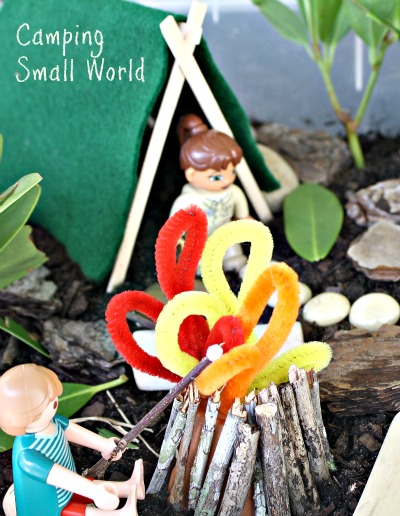
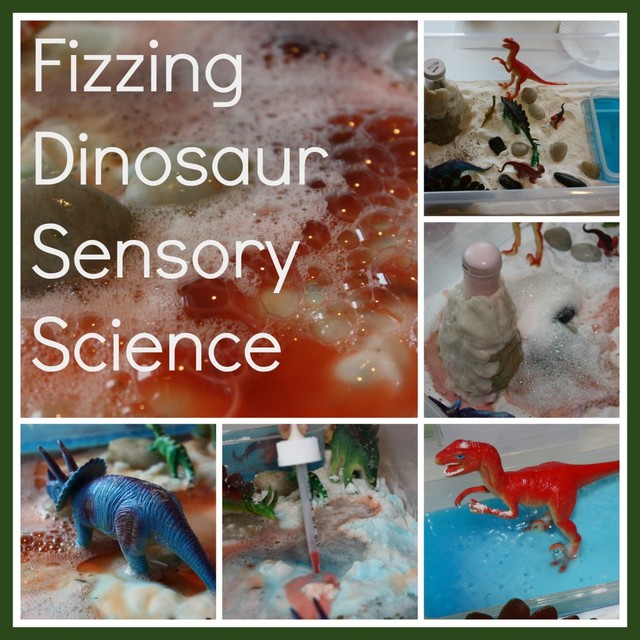
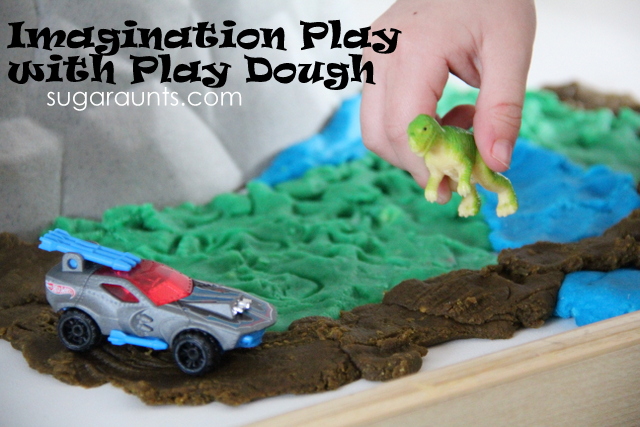
There is just something about small world play as a sensory play activity that supports skill development. Occupational therapy and play go hand in hand. When kids participate in small work play, they are building skills in creativity, fine motor skills, sensory exploration, communication, self-confidence, and so much more. Here, you’ll find small world play examples and ideas to support development in these areas.
Small World Play
Before we go further, let’s cover exactly what we mean by small worlds.
A small world is a play activity on a small scale. Kids interact with the miniature toys, small sensory tables and use imaginative play to explore and pretend on a smaller scale.
A small world can be set up in a variety of ways:
In a sensory bin
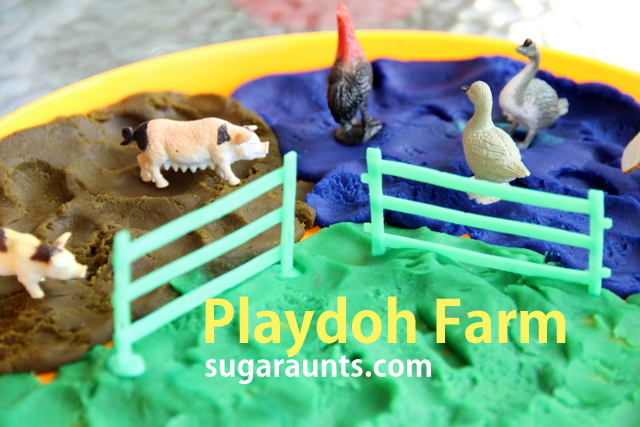
In play dough
On a train table or other low table
In a cardboard box
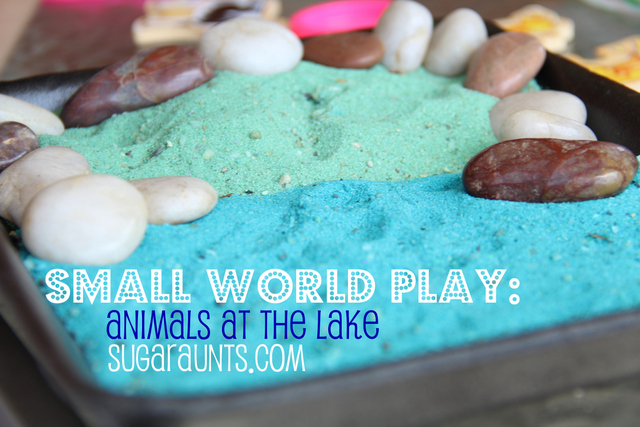
In a low tray
On the ground
One way to think about small worlds is a fairy house: Kids set up a fairy house area under a tree or in a corner of the yard. They can move and manipulate items to use in pretend play: natural material or commercial fairy houses, small objects like pebbles, sticks, bark, and fairy objects. These items are all part of the fairy small world.
Why Set up a Small World Play Area?
When kids play in a small world, they develop many areas. Additionally, small world areas offer children in small groups opportunities to experience parallel play in a joined environment so children can see various creative play ideas.
Most likely to develop is fine motor skills, but other areas can develop, too:
Precision
Eye-hand coordination
Finger isolation
Hand strength
Visual motor skills
small world play ideas
There are items your can use from around the home to use in small worlds. Here is a list of items to gather when creating a little world:
Container: bin, box, sensory table, etc.
River rock
Mini figures: animals, farm sets, train sets, dolls, etc.
Sand
Fake flowers
Craft materials
Play dough
Beads
Sensory dough or slime
The options are basically limitless when it comes to setting up a small area. Use the examples below to spark more ideas.
Small World Play Examples
Our kids love small world play. We’ve done so many activities that involve little worlds of imagination and pretend. Small world activities foster language development, story telling, self-confidence, fine motor skills, sensory exploration, and more.
Outdoor small world– We set this activity up under the base of a tree. Use materials like sticks, flowers, rocks, pebbles, roots, grass, etc.
Fairy small world– set up a fairy pretend area in a sand box. Use items like craft houses, rocks, and even glittery items.
Colleen Beck, OTR/L has been an occupational therapist since 2000, working in school-based, hand therapy, outpatient peds, EI, and SNF. Colleen created The OT Toolbox to inspire therapists, teachers, and parents with easy and fun tools to help children thrive. Read her story about going from an OT making $3/hour (after paying for kids’ childcare) to a full-time OT resource creator for millions of readers. Want to collaborate? Send an email to contact@theottoolbox.com.
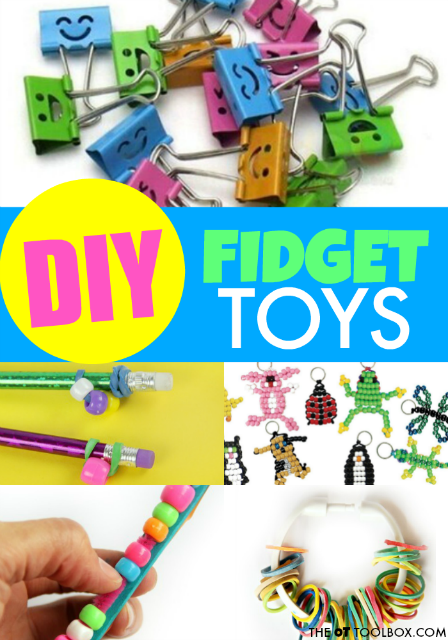
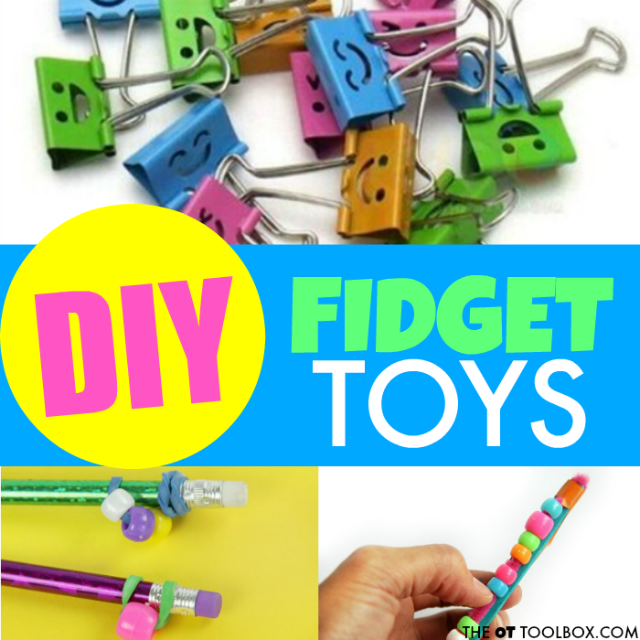
These DIY fidget toys are homemade fidgets that kids can make. Use these fidget items to help kids pay attention and focus in the classroom or home. Add these ideas to your occupational therapy toys that support kids through play while targeting self-regulation skills.
DIY Fidget Toys
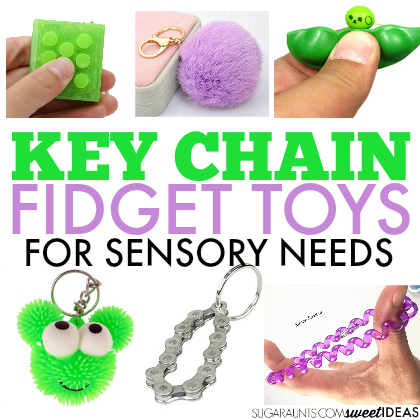
Fidget toys are in the hands of many school-aged kids. Students without sensory or attention needs are playing with fidget toys on the playground, on the school bus, and in the classroom. You can find spinner fidgets, and so many other fidget toys in many stores and online, but what about the DIY version?
The thing about some store-bought fidget tools is that they are noisy and call attention to the user. Fidget toys have become more popular in recent years, allowing those that truly need them for meeting sensory and motor needs to be more mainstream.
In fact, using a few of these games with paper clips are good ways to fidget with the fingers using everyday materials.
However, that can be another issue when a student has a fidget tool in the classroom. It can draw attention to the student because other students see the itm as a toy rather than a tool to support learning.
Coming up with quiet fidget toys that help the child meet their sensory and movement needs without creating more noise or attention in the classroom can be tricky. Here are more ideas for quiet fidget toys for the classroom.
So what is the obsession with these fidget toys?
The fidgets are intended to provide kids with a means to occupy their hands so that they can focus during tasks that require attention. There are many children who need fidget tools in order to complete work. Most of us know the feeling: the urge to doodle when talking on the phone or the tendency to tap a foot during a lengthy work meeting.
Fidgeting is a tool that helps us to actually pay attention and focus on the task at hand in many situations. Fidgeting during homework or in the classroom is a common behavior.
You have probably seen kids (and maybe your own kids) spinning these spinner fidget toys.
The fidgets that are in every school and classroom these days are beneficial to some students. For others, they are a cool new toy. For those that require a fidget tool to focus or attend, or have sensory needs requiring the hands and fingers to move, other fidget toys may work just as well.
Fidgeting during work stimulates the brain, allowing a child to complete school work or homework.
Fidgeting is mindless play or touching fingers, pencils, hands…anything that allows a person to focus on the task at hand. Kids that are fidgeting are seeking calm, and focus so that their brain can complete a task.
The problem is when the brain’s urge to fidget distracts a child from school tasks. They might be so wiggly and moving that they just can not sit still and focus in a functional manner. Fidgeting can be managed with less distracting techniques which can allow the child to accomplish the homework, and move on to other things.
Make a paper fidget toy that doubles as a fine motor workout! These paper flextangles are too cool!
How to Make Fidget Toys
Getting kids involved with making homemade fidget toys is part of the fun. There are fine motor benfits involved in this process, too.
First, select the type of DIY fidget you would like to use to meet specific needs.
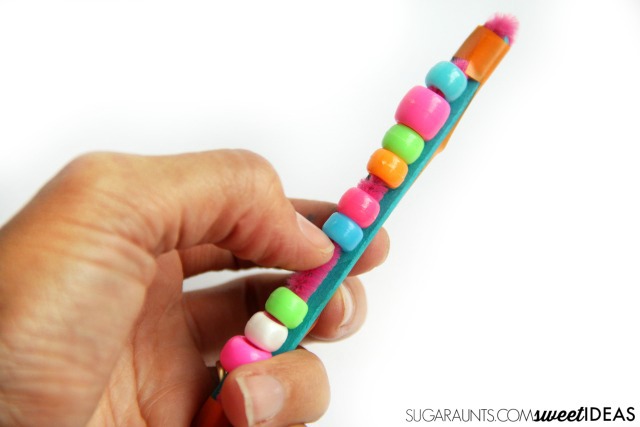
Next, select materials. You may need pipe cleaners, beads, balloons, or nuts and bots.
Prepare a work space. Set out the materails on a table or desk.
Students can select the materials they would like to use.
Create a fidget tool using the materials.
The nice thing about fidgets is that with the growth of YouTube as a resource, there are many videos on how to make fidget toys out there. Use one of those available videos as your inspiration, or use the materials you have on hand.
If one thing is for certain, it is possible to make a DIY fidget toy using anything!
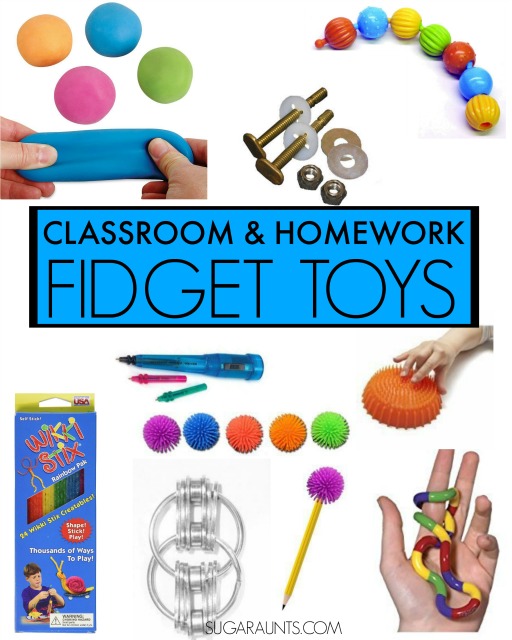
Try these suggestions for homework and classroom fidget tools.
What are your favorite DIY fidget toys? Do you have any favorite tools that work for your child, student, or client?
fidget tool or a fidget toy?
Here is your disclaimer on the wording of this blog post…
The term fidget toy is very well known these days, with the popularity of spinner fidgets. However, there is a distinction between a fidget toy and a fidget tool. When there is a therapeutic need for a product, it is a tool. A therapy tool is one that helps meet goals, results in independence through intervention. Something that looks like a toy can be a tool for the child with sensory needs, fine motor challenges, attention difficulties, or any other problem areas.
Fidget tools are those that help kids cope, meet sensory needs, and get the input they need so they can focus, pay attention, and move. In this blog post, I am using these terms interchangeably, for best search results. In other words, people complete a Google search for fidget toy, not a fidget tool, and I want this information to be found on Google so that the kids who need a fidget tool are well-served!
Need to add DIY fidget toys to a sensory diet? Wondering how to integrate a sensory diet into everyday tasks? A sensory lifestyle may be more of what you are looking for! DIY fidget toys fit right into a sensory lifestyle with ease and flexibility.
Read all about how to create a sensory lifestyle here:
The Sensory Lifestyle Handbook walks you through sensory processing information, each step of creating a meaningful and motivating sensory diet, that is guided by the individual’s personal interests and preferences.
The Sensory Lifestyle Handbook is not just about creating a sensory diet to meet sensory processing needs. This handbook is your key to creating an active and thriving lifestyle based on a deep understanding of sensory processing.
Colleen Beck, OTR/L has been an occupational therapist since 2000, working in school-based, hand therapy, outpatient peds, EI, and SNF. Colleen created The OT Toolbox to inspire therapists, teachers, and parents with easy and fun tools to help children thrive. Read her story about going from an OT making $3/hour (after paying for kids’ childcare) to a full-time OT resource creator for millions of readers. Want to collaborate? Send an email to contact@theottoolbox.com.
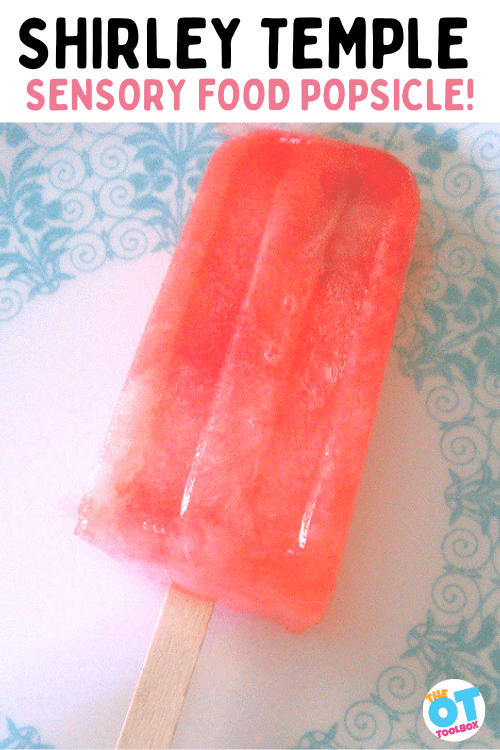
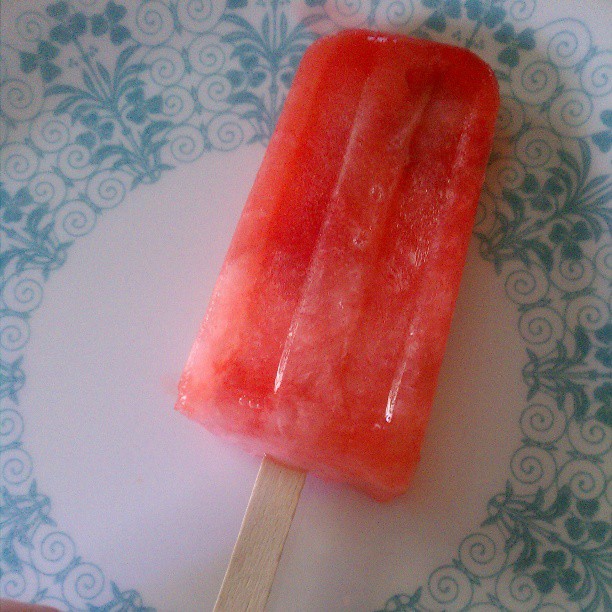
Today’s Shirley Temple popsicle recipe is a cool treat for summer, but also a great way to get kids busy in the kitchen cooking and developing skills. We’ve shared a ton of cooking with kids recipes, and this 7up popsicle recipe is even better because its an alerting sensory food that can be a great sensory tool for this time of year.
Shirley Temple Recipe
I wanted to share a sweet treat with you today that my kids ( and the neighborhood kids) love. Who doesn’t love Shirley Temples? These are in popsicle form and are oh so good. I hope you enjoy!
When I was a little girl, there was a seafood restaurant in the town we lived in called Neptune’s Galley. I have no idea if that restaurant is still in business or not, but I remember it vividly. There was a huge statue of Neptune on the roof of the building and it was dark and nautical on the inside. I have to admit, I do not remember the food that was served there.
I remember first being introduced to Shirley Temple’s!
At the time, my favorite movie just happened to be Shirley Temple in The Little Princess. And my daddy knew that and ordered me a Shirley Temple to drink…and the rest is history.
I think I requested that drink at every restaurant we ate in for the next five years after that!
In case you didn’t know, a Shirley temple drink is a kids’ drink that has 7up, Sprite, or other cool and refreshing fizzy drink. You add a touch of cherry, and maybe another fruit juice, and you’ve got yourself a kid-friendly drink that is a huge hit.
Therapy Benefits to Make these Popsicles
Not only are these popsicles a fun treat, there are also benefits to getting kids involved in the actual preparation process.
Pour and Scooping Activity- The best thing about making a Shirley temple drink with kids is that it’s an easy recipe. There are only a few ingredients, but children can pour and scoop the food items, working on so many fine motor skills. By pouring and scooping the ingredients, you address bilateral coordination, crossing midline, eye-hand coordination, strength, graded motor control, motor planning, and much more.
Fine Motor Skills- We’ve covered the benefits of fine motor development during cooking in the past, and this is a great starter recipe to try with kids…they get a huge reward in the end- a refreshing Shirly Temple popsicle!
Cold, bubbly Sprite, grenadine and a cherry on top. Oh, how I loved getting that pink-tinted drink brought to me. I felt so grown up!
Flash forward 20 years. My boys and I were at Red Robin and I introduced them to Red Robin’s Shirley Temples.
Ummm, they were not impressed. I guess it is a girl thing. They ended up with root beer floats. But I was determined to get them to like them!
So last week I set out to make Shirley Temple Popsicles.
At first I tried with just Sprite and maraschino juice. Eh. Then I added cherries to the mix. Still not right. So, after a few trial and errors, I added fresh orange juice, sprite, cherries and cherry juice. Perfect. And the boys ate them all.
So here is to nostalgia. And Shirley Temple!
Ingredients:
2 cups Sprite or 7-Up soda
1/2 cup fresh orange juice ( it took about 3 medium oranges to get the juice I needed)
Grenadine (I find this in the aisle with the margarita mix, etc)
Maraschino cherries
Directions:
In a large mixing cup, combine the soda and the orange juice. Set aside.
Fill popsicle molds with maraschino cherries. (Mine were smaller molds, so I used 3 cherries in each mold.)
Add about a teaspoon of grenadine to each mold. (You could use the cherry juice in the bottle of cherries, if there is enough, in place of the grenadine)
Add the soda and orange juice mixture to each mold, about 2/3 full. Don’t fill to the to the top of the molds. It will expand after freezing.
Place tops on popsicle molds and freeze.
Sensory Food
This popsicle recipe is a great sensory food, because of the alerting factor the cool ice pop offers to the mouth. We talked a lot about the benefits of sucking and alerting or calming properties of cool and warmth on this website in the past.
In fact, our post on using a sports bottle as a self-regulation tool shares information on the sensory receptors in the mouth and jaw. It is these receptors that register the cool, alerting temperature of a popsicle.
The cold temperature alerts, or “wakes up” the mouth. This can be a great sensory strategy to use for achieving attention or focus. It can help to regulate a child’s sensory needs when they are feeling lethargic or overly run-down.
Not to mention that during the hot summer months, a cold popsicle is the perfect treat!
However, there’s more to it than that. Sucking on a popsicle engages proprioceptive input through the muscles and joints in the mouth and jaw. Essentially, the popsicle is a strategy to offer heavy work through the mouth. So, a popsicle can actually be calming, too. It really depends on the child as well as the situation.
Think about a hot and humid summer day. A popsicle and a moment of chill-out time can help a child to calm down, re-group, and regulate their senses.
As an added benefit, a popsicle can be a great tool to use in oral motor exercises.
Lemon Lime Popsicle
Important to note about this recipe is that you can use Sprite or other pop or soda that contains lemon lime flavoring as one of the main ingredients.
The lemon-lime flavor is very alerting, as they are citrus foods. This flavoring in the popsicle “wakes up” and alerts the taste buds and acts as sensory input.
One tip: If you are concerned with the sugar intake, or want to find a lower sugar version, consider using low calorie lemon lime drink or 7-UP ten as an alternative to the lemon lime popsicle treat.
So? What do you think? Let us know if you make Shirley Temple popsicles and use them to develop skills!
Colleen Beck, OTR/L has been an occupational therapist since 2000, working in school-based, hand therapy, outpatient peds, EI, and SNF. Colleen created The OT Toolbox to inspire therapists, teachers, and parents with easy and fun tools to help children thrive. Read her story about going from an OT making $3/hour (after paying for kids’ childcare) to a full-time OT resource creator for millions of readers. Want to collaborate? Send an email to contact@theottoolbox.com.
If you’ve ever walked into an occupational therapy gym, you may have seen a variety of sensory swings and wondered, “why does occupational therapy swing kids in their OT sessions?” There are many reasons why, and in this blog post, we’ll cover sensory swings, the best sensory swings to use for sensory needs, and why!
There are many types of sensory swings that we use as occupational therapy providers. This is one piece of sensory equipment that is worth the price. We recommend splurging for a swing of some type in our blog post on creating sensory rooms on a budget.
Sensory Swing Movements
Swings are simply a great tool for sensory input as well as sensory integration. The predictability of linear swinging can be calming and settling for the children who need that support. For more information on the theory and background on this concept, check out our blog post on Ayres Sensory Integration.
Having the swing perform unpredictable moves such as rocking, spinning, side to side movement, and even start and stop movements while suspended in air, can be very alerting and stimulating for the children who need that support.
In our blog post, Sensory Swings for Modulation you will read how powerful the swing can be when used as a sensory strategy for individual sensory processing needs and modulation.
There are many considerations when it comes to sensory swings, however. A swing can be a tool for modulation but it can also cause sensory dysregulation in users.
Dysregulation refers to internal needs of the sensory systems that result in meltdown because the sensory processing system is out of balance.
You might find that only 5 minutes of intense swinging leads to dysregulated sensory system with overstimulation. This state can require a long period of time and intervention to get the individual to reset or calm down.
When it comes to sensory swings, different types of movements can impact modulation or dysregulation. It’s important to be aware of these considerations before using a sensory swing as a tool in therapy.
Each individual will be different and it can be a delicate balance of movements that are stimulating verses calming. A swing for one child might spiral into dysregulation with a lengthy period of time and calming input required to regulate the sensory systems. Other individuals may crave intense movements and can benefit from that swing input for a longer period of time, allowing for functional participation.
Alerting sensory swing movements
In general, fast rotary vestibular input is often stimulating. Likewise, quick and sporadic movements on the swing are stimulating.
The vestibular sense which is utilized during swing use helps to activate more body awareness, muscle tone, balance, and coordination as well as providing a level of increased alertness. If you want to learn more about vestibular activities in general, you can read the blog post Vestibular Activities.
Calming sensory swing movements
Calming or regulating sensory swing movements may include gentle, linear movement to calm the vestibular system. These swing pushes should be rhythmical and linear movement as these are more calming swing movements.
The proprioceptive sense can be activated during swing use by reclining in a swing and rocking rhythmically in a swing providing deep pressure input to the body can help soothe strong emotions and decrease engine levels of high alertness. This helps with self-regulation and body control.
You can see that there are many different variables and each individual will require independent assessment from a qualified professional. This is why simply adding a sensory swing to a sensory room in a school can be a detriment to all of the students. School administrators and educators should always consult the occupational therapy professional before using a sensory swing in the school environment.
Occupational therapy Swings
Sensory processing is not the only area that can be addressed with the use of swings.
How you utilize a swing and even the type of swing you use, can help a child to work on core and upper extremity strengthening, balance, visual processing, bilateral coordination, motor planning, righting reactions, body awareness, position in space, gross motor coordination, neck extension, eye-hand or eye-foot coordination, and visual tracking.
When working with occupational therapy swings, each child is different in their needs and their preferences and it is up to you as the OT professional to determine what is needed and what needs to be worked on for skill development.
It is also your role as the OT practitioner to guide and educate other professionals and parents of children to ensure the child’s needs are being met properly and that safety measures are being utilized.
Now, two questions for you regarding those OT swings:
Do you know what swing to use for the kiddos you see in therapy?
Do you often ask what activity can I do while they are on this swing so they will continue to remain motivated?
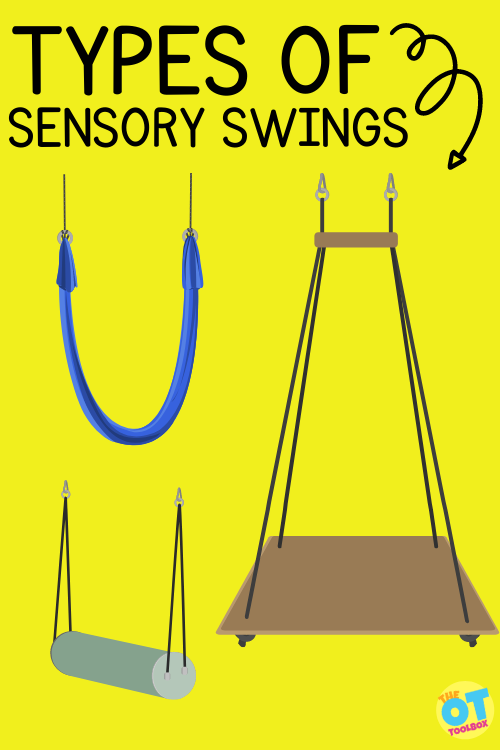
Types of Sensory Swings
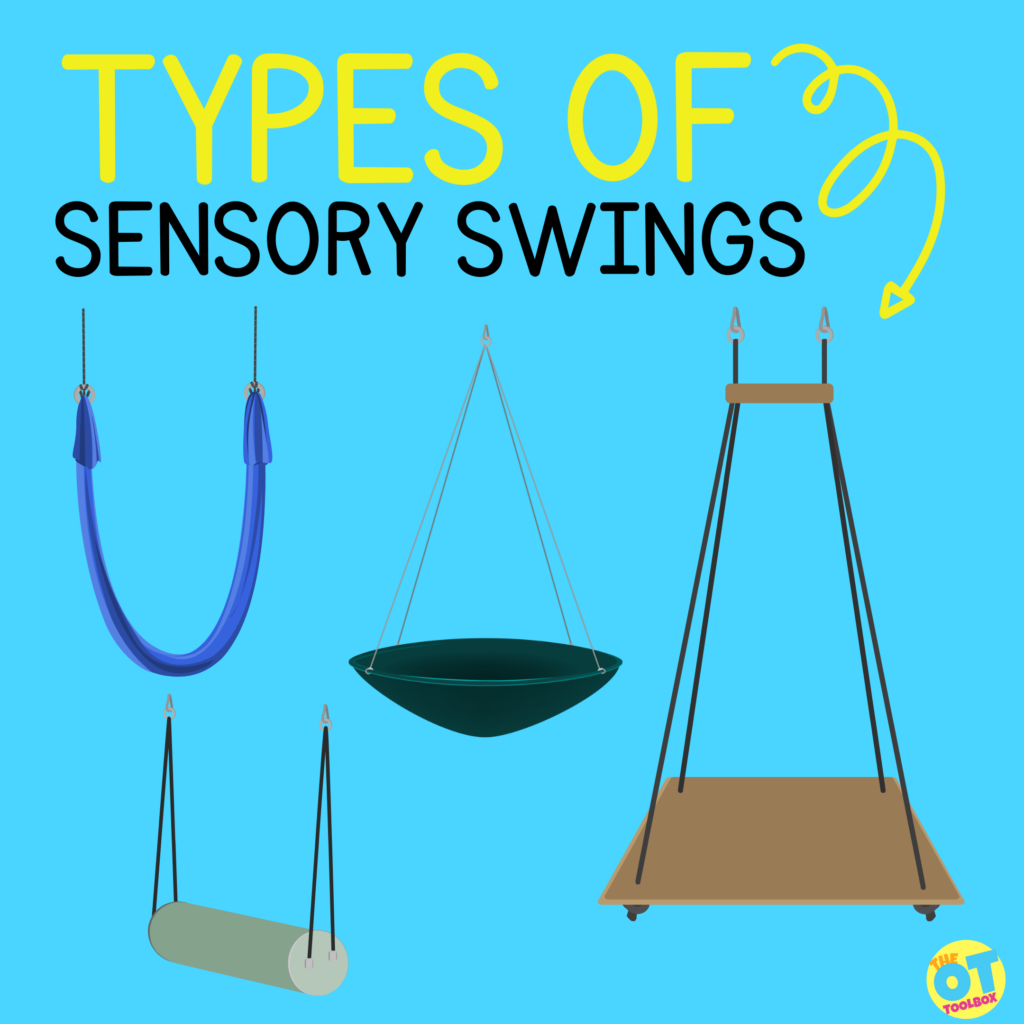
Well, let’s take a look at six of the most common therapy swings utilized in occupational therapy clinics and therapy rooms in schools. These types of sensory swings can be used for various reasons and in a variety of sensory swing activities.
Also, there are swings that parents can use indoors or outdoors to address a child’s sensory needs. If you read our post Outdoor Sensory Swing you will learn how taking sensory play activities into the outdoors will provide children with many outdoor sensory experiences just by using the world around us.
If purchasing a sensory swing is just simply too expensive to think about, read all about how you can use the playground equipment to address Sensory Integration at the Playground with the guidance of the therapist to meet each child’s needs.
There is no best sensory swing of this list, rather, each type of sensory swing has it’s own specific uses and benefits to supporting the needs of the individual user.
Bolster Sensory Swing
A Bolster swing (affiliate link) is a type of sensory swing that challenges balance, vestibular processing, motor planning, cervical extension endurance, proximal control/stability, and core strengthening, The child can lie prone, inverted, kneel, sit or straddle the swing.
Bolster Swing Activities:
Have a child work on hanging inverted like a koala bear and then time them to see if they can meet or beat their last best time.
Have a child kneel on the bolster while hanging on and then attempt to toss bean bags into a basket.
Have a child straddle the bolster swing like a horse and use a reacher to pick up bean bags from the floor and then try to toss them into a basket using the reacher to toss.
Spread balls around on the floor under the swing and have the children lie prone on the swing and attempt to reach out to pick up the balls and place them in a basket. You will move the swing around as needed.
Ladder Sensory Swing
A Climbing ladder swing (affiliate link) provides the challenge of motor planning while simultaneously working on balance, strength, and body awareness. The child simply works to climb the ladder from the bottom to the top and then back down again. It adds the fun of swinging while providing a challenging workout.
Ladder Swing Activities:
Place a bucket or basket filled with puzzle pieces, letters, shapes, or other items at the top of the ladder for a child to retrieve one at a time by climbing up and down the ladder swing. Then, have them either put the pieces into the puzzle base or practice writing the letter or drawing the shape before going back up the ladder to grab the next item.
An adult can stabilize the bottom of the swing by holding it steady while the child climbs or an adult can slightly twist and turn the ladder swing while the child attempts to climb up and down. It’s called the ship on the rocky seas!
Place two or three articles of clothing at the top of the ladder and have the child retrieve one at a time and when they get to the bottom they can work on zipping, buttoning, or snapping!
Hammock Swing
A Cuddle hammock swing (affiliate link) (also called a cocoon swing), is a calming type of sensory swing that provides proprioceptive input, assists with soothing strong emotions, and gives a nice deep pressure input which is calming and grounding for some children. This swing can be an easy first swing for children who need more gross motor support and are fearful of the movement other swings provide. The Lycra-type material allows children to sit, stand, or lie in the swing making it a highly versatile swing.
Hammock Swing/ Cocoon Swing Activities:
Have a child lie prone with their head and arms positioned outside the swing. This position creates a form of weight bearing through their arms and works on full upper body strengthening. They will work to pull and push themselves using the floor while inside the swing.
Place items around on the floor under the hammock just out of the reach of the child and then have them pull themselves along the floor to reach the items, such as bean bags, to toss into a basket.
Have the child lie prone and then grasp and hold your hands while you are seated on the floor in front of them. They will pull themselves toward you to shift the swing back and forth.
Have the child lie supine and reach up to remove clothespins that are clipped on the edge of the swing. The swing provides body support but works on building upper extremity strength and endurance as the child works against gravity to reach up. You can alternate activities and have the child place the clothespins instead.
Have the child recline or lie within the swing and simply do deep breathing or mediation exercises while slowly swinging back and forth.
Pod Swing
A Hanging pod swing (affiliate link) provides vestibular input, assists with balance, and makes a nice cozy pod that gives children a sense of calm regulation and relaxation to just simply cool inside. This swing can serve as a good first swing as it allows for seated support while simply swinging slowly and provides more comfort to children who may be more fearful of the freedom of other types of swings.
Pod Swing Activities:
Try turning off the lights, playing soft music, and have a child hold a small fidget or light-up toy while swinging slowly back and forth as they stay cuddled inside.
Place a pillow inside of the pod swing and have the child climb inside to provide a cushy, deep pressure input while swinging slowly and rhythmically in a linear fashion.
Blowing bubbles for the child to watch while seated in the swing provides a calming feel as the motion of the bubbles will be slow as they descend.
Have the child sit in the swing and complete deep breathing or mediation exercises while slowly swinging back and forth.
Platform Swing
We covered specifics about platform swings on a related blog post.
A Platform swing (affiliate links) (or this version of a platform swing with net base or material platform base) is the most common swing found in therapy settings and provides the opportunity for calming and alerting to get the child’s engine right where it needs to be for a treatment or classroom session. It is highly versatile as it can help a child build upper body strengthening, core strengthening, balance, and motor planning.
Platform Swing Activities:
Use this unstable surface swing to challenge a child’s body positioning to include side-lying, tummy time, tall kneeling, standing, criss-cross sitting, long sitting, and partial kneeling.
Have the child lie prone with their head and arms positioned over the edge. Then have them walk with the upper extremities around the floor picking up puzzle pieces to place in the puzzle base located in a central location. Pieces are picked up one at a time.
Place different colored bean bags in a circle on the floor around the swing. Call out different colors and have the child rotate themselves while lying prone on the swing and using their hands to walk around on the floor to stop at each color called out. Letters and shapes can be used for this activity too.
Place cones on an elevated surface and while the child is either lying prone or in a quadruped position, have them reach out to drop rings onto the cones.
Have the child sit criss-cross in the center and toss a beach ball to themselves.
Trapeze swing (affiliate link) provides a good opportunity to work on upper extremity strength and endurance, gross grasp skills, trunk strength, and motor planning. If you add lower extremity work also, then you address upper and lower body coordination.
Activities:
While swinging or not, encourage a child to hold and lift their legs to kick a ball.
While swinging, the child can simply jump over a therapy ball that is placed inside of a tire tube.
Simply work with a child on grasping and swinging while pumping the swing with their own feet.
While swinging or not, have a child hold on and lift their legs to kick a set of bowling pins or have them attempt to pick up each bowling pin with their feet and place them in a basket.
While swinging the child, can work on timing and release to let go and crash into a crash pad.
Sensory Swing Tips
What do you do with all of this information and activity ideas? Go get onto a swing and try out some of these fun activities! That’s right, we as adults need to have some fun too!
But, after you’ve tried them, demonstrate them to the kiddos as they will most likely be more motivated to do the same activity after they see YOU do it. After all, you and I both know that the best way to teach a child is by setting a good example and you’ll get to have some fun in the process! It’s a win-win folks!
One tip for using a sensory swing in a therapy session can include a visual schedule with a plan that helps the individual with regulation needs. It can include swinging, then heavy work, music, blowing bubbles, dim lights, heavy rhythmic play, and deep breathing. All of these sensory tools regulate the system and can calm the system after the movement from the sensory swing. This is just one example and each individual will benefit from different strategies.
Be sure to take a look at the maximum pounds allowed for some swings as you’ll want to be sure that it will work for all of your kiddos before purchasing.
Always supervise children while on swings especially when rotary swinging as this can instigate seizure activity in some children.
sensory swing safety
There are important things to remember when it comes to sensory swing safety. Safety considerations for sensory swings relate to both in the clinic and, with the ready availability of purchasing a sensory swing online, in the home as well.
Remember these sensory swing safety tips:
Installing a sensory swing- Always read the manufacturer’s instructions and follow them carefully. Different types of sensory swings may have different weight limits, installation requirements, and safety recommendations. You may need specific installation parts for sensory swings, especially considering the weight of the user and how the sensory swing will be used.
Support structures for sensory swings- Make sure the swing is securely anchored to a strong support structure. The support structure should be able to handle the weight of the swing, the child, and any additional equipment or accessories.
Monitor the sensory swing for signs of wear and tear- Check the condition of the swing and its components regularly. Look for any signs of wear and tear, such as frayed ropes, torn fabric, or rusted hardware. Replace any damaged parts immediately.
Supervision during sensory swing use- Always supervise your child while they are using the swing. Never leave them unattended, even for a short time.
Educate the user on how to get on and off the swing, and how to use a sensory swing- Teach your child how to use the swing safely. Show them how to sit or lie down properly, how to hold on to the ropes or chains, and how to get in and out of the swing safely. This is especially important for particular positioning such as laying in supine (on belly) or when spinning is used in the sensory swing. Teach your child and other children using the swing to watch for signs of overuse.
Where to put a sensory swing- Make sure the swing is set up in a safe and open area. The area around the swing should be clear of any obstacles or hazards, such as furniture, sharp objects, or hard surfaces.
Other safety equipment- Consider using a safety harness or seat belt to keep your child secure in the swing. This can be especially important for children who have difficulty sitting still or have balance or coordination issues. You can also consider padding around the swing area on walls using gymnastic pads or wall padding, or cushioning pillows of pads on the floor.
Upkeep- Keep the swing clean and dry. Wipe down the fabric or other materials with a damp cloth and allow it to air dry between uses.
Consider overuse and type of use- If your child has any medical or physical conditions, consult with their healthcare provider before using a sensory swing. They can provide guidance on whether the swing is appropriate and safe for your child’s needs.
Lastly, trust your instincts. If something doesn’t feel right or safe, don’t use the swing until you can address the issue or seek guidance from a qualified professional.
Therapy Swings- What to watch for
When using a therapy swing of any kind, it is a must to watch for overuse or overstimulation. This is because the sensory input of a therapy swing/sensory swing can be very overwhelming.
Particularly with rotary input, a therapy swing (either at home or in the clinic setting or in a sensory room in the school setting) can lead to overstimulation, dizziness, agitation, hyperactivity, fatigue, or other considerations. For this reason, it’s very important to limit rotary input to a specific set of minutes which should be monitored throughout use of the therapy swing.
Also, it’s extremely important for therapy swings to be used under the guidance and recommendation of a pediatric occupational therapy professional.
While sensory swings can be beneficial for children with sensory processing issues, overuse or improper use can potentially cause harm. Here are some things to watch for with sensory swing overuse:
Dizziness or nausea: Rapid or repetitive swinging can cause dizziness or nausea, especially in children who are sensitive to motion.
Overstimulation: While sensory swings can be calming for some children, they can also be overstimulating for others. Overstimulation can cause anxiety, irritability, or difficulty with attention and focus.
Fatigue: Prolonged use of a sensory swing can cause muscle fatigue or soreness, especially in children who have weak muscle tone or low endurance.
Agitation or hyperactivity: Some children may become overly excited or hyperactive after using a sensory swing, which can make it difficult for them to transition to other activities or tasks.
Risk-taking behavior: Children who become overly confident or adventurous on a sensory swing may engage in risky behavior, such as jumping off or swinging too high, which can lead to injuries.
Increased dependence: Overuse of a sensory swing may cause a child to become overly reliant on the swing for sensory input or emotional regulation, which can interfere with their ability to develop coping skills or self-regulation strategies.
If you notice any of these symptoms or concerns with your child’s use of a sensory swing, it may be a sign of overuse or improper use. Consider reducing the amount of time your child spends on the swing, or consulting with a healthcare provider or occupational therapist for guidance on how to adjust or modify the use of the swing to better meet your child’s needs.
The Sensory Lifestyle Handbook walks you through sensory processing information, each step of creating a meaningful and motivating sensory diet, that is guided by the individual’s personal interests and preferences.
The Sensory Lifestyle Handbook is not just about creating a sensory diet to meet sensory processing needs. This handbook is your key to creating an active and thriving lifestyle based on a deep understanding of sensory processing.
Regina Parsons-Allen is a school-based certified occupational therapy assistant. She has a pediatrics practice area of emphasis from the NBCOT. She graduated from the OTA program at Caldwell Community College and Technical Institute in Hudson, North Carolina with an A.A.S degree in occupational therapy assistant. She has been practicing occupational therapy in the same school district for 20 years. She loves her children, husband, OT, working with children and teaching Sunday school. She is passionate about engaging, empowering, and enabling children to reach their maximum potential in ALL of their occupations as well assuring them that God loves them!
Looking for summer occupational therapy activities to support skill building or developmental areas with a summer OT theme? Today, we have a spin on our traditional occupational therapy activities to bring you Summer occupational therapy strategies that can be used in summer sessions or in home programs for the summer.
Summer Occupational Therapy Activities
Summer OT activities may look a little different than previous years. In years past, therapists may have been gearing up for an end of another school year and a break from in-person OT sessions. In recent years, you may be seeing more pencil grasp needs, self-regulation needs, handwriting issues, and fine motor skill needs.
What hasn’t changed about the end of a school year is the carefree days of summer that are ahead. As an OT, I love the feeling of the start of summer. There is just something about back-to-the-basics play of summer. Running around the backyard, hopping on bikes, sidewalk chalk, sprinklers and water play…summer play is a goldmine of motor and sensory activities that can boost those underlying skills kids NEED.
Because of this, I wanted to put together a resource on summer occupational therapy activities that can be implemented today. These are strategies to use for your own child to boost development and challenge skills. These are ideas to use in teletherapy or in home programs. These are play ideas that help kids with the balance of screens and active play. Use the summer resources for parents, teachers, and therapists to develop underlying skills in very fun ways! These are AWESOME summer occupational therapy activities!
Let’s help kids struggling from a year of mega-screen overload meet the goals they need to thrive. Plus…take more time for you this summer by using done-for-you resources!
Summer Occupational Therapy Activities
In many areas, schools are winding down for the year. You may have a few weeks or a few days left. The daily countdown of number of remaining school days is dwindling.
You might be wondering how to balance work-from home and making summer days count.
You might be wondering how to keep the kids busy this summer without breaking the bank.
You might be a clinician thinking about summer programming and need a few fresh ideas.
You might be thinking about summer plans and ways to encourage development in fun ways the whole family can enjoy.
You might be a therapist putting together summer home programs.
You might be a teacher who is READY for the final bell to ring this school year 🙂
I wanted to put together a list of resources for summer activities that can boost the skills kids need. The “summer slide” can happen in handwriting and other school-based therapy goal areas, too!
Summer Occupational Therapy Activity Ideas
Occupational therapy practitioners often use movement and sensory experiences in therapy sessions to challenge motor planning, motor skill development, and incorporate sensory motor activity through the primary occupation of childhood: PLAY.
Because of this, sensory motor rich activity is recommended as supplemental and everyday activity for kids of all ages to support development of skill growth. Many of the OT activity ideas listed below also support executive functioning skills, problem solving, and other cognitive aspects of functional tasks.
First, grab this summer sensory path printable packet. It’s a free sensory path printable with a summer theme. Use it in therapy clinics, home OT sessions, or in summer sensory camps!
Try adding these OT activities to your summer bucket list:
Make our 3 ingredient kinetic sand– Making kinetic sand offers heavy work through the hands as a self-regulation tool and offers a tactile sensory experience.
Make a kite craft to develop fine motor skills, visual motor skills, eye-hand coordination, and scissor skills.
Play TV tag (or one of these tag games)- Tag is a great gross motor activity to develop endurance, motor planning, coordination, balance, and visual motor skills while adding proprioceptive and vestibular input to regulate the system.
Make an ice cream craftto support hand strength and fine motor skills. This craft is great for developing scissor skills too.
Play sidewalk hopscotch– Use sidewalk chalk to draw a hopscotch board. Then play using rocks or bean bags. Hopscotch is a great tool to add heavy work, vestibular and proprioceptive input, and to challenge motor planning, balance, and other gross motor skills. Hopscotch is a way to teach skipping skills, too.
Paint rocks- This sensory experience challenges tactile input and offers a fine motor activity. Use finger paints or a paint brush to incorporate tool use and more fine motor work.
Wheelbarrow walk– This exercise is a heavy work exercise that helps kids with motor planning, movement, and endurance through play while adding heavy work. Use wheelbarrow walks in relay races or in obstacle courses.
Make a flower craft– Go on a nature walk as a motor and sensory experience. Then use the nature hunt findings to make a fine motor flower craft. There will be no two crafts alike with this fine motor activity.
Wrap sticks in string- This simple activity is big on bilateral coordination, fine motor skills, precision, eye-hand coordination, and executive functioning skills. Go out in the yard and gather some small twigs. Then, tie a knot with the string and wrap around the stick. Switch out colors to make colorful designs and patterns. Can you cross different colored strings or yarn together to make a pretty wrapped stick? You can see how we wrapped craft sticks in string here.
Make lemonade- Making food with kids is a huge fine motor, sensory motor, and executive functioning tool to develop many skills with kids of all ages. Check out our cooking with kids page for tons more cooking ideas and recipes for kids as well as why each recipe supports development of skills.
Make a bug catcher– This fine motor activity is a huge hit with kids, and you can use the materials you have on hand. Just raid the recycle bin or grab some boxes and containers before they go into the trash can. Then, head outside to catch some bugs. This is a challenging activity that supports fine motor, visual motor, and sensory development.
Visit a playground- Playing at the playground has many sensory integration benefits and there are so many ways to use regular playground equipment to develop motor and sensory skill sin kids. If self-regulation is a challenge, then the playground is a wonderful summer haven for supporting specific needs.
Play tug of war- This heavy work game offers strengthening, balance, motor planning, and proprioceptive input that can be calming to support self-regulation needs.
Play in the sprinkler- A hallmark of hot summer days is playing in the hose or sprinkler. Children can practice putting on their swimming suit, applying sunscreen, and work on hopping, jumping, skipping, and moving through the sprinkler. And, don’t forget about involving the child in setting up and removing the sprinkler and hose, too. Pulling a hose is an opportunity for proprioceptive input that can be very calming.
Pick flowers- Go on a sensory nature walk with the family along a trail or in a park. Picking flowers supports development of visual perceptual skills, working memory, visual processing, fine motor, and self-regulation skills. Getting outside in nature can be a great overall activity that supports development and is a reset for the whole family.
Make lunch for your family- Develop fine motor skills, sensory experiences, executive functioning skills, and functional participation development by making lunch or dinner. Here are all of our cooking with kids recipes where you’ll find specific recipe ideas that support development, all from the perspective of an occupational therapist.
Chalk line obstacle course- Work on balance, motor planning, gross motor skill coordination through play using sidewalk chalk to create a driveway obstacle course. Can you hop on lily pads, tiptoe along a bridge, and animal walk on a wavy line?
Make DIY musical instruments- Making musical instruments are a fun way to build fine motor skills and address auditory processing skills too. Ideas include:
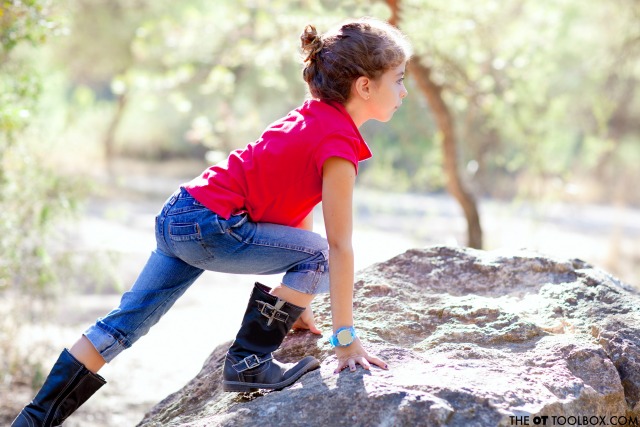
Climb a tree- Climbing on trees and limbs are a wonderful way to offer proprioceptive input, vestibular input, visual processing skills with depth perception, visual scanning, and eye-hand coordination. Holding on to a branch, pulling oneself up and over limbs, crossing midline, and bilateral coordination are developed through play. When finished, this is a powerful confidence booster!
Write a letter to a friend- (or a post card or email!)- Work on letter formation and other handwriting skills by writing a short letter or card to a friend this summer. It’s a very functional handwriting task that kids will be proud of!
Make a fairy garden- Use materials found around the home to support development of fine motor skills. The pretend play is a fun way to develop social emotional skills, too.
Wash the car (or a bike)- Support gross motor development by using a sponge, soapy water, and the hose to add proprioceptive input.
Watch and draw birds- Look for birds outdoors, in the yard, or from the windows. Address visual scanning, working memory, and pencil skills.
Go on a rainbow nature hunt- Use a piece of contact paper and find items of different colors of the rainbow to make a rainbow nature hunt craft. This is a great activity for fine motor, visual processing, and heavy work input.
Trace a friend with chalk on a driveway or sidewalk- Use sidewalk chalk to trace a friend on the driveway or sidewalk. This is a great activity to develop fine motor skills, and can support development of interoception by drawing internal organs and talking about how the body works inside and out!
Make bubble wands with pipe cleaners- use pipe cleaners and beads to develop fine motor skills to make a bubble wand. Then support oral motor skill development by blowing bubbles.
Play Red Rover-Lawn games like red Rover develop gross motor skills, visual motor skills, and executive functioning as well as adding proprioceptive and vestibular input.
Write the alphabet with chalk- Writing letters with sidewalk chalk supports the motor plan to create each letter and offers great proprioceptive feedback through kinesthetic learning. Writing letters with chalk or names and words can be a fun summer activity. Then spray the letters and words off with the hose or a spray bottle for more motor skill development!
Find shapes and images in the clouds- Look up to work on visual canning, memory, attention, and visual motor skill by finding shapes and outlines in the clouds.
~Grab some of the materials in The OT Toolbox Member’s Club. There is something for everyone and Summer themed activities to support all skill levels.
~ Do some or all of the activities listed here in this Sensory Summer Camp at Home plan. All of the activities and ideas are free and use items you probably already have.
~ Sneak in handwriting practice while traveling with these motivating and authentic ideas. HERE are a few MORE natural writing experiences for summer that keep those pencils moving.
~ Try some of the activities in this Summer Activity Guide designed to encourage play and creativity in activities for the whole family.
~ Practice the motor planning and fine motor skills needed for handwriting and with a sensory twist using the ideas outlined in this Sensory Handwriting Backyard Summer Camp.
~ Print off this June Occupational Therapy Calendar for ideas to last the whole month. (It’s from a couple of years back so the dates are off, but the activities still work!)
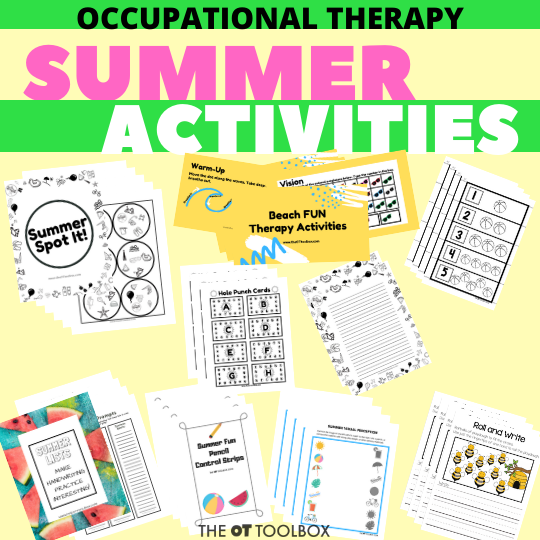
It’s a collection of 14 items that guide summer programming at home, at school, and in therapy sessions. The summer activities bundle covers handwriting, visual perceptual skills and visual motor skills, fine motor skills, gross motor skills, regulation, and more.
You’ll find ideas to use in virtual therapy sessions and to send home as home activities that build skills and power development with a fun, summer theme. Kids will love the Summer Spot It! game, the puzzles, handouts, and movement activities. Therapists will love the teletherapy slide deck and the easy, ready-to-go activities to slot into OT sessions. The packet is only $10.00 and can be used over and over again for every student/client!
NEW RESOURCE: The Summer Fine Motor Kit– This 90 page packet it specifically designed to build the motor skills kids have been limited in over the past year or so: handwriting, cutting with scissors, small motor manipulation, arch development and hand endurance, strength, pinch, and coloring. The Summer Fine Motor Kit includes different tools and materials than our other fine motor kits, but has some of the most-requested favorites in fun summer themes:
Summer Play Dough/Handwriting Mats (3 writing paper styles: single rule, double rule, and highlighted lines)
Lacing cards
Color and cut sensory bin cards
Sea Creature, Summer Play, & Summer Treats Silly Paths (great for pencil control and eye-hand coordination)
Tracing mazes/ Fine motor mazes
Symmetry drawing page
Fine Motor Flip Pages (flip a coin or small object and place them along a path)
Glue skills pages
Prewriting shapes sheets
Toothpick art activities
Pencil control worksheets/Fine motor placement paths
Scissor skills activities (simple and complex shapes)
Sensory bin cards
NEW RESOURCE: The Summer OT Bundle– Want to cover all your bases this summer? This bundle has everything you need for therapy planning, home programs, summer camps, Grandma’s house, or extended school year programs so you can just print and go. The bundle is $20 and includes:
The ideas listed above should help you create therapy home programs, and keep the kids loaded up on creative, open-ended, and movement-based PLAY that their little bodies NEED!
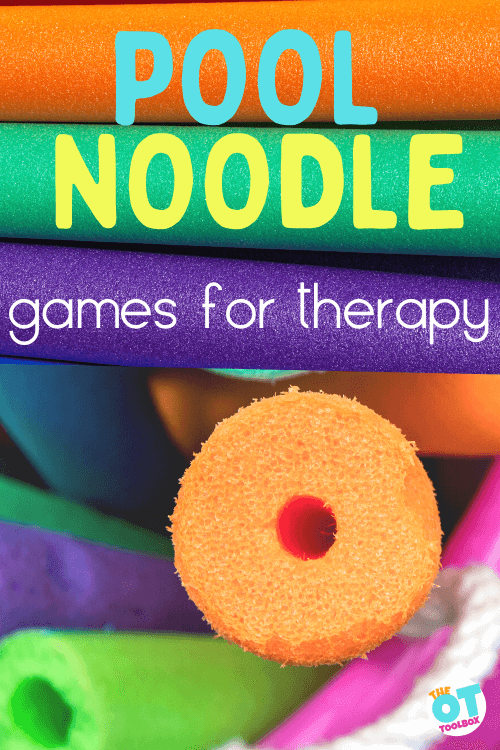
If you are looking for fun gross motor coordination activities, then these pool noodle games and activities are a great therapy tool to support skill-building. The pool noodle games are great activities to add to therapy sessions, use in home programs, or to add to Field Day or summer therapy camps. Check out these pool noodle games that support development, learning, and sensory motor skills.
Pool Noodle Games
A pool noodle is a swim toy that can be used to build swim skills or have pool-time fun. It can also be used as an OT tool to help build hand/finger skills, overall body strength/coordination, as well as balance, and motor planning skills.
Because they are readily available in stores during the Spring and Summer months, pool noodles are a great addition to your Summer occupational therapy activities.
Pool noodles are a versatile toy that can be cut, divided, and shaped into many tools to benefit children in their skill development, and overall needs. These toys are colorful, inexpensive, and attractive to children, which make them motivating, and facilitates engagement in pool noodle activities created with them.
This is a gross motor toy you’ll want to add to your therapy toolbox, and we’ll cover why that is below.
In addition, imagine all of the equipment needs that can be addressed to help with daily living skills using these noodles.
Add pool noodles to a few other ideas here on the website for a Summer of fun:
Pool noodles can be used by a variety of children, for many needs, and for several purposes. They can easily be used indoors or outdoors, in the home, the classroom, and therapy room. Pool noodle activities can be used with all ages, and in all environments. That’s right all ages. Maybe not in the conventional manner, but there are many imaginative and thoughtful activities that are fun and safe for anyone!
The best part? Pool noodles are cheap, cheap, cheap. They can be more challenging to find, if you look for them off season. My helpful tip to you is to buy them in bulk when they go on clearance at the end of the summer season, and you’ll have them whenever you need them. Sometimes you can even find them on clearance for just a few cents, that’s right, A FEW CENTS!
Let’s take a look at some fun, creative pool noodle activity ideas to get kids up, moving, active and a little ‘noodley’ this season! If you do not need them for pool noodle activities, but want some creative tool ideas instead, I’ve got you covered there too. Just scroll down to the bottom of the page, and you’ll find some innovative ideas for equipment and tools.
Gross Motor pool noodle activities:
These gross motor pool noodle ideas offer strategies to support motor planning and body awareness. It is by adding a simple pool noodle to play activities that can offer challenging motor tasks, while encouraging coordination, balance, body awareness, and motor planning skills.
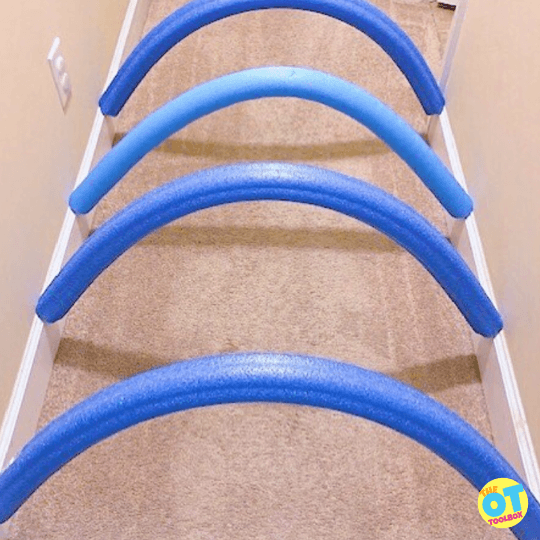
Pool Noodle Tunnel- Use a few pool noodles down a hallway and create a fun pool noodle tunnel for kiddos to crawl under, take a look here at our blog post Play Tunnel Activities. Use skewer sticks to secure noodles outside, and create a pool noodle hurdles.
Pool Noodle Wand- Create a Pool Noodle wand for reaction time, coordination, and balance. All of these skills can be addressed with the simple use of a pool noodle and PVC pipe to create the stick.
Pool Noodle Hurdles- We shared how to make pool noodle hurdles in our Family reunion activities post. Simply cut a pool noodle and use paint stirrers to stick small pieces into the ground. Then balance a long pool noodle on top for a balance, coordination, and gross motor activity that kids can step over, jump, or hop over in an obstacle course.
Pool Noodle Relay Race- This pool noodle game is great for lawn games, outdoor sensory diets, and family fun. Divide players into teams. Each team has a pool noodle. Players can race to a certain spot and then turn around and pass the noodle to the next player in the line. The first team to get all of their players to run with the pool noodle is the winner. This game can also be played in the swimming pool.
Pool Noodle Balance Game- Cut a pool noodle into smaller pieces (about one half of a pool noodle). Each player receives a piece. Balance a ball on top of the pool noodle hole. The players should race across the lawn or room while balancing the ball on their pool noodle. This is also a great addition to an obstacle course while challenging changes in positioning.
Balance Beam- A pool noodle is a great way to create a DIY balance beam, which provides balance opportunities, works on core strength, and provides vestibular input to help improve regulation.
Wobble Board- Use a pool noodle as a wobble board by adding a platform or boogie board over the noodle. Here’s another great idea for a DIY wobble board.
Pool Noodle Limbo- Want to limbo this season? Use a pool noodle for a fun game of limbo at home, or during therapy. Have children perform animal walks under the limbo stick. Easy, simple, effective and FUN! This one allows kids to work on multiple body skills.
Gross Motor Drum Sticks- Use pool noodles as gross motor drum sticks. When you use pool noodles as desk drumsticks, you address core strength, eye-hand coordination, bilateral coordination, and motor planning. Desk drumsticks can build fitness, and give a quick movement break to the entire class, with very little effort and cost. Now, that’s a winner in my book! To add gamification to this pool noodle idea, add music and play to the music. When the music stops, everyone needs to stop playing. It’s a great auditory processing activity.
Pool Noodle Skipping- You can use pool noodles as a tool to teach skipping.
Pool noodles can be used on a small scale, too to work on fine motor skills. Try some of these ideas.
Pool noodles and rubber bands – Cut a pool noodle into smaller pieces. Use rubber bands to wrap around the pool noodle. This is an easy fine motor activity that you can create. Learners work on stretching the bands around the noodle, which will provides a fun, but effective fine motor strengthening tool, and a good bilateral coordination activity.
Press pipe cleaners into pool noodles- This is another easy, but fun activity to work on important fine motor, and bilateral coordination skills. Slide beads onto the chenille stems (pipe cleaners) to work on threading, or have them string in a specific order to add an opportunity for working on listening and following directions.
Threading activity- Use those same pipe cleaners pressed into the pool noodles and add beads, buttons to place onto the pool noodles. Learners will work on fine motor skills, eye-hand coordination, and finger strengthening with these fun activities. You can also thread pool noodles on a jump rope like we did with this pool noodle sensory bin idea.
Pool noodle and pom-pom transfer is just what you are looking for if you need a child to work on tong use, or practice pre-scissor skills using a pair of tongs. Children use tongs to transfer pom-pom balls into the holes of the pool noodle slices. Not only is this for fine motor skill development, but look at the built-in eye hand coordination too!
Put a cork in it! is a super fun activity that works on finger strengthening and bilateral coordination, as children will work to twist and push corks into the holes of pool noodle slices. Where do you find corks without having to drink dozens of bottles of wine (which is not terrible). Go to any craft store and they are available for purchase.
Pool noodle pom-pom shooter is a fun pool noodle activity that works on fine motor strengthening, as children work to pull the rubber band back to shoot the pom-pom from the pool noodle chunk. It most cases, the farther they pull the rubber band backwards, the farther the pom-pom will go. Set up a target using a laundry basket or box, and see if they can shoot the pom-poms into the target to score points.
Make a creature- Cut a pool noodle into small pieces. Affix or draw monstors or pictures of people or animals onto the pieces. Learners can then mix and match creature blocks with pool noodle chunks to build their own creatures. You can take pictures of completed creatures and have children attempt to copy the picture by stacking the appropriate pool noodle pieces, they work on visual perceptual skills.
Sensory pool noodle activities:
Sensory Bins- Use pool noodles as part of a Pool Noodle Sensory Bin to give the illusion of the ocean, and/or bubbles that you see in the ocean. Children can stack, fill, or squeeze them.
Pool Noodle Boats- How about some pool noodle boats for bathtub time, in a water bin? Take a look at how easy making these pool noodle boats are, and what fun they will be to play with during water playtime.
Letter Scoop Race- Cut a pool noodle into small pieces. Write letters on the outside of each piece. Then, place the noodle pieces into a sensory bin or on a tray. Ask the learner to scoop letters and as fast as they can match upper case letters to lower case letters, or letter to letter. They can stack the matching letters on top of one another to work on fine motor skills.
Eye-Hand Coordination using pool noodles:
Marble Maze- After an adult slices the pool noodles in half, have kiddos work on taping a variety of pool noodle pieces onto the wall with painter’s tape to create a fun Pool Noodle Marble Maze. Kiddos can change it up, making new mazes. It makes for a great STEM activity that builds problem-solving, and eye-hand coordination. This is a great DIY marble run for a visual scanning activity.
Pool noodle track- Easily create a visual tracking and bilateral coordination activity with use of a pool noodle circle track which requires a pool noodle sliced in half, taped together in a circle, and a marble inserted for rotating around the track. Making your own race track is a fun and challenging pool noodle activity, as you have to keep the speed of the marble going around the track so it will not fall out. Definitely for higher level learners, but a fun one!
Pool noodle batting is a simple activity using pool noodle pieces and a balloon or a beach ball suspended from the ceiling with a string. This provide a great opportunity to work on eye-hand coordination, upper extremity strengthening, and range of motion.
Javelin Throw– Use pool noodles to create a pool noodle javelin throw activity to work on visual motor skills as children throw a pool noodle javelin through a circled pool noodle suspended from the ceiling.
Pool Noodle Bowling- In this bowling game all you have to do is cut pool noodles into equal sized pieces, and you have a set of bowling pins! Anyone can use a set of simple bowling pins for a fun eye-hand coordination activity. You can use pool noodle slices stacked into a pyramid shape for the same purpose!
Everything listed here is all about tools, adaptations, apparatus, or simple equipment ideas to children at home or school. Take a peek, and see if any of these ideas can help your learners.
Pool Noodle Card Holder- Know a child that has a hard time grasping and holding a set of cards? Make this great pool noodle card holder just for them! It can be used in the classroom, during therapy, and at home. Have a child that cannot hold cards, but needs to see them? Try this quick hands-free card holder adaptation.
Pool Noodle Adapted Seat- Maybe you need a pool noodle seat for a kiddo that has difficulty knowing where their seat ends due to poor body awareness. If so, this simple pool noodle seat will give them the physical cue they need to help with body awareness and balance within a chair. You know that one kiddo who frequently falls out of their chair? Try this and see if it helps! Here are more flexible seating ideas and DIY adapted seating (perfect for pool noodles!)
Pool Noodle Feet Positioner- How about a quick feet fix when a kiddos feet do not quite touch the floor, or they need a little movement for their feet while seated. Check out this pool noodle feet positioner.
Pool Noodle for High Tone Seating Needs- Sometimes there is that one kiddo that needs a little flexion positioning due to their excessive extension pattern, due to have high tone. Take a look at how to use a simple pool noodle and bungee cord to provide a little buffer for the excessive extension.
Therapy Ball Seat Positioner- If you tape a pool noodle into a circle, you can use it as a pool noodle ball chair by placing the therapy ball on top of the pool noodle to hold in place. Kiddos can still move slightly on it, just not excessively. This makes the ball less distractive, and kept within their personal space at their desk!
Summer is fast approaching, run and stock up on pool noodles now. One last thing that I want to remind you about pool noodles, remember to purchase them now, or when they are on clearance at the end of the season! They are just a few cents and you can use them all year long whenever you need them!
Regina Parsons-Allen is a school-based certified occupational therapy assistant. She has a pediatrics practice area of emphasis from the NBCOT. She graduated from the OTA program at Caldwell Community College and Technical Institute in Hudson, North Carolina with an A.A.S degree in occupational therapy assistant. She has been practicing occupational therapy in the same school district for 20 years. She loves her children, husband, OT, working with children and teaching Sunday school. She is passionate about engaging, empowering, and enabling children to reach their maximum potential in ALL of their occupations as well assuring them that God loves them!
The terms kids, kiddos, and children are used throughout this post. These pool noodle activities can be used for learners of all ages and developmental levels.
A hula hoop is a great old-school toy and specific hula hoop activities can be used to not only build strength, coordination, balance, and motor planning, but can be used in other areas such as learning, sensory, and visual motor, as well as gross motor coordination. Hula hoops are versatile and inexpensive, while being colorful and attractive, to spark the interest and motivation of children. There are a wide array of hula hoop activities that can be done, in addition to the traditional method.
Hula hoop Activities are great!
Hula hoops can be used indoors or outdoors and with children and adults of all ages. That’s right all ages. In addition to the conventional manner, there are several imaginative and thoughtful hula hoop activities that are fun and safe for all!
Hula hoops are cheap and easy to find. If you don’t have, or can’t find a hula hoop that’s okay, you can make your own hula hoop! The directions are included in this post. People can decorate it however they wish, making it a special craft activity too.
Take a look at some fun, creative hula hoop activity ideas to get kids up and active, and a little ‘hoopy’ this season!
The hula hoop games and activities below are great for outdoor lawn games this summer, but they can be included in indoor therapy obstacle courses or games to get kids moving!
Gross Motor hula hoop games:
The Floor is Lava Games– These are fun games for home on a rainy day. Use a hula hoop as a “safe island” when playing is game. They work on jumping, leaping, hopping, rolling, and crashing.
Hula Hoop Jumps– provide heavy work input through the core and gross motor muscle groups, to improve regulation, and body awareness.
Rabbit Hole – is a cooperative gross motor group activity that helps to teach the concept of personal space, using a hula hoop, and safety cones. This is a great way to teach about personal bubbles.
Hula Hoop Run activities – use several hula hoops positioned out on the ground, or floor to create a “tire run” pathway for kids to hop, jump, or leap through. There are several pattern ideas included, which will address gross motor coordination, balance, and agility while having fun too!
Hula Hoop Pass – Grab some friends and a hula hoop! Children hold hands while standing in a line or a circle, while working to move the hula hoop around the group, stepping in and out of it, ducking through it, while holding hands. This works to shift the hoop to the next person, until it makes it from the first, to the last person within the group. This is an incredible coordination and motor planning activity that helps to build group cooperation and teamwork.
Don’t Jiggle the Spiders! Much like our spider obstacle maze, you can wrap yarn around a hula hoop and thread spider rings through the string. Then, children can move the hoop as a hand-held obstacle course has a fun way to have children work on balance and body control as they work to move through the spider web, designed on a hula hoop, and try not to ‘jiggle the spiders’ while doing so.
Basket of Toys- Here is a fun twist on the traditional toy scavenger hunt. In this game, you scatter small toys or water balloons and hula hoops on the ground. Children work to move the toys and balloons using their feet to their specific hula hoop. What happens if they pop a balloon while kicking? They must visit the Toy Master (and adult or a specific player) and complete a motor task to earn another balloon. A fun way to work on gross motor skills, motor control, and eye-foot coordination.
Hula Blockers is a fun hula hoop game in which each player stands in their own hoop tossing a bean bag into another player’s hoop, while simultaneously attempting to defend their own hula hoop space, blocking another player’s bean bags from landing in their space.
Hula Hoop Mobile– here is a fun visually stimulating idea for children with visual impairments, or other challenges, that might benefit from a colorful hanging mobile that has texture, sound, weight, and visual appeal. It can be used for individual play, or as a group activity.
Sensory Hula Hoop Video– need a fun sensory tool for babies? Then this Sensory Hula Hoop video might be a fun DIY for you! It includes a variety of visually stimulating materials as well, as texture and sound. It can be placed flat on the floor to encourage tummy time, or hung above a baby lying supine, to encourage reach and exploration. Note: Always choose baby-safe materials to prevent injury.
Baby and Toddler Tummy Time Activity- Another spin on the sensory hula hoop activity, is to attach baby rattles and baby toys around the circle, then have babies start with tummy time in the center of the hoop. This is a great tool for adding novel activities to tummy time. The circular positioning of the toys around the hoop encourages babies to reach, visually scan, roll, and pivot on the upper body, as they move and stretch to reach, and engage with different toys.
Hula Hoop Canopy– If you’re feeling really ambitious you can create a Hula Hoop Canopy with lights and sheer curtains. It makes a great addition to a calming corner.
Hula Hoop Tunnel Activity – Make a tunnel with several hula hoops and you can even add scarves or longer strips of streamers for children to move through making it a gross motor AND sensory experience in one!
Eye-Hand Coordination hula hoop games:
Hula Hoop Web – use masking tape to create a Hula Hoop Web in the hoop. Have children toss cotton balls or pom-pom balls to stick to the web.
Hula Hoop Target – Hang a hula hoop from the ceiling or a tree, and you have an instant target for ball tossing.
Hula Hoop Bullseyes- Lay different-sized hula hoops on the ground, creating a bulls-eye target. Place numbers inside the hoop to create targets, to score points when tossing a bean bag.
Place safety cones on the ground for children to toss a hoola hoop around the cones, to score points.
Hula Hoop Basketball– Hang a few hula hoops from a basketball goal for young children to have their Hula Hoop Goal for ball play. A great way to have younger kiddos enjoy their own skill level of basketball.
Flight School – Create this fun game by having children fold paper airplanes, then try to fly them through hula hoops that are hung from the ceiling. Include children of all ages with this fun activity, as you can hang the hula hoops at different heights to accommodate any skill level. Another way to play when hanging the hoops at different heights, would be to use a point system, and score points based on the different heights of the hoops.
Learning games with a hula hoop:
Around the Clock hula hoop activity is a fun way to work on time with kiddos in the classroom, during therapy, and at home!
Hula Hoop Zones Activity- Use red, yellow, green, and blue hoops to work on the Zones of Regulation™ curriculum in the classroom and during therapy. Read more on this activity.
Find and Rhyme game is a great way to work on rhyming with young children! All you need are some hula hoops, and plastic plates. It’s similar to a scavenger hunt for words. Here is an explanation.
Personal space– Need to help children understand personal space? The use of a hula hoop is the perfect tool! They can sit or stand inside of it, to help them visualize their own personal space, and the space of others. I’ve seen them used while sitting at a table during snack time to help children understand their personal space.
make your own hoop
Here are the instructions for Making a Hula Hoop. They include a brief explanation of the three most common types of tubing people use to create one. If you think you need more detailed instructions for creating a hula hoop, take a look at How to Make Your Own Hula Hoop, and see how they designed their hoop using irrigation tubing.
Want another fun idea for creating a hula hoop? I found this Snap Together Hula Hoop (affiliate link) that children can work on building before using! This type of hoop makes it easy to transport and adds another element of motor skills while building and deconstructing.
There’s only one last thing to say about hula hoops, remember to join in the fun yourself and enjoy some screen-free playtime with kiddos!
Want to add this resource to your therapy toolbox so you can help kids thrive? Enter your email into the form below to access this printable tool.
This resource is just one of the many tools available in The OT Toolbox Member’s Club. Each month, members get instant access to downloadable activities, handouts, worksheets, and printable tools to support development. Members can log into their dashboard and access all of our free downloads in one place. Plus, you’ll find exclusive materials and premium level materials.
Level 1 members gain instant access to all of the downloads available on the site, without enter your email each time PLUS exclusive new resources each month.
Level 2 members get access to all of our downloads, exclusive new resources each month, PLUS additional, premium content each month: therapy kits, screening tools, games, therapy packets, and much more. AND, level 2 members get ad-free content across the entire OT Toolbox website.
Regina Parsons-Allen is a school-based certified occupational therapy assistant. She has a pediatrics practice area of emphasis from the NBCOT. She graduated from the OTA program at Caldwell Community College and Technical Institute in Hudson, North Carolina with an A.A.S degree in occupational therapy assistant. She has been practicing occupational therapy in the same school district for 20 years. She loves her children, husband, OT, working with children and teaching Sunday school. She is passionate about engaging, empowering, and enabling children to reach their maximum potential in ALL of their occupations as well assuring them that God loves them!
Have you ever had a professional mention the term “sensory diet”? Have you wondered why a sensory diet would be used with kids? This post describes the goals of a sensory diet for kids with sensory processing needs.
This resource on how to create a sensory diet is a good place to begin when it comes to creating a sensory plan that helps kids thrive and function in their daily tasks.
This related resource on breaking down goals is another tool you’ll want to add to your therapy toolbox to create a sensory diet. Likewise, consider the sensory diet for adults that can support adults with sensory needs.
To begin, read this blog on what is a sensory diet. You’ll discover that sensory diets are a commonly known strategy for addressing sensory needs. The term “sensory diet” was coined by Patricia Wilbarger in 1984 to explain how certain sensory experiences can improve occupational performance and help to remediate disruption of the sensory processing systems.
When it comes to benefits, a sensory diet is a means to adjust sensory input in relation to an individual’s needs.
There’s more to it, though.
Sensory diets don’t need to be a strict set of prescribed structured activities for every child. They ARE a meaningful set of strategies for developing sensory programs that are meaningful, practical, carefully scheduled, and controlled in order to affect functioning.
We use sensory diets for many reasons:
Specific needs- While a sensory diet offers specific sensory input at times in preparation for periods of poor regulation, the optimal sensory diet becomes a sensory lifestyle, in which the individual has a “bank” of sensory strategies at their disposal and can use those tools in preparation before a meltdown or crash occurs.
Individualized needs- No two individuals are alike. And, no two individuals will experience the same sensory needs. As a result every sensory diet will differ in sensory input, timing, and various other factors. Sensory diet activities provide appropriate sensory input based on the needs of an individual.
Balance- Just as a healthy diet consists of a variety of foods, a sensory diet is a balanced set of sensory information that allows an individual to function. A person cannot survive on broccoli alone. Similarly, a child cannot function with only one type of sensory activities.
Sensory diets are not just for kids with identified sensory issues. We all need a diet of sensory input.
Position in Space- Our bodies and minds instinctively know that varying sensory input allows us to function appropriately. Neuro-typical children naturally seek out a variety of proprioceptive, vestibular, and tactile sensory input. Children that struggle because of underlying issues or developmental concerns may show difficulties with fine motor, gross motor, sensory processing, self regulation, executive function, creativity, and general life skills. It’s through a process of identifying specific sensory processing needs that these areas can be impacted.
Routines and Transitions- Having a better understanding of transitions for children, routines, and schedules may allow children to know what to expect in their day. A sensory diet offers this opportunity.
Confidence- When we offer children strategies that support their needs, they thrive. This is true for children of all abilities and skill levels. Involving kids in movement based and sensory activities allows them to connect with others, and learn about the world around them, how their body moves and interacts in daily tasks, and this offers confidnce and further skill-building, as well as overall competence.
Regulation Needs- As a result, they are able to accept and regulate other sensory input such as a seam in their shirt, a lawnmower running outside their classroom, or the scent of chicken cooking in the kitchen.
Why Sensory Diets?
Studies support the use of active participation in multi-sensory activities for at least 90 minutes per week to improve occupational performance and autism symptoms and behaviors (Fazlioglu & Baran, 2008; Thompson, 2011; Woo & Leon, 2013; Wuang, Wang, Huang, & Su 2010).
Children who have a toolbox of sensory activities available to them for daily use may benefit from prescribed sensory activities. These activities can be a part of and incorporated into the day in a natural way.
A sensory diet is a set of activities that are appropriate for an individual’s needs. Specific and individualized activities that are specifically scheduled into a child’s day are used to assist with regulation of activity levels, attention, and adaptive responses.
Sensory diet activities are prescribed based on the individual’s specific sensory needs. Just as there are no two people that are alike, there are no two sensory diets that are alike.
Every sensory diet will meet the specific needs whether in activity, position, intensity, time, sensory system, or type. Additionally, a sensory diet can be modified throughout the day and based on variances in tasks.
A sensory diet needs to be specific with thoughtful regard to timing, frequency, intensity, and duration of sensory input.
Goals of a sensory diet are to:
Provide the child with predictable sensory information which helps organize the central nervous system.
Support social engagement, self-regulation, behavior organization, perceived competence, self-esteem, and self-confidence.
Inhibit and/or improve modulation of sensation within daily routines and environments.
Assist the child in processing a more organized response to sensory stimuli.
Fazlioglu, Y., & Baran, G. (2008). A sensory integration therapy program on sensory problems for children with autism. Perceptual and Motor Skills, 106, 415–422. http://dx.doi.org/10.2466/PMS.106.2.415-422
The Sensory Lifestyle Handbook walks you through sensory processing information, each step of creating a meaningful and motivating sensory diet, that is guided by the individual’s personal interests and preferences.
The Sensory Lifestyle Handbook is not just about creating a sensory diet to meet sensory processing needs. This handbook is your key to creating an active and thriving lifestyle based on a deep understanding of sensory processing.
Colleen Beck, OTR/L has been an occupational therapist since 2000, working in school-based, hand therapy, outpatient peds, EI, and SNF. Colleen created The OT Toolbox to inspire therapists, teachers, and parents with easy and fun tools to help children thrive. Read her story about going from an OT making $3/hour (after paying for kids’ childcare) to a full-time OT resource creator for millions of readers. Want to collaborate? Send an email to contact@theottoolbox.com.
Have you ever considered what a wealth of sensory input there is in outdoor sensory play? Here, you’ll find outdoor sensory activities that would make a great addition to outdoor occupational therapy sessions, or just sensory input through playing outdoors! Consider taking the benefits of sensory play and moving them to an environment with differences in sounds, temperatures, textures, surfaces. You end up with a functional space that invites motor and sensory development!
Previously, we’ve shared how to go on a sensory nature walk, but this resource covers much more in the way of outdoor occupational therapy activities to support needs.
Outdoor Sensory Activities
The outdoor sensory ideas listed below include sensory activities that can naturally be found outdoors!
It’s a fact that kids are spending less time playing outdoors. From after-school schedules to two working parents, to unsafe conditions, to increased digital screen time, to less outdoor recess time…kids just get less natural play in the outdoors.
Research on outdoor sensory play tells us that playing outdoors supports development through areas such as: developmental and primary tasks that children must achieve can be effectively improved through outdoor play. These include: exploring, risk-taking, fine and gross motor development, absorption of basic knowledge, social skills, self-confidence, attention, language skills, among others.
In fact, one study found a sensory diet in outdoor play along with sensory integration therapy resulted in better functional behavior of kids with ADHD (Sahoo & Senapati).
Some therapists have connected the dots between less outdoor play and increased sensory struggles and attention difficulties in learning. Knowing this, it can be powerful to have a list of outdoor sensory activities that can be recommended as therapy home programing and family activities that meet underlying needs.
A note about using outdoor activities in sensory diets (and creating a sensory lifestyle…)
Sensory activities can be prescribed according to need along with environment in order to maximize sensory input within a child’s day such at home, within the community, during transitions, or within the school day. Outdoors are part of our everyday. Whether it’s walking to the car or school bus, travelling down a sidewalk, or spending time outside in the yard, there are many opportunities to support sensory and emotional regulation needs with outdoor play.
Using authentic sensory input within the child’s environment plays into the whole child that we must understand when focusing on any goal toward improved functional independence.
We’ve been talking a lot about sensory diets here on The OT Toolbox recently. Understanding what a sensory diet is and how it can be used within a sensory lifestyle is a big part of integrating sensory activities and sensory play into needed sensory input that a child needs to self-regulation, cope with his or her environment, and to attend or focus despite sensory overload or distractions.
For specifics on how to get started with a sensory diet, and how to use these outdoor sensory processing strategies in a sensory plan, start here with this resource on how to create a sensory diet.
When therapists develop a specific and highly individualized sensory diet, it’s not just throwing together a day filled with sensory input. It’s activities based on sensory need and strategizing. Each of the nature-based sensory activities above should meet specific needs of the child.
Imagine a world with more creative outdoor play that involves a variety of enriching sensory input. The proprioceptive input from running and jumping into puddles can calm the child who is typically overactive.
Outdoor occupational therapy supports the development of skills in a functional and natural space. When OTs venture outdoors for therapy practice, the world opens up in the way of sensory input, motor experiences, emotional regulation, and skill-building.
Occupational therapists practice outdoors for many reasons:
Develop confidence
Social skill building
Independence with clothing
Attention
Focus
Body awareness
Problem solving
Executive functioning skills
Safety skills
Motor planning
Sensory processing
Connection with others
Through outdoor occupational therapy, individuals experience all that nature has to offer while developing skills, just like one would in traditional occupational therapy services.
Below, you’ll find specifically sensory occupational therapy activities that can occur outdoors.
Sensory Activities for Outdoors
Nature, playing outdoors, and experiencing everything the outdoors has to offer supports all of the sensory systems. Let’s break this concept down:
Visual System- Outside, we can see details in the trees, notice differences in plants, spot items hidden in the grass. Vision is more than just acuity. It’s through the visual sense that we learn, communicate. Visual motor activities and visual processing tasks occur naturally through play and experiencing the outdoors.
Try some of these outdoor activities to support the visual system:
2. Proprioceptive System- Another of the “Big 3” sensory systems (explained in detail in our book, The Sensory Lifestyle Handbook), is the proprioceptive system.
There are so many proprioceptive activities supported by the outdoors. Try some of these:
3. Vestibular System- The vestibular benefits of slowing swaying side to side on a tree vine can organize the child who is challenged by sensory overload.
4. Interoceptive System- There is a connection with interoception, too. This sensory system is responsible for hunger, thirst, fatigue, digestion, sleep, toileting, and other internal systems. Sensory activities like going outdoors, experiencing differences in temperature and texture (warmth of the sun, cool breeze, wet rain drops, damp soil, etc.) on the skin receptors can impact how we feel, how mindful we are, and how the interoception system responds.
Outdoor sensory activities that impact the interoceptive system include:
Running/walking/crawling
Playing in wet sand, soil, grass
Feeling the breeze on skin
Feeling the warmth of sun on skin
Playing on swings
Going up or down a slide
Laying on the ground (pressure on the stomach and internal organs)
Rolling on the grass (vestibular and proprioceptive systems)
5. Auditory System- Outdoors, you can rest your state of mind just by listening. The outdoors offer a great mindset strategy for emotional regulation and is a way to calm the body. These backyard auditory processing activities will get you started. Try these outdoor auditory processing strategies for regulation and sensory needs:
Listen for birds
Mimic sounds
Play “I hear” (just like I Spy for sounds)
6. Tactile System- The outdoors offer so many tactile experiences. From walking in grass without shoes on, to playing the variety of natural tactile sources, there are so many ways to support the tactile system outdoors.
Try some of these calming or alerting sensory activities for the tactile sense:
7. Gustatory System- The gustatory sense, or the sense of taste can be incorporated into the outdoors. Think about your experience with picking berries, tasting a cool and sweet popsicle on a hot day. There are so many sensory-based memories involving tastes. Try some of these gustatory sensory activities in the outdoors:
Grow a sensory garden with fruits and vegetables that can be eaten outdoors
Eat a juicy watermelon outside- This is a great tactile activity, too
Make ice pops, smoothies, or ice cream using fresh fruits.
9. Olfactory System- This is the sense of smell. Outside, there are so many scents that occur and may change every day (and even based on the time of day!) Consider these olfactory sensory ideas:
Smell flowers
Smell grass
Identify odors and scents by location
Name the type of plant based on scent
Garden- Plant herbs such as mint, parsley, basil, lavender, etc. These are powerful scents that can be calming.
Outdoor Sensory Play
There are so many outdoor activities that incorporate play naturally while meeting underlying needs in the great outdoors! The ideas you’ll find below are naturally occurring play ideas using items found in nature, natural environments. They are outdoor activities that kids can try without any additional equipment or specialty therapy items.
The point with these outdoor occupational therapy strategies is to support motor skill development, motor planning, visual motor skills, and overall development through the natural environment of the outdoors.
The outdoor world is full of sensory input that can meet individual needs of every child. The kids with sensory needs as well as those who present as neurotypical will benefit from a lifestyle of sensory play and experiences in the outdoors.
As always, these activities should be looked over and utilized along with assessment and intervention of an occupational therapist, as each child differs so very vastly.
Some of the ideas above are going to be described in more detail here on The OT Toolbox. Watch this space for more outdoor sensory play ideas based on the following outdoor play spaces:
Sensory diets and specific sensory input or sensory challenges are a big part of addressing sensory needs of children who struggle with sensory processing issues.
Incorporating a schedule of sensory input (sensory diet) into a lifestyle of naturally occurring and meaningful activities is so very valuable for the child with sensory needs.
That’s why I’ve worked to create a book on creating an authentic and meaningful sensory lifestyle that addresses sensory needs. The book is now released as a digital e-book or softcover print book, available on Amazon.