Sensory Handwriting Backyard Summer Camp

Have you ever thought about running a handwriting tutor session or a Summer handwriting camp? A handwriting camp is a great way to support the Summer slide when it comes to handwriting skills, or work on a few handwriting activities in fun and engaging ways over the summer months. For school based OT practitioners, this is a great summer work opportunity too!

If you’ve ever had the idea to run some kind of handwriting tutoring sessions over the summer, but didn’t know how to get started with this, you’re in the right place. But, before we jump into HOW to actually do this, be sure to check out the resource we’ve added to our shop: Create Your Own Summer Camp Side-Business. This is a printable workbook that walks you through every step of setting up a paid Summer Camp. You can use this process for year-round paid playgroups, handwriting tutoring, or any themed group.

The Summer Camp & Tutoring Side Business Workbook gives you everything you need to plan, price, and launch your own skill-based program, perfect for OTs, PTs, and SLPs who want to use their expertise in a fun, flexible way.

how to run a handwriting summer camp

How to Run a Summer Handwriting Camp

There are a lot of different ways you could go about this…I have personally run handwriting sessions in different ways. In this blog post, we’ll cover a few different ideas. Some might work better for you!

  • Handwriting tutoring- Reach out to your current caseload (the ones that may benefit) with the option to enroll in cash based tutoring sessions. This is just like summer tutoring that teachers offer. You may want to consider offering this option to a counselor in the school that has a list of teachers that offer tutoring because parents ask for a list of tutors all the time. Why shouldn’t your name be on that list too?
  • Run a summer camp. Set this up in a park, at a local rental space, or other location. Outdoor handwriting is a great idea for developing skills! You could incorporate kinesthetic learning activities and outdoor sensory activities.
  • Run sessions throughout the summer- This would be weeklong sessions (already outlined with specific activities in mind) and parents could sign up for one or more of the sessions.
  • Just offer summer handwriting activities– This could be in a camp style or even a backyard summer camp type of session.

Summer Handwriting Camp Ideas

Summer is a time of relaxation, lazy play, and freedom for kids.  It can be a time of sliding backward in skills like handwriting, too.  While it’s important to remain free of schedules over the summer and allow kids to just be kids, there can be a need for some kids to maintain skills to prevent a loss of skills.  

These sensory handwriting activities are a fun way to incorporate the senses into handwriting practice, in a fun way.  I’ve created sensory-based handwriting activities that can be used to create a DIY backyard summer camp at home.


Use these ideas to work on handwriting skills through the senses!

sensory summer camp at home idea for handwriting summer camp for kids using all of the senses to prevent the summer slide.

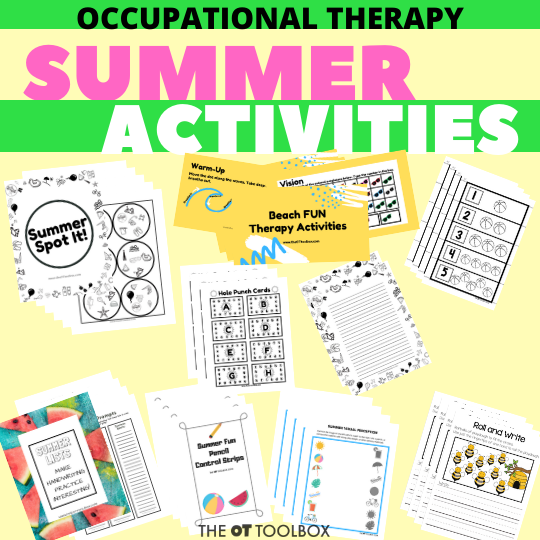
You’ll also be interested in our new Summer Occupational Therapy Activities Packet. It’s a collection of 14 items that guide summer programming at home, at school, and in therapy sessions. The summer activities bundle covers handwriting, visual perceptual skills and visual motor skills, fine motor skills, gross motor skills, regulation, and more.

You’ll find ideas to use in virtual therapy sessions and to send home as home activities that build skills and power development with a fun, summer theme. Kids will love the Summer Spot It! game, the puzzles, handouts, and movement activities. Therapists will love the teletherapy slide deck and the easy, ready-to-go activities to slot into OT sessions. The packet is only $10.00 and can be used over and over again for every student/client!

Grab the Summer Occupational Therapy Activities Packet HERE.

summer occupational therapy activities for kids

Tips to be a Handwriting Tutor

This post contains affiliate links.

Before beginning handwriting tutoring sessions, or a handwriting camp, you’ll want to create a few pieces of paperwork. Important papers such as disclaimers, waivers, and intake information can cover a few important issues as a handwriting tutor, handwriting coach, or handwriting camp. 

  1. Identify if you are using your therapy license or not? This is an important item to cover from the very start. Identify the scope of the handwriting tutoring sessions or camp sessions. If they are going to be considered under the scope of occupational therapy, there are certain considerations to be addressed. These are not to be considered therapy, unless you are actually doing an occupational therapy evaluation and creating a specific course of treatment. In these cases, fees for therapy or insurance can be collected, and you would operate under your license. Occupational therapy assistants would need to work under supervision of an occupational therapist. If the sessions would be operating without evaluation, assessment, and individualized interventions, then the scope of the sessions can occur under general tutoring or camp activities. In both situations, a disclaimer explaining these specifics should be created (next item).
  2. Disclaimer- Create a disclaimer that covers the scope of the tutoring or camp sessions.
  3. What will you cover in tutoring/handwriting camp? Identify the scope of tutoring content or handwriting summer camp content. Are you going to be covering letter formation? Simply handwriting practice? The importance of cursive writing? Cursive letter formation? Copying skills? Functional handwriting? Pencil grasp? Fine motor skills? Free writing?
  4. Waiver- Create a waiver that covers liability and removes yourself from any liability issues as a tutor or camp creator. There are many waiver and liability templates available, or you can reach out to a local attorney.
  5. Intake paperwork- Create paperwork for collecting information from parents. This should include name, contact information, special considerations such as allergies, emergency contact information, etc.
  6. Handwriting Camp Plans- Create a plan for handwriting tutoring or handwriting camp sessions. See below for ideas for each handwriting camp session.
  7. Collect money- Determine how you will be collect money to paid for tutoring sessions. You can set up a Venmo account. You can create an account and create a “product” that is listed as a service. For an average of $20/month, you can have a way to collect income, sales pages, and market to your list month after month.

Handwriting tutoring or Handwriting Camp Plans

After you’ve created the logistics of the camp or tutoring session, it’s important to come up with a plan for general tutoring or camp sessions. You can create a plan for the entire camp that covers several weeks so that you’ve got ideas Try these tips to keep handwriting summer camps fun and stress-free.

  1. Identify what will be covered in the handwriting camp/handwriting tutoring.

Start by identifying what you’ll be covering in tutoring sessions or handwriting camp sessions. These are general topics and can be used with any student no matter the level (this is important if you are not going to be doing an evaluation and treatment plan and operating under your license).

Some topics for handwriting camps and handwriting tutoring sessions can include:

You can also consider a theme for the camp or handwriting sessions. Some ideas include an outer space camp theme or a circus summer camp theme.

2. Next come up with a schedule for handwriting camp sessions or handwriting tutoring:

Start off sessions with movement, play, and activities that build skills through play. Below are some ideas for the schedule of a tutoring or handwriting camp session:

  • Use lots of movement breaks and brain break activities.  Try to keep written work tasks as movement oriented as possible. 
  • Start each mini-session with gross motor activities: crab walks, jumping jacks, heavy work, or vestibular games.
  • Move on to fine motor movement activities, incorporating proprioception, and dexterity tasks.
  • Proceed to handwriting activities, keeping them as fun and activity-based as possible.  Incorporate several of the senses into written work, allowing the children to involve as many senses as possible in each mini-session. Limit written work activities to 15-20 minutes. You can use our free Handwriting printables and resources available on the website. See all of our Free Handwriting Resources HERE
  • Try using some handwriting games to keep the motor skill work fun and engaging.
  • Encourage 10 minutes of journal writing or letter writing.
  • Use these Summer Writing Lists for quick list writing that build handwriting skills
  • Finish with movement activities, using whole-body games like playing catch, batting a balloon, jumping rope, or kicking a ball. 
sensory summer camp at home idea for handwriting summer camp for kids using all of the senses to prevent the summer slide.

Summer Handwriting Camp Ideas


When it comes to handwriting, the motor sensory systems have a HUGE input in terms of handwriting ability, legibility, and fluency.  

START HERE for learning more about sensory processing and handwriting; This is everything you need to know about handwriting and sensory concerns.


I will be the first to admit: There are not too many kids out there who want to work on handwriting during their summer break.  The trick to building or maintaining skills it to make it fun.  Here are a bunch of ideas for motivating kids to write.


Once you’ve got some ideas to incorporating handwriting into summer days, you can try a few sensory strategies for practicing written work.  Try the handwriting ideas below to making written work fun using the senses.


Tactile Sensory Handwriting Ideas:

  • Pressing Too Hard When Writing Proprioception Tips is the perfect post if you are looking for tips on writing with too much (or too little) pencil pressure.
  • Fizzy Dough Cursive Letters uses the sense of touch with tactile exploratory input with fizzy, sensory letter formation.
  • Sensory Letter Formation Work on letter formation using dish soap in this tactile and olfactory letter learning and writing activity.
  • Fidget tips and tools can be used for kids who are constantly fidgeting during writing activities.
  • Write in shaving cream on a plastic tablecloth.
  • Practice letters while writing in oobleck.
  • Use mess-free sensory bags.
  • Form letters in a sand tray, salt tray, sugar tray, cornmeal tray, or flour.
  • Write with wet chalk.

Auditory Sensory Handwriting Ideas:

  • Write in the air letters while singing.
  • Use Encourage singing or humming during written work.
  • Use headphones to block out sounds or to provide background noise.
  • Practice written work from an auditory source.  
  • Take handwriting activities outdoors to the backyard, and notice birds chirping, cars, dogs barking, etc.
  • Minimize auditory distractions for other children.
  • Ask children to repeat the directions.
  • Use visual cues such as index cards with written directions.
  • Handwriting on Foam Craft Sticks and letters and coffee filters use the auditory sense when writing.  Whisper, tell, yell, rhyme, or sing the letters as your child writes them.

Olfactory Sensory Handwriting Ideas:

Proprioception Handwriting Ideas:

  • Start with these ideas  for understanding the basics of the proprioception sense and its impact on handwriting.
  • Write on a resistive surface.
  • Form letters with push pins on a lid.
  • Write with chalk on a driveway or rocks.  Try rainbow writing with chalk.
  • Write while laying on a trampoline. TIP: Use a clipboard.
  • Use a therapy ball to sit on, lay on, and write on.
  • Practice letter formation and pencil pressure by lacing a sheet of paper over a foam computer mouse pad. If pressing too hard, the pencil point will poke through the paper. 
  • vibrating pen provides sensory feedback to the fingers and hand and helps to keep children focused on the task. 
  • Practice handwriting by placing a sheet of paper over a piece of sandpaper. The resistance of the sandpaper is great heavy work for small muscles of the hand. 
  • Practice Ghost Writing: Encourage the child to write very lightly on paper and then erase the words without leaving any marks. The adult can try to read the words after they’ve been erased. If the words are not able to be read, the writer wins the game. 
  • This will provide the child with awareness and words for the way they are holding the pencil. 
  • Wrap a bit of play dough or putty around the pencil as a grip. Encourage the child to hold the pencil with a grasp that does not press deeply into the dough. Encourage using a “just right” pressure. 
  • Provide terms for they way they write. Encourage “just right” writing and not “too hard” or “too soft” marks. 
  • Use a lead pencil to color in a small picture, using light gray, medium gray, and dark gray. Talk about how using different amounts of pressure changes the shade of gray. 
  • Practice writing with a pen on thin paper surfaces such as napkins and tissue paper.

Vestibular Sensory Handwriting Ideas

  • Write while laying in the slide. Try using the slide as a writing surface while the child is lying on their belly.  Try both head towards the top of the slide and head towards the bottom of the slide.
  • Try a wiggle seat cushion such as a balance disc or a wobble chair.
  • Try sitting in a rocking chair, using a clipboard to write on.

Gustatory Sensory Handwriting Ideas

  • Form letters with taste-safe play dough.
  • Use bread dough to form letters.  Bake and eat.
  • Write in pudding.
  • Try taste-testing handwriting activities:  Try practicing writing while the student is chewing gum, or sucking on hard candy.  Other ideas include: chewing licorice, sour candy, chewy gummy candy, lollipops, or crunchy pretzels.  These types of oral sensory input are organizing. With the children, see if they notice improved concentration and written work output with these types of oral sensations.

Visual Sensory Handwriting Ideas

  • Write with highlighters.
  • Write with a flashlight in a darkened room.
  • Write with sparklers in the evening. (Use glow sticks for a safer option.)
  • Make a DIY light box.

 Sensory Summer Camp at Home themes

What do you think?

Have you thought about running an occupational therapy summer camp or a sensory summer camp? Maybe you’re thinking about targeting clients or just creating a group activity for non-clients as part of summer programming. Let me know if you’ve done any of the activities listed here. And, tell me…What are some awesome occupational therapy summer camp ideas you’ve had or sensory summer camp strategies that you’ve used?

Set up Your Own Summer Camp

What’s next? Actually taking the steps to create your own Summer side-gig! If you’re ready to take the leap and turn your camp idea into something real, the Summer Camp & Tutoring Side Business Workbook is your perfect next step. Created specifically for OT, PT, and SLP professionals, this printable guide walks you through everything you need to set up and run your own skill-based summer program. It walks you through everything you need to know about this process, from planning and pricing to registration forms, waivers, and activity templates.

Whether you’re thinking about a handwriting bootcamp, sensory playgroup, or life skills club, this workbook helps you put your ideas into action, on your schedule, with your expertise, and without the overwhelm.

This workbook was inspired by my own experience starting a sensory playgroup while juggling work and mom life. I built it on my own terms, brought my kids along, and created fun, meaningful experiences that supported real skill development, and made extra income while doing it.

Now it’s your turn! Check out the Summer Camp Guide Workbook here.

Inside the workbook, you’ll find:

  • Program planning worksheets
  • Budget and pricing calculator
  • Activity planners
  • Registration and intake forms
  • Legal/safety templates (like waivers)
  • Ideas for promotion, themes, and scheduling
  • …and everything you need to confidently launch a camp, playgroup, or tutoring program this summer.

Whether you want to run handwriting bootcamps, sensory skill groups, or one-on-one sessions, you don’t need a full course or new certification. You just need a starting point. This is it.

Grab the workbook here.


Colleen Beck, OTR/L has been an occupational therapist since 2000, working in school-based, hand therapy, outpatient peds, EI, and SNF. Colleen created The OT Toolbox to inspire therapists, teachers, and parents with easy and fun tools to help children thrive. Read her story about going from an OT making $3/hour (after paying for kids’ childcare) to a full-time OT resource creator for millions of readers. Want to collaborate? Send an email to contact@theottoolbox.com.

Want to take summer play to the next level? Be sure to grab your copy of the Summer OT Activities Bundle!

Summer activities for kids

Space Activities for Kids

Space camp ideas for home programs or DIY summer camp with space fine motor, galaxy crafts, and space sensory play

If your kids are outer space enthusiasts, then this space theme activities are just the thing to add learning and skill building with space activities. This collection of space activities for kids are actually part of a DIY summer camp that we designed. When the kids need a backyard summer camp or something fun to look forward to, easy and creative activities based on a space theme can do just that. This summer, create a home summer camp with an Outer Space theme…all while building skills in therapy or at home. Our space theme slide deck is just one way to help kids build skills, and a great way to lead into space theme learning and play with the kids!

For another space themed virtual therapy activity, try this free outer space Connect 4 game. It’s great for kids of all ages.

Space camp ideas for home programs or DIY summer camp with space fine motor, galaxy crafts, and space sensory play

Here, you’ll find everything you need to plan a space camp fun that builds skills like fine motor skills, gross motor skill development, sensory input, regulation, emotional support, bilateral coordination, eye-hand coordination, executive functioning skills, and more. Read on for all of the outer space fun!

Space Camp for Kids

Whether you are planning a space camp in your therapy programming or trying to think of ways to build skills for kids this summer in a fun and creative way, this space camp idea is for you. For parents that need something out-of-the-box this summer (that doesn’t break the bank!), a backyard space camp can be just the thing to get excited about.

Outer space activities for a space camp or space theme home program

Space theme ideas

You’ll want to check out some other space activities we have here on the Toolbox website. Add these ideas to your space camp planning. These ideas can get you started with planning. Scroll below to find more specific space activities based on skill area.

For more creative ideas with a space theme, be sure to check out my Outer Space Awesome Pinterest board.  

We even grabbed up a handful of our all-time favorite Outer Space books from the library to share with you.  If you’re looking for activities to do with the kids this summer, a space theme will be a sure hit. Your Summer Camp at home will be complete with Space crafts, Space snacks, Space sensory, fine motor, and gross motor learning and play.

Outer space theme activities for kids

Space theme

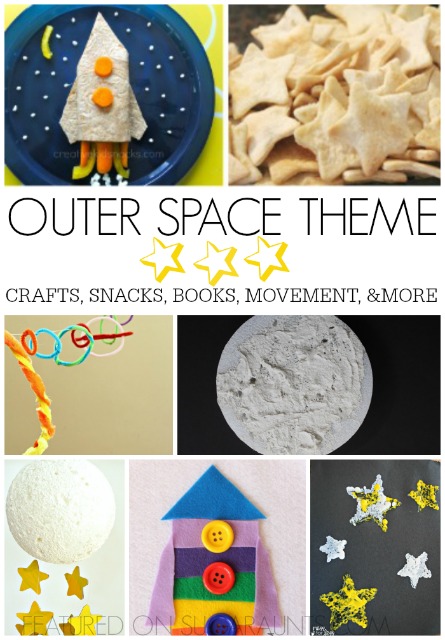
These activities are set up by theme (books, snacks, crafts, solar system models, sensory play, and movement learning activities) so that you can pick and choose activities for each day of your themed camp.  Make the week work for you!  Choose just one or two activities for each day, or go all out and do one from each category.  It’s totally up to you and your little campers! 

space fine motor activities for using to improve fine motor skills with a space theme

Space Fine Motor Activities

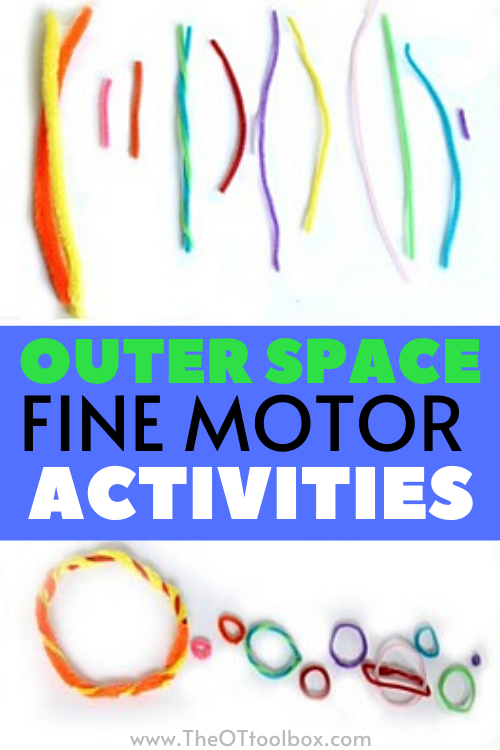
Use this outer space play dough mat printable to work on hand strength, fine motor skills, and eye-hand coordination. Simply print it off and slide into a page protector to use each day during your space camp.

 We made this Outer Space model using pipe cleaners.  We didn’t get into planet size, but rather checked out the size of each planet compared to the others from The Planets book and crafted them based on the pictures in the book. we strung the pipe cleaner planets along fishing line and taped it between two walls. This was a fun way to explore how the planets are spaced from the sun.

Outer Space Pipe cleaner solar system model

Space Visual Motor Activities

Visual motor skills and visual perception can be worked on with a space theme. Grab this free space visual discrimination worksheet to incorporate visual processing into a space camp.

Here is another free space visual perception worksheet to print off and work on visual processing skills.

This space maze is a visual motor activity that my own kids loved. Use Wikki Stix to build a maze and work on eye-hand coordination and other visual processing skills to work through the outer space maze.


Outer Space Books

Start off your daily activities during a week of Space activities with a Space book.  Some of our favorites are ones we read weekly and others are ones we love to check out from the library.
Here are outer space books for kids.


Outer Space Snacks

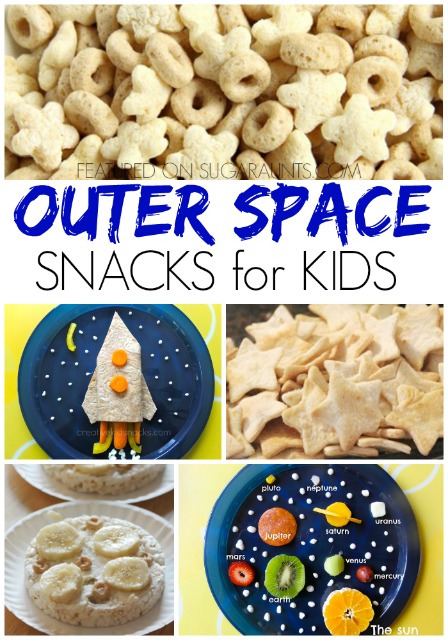
Cooking with kids is a huge way to build motor skills and executive functioning skills through cooking. Below are outer space snacks that the kids can help to make while building skills.

Outer space themed snack Stars and Planets snack for kids

Affiliate links included below.

We quickly made this space snack while doing a little space reading.  Kids will gobble up the stars and planets. We even made it a fine motor sorting activity by sorting the stars and planets from the snack mix.  This outer space themed snack will be a hit during your Summer Camp at home or space themed week.  We used a cup of Cheerios Cereal and a cup of Puffs snacks to make our stars and planets snack mix.  Have the kids sort the planets and stars into separate bowls for fine motor practice that Toddlers and young Preschoolers will love.

More Space themed snacks to fill the rest of your week:

Outer space snack ideas for kids

Eat the solar system from Creative Kid Snacks
Rocket Ship Wrap from Creative Kid Snacks
Eat the Moon snack from Things to Share and Remember

More Solar System Models for Kids for the rest of the week: 

Make a solar system mobile like Artsy Craftsy Mom
Use recycled plastic lids to create a solar system like Still Playing School
Make a solar system with Legos like Kitchen Counter Chronicles.

Outer Space Crafts

If there is one thing that occupational therapists love, it’s the use of kids crafts as a therapy tool. Be sure to check out our Constellation crafts.  There are a bunch of space and star craft ideas based on constellations and outer space…that double as a fine motor and visual motor skill building tool.

Use this space martian craft that the kids can make to build fine motor skills, and then use in handwriting activities to space between letters and words.

Use these outer space crafts to make one each day of the week of your DIY summer camp…or just use them with your space-loving kiddo!

Make a Rainbow Rocket ship like Frogs and Snails and Puppy Dog Tails
Create a Textured Moon craft from Fantastic Fun and Learning
Make Q-tip Star Art like Mess for Less
Kids will love this Launching Rocket Ship toy from Lalymom.
This Moon mobile will be a hit. (from Fantastic Fun and Learning)

Outer Space Sensory Play

 Our Outer Space sensory activities were a huge hit in adding proprioception, vestibular, and tactile sensory play into the day. Use them as part of a sensory diet with learning components. Mix these space sensory ideas into the schedule as a reward that also meets the sensory needs to benefit regulation and social-emotional skills.

These space themed sensory play ideas are ways to teach about planets, with an astronaut theme in mind. Know a little future astronaut? They will love these sensory play and learning ideas.

Lots of ideas are to be found on our Outer Space sensory  round up!

Space Themed Move and Learn Activities

I love the rocket ship in this space themed party!  Climb in and out of a cardboard rocket ship for lots of movement and play. 
Then, use another cardboard box to make this glow in the dark space fort like Lalymom.
Nurturestore made a great Space math game.

Space Fine Motor Kit

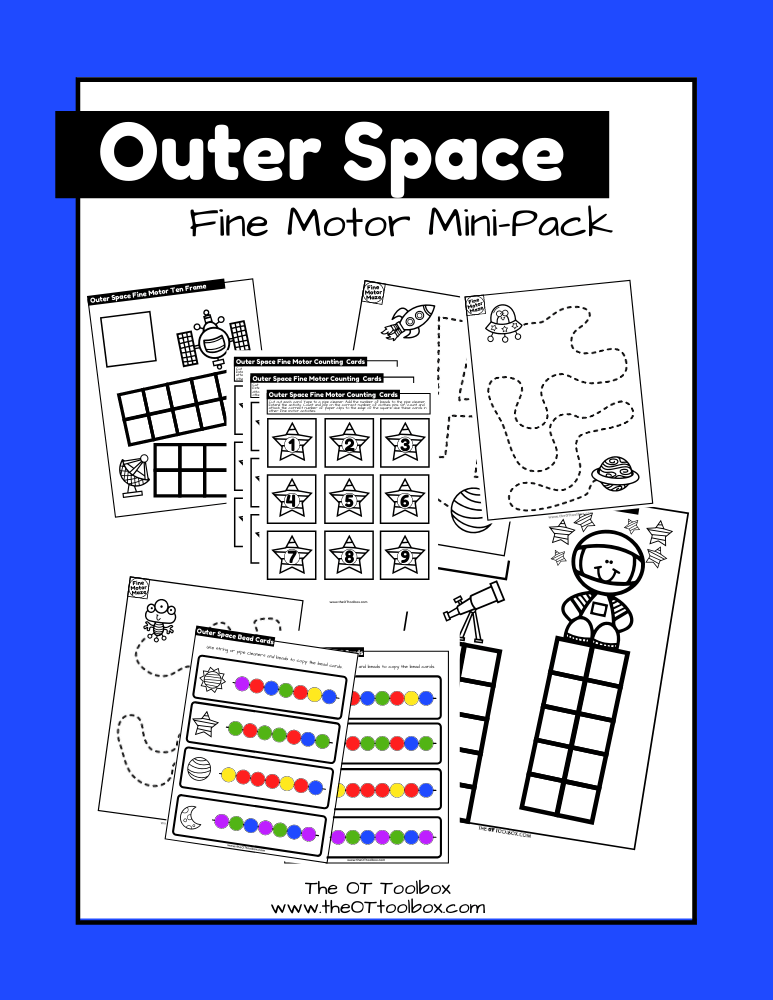
Know a kiddo that loves all things space, astronauts, and planets? The Outer Space Fine Motor Kit is your chance to develop fine motor strength, dexterity, and coordination skills.

Addressing hand strength, endurance, and precision is out of this world fun! The Outer Space Fine Motor Kit includes:

  • Fine Motor Mazes
  • Fine Motor Ten Frames for motor activities
  • 1-20 Star Counting Cards
  • Bead Copying Strips
  • Space Alien Directed Drawing Sheets

This fine motor kit includes 24 pages of printable resources. Included in this printable pack are:

  1. Two pages of color coded bead copying strips
  2. Two pages of blank bead copying strips
  3. Four pages of “draw and write” directed drawing activities with a space theme (Includes 3 styles of handwriting lines: highlighted lines, single rule, and double rule)
  4. Nine pages of fine motor mazes
  5. 1-20 Outer Space Counting Cards
  6. Four pages of fine motor ten frames activities

These printable activities extend to work on a variety of other functional areas, too: handwriting skills, numbers, math, adding, subtracting, one-to-one correspondence, scissor skills, coloring, and more.

Click HERE to grab the Outer Space Fine Motor Mini-Kit.

Outer Space Fine Motor Kit


Have fun with your Outer Space themed week of fun! 

Outer Space and Star Wars

For even more space themed activities for kids, add some of these Star Wars occupational therapy ideas to your therapy planning. We’ve broken down a bunch of space ideas using the Star Wars theme and include handwriting activities, sensory play, executive functioning ideas, crafts, gross motor ideas, and more. Kids will love it!

Set up Your Own Summer Camp

What’s next? Actually taking the steps to create your own Summer side-gig! If you’re ready to take the leap and turn your camp idea into something real, the Summer Camp & Tutoring Side Business Workbook is your perfect next step. Created specifically for OT, PT, and SLP professionals, this printable guide walks you through everything you need to set up and run your own skill-based summer program. It walks you through everything you need to know about this process, from planning and pricing to registration forms, waivers, and activity templates.

Whether you’re thinking about a handwriting bootcamp, sensory playgroup, or life skills club, this workbook helps you put your ideas into action, on your schedule, with your expertise, and without the overwhelm.

This workbook was inspired by my own experience starting a sensory playgroup while juggling work and mom life. I built it on my own terms, brought my kids along, and created fun, meaningful experiences that supported real skill development, and made extra income while doing it.

Now it’s your turn! Check out the Summer Camp Guide Workbook here.

Inside the workbook, you’ll find:

  • Program planning worksheets
  • Budget and pricing calculator
  • Activity planners
  • Registration and intake forms
  • Legal/safety templates (like waivers)
  • Ideas for promotion, themes, and scheduling
  • …and everything you need to confidently launch a camp, playgroup, or tutoring program this summer.

Whether you want to run handwriting bootcamps, sensory skill groups, or one-on-one sessions, you don’t need a full course or new certification. You just need a starting point. This is it.

Grab the workbook here.

Colleen Beck, OTR/L has been an occupational therapist since 2000, working in school-based, hand therapy, outpatient peds, EI, and SNF. Colleen created The OT Toolbox to inspire therapists, teachers, and parents with easy and fun tools to help children thrive. Read her story about going from an OT making $3/hour (after paying for kids’ childcare) to a full-time OT resource creator for millions of readers. Want to collaborate? Send an email to contact@theottoolbox.com.

Coffee Filter Butterfly Craft

coffee filter butterfly craft for kids

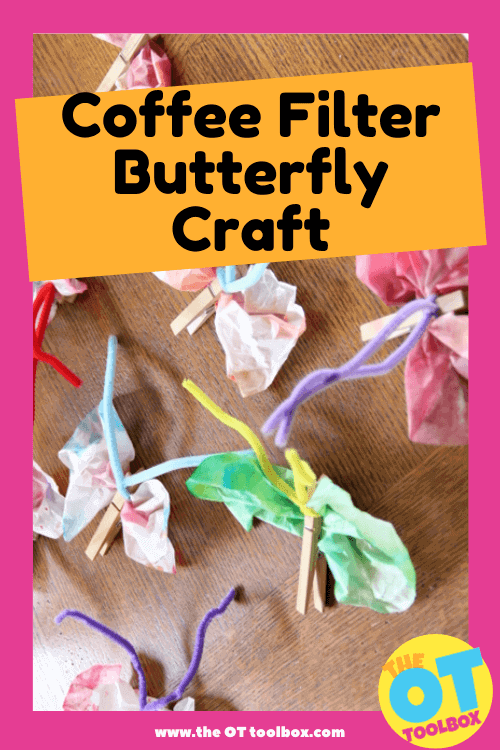
I love using coffee filter butterfly crafts in occupational therapy to work on several skill areas. The fine motor benefits are huge with this one. This coffee filter butterfly craft is a great fine motor and bilateral coordination activity for kids. If you are looking for butterfly life cycle crafts, this one is a great addition. Or, if you are seeking Spring OT activities, be sure to add this colorful fine motor butterfly craft to your list.

Coffee filter butterfly craft to build fine motor skills in kids.

Why make a Coffee Filter Butterfly Craft?

One craft that hits on several skill areas is a benefit in pediatric occupational therapy sessions. This coffee filter craft is a nice one to develop skills because it works on so many areas that are covered in therapy sessions:

  • Pinch and grip strength
  • Eye hand coordination
  • Bilateral coordination
  • Motor planning
  • Crossing midline
  • Precision and dexterity
  • Open-thumb web-space
  • Arch development
  • Separation of the sides of the hand
  • Finger isolation
  • Thumb IP joint flexion (great for pencil grasp!)

How to make a coffee filter butterfly craft

This was an easy set-up and fun craft we did one afternoon recently.  You’ll need the following materials:

  • Coffee filters
  • Water color paints/water
  • A straw
  • Clothes pin
  • Pipe cleaner
  • String (to make a banner)

Directions to make a tie dye coffee filter butterfly

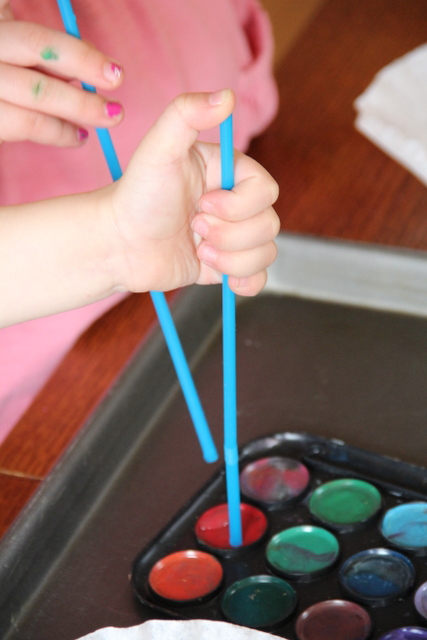
  1. Use a paint brush to add a bit of water to the wells of a water color paint pallet. To really work on fine motor skills, use your thumb to drop water droplets into the paint tubs.
  2. Use the straw to drip colored water from the water color paints. Then drop them onto the coffee filter. Allow the colors to blend into one another. If you add more water to the paint wells, you can transfer that water with the straw.

This version of painting a coffee filter can be a challenging fine motor task but one that really develops separation of the sides of the hands, thumb IP joint flexion, and motor planning skills.

To make this painting process easier, try using a eye dropper where the child can squeeze the end of a small dropper to draw up water from the water color wells. Another option is using a small plastic syringe to draw up watercolor paint and dropping it onto the coffee filter.

Read more about the thumb IP joint and thumb wrap grasp in pencil grip. This craft is a powerful way to work on this functional grasp skill!

Make a coffee filter craft and build fine motor skills with kids using a straw to paint.

Little Guy and Big Sister both loved dropping the water into the color wells.  Big Sister felt pretty good about showing her little brother how to drop the water into the color wells using her straw. 

Use straws to paint with watercolors and work on fine motor skills with kids.

This is a great activity to work on thumb isolation and control of the thumb during fine motor activities. 

Next, dip the edges of the coffee filters into the colors so the water creeps onto the edges of the coffee filter.

Other ways to add the color can use the straw end or the paint brush. This craft is nice because it can be adjusted for many different kids.

When kids drip the color on with a paintbrush, or drop color with the straw, it’s fun to try different ways to color the filters and see the colors blend together.  

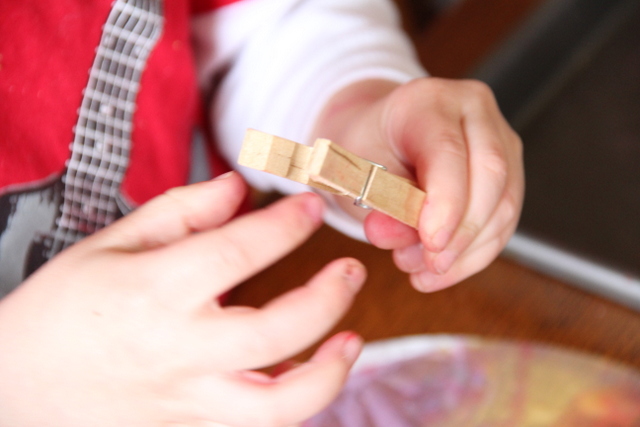
Work on fine motor strength with clothes pins to make a butterfly coffee filter craft.

Next, use clothes pins to pinch the middle of the coffee filter together in the middle. This is a great hand strengthening and eye-hand coordination task.

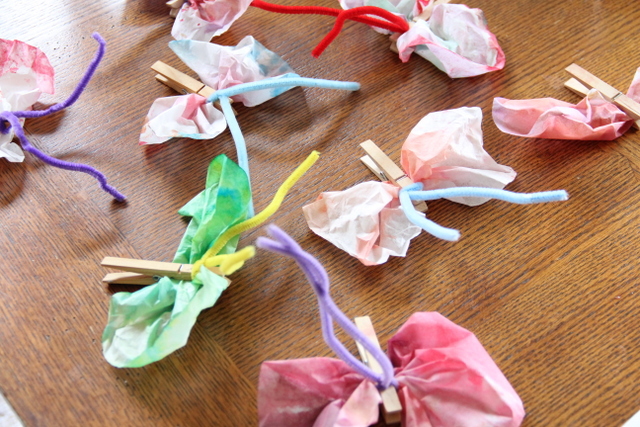
Finally, add a pipe cleaner to the end of the clothes pin for the antenna of the coffee filter butterfly. Bend the pipe cleaner around the clothes pin and twist it up to make antenna.

Coffee filter butterfly craft for building fine motor skills.

If you like to create several butterflies in a variety of colors, you can clip them onto the string for an other bilateral coordination task.

They look pretty!  Big Sister wanted to hang them on the ceiling of her room.  We strung the butterflies on yarn and taped them to her ceiling.  This would be a great way to display a whole client caseload of coffee filter butterflies and really show off those fine motor skills!

Add this butterfly craft to a butterfly theme in therapy or home programing.

These heavy work cards include a page of butterfly life cycle activities that incorporate calming heavy work activities for motor planning and proprioceptive benefits.

Or, in the Spring Fine Motor Kit, you’ll find butterfly and caterpillar activities that are designed to build a variety of fine  motor manipulation, dexterity, and strengthening tasks.

Butterfly coffee filter craft

Spring Fine Motor Kit

Score Fine Motor Tools and resources and help kids build the skills they need to thrive!

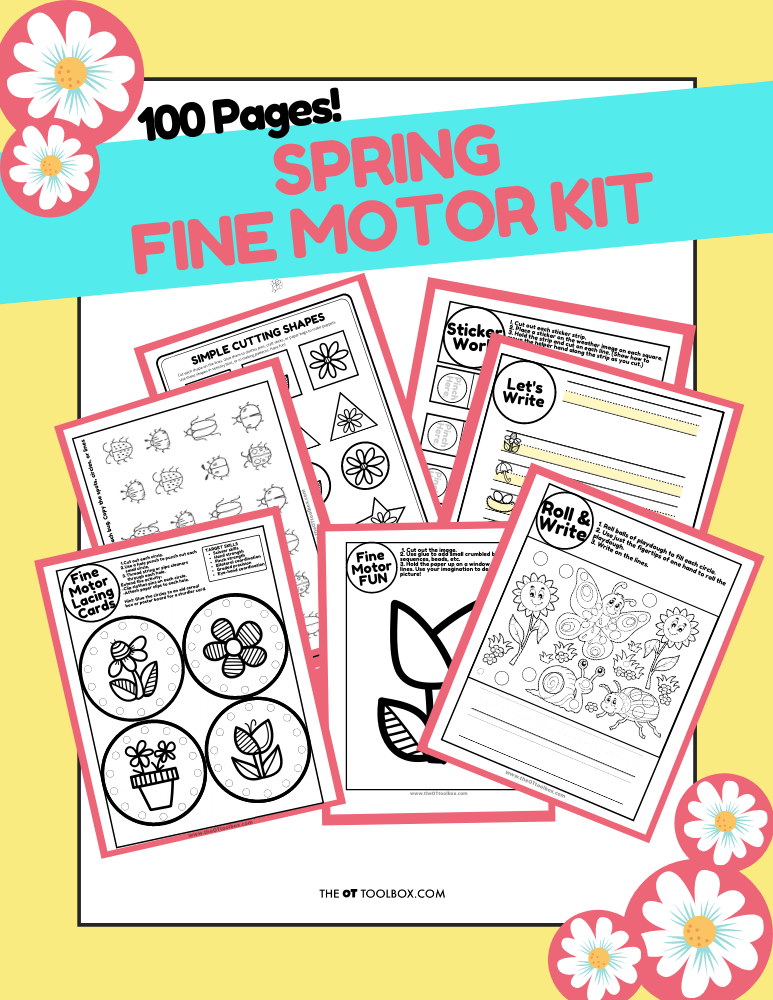
Developing hand strength, dexterity, dexterity, precision skills, and eye-hand coordination skills that kids need for holding and writing with a pencil, coloring, and manipulating small objects in every day task doesn’t need to be difficult. The Spring Fine Motor Kit includes 100 pages of fine motor activities, worksheets, crafts, and more:

Spring fine motor kit set of printable fine motor skills worksheets for kids.
  • Lacing cards
  • Sensory bin cards
  • Hole punch activities
  • Pencil control worksheets
  • Play dough mats
  • Write the Room cards
  • Modified paper
  • Sticker activities
  • MUCH MORE

Click here to add this resource set to your therapy toolbox.

Spring Fine Motor Kit
Spring Fine Motor Kit: TONS of resources and tools to build stronger hands.

Grab your copy of the Spring Fine Motor Kit and build coordination, strength, and endurance in fun and creative activities. Click here to add this resource set to your therapy toolbox.

Colleen Beck, OTR/L has been an occupational therapist since 2000, working in school-based, hand therapy, outpatient peds, EI, and SNF. Colleen created The OT Toolbox to inspire therapists, teachers, and parents with easy and fun tools to help children thrive. Read her story about going from an OT making $3/hour (after paying for kids’ childcare) to a full-time OT resource creator for millions of readers. Want to collaborate? Send an email to contact@theottoolbox.com.


St. Patrick’s Day Occupational Therapy Activities

Celebrating St. Patrick’s Day with engaging and skill-building activities is a fun way to support child development while incorporating a festive theme. At The OT Toolbox, we believe in using hands-on activities to promote fine motor skills, sensory exploration, and movement, all while keeping therapy sessions fun and engaging. Incorporating St. Patrick’s Day occupational therapy activities into your lesson plans or therapy sessions can help children develop essential skills through play and creativity. It’s a therapy theme that’s fun and functional!

Occupational Therapy Occupational Therapy Activities

From shamrock fine motor activities and leprechaun-themed crafts to rainbow gross motor games (and other rainbow activities), or a fun pot-of-gold sensory play, this page is filled with creative ways to target developmental skills in a fun and meaningful way. Whether you’re working on cutting skills with shamrock templates (find them inside The OT Toolbox membership!), strengthening hand muscles with leprechaun bead stringing, or encouraging movement through treasure hunts, these St. Patrick’s Day OT activities offer something for every child to enjoy while supporting their growth and independence.

Because we love focusing on fine motor skills through play, that means we get to have fun and get creative in our occupational therapy sessions with fun crafts, sensory bins, play-based obstacle courses and more!

Looking for St. Patrick’s Day activities to work on skills in therapy sessions that use a St. Patrick’s day theme? Here, you’ll find four leaf clover activities, rainbow activities, St. Patrick’s Day crafts, snacks, and more. Use these ideas to foster child development of functional skills using a fun theme.

St. Patrick’s Day ideas for Therapy

 
How is it March already?? We’ve got lion-like weather yet again around here, but spring, rainbows, and lamb-weather are on the horizon, Yay for warmer weather!
 
These St. Patrick’s Day theme activities and ideas are great for planning therapy sessions based on four leaf clovers, shamrocks, leprechauns, and pot of gold fun. It’s time to get in a spring-like mood and a fun little themed play date or preschool party sounds like just the thing  Check out the ideas below for green-themed party ideas for the kids.
 

Use a St. Patrick's day theme in planning therapy activities with kids.


St. Patrick’s Day Theme in therapy 

Having a weekly theme in your therapy sessions makes planning much easier. Each St Patrick’s Day activity can be adjusted to meet different levels and functional goal area depending on the kids that therapists are serving.

Check out all of the St. Patrick’s Day theme activities below. You’ll find resources for teletherapy, fine motor, gross motor, crafts, and more. If St. Patrick’s Day ideas for kindergarten, preschool, or specific age groups are what you’re looking for, you are in luck. 

St. Patrick’s Day PDFs

Feeling lucky for some last minute St. Patty’s day treats? These materials are all click and go. You can download the St. Patrick’s Day PDFs, print them off, and start using to develop fine motor skills, visual perception, handwriting, and more. 
 
 
You’ll find shamrocks, clovers, and rainbow activities that kids will love:
 
 
There are more free St. Patrick’s Day activities and downloads below, too. We’ve sorted these out by free slide decks, and activity areas. 
 

St. Patrick’s Day theme therapy slide decks

Try these St. Patrick’s Day therapy activities in the format of a free Google slide deck. Therapists can go through the slides with the clients on their caseload and foster development of goal areas.

St. Patrick’s Day Write and Sign slide deck– Work on handwriting with these writing prompt activities. Then use ASL to sign the words, building fine motor dexterity, coordination, finger isolation, and motor planning.

Shamrock Visual Perception slide deck– This slide deck includes 7 different visual perception activities. Kids can move the pieces on the slide decks to work on areas such as visual discrimination, visual attention, visual scanning, and much more.

Four Leaf Clover Balance Exercises– Go through the slides and follow the exercises as kids are challenged to balance a pillow or beanbag in different ways (a stuffed animal or roll of socks works too!). Encourage coordination, motor planning, core strength, proprioceptive input, and more.

Rainbow Gross Motor/ Pre-Writing Lines slide deck– Kids can “air write” and copy pre-writing rainbow lines.

Rainbow Emotions Spot It Game slide deck– Work on social emotional skills and visual discrimination and other visual perceptual skills with a matching game.

Rainbow Visual Motor Activities slide deck– Working on handwriting, but the underlying issue of copying forms and visual motor integration is an issue? Kids can copy simple-to-complex rainbow forms and work on pencil control, eye-hand coordination, and more.


More St. Patrick’s day Ideas

St. Patrick’s Day Party Snacks for Kids

To really build fine motor skills and executive functioning in kids, have them make these healthy rainbow snacks. There is a lot of skill-building to happen in the kitchen.

St. Patrick’s Day Songs for Kids

Get the party started with some Leprechaun Songs for St. Patrick’s Day from Let’s Play Music.  Wouldn’t these be fun songs to sit the kids in a circle for a preschool sing-a-long?

St. Patrick’s Day Printable Pages for Kids

Set up a little table with some print outs to keep the kids busy and having fun with friends. Scatter a box of crayons and a pile of printable sheets on a little picnic table are all you need.

Cutting strips of paper or foam craft sheets are great fine motor work for beginner scissor users. If you are looking for St. Patrick’s Day activities for kindergarten and preschool ages, have kids cut strips of colorful paper like we did in this rainbow window activity.

St. Patrick’s Day Games and Activities for Kids

If sensory play is your thing, a green rice sensory bin would be so much fun…throw a sheet down on the floor (or a baby pool set up indoors would work, too!) and let the kids in on the sensory fun with 3 Rainbow Sensory Bins!

 
Colors Handwriting Kit

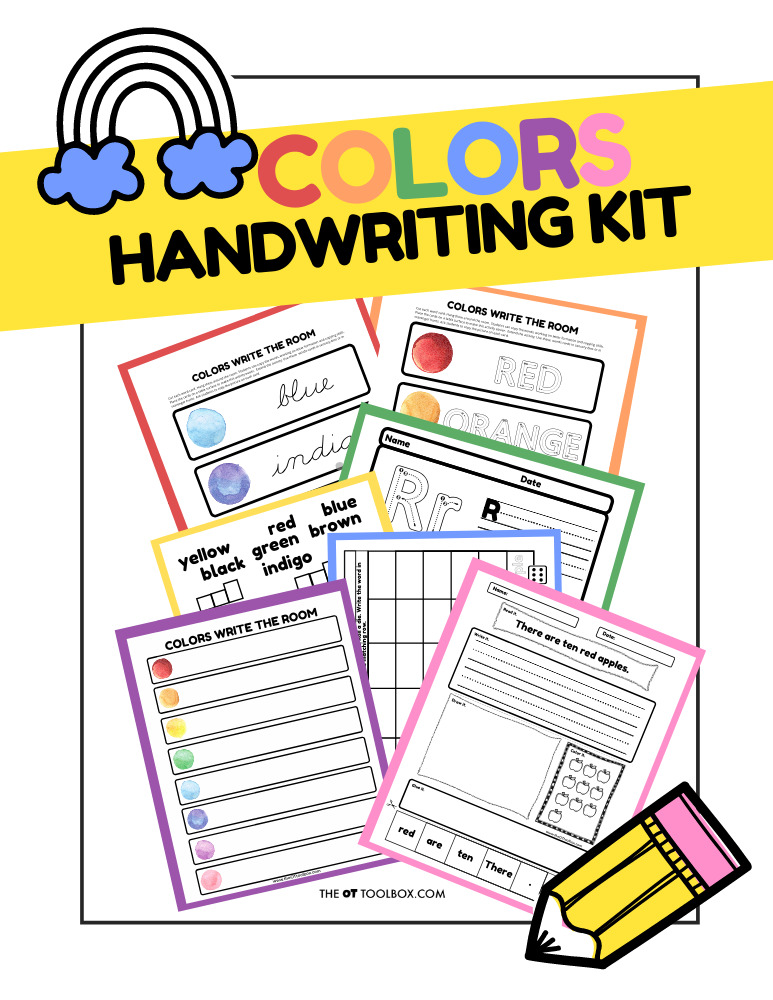
Rainbow Handwriting Kit– This resource pack includes handwriting sheets, write the room cards, color worksheets, visual motor activities, and so much more. The handwriting kit includes:

  • Write the Room, Color Names: Lowercase Letters
  • Write the Room, Color Names: Uppercase Letters
  • Write the Room, Color Names: Cursive Writing
  • Copy/Draw/Color/Cut Color Worksheets
  • Colors Roll & Write Page
  • Color Names Letter Size Puzzle Pages
  • Flip and Fill A-Z Letter Pages
  • Colors Pre-Writing Lines Pencil Control Mazes
  • This handwriting kit now includes a bonus pack of pencil control worksheets, 1-10 fine motor clip cards, visual discrimination maze for directionality, handwriting sheets, and working memory/direction following sheet! Valued at $5, this bonus kit triples the goal areas you can work on in each therapy session or home program.

Click here to get your copy of the Colors Handwriting Kit.

St. Patrick's Day crafts for occupational therapy

St. Patrick’s Day Fine Motor Activities 

Use these St. Patrick’s day theme ideas in working on fine motor skills with kids. Amazon links included below.

6 Fine Motor Activities Using Gold Coins– This printable handout on 6 fine motor activities using coins strengthens those fine motor skills using just a handful of coins. We used plastic gold coins in our activity, but you could use pennies as well.

Shamrock Balance Beam– Cut out shamrocks from paper and use them to make a balance beam to incorporate core strength, coordination, vestibular input, and more.

Finger Isolation Clover Fingerprints Got paint? Use it to make fun fingerprint 4 leaf clovers and work on finger isolation, separation of the sides of the hand, eye-hand coordination, and more. This would be fun with homemade puffy paints, too (just need flour & water).

Bilateral Coordination Clover Activity– Stick a piece of paper to the wall and draw symmetrical clovers to work on bilateral coordination, visual tracking, visual motor integration, and more.

Four Leaf Clover Deep Breathing Exercise & Coloring Page– Take mindful coloring to the next level with this deep breathing exercise. Kids can color and then use the printout as a deep breathing exercise over and over again.

St. Patrick’s Day Gross Motor Activities

Next up are gross motor activities for a St. Patrick’s Day theme in occupational therapy sessions.

My main favorite activity to address balance, coordination, and motor planning in OT sessions is by creating a shamrock balance beam. You can challenge a variety of skills like walking on tip toes, balancing on one foot, stooping and squatting, and more.

Other gross motor St. Patrick’s Day ideas are:

  • Draw a giant 4 leaf clover on the wall
  • Leprechaun gold coin relay race
  • Rainbow hopscotch using colored spots
  • Shamrock scavenger hunt with movement challenges
  • Pot-of-gold bean bag toss
  • Lucky charm obstacle course
  • Jumping over “rainbow puddles” (colored floor markers)
  • Gold coin toss into a pot challenge
  • St. Patrick’s Day-themed yoga poses (leprechaun stretch, rainbow arch, shamrock pose)
  • Rolling like a gold coin race
  • Leprechaun hat ring toss with large movements
  • Irish jig dance party for coordination and rhythm
  • Carry the gold (balance small objects while walking)
  • Shamrock sack race
  • Crawling through a rainbow tunnel
  • Tossing golden coins into a target
  • Frog jumps over shamrocks
  • Pot-of-gold bowling using green bottles as pins
  • Treasure hunt with clues requiring gross motor actions
  • Parachute games with gold coins or green balloons
  • Leprechaun chase game (tag with a St. Patrick’s Day twist)

St. Patrick’s Day Fine Motor Activities

We can incorporate fine motor development into therapy sessions in a lot of different ways. Things like using fake gold coins is one favorite idea. You can check out our:

Here are more St. Patrick’s Day fine motor activities:

  • Make rainbow pipe cleaner bracelets
  • Picking up and sorting gold coins with tweezers
  • Stringing rainbow-colored beads to make a necklace
  • Cutting out shamrock shapes from paper
  • Tearing green tissue paper to create a collage
  • Using clothespins to clip gold coins onto a string
  • Tracing and decorating shamrocks with glitter glue
  • Placing stickers on a rainbow outline
  • Rolling and shaping playdough into leprechaun hats
  • Transferring small pom-poms with tongs to a pot of gold
  • Threading pipe cleaners through a colander to make a rainbow
  • Pinching and placing small sequins onto a leprechaun craft
  • Folding paper to make origami four-leaf clovers
  • Punching holes along the edges of a shamrock to lace with yarn
  • Peeling and sticking gold star stickers onto a chart
  • Squeezing a glue bottle to make a rainbow craft
  • Using Q-tips to paint tiny gold coins
  • Stamping shamrocks with small sponges
  • Sorting and placing mini rainbow erasers into sections of an ice cube tray
  • Using a dropper to transfer green-colored water into a container
  • Scrunching tissue paper to create a textured rainbow craft

St. Patrick Sensory Bins

The nice thing about a sensory bin is that you can target so many goal areas- work on tactile discrimination. Address crossing midline. Work on attention or visual motor skills. Here are some of our favorite St. Patrick’s Day sensory bin ideas:

  • Rainbow sensory bins
  • Green-dyed rice with gold coins
  • Rainbow-colored pasta with scoops and cups
  • Shredded green paper with hidden shamrocks
  • Dyed chickpeas in shades of green and gold
  • Kinetic sand with small St. Patrick’s Day-themed molds
  • Cotton balls and rainbow-colored pom-poms for a cloud and gold treasure hunt
  • Dry split peas with hidden letters or numbers for a matching game
  • Green slime with gold glitter and mini plastic coins
  • Dry oatmeal with rainbow-colored scoops and spoons
  • Rainbow-colored sensory foam with hidden gold gems
  • Green playdough with shamrock cookie cutters and small rolling pins
  • Crinkle paper or tissue paper squares in rainbow colors with tongs for fine motor play
  • Water with floating green and gold sensory items
  • Dyed salt with paintbrushes for tracing letters and shamrocks
  • Cornmeal or flour “gold dust” with hidden treasure items
  • Cotton balls with peppermint extract for a “lucky cloud” bin
  • Ice cubes with frozen gold coins for a melting treasure hunt
  • Cereal rainbow (Froot Loops) with scoops and tongs for sorting

Colleen Beck, OTR/L has been an occupational therapist since 2000, working in school-based, hand therapy, outpatient peds, EI, and SNF. Colleen created The OT Toolbox to inspire therapists, teachers, and parents with easy and fun tools to help children thrive. Read her story about going from an OT making $3/hour (after paying for kids’ childcare) to a full-time OT resource creator for millions of readers. Want to collaborate? Send an email to contact@theottoolbox.com.
Valentine’s Day Heart Craft

paper heart craft

Creating a simple heart craft is a fun and engaging way to support fine motor skill development while celebrating Valentine’s Day. It’s a great addition to your Valentine’s Day Occupational therapy activity ideas! As occupational therapists, we believe in using hands-on activities to help children build important skills through play and creativity.

paper heart craft

Incorporating an easy heart craft into therapy sessions, classrooms, or at home can encourage children to strengthen their hand muscles, improve coordination, and practice scissor skills, while making something festive and fun.

From construction paper heart projects to cut folded paper designs, this page is filled with simple Valentine’s Day crafts for preschoolers that support fine motor development. Whether you’re looking for a heart craft to help with cutting skills, hand strength, or coordination, this activity is a great way to promote learning while celebrating the holiday with creativity.

We have other heart crafts here on the website you’ll want to check out, too.

Cutting a paper heart

Before we get into the craft, let’s talk about how a simple paper heart craft is an easy way to work on skills in an occupational therapy session.

I love to use an easy craft like, just cutting construction paper into a heart shape because we are working on so many areas! This activity naturally promotes scissor skills, as children must carefully hold and manipulate scissors to follow a curved cutting line.

Cutting along a folded edge provides a visual and tactile guide, helping children develop control and precision while strengthening the muscles in their hands. You can make the lines bold or thin. You can use thick or thinner paper…there are so many ways to individualize this one craft, which is perfect for the busy school based OT.

Additionally, bilateral coordination is required as one hand stabilizes the paper while the other operates the scissors, reinforcing the ability to use both hands together in a coordinated manner. This carries over into daily tasks like dressing, handwriting, and using utensils.

Beyond cutting, the act of folding the paper before cutting works on pinch strength and hand dexterity. Pressing the paper together and making a crease encourages children to use their fingertips and develop the small muscles of the hand, which are important for fine motor control.

Occupational therapists can use this easy heart craft as a tool to address different areas of need by adapting the activity to the child’s skill level. For children with weaker hand strength, using thinner paper or assisting with the fold can make the task more accessible, while those needing more of a challenge can try folding multiple layers or cutting intricate designs. By incorporating this simple craft into therapy sessions, school activities, or home play, therapists, parents, and teachers can provide a fun and engaging way to build foundational motor skills in a meaningful and festive way.

 
Are you getting ready for Valentine’s day?  Maybe putting together a few ideas for next week or just enjoying the pretty pink pictures (is Valentine’s Day reeeeally a holiday??)  maybe you are looking for a few Valentine’s Day activities to use in occupational therapy.
 
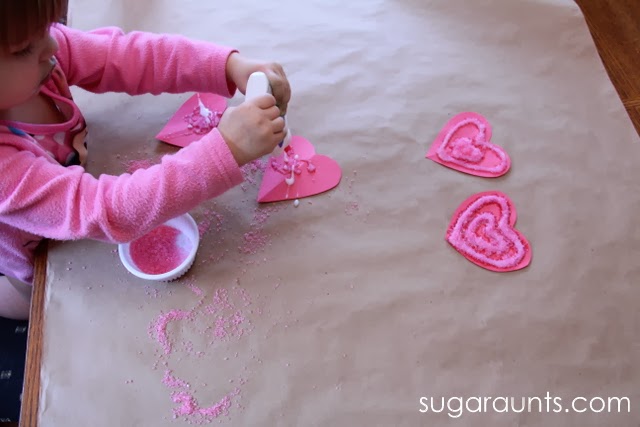
Either way, you have to admit…the hearts, love, and kindness is pretty contagious!   We’ve been having fun doing a few Valentines Day activities and this Sparkle Heart Craft was no exception.  Valentine’s Day Activities are just FUN.  This one was scented and smelled as pretty as it looked.
 
 
picture of sparkle heart craft for kids to make


Paper Heart Craft

 
We started with a few supplies:
 
Construction paper hearts and bath salts


I cut a few hearts from the construction paper.  Baby Girl did this craft with me and she was excited to see the hearts.

I poured a little of the pomegranate bath salts into a little cup.  They smelled SO good!  This craft was turning sensory already.

Bath salts sprinkled on glue for a heart craft for kids


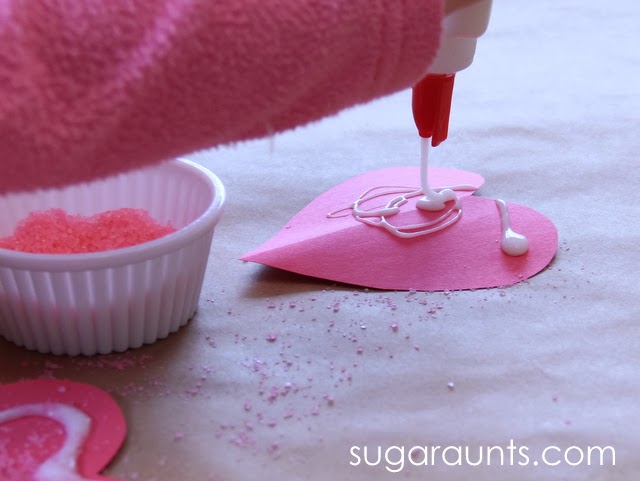
Next, I used the glue to draw a couple of hearts and showed Baby Girl how to sprinkle the salts on the glue.  She was hooked!


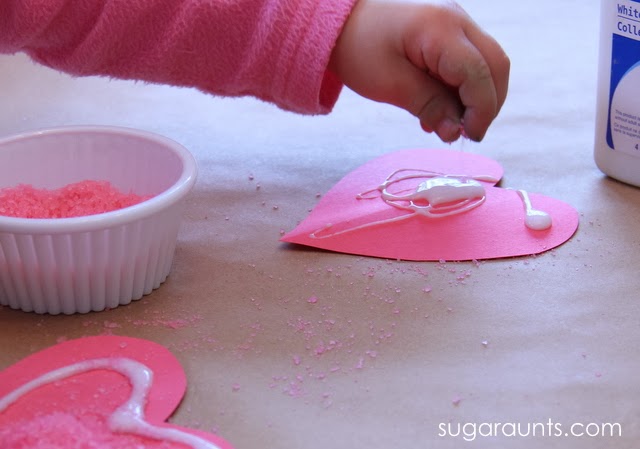
She LOVED this activity!  She squeezed the glue and drew all kinds of decorations on our red hearts.  Sprinkling the bath salts was a great way to encourage pincer grasp

There were also times when she transitioned to a tripod grasp to sprinkle the glitter. Using the pointer finger, middle finger, and thumb to grasp with the ring and pinkie fingers tucked into the palm is a tripod grasp.  She sprinkled the salts all over the glue.  I had to cut more hearts because she wanted to keep making more and more sparkly hearts!


Valentine’s Day Craft with Fine Motor Skills

 
This craft worked on tripod grasp by sprinkling the bath salts (with a great scent!) and gross grasp of the hand when squeezing the glue bottle.  This was a great activity for little hands!
 
Toddler squeezing glue onto construction paper hearts

Looking for more Valentine’s Day activities?  You may also like Valentine’s Day Goop Painting for more sensory and fine motor fun!

Colleen Beck, OTR/L has been an occupational therapist since 2000, working in school-based, hand therapy, outpatient peds, EI, and SNF. Colleen created The OT Toolbox to inspire therapists, teachers, and parents with easy and fun tools to help children thrive. Read her story about going from an OT making $3/hour (after paying for kids’ childcare) to a full-time OT resource creator for millions of readers. Want to collaborate? Send an email to contact@theottoolbox.com.

Play Tunnel Activities

If you are an occupational therapist like me, then you know the power of using play tunnels in an occupational therapy obstacle course. The heavy work input provided by crawling through a tunnel is unmatched, especially when we use it as a warm up to fine motor tasks or functional activities.

Let me explain…

How Play Tunnels Help Kids

Play tunnels are one of the best tools for therapy as you can work on so many skills if you just put a little creativity into it. Tunnel activities simply invite kiddo fun and engagement while working on very important skill development across a spectrum of areas. You can use fabric tunnels or nylon, pop-up tunnels depending on the skills you want to address with tunnel play. With a little imagination you can build your own DIY tunnels too!

Tunnel for Occupational Therapy

There is a reason why OTs love using tunnels in occupational therapy sessions!

Keep reading to get some play tunnel ideas using different materials. For home-based therapists, DIY tunnels are a great tool for families to use in the home environment providing an opportunity for a fun and easy to implement home-based program. Some of these tunnel activities for babies and tunnel activities for toddlers can be used to address specific needs through play.

Play tunnel activities using a sensory tunnel
Tunnel activity for sensory input

Play Tunnels and Sensory

During tunnel play, not only do therapists want to work on the obvious gross motor skills such as crawling, bilateral coordination, motor planning, core strength. Then there is the neck/upper extremity strength, lower body strength, and body awareness.

They also like to use tunnels for sensory needs such as vestibular and proprioceptive input. In the simplest of terms, the vestibular sense is known as the movement sense telling us where our body is in space, while the proprioceptive sense is known as the deep pressure sense telling us the direction, speed, and extent of our body movement in space.

These senses are important to help a child develop balance, body awareness, understand the position of their body in space as well as knowing how much speed and pressure their bodies are exerting when completing an activity or moving within their environment.

Adding a play tunnel into sensory diet activities to meet a variety of needs. It’s an easy way to encourage sensory input in the school environment, home, or clinic.

Tunnel activities using pool noodles

So, you may be asking, how can children gather vestibular input from tunnel time activities? You can have children roll within the tunnel, perform various body movements such as forward and backward crawling, balancing on all fours while simply crawling through the tunnel, slither on their backs, or have them crawl in the tunnel placed on top of cushions and pillows.

These activities are great for supporting the development of crawling in babies and toddlers, especially because we end up seeing challenges down the road for kids that skip crawling. Here’s what an OT has to say about types of crawling.

Fabric tunnel for proprioceptive input.

Proprioceptive input can be obtained while the child is bearing weight on the upper and lower extremities during crawling providing input to the joints and muscles. They can push objects through the tunnel such as large therapy balls or large pillows, army crawl through the tunnel, and shaking the tunnel while child is inside can provide valuable proprioceptive input.

By using a play tunnel to address proprioception to improve body awareness, the proprioceptive sense allows us to position our bodies just so in order to enable our hands, eyes, ears, and other parts to perform actions or jobs at any given moment. Proprioception activities help with body awareness. Using a fabric tunnel that is snug against the body can provide good input which can also have a calming effect for some children.

DIY tunnel activity using cardboard boxes
Use these play tunnel activities to improve motor skills and sensory activities.

Play tunnel activities

When using a tunnel, you can work on other skills that address multiple areas for children. Try some of these fun tunnel time activities:

  1. Play Connect Four with pieces on one
    end and the game played on the other end.
  2. Assemble puzzles with pieces on one
    end and then transported through the tunnel to the other end.
  3. Clothespins attached on end to transport
    and place on the other end. You can use clothespins with letters to spell words.
  4. Push a large ball or pillow through
    the tunnel.
  5. Crawl backwards from one end to the
    other.
  6. Slither through the tunnel (rocking
    body left and right) to get from one end to the other.
  7. Scoot through the tunnel using hands
    and feet or even crab walk through the tunnel.
  8. Recall letters, shapes, or words from
    one end and highlight on paper at the other end.
  9. Recall a series of steps to complete
    a task at the other end.
  10. Blow a cotton ball or pom-pom ball through the tunnel. Kids
    love this to see how many they can blow in a timed fashion.
  11. With pennies on one end, have child transport them to the
    other end to insert into a bank. You can even give them the pennies at end of
    the session if you want.
  12. Push a car through the tunnel to drive it and park it at the
    other end.
  13. Build a Lego structure by obtaining blocks at one end of the
    tunnel and transporting to the other end to build.
  14. Intermittently crawl through the tunnel and lie within one
    end to work on a drawing or handwriting activity. This is just a different and
    motivating way to encourage handwriting practice.
  15. Crawl over pillows or cushions placed inside or outside of
    the tunnel.
  16. Use a flashlight and crawl through the tunnel gathering specific
    beads that have been placed inside to string at the other end of the tunnel. You
    could work on spelling words with letter beads or simply just string regular
    beads.
  17. Place Mat Man body pieces at one end and have child obtain
    pieces per verbal directive and then crawl through the tunnel to build at the
    other end.

tunnel activities for preschoolers

Ok, so for the preschool age range, let’s come up with tunnel activities for preschoolers that support development at this stage.

  • Crawl through a tunnel while holding a puzzle piece like a letter from an alphabet puzzle. Then they can place the puzzle piece in the puzzle when they get through the tunnel.
  • Set up an obstacle course with tunnels to crawl through
  • Play “follow the leader” through the tunnel. This is great for direction following and body awareness for preschoolers.
  • Crawl through a tunnel to match objects or sort colors. I like using blocks to sort into baskets.
  • Pretend the tunnel is a cave or secret hideout during imaginative play.

tunnel activity for toddlers

Next up are some of my favorite tunnel activities for toddlers. These also help to support development at the toddler stage.

  • Crawl through a fabric or pop-up tunnel
  • Push a toy car or ball through a tunnel
  • Play peek-a-boo at each end of the tunnel
  • Roll a ball back and forth through the tunnel
  • Crawl to retrieve objects placed inside the tunnel. I like to pair this idea with our ball in a muffin tin activity.
DIY tunnel activity

Next, I want to share some DIY play tunnel ideas because as occupational therapists, we are always coming up with fun play ideas using everyday materials!

DIY Play TUnnel Ideas

So, as mentioned previously, what if you don’t have a tunnel or you want to create one within a home for developing a home-based program? Well, make one! How can you do this? Read on for a few fun ideas.

  1. Create a tunnel by crawling under
    tables or chairs.
  2. Create a tunnel in the hallway with
    use of pool noodles. Bend them over in an arch to fit or simply cut them down
    to size to slide directly between the walls.
  3. Use large foam connecting mats and assemble
    a tunnel.
  4. Use tape or yarn and string to
    alternating walls down a hallway to crawl under.
  5. Use sturdy pieces of foam board
    positioned or connected together to make a tunnel.
  6. Use an elongated cardboard box. Sometimes
    you can get large boxes at an appliance, hardware, or retail store.
  7. Stretch a sheet or blanket over
    furniture and crawl.
  8. Simply place a sheet or blanket on
    the floor and have child crawl under it (a heavier blanket works well).
  9. Place a therapy mat inside a series
    of hula hoops.
  10. Use PVC pipe to build a tunnel. Add sensory items to the PVC
    frame to create a fun sensory element to the crawling experience. One such
    tunnel was built by my wonderful fieldwork student, Huldah Queen, COTA/L in
    2016.  See the picture below.
  11. Sew a fabric tunnel (if you have that skill).
  12. Use pop up clothes hampers connected together after cutting
    out the bottoms.
  13. Simulate tunnel crawling with simple animal walks or moves.

Tunnel activities can facilitate child engagement while providing an optimal skill development setting.  Tunnel time can address gross motor and sensory needs while also incorporating other activities making tunnel time a skill building powerhouse tool. Incorporate fun fine motor and visual motor activities to make tunnel time a “want to do” activity every time!

Regina Allen

Regina Parsons-Allen is a school-based certified occupational therapy assistant. She has a pediatrics practice area of emphasis from the NBCOT. She graduated from the OTA program at Caldwell Community College and Technical Institute in Hudson, North Carolina with an A.A.S degree in occupational therapy assistant. She has been practicing occupational therapy in the same school district for 20 years. She loves her children, husband, OT, working with children and teaching Sunday school. She is passionate about engaging, empowering, and enabling children to reach their maximum potential in ALL of their occupations as well assuring them that God loves them!

Welcome to the Pencil Grasp Challenge!

pencil grasp challenge course includes pencil grasp playbook, bundle, certificate of completion, pencil grasp activities, and data collection sheets

I am SO excited about this challenge. What is the Pencil Grasp Challenge? Well, if you know a child who struggles with pencil grasp, holds the pencil with a tight or inefficient grip, uses all of their fingers to hold a pencil, or writes with an awkward grasp, the Pencil Grasp Challenge is for you!

We’ve updated this challenge to add more resources and tools to promote functional pencil grasp for efficient and legible handwriting. Here’s what’s new…

We amped up the resources and added data collection and observation tools, the Pencil Grasp Play Book, the Pencil Grasp Bundle so you can continue to work on the areas impacting handwriting, and added a certificate of completion for this challenge.

If you are a member and access the challenge through your membership, or purchase the paid challenge, it INCLUDES a certificate of completion for 1.2 contact hours!

Challenge Includes:

  1. Five lessons that break down pencil grasp into actionable activities
  2. Five Activities based on underlying skills needed for a functional pencil grasp
  3. Five Observation Sheets and Data Collection Sheets to track progress on the underlying areas that make up a functional pencil grasp
  4. Challenge Intro Workbook
  5. Pencil Grasp Play Book- Play-based activities and checklists to foster pencil grasp and fine motor skills ($8 value)
  6. Pencil Grasp Bundle ($42 value)
  7. Certificate of Completion for 1.2 contact hours!

These items are not included in the free email version of this challenge: Observation Sheets for each activity, Data Collection sheets, Pencil Grasp Play Book and Pencil Grasp Bundle. You can get these resources only in the paid version of the challenge or in the membership. What You’ll Learn:

  • Why behaviors and big emotions affect learning and participation.
  • The connection between emotions, the fight-flight-freeze response, and self-regulation challenges.
  • The role of heavy work, proprioceptive input, and whole-body movements in supporting regulation.
  • How to teach deep breathing techniques to hijack anxiety and promote calm.
  • Practical ways to integrate self-regulation tools into classroom settings.

In this 5 lesson challenge, I’ll be teaching everything you need to know about the skills that make us a functional pencil grasp. You’ll learn what’s going on behind the inefficient and just plain terrible pencil grasps you see everyday in the classroom, clinic, or home. Along with loads of information, you’ll gain quick, daily activities that you can do today with a student or your own child. These are easy activities that use items you probably already have in your home right now.

pencil grasp challenge course includes pencil grasp playbook, bundle, certificate of completion, pencil grasp activities, and data collection sheets

The Pencil Grasp Challenge is a comprehensive, self-paced online course designed to equip occupational therapy practitioners, educators, and caregivers with practical strategies to address this critical need.

Let me tell you a little more about the challenge.

PENCIL GRASP CHALLENGE

The pencil grasp challenge for kids

If you already signed up, be sure to check your email, because I have some surprises there for you and access to our private community.

If you haven’t sighted up yet, but want to, find the link to join us below.

What is the Pencil Grasp Challenge?

The pencil grasp challenge is a 5 day mini course and challenge. During the course of five days, I’ll be teaching everything you need to know about the skills that make us a functional pencil grasp.

You’ll learn what’s going on behind the inefficient and just plain terrible pencil grasps you see everyday in the classroom, clinic, or home. Along with loads of information, you’ll gain quick, daily activities that you can do today with a kiddo you know and love.

These are easy activities that use items you probably already have in your home right now.

Pencil grasp challenge activities to help pencil grasp problems

Besides learning and gaining a handful (pun intended) of fun ideas to make quick wins in pencil grasp work, you’ll gain free printable handouts that you can use to share with your team or with a parent/fellow teacher.

You’ll get access to printable challenge sheets, and a few other fun surprises. And, possibly the best of all, you’ll get access to a secret challengers Facebook group, where you can share wins, chat about all things pencil grasp, and join a community of other therapists, parents and teachers working on pencil grasp issues. This is going to be fun!

Pencil grasp challenge and activities for a better pencil grasp

If you haven’t already, be sure to sign up now, because we’re gearing up for a fun week in the pencil grasp Facebook group.

Use these pencil grasp activities to  help build the fine motor skills kids need for handwritng

More about the challenge

This challenge has been a yearly challenge for the last three years.

The Pencil Grasp Challenge started because on The OT Toolbox, we have had many questions on handwriting and pencil grasp. Parents, teachers, and therapists have questions on concepts such as:

  • How do I fix pencil grasp?
  • What is an appropriate pencil grasp?
  • How does pencil grasp develop?
  • What is a functional pencil grasp?
  • How does pencil grasp impact handwriting?
  • I need handwriting help! Where do I begin?
  • When is it developmentally appropriate to work on pencil grasp?
  • My child/student has a terrible pencil grasp! What do I do?

As a result, I have A LOT of handwriting and fine motor activities here on The OT Toolbox website. A lot of those activities are perfect for developing a functional and efficient pencil grasp. The Pencil Grasp Challenge started as I had an idea to create a challenge of fine motor activities to boost the skills kids need for strong and efficient hands, so they can hold and manipulate a pencil without difficulty. I started using #pencilgraspchallenge hashtag on my Instagram posts for those activities, with the intention to start this challenge with all of you.

In fact, go ahead and check out #pencilgraspchallenge on Instagram…you’ll find loads of fun fine motor activities designed specifically to build the skills needed for a better pencil grasp.

Join the pencil grasp challenge series to build fine motor skills in kids

Enter the Pencil Grasp Challenge!

Get ready because The Pencil Grasp Challenge is making a comeback, and this year, it’s bigger and better than ever! Over the years, we’ve offered a free email challenge, but this time, we’ve taken it to the next level.

We’ve ramped up the lessons, added essential observation and data collection tools, and included not one but TWO incredible resources—the Pencil Grasp Bundle and the Pencil Grasp Play Book. Plus, for the first time ever, participants can earn a certificate of completion for 1.2 contact hours, making this challenge a must-have for professionals looking to enhance their skills.

How to Join the Pencil Grasp Challenge

We’re offering three flexible options so you can choose the one that best fits your needs:

1. Best Value: Purchase the Course for Just $25!

If you’re not a member yet, now is the perfect time to grab this exclusive offer. For just $25, you’ll receive:

  • All challenge materials, including the observation & data collection tools,
  • The comprehensive Pencil Grasp Bundle,
  • The Pencil Grasp Play Book,
  • And a certificate of completion for 1.2 contact hours.

👉 Sign up for the full challenge here!

This is an amazing deal considering the valuable resources included!

2. Already a Member? You Get Access!

Good news for our members—this challenge is included in your membership! Simply log into your account and access the course here:

👉 Members: Access your course now.

3. Free Email Course Option

Want to try the challenge without the extras? Join our free email course to participate in the core challenge. While you won’t receive the premium resources (such as the observation tools, play book, or certificate), it’s still a great way to improve fine motor skills.

👉 Join the free challenge below by entering your email address into the form.

Why Join the Pencil Grasp Challenge?

This challenge is fun, actionable, and effective, making it perfect for parents, teachers, and therapists looking to support children’s handwriting development. You’ll be amazed at how quickly fine motor skills improve with these targeted activities.

Don’t miss out on this opportunity to take your handwriting skills to the next level. Whether you’re a professional or a parent supporting your child, there’s an option for everyone.

Join today and see the difference for yourself!

Want to join us in helping kids achieve a better, functional pencil grasp that works for them? Enter your email address into the form below. This is the free email version of the course:

Do you know a child with a terrible pencil grasp?

✏️Want to know what exactly is going on behind an awkward or weak pencil grasp?

✏️Want to know how to fix pencil grasps so they are FUNCTIONAL and EFFICENT?

✏️Want fun and actionable activities to build stronger hands so kids can write with ease?

Join the Pencil Grasp Challenge for 5 days of tools and resources!

    Are you interested in resources on (check all that apply):
    We won’t send you spam. Unsubscribe at any time.
    Pencil activities to help kids write with a functional grasp

    Colleen Beck, OTR/L has been an occupational therapist since 2000, working in school-based, hand therapy, outpatient peds, EI, and SNF. Colleen created The OT Toolbox to inspire therapists, teachers, and parents with easy and fun tools to help children thrive. Read her story about going from an OT making $3/hour (after paying for kids’ childcare) to a full-time OT resource creator for millions of readers. Want to collaborate? Send an email to contact@theottoolbox.com.
    Indoor Recess Ideas

    There are certain times during the school year when indoor recess becomes a must. When the temperatures are below freezing or there is constant rain, i seems like there are days on end of indoor recess. We wanted to put together a list of indoor recess activities that can support attention spans and keep kids from wreaking a classroom.

    indoor recess ideas

    Recess is a must for moving and getting the brain breaks needed for learning. It’s a sensory coping tool built right into the school day!

    Indoor Recess Activities

    Looking for indoor recess ideas? Below, you’ll find winter indoor games and activities to add to the recess line up when it’s too cold to go outdoors for recess. We’ve tried to come up with indoor recess games for older kids AND indoor recess ideas for kindergarten and the younger grades.

    Some of these ideas work well with traditional indoor recess group activities, and others are better suited for socially distancing during indoor recess, while still allowing kids to move! All of the inside recess ideas can be used to add activity and movement when it’s raining or too cold for outdoor recess!

    Indoor recess activities can use materials you have in the classroom like games. Sometimes just rotating games during these days helps.

    Other ideas use crayons from the student’s desk and a stack of paper. The goal is to curtail the mess but also allow kids to get up and move.


    Indoor Recess Winter Activities for Kids

    Here are more ways to get the kids moving this time of year:

    MONDAY- INDOOR RECESS IDEAS

    TUESDAY- 
    WINTER BRAIN BREAK IDEAS

    WEDNESDAY- 
    WINTER BILATERAL COORDINATION ACTIVITIES

    THURSDAY-
    WINTER MINDFULNESS ACTIVITIES

    FRIDAY- 
    WINTER FINE MOTOR ACTIVITIES


    Indoor Recess Ideas

    This time of year can be a real struggle for kids. They’ve got a long school day, where it’s too cold to go outside for recess. Many are on screens during much of that day, especially if schooling is done virtually or at home with distance learning.

    After school brings continued cold temps and an  followed by coming home to an early sunset. Not to mention, many kids have after-school activities scheduled. It’s no wonder that kids are less active than ever before.

    Because of this, I wanted to share these indoor recess ideas that can be used to add activity, motor planning, visual motor skills, midline crossing, and general movement!

    1. Turn on the music and have a Crossing Gross Motor March. Crossing Midline is a developmental ability that is important for so many gross motor tasks.  When a child has difficulty with crossing midline, they may demonstrate inefficiency with other areas like fine motor skills, bilateral coordination, hand dominance, self-care, reading, handwriting, and so many other areas. This can be done in a socially distanced format in a well-spaced out area such as a gym or hallway. And, for our virtual learners, this activity is fun for the whole family.


    2. Add proprioceptive and vestibular input with an Indoor Skating activity! All you need for this activity is a pile of paper plates or old tissue boxes. If you have a carpeted area in the classroom, this can be a great way to identify a space for indoor ice skating during indoor recess. Add specific moves and have kids copy the ice skating moves to really incorporate motor planning and direction following.


    3. Do the Hokey Pokey. Need some fresh ideas when it comes to the classic hokey pokey? Try playing “Snow-key Pokey” with a snowman theme. Just label the various body parts a snowman would have. For example: Snow cap, stick arms, boots, snow bottom, etc.


    4. Animal Races- Gather a group of kids and have relay races in the hallway or gymnasium area. Kids can split into two teams and race against one another. Each child will need to come up with an animal walk as they race back to tag another person on their team. Some animal walk ideas include: donkey kicks, penguin waddles, bear walks, crab walks, frog jumps, elephant walks, snake slithers, etc.


    5. Arctic Animal Yoga- Add animal walks with an artic theme. These would go perfectly with an animal theme and add the bonus of calming stretches. They are a great movement break during the day, use at circle time, morning meeting, free time or for use during stations. These cards are fun for use during physical education or in group/individual physical and occupational therapy. They are a great way to add simple movement into the day which we know is essential for learning and concentration. Use them with an arctic unit! These polar bear gross motor therapy activities can be used as a winter brain break or recess activity.


    6. Freeze Dance- Turn on YouTube and dance to the music. When the music stops, everyone needs to FREEZE!


    7. Charades- Ask each student to write on a slip of paper a character, animal, or object. Combine themes from the curriculum, favorite books, or movies. Students can act out the people or objects on the cards while the rest of the class guesses what the student is describing with movement.


    8. Indoor Balance Beam- Try some of these indoor balance beams using everyday items or a roll of painters tape. There are so many benefits to using balance beams. It’s a fun way to break up indoor recess into centers, too.


    9. Ribbon Wand Dance- Make a handful of DIY ribbon wands and sneak in some gross motor skills and movement by dancing to music.


    10. Indoor Gross Motor Game- Get the whole class involved in gross motor play with jumping, hopping, and more with this Dinosaur Gross Motor Game uses mini dinosaur figures. Grab the free printable game spinner and activity here


    11. Bean Bag Games- This group gross motor core strengthening activity is a fun way to get the whole class involved in a group game! Make it a winter theme with these snowflake bean bags.


    12. Play the Four Corners Classroom Game Add movement and sneak in some auditory processing work with this fun game shared over on The Game Gal.


    13. Who Am I Game- The kids can write down book and movie characters on a sticky note and stick it to their forehead. They can ask other students questions as they move around the room, trying to figure out who they “are”!

    11. Winter Toothpick Art– Use the Winter Fine Motor Kit materials to get kids moving with the toothpick art activities. These can be used on cardboard or a carpeted area to help kids build fine motor strength and tripod grasp.

    12. Winter Crumble Art- This is another fun fine motor activity for indoor recess. Use bits of tissue paper or crumbled up construction paper to create a winter picture. These sheets are in the Winter Fine Motor Kit, too.

    Quiet indoor games for the classroom

    If you need quit games or activities kids can do in the classroom without a lot of gross motor movement like charades or yoga, pull out the crayons. Here are some ideas to try during indoor recess:

    • Tic Tac Toe Tournament
    • DIY Pictionary
    • Paper Dolls
    • Paper Snowflakes
    • Doodle Relay
    • Fold-and-Pass Story Drawing
    • Crayon Rubbing Art
    • Origami with Notebook Paper
    • Connect the Dots Challenge
    • Crayon Resist Art
    • Grid Drawing Challenge
    • Paper Chain Contest
    • Draw Your Favorite Animal
    • DIY Board Game Design
    • Collaborative Mural
    • Symmetry Drawing
    • Maze Creation
    • Hidden Picture Challenge
    • Letter Art Contest
    • Create a Comic Strip
    • Crayon Texture Collage

    How do you make indoor recess fun?

    What ideas to you have in your toolbox for an indoor recess that allows kids to move?


    I hope these ideas are helpful in creating opportunities for movement and activity during these indoor recess months at school! 

    winter fine motor kit

    The Winter Fine Motor Kit has materials to print-and-go, including arctic animal finger puppets to develop finger isolation, toothpick art activities with winter themes, crumble art pages, coloring and pencil control activities for building strength and endurance in the hands. All of these materials are included in a 100 page packet with winter themes: snowmen, mittens, snowflakes, penguins, polar bears, arctic animals, and more.

    Looking for a consistent way to support fine motor skills all year?
    This yearlong fine motor system includes seasonal activity kits and monthly data collection tools to support planning and progress monitoring.

    If fine motor planning and data collection feel overwhelming, you’re not alone.
    This done-for-you yearlong bundle organizes seasonal activities and monthly screening tools in one system.

    Get the Yearlong Fine Motor and Data Collection Bundle today!


    Colleen Beck, OTR/L has been an occupational therapist since 2000, working in school-based, hand therapy, outpatient peds, EI, and SNF. Colleen created The OT Toolbox to inspire therapists, teachers, and parents with easy and fun tools to help children thrive. Read her story about going from an OT making $3/hour (after paying for kids’ childcare) to a full-time OT resource creator for millions of readers. Want to collaborate? Send an email to contact@theottoolbox.com.
    Toys to Improve Pencil Grasp

    Juguetes para agarrar el lápiz

    Have you ever used pencil grasp toys to support development of handwriting? Helping kids with pencil grasp can be a challenge, so using motivating and fun activities to support the underlying skill areas is essential. Today, we’re going over the best occupational therapy toys that target pencil grasp development. Pencil grasp toys to challenge precision, dexterity, endurance, separation of the sides of the hand, and other skills needed for a functional pencil grasp. All of this can happen through play using toys to support stronger hands by focusing on grasp pattern development through play!

    Amazon affiliate links are included in this blog post. As an Amazon Influencer, I earn from qualifying purchases.

    The best pencil grasp toys to support the fine motor skills needed for a better pencil grip.

    Recently, we shared fine motor toy ideas and then gross motor toys. Both of these areas are closely related to a functional pencil grasp, so be sure to check out those toy suggestions, too.

    Pencil Grasp Toys

    We love coming up with fun play and craft activities designed to work on the development of an efficient grasp.  Being the season of gifting to others, we thought it would be fun to bring you our top recommended toys to work on tripod grasp, intrinsic muscle strength, rotation of the pencil while handwriting, and an open thumb web space

    Children who have difficulty with handwriting may completely HATE to work on letter formation and pencil grip.  Why not gift them with a fun toy this holiday that will work on the developmental skills necessary to improve their grip on the pencil?  Make the exercise fun as they PLAY their way to a better pencil grasp!

    Handwriting is more than just pencil grasp! Manipulating a pencil to write letters and numbers has a lot to do with visual perceptual skills. You’ll find easy and fun ways to work on visual perceptual skills through play here. 


    You will also love these Games to Improve Pencil Grasp

    Best Toys to Improve Pencil Grasp

    Toys that will help improve pencil grasp

    {Note: This post contains affiliate links.}

    Toys That Improve Pencil Grasp

    Coming up with this list, we thought about the skills needed for an appropriate pencil grasp and age-appropriate handwriting.  This toy gift guide is broken down into toys that will help with different sets of problem areas when it comes to a poor pencil grasp.

    Let’s take a closer look at toy suggestions for these areas:

    • Toys for Tripod Grasp
    • Toys for an Open Thumb Web Space
    • Toys for Hand Strength
    • Toys for Extended Wrist

    Toys for Tripod Grasp

    Tripod grasp: The most efficient way to hold the pencil when writing is with a dynamic tripod grasp. While not necessary…a functional grasp works, too…a tripod grasp is a term we’ve probably all heard described before.  So WHAT is a tripod grasp

    A Tripod grasp starts with a nice round circle made with the thumb and index finger.  The pencil is pinched with the tips of the thumb and index finger and held close to the point of the pencil.  The pencil is resting on and assisted by the middle finger.  The ring finger and pinky fingers are tucked into the palm.  All movement should happen with the fingers and thumb.  The wrist and arm should not move while writing, coloring, or drawing. 

    Often times, new pencil and crayon users will hold the writing utensil in a different way.  You might see four fingers opposing the thumb to hold the pencil.  You might see the pencil positioned in the knuckles between the index and middle fingers.  Maybe they hold the pencil away from the tip where the lead is and instead hold it in the middle of the pencil shaft.  There are SO many variations of awkward and inefficient pencil grasps.  If your little hand writer is showing some version that affects their letter formation and pencil control, try a few of these fun toys…

    A few toys that help to encourage a tripod grasp:

    Light Brite: (affiliate link) Picking up and manipulating those little colored pegs encourage a tripod grasp.  Pushing them through the paper and into the holes is a great resistive exercise…disguised as FUN! 

    We have this Lite Brite Flatscreen – Red (affiliate link) from Hasbro and love making pictures with the pegs!  When the child holds the pegs in his hand, it’s a great way to encourage the ring finger and pinkie finger in a tucked position.  Show your child how to pick up a handful of pegs and “squirrel them away” in their palm while they push one peg into the board.  What a great fine motor exercise!  Not to mention, the dots of the guide paper is a great visual motor activity…so important in handwriting!

    Lacing Cards: (affiliate link) Lacing cards are a great way to encourage a tripod grasp.  This set of Lacing Shapes (affiliate link) from Patch Products come in simple shapes with bold colors. The child must hold the tip of the string in a dynamic tripod grasp to push through the holes of the card.  If your child has their thumb squashed up against their index finger while threading the cards, be sure to show them how to make a nice round circle for an easier time.

    Peg Boards: (affiliate link) Grasping pegs encourage a tripod grasp especially while pushing them into the holes of a peg board.  Here are homemade pegboard ideas and even a precision pegboard you can make using perler beads (see below).

    This Lauri Tall-Stacker Pegs Building Set (affiliate link) from Lauri is great for building peg towers while learning colors and shapes. 

    Older kids might love Fusion Beads like the Perler Beads 6,000 Count Bucket-Multi Mix (affiliate link) from Perler.

    Spike the Fine Motor Hedge Hog– (affiliate link) This fine motor toy builds a stronger tripod grasp, and when positioned appropriately, can place the wrist into an extended position, too. This helps to further refine precision movements for accuracy and dexterity. These are great skills to carry over to pencil control and pencil movements during handwriting tasks.

    Learning Resources 3 Prong Tong– (affiliate link) This tong tool promotes a better grasp on objects…but only if the hand is positioned correctly. If you allow kids to just pick up the 3 prong tongs and start using them, they likely will position the tong into their hand with a gross grasp, or by using all of the fingers along the length of the prong. This can actually strengthen the wrong muscles, and promote an ineffective motor plan that becomes muscle memory when writing with a pencil.

    When kids use these tongs, they should have their hand positioned almost under the tongs, as if it were a pencil. When used this way, the tongs can strengthen the intrinsic muscles and promote a tripod grasp. These 3 prong tongs can work well when used correctly, but be sure to work along side a child with this one.

    Toys for Open Thumb Web Space

    Sometimes you will see a child who is holding their pencil with a closed web space.  This happens when the thumb web space is the area between the thumb and the index finger.  If the thumb is squashed up against the side of their index finger, they are not able to manipulate the pencil with small movements.  They might move their whole arm to make letters instead of just the hand.  A closed web space is an inefficient way to grasp the pencil and will lead to poor handwriting.  This type of positioning requires activities that strengthen and stabilize the thumb.

    A few toys that help encourage an open web space:

    Tweezer Games:  Tweezer activities promote an open web space and stabilization of the thumb.  This Avalanche Fruit Stand (affiliate link) from Learning Resources is a colorful way to encourage an open web space.  The vertical surface is perfect for encouraging an extended wrist.

    Bead Sets: (affiliate link) Stringing beads is a good way to encourage an open web space.  The child must hold the bead and string between their thumb and index fingers.  Collapsing of the thumb web space will happen when the child demonstrates weakness in the muscles of the thumb.  Beading is a repetitive activity and promotes strength. 

    This Melissa & Doug Deluxe Wooden Stringing Beads with over 200 beads (affiliate link) from Melissa & Doug has over 200 beads in different colors and shapes, and even letters!  You could even form sentences for the child to copy and practice their improved pencil grasp!

    Rock ‘Em Sock ‘Em Robots: (affiliate link) Often times, a child will wrap their thumb around the index finger when they are writing with a pencil.. This indicates instability in the thumb and the muscles that allow for smooth pencil motions. 

    Pushing down on the buttons of the Rock ‘Em Sock ‘Em ROBOTS Game (affiliate link) from Mattel really strengthens the muscles of the thumb and allows for more stability leading to an open web space and ultimately more fluid motions of the pencil in letter formation.  Plus, this game is just plain old FUN for kids of all ages!

    Toys for Hand Strength

    Hand Strength:  If a child has weakness in their hands, they may complain that their hand is tired when they write or color.  Then, to compensate for muscle fatigue, they resort to an inefficient hand grasp.  They may grip the pencil with four fingers or with their whole palm.  many times, a child will start off with a nice tripod grasp and then switch to a less efficient grasp…or even switch hands!  Do they complain that their hand is tired or that it hurts?  These kiddos need to work on hand strength.  To allow for increased endurance when writing and coloring, this child would benefit from strengthening exercises.

    A few toys that help encourage hand strength:

    Pop Beads:  (affiliate link) Pushing pop beads together is a perfect way to strengthen the intrinsic muscles of the hands including the arches of the hands. 

    Pop beads are such a fun toy that can be used to make patterns, different lengths, bracelets, necklaces, and even shapes. This Pop Beads (affiliate link) from ConstructivePlaythings are unique in their shape, color, sizes, and textures. A twist on the classic bead, this set will excite girls and boys of all ages.  Be sure to shop for size-appropriate beads for your child’s hands.

    Play-Doh: (affiliate link) Play dough is the ultimate open-ended toy for hand strengthening.  There are unlimited ways to play all the while encouraging hand development. 

    We love this Play-Doh 24-Pack of Colors(affiliate link) for lots of creative play!  Hide coins, beans, or beads in the dough and allow the child to find the items.  Roll small balls of dough using just the thumb, index, and middle fingers. 

    Roll a play dough snake with the dough and have the child pinch the dough between their thumb and index finger.  Just get creative and make some things with your play dough.  Most of all, have fun!

    Tissue Paper Art: (affiliate link) There is possible no better art project for hand strengthening than tissue paper art!  Crumbling little bits of tissue paper is perfect for strengthening the small muscles of the hand. 

    Encourage your child to use just their finger tips to crumble the bits of tissue paper rather than two hands to crumble.  This ALEX® Toys – Early Learning Tissue Paper Art -Little Hands 521W (affiliate link) from Alex Toys is bold, colorful and just plain fun art!  Even better for the intrinsic muscles of the hands is tearing bits of paper before crumbling.

    Squeeze Toys:(affiliate link) a gross grasp is using the whole hand to squeeze and flex into a grip. 

    What a great way to strengthen the muscles of the hands!  This Lobster Claw Catcher (affiliate link) from is a fun way to encourage hand strength and endurance for coloring and writing.

    Geoboard Activities– (affiliate link) Using a geoboard supports hand strength to enable endurance in handwriting. Manipulating the rubber bands promotes finger isolation, open thumb web-space, and and extended wrist.

    Learning Resources Helping Hands Fine Motor Tool Set Toy– (affiliate link) This set of fine motor tools includes an eye-dropper, scissor scoops, and tongs. The sensory bin scoops and tools support hand strength through manipulating small objects or water.

    These tools are a great way to strengthen the exact muscles needed for a functional pencil grasp.

    Toys for Extended Wrist

    Extended Wrist:  An Extended wrist is a slightly bent back wrist.  When a child’s hand is bent forward toward the palm, they typically exhibit inefficient grasp on the pencil and weakness in the hand. A slight bend in the wrist towards the back of the hand (bent up toward the ceiling when writing) allows for better movement and flow of the fingers when forming letters.  Often times a child with a poor handwriting demonstrates a “hooked wrist” or a flat wrist and it leads back to inefficient control of the pencil and messy handwriting. 

    A few toys that help encourage an Extended Wrist:

    Easel: (affiliate link) An easel can be used in so many ways while encouraging an extended wrist.  Paint, draw, color, or write on the elevated surface.  We love taping contact paper to our easel and sticking all kinds of craft supplies. 

    This really encourages an extended wrist while using a tripod grasp or tip to tip grasp to manipulate little items (think tissue paper, sequins, foil squares…the possibilities are endless!) This Easel (affiliate link) is great for extended wrist activities.  And, it even folds down to reveal a desk surface.  It’s the perfect gift to promote improved handwriting!

    Ker Plunk: (affiliate link) The Ker Plunk Game (affiliate link) from Mattel encourages an extended wrist as the child pushes the sticks into the holes of the game.  They are encouraged to use a tripod grasp to hold the sticks as well.  Rotating the sticks encourages two types of in-hand manipulation.

    Take this game a step further in handwriting exercise for strengthening and play laying down on the floor, propped up on your elbows.  Getting down on the floor to play will activate the large muscles of the back and the shoulder girdle to improve precision in pencil grasp.

    Montessori Boards-(affiliate link) Precision and dexterity activities are needed for pencil grasp and when you add in dexterity tasks and manipulation of tongs, spoons, or tweezers to move and place objects, it’s a win-win.

    This precision Montessori board (affiliate link) builds the skills needed for pencil grasp: a stabile wrist, in-hand manipulation, open thumb web space, and dexterity.

    Best toys and ideas to help kids improve their pencil grasp

    Looking for a few activities to improve handwriting skills? Check out our round-up of the best handwriting activities from our blog and these other toy suggestions:

    More Therapy Toy Ideas

    Want to find more therapy recommended toys to help kids develop specific skills? Check out the list of skill areas below.

    1. Fine Motor Toys 
    2. Gross Motor Toys 
    3. Pencil Grasp Toys
    4. Toys for Reluctant Writers
    5. Toys for Spatial Awareness
    6. Toys for Visual Tracking
    7. Toys for Sensory Play 
    8. Bilateral Coordination Toys 
    9. Games for Executive Functioning Skills
    10. Toys and Tools to Improve Visual Perception
    11. Toys to Help with Scissors Skills
    12. Toys for Attention and Focus

    Printable List of Toys for Pencil Grasp

    Want a printable copy of our therapist-recommended toys to support pencil grasp?

    As therapy professionals, we LOVE to recommend therapy toys that build skills! This toy list is done for you so you don’t need to recreate the wheel.

    Your therapy caseload will love these PENCIL GRASP toy recommendations. (There’s space on this handout for you to write in your own toy suggestions, to meet the client’s individual needs, too!)

    Enter your email address into the form below. The OT Toolbox Member’s Club Members can access this handout inside the dashboard, under Educational Handouts. Just be sure to log into your account, first!

    Therapist-Recommended
    PENCIL GRASP TOYS HANDOUT

      We won’t send you spam. Unsubscribe at any time.

      Colleen Beck, OTR/L has been an occupational therapist since 2000, working in school-based, hand therapy, outpatient peds, EI, and SNF. Colleen created The OT Toolbox to inspire therapists, teachers, and parents with easy and fun tools to help children thrive. Read her story about going from an OT making $3/hour (after paying for kids’ childcare) to a full-time OT resource creator for millions of readers. Want to collaborate? Send an email to contact@theottoolbox.com.